Christmas reflections on peace, and peacekeeping

Kind of on the funny side: Spending my holidays in the wonderful and relatively peaceful environment of Maine.
Why “relatively”? Well, the local newspaper “The Bridgton News” always publishes items on the Bridgton Police Department Blotter. It’s an entire account of the past days’ activities of Brighton’s Finest. It’s our absolute favorite when we are here.

My best ones this time: “1:18 p.m. A car parked near the power lines on the Harrington Road turned out to belong to an environmental worker.”, followed by “4:33 p.m. An intoxicated patient came into the Emergency Room at Bridgton Hospital and then just walked out.”

My favorite early 2000 in Pristina, Kosovo, a little less than a year after the war of Milosevic against the Kosovo Liberation Army was ended through a NATO intervention: “Two cars were involved in a traffic accident downtown Pristina. The drivers accused each other of violating the traffic rules. Subsequently, one driver grabbed a rocket propelled grenade launcher from the trunk of his car and fired an RPG towards the other person. The RPG hit a building behind the car and caused major structural damage. NATO soldiers locked the area down. Investigations ongoing.”

Peace, and the disturbances of peace, are a very relative thing. I got used to news like the above, I have uncounted numbers of stories which, today, even sound funny, taken out of the severe context in which they happen.
Like the Bridgton police news do sound funny to me. Well, that’s relative too. It may well be that they sound funny to any guy visiting from Bed-Stuy, Brooklyn, New York.
Oh yes, I will never forget about the international police officer who woke up one morning, just finding an entry hole and an exit hole in two adjacent walls of his living room. A grenade had passed through during the night, without exploding. It was an intimidation of somebody targeting his landlord.

What I always struggled with is the fact that people who enjoy peace (including the profound type of peace in Bridgton…) have difficulties to accept that engaging in peacekeeping in areas where rocket propelled grenades are used to settle conflicts is necessary and requires engagement abroad.

Happy holidays, enjoy, everybody, where ever you are.

Reflections on police integrity in a global context

My friend and colleague Zoe Mentel and I wrote this for a conference earlier this year. Our joint thoughts and ethical basis are reflected in it, and sure enough, all my experience from so many different places of this world. But most importantly, this article is the result of Zoe’s brilliant work putting our combined thoughts “on paper”.

Re-reading this, almost a year later, within the context of a current discussion about Police reform, here in New York, and the United States, it becomes clear how complex reform is, and how much time is needed for it: The same Police organization (and the same political oversight body) that I am referring to in this article is subject to renewed and deep, loudly voiced distrust by citizens.

Does it mean that this Police regressed? Does it mean that the citizens are wrong? Does it mean that my arguments are wrong, or my assessment of a positive reform which started here in the 90’s?

All statistical and empirical data (and there is a lot), and all work by researchers and scholars clearly make the case that the current policing model over here needs to be fundamentally adjusted. And moreover, a fundamentally democratic and peaceful process of citizens demonstrating is calling for it. So, it both means to acknowledge how much time is needed for sustainable reform, and that reform never is a job that will be, at some point, finished. Rather, it is a continuous process of adjusting Police organizations to contemporary needs of the society they serve, to constantly reflect on mismatches between expectations of the public, and actions by the Police, and to address denial as a deep seated psychological mechanism preventing people from seeing and acknowledging the reality. At the same time one needs to strongly advocate the values on which policing is founded, and ensuring compliance with those values.

Which values? Well, my values are obvious, from the below. I argue that, in my experience of successful policing even in the harshest and most dangerous societies, they are almost universal, and they actually work. More about the latter in many examples I am planning to write about, here. I will also write about denial.

So, here we go:

Reflections on police integrity in a global context

On an affective level, the word “police” evokes widely disparate responses from individual citizens. On the one hand, those of us who enjoy the protection of a well-disciplined, professionalized service organization, which respects the principles of democratic policing and human rights, live in a reality where policemen and women are understood as public servants, accountable to the public.

Under this schema, individuals are able to associate the image of the uniformed police officer with a provider of security and order, a crime-fighter who puts the safety and security of others front and center.

Conversely, those who are subject to discriminatory, arbitrary and corrupt police practices likely associate the police with the abuse of authority and poor governance, either of an ineffectual or authoritarian flavor.

Transparency International’s “Global Corruption Barometer 2013” found that, in the 36 countries where “the police are seen as the most corrupt institution [,] … an average of 53 per cent of people report having paid a bribe to the police.”[1]

As the police officer is often the most visible, daily representative of state authority within a community, erosion of trust in the police is inextricably linked to an erosion of trust in the government and the rule of law overall. These two polar images of the law enforcement profession establish serious challenges for any who attempt to modernize a police organization through change management.

This is even truer in a peacekeeping environment. The public’s understanding of police varies from country to country, from city to city. Even within cities, the legitimacy of local police may fluctuate drastically from neighborhood to neighborhood, especially when questions of police bias against minority communities come into play. In its ideal form, however, policing is society’s safeguard for protecting the most vulnerable, rather than the most powerful, among us. The best police officers are the ones who demonstrate the spirit of service, instead the desire to exercise power. A government that holds its police accountable to its citizens, adhering to transparency of law enforcement action, has a much stronger chance to be considered a legitimate stakeholder of citizen’s interests.

Police transparency and the development of modern policing

When Sir Robert Peel first developed modern policing in early 19th century London, he instituted a number of principles and mechanisms that we still operate under today. One of these seems so simple, that we often forget how radical it was at the time. Every police officer in the new Metropolitan Police Force in 1829 was given an identification number. Upon induction into the force, each officer under Sir Peel received this number, so that he (and at the time, of course, all police were “he’s”) could be held accountable for his actions.

Today, the ability to identify an individual law enforcement official remains a common practice. Police officers from countries all over the world have their unique identification numbers or nametags displayed physically on their uniforms, embroidered on epaulettes or collars and imprinted on official badges and ID cards. Most recently, a modern variation of this practice can be seen in parts of Granada, Spain, where some police are wearing their Twitter handle on patches on their right shoulders.[2]

Community-oriented policing relies on accountability, transparency and open communication and cooperation with the public. And of course, in the post-conflict and crisis-affected states in which the United Nations Police work, building these key elements of policing require much more than badge numbers and twitter handles. Nevertheless, the general principles remain the same.

Police integrity, police accountability, police legitimacy and police effectiveness are built both on the macro-level by large, systemic reforms and on the micro-level by the individual actions, behaviors and attitudes of the women and men who walk the beat, investigate crimes and respond to calls for service.

No discussion of modern policing would be complete without referencing the intrinsic connection between policing and the rule of law. The rule of law is a principle that situates the relationship between citizens and authorities within a legal framework, rather than upon the arbitrary execution of power. It ensures that any government action is based on law and legality. As the late British judge Tom Bingham described it, “All persons and authorities within the state, whether public or private, should be bound by and entitled to the benefit of laws publicly made, taking effect (generally) in the future and publicly administered in the courts.”[3]

For the reasons stated above, policing refers to a function of governance responsible for the prevention, detection and investigation of crime; protection of persons and property; and the maintenance of public order and safety. Police and law enforcement officials (including police, gendarmerie, customs, immigration and border services, as well as related oversight bodies such as interior and justice ministries) have the obligation to respect and protect human rights, including the right to life, liberty and security of the person, as guaranteed in the Universal Declaration of Human Rights and reaffirmed in the International Covenant on Civil and Political Rights and other relevant instruments.

Pursuant to the UN Code of Conduct for Law Enforcement Officials, police and other law enforcement officials are required, at all times, to fulfil the duty imposed upon them by law, by serving the community and by protecting all persons against illegal acts, consistent with the high degree of responsibility required by their profession.[4] For the United Nations, the function of domestic policing must be entrusted to civil servants who are members of police or other law enforcement agencies of a national, regional or local government, within a legal framework that is based on the rule of law.[5]

Police integrity and organizational culture

Policing, as we commonly understand it, only works if the community accepts as legitimate those who are entrusted to enforce the law. But in places recovering from conflict, those who committed atrocities – including, unfortunately, the acts of sexual and gender-based violence that frequently characterize contemporary intrastate warfare – were often those who also wore a uniform. How do we build police legitimacy, therefore, in a state where the police may be fundamentally mistrusted?

Clearly, we need to help host-states undertake long-term, system-wide reforms, including proper training, the vetting of officers, accountability measures to root out corruption and abuse, internal affairs units, citizen oversight mechanisms, merit-based promotion systems, professional standards, and strong commitment from top brass for all of the above.

Experience demonstrates that without a deeply rooted commitment by the state and the society it governs, fundamental and sustainable transformation of policing into the above is nearly impossible. At the same time, the entire internal police culture must change. Ethical police organizations are ones that police themselves, ones in which peers and colleagues hold each other accountable in terms of integrity and ethics. These organizations are fundamentally open to scrutiny and dialogue with civil society.

Criminologists have come to understand how informal social control can be more powerful than formal, institutional controls in curbing criminality within a community. The same argument can be extended to building integrity within police organizations. In addition to formal mechanisms listed above, we must also change the norms of accepted behavior – and leverage the power of peer influence within police cultures to root out bad police practices.

Fostering ethics and integrity from within a police organization is, notoriously, no easy task. It often requires making tough calls and unpopular decisions. In 1994, for example, a new police chief took over one of the most famous police organizations in the world, the NYPD. Its image at the time was badly damaged. Corruption was, in certain stationhouses, endemic. The worst, some argued, was the 30th precinct in Harlem, which was scandal-ridden and accused of a wide litany of abuses, from officers stealing drug money to physically assaulting suspects. In the middle of the night, the NYPD’s chief, backed by the District Attorney, gathered local news media and raided the so-called “Dirty 30.” In front of news cameras, he began publically confiscating the badges of corrupt officers and throwing them into the garbage can. “I am retiring their badges,” he said to the press, “so that no cop will have to wear a disgraced number again.”[6] In the end, almost three dozen officers were arrested and prosecuted.

Many police observers have understood this highly symbolic action as a turning point for the NYPD. Organizational culture began to change once it became clear that neither police leadership nor the public would continue to tolerate corruption and criminal behavior. But the job that we face in an expeditionary police setting is, unfortunately, often much more complex and fraught with difficulties. Former United Nations Police Adviser, Mr. Mark Kroeker, has on occasion told a story about rebuilding the police in Liberia, immediately after that country emerged from its brutal civil war. He wanted to engage a Liberian National Police officer in a conversation about how to prevent corruption in the LNP.   Instead of talking about reform measures and capacity building, however, this officer turned to then-Commissioner Kroeker and said, with simple candor, “I cannot feed my family on integrity alone.”

Doubtless many police who have served with international police missions would be able to recount similar anecdotes from all over the world, from countries torn by or emerging from conflict.

The global effects of both large- and small-scale police corruption

This is how corruption persists. It’s not a simple question of good vs. evil. Questions of ethics rarely are. However, this binary “logic,” often associated with quick and easy value judgments of public services in less developed countries, can lead us to simple assessments: bad police institutions become no more than a collection of backwards, bad people.

Moreover, reforming the police must be done in tandem with reform in overall governance, as corruption in the former is largely symptomatic of corruption in the latter. Corruption persists not only because of greed and criminal intent on the part of individual police officers. It persists also because “shortcomings of state capacity” – including, systemic failures in the rule of law, as well as the failure to meet the material needs of both the police and the citizens that they are supposed to protect.[7]

Serious and fundamental deficiencies in the most basic policing infrastructure leave “even well-intentioned and dedicated officers” without the tools to “do their job properly.”[8]

How do we build the political will required to adequately resource a professional police service? Often this boils down to influencing governments to find a way to pay the wages of their police officers, sufficiently and regularly. It also means recruiting the right people and, then, training and equipping them properly. However, anyone who has spent even a short period of time with police in a less developed country will attest to the lack of the most basic infrastructure, which modern police services take for granted. Besides body armor and safety equipment, serviceable police stations, dedicated police vehicles and humane detention facilities, host-states colleagues often lack typewriters, paper and pens – not to mention the literacy that must accompany their use.

But beyond providing resources for such seemingly Sisyphean needs, fighting police corruption also means instilling, in the hearts of every line officer, the fact that each citizen interaction represents a choice – the choice to uphold the principles of democratic policing or the choice to undercut them. While police infrastructure and capacity may be built brick by physical brick, police integrity is built during each and every traffic stop. This is critically important because police integrity lies at the heart of whether we, the international community, succeed or fail.

Perito and Bayley argue that “Eliminating police corruption is required for any country that has establishing the rule of law as a national objective. Ignoring this imperative means that international efforts at nation building proceed at their own peril.”[9] Taking this line of thought even one step further, one could argue that police corruption threatens not only nation building within a government’s borders, but also regional stability as a whole.

Large-scale police failures support global instability through known linkages between traffickers of illicit goods, armed groups, and corrupt political actors. This is made clear by the ability of transnational organized criminals to create serious threats to the international community’s efforts, including peacekeeping, to assist fragile and recovering states. Specifically, illicit networks have demonstrated a resilient ability to undermine to government legitimacy and authority, as we have seen firsthand in a number of contexts. For decades, well-resourced and powerful drug trafficking syndicates have exploited weak governance, porous borders, and limited law enforcement capacity in Central America. More recently, they have also contributed significantly to the entrenched dysfunction troubling a number of host-states, ranging from Guinea-Bissau to Afghanistan, where the weakness of state institutions both creates and is created by the proliferation of drug trafficking.

However, as much as large-scale police corruption, such as complicity with international criminal organizations, supports global instability, it would be dangerous to overlook how “small-scale” or “routine” police corruption can, both individually and in the aggregate, influence world-historical events. In a world that is increasingly interconnected, the actions of a small number of patrol-level police officers can move from local to global in the blink of an eye.[10]

While the geopolitical causes of the Arab Spring are deeply contested and its long-term effects still unclear, one founding narrative has remained constant. The symbolic event most often cited as the immediate spark for this unprecedented regional upheaval has coalesced upon the actions of a single fruit vendor. Both traditional and social media have mythologized a young Tunisian named Mohammed Bouazizi. In 2011, his spontaneous self-immolation on the streets of Sidi Bouzid, a town of 40,000 residents some 280 kilometers from the seaside capital of Tunis, provided the impetus that, in part, mobilized widespread, cascading protests. His suicide unleashed long-simmering frustration at decades of ineffective and corrupt governance. The alleged trigger for Bouazizi’s desperate act has been reported as harassment from local police and municipal officials, who regularly confiscated his wares and the scale he used to weigh his fruits and vegetables. Described as “petty bureaucratic tyranny,” this type of routine police intimidation feeds on the humiliation of individuals without access to well-paying jobs and education, and it preys on communities without recourse to the collective efficacy needed to stop it.[11] The shakedowns, “taxes” and bribes characteristic of police abuse in bazaars and souks and street markets, at traffic checkpoints and in backroom deals, has a significant negative effect not only on the profession but the stability of whole governments.

Our job as UN Police is to reinforce this idea, over and over, both on the ethical and practical levels.   The seemingly isolated response by an individual police officer has the ability to send ripples of mistrust through a society.

Police integrity and the way forward: the interplay of the individual and the systemic

The red thread in discussions on police integrity is the interaction between the individual police officer and the state authority that his or her uniform represents. Much of this particular reflection has focused on corruption – but integrity is also built on the ability of the police to avoid other forms of abuse, including excessive use of force, racial and ethnic bias and, even, police indifference to reported crimes, especially those related to sexual and domestic violence.

However, all of these threats to establishing integrity within policing institutions must be met by efforts aimed both at the individual police officer and serious system-wide change.   To hold police, from commissioner to constable, accountable for his or her actions requires both formal sanctions for police abuse by supervisors and informal stigmatization of bad behavior by peers.

Practically speaking, no foreign actor – be it benign or otherwise – should attempt do “police reform” by imposing its own values on a police force in another country. Instead, the international community can best help weak or post-conflict states by “modelling the way,” by mentoring and advising host-state police institutions into resetting their own internal norms for behavior.

However, in the face of the multitude of problems facing police organizations in weak states, picking a starting point for building police integrity, can be dizzying, if not defeating. Perhaps we in the police profession should take our cue from past successes in changing behaviors around crime in general; after all, the actions that undermine police integrity are often crimes themselves – just ones that are committed by those who are supposed to be upholding the law instead of undermining it.

In the 1990s, police found some degree of success against surging crime rates in large, urban areas by focusing on quality of life crimes. Through a broken windows or problem-oriented policing approach, police attention (not to be confused with enforcement-only “crackdowns”) began to target “small” problems, hitherto ignored, such as graffiti, vandalism and subway turnstile jumping. This refocused attention on demands from the public signaled that the police cared about the problems that communities themselves found most troubling, even if those daily annoyances had seemingly little to do with the homicides, rapes and shootings that usually consumed the attention of most municipal police forces. Nevertheless, this reorientation of police efforts, combined with more enhanced analytical capability and evidence-based practices, contributed to dramatic declines in crime rates across the board, from property to violent crimes.

One limitation to a community policing approach is that research into its effectiveness has primarily been focused on the Western policing context. Another is that its definition is notoriously slippery. However, community policing’s success in the 1990s demonstrates that the way forward can begin with small, narrowly focused goals, which eventually bubble up to large-scale changes. Again, perhaps the best example to invoke is the simple traffic stop. Focusing on combatting police corruption by beginning with this routine task could be one small, but ubiquitous way to kick start the long-term process of building police integrity.

If police officers learn the correct way to conduct traffic stops – focusing on public safety instead of the exertion of authority (or extortion of a bribe) – this would communicate to the public a major shift in what to expect from their police: safety over subjugation, help instead of harassment. The other added advantage is that this first step seems small enough in scale to be practically implemented. All too often, the problems of working in international police reform, as well as the “solutions” proposed to remedy them, seem paralyzing in their complexity. Perhaps by focusing on realistically achievable goals, we can both focus on the actions of the individual police officer and secure the needed commitment from command staff.   In other words, the traffic stop allows for building police integrity from the bottom up by instituting policy changes from the top down. Nevertheless, the work ahead of us in this area will not be solved through this step alone. It would be naïve to think so. Yet, progress is no pipe dream, and policing is worthy of our concerted and collective effort.

Living free from the fear of crime and violence should be the entitlement of all, rather than the privilege of the few. Achieving this reality must, first and foremost, begin with building a legitimate police force, one that communities feel confident in turning to, as a defender of equal protection under the law.

[1] Transparency International (2013). “Global Corruption Barometer 2013,” p. 17. Retrieved from http://www.transparency.org/gcb2013/report/. [2] Gordon Macmillan (2013, 24 June). “Pretty amazing approach to Twitter in Granada. All police officers have their Twitter handle on their uniform pic.twitter.com/ZHbJ0Y2oKa” [Twitter post]. Retrieved from https://twitter.com/gordonmacmillan/status/349105381135511552/photo/1. [3] Tom Bingham, The Rule of Law (London: Penguin, 2010). [4] UN General Assembly, 34th session, “Resolution 34/169 (1979) [Code of Conduct for Law Enforcement Officials], Article 1. [5] According to the “Report of the Secretary-General on the Rule of Law and Transitional Justice in Conflict and Post-Conflict Societies” (S/2004/616), “the rule of law refers to a principle of governance in which all persons, institutions and entities, public and private, including the State itself, are accountable to laws that are publicly promulgated, equally enforced and independently adjudicated, and which are consistent with international human rights norms and standards. It requires, as well, measures to ensure adherence to the principles of supremacy of law, equality before the law, accountability to the law, fairness in the application of the law, separation of powers, participation in decision-making, legal certainty, avoidance of arbitrariness and procedural and legal transparency.” [6] Levitt, L. NYPD Confidential, New York: Macmillan, 2009, p. 84. [7] Goldsmith, A. “Policing Weak States: Citizen Safety and State Responsibility.” Policing and Society, (2003) 13.1, p 10. [8] Ibid. [9] Bayley, D. and Robert Perito. “Police Corruption: What Past Scandals Teach about Current Challenges,” Washington D.C.: U.S. Institute of Peace (2011), p. 2. [10] Social media, furthermore, has rapidly increased the visibility and scrutiny of questionable actions by individual police officers. For example, the contested, fatal shooting of an unarmed, 22-year old named Oscar Grant III by a transit police officer in Oakland, California, was caught on film by multiple mobile phone video cameras. YouTube footage of the shooting has received millions of views and fueled both protests and rioting. [11] Ryan, Y. (2011, 20 January). The tragic life of a street vendor. Al Jazeera English. Retrieved from http://www.aljazeera.com.
Accountability of the Police, and operational independence of policing from political influence

This text is based on a version that I wrote in my capacity as Head of the European Union Police Mission in Bosnia&Herzegovina, in 2012. I replaced the specific links to this amazing and so much torn country on the Western Balkans with more general contexts. What came out of it has deep relevance to everything I am doing these days.
“The rule of law is a principle basing the relationship between citizens and authorities on a legal framework rather than the arbitrary execution of power. It ensures that any government action is based on law and legality. As the late British Judge Tom Bingham describes it: “All persons and authorities within the state, whether public or private, should be bound by and entitled to the benefit of laws publicly made, taking effect (generally) in the future and publicly administered in the courts.“
Law is made by a political process. The application of law is ensured by an apolitical system of governance. Actions of police and other parts of the executive are governed by this law. These laws are the only basis and set the limits of democratic policing. The limits of policing are also to be found in international human rights norms, such as the European Convention of Human Rights which is directly applicable law in Bosnia and Herzegovina. When police interacts with citizens, all actions have to be within the legal framework set for those interaction. No questioning of a witness or a suspect, no arrest, no seizure of evidence may happen without a legal framework providing for it. No arrest, interrogation or search must happen on political request or undue influence.
It is the very fact that interactions of the police with citizens are bound by law which constitutes the basis for the principle of “operational independence”. Because the law has no space for political interpretation, the police applies the law without political interference, but based on the principle of legality.
The police must also act on concerns and requests of citizens. Setting policing policies is part of government action and requires strategic political decisions. The professional conduct of police is based on modern values cultivated by leadership. Leadership has to lead by example.
This requires responsible education and training. Policing as a service is consuming public resources. For all this, and more, the police must account for. Thus, operational independence and adherence to the law does not exempt the police from being accountable on administrative and managerial levels, within a larger system of governance. All parts of
public administration, including the police, are part of the executive branch, and as such, policing is also subject to legitimate policy discussions. This is necessary to reflect the interests and demands the citizens channeled through the democratic process. Police action is therefore also subject to the scrutiny of the courts.
Appropriate solutions must integrate the police into a reliable framework of accountability. In all situations where the International Community assists in the reestablishment of governance, affected by conflict, broken down as a consequence of conflict, or having been part of the conflict, a home-grown solution ensuring accountability has to be found. In our assistance to the establishment of sustainable policing arrangements and the rule of law in countries affected by conflict, international policing is monitoring and advising on the establishment of a better system of law enforcement.
Such a system is the true cornerstone of the rule of law. We respect the political discussions about the legal framework that govern the work of the police. Law is never static. Its development is an important element of democratic life. In the resulting democratic discourse, international policing assistance is not party and cannot take sides.
Our role relates to whether a law meets requirements, standard, and best practice. A political discussion whether lawmakers are motivated by the right spirit, or not, is not a discussion in which international policing has a public place. However, we raise our voices internally, in true partnership with those who we assist.
Publicly, we may assess whether any of the laws in question does contribute to a legal framework in a manner that is reflecting international standards, and international principles. We also monitor and assess whether practical action of authorities, be it police, criminal justice system, or ministries, adhere to text and spirit of the law, to the rule of law and to the principles of democratic governance.
We encourage that the actors in the political arena lead a discussion in an open, fair, factual and transparent manner. A meaningful discussion needs to involve consultation of all stakeholders, and the general public. This will allow for a discussion about substance which should replace rhetoric. This applies also to stakeholders from the police. We expect and see that police is invited to contribute their opinion as experts.
Experts should limit their contributions to expertise and refrain from participating in the political exchange of arguments. Otherwise, important factual contributions get blurred in political rhetoric undermining the credibility of the arguments.
The area of justice, liberty and security is a particularly important field for the rule of law. The ability to discuss and pass relevant legislation remains an important test for the maturity of any democracy.”

Conflict, organized crime, extremism and terror, and corruption

Within most of our peace operations, we face security and justice institutions being incapacitated by conflict. Achieving peace and security requires establishing sustainable governance in a community, nation, and State. 

Whilst we do base our mandate implementation on the understanding of a specific local context and regional dimensions, we also acknowledge that every local or regional conflict is tied into a global context. It is important to better understand the global drivers of conflict, interconnected to each and any peace operation, a knowledge with which we can establish better foundations for achieving progress on the road towards sustainable peace and security. This includes an in-depth understanding of the level of collaboration of transnational organised crime with extremists and terrorists, on a fertile soil of corruption, including global, regional, and local, schemes of their operations.

Within the UN Secretary General’s key priorities, promoting a safer and more secure world features prominently. Ban Ki Moon calls on enhancing coherence and scale up counter-terrorism efforts, and addressing the heightened threat of organised crime, piracy and drug trafficking. The collaboration between transnational organised crime and extremism and terrorism is undermining legitimacy of governance in the interest of some, and against fundamental and inalienable human and individual rights of all. The collaboration between organised crime and forms of extremism and terror is more than a local or regional phenomenon, and it needs to be much better understood, on all levels, global, regional, and local.

New dimensions of violence, such as seen within horrible and seemingly senseless actions of “Islamic State IS”, “Boko Haram”, and others, have rekindled international outrage. Within organised crime however, organised crime groups such as, for example, “Los Zetas” in Mexico, or Central America’s criminal groups named “Maras”, are by no means different. All are united in their ideology and politics of establishing power and total influence. These organisations are unified in applying the sheerest form of evil: The utter absence of any respect for humanity. Behind horrible and seemingly senseless violence there is an emerging business model which connects all of them: The establishment of power including through a threat of horror. Homicide ratios per capita in some States affected by transnational organised crime go far beyond a ratio threshold that would indicate the existence a war-, conflict- or post-conflict-zone, such as the places where our peace operations are deployed.

Contemporary scholars and experts discuss which side, organised crime or terror, has adopted this strategy of reigning through massive violence from the other. Or, may be, there is just coincidence in its (re)emergence. However, we should consider that others might adopt similar strategies, and we shall not make a mistake by believing there is only similarity in the strategic application of evil: The business model of both transnational organised crime and terror is the same, in radically attacking all forms of governance that go counter to their own goal. The message is: If you are not with us, we will kill you, torture your loved ones, and we will do it without a blink of the eye.

Secondly, there is indication for a global collaboration between transnational organised crime and terror. Global interests of, for example, the South-American narco-cartels; regional African interests of groups facilitating trafficking in narcotics, weapons and human beings and illegal immigration; and interests of any form of violent extremism and terrorism meet where we deploy peacekeepers. The interests of such groups run counter to any governance, and our assistance to establishing it. We inflict on their goals. More recently, peacekeepers have come increasingly under direct attack because of our mandate to assist in restoring governance, peace, and security. In Mali alone, we have lost twenty-three peacekeepers since the end of June by the time of this writing. In short, looking at the reasons for this, we should not limit ourselves to looking at extremism and terror, alone.

It is important to take into account that the systematic application of seemingly senseless violence is one strategy, a very effective one, for creating antagonism and hatred, beyond fear. Newly emerging violent patterns of organised crime and terror do not only aim to mute, or to retaliate. Rather, violence is a tool supporting the feeding ground on which they thrive, and grow. 

Enforcement action needs to be embedded into a profound and comprehensive strategy on a higher level: (1) To understand better the context of complex collaboration between organised crime and terror; (2) To be placed into an overarching strategy, within and beyond individual peace operations, so to avoid the antagonisation which is intended by the other side, and which will include a significant risk of us getting weaker and them getting stronger. (3) We need to find innovative ways to return to the sentence with which I began: We face security and justice institutions being incapacitated by conflict. Understanding the drivers of conflict better will allow us to calibrate what needs to be done to reduce the threats these institutions face from organised crime and terror.

First attempt to close in on a challenging topic: Torture

There will be more entries, don’t how how many initially, yet.

Here is how I want to begin:

In 1976, I became a police detective trainee. I was eighteen years old, had just finished High School. Pondering what to do, I had pursued enrolling in University, with a main interest in biochemistry, or, believe it or not, becoming a police officer. My father had recommended to pursue a second career option, in parallel to my interest in sciences. The additional benefit: If I were to become a police officer, it would exempt me from mandatory military service, as police service is considered equivalent in my system.

Well, I had won the job, and had begun just a few months ago, I loved the Police from the first day on, abandoning my other career option as soon as I saw: “This is it”.

I had entered a mixed training that would bring me to an Undergraduate Degree in Public Administration within three years, through a combination of academic studies and practical training on the job.

Meaning, that soon after entering the Police in a large local Police Department, I was assigned to my first practical trainee work. My trainee colleagues and I were were allocated to various functions of investigative policing and patrolling, mentors would show us how they did the various jobs.

Perhaps two months into this exciting new phase of my life, a trainee colleague spoke to my friend and me. The previous night, he had been assigned to shift duty in a 24/7 investigative desk. Over night, several arrests had been made in that department, people were kept in holding cells. My colleague’s mentor took my trainee colleague into one of these holding cells. Inside, a suspect of a crime who had not revealed his identity, no ID card was found on him.

The mentoring detective asked this person: “What’s your name”. “John Doe” (or the German equivalent to it), the person replied. SLAP, BANG, the first slapping into the face of the suspect happened immediately.

The mentoring detective asked the next question: “When were you born?” – “John Doe” was the reply, SLAP BANG was the consequence.

Over the next minutes, this interrogation continued, non-compliance led to physical abuse through slapping the person straight into the face.

I do not remember whether my troubled trainee colleague who told me the story reported whether the slapping led to that the interrogation was “successful”.

What I remember are several other things:

My trainee colleague was deeply, profoundly shocked. He was not sure about what to do, whether to report this, or not, whether to stay in the training, or to quit.

I was profoundly shocked. Realizing how vulnerable the position of my trainee colleague was, I had no idea what to recommend. Recommending to report it? Well, my colleague would have had his word against that of this Old Hand, and he would have likely lost his job. Reporting it myself? How? What would be the consequence? Would I loose my job?

I was eighteen years old, had just, two months earlier, begun to enter into an amazing new world, the shiny surface of this world had just cracked.

At the end of the day, I did nothing. Felt terrible about it. Forgot it at times, but it always came back. It was one of the first defining experiences that form me today, including, that from the moment on that I had a standing in my profession, I began to develop a zero-tolerance against events like these. At no time later in my career I do remember that I would have become complacent, and/or complicit. This one was enough. I would never ever accept this again. I will write about other experiences.

In this blog, my question is less the (extremely important) managerial side of it, and the ethical one. Here, my question is: Was this torture?

Wikipedia defines torture as following: “Torture is the act of deliberately inflicting severe physical or psychological pain and possibly injury to a person (or animal), usually to one who is physically restrained or otherwise under the torturer’s control or custody and unable to defend against what is being done to him or her.” (http://en.wikipedia.org/wiki/Torture, accessed Dec 22 2014, 12:55 local time in NYC).

Was the slapping causing severe physical pain? Was the psychological pain severe, like for example that the suspect would not know whether the slapping would be more painful the next time it would happen?

James Mitchell, one of the two chief architects of the CIA program including waterboarding and other horrible forms of torture (I will correctly refer to everything in later blogs on this topic) is quoted In http://yahoonewsdigest-us.tumblr.com/post/105345504194/psychologist-admits-he-waterboarded-al-qaida as saying to the news service “Vice”: “It’s like any sort of thing you fear: The closer you get to it the next time, the more you struggle to get out of it and find an escape. So the moment [a detainee] was most susceptible to beginning to provide information was just before the next waterboarding session.”

The same principle, obviously. Was it torture what happened to the suspect in that holding cell 1976? In my view, a definite “Yes”.

In my German Criminal Procedural Law, we name the application of methods like these “Prohibited Methods of Interrogation”. Any action, including cheating, establishing a false belief, tricking the suspect into revealing something he or she would not have decided to do if he or she would have known the intentionally and actively falsified reality, or abuse, including through violence, falls under it. The result is that the Police Officer applying a prohibited method of interrogation can commit a crime, at least if he does what this detective mentor did.

The United Nations Convention Against Torture can be found here: http://www.hrweb.org/legal/cat.html.

Article 1 and 2 of this Convention read as follows:

Article 1

  1. For the purposes of this Convention, torture means any act by which severe pain or suffering, whether physical or mental, is intentionally inflicted on a person for such purposes as obtaining from him or a third person information or a confession, punishing him for an act he or a third person has committed or is suspected of having committed, or intimidating or coercing him or a third person, or for any reason based on discrimination of any kind, when such pain or suffering is inflicted by or at the instigation of or with the consent or acquiescence of a public official or other person acting in an official capacity. It does not include pain or suffering arising only from, inherent in or incidental to lawful sanctions.
  2. This article is without prejudice to any international instrument or national legislation which does or may contain provisions of wider application.

Article 2

  1. Each State Party shall take effective legislative, administrative, judicial or other measures to prevent acts of torture in any territory under its jurisdiction.
  2. No exceptional circumstances whatsoever, whether a state of war or a threat or war, internal political instability or any other public emergency, may be invoked as a justification of torture.
  3. An order from a superior officer or a public authority may not be invoked as a justification of torture.

I stop here. In my next blog on this issue, I will give other examples, two that formed my ethical view on torture, and one in which I acted decisively, myself.

To be continued, hang in there!

Learning: On My Blog

There are so many things that I want to write about these days. I wanted to write for many years and never found the time, or better, the energy. There always were excuses: Demanding work, things happening in my life. Subsequently, my archive of little notes that I am collecting for later processing, it grew. Stacking them away, in text collections, diaries, and else, they kind of disappeared, been put into a dusty corner on the mental den, so to say.
Now, with my decision to begin to write again, I am revisiting my mental den. It’s almost overwhelming, I have projects on accountability, on organized crime, on the nexus between organized crime and terror, on torture, on trauma and it’s profound effects on individuals, and then on groups and societies, and so much more.
When I begin to write on a complex issue, I usually go deep, beginning with analysis and definition, looking up references, stats, supporting material. That’s not what this blog should be all and only about. This blog may collect refined thoughts that then form the basis for deeper analysis, may be for articles, or books. This blog also needs to reflect what’s on my mind right now. Readers commenting (which I hope to see at some point, through promotion of this blog), may then contribute to my learning and refining.
So, that’s helpful, clearing my mind. Entries here need to focus on what’s happening right now, what I am thinking about right now, reflections on elements of larger and more complex issues. That will help keeping the read interesting, and writing will remain a creative and living process, one through which I will discover new connections between topical issues, and insights.
So let me prepare the next entry with some initial thoughts on denial processes. I read so much about this more recently, and there are so many highly actual and profound discussions in the public space where the problem with denial, it’s negative consequences, and the challenges to break denial up, can be seen. There are two highly interesting public debates here in the United States right now in which denial plays a role: The first discussion is about profiling with massive and negative effects on communities of black and colored people, through the combined system of political decisions and actions (War on Drugs), action of law enforcement, and action of the criminal justice system. The second discussion relates to the most recent report on abuse and (should I say alleged?) torture by the CIA.
As a professional police officer, both discussions deeply upset me, make me following up, and engaging in discussions. But all my international experience also includes tons of experience with the same structural effects of denial, in almost every part of my professional experience, and since some time, learning about what effects denial had, in my personal life, too.

On dialogue, and the absence thereof

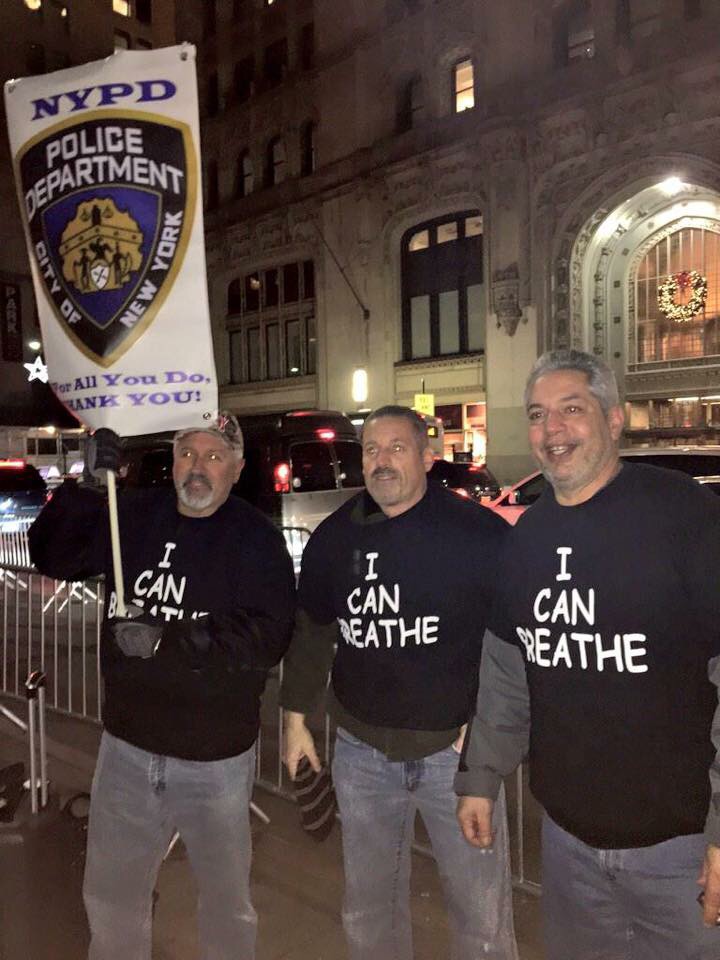
The link http://www.dailymail.co.uk/news/article-2881588/I-breathe-100-police-supporters-storm-New-York-City-sick-t-shirts-mocking-Eric-Garner-s-words.html gets you over to the UK’s Daily Mail.

For those who don’t know: “I can’t breathe” were the last words, repeated many times, uttered by Eric Garner, a black New York citizen selling cigarettes at the corner of a street, thus being subject of a police control. Look up the video on YouTube, watch how he dies in a police officer’s chokehold, repeatedly saying “I can’t breathe”.

Now, on one hand, watching this video is unsettling in itself. But what did really upset many was the fact that the officer(s) were not indicted, following a Grand Jury decision.

As this was also what was happening in the Ferguson case, and because during the same time a 12-year-old black boy, yielding a toy gun on a playground for ten minutes, got shot dead by police officers in Cleveland, within two seconds after their arrival, and from within the police car (look up the video on Tamir Rice, it is as unsettling as the videos in both other cases), it contributed to the public outrage that ultimately led to all demonstrations in New York, Washington, Ferguson, and all over the country.

“I can’t breathe” became a protest slogan, yelled from thousands of mouths.

The Police had to ensure that these demonstrations were happening in a peaceful manner. I saw the first ones, early on, here in New York. The visibility of Police was overwhelming, creating a feeling of threat even for me, a bystander with decades of police experience in really tough situations. The large nationwide demonstrations of the last weekend, however, were secured with a very low profile police visibility, at least here in New York.

Yet, antagonism could be seen from early on. It always is the same: Sides are created, either side feels threatened, and the members of the challenged side stiffen up, feeling obliged to justify their position. In many cases, the result is that sides don’t talk with each other, but only about each other. That often includes shouting matches.

The challenge is to establish a dialogue in which both sides can listen. If the dialogue necessary for that is nationwide, and root causes exist for decades, this challenge is huge, because sentiments, preoccupations, judgement calls, condescending attitude, at times hatred, run very deep.

Not unexpectedly, initiating dialogue is difficult, big time for spoilers of dialogue. There always are spoilers, always always. I see them in my line of international work in conflict- and post-conflict-environments, every day. I saw them during all those years of national police work as well.

However, there is no alternative to dialogue. Those who want to defend their position without listening, they know that dialogue erodes their claimed position of righteousness. Or they muscle up, in order to be in a better bargaining position, including through shouting matches.

Here in the aftermath of Ferguson, Police Trade Union representatives went on a path of, in my view, outrageous action, including even to publicly call on the Mayor of New York City not attending funerals of police officers, killed in the line of duty, any longer. They created a form to be filled and signed by police officers, requesting the Mayor and his spokesperson not to attend their funerals, in case they would be killed in the line of duty. ( http://mobile.reuters.com/article/idUSKBN0JR0JK20141213?irpc=932 )

Now this one: Police officers wearing hoodies with the words “I can breathe”. Which is understood by others as “I can breathe, you can’t”.

This is so unhelpful, and so common. It shows no respect, at all. It must feel terrible for late Eric Garner’s loved ones. Shameful, and I offer the apology that they don’t offer: I am profoundly sorry.

Not going into details, it’s a long other story about what happened in April 2003 in Mitrovica, Kosovo, when approx. 20 of my police officers were injured, including through grenades. As my police did not feel protected by NATO’s soldiers, they created a t-shirt with pictures of burning police cars and soldiers looking away. What they failed to see: They had set the cause for the grenade attack and breakdown of law and order themselves, through a show of force rather than acting on a solid support basis of the relevant communities: Police either acts on such a basis, or enforces external rules. The result of enforcement of external rules is always the same: Resistance. Resistance led to my police officers thinking how to break it. That led to violence on a massive scale. The military force had to shut down this situation, in order to contain. Which made my police officers felt abandoned.

General Marcel Valentin, then Commander of the NATO Force, and I, came together. We knew we sat on a huge joint problem: Two sides, police officers and soldiers, blaming each other.

If I would have taken punitive action against those police officers producing the t-shirts, I would have increased their feeling of being victims, unappreciated. If I would have done nothing, I would have supported that their wrong attitude which led to the violence is the path on which they shall continue.

My strategy was a mixture of zero-tolerance against those who produced the t-shirts, and a combination of methods that established dialogue.

Half a year later, the results were stunning. Results of patient dialogue and listening to others, and then to act on commitments, always are.

In this case, we systematically asked the population about their very specific security concerns. Once we knew, we committed with dedication to exactly address the local concerns, which were, believe it or not, a surprisingcombination of citizens being affected by illegally parked vehicles and illegal prostitution. After addressing exactly these concerns, we could walk the streets to do the beat, international, and ethnically mixed local police. That would have led to massive violence six months earlier.

There is no alternative to dialogue between police and the citizens they are supposed to serve and to protect.

/home/wpcom/public_html/wp-content/blogs.dir/43e/81126473/files/2014/12/img_4616-0.jpg

On Peace, Justice, and Security

The easy but important stuff first: Linking this blog to important pieces that I have published in my official capacities.

November 26, 2014, I published the following text in The Huffington Post, where it appeared as “An Insider’s View on UN Policing” (http://www.huffingtonpost.com/stefan-feller/an-insiders-view-on-un-po_b_6278716.html).

The underlying schemes will resonate through, I guess, many entries that I will be publishing here: Which are the common denominators that should define policing, police institutions, and justice institutions? In Kosovo between 2000 and 2004, I was in command for on average 4.500 police officers who were sent to the United Nations Interim Mission in Kosovo (UNMIK) from up to 54 different countries from all around the world. It was my first experience with what it means to establish an international police organisation from scratch, with no blueprint. Moreover, this Police within UNMIK was supposed to be the real Police in Kosovo: The former Police had been a brutal and repressive element of Milosevic’s regime, and had participated in abuse, oppression, and atrocities. So they had to leave after the NATO air strike was successful. Which left Kosovo without ANY policing, apart from illegal structures that sprang up like mushrooms. There never is a void that is left unfilled…

It was my first experience with what it means to harmonise different approaches, cultures, understandings, values, education, managerial styles, operational practice, and tactical engagement. For the outsider it looked like a “Mission Impossible”, and yes, it was daunting, by all accounts. But it was also, in my view, surprisingly successful.

On basis of many similar experiences thereafter, a network of likeminded friends and I, who had been in command of such operations, identified the most pressing task: What is the least common denominator for policing that we all should accept, wherever we come from?

The below article gives actual insight in where we are on that. However, it is no coincidence that I wrote this article as well at a time during which I witness an intense discussion on Police accountability on occasion of incidents which happened lately in Ferguson, New York, and Cleveland. I am witnessing a fundamental discussion here in the U.S., one in which these incidents are perceived as results of a disguised racism, and insufficient accountability. The public reaction is encouraging, a large and peaceful movement has expressed the views of many citizens, white and coloured alike. Last weekend, I walked up Fifth Avenue in New York as a part of what the press describes as 25.000 peaceful protesters.

2014-12-13 14.53.22 HDR

I am witnessing much more, and all that is profoundly encouraging. So, here my piece in the Huffington Post:

“Justice is both a concept and a function sitting at the core of any society. Whichever form it takes, it contributes to the fundamental connection of an individual or a community to the larger whole. We may take our understanding of justice as a given, or we may even assume that the specific understanding that we grew up with should apply to all others. The reality is that justice comes in many different conceptual shapes, and forms, based on ethical or moral values, or a combination thereof. The world is an arena for different forms of justice and judicial concepts, within larger ideological and secular and religious frameworks. These memes coexist, they compete, at times they fight each other.

As a value in itself, it is inextricably linked to the absence of it, to injustice. Here, things become challenging: Injustice may for example occur if an individual is not treated in a just way. Being treated “justly” includes appropriateness of the rules one is subjected to and that the given rules are universally applied. Equally important is that the feeling of whether an individual or a group is treated “justly”, or not, is often based on complex and very subjective perceptions. What matters most is that injustice, or the perception of injustice, creates the feeling that one does not belong. In my line of work, United Nations Peace Operations, this often is one factor leading to violent conflicts and the difficulty to move from conflict to lasting stability and peace.

The same holds true for security: security and insecurity, as well as the subjective perception of whether to feel secure or insecure, are critically important for any development of lasting peace. Individual members and communities define their belonging to a society including through whether they are safe, and that their concerns on safety and security are appropriately addressed by the society to which they belong.

Therefore, institutions of governance which provide security and adjudicate justice are of critical importance for development into lasting peace and security. For the United Nations, conflict prevention and sustainable peace comprises measures for the prevention of (armed) conflict and addressing its root causes, including through strengthening the rule of law, national reconciliation, good governance, democracy, gender equality and respect for, and protection of, human rights.

The United Nations is looking back on almost 55 years of deploying international police into peace operations. There are currently over 13,000 UN police from ninety-one Member States of the UN in eighteen peace operations all over the world. We operate globally, in the harshest, most challenging and most dangerous environments. We take casualties. We live in those communities where we contribute to their re-establishing forms of governance that lead to lasting peace. We protect vulnerable communities and individuals being targeted by violence and victimized by the abuse of power. In this, more recently, peacekeepers including police officers have become direct targets of those who try to deprive communities of their right to receive good governance. We face being in the cross-hairs of extremists and terrorism, as we are directly inhibiting their actions to suppress freedom and to subjugate communities under the reign of terror. We assist in the establishment of institutions of just and secure governance that contribute to lasting peace and security, after and during violent conflict. We face the menacing nexus between transnational organized crime and extremism and terror, and the often endemic corruption on which both can thrive.

We have learned the hard way which policing concepts work, for security and justice, and which do not. Consequently, we have put our experiences into a consultative process that, literally, includes the world. Our distilled essence is a policy that is based profoundly on what the Global Community understands as the common denominator of policing. On that basis we continue to shape how to promote this form of UN policing. Naturally, this relates to the peace operations in which we take risks. But what we say is also relevant for all police-related policy discussions, simply because we all agree to it.

On 20 November 2014, the United Nations Security Council had its first ever thematic discussion on policing and peace operations. In an overwhelming show of engagement, every member of the Security Council took the floor. The Security Council unanimously voted for its Resolution 2185 which stressed the importance of international policing in peace operations and requested that the Secretary-General further promote professionalism, effectiveness and system-wide coherence in the policing-related work of the United Nations, including through the development and implementation of standards and guidance through the Strategic Guidance Framework for International Police Peacekeeping. Likewise, the relevant Committees of the UN General Assembly, forming the voice of all 193 United Nations Member States, appreciate both the comprehensive consultative approach and the relevance of this framework for international police peace operations.

So, what is the essence of what we have learned? Our growing repository of guidance can be found online (For starters: See here). It is based on a core principle that can be found in our policy framework, which is fundamentally supported by all Member States, whichever form of justice and security they choose, whatever their culture, history and societal values:

In accordance with United Nations standards, every police or other law enforcement agency should be representative of and responsive and accountable to the community it serves.

Police and law enforcement officials have the obligation to respect and protect Human Rights, including the right to life, liberty and security of person as guaranteed in the Universal Declaration of Human Rights and reaffirmed in the International Covenant on Civil and Political Rights and other relevant international instruments. Pursuant to the UN Code of Conduct for Law Enforcement Officials, police and other law enforcement officials are required at all times to fulfil the duty imposed upon them by law, by serving the community and by protecting all persons against illegal acts, consistent with the high degree of responsibility required by their profession.

Policing must be entrusted to police or other law enforcement agencies of a national, regional or local government, within a legal framework that is based on the rule of law. Thus, the police are accountable to laws that are publicly promulgated, equally enforced and independently adjudicated and which are consistent with international human rights norms and standards. Policing the police requires measures to ensure adherence to the principles of supremacy of law, equality before the law, accountability to the law, fairness in the application of law, separation of powers, participation in decision-making, legal certainty, avoidance of arbitrariness and procedural and legal transparency.

As the police adviser to the United Nations, I believe that every serious discussion about the relationship between the society and the policing model that a society chooses for itself needs to be informed by these guiding principles.”

Every journey has a beginning

So, this is it:

Today, I finished brushing up the initial design that I want to use, setting up the About-page, establishing security, what ever.

Yesterday, I finally decided to run a personal blog on those topics that define a good portion of my life. My experiences with, and within peace operations. My experiences with assisting in the establishment of sound, impartial, fair, accountable, humane, security and rule-of-law institutions. My experiences with conflict, and reconciliation. My experiences with trauma stemming from abuse, on individual, group, and societal level.

It´s been a while that I am using internet media not only for my daily consumption of news, but also to communicate what I do, in my official capacities. There have been various over the last fifteen years of international work, within my thirty-eight years of a police career. The latest one: Look up #UNPOL on Twitter.

I am brimming with experiences and topics that I want to explore which can not be voiced through channels which are defined through my professional relationship to one organisation, currently the United Nations, before that the European Union, before that the United Nations, before that policing in Germany, or any of them.

My experiences and questions run deeper, are often very personal and intense. That’s why I am switching the light on in this blog.

Stay connected, link up, if you find it useful, spread through links.

But first and foremost, please contribute to discussions, if you feel like that. Enjoy reading.