Policing and Police
On dialogue, and the absence thereof
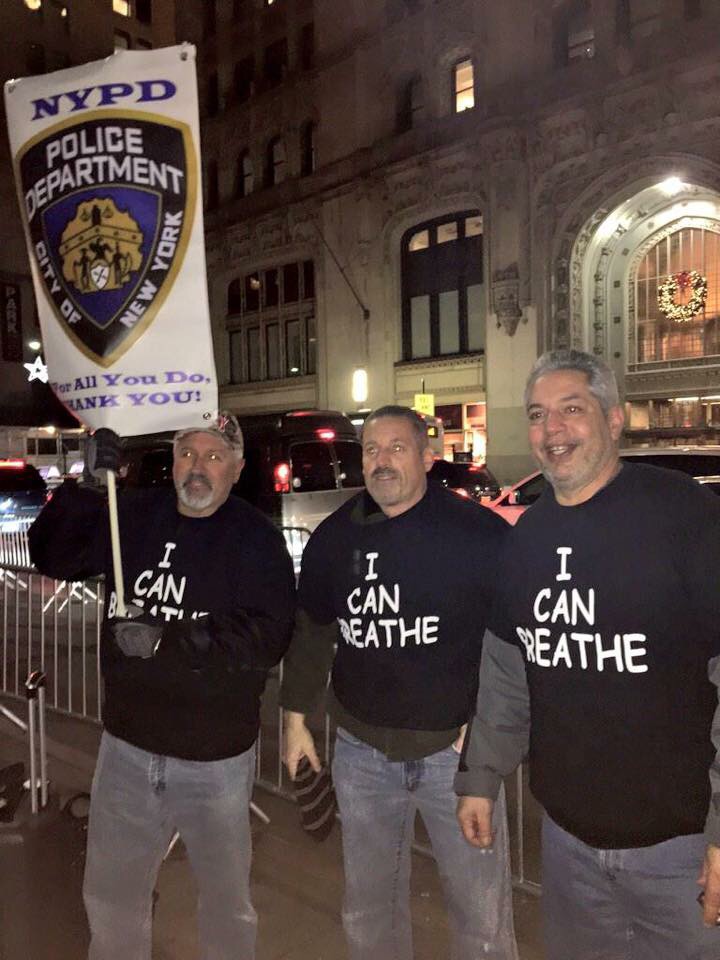
The link http://www.dailymail.co.uk/news/article-2881588/I-breathe-100-police-supporters-storm-New-York-City-sick-t-shirts-mocking-Eric-Garner-s-words.html gets you over to the UK’s Daily Mail.
For those who don’t know: “I can’t breathe” were the last words, repeated many times, uttered by Eric Garner, a black New York citizen selling cigarettes at the corner of a street, thus being subject of a police control. Look up the video on YouTube, watch how he dies in a police officer’s chokehold, repeatedly saying “I can’t breathe”.
Now, on one hand, watching this video is unsettling in itself. But what did really upset many was the fact that the officer(s) were not indicted, following a Grand Jury decision.
As this was also what was happening in the Ferguson case, and because during the same time a 12-year-old black boy, yielding a toy gun on a playground for ten minutes, got shot dead by police officers in Cleveland, within two seconds after their arrival, and from within the police car (look up the video on Tamir Rice, it is as unsettling as the videos in both other cases), it contributed to the public outrage that ultimately led to all demonstrations in New York, Washington, Ferguson, and all over the country.
“I can’t breathe” became a protest slogan, yelled from thousands of mouths.
The Police had to ensure that these demonstrations were happening in a peaceful manner. I saw the first ones, early on, here in New York. The visibility of Police was overwhelming, creating a feeling of threat even for me, a bystander with decades of police experience in really tough situations. The large nationwide demonstrations of the last weekend, however, were secured with a very low profile police visibility, at least here in New York.
Yet, antagonism could be seen from early on. It always is the same: Sides are created, either side feels threatened, and the members of the challenged side stiffen up, feeling obliged to justify their position. In many cases, the result is that sides don’t talk with each other, but only about each other. That often includes shouting matches.
The challenge is to establish a dialogue in which both sides can listen. If the dialogue necessary for that is nationwide, and root causes exist for decades, this challenge is huge, because sentiments, preoccupations, judgement calls, condescending attitude, at times hatred, run very deep.
Not unexpectedly, initiating dialogue is difficult, big time for spoilers of dialogue. There always are spoilers, always always. I see them in my line of international work in conflict- and post-conflict-environments, every day. I saw them during all those years of national police work as well.
However, there is no alternative to dialogue. Those who want to defend their position without listening, they know that dialogue erodes their claimed position of righteousness. Or they muscle up, in order to be in a better bargaining position, including through shouting matches.
Here in the aftermath of Ferguson, Police Trade Union representatives went on a path of, in my view, outrageous action, including even to publicly call on the Mayor of New York City not attending funerals of police officers, killed in the line of duty, any longer. They created a form to be filled and signed by police officers, requesting the Mayor and his spokesperson not to attend their funerals, in case they would be killed in the line of duty. ( http://mobile.reuters.com/article/idUSKBN0JR0JK20141213?irpc=932 )
Now this one: Police officers wearing hoodies with the words “I can breathe”. Which is understood by others as “I can breathe, you can’t”.
This is so unhelpful, and so common. It shows no respect, at all. It must feel terrible for late Eric Garner’s loved ones. Shameful, and I offer the apology that they don’t offer: I am profoundly sorry.
Not going into details, it’s a long other story about what happened in April 2003 in Mitrovica, Kosovo, when approx. 20 of my police officers were injured, including through grenades. As my police did not feel protected by NATO’s soldiers, they created a t-shirt with pictures of burning police cars and soldiers looking away. What they failed to see: They had set the cause for the grenade attack and breakdown of law and order themselves, through a show of force rather than acting on a solid support basis of the relevant communities: Police either acts on such a basis, or enforces external rules. The result of enforcement of external rules is always the same: Resistance. Resistance led to my police officers thinking how to break it. That led to violence on a massive scale. The military force had to shut down this situation, in order to contain. Which made my police officers felt abandoned.
General Marcel Valentin, then Commander of the NATO Force, and I, came together. We knew we sat on a huge joint problem: Two sides, police officers and soldiers, blaming each other.
If I would have taken punitive action against those police officers producing the t-shirts, I would have increased their feeling of being victims, unappreciated. If I would have done nothing, I would have supported that their wrong attitude which led to the violence is the path on which they shall continue.
My strategy was a mixture of zero-tolerance against those who produced the t-shirts, and a combination of methods that established dialogue.
Half a year later, the results were stunning. Results of patient dialogue and listening to others, and then to act on commitments, always are.
In this case, we systematically asked the population about their very specific security concerns. Once we knew, we committed with dedication to exactly address the local concerns, which were, believe it or not, a surprisingcombination of citizens being affected by illegally parked vehicles and illegal prostitution. After addressing exactly these concerns, we could walk the streets to do the beat, international, and ethnically mixed local police. That would have led to massive violence six months earlier.
There is no alternative to dialogue between police and the citizens they are supposed to serve and to protect.
On Peace, Justice, and Security
The easy but important stuff first: Linking this blog to important pieces that I have published in my official capacities.
November 26, 2014, I published the following text in The Huffington Post, where it appeared as “An Insider’s View on UN Policing” (http://www.huffingtonpost.com/stefan-feller/an-insiders-view-on-un-po_b_6278716.html).
The underlying schemes will resonate through, I guess, many entries that I will be publishing here: Which are the common denominators that should define policing, police institutions, and justice institutions? In Kosovo between 2000 and 2004, I was in command for on average 4.500 police officers who were sent to the United Nations Interim Mission in Kosovo (UNMIK) from up to 54 different countries from all around the world. It was my first experience with what it means to establish an international police organisation from scratch, with no blueprint. Moreover, this Police within UNMIK was supposed to be the real Police in Kosovo: The former Police had been a brutal and repressive element of Milosevic’s regime, and had participated in abuse, oppression, and atrocities. So they had to leave after the NATO air strike was successful. Which left Kosovo without ANY policing, apart from illegal structures that sprang up like mushrooms. There never is a void that is left unfilled…
It was my first experience with what it means to harmonise different approaches, cultures, understandings, values, education, managerial styles, operational practice, and tactical engagement. For the outsider it looked like a “Mission Impossible”, and yes, it was daunting, by all accounts. But it was also, in my view, surprisingly successful.
On basis of many similar experiences thereafter, a network of likeminded friends and I, who had been in command of such operations, identified the most pressing task: What is the least common denominator for policing that we all should accept, wherever we come from?
The below article gives actual insight in where we are on that. However, it is no coincidence that I wrote this article as well at a time during which I witness an intense discussion on Police accountability on occasion of incidents which happened lately in Ferguson, New York, and Cleveland. I am witnessing a fundamental discussion here in the U.S., one in which these incidents are perceived as results of a disguised racism, and insufficient accountability. The public reaction is encouraging, a large and peaceful movement has expressed the views of many citizens, white and coloured alike. Last weekend, I walked up Fifth Avenue in New York as a part of what the press describes as 25.000 peaceful protesters.
I am witnessing much more, and all that is profoundly encouraging. So, here my piece in the Huffington Post:
“Justice is both a concept and a function sitting at the core of any society. Whichever form it takes, it contributes to the fundamental connection of an individual or a community to the larger whole. We may take our understanding of justice as a given, or we may even assume that the specific understanding that we grew up with should apply to all others. The reality is that justice comes in many different conceptual shapes, and forms, based on ethical or moral values, or a combination thereof. The world is an arena for different forms of justice and judicial concepts, within larger ideological and secular and religious frameworks. These memes coexist, they compete, at times they fight each other.
As a value in itself, it is inextricably linked to the absence of it, to injustice. Here, things become challenging: Injustice may for example occur if an individual is not treated in a just way. Being treated “justly” includes appropriateness of the rules one is subjected to and that the given rules are universally applied. Equally important is that the feeling of whether an individual or a group is treated “justly”, or not, is often based on complex and very subjective perceptions. What matters most is that injustice, or the perception of injustice, creates the feeling that one does not belong. In my line of work, United Nations Peace Operations, this often is one factor leading to violent conflicts and the difficulty to move from conflict to lasting stability and peace.
The same holds true for security: security and insecurity, as well as the subjective perception of whether to feel secure or insecure, are critically important for any development of lasting peace. Individual members and communities define their belonging to a society including through whether they are safe, and that their concerns on safety and security are appropriately addressed by the society to which they belong.
Therefore, institutions of governance which provide security and adjudicate justice are of critical importance for development into lasting peace and security. For the United Nations, conflict prevention and sustainable peace comprises measures for the prevention of (armed) conflict and addressing its root causes, including through strengthening the rule of law, national reconciliation, good governance, democracy, gender equality and respect for, and protection of, human rights.
The United Nations is looking back on almost 55 years of deploying international police into peace operations. There are currently over 13,000 UN police from ninety-one Member States of the UN in eighteen peace operations all over the world. We operate globally, in the harshest, most challenging and most dangerous environments. We take casualties. We live in those communities where we contribute to their re-establishing forms of governance that lead to lasting peace. We protect vulnerable communities and individuals being targeted by violence and victimized by the abuse of power. In this, more recently, peacekeepers including police officers have become direct targets of those who try to deprive communities of their right to receive good governance. We face being in the cross-hairs of extremists and terrorism, as we are directly inhibiting their actions to suppress freedom and to subjugate communities under the reign of terror. We assist in the establishment of institutions of just and secure governance that contribute to lasting peace and security, after and during violent conflict. We face the menacing nexus between transnational organized crime and extremism and terror, and the often endemic corruption on which both can thrive.
We have learned the hard way which policing concepts work, for security and justice, and which do not. Consequently, we have put our experiences into a consultative process that, literally, includes the world. Our distilled essence is a policy that is based profoundly on what the Global Community understands as the common denominator of policing. On that basis we continue to shape how to promote this form of UN policing. Naturally, this relates to the peace operations in which we take risks. But what we say is also relevant for all police-related policy discussions, simply because we all agree to it.
On 20 November 2014, the United Nations Security Council had its first ever thematic discussion on policing and peace operations. In an overwhelming show of engagement, every member of the Security Council took the floor. The Security Council unanimously voted for its Resolution 2185 which stressed the importance of international policing in peace operations and requested that the Secretary-General further promote professionalism, effectiveness and system-wide coherence in the policing-related work of the United Nations, including through the development and implementation of standards and guidance through the Strategic Guidance Framework for International Police Peacekeeping. Likewise, the relevant Committees of the UN General Assembly, forming the voice of all 193 United Nations Member States, appreciate both the comprehensive consultative approach and the relevance of this framework for international police peace operations.
So, what is the essence of what we have learned? Our growing repository of guidance can be found online (For starters: See here). It is based on a core principle that can be found in our policy framework, which is fundamentally supported by all Member States, whichever form of justice and security they choose, whatever their culture, history and societal values:
In accordance with United Nations standards, every police or other law enforcement agency should be representative of and responsive and accountable to the community it serves.
Police and law enforcement officials have the obligation to respect and protect Human Rights, including the right to life, liberty and security of person as guaranteed in the Universal Declaration of Human Rights and reaffirmed in the International Covenant on Civil and Political Rights and other relevant international instruments. Pursuant to the UN Code of Conduct for Law Enforcement Officials, police and other law enforcement officials are required at all times to fulfil the duty imposed upon them by law, by serving the community and by protecting all persons against illegal acts, consistent with the high degree of responsibility required by their profession.
Policing must be entrusted to police or other law enforcement agencies of a national, regional or local government, within a legal framework that is based on the rule of law. Thus, the police are accountable to laws that are publicly promulgated, equally enforced and independently adjudicated and which are consistent with international human rights norms and standards. Policing the police requires measures to ensure adherence to the principles of supremacy of law, equality before the law, accountability to the law, fairness in the application of law, separation of powers, participation in decision-making, legal certainty, avoidance of arbitrariness and procedural and legal transparency.
As the police adviser to the United Nations, I believe that every serious discussion about the relationship between the society and the policing model that a society chooses for itself needs to be informed by these guiding principles.”