On a request to establish a Peace Operation in the Ukraine

16 March 2022, the international news is reporting about a visit of the heads of the governments of the Czech Republic, Poland, and Slovenia to the Ukrainian government. Three weeks into a war of aggression against the Ukraine, prepared in a way meeting the immense security challenges, the highest officials of these governments traveled to Kyiv by train, meeting President Selenskyj of Ukraine. Amongst other, the delegation included Vice President Jaroslaw Kaczynski of Poland. Vice President Kaczynski went public following the meeting by demanding an armed “NATO Peace Operation”, acting with approval by the Ukrainian President, on Ukrainian territory. That request is generating a flurry of public comments, covering the full spectrum of why this would be very complicated, or unlikely, or way too early.

Time to have a select look on the state of peace operations, why current operations struggle, leading to some thoughts on basic preconditions for peace operations, ensuring the unfolding of civilian aid and assistance.

To start with a term the United Nations got used to: “Robust Peacekeeping” was coined some years ago within the United Nations. It was used even by highest officials to describe the environment in which Peacekeeping Operations (PKO) of the UN increasingly found themselves: Being tasked with peacekeeping where there is little or no peace to keep. There is a notion of exasperation and despair in this term which I so vividly remember from many speeches. In the doctrinal framework of the UN, “peacekeeping” sets in after a peace settlement has been achieved, or, after at least some ceasefire agreement has begun to take shape. PKO such as MINUSMA in Mali, or MINUSCA in the Central African Republic provide the painful experiences which forced peacekeepers to adapt to situations where their real raison d’etre was a lofty dream. Never before the UN lost so many lifes, and the UN tried to adapt by making PKO more robust. So, that’s how the term “Robust Peacekeeping” was born. Member States of the UN and the UN Secretariat even accepted a path of providing the PKO MONUSCO in the Democratic Republic of Congo with a specially equipped and trained military intervention brigade authorised to “neutralize” elements. A term used for describing offensive lethal operations, not limited to the objective of defending the PKO and its mandate. Much has been written about this extraordinary step going beyond the concept of armed military or police mission elements for self-defence and defense of the mandate in a UN PKO.

There always were some blurry lines between how the UN uses the term “peacekeeping”, NATO is using the term “peace support operation” (PSO), or, in a similar way, how the African Union (AU) describes their own engagement in Somalia through AMISOM. Yet, in broad strokes, there is a distinction between “peacekeeping”, “peace support”, and “peace enforcement”. The UN limits itself to “peacekeeping”, current missions of the European Union in the field of civilian and military crisis management follow that line, NATO has experience in “peace support” and certainly in “peace enforcement”, the AU in “peacekeeping” and “peace support”. All these missions broadly are “peace operations”.

Of course and by contrast, any use of the term “peacekeeping” by the Russian Federation in relation to the horrible invasion of, and war in, the Ukraine by Russia is not only misleading propaganda, but a blatant abuse of the term “peacekeeping”. Taken together with the use of the term “special military operation” it is trying to evade the accusation of a violation of the Charta of the UN: That Russia is waging war against another sovereign State, a Member State of the United Nations. In order to get a common position allowing 141 Member States to condemn, only 35 Member States to abstent, and just Belarus, North Korea, Eritrea, Russia and Syria to vote against, the Resolution had to speak of “military operations”. We often hear the phrase “being on the right side” today. On that right side, this military operation is a war. It is ongoing, and it is escalating, and there is no current publicly visible sign hinting towards a path of peace negotiations. Even talks about humanitarian corridors for evacuation of civilian populations utterly fail.

The fact that Russia appears, in addition to violating Art. 2 of the UN Charter, to commit war crimes against the civilian population in the Ukraine, stands separate. 16 March 2022, U.S. President Biden took the unprecendented step calling President Putin of Russia a “war criminal”. Taken the violation of the UN Charter and the alleged committment of acts constituting war crimes together, this is making the use of the term “peacekeeping” by the Russian Federation an insult to anyone who has worn a light blue UN beret, a dark blue EU beret, or the green beret of the African Union.

Vice President Kaczynski’s suggestion to establish a NATO peace operation needs to be specified in terms of what this would mean, and it never is too early to think about what comes ahead. In whichever way the catastrophe strangling the Ukrainians will unfold further, we shall never give up efforts and hope that this can be stopped. From what I understand from the public comments of Vice President Kaczynski, a “peace operation” would require a peace agreement, or a ceasefire declaration, meaning it is not “peace enforcement”. More likely, it would be understood as something resembling “robust peacekeeping”. Then, Russia, and [the Ukraine] would have to agree how to move forward on the incredibly winded road restoring peace & security. Note the square brackets: The Russian President decided to recognize the Donetsk and Luhansk People’s Republics declarations of independence just hours before starting his military operations, or, in my view, war. Which led to widespread international condemnation, in return. How a Peace Agreement, or the rationale for a ceasefire declaration would play out will be incredibly difficult, and any international mediation will be a nightmare. But nothing is more important in order to define a difference between a peace operation having a chance of supporting return to peace, and a peace operation where there is no peace to keep. It is the single defining difference for the immense suffering of human beings in the Ukraine.

Many also push against the idea of a NATO peace operation, for the obvious reasons which brought Vladimir Putin to the point of attacking the Ukraine, and demanding its demilitarisation. On top of it, he wants to decapitate the Ukrainian government, claiming a “denazification”. But that is another horrible story, another lie. Here the question would be, in case of any chance for a peace agreement or ceasefire declaration whatsoever, who the implementing organisation or entity would be that could be tasked with a peace operation. From what I have read, Vice President Kaczynski is rather pragmatic: It can be NATO, it can be others. So it can be the UN, the EU, OSCE, NATO, or any combination of those. All of those have done peace operations, in the form of peacekeeping operations of the UN, crisis management operations of the EU, peace support operations of NATO, peace enforcement operations of NATO, or OSCE missions.

As mentioned, it never is too early to begin thinking about what comes after. Too often the results from planning are less than optimal otherwise. Mistakes haunting the international community for years have been made right in the beginning, during the conceptualisation and design phase, and reasons do not only include unalterable facts of the political environment for these planners, but also severe shortcuts because of time constraints. The earlier the thought process and the better the results, the less suffering for people after this war is stopped.

It is suggested that this operation is including at least armed elements, provided with a possible mandate of armed self-defense. Nothing more specific, so far. Also not about which civilian tasks would require armed protection. The request for armed means especially makes a case for a mandate by the UN Security Council (UNSC), since obviously a sole request from the Ukraine would not suffice in the given dispute, and also specifically in light of a historical dispute on interventions, where there was no such mandate by the UNSC. Assuming no veto by any of the five permanent members, the implementation by any suitable international organisation would be possible.

Without a UNSC Resolution, any operation would not survive the first day of our coining it a “peace operation”. It would be treated as a military aggression, escalating the existing conflict, perhaps in dramatic ways. However, it is important to be clear that nothing like that could hope to fly under the brand name of “peace operation”.


Final thoughts on mandate elements of a “peace operation”: Little to nothing has been thought about in the public which elements such an operation would have (military, police, civilian). Nothing is clear in relation to that armed capability, how robust, for which purpose, and whether it will entail military elements only, or also police elements, and whether they would be robustly equipped too, and for which purpose.

On earlier occasions, this blog contains many articles which point towards the vast experience available in the field of international policing and its cooperation with military elements, both in the UN and the EU (including the External Action Service itself, but also specific initiatives started by groupings of EU Member States, such as the European Gendarmerie Force EGF and the Center of Excellence for Stability Police CoESPU). There also is institutional knowledge about these topics within the NATO Center of Excellence for Stability Police.

On the rule of law and trusting it in times of misinformation and manipulation spread using social media

I finished my reading of the book “How Civil Wars Start And How To Stop Them”, written by Barbara F. Walter (Crown, 2022, Ebook ISBN 9780593137796). I wrote about it in my article “Anocracies – And Thoughts on International Efforts Related to Conflict Prevention“. There I said that I was impressed with the detailed historical account on the many civil wars, and what political science learned about their predictability. I also said that I will comment less on the second part of the book, where the author is applying those experiences on the current state of affairs in the United States of America. But here is a brief personal impression:

Purely from an emotional perspective, the first part of the book felt gripping, the second part felt like something was missing. Because the first part tells the story of not only why things went haywire, but also how they went haywire. The first part of the book talks about catastrophies that happened. Because the current situation in the U.S. is troubling, and partly deeply concerning, but has NOT led to a worst case scenario (yet?), the book is speculative in this regard, because, simply, it has to.

The author attempts to come up with a future scenario of how a descent into civil war in the U.S. could look like. When I read it, it felt incomplete. It had to. I believe the scenario had to necessarily stay away from including a potential role of individual actors which brought us to the brink of that abyss. Otherwise the book would have become speculative and politically antagonizing. The role of “Number 45” is being described in how the U.S. witnessed it’s downgrading from a starling democracy into the field of anocracies. But the book’s scenario on possible further descent stays away from involving contemporary individual actors. An that is why the scenario feels hypothetical. The absence of this link allows for concluding that we are, perhaps, far away from seeing one of the most stable democracies of the world itching closer to internal chaos. Which we are not, as I believe.

Here are two recent news articles which may make you better understand where my concerns are, still allowing me to stay out of the same trap. Make your own conclusions on whether the future may bring us closer to worst-case, just by reading and thinking about this one, and this one. We are a far cry away from being out of trouble. The mid-term elections in the U.S. are coming up, I feel we are in for a very bumpy 2022. From a European perspective, the current stabilisation of transatlantic jointness is extremely fragile, depending on future development.

At one point I was wondering what would happen if a future presidential candidate would claim his right for using Twitter back. It feels like “You’re damned if he is allowed, and you’re damned if he is not”. The claim of the far-right that it is fighting a corrupt, even pedophile global cabale, including depicting the free press as the enemy of the people, it will see a new and even more intense replication: The next round of racism, xenophobia, white supremacy, male domination, conspiracy theories challenging the efforts to fight the pandemic, and global warming, attempting to establish a narrative fighting Western democracies, it is just coming up. And the use of social media will be pivotal for those who attack, and those who defend.

The jury is out how this unfolds. And then there is the nutshell of Barbara F. Walter’s point how a fragile and unstable further descent into becoming an anocracy can be turned around. Here, the author refers to a piece of work she was commissioned with in 2014, for the World Bank. Like other scholars, the author found three factors standing out by far as being critical for preventing descent into conflict and chaos, including civil war: (1) The Rule of Law; (2) Voice and Accountability; (3) Government effectiveness. So, we will have to think about how we translate these fundamentals into concrete action allowing people all over the world to trust the form of governance which we say is the best of all alternatives we have been able to come up with so far.

So, here we are again. It is why any effort getting us collectively out of the currently very troubled waters must look at the rule of law, which Walter describes as “the equal and impartial application of legal procedure”. I stick to the definition of the rule of law as adopted by the United Nations: “For the United Nations (UN) system, the rule of law is a principle of governance in which all persons, institutions and entities, public and private, including the State itself, are accountable to laws that are publicly promulgated, equally enforced and independently adjudicated, and which are consistent with international human rights norms and standards. It requires measures to ensure adherence to the principles of supremacy of the law, equality before the law, accountability to the law, fairness in the application of the law, separation of powers, participation in decision-making, legal certainty, avoidance of arbitrariness, and procedural and legal transparency.

However, my experience entails that in order to establish any rule of law, there needs to be a large consent of the respective society in how this principle is applied, and this consent must go beyond any larger factionalisation in that society. Any large faction of a society must accept this larger principle, rather than challenging the application of a rule of law as being biased, being imposed on them by other factions. Those who stir conflict for advancing their own objectives, they always will establish a narrative that there is no justice for their constituency. They will portray the rule of law as being a weapon wielded by their enemies against them. What these individuals do is to undermine the trust of their followers in a rule of law applied to their society as a whole. Which points to a second invisible feature of any successful establishing a rule of law: Trust.

It is about trust accepting the specific rule of law, for myself, and others, for the powerful and the less powerful. And it is about trusting that justice will always attempt to prevail, no matter how long it takes. Because very often, it can take a long time. And still, after many years, cases may be unresolved, often are. A society at large must trust the course which justice takes, even if individual members experience pain because their grievances are open and festering wounds for many years, before closure is possible, or sometimes even never.

For me, this challenge can be seen nowhere else with all clarity than in situations where I contributed to the efforts to re-establish a rule of law in a society where it had broken down. May be I will write more about a few of those experiences. Here it would be too long, because I want to finally focus again on the critical role of social media. Here is just one example:

There were two main ethnic factions in Kosovo before and after the violence ending in 1999. Under the UN Security Council Resolution 1244 Kosovo found herself with a majority and a minority faction, no form of own governance at all, and no rule of law beyond what UNSCR 1244 tasked us with. The Old had broken down and had to disengage. The New was not there. It was to be established, and being part of the international community engaging in assisting in finding a new New, I was representing the international interim police.

Whilst, on a technical level of developing policing, and helping a new Kosovo Police to emerge, being more and more successful, we found ourselves in a classical “Catch-22-situation”: All factions involved were blaming us not being able to provide security, and justice. Each side would accuse us to act on the interest of the other side’s agenda. And practically it meant that in case of any evidence of a severe crime which would allow us to make arrests, and prosecute suspects of grievious crime, there would not be a societal consent, or trust beyond factions. At least at the beginning. During those early years, any action by us leading to an arrest would be perceived by one faction as a biased, if not politically motivated, action in favor of the other faction. I have many examples for both factions.

I believe that, over time, some trust could be instilled. Not only that the Kosovan society at large moved forward towards healing from own wounds. Not only that our persistent sticking to a common rule of law for All slowly helped in setting some foundations for trust. Not only that the real success story is the work on the credibility of the Kosovo Police itself, establishing itself as a trusted actor within an emerging rule of law. But any development until today also shows how fragile this trust is. Including in recent times, operational situations can demonstrate how quickly old tensions, mistrust, and biased interpretation of events can break up. But what I want to demonstrate here is exactly that: That any rule of law is critical for peace&security in a society, and that this does go way beyond the technical application of such a principle.

It requires acceptance of that rule of law by a majority of all constituencies in a society, and it requires a sound trust in the equal application and adjucation of that rule of law, beyond personal grievances, and existing factions.

As said earlier (in my first blog article on this book), this holds true both for a society moving towards a rule of law, and it applies to a society where the efforts of trusting a rule of law are heavily undermined by the spreading of misinformation and fake news. Whether the society moves into a positive direction or a negative direction, it is the middle zone between the Old and the New which makes the situation most volatile.

All three factors mentioned by Barbara F. Walter, (1) The Rule of Law; (2) Voice and Accountability; (3) Government effectiveness played into any descent into chaos I have personally witnessed.

In 2022, the means to disrupt by using manipulative voice and amplifying non-accountability are a global challenge: Social media has become a bull-horn for those who know how to exploit fragility, and to further it.

So, how to translate Barbara F. Walter’s message, that civil wars can be avoided, into practice?

By taking responsibility for own action, and making our voices of reason being heard, day by day. Neil Young requested from Spotify to remove his music from the platform because Spotify is hosting “The Joe Rogan Experience”. Neil Young did not want to be on a platform which prominently features a protagonist for this type of spreading misinformation, lies, and manipulation, including wildest conspiracy theories about some mass-hypnosis being used by a global cabale enslaving citizens. Joni Mitchell followed suit, and she is not the only one.

This fight is taking us on a long haul, it is far from being over. Every personal contribution matters.

Anocracies – And Thoughts on International Efforts Related to Conflict Prevention

Anocracy or semi-democracy is, according to Wikipedia, a “form of government that is loosely defined as part democracy and part dictatorship, or as a “regime that mixes democratic with autocratic features.” Another definition classifies anocracy as “a regime that permits some means of participation through opposition group behavior but that has incomplete development of mechanisms to redress grievances.” The term “semi-democratic” is reserved for stable regimes that combine democratic and authoritarian elements. Scholars have also distinguished anocracies from autocracies and democracies in their capability to maintain authority, political dynamics, and policy agendas. Similarly, the regimes have democratic institutions that allow for nominal amounts of competition. Such regimes are particularly susceptible to outbreaks of armed conflict and unexpected or adverse changes in leadership.”


In my blog post “Under The Hood” I wrote that I had pre-ordered “How Civil Wars Start And How To Stop Them”, written by Barbara F. Walter (Crown, 2022, Ebook ISBN 9780593137796). After its publication date it got delivered (in my case as an Apple iBook). I am reading it now, and it is as good as it was assessed in that New York Times book recension. As it was said in that recension, Barbara F. Walter spends much of the first half of the book on a profound history of nearly every civil war haunting mankind in the past many decades before beginning to apply the results of academic research of political scientists on civil wars to the situation of the United States of America.

I am through the first half of the book, and inasmuch as I am now keenly reading her account of the more recent developments in the U.S., I am not intending to write on that subject matter. I have an opinion there, and I share the author’s risk assessment, but this public discourse is already ongoing in the U.S.: Look here and here.

I wanted to reflect on a few general observations that stem from the book’s solid comparative approach of recent situations which led to wide-spread violence, and the solid and vast description of the state of affairs of a number of contemporary nation states. After all, no country is exempted from the danger of plunging into wide-spread violence, just pretending “It can’t happen to us” is nothing less than dangerous denial and wishful thinking of the ostrich burying her head in the sand. In this, Barbara F. Walter’s book establishes itself in the same rational and academic realm as the books “Twilight of Democracy: The Seductive Lure of Authoritarianism” by Anne Applebaum and “Fascism: A Warning” by former U.S. Secretary of State Madeleine Albright.


My line of work has frequently put me into situations where we have wondered how one can measure the risk of a country or constituency descending into violent forms of conflict, including civil war. On several occasions I have been part of the international community’s peacekeeping efforts following the outbreak and the aftermath of civil war. Operationally and strategically I was part of such efforts in Kosovo under the United Nations’ mandate through Security Council Resolution 1244. Strategically I was part of such efforts in situations such as in Sudan, South Sudan, Mali, the Central African Republic, Somalia, and several more.

Then there is peacebuilding: How to make sure that a successful peacekeeping engagement finds its continuation through peacebuilding, and leads to a stable peaceful environment that will not relapse into conflict? That’s one of the elements of my current line of work, or why I was operationally working in Bosnia&Hercegovina, or strategically in headquarters of UN and EU on a large number of similar situations in greater Europe, the Middle East, Asia, Africa, and the Carribean.

Finally, there is conflict prevention: I often sat in meetings with like-minded peacekeepers and peacebuilders where we dealt with conflict prevention. Meaning to extinguish the fire when it was starting small, or even better: To help keeping things stable long before they reach critical mass of instability, and to find ways helping a country, or a constituency, in efforts to resolve disputes peacefully, and to succeed in that. Here I will not give examples. There were a number of cases in which I participated and where we could help in de-confliction of interests, and peaceful resolving of grievances. Those cases did not lead to bad-news-stories, in the general public they went almost entirely unrecognized, and good-news-stories sometimes can not be told in order to keep the good news continuing.

Those stories also don’t sell. Even in the “normal” world of crime, crime prevention does not attract the same interest by readers as the gruesome murder story does. Prevention is the silent humble sister of the guys and gals in military and police fatigues. Repression, threat, coercion, and the use of force, all too often these stories outrun any peaceful piece of news. This is the achilles-heel of prevention, and exponentially more so since the advent of social-media, whose algorithms prefer stories, fake or true, that create viral attention: Stories that create anger will always knock out the stories of crime that never happened. Even cute-cats-stories outrun every story about a conflict which never happened because we all did the right things.


In all those discussions on how to prevent conflict better, we asked ourselves how to asses and to measure the risk of conflict with hard numbered indicators. I remember reading the book “The Responsibility To Protect” by Gareth Evans. Evans, one of the chief architects of a concept called R2P, which tragically failed, at one point mentions the many efforts of academia to come up with a measurable set of indicators. He stated that for many years there was inconclusive academic research on that. In his book he mentioned that only one hard statistical fact could be boiled down: That conflict is much more likely in a country where there was one -more recently- before.

For years, I accepted that. Barbara F. Walter’s book has profoundly changed this view. May be I did personally not notice, or may be it is more of a late-breaking recognition, but according to Walter political science has made tremendous progress and has developed a sophisticated set of predictors, or risk indicators, based on sound bodies of empirical data in at least three very large and internationally recognized data-sets. In order to keep this a relatively easy read, I won’t go into details. The book is very captivating and it is very comprehensible. I truly enjoy the way how hard science is transformed into popular language by Barbara F. Walter. There is no need to undergo a 101 course in political sciences, so instead of summarizing a detailed book, I recommend reading it yourself.


Walter’s book has drawn my attention to three factors that increase the potential for, and are the reasons for, civil wars. Academic research appears to have managed to put these three factors into a rock-hard framework of statistical measurability: (1) Transitions from one system of governance to another system of governance; (2) Factionalisation in societies; (3) The drastic effects of social media.


(1) Transitions from one system of governance to another system of governance

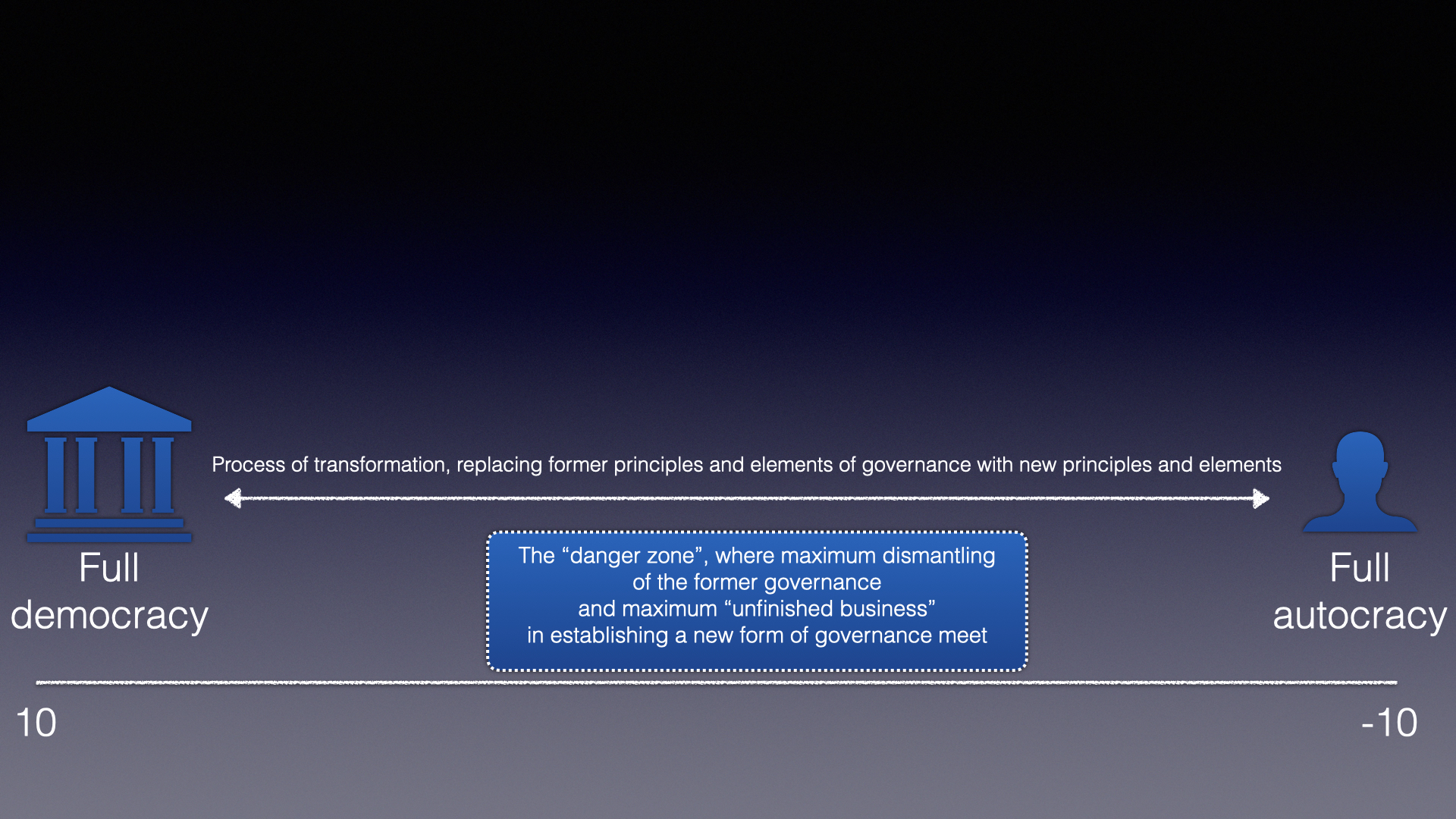
For me, one important contribution of Barbara F. Walter’s book sits with drawing attention to process, rather than a snapshot of a state of affairs in time. Any form of governance can be categorized, and put on a scale. A true representation of all common criteria for a democracy can put a State into a category of “best in class”. Another State can be a full representation of what we call an autocracy. That State would be on the opposite side of that scale. From the viewpoint of a true defender of democratic values, that would bring this State into the zone of “worst in class”. Of course, “the other side of the aisle” would disagree with that judgement, and there we are in a polarized discussion.

But the true focus of Barbara F. Walter is not on the snapshot where a State finds herself on such a scale. It is about the movement from one end to the other, in both directions, and it is about the speed of that process. A State can find herself on the path towards more autocratic forms of government, or on the path from autocratic governance towards democratic governance. Political science has established evidence for that the “middle zone” between one form of governance and another form of governance is the most dangerous and volatile area, and the faster the transitional process from democracy towards autocracy, or from autocracy to democracy, the more risk for wide-spread violence exists on a statistical level.

And this makes perfect sense. Here is my attempt to visualize it:

It means that the “door swings in both directions”: The risk of violence does not only exist in a situation where a country is slipping towards semi-autocratic or fully-autocratic forms of governance. The same risk exists in a situation where interested parties, supported by the international community for example, engage in promoting and establishing regime change towards democracy. Barbara F. Walter makes it clear that the risk for violence is highest when this process into either direction has placed the constituency in question into the middle zone, when transformational change is most unfinished, with the old being ripped down and the new not yet formed and rooted.

Secondly, science tells us that, again, the risk is quantifiably higher if the process of transformation is either too slow or too fast, for which there can be many reasons. From how I look at things from my own experience, it is scientific evidence for what happens when the international community pushes too fast, is compartmentalised in such efforts, displays not enough comprehensive depth in supporting transformational change, nor patience for a long-term coherent support approach based on vision and strategy. Which I often saw when international mandates and policy discussions were held unter terms such as “democratization”, or “state building”.


(2) Factionalisation in societies

The second aspect in Barbara F. Walter’s book is a comprehensive analysis of previous civil wars and the relation between constituencies moving into the “danger zone” of being an anocracy, and the existence of factions in these societies. Also here, the book is very comprehensive in giving a detailed account for a vast array of previous civil wars. In my reading this book, one aspect stood out: Any change of one system through which a state applies governance to citizens towards another set of governance rules inevitably leads to the demise of old elites and the struggle which is happening when new elites try to form, and old elites fight to participate in societal control, for their benefits. This is the second factor which makes the “danger zone” so volatile, and the book provides detailed analytical results to the question when, how, and why this leads to violence. I want to highlight one sentence:

“Remember, it’s not the desperately poor who start civil wars, but those who once had privilege and feel they are losing status they feel is rightfully theirs”.

Likewise I quote her account on a declassified CIA report from 2012: “Most insurgencies, the report notes, “pass through similar stages of development during their life cycle.” In the pre-insurgency phase, a group begins to identify a set of common grievances and build a collective identity around a gripping narrative—the story or myth that helps them rally supporters and justify their actions. They begin to recruit members, some of whom even travel abroad for training. They begin to stockpile arms and supplies.

I note that it is the last sentence which connects my current line of work with the larger picture.

Then Barbara F. Walter goes on to analyze the role of social media in contemporary conflicts:


(3) The drastic effects of social media

Social media acts like the proverbial gasoline poured on a fire. By now, many of us have begun to appreciate this very dark side of a technology which also has contributed so much to bringing us close together in a global world. The author’s account on how social media has been, and continues to be, systematically exploited by those who seek control, including by inciting violence, is nothing short of scathing criticism. Again, the book is unbiased by taking a very comprehensive view on situations of recent violence, and contemporary situations in countries all around the globe, within something which appears to be a rising global pattern of instability, emerging and brooding conflict. She refers to solid data that would allow to conclude that there is a clear connection between the exponential rise of volatile situations and war on one hand, and the the abuse of social media for that purpose on the other hand. It is here where the role of social media and its systematic and professional exploitation by reckless individuals and groups is pervasive. Whereas encouraging factionalism on religious, ethnic, racial, or any grounds has been the key defining modus operandi of individuals manipulating populations into fear and hate of the other, and the acceptance that “Dear Leader” may be the lesser evil, contemporary situations are characterised by a systematic manipulation of many, through some, using social media. The book demonstrates this in Myanmar, in countries in Europe including Eastern and Central Europe, and elsewhere, before even beginning to analyse what happened in the U.S. in recent years.

Our societies struggle with the question of how to apply accountability and regulative frameworks to this new phenomenon. Because, new it is: The effects of how social media can be used for manipulation, inciting hatred, and fueling violence, they may be just ten years old. But they are extremely transformative. And again, we see different approaches in relation to how to control social media in China or Russia, say compared to how open societies handle this challenge. But what we also see: Aspiring autocrats virtuously use social media to gain control. After that, these individuals will undertake everything to control the instrument they have used.

Because, they know better than anyone else how it can be used to their advantage, and against them.


This got long again. I leave it without conclusions, simply because there are so many. This is true for a paradigm change on how we consider engaging in conflict prevention in a world filled with old instruments of international order which require overhaul, or may be outdated if we don’t succeed in transforming them into effective tools. This is also true for how we accept our being affected by what we call “social media”. Personally, I feel this question may belong to the most important ones in our lifetime, in all aspects of our lives.

Under The Hood

Forgiveness says you are given another chance to make a new beginning.
DESMOND TUTU

This entire blog is about peace and security, trauma and reconciliation. It is my chosen overarching theme since I began writing.

Ultimately, in order to sustain lasting peace and security in a society, the society needs to be at peace with itself. The impact of traumatic situations and the societal ability to heal these, through reconciliation, is directly affecting the cohesion which is also often referred to as a “social contract”. The less cohesion in a society, the more likely the foundations of that agreement erode.

I pre-ordered “How Civil Wars Start And How To Stop Them”, written by Barbara F. Walter (Crown, 2022, Ebook ISBN 9780593137796). I read an article in the New York Times discussing this book and was immediately drawn to it. Of course, much attention is given to such topics because January 06, 2022 we also looked back on what happened one year earlier: The attacks on the U.S. Capitol by violent crowds, incited by an angry former U.S. President ready to rip everything into pieces and to burn the house to ashes when facing his power coming to an end.

I am specifically interested in understanding the author’s methodological approach. To quote from the New York Times article: “As a political scientist who has spent her career studying conflicts in other countries, she approaches her work methodically, patiently gathering her evidence before laying out her case. She spends the first half of the book explaining how civil wars have started in a number of places around the world, including the former Yugoslavia, the Philippines and Iraq.

So I began this blog entry by looking at my four terms “Peace, Security, Trauma, Reconciliation” with a focus on the January 06, 2021 Capitol riots:

There was no peaceful event, there was no security, there is massive traumatisation of an entire society, and there are huge challenges when it comes to reconciliation. The fabric of the U.S. society is critically wounded. Many, including the current President of the United States, have made that clear on occasion of the commemoration events. Others have blamed them for saying that, accusing them of dividing the very society they have undermined themselves. No matter on which side of the aisle one is, the fact of deep divisions in the society of the U.S. can not be disputed by anyone, because they all participate in it, blaming the respective other side.


Currently in every open society the fabric of consent appears to be at threat. We experience attacks from the outside and from the inside, and we have a large-scale public discourse about that. Attacks and covert efforts in a cyber-information-warfare do point back to actors from inside authoritarian systems, but not only: They include actors from within open societies, in an effort to overturn the systems of governance as they have been set up on grounds of the respective societal contract, enshrined in the relevant basic laws of these societies, their constitutional law. There is a blurry spider web of people and interest groups out there, networking on a global scale, who seem to diligently work on that.


We see societies with authoritarian leadership, heavily applying coercion, and whereever deemed useful, heavy violence against own constituencies. Whichever legitimacy, or sheer power, sits behind coercion into cohesion in those societies, the number of current examples of authoritarian regimes quelling opposition and unrest is considerable. Instability, public unrest, violent coercion of populations by a ruling structure, whether Central Asia, Africa, the Near, the Middle, and the Far East, the Americas, there are many examples.


We see societies with illiberate structures of governance that appear to be stable, sorts of. Big ones, and smaller ones.

We do speculate about the stability of the bigger ones, we suspect, or bluntly see them being in a game of stabilising themselves by dominating spheres of influence, and coercion, whilst at the same time being engaged in efforts destabilising opponents on the side of what we call open societies, including the so-called “West”.

We see smaller societies on their path to illiberate control that position themselves by jockeying for alliances, keeping options open, attempting to take advantage of being friendly to the one or the other, being ambigous.


That is how I came to suspect that the common denominator for all, on a global level, is about societal cohesion. On this level of analysis it is not about attacks of authoritarianism against democracy. It appears to be that notwithstanding the form of governance in many societies, we all struggle with societal cohesion. We all have the same problem, we only differ in how we deal with it.


With that in mind, I revisited my blog entry “Futuretelling” from April 2021. There I had written about the latest report published by the collective of American intelligence agencies: “Global Trends 2040”. The report “finds that the pandemic has proved to be “the most significant, singular global disruption since World War II,” with medical, political and security implications that will reverberate for years. That’s not sturm und drang. It’s the prologue to a far darker picture of what lies ahead.”

Five themes are identified in that assessment: (1) Global Challenges, (2) Fragmentation, (3) Disequilibrium, (4) Contestation, and (5) Adaption. I won’t repeat how I summarized the report in my previous artcle, but I do quote the following: Global challenges include climate change, disease, financial crises, and technology disruptions. The report states that they are likely to manifest more frequently and intensely in almost every region and country. Their impact on states and societies will create stress, or even catastrophic shock. The report assesses the current pandemic as “the most significant, singular global disruption since World War II, with health, economic, political, and security implications that will ripple for years to come.“


That’s huge, and overwhelming. So, what can each and everyone do, in our circles of life?

I am coming back to the basic motivation which I had when I began writing this article. Because it has not been reflected in any of the above, but I believe it is the essence of any individual contribution to finding new ways into cohesion. Lasting cohesion requires some form of consent. Which can only be achieved by talking to each other, and not at all by talking about each other. Talking about each other contributes to dissent. Often we see the dissent manifesting within a public discourse, and all our new contemporary mechanisms of discourse, especially social media, are designed to reinforce messages which achieve large public attention. Those messages are fueled by rage and anger. It is how these systems are set up.

They also function by establishing closed networks. Friends, followers, open or closed chat groups. The opposite to talk with each other is possible there. Stalking, mobbing, bullying, that all adds. Because any dissenting voice within such groups will be yelled at. Can even happen to Ted Cruz, by Tucker Carlson, recently. You stray off the party line, you will be punished.

We can not talk about divisiveness in divisive terms if we genuinely want to address it. Those who do, they purposefully do that in order to solidify it, rather than reverting back to consent. They want to impose a new consent, by manipulation and force.

In everyday life, this is difficult. Like all of us, I have concrete examples: I do not know anti-vaxxers in my circle of friends. Because I have begun to separate myself from any of those. Neither they want me to be part of their circle of friends. And once one enters into those social media groups where attitude to an issue is the polarizing theme, a subtle brainwashing is going on. If I stay, I have to have the same beliefs. They reinforce, and they isolate from any dialogue with others. Over time, own positions and beliefs will radicalize the longer one stays in these groups and circles. As if we would not know how this works. Have we forgotten about how sects do this, how people have difficulties getting out of the prison of Scientology, how difficult it is to de-radicalize people who have been caught in the web of ISIS? There is little difference in the psychology behind all this.

This, again, is happening “under the hood”, and that’s why I have chosen this title. We see the open manifestations of societal dissent. It is hard to quantify and qualify to which extent the invisible divisive lines have already permeated societies. It is fair to suspect these lines of division run much deeper than we see, or acknowledge.

So, I will be interested to see what Barbara F. Walter has to say on that. Because over the last two decades I have been living in societies which at some point broke into open conflict. Or I have been dealing with working for peace in countries which all of a sudden, and often to the surprise of the international community, experienced relapse into conflict and war.

This time, I get a sense it is increasingly about all of us, not about a country far away from us.

How can we identify the threat-level? But notwithstanding that, I firmly believe that nurturing the ability of individuals to listen to others with a dissenting opinion, in an effort to understand the other, rather than subjugating the other under the own doctrine, will be key.

That’s why this will be a momentous task for generations to come.

On the Right of Girls to Enjoy Education

It’s been a while since my last writing over here. As always, there were reasons for it. This time it is because I spent a lot of time on writing chapters of my book. That can be an emotionally exhausting process. Taking a break from it, I’m starting easy here, by referencing and recommending a Wall Street Journal article for reading.

Much co-authoring has gone into this article by Lana Zaki Nusseibeh, the Ambassador and Permanent Representative of the United Arab Emirates to the United Nations. My friend, who is one of the individuals supporting her work, sent me the link. And Amina J. Mohammed, the United Nations’s Deputy Secretary General, creates a lot of fond memories of my time in New York, and profound admiration for her work. Taken the two authors together, this is a really powerful article, written by two prominent protagonists of promoting, protecting, and advancing, the right of women. They draw support from a dedicated network of female activists, and feminists. I consider myself being part of this network, and I am grateful for having an opportunity promoting their case here.

We all think in schemes, we tend to fall into traps of preoccupations, we categorize things according to what we hear, what we are told, and what we believe. For me, the fact that the Ambassador of the United Arab Emirates to the United Nations is a powerful and compassionate woman fighting for equal rights of women, for human rights in general, and the protection of children and minorities, often enough in most dire situations, like here in the case of Afghanistan, speaks books, not words. Not only for herself, but also on behalf of the country she is representing. It is one of the many signs that things are not black and white, and never they are without hope.

So, having said that, without further ado, I recommend reading the OpEd “Educating Girls is an Islamic Obligation – Extremists like the Taliban distort the Quran’s teachings and harm their countries“, as of November 11, 2021, Wall Street Journal.

Sunday News Blues

Here are a few clustered “pieces of news” which I found myself reading about, and following on various other media, throughout the past couple of days:

  • Afghanistan related news continued to show up on my newsfeeds with a somewhat toned down tendency. Whilst still being a main topic, the fierceness and rage of those weeks in August is lessening. We become used to information about women being deprived from education and from participating in forms of public life, we seem to begin to resign into facing a reality where two decades of successful promotion of women’s rights are being wiped out within weeks. We become used to news about journalists being deprived from the freedom to report. We hear from the humanitarian community warning about an imminent desaster, and we learn about a Taleban government comprising our worst previous enemies. Sometimes I feel that government is just sitting it out: “Don’t produce too bad news about violations of human rights, the international media train will move on after a while.”
  • New news capable to create attention by producing feelings of being upset, being angry, they moved on to Mali. Already being a country where military control replaced civilian governance, within a growing set of West African countries moving away from democratic rules of governance, we now see a potential engagement of the Russian “Wagner Group” mercenaries, on request of the Malian ruling military class, and certainly on basis of profound Russian geo-strategic interests, leading to that France, Germany, and others raise questions of conditionality related to the engagement of our own military capacities, within the United Nations peacekeeping Mission MINUSMA, within EU-led military training missions, and through a multilateral set of counterterrorism forces operating in Mali, and the wider region. Feels like another looming implosion.
  • The most recent clash is a different one: France recalling her Ambassadors to the United States and to Australia for “consultations” after being completely kept in the dark on discussions that led to what now is coined AUKUS. A new alliance being formed in secrecy between the U.S., Australia, and the UK, in a global undertaking confronting China in the Indo-Pacific. A multi-billion deal delivering French conventionally-powered submarines to Australia being scrapped with nothing else than shortest notice, in favor of nuclear-powered submarine technology provided by the U.S., assisted by the UK. These news somewhat also feel like the bookends to a discussion in between, a discourse about the future of the North-Atlantic alliance, and the parallel soul-searching of the European Union where we have a place in all this, including through own military capacities and capabilities. A French President and a French Foreign Minister asking as to which extent there is an extension of abandonment which some hoped to be only temporary during the Trump administration, into the Biden administration. Everyone who is reading this will grasp at least a sense of how profound global alliances and interests are changing. In a different piece, for other channels, I reflected on how much this also affects the work of the United Nations, within the field of peace&security, through political and peacekeeping efforts. Just mentioning that, here. And lastly, at least I begin to make an argument about the emergence of the big picture which explains also why the hard decisions on leaving Afghanistan may have been made: It is about re-organizing political and military might along new geo-strategic lines, and not being timid when implementing it.
  • On a sarcastic note, then there also is rapper Nicki Minaj. For many, here is what CBS graced us with: “The White House has offered Nicki Minaj a call with a doctor, according to an official, after she expressed concerns this week about getting the COVID-19 vaccine. The rapper tweeted on Monday that she wants to do more research before getting vaccinated and claimed that a friend of her cousin’s had experienced adverse effects from it, which health officials have refuted. “My cousin in Trinidad won’t get the vaccine cuz his friend got it & became impotent. His testicles became swollen,” Minaj tweetedMonday. “His friend was weeks away from getting married, now the girl called off the wedding. So just pray on it & make sure you’re comfortable with ur decision, not bullied.” Well, sarcasm also reflecing on that this tweet provides a perfect example for how the media frenzy is providing opportunities for something which I am attempting to describe below.

The above almost arbitrary selection of newsbites which caught my attention yesterday and on this sunny and pleasantly chilly autumn morning in Belgrade, it made me thinking. Because, more often than not, my news selection leaves me with frustration, despair, worry. I know very well what these emotions do to me. If being allowed to go on the rampage, they make me restless and I find myself in a spiral of obsessive reading. My days may not be ending on a positive note then. Like in many other areas of my life, it is about emotional moderation, sometimes we call it emotional sobriety. There is a very thin line between compassion and obsession. If I don’t find a way into some form of loving non-attachment, I take everything personal.

I have to pick and choose amongst the thousands of pieces of information offered by my newsreader. The settings of this newsreader only subscribe to channels which I find interesting, acceptable, in line with my cultural and political belief system. So sorry, Fox News, Bild Zeitung, or alikes. Not subscribing. As a consequence, I have to accept a filtered view on the state of affairs because of my own choices. Solid journalism is not free from beliefs. A robotic emotionless and value-neutral set of information items does not exist. With every new reading, I am solidifying the neural pathways forming my own framework of how I see the world outside myself. With every piece of my writing here, I am doing the same.

The engineers and master-minds behind the advertising machinery and the machinery of political manipulation know about this. Walking in their shoes, I reckon they have at least two questions driving them when optimising their strategies:

  • How to keep people in an existing framework, sometimes also referred to as “ecosystem”? Cynical emphasis put on “eco”. I prefer “belief system” as being a bit more precise. If I go one step further, I would even question “belief” and replace it with “emotion”. Whether we talk about a preference to, say right-wing or left-wing political beliefs, or people using Android or iOS, or PCs or Macintoshs, or being a hard-core fan of BMW or Mercedes, it doesn’t matter. Examples are endless. It’s all about emotions, creating emotional attachment, and emotional dependency.
  • How to manage cross-overs, meaning, getting people moving over from one system to another? That, too, is all about emotions.

In a digital realm profoundly based on psychological knowledge how to manipulate, and how to exploit the neuroscience of addiction, Artificial Intelligence (AI) is a blessing for those performing Black Magic. As a consequence, I navigate to the best of my education and ability to at least identify some of the manipulation efforts which are ferociously thrown at me every time I enter the Internet. Not only my computer needs a firewall, my brain needs a firewall as well, allowing me to stay clear from malicious forms of manipulation and from fake news. This goes so much deeper than only avoiding spam and malware attacks. “Social engineering” is a term which had been coined by the hacker scene. But AI takes social engineering to a quantum leap, and a new meaning: Very much like the hacker uses some fake personal credibility through phone calls in order to gain entry, social media perverts the personal meaning of “friends”. One click allows me to request somebody to be my “friend”. Nobody does this free from emotions: Whether I ask somebody in person to be my friend, or I push a button, the emotional reaction is very similar, may be except for sociopaths. With that person’s accepting click, we’re done! I have a new friend, and it is creating an emotional reaction again. If, then, a friend tells me a story, I tend to believe, or to support the attitude behind. That’s what friends do, right?

AI aiming at getting me to become a member of a group of friends, or a “follower” of another category of people, called “influencers”, that’s the wizardry of really smart social engineering. By the way, as perverted the digital meaning of “friend” may be, as cynically clear is the meaning of “influencer”. An “influencer” does what the name is suggesting: Influencing. Not “reasoning”, “informing”, or “entertaining”, but “influencing”. Stomach this. I don’t want to be a friend, nor a follower of, say, Nicki Minaj (see above). My son is dreaming of becoming an “influencer”. Because it’s all about status. But then the opposite to “being an influencer” is “being influenced”. There both is a benign meaning given to it by the new generations of smartphone kids, and a very malicious one, covertly applied by those who manipulate for reasons of profit, or ideological, religious, or political agenda. For those less benign, it is about that content only serves one purpose: Generating a click. There is no difference between somebody using that in order to catch followers adoring long and carefully draped blond hair sitting on top of a rosy face, and somebody who does this in order to catch attention to some specific upper torso specifics.

Nicki Minaj’s boobie-trapped testicle-reasoning against Covid-19-vaccines contributes to fueling the mistrust of millions, and of course because it just is a fancy way for Nicki to create attention for her media circus. No accountability, or sense of responsibility, Ms. Minaj, taking into account the Covid-deaths, suffering, and infringements on the rights of vaccinated people? People who can not pay themselves into privileged high-society realms, now including space, since this weekend’s SpaceX Inspiration4 spaceflight of a billionaire with his three friends?

One of the reasons why democratic values are so much challenged these days: Democracy works best when people make educated choices, and when there is at least some pretention of that all of us are equal. At least that was the idea. If we don’t find a way back into this understanding, democracy may be shown the way to the exit door.

My personal choices in this new world include that I stay almost entirely away from social media sites, like Twitter, FaceBook, Instagram, Tic Toc. I also am extremely concerned about their impact on emotional health issues of teenagers. Parenting two teenagers who struggle heavily with this, like millions of other teenagers too, I need to put this aside for another blog entry.

Yes, I have a select set of Youtube channels and I actively use Youtube to broaden my views on things I am interested in. Yes, I have a LinkedIn profile which I use only in a very restricted manner. But mainly, my own subjective worldview is based on choices I make when reading news in the Internet, using my Newsreader. I try to avoid the worst honeytraps of manipulation, and to mitigate the remainder through educated choices.

I consider myself being moderately good at this. I am aware of that I am blessed with sound education, a very broad experience, a non-local life-style, and broad cross-cultural and inter-cultural experiences. In this, I belong to a global minority. This summer allowed me, again, to see this. I traveled for many months and I stayed on campsites all over Europe, making many experiences meeting people from all walks of life. Sourcing my information from verified channels makes me part of a minority.

It’s not only about the quality of the news sources. It also is about the depth and the width. In order to understand (or trying to) global events, I need to maintain a global perspective. In order to understand complexity and interdepedency of events, I need to inform myself about a large variety of topics. Otherwise, developments seem local, disconnected, and hard to understand. Many people who I have met don’t do that. They source their information from unverified sources, they show limited interest to what happens outside their neighborhood, they feel overwhelmed by the onslaught of complex bad news. But they all try to make meaning.

No surprise then how seductive the simplifications offered by pied pipers are. Threatening narratives sell on feeding grounds soaked with fear. This I have expressed in various pieces on my blog here, and I feel it is not enough. There is some more, but I struggle with how to describe it in a way that is making sense without becoming too lengthy in this piece.

But I would end with that people in democratic societies vote. We are one week away from German Federal elections. I keep fingers crossed. Until then, I’ll go for a forest walk now enjoying the beautiful Belgrade late summer.

On Weapons, Ammunition and Explosives – An Afghanistan Threat Assessment

20 August 2021, Christoph Heusgen, former permanent representative of Germany to the United Nations, and former longtime foreign and security policy advisor to Chancellor Angela Merkel, found clear words. In an article on the website of the European Council on Foreign Relations headlined “Germany and Afghanistan: Time to ditch bad governments, not good governance“, he draws a comparison of the engagement in Afghanistan with the situation in Mali, West Africa. He begins with stating “After Afghanistan, countries such as Germany should reconsider their presence in Mali, unless the ruling class commits to good governance and democratic principles.”

In the above article he talks about “good governance”, not only about “democratic principles”. He carefully lists both terms connected with an “and”. They stand separate from each other. And he talks about “the ruling class”. I will come back to “good governance”, conditionality, but also moral responsibilities, towards the end.

At the time of this writing the new Emperor is dressing into governmental clothes: The Taleban are in a process of forming and announcing a new government. When the insurgency had reached Kabul’s outer perimeter, the former Afghan government imploded, literally, after the former President fled the country. In an earlier article on Afghanistan developments I wrote that the difference with this implosion of governance is that we were observing it being on the inside, not on the outside. And in my last piece as of September 02, 2021 I wrote about a country being “armed to the teeth”. This because, amongst many other, the implosion has extraordinary consequences for the amount and type of military and police equipment, weapons, ammunition, and explosives.

Roughly, my questions related to future threats are:

  • Is this gear now subject to new governmental control, and to which extent, and how?
  • What will this gear be used for in Afghanistan by those who claim legitimacy for their governing the country, or just do rule it without any process resembling legitimacy?
  • Will the new Emperor (so to speak) undertake a comprehensive effort to secure large stockpiles of weapons and ammunition before even more will disappear into dubious, criminal, and terrorist channels as for sure is the case already right now? And how will this be done, concretely looking at possible new faultlines of terror and organised crime, by creating new generations of people being subjected to cruelties?
  • Which consequences come from the implosion preceeding the victory? Where are soldiers, police officers, commanding officers of any rank, organisational structures? We hear stories of individuals hiding, of entire units fleeing into neighboring countries together with the equipment they were carrying. We don’t know who will partner up with warlords. We don’t know who will end up on the side of terrorist organisations. And by the way, we do hear about the hostility between IS and the Taleban. We do hear about disappointed Taleban joining the ranks of ISIS-K, who are historically hostile to the Taleban, and who are extremely radical in their religious beliefs. What does this mean for weapons being readily available? Which threats come from extremism and terror in the region, for other parts of the world, including, but not only, Europe?

I am not even pretending this list is complete. Neither I would make a comparison in detail about what happened in other country situations where governance imploded, such as in Libya. Except for the numbers of weapons out of control after Libya’s implosion which were ending up fueling the conflict cycles which haunt us in addition to Libya, thereafter. I talk about Mali and what I witnessed there throughout my travels 2013 and the following years. Today, nine years after the initial crisis in Mail, the fire which we try to extinguish is burning in neighbouring countries, and beyond.

What I say is that we have serious reasons for working on a profound threat assessment. In my conversations, I hear all sorts of opinions. Some would be on the cautious side. Others would say “There won’t be much happening”, or they would say “There is not much that will be a threat for Europe, Afghanistan is too far away”, or, “I am not interested”. The last one being something I heard very often when I listened to people on the streets.

If the catastrophic failure of all collective assessments of intelligence, diplomacy and politics led to the circumstances which we witnessed in July and August, with many voices likening it with an embarrassing “defeat of the West”, what more do we need as a wake-up call that we need to wrap our minds around everything which could be a potential threat for humanity, peace, and security? For the citizens in Afghanistan, in Afghanistan’s neighborhood, in countries closer to the European Union, and the EU itself?

There is no time for complacency any longer.

Just a recap: Until recently, we fought a war against the Taleban, considering them insurgents at least, but we would put them close to terrorism, or we would consider them committing acts of terror. We have, until now, all indications for Taleban forces being responsible for atrocities, for countless crimes against humanity. We have not only withdrawn from a war against the Taleban, with international forces fighting against the Taleban. Rather, the Afghan military and the Afghan Police apparatus has been built, trained, staffed, and equipped. With huge amounts of military and police gear.

This has not been an isolated U.S. endeavor. The U.S. was involved on their own, and being part of NATO. NATO, and NATO member States were in this, together with the United States. The European Union was in it, amongst many other topical areas the EU, and EU Member States, provided large financial contributions to what is known as LOTFA, the Law and Order Trust Fund. Throughout two decades, Afghanistan’s military and policing capacities and capabilities were defined through often mainly international decisions, and when the capacities were stood up, they were dependent on everything, including salaries, equipment, and training. We are talking about an entire Army, and an entire Police setup. From everything I know from public sources, there wasn’t much sustainable development at all if the entire security apparatus depends on salaries being paid through international trust funds, capabilities being generated as donations, with huge dependencies on foreign contractors working on maintenance and supply chains, and constant ongoing training.

Even in a “best case” scenario, I have difficulties imagining anything like a smooth transition of what we call a “chain of command” from one government to the next. It feels almost cynical to name it like that. Rather, I anticipate that sheer power of coercion by the Taleban, may be combined with tribal play which we hardly understand, will compete with resistance, dissolution, and the panic of individuals who fear for their life, and that of their families. There are news about the Taleban not living up to what they publicly claim, that they hunt and execute former police and military officials. What does this mean for weapons control, and for the fate of armed people who are desperate, and need a living at the same time?

Within days in August, the Talban took control. A short while later, the last U.S. airplane being part of the international evacuation and rescue effort, now hailed by the U.S. Secretary of State as the biggest air bridge ever, left Kabul 30 August, 23:59 hours. With that, the U.S. declared the war in Afghanistan being over. Already before, we froze all international aid, by far not only the humanitarian side of it. Who is paying salaries for soldiers and police, right now?

International attention, and attention of the general public, often has a short breath. I can already feel that some may say “Alright, we have lost that war, let us move on.” For twenty years, we were with the Afghan people. Like everyone else in Afghanistan, our military and police colleagues grew friends with us. Fought with us, risked their life for their people, and trusting our promise that we would not leave them alone. Afghan police and military were the ones who took unimaginable casualties (the police even more than the military), and won’t forget the civilian casualties from two decades of war, either. After all, the victims were family, or friends.

Thus, further instability may not only depend on how the Taleban act when delivering on what they claim: That they are different now. It also depends on whether we are able to create new trust amongst those who feel they have lost everything. This means that we can not only think about threats from Afghanistan we may have to contain in the closer and larger neighborhood. We have to seek ways how we can establish a dialogue inside Afghanistan as well. Here, conditionality will be critical.

Apart from any moral assessment of this, which has its legitimacy in its own right: From a pure threat assessment perspective we need to think about a situation where former friends may feel that we have handed them over to former enemies. Where does this lead us to? Our own actions decide about whether this points to future enemies, or scenarios of cooperation. I stop there, the humanist in me wants to, of course, think of even more.

It means that, concretely for the topic at hand – large amounts of weapons, ammunition and explosives – we need to look into long term strategies, waiting for opportunities and avenues allowing the support to containment, control, and demolition inside Afghanistan, and immediate strategies allowing to help in establishing conditions for networks addressing SALW control in Afghanistan’s neighborhood.

Weapons – Ammunition – Explosives – On Afghanistan – Numbers first and what we do not know

In my previous blog article I wrote about the core of my current line of work: Advising the German Federal Foreign Office on aspects of assistance related to systematic control of what is known as Small Arms and Light Weapons (SALW). The categorization “Small Arms and Light Weapons” can be somewhat misleading, because of the attributes “small” and “light”. Like, light weapons being weapons requiring not more than three people carrying them. We don’t talk about toy weapons. We talk about everything including pistols, rifles, submachine guns, machine guns, and sorts of equipment capable of destroying tanks, or gunning aircrafts down, as long as this stuff can be moved around easily.

We talk about some of the most lethal gear which can be used in asymmetric warfare, organized crime, insurgency, violent extremism, and terrorism. If you want to binge, go to Youtube and look up those gun nerds who run channels where they use this type of weaponry on firing ranges for smashing just about everything, because it creates huge numbers of people watching it. Some of those people don’t only smash things, but also explain the weapons and ammunition in a very detailed, very professional way. Veterans of various wars, having found a retirement business model.

Just to set the record straight about the type of stuff I am looking at in the following paragraphs.


Since every assessment in my line of work starts with a threat assessment, I began to wonder about what we know about the amount of SALW which we can expect to be in Afghanistan after the takeover by the Taleban, and also, where this gear is from. I have no intention to go into a comprehensive research, but I would like to use some publicly available figures as an example, and some simple logical conclusions, in order to at least point into the direction of a staggering dimension of weapons we are talking about.

Let me begin, therefore, with a few things which we know, and a few things which we do not know much about, at least publicly.

We do know that the Taleban themselves have lots of weaponry. Perhaps we do not really know, or only have confidential knowledge about the numbers, and the type of weaponry. For making my argument this is less relevant. We do know that they have enough weapons, ammunition, and explosives which allowed them to fight an entire army and a set of police organisations in a warfare where the Afghan military and police were only able to hold their ground, still loosing control over significant swaths of Afghan territory as long as the international military campaign provided superior capacities and capabilities, meaning for example air support, reconnaissance, drone firepower, specialised ground forces, and a whole international supply chain enabling the Afghan defense against this insurgency. Yet, the Taleban had enough military capability to conduct their insurgency, carrying out horrible atrocities along the way. They had and have an own supply chain, and they had and have an own financial and logistical structure for this supply chain. BBC’s report “Afghanistan: How do the Taliban make money?” gives you a sense.

How many weapons do we talk about which never were under Afghan governmental control and not under control of the Taleban, meaning, weapons in the hands of ordinary citizens, criminals, and terrorists such as ISIS-K? For future analysis, also this question will be relevant. From every experience in other zones of conflict and war it is self-evident that weapons circulate for all kinds of self-defense purposes, criminal purposes, and as instruments of terror. The situation of Afghanistan being a core area of the world’s poppy cultivation, opium production and trade, and heroin production and trade adds. There is simply no way to discard the amount of weapons which never were under any form of organisational control, be it the previous government, or the insurgency. In itself, this amounts to significant amounts of weapons which should be under control, because they are a threat.

How many weapons were left behind by hastily leaving international forces? We simply do not know. We do know that the international military had huge amounts, of course, and hopefully took as much of this gear out as possible. There is, however, indication that not everything was taken out. Here is an example for large weapons stockpiles which were simply burned to the ground, in order to make them unusable: Taleban video footage which was gained by the New York Times, indicating how the CIA burned down own facilities in Kabul before leaving. Those weapons in that video footage seem to be destroyed, however, we also know, at least in relation to some type of military gear, that the advancing Taleban took control of it. There is a lot of coverage about Taleban posing in military gear obtained from former military bases of the international coalition.

How many weapons, how much ammunition, how many explosives were in the possession of the Afghan military and security apparatus before the Taleban took over? Here we may, at least, come up with some figures about what the international community donated to the security apparatus. Whether we do have oversight about the Afghan security forces own procurement processes, I don’t know. I’m a pessimist, I doubt we know much. And the knowledge about what type of gear came from international aid, it may be kept as sensitive information, may be also because of some shame we may feel. But here are two links to professional investigative research on this topic, and here they only serve as examples, proper work requires much more: (1)Staggering costs – staggering numbers”, a Forbes magazine attempt to look into military equipment and weapons left behind in Afghanistan because the equipment was donated to Afghan military and security; (2) “Afghanistan: Black Hawks and Humvees – military kit now with the Taliban”, BBC reporting also attempts to identify how much heavy military equipment now is under Taleban control. For starters, they list 43 MD-530 helicopters, 33 C208/AC208 planes, 33 UH-60 Black Hawk helicopters, 23 A-29 light attack air planes, 32 MI-17 helicopters, and 3 C-130 Hercules military cargo planes known as useable in-country as of 30 June 2021. They go on with staggering numbers of vehicles, including 3012 Humvees, and 31 Mobile Strike Force Vehicles. They also list at least 3598 M4 carbines. Like everyone else, BBC scrambles all qualified guesswork attempting to estimate how much of this equipment is in country, and unter Taleban control. Taken together, it is really not difficult to assume that the amount of Small Arms and Light Weapons which were part of the internationally donated equipment over twenty years will be in the milions.

These questions and examples are enough to make my point. We are talking about a country armed to the teeth.


Importantly, the next question relates to how much control there is over these weapons, and by whom. This leads to an attempted threat assessment, and I put that out in my next article.

Weapons – Ammunition – Explosives – A way how to assist in controlling them

I began my day by reading a guest essay in the New York Times by Josep Borrell Fontelles, the European Union’s high representative for foreign affairs and security policy. In “Afghanistan Was a Wake-Up Call. Europe Needs to Step Up.” the Union’s Foreign Policy Chief dives into security issues on a strategic level. Because, the situation in Afghanistan and its wider context is confronting us with a gargantuan collection of challenges which we only begin to understand. Of course, security implications require the same attention as the humanitarian suffering already does.

I want to focus on one specific aspect: Weapons, ammunition, explosives.

On Afghanistan I will do that in my next article, but before doing that I want to spend a few sentences on how we support a comprehensive initiative in the field of weapons, ammunition, and explosives, in the Western Balkans. We do this since several years together with France, increasingly with the European Union, and many others. Good news stories often go unnoticed when facing the onslaught of catastrophic news. So, before looking at something strongly appearing to be a big mess, here a positive story first.

My current work revolves around advising the German Federal Foreign Office on German assistance to systematic efforts of governments and societies controlling all aspects of what is known as Small Arms and Light Weapons (SALW), their ammunition, and explosives. It is a very holistic approach, and here is a good entry point on global aspects of SALW.

What does our support mean? Here some examples:

  • It means to help partners in improving meeting international and European standards on how to regulate trade and export according to international treaties;
  • It is about how to ensure safe use, storage, and transport of such items both in the military and the civilian realm;
  • It is about prevention of diversion of legally owned weapons, ammunition and explosives into criminal channels;
  • It is about fighting the use of weapons for criminal purposes, about detecting and deterring organised criminals and terrorists trafficking in weapons or using weapons;
  • It is about prevention of crime, about addressing domestic violence, and violence against women, children, and vulnerable groups;
  • It is about strengthening the role of women in policymaking related to how societies and States want to control all legal aspects on SALW, and to fight all illegal aspects.

That’s already a long list, and more often than not the topic only catches the attention of the general public when there is a horrific terror attack, such as the Paris attacks of 2015. Since two weeks, the situation in Afghanistan is drawing increasingly attention to it.

The key principle is assistance to efforts coming from States and societies themselves. In the case of the Western Balkans it concretely means the joint efforts of six jurisdictions (I will refer to Kosovo with reference to UN Security Council Resolution 1244) Albania, Bosnia & Hercegovina, Kosovo, Montenegro, North-Macedonia and Serbia. With assistance, they have developed a systematic regional roadmap. These jurisdictions have given this roadmap to themselves, their legislators adopted it.

It began as an exercise where the Western Balkans appreciated help, and it developed into an endeavor that now brings partners in the Western Balkans and in the European Union ever closer together. Germany invests a lot of political support, expertise, and a significant financial contribution, into a coordinated support of donors and international implementing organisations who work together under a specific umbrella of coordination. Assistance is implemented by the United Nations Development Programme UNDP, the United Nations Office on Drugs and Crime UNODC, the Organisation for Security and Cooperation in Europe OSCE, the North Atlantic Treaty Organisation NATO.

In a very comprehensive and coordinated way this goes beyond, but critically includes, the work of law enforcement and criminal justice within the six juridictions of the Western Balkans, and their cooperation with Interpol, Europol, Frontex, and others. Moreover, we now see partners acting in a joint interest, less and less as neighbors, more and more as being part of something joint. If you are interested in details, you will find an entry point into this whole universe of comprehensive assistance here, any quick web research will give you tons of more resources. And watch out for more news. There is a high-level conference coming up early September, taking stock half-way through the intitiative. I will post public statements here in my blog once I am authorised to do that.

The way how this roadmap has been developed by the governments in the Western Balkans themselves, and the way how donors and partners assist them in it, has found international recognition, including inside the European Union itself, and the United Nations. Recently, the UN explicitly praised the Western Balkans roadmap inititiative as a role model that could be adapted to other situations. And Germany already supports the interest which has been raised in the Carribean, or in West Africa. Both regions make good progress in developing their own tailormade approach.

Making it clear from where I look at select aspects of what can be seen as challenges within the Afghanistan context is meant to indicate two experiences which I support:

The relevance of weapons, ammunition and explosives in a global threat environment at times goes underrated, until a catastrophe is hitting the news again. The threat is constant, and in my experience it is growing;

There are successful models on assisting countries in conflict; countries emerging from conflict; countries being confronted with conflict in their immediate neighborhood; and countries that are well advanced on their long path into building lasting peace. We have alternatives to the failed models of the past. Initiatives like the one I have described above are important examples for something that can be used in many other topical and geographical areas.

They are relevant because of the key principles of assistance, partnership, and coherence of support efforts which I have touched upon above.


The End Is Just The Beginning

On this blog entry I have been on and off. Processing so many experiences from this summer, personal, and professional, this piece of writing tries to find common issues in very different fields. Sometimes I am happy with progress expressing what wants to come out, sometimes I feel like wanting to throw it into the bin. When it pops up on my blog, a future version will have made me pushing the “Publish” button. The following is what you then will read. Hope you find it interesting.

Essentially, this is a personal reflection on change. Choosing the title “The End Is Just The Beginning”, I planned to continue writing on Afghanistan and the wider context of implications which I see. I wanted to reflect on my perception that the current development for many people appears to feel like a defeat, and an end. To me, the notion of the “end” just being a “beginning” reflects on the only eternal universal truth: Everything changes.

I arrived back in Belgrade at the same time when a long and hot summer heat wave is ending. The weather is changing. Since a few days the first signs of the fall can be sensed. Temperatures significantly down, the blue sky is often replaced with the darkish grey of rain clouds. The long summer days are now followed by shorter periods of daylight. For a while I will be switching to a more stationary routine in my apartment after three months of being a digital nomad. Well, we will see how long I can keep my itchy feet under an apartment table, mitigating the risk of restlessness and focusing on healthy aspects of constant, but somewhat moderated change.

On a larger scale, what kind of change will happen for me next? During the summer I thought about the many different places scattered around the world which form part of what I would call my “home”. Partly, “home” is about places. More importantly, “home” is about meaningful connection to the people in my life who matter to me, and to whom I matter. Everything, places, situations, relationships, everything changes over time. Like everyone else, I experience times where I embrace change, and times when I dread it, when I cling, when I try to control change. I have found during the pandemic that it is possible to nurture important relationships in my life, though they are long-distance. Using videoconferencing, voicemail, calls, texts I could find a way even deriving comfort from virtual contacts with children, loved ones, friends. But there needs to be physical contact, too. So, “home” is also about deciding where to live close to some of those who matter in my life. At the end of the summer, I could see a path forward, and change is coming up, and is being embraced by me.

Then there is a book on my reading list. Tiziano Terzani’s Book “Das Ende ist mein Anfang”, literally in English “The End Is My Beginning” (German description of the book here; English description of the movie based on it here). The book patiently waits for my being ready to read it. The subtitle reads “A Father, A Son, and the Big Journey of Life”. The son, Folco Terzano, interviews his father Tiziano, who is in his last days. The son and the father talk about the meaning of life, and about the father’s experiences as a widely traveled journalist. The book is not ready for me, yet. It patiently waits, there is no hurry, it will tell me when I am supposed to read it. It touches a nerve:

I had many talks with my father over the past months. I see his existential fear, his suffering from his ego feeling locked down in an ageing and frail body. There is a stubborn denial on his side, rejecting any notion that he might not be able to live without help at some unknown point in the future. There is despair about the meaninglessness of days now and in the future, and a strong attachment to memories of the past. Sometimes, he almost exclusively lives in his memories, when things still did have a future perceived as being meaningful. On other occasions, I saw some clarity about the inevitable deterioration, and some peaceful acceptance. Mostly though, I witnessed a heartbreaking fight against upcoming defeat, and a perceived end.

Being his son, by logic I am younger than my father. I feel healthy, which allows my vain thinking ego to tell me that I am significantly younger. My ego tells me that I can do more of the same. That my future includes further extension of external validation. That my career continues with growth of the same kind that was its hallmark for many decades.

Spending time with my father, I saw what happens when we miss a transition into a different kind of growth. A kind of inner growth that does make use of the vast accrued experience of many decades, and transforms it into learning about how I can be be useful to others. I saw, and I see in my own case, how the ego clings to control, discriminates between “me” and everything “non-me”. The Buddhists talk about the duality coming from this discrimination, Buddhism teaches non-duality. To those of us who do not get enlightened early on, working on giving up the duality view reflected in “us and them” is a lifetime assignment.

Some profound changes in my life are based on developments eight years ago. So I was able to be with my father, and at the same time to reflect on my own experiences with denial, control, and the importance of external validation for my inner own esteem. I feel great compassion for my father. And I know that I have plenty of time for learning to stop worrying about the future, any perceived “endings” and wasting time by regretting the past long gone: I have today, which is endless. It means that I accept change, that I embrace change, that I am happy with change. There have been really painful experiences in my life, including somewhat recently, on what happens when I cling, deny change, deny knowledge about how toxic a situation, a relationship, or an environment, may have become for me. The denial always sits with attempting to find external reasons for the toxidity. The acceptance of change only always came when I focused on my own contribution to the toxic situation, relationship, or environment. And always, this required to experience yet another “hitting rock bottom”.

In our individual lives we run through uncounted iterations of postponing to accept that everything composite has a beginning and an end. Through many decades of our lifetime we manage to postpone thinking about the inevitable, piling up more activities and goals giving meaning to the respective phase of life we are in. As if this could go on in eternity. So, instead of understanding also the final phase of an “individual” life as a means to achieve growth, we close our eyes, pile up more external things day after day, year after year, until we simply can not go on any longer.

Then we feel being defeated.

In the world of recovery from trauma and resulting compulsive-addictive pain-sedation, we call this process “reaching rock bottom”. It is an absolutely inevitable final point when one realizes that one has no control any longer. It is the starting point of change. When we realize that we do not have control, and only then, we are able to acknowledge that our circumstances have become unmanageable. It is the ensuing breakdown which sets the stage for the new beginning. When an individual realizes that the own self sits at the root of all misery, and not external circumstances, that is the point from when on positive change is possible. Never this happens one second before. It is what I experienced eight years ago, and I practice since then. I have seen this fundamental principle everywhere, and I am just realising that it is true for the situation we find ourselves collectively in, in Afghanistan and beyond, too.

Because, in a very similar way, I have perceived the phases of our two decades of intervention in Afghanistan. We had reasons for the beginning. We discovered reasons for why to continue. We came up with new meaning when growth wasn’t working any longer. We realized that it can not continue the same way in all eternity. At some point we did not know how to make further meaning of it, so we somehow soldiered on, without a real vision how to transform things into growth, beyond our international interventions. Means of control, and of denial, worked less and less. We blindsided ourselves in relation to the inevitable, and now we feel defeated. Very much the same way an individual “ego” feels defeated, our corporate consciousness feels the same.

How does it feel for Joe Biden having to make a decision ending a seemingly endless war, and not really having a blueprint that would best mitigate the ensuing paradigm changes? I prefer to say “paradigm change”, rather than talking about chaos, since this wrongly indicates we have no way forward. There is suffering in what was, and there is suffering in what is. Now he and his administration have to face the early, and very harsh, judgements which come in through uncounted articles, OpEds, interviews. All legit. But I sympathise a lot with the U.S. President’s decision to pull-out. Obviously, it is a chaotic, messy, dramatic, heart-breaking pull-out. There is all reason to believe that we could have done better, together. As if there only was this guy, Joe Biden, or as if there was only that messed-up negotation between Nr 45 and the Taleban. No, throughout twenty years we all carry our own share of responsibility adding to the mess, we all do good looking onto our own respective side of the street.

But at the end, I wanted to say what I began with: This needs to be understood containing the piled-up energies which explode into paradigm change. The mistakes we piled up for two decades, they did not allow for any less-explosive unfolding. That is why we need to embrace the change. Simply because it is not an end. It is a chance to do things differently, together, and in humility.

We tend to think in beginnings and endings. We think in activities, and blocks of activities. We categorize. We come up with goals, and we put them on timelines. It is a way to reduce complexity, and we attempt to give meaning to what we do. In doing so, we usually look into the future from a perspective of the past, and when we have reached a goal, it becomes part of the past, we move on, to the next goal. Often, it distracts us from seeing what there is right now, and that there is nothing else than the Now.

Zooming out, so to speak, a larger view reveals the process-nature of everything. Things don’t stop when we have done something, when we have achieved something. Or when we are defeated by something. Everything is part of processes, of constant change. Everything moves. Constantly.