essays on policing – Integrity – My own becoming part of a system


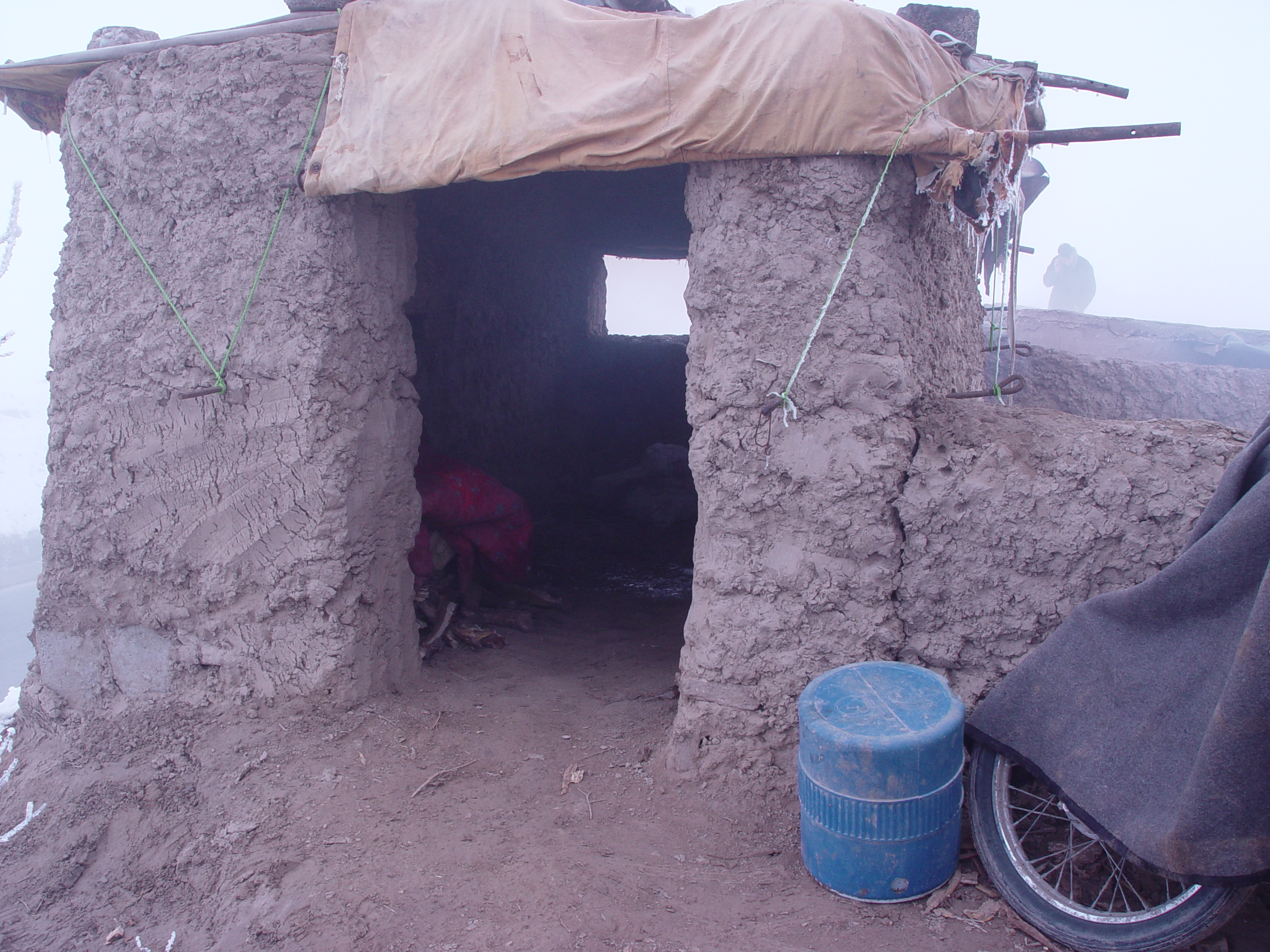
On the featured picture: Being a young detective police officer – There was nothing resembling any computer in my office. We used typewriters. Landline telephones. Radio communication. The only computer connection was in an office in headquarters which had connections to State and Federal databases through a terminal. You would call that office by phone, or by radio. As a backup for this computer connection we had a thick book containing basic data about all persons with an active arrest warrant. Just in case the computer system would not work. If I needed to look into more information about a person of interest, or into fingerprint registries, or information to items like, a stolen car or a seized weapon, I had to get into the car and to travel roughly an hour and to walk into registries and archives in headquarters. Those were the seventies of the last century.

2022 I was stopped with my van during a routine traffic checkpoint in Bosnia&Hercegovina. The officer took my license card and radioed from his car to his cantonal police station. There they were checking manually if I would have any outstanding traffic citation in that canton. It took a few minutes, then I was allowed to continue with my travels.


I grew up with being told that the most noble way of learning is from following wisdom advice given to me, and that the hardest way to learn is from making mistakes. In a way, this established a pattern of attempting to avoid mistakes, and to feel ashamed when I made some. It took me a very long time until I was able to embrace the simple fact that life is about experimenting, that life is about learning from consequences of one’s own actions, and that a robust framework of advice and accountability would allow me to navigate in a positive way, embracing the aftermath of situations when I had to correct my course, to hold myself accountable, but not to beat myself up about it. Like, with my own children today: I may provide them with reference points which allow them to circumnavigate some challenges in their lifes, where I hope they may do better than I did. But I will not be able to prevent them from making own, sometimes very painful, experiences with consequences of their own actions.

This sets the stage for my reflections on what the term “integrity” meant in my upbringing as a police officer, and what it meant as I rose through the national parts of my career. Later, in my international career, I would be confronted with efforts to establish, or re-establish policing in a society. I always struggled with attitudes to to this quickly, to “stand up a force”, and to expect that this would work without a long-term approach which provided the opportunities at the root of a system to ensure integrity by putting these efforts into the core of education, and management.

In order to make this thought practical, I will reflect on my own upbringing, as this is the only and the most crucial reference point I have. The reader may relate, or have other experiences, and thoughts. These here are mine. I believe that, within efforts of international assistance to peace&security by institution-building, there is a more or less binary decision to make: Either to accept the long-term approach, and to commit sustainably to it, or to not add assistance to institution-building into the overall concept of assistance. Like, say, in the case of Afghanistan, where part of the reason why our assistance efforts faltered may sit with the incoherence of strategic plans, and to find a genuine way into domestic ownership. There are many other reasons, of course. But to see a billions-of-dollar-exercise with uncounted numbers of international experts involved in building policing in Afghanistan disappear in an implosion, is sobering. To say the least. For many of us it is disappointing. I belong to those who feel sadness and shame.

So, how did I find my own way into the police, and policing?


A child’s view on police, and what they do

 What are my first memories? 

Like many children, I loved that time of the year when you can don a costume. In Germany, this is what happens during the “carnival season” around February. Children, but also adults, will slip into another role, dressing up for it. In North America children have a similar habit on occasion of Halloween, October 31st,

Kids don all sorts of phantasy costumes on those occasions. I remember that, more than fifty-five years ago, I always chose being a “cowboy”. It didn’t require much else than a cowboy style hat, perhaps a vest made from some plastic resembling leather, and putting on an artificial mustache, even drawing one with some eyeliner was fine. If you could afford to invest more money, only the sky was limiting your phantasy. 

Being a cowboy always included guns. A revolver, in a holster. A toy rifle would be optional, but awesome. Those things were expensive for us children at the time when I was, perhaps, five or six years old. Over the weeks preceding carnival season, the windows of local shopkeepers selling kids toys were chock full with that sort of equipment. My eyes were glued to those windows, marveling fancy toy rifles. I also liked to go out as a “sheriff”. Meaning just adding a sheriff’s badge to my outfit. On the equipment side, toy weapons were essential. No way to go without, and if we would not be able to afford some weapon from the store, a carved and painted piece of wood would do.

During those years in the early sixties of the last century Germany’s pop culture was hugely influenced by American movies and American cultural notions. We loved movies about the “Wild West”. The cultural signs associated with the land where everyone was able to live his or her dreams, they included this notion of “law enforcement” embodied by the sheriff, against the lawlessness of the Wild West. It included weapons, and in those movies, of course, shootouts. Between the good guy and the bad guys, preferably with the good guy riding off into the sunset.

By contrast, if I would have been asked as a kid about the function of a police officer, I would have repeated the ubiquitous notion of those times which exists until today in German public consciousness: “Die Polizei, Dein Freund und Helfer”. In English: “The Police, Your Friend and Helper”. As kids, we would associate that with a friendly uniformed police officer regulating traffic, or police officers being on patrol in a car painted in police colors with a blue light on its roof, pursuing criminals on the run and arresting them.

On the “detective side of things”, or what we call “Kriminalpolizei”, it would be a bit different. If you would watch American detective movies, you would definitely see the difference to German detective movies. But one thing they had in common, whether “Made in Hollywood”, or “Made in Germany”: The detective branch was always displayed as superior to the uniformed branch. This can even be seen in the shorthand label “uniforms” for uniformed police officers: You literally reduce the person wearing the uniform to the uniform itself. That individual character is replaceable, whilst the detective guy has a distinct, mostly cool, personality. We have it in German pop culture as well, and the subtle arrogance of a detective who is expecting uniformed police officers doing the minor work for him or her, culturally they were pervasive in my childhood and long after. I think this meme runs until today to some extent. With my youngest children I love to watch “Brooklyn 99”, there you have it in a funny comedy style.

Many years later I would come across that notion of a different corporate identity again when we were attempting to conduct a fundamental policing reform in my State. Fusing both the detective branch and the uniformed police branch into a more integrated hierarchy was difficult. The feeling of being “one up” if you were to wear civilian clothes was, and is, part of the policing DNA. I can say that for Germany, but I can say that for many other countries too. This reform in my State is also part of my memories about how challenging any effort of sustainable reform of policing is when it touches what I call the DNA-level.

Back to my childhood: Next I remember in relation to police was that my father became a police officer. My father entered the uniformed police branch comparatively late. In the Germany of the sixties, a typical police career would start with police education at the age of between 16 and 18 years, followed by promotion into the lower ranks of a police officer at the age of eighteen or a little later. My father entered the police at the age of 27. I have quite some vivid memories of how this changed his life and our life as a family.

The effects of my father becoming a police officer on our family were huge. Like, he was on shift duty for the entire time between my childhood and when I left the family home. Shift duty had very bad effects on his circadian rhythm. Night shifts were a nightmare for us kids. I would come back from school at lunchtime, tip-toeing into the house, hoping I would not disrupt my father’s unstable sleep. If he would wake up too early, that would be like putting gasoline on the fire of his raging temper which he suffered from for many decades of his life. 

There are memories of a police car parking in front of our house when he had an opportunity to take his lunch-break at home. Other recalls deal with with how my father struggled with letting go of a cop-attitude when being off duty. Self-righteousness, combined with power given to somebody by law, and with being prone to road-rage anyways, boy, that can lead to embarrassing situations. When my father felt that he was right and the other one was wrong, honking the horn would only be the beginning. He would pursue and try to stop the other person. Much to my mother’s despair he would rage in the car. He would get out, confront the other person, even off-duty he would file a complaint or a minor traffic citation if the subject of his rage would push back. Those were my first experiences with how power can fuel self-righteousness, and that there is a fine line between engaging in a situation where the law is violated, and how to avoid escalation.

On the other side, already as a child I saw the camaraderie that came with being a cop. His colleagues meant a lot to my father. Which is a good thing in principle. He is 87 years old at the time of this writing and he closely follows obituaries of former colleagues when they pass away. Early on I also saw glimpses of what happens if cops stand in for each other, including when there is an allegation of misconduct. My father was a law abiding person. Yet, there could be situations when he would support a minor cover-up, or justify debatable action taken by some of his colleagues. To my memory, never in a really serious situation. But who helps you in a situation when you’ve got to decide whether a cover-up is minor or not? Who are you to decide that? 

There is a really fine line in this, and I would see the imminent danger many years later when I came back to the same police precinct in which my father was working. I was a detective captain assigned to a team investigating some of his colleagues who had gone rogue, from covering some knowledge about fraudulent behavior by their peers to directly and shamelessly participating in it. With no bias, the team of detectives I was part of was also checking the administrative records of my father and his colleagues. I stayed out of checking my father’s record. My colleagues who did check his records told me that my father was immaculately clean. My father was shocked about the dimension of moral corruption which had made some of his colleagues participating in a scheme defrauding the medical insurance system for own financial benefits. How could personal integrity break down to such an extent? My father wouldn’t understand.

Without an ethical compass, integrity can quickly become compromised. Then there is management, and systemic prevention through a system of checks and balances. I’ll come back to that. In my experience, any individual, even if being well motivated by ethical standards, is vulnerable to straying off-course if the system fails to protect values and to guide individuals in a practical way. Accountability is a main theme in my essays.

Not delving into childhood memories too much, I would conclude by saying that nothing in my youth and adolescence made me imagine that I would follow my father in his foot-steps. Never I had the idea of wanting to become a police officer myself. Not that I did not like the job of a police officer. I just never thought that I could possibly become one myself. 

Until the age of seventeen, that is. 


How I applied to become a police officer

During my high-school time I had discovered my love to science. I had a deep interest in physics, biology, and biochemistry. Throughout those years I thought more and more often about studying biochemistry and to find a job in this field of science. Until today, give or take fifty years later, scientific topics form parts of my daily reading and watching portfolio. I love learning about new discoveries. Back then, as a teenager, I ran a little chemical laboratory. A friend of mine had such a lab too. Together we would do little projects, including our own efforts investigating local environmental pollution.

Preparing for my upcoming high-school diploma all things seemed to be set for a career in science. However, one day my father suggested that I might want to consider a fall-back option. I had to apply for a slot at relevant universities offering courses in my field of interest. My father suggested to apply in parallel for a new upcoming possibility allowing me to directly enter the captain-level of ranks within the detective police branch. The police of my State was in need of officers, offering a direct entry on a medium-level of seniority for people with university-entrance qualification.

There were reasons why this proposal of my father sounded very attractive to me. On one hand, I could continue to pursue an application for studying at one of my favorite universities. Applying for an interesting job in the police was risk-free, offering the benefit of taking a twin-track approach. The other argument was that during those times Germany had a system of mandatory military service. Every male adult was meant to spend one year in the military as a conscript. Except if you would be a police officer. Police duty was duty equal to military duty. Police officer recruits were exempt from recruitment into mandatory military service.

I applied. I ran through several examinations, written, physical, and oral. I got an offer to be recruited by the Police of my State, the State of North Rhine Westphalia, in the western parts of Germany. I was offered a paid three-years police education, earning me an Undergraduate Degree in Public Administration. After which I would become a detective captain in my Police.

Next I knew, I accepted the offer. My application for studying a specific discipline in the field of biochemistry was still up and running. Three months into my police education I was granted a slot to study at a university in the same city in which I had taken up my police education. At that point I already knew that policing was my thing. With no regret at all I declined the study offer and continued with my police education.


Why did I change course? What was it that hooked me up to policing?

What had happened during these first three months within the police which made me feel that this was my path into a job career? Studying a field of science, or working as a detective, the differences are more than huge. Had I not been serious about my scientific plans? Had I become lured into the perspective of an attractive job, with a lot of power, and decently paid? Or were there first experiences within those three months that made me feel, in my heart of hearts, that this is what I was meant to do?

There are as many different sets of motivations as there are people. Over many following decades I would also see generational change in why people are choosing the profession of a police officer. Then there is the societal and cultural context which may be entirely different from country to country, from society to society, from how the work of a cop is being perceived. There are questions like economic security and financial safety involved. I can only speak for myself. Throughout many decades of my life I would have given one answer only to why I decided to stay in the police from early on: Idealism. Many years later I would also recognise that there was a second main motivation involved: The desire to achieve, and to receive external validation, the desire to be recognized.

I remember that I had early discussions with former class mates. We were a band of friends from school who maintained their connection during the initial years when we went to study at college or university, or would take up a job. When I explained my decision why to become a police officer, I said “You can contribute to change from outside, or from within.” I had decided to contribute from within.

Of course, there always is rationalization involved after having taken a decision. Whether it is about buying a specific car, or why one needs the latest IT gadget, or why I decided to stay in the police. I am aware that there often is true motivation combined with an element of convincing myself. That is how the human mind works. However, looking at 45 years of police work with hindsight, I find a lot of evidence for an idealistic character trait.


The first months

To be a bit more concrete, I need to put my police education into a context of how that looked like in practice.

I remember the first day. August 02, 1976, my father and I drove to the city of Dortmund, from my home town, Warstein. Dortmund is a big city within an even larger setup of cities forming the “Ruhrgebiet”. A sprawling cluster of cities melting into each other, following the river “Ruhr”. During the seventies of the last century these cities witnessed their first glimpses of transition from  heavy coal mining, steel factories and chemical industry towards a future where coal mining was moving northbound, and steel production was slowly moving into countries offering lower production costs. Today, the “Ruhrgebiet” has transformed into a hub of service industries. Some parts have been more successful than others in this, there are impoverished parts, and flourishing parts. The “Ruhrgebiet” is going by the nickname “Kohlenpott”. A big pot of black coal, so to speak. The high landmark towers of coal mines digging deep into the ground, with elevator- and compressor-systems for getting people and machines and air supply in, and coal out, they were part of the landscape. Smoking chimneys of steel plants, the bright red light on the horizon when hot steel was poured out from blazing hot smelters. Chimneys producing a lot of heavy sulfur-smelling smoke related to chemical production. Those were the signs of a blue-collar area with workers having migrated over generations, from Eastern Europe, or from Turkey. If you’re sentimental and you remember those days back then, watch this. Today, this area carries only a few historic signs of that time, some in the form of museums. The Ruhrgebiet is very green, and often very beautiful. But some areas have also taken a depressing development. Which includes a lot of crime. Like clan-based organised crime.

Back to August 02, 1976. My father let me drive the family car. Proudly I navigated through three-lane-traffic for the first time in my life. First stop was the Police Department of Dortmund, a big conference room up on the highest levels of that tall building. There I met my future police trainee colleagues. Relatives like my father proudly in the back of the room, us new kids on the block in the first rows. Of course, some people holding speeches. I don’t remember those. What I remember is that I took an oath of office, promising to uphold the German constitution, and to adhere with the legal framework that comes with becoming a public servant in Germany. I took that oath as my first step on this path.

What I also remember: At the end of this ceremony I got two documents, and plans telling me where, when, and how to show up for the first day of police education. The two documents, though, were more interesting: The first document was a letter of appointment. Nice! The second document was an administrative note. It was telling me my official retirement date. On my first day as a public servant, in 1976, I was notified that my retirement date would be January 31, 2018!

You may have noticed that I was retired January 31, 2020. The mandatory retirement age at the time of my beginning to work as a police officer was sixty years. Only later, the law was amended and for me, the active period of being a public servant was extended to the age of 62 years.

In Germany a police officer enters a system which will allow this officer to expect, if she or he wants, to serve for an entire lifetime. It comes in steps: It is less difficult to terminate a contract of a police trainee, if performance is lower than the minimum threshold. Initial appointment is followed by a period until a person reaches a minimum time of service, earliest at the age of 27. Until then the appointment is limited in time in principle, but the reasons for termination must already be quite severe. However, at the end of that time a German police officer will be appointed for life, until the legally prescribed retirement age, that is. Termination from then on is only possible under defined circumstances, like, a more than minor criminal offense for example.   

That sounds luxury, and a recipe for disaster to you? Well, no. All policing systems are different, which is a main theme in this set of essays, and I need to explain to some extent how I learned from the beginning on about the way the German system is set up, so to allow context for my specific German notion of what I call the DNA of policing. 

Like a soldier, a public servant in Germany, especially a police officer, accepts with the oath of office that some privileges which are part of individual rights are being subject to important limitations. Like, I have to maintain neutrality when it comes to partisan political issues. As a member of the public administration, I have to stay neutral to party politics. I also have an obligation to behave appropriate to public expectations. Both whilst being on the job, and also to a somewhat lesser extent when being off-duty. These public expectations, or norms, of course they change over time. In the Germany of the seventies of the last century, there would have been no way to display tattoos in public, as a police officer. My arms today are sporting a few tattoos. Back then, that would have been impossible to reconcile with the public image of a police officer. Expectations would try to make sure that I honor the respect to a public official with a degree of appropriate behavior considered to be acceptable to mainstream public expectation. 

The neutrality of opinion, and the restraint in voicing an opinion in public, it is part of my DNA. You can still see this today, in times of social media, or blogs and vlogs. Antagonistic speech and hate- and fear-mongering public discourse is not mine. Partly because I am deeply convinced that this is the wrong approach. But partly because an attitude avoiding bias and conduct-unbecoming sits at the heart of my socialization into what is expected from a German public official. Early 2022 I wrote an open letter on my blog reminding a former President of a Federal Intelligence Agency about his obligation coming from this legal context. You can read it here. One year later, Hans-Georg Maaßen was in the German news again. The political party he belongs to, the Christian Democrats, moved to expel him from their ranks because of alleged anti-semitic and conspiracy-ridden comments he has made on social media. 

For me, ethical policing comes from an ethical attitude being a public servant, and in the German context, from an ethical understanding rooting in specific provisions enshrined in the German Constitution.

In return for giving up some of my fundamental rights when entering the police, I received an obligation, and a promise, by the German State: To care for me, which is called “Fuersorgepflicht”, or duty of care, and the promise to receive a retirement pension. So, the German system how to appoint public servants reflects a long-term relationship between the State and the individual.

I close this little excursion with an important constitutional point which I began to be taught very early on in my police education: In the German constitutional system we do explicitly treat human and citizen rights as defense rights against the State. As a public servant, I take an oath on the constitution, meaning especially those first nineteen paragraphs in which the human rights and citizen rights are enshrined, which I am obliged to protect. 

As a police officer I do not protect the State exercising powers of the State. I protect the constitutional rights of citizens and other human beings. This has very profound legal consequences, and I learned about them from the first day on. Any action as a police officer with which I inflict on one of the basic rights of a citizen, whether in the form of a human right or a citizen right named in the Constitution, requires that I am authorized to do this by a specific provision in the law which is explicitly granting the authority in prescribed scenarios. In addition, I am obliged to exercise this right to inflict on other people’s life only if a legally possible action is objectively able to achieve the intended effect, and is necessary and proportional. 

I emphasize this here because you will see that my service as a German police officer does, through this setup, prevent the State from using agents through which the State can do what the State wants. I am, by this legal constitutional construction, an agent of the State who is obliged to protect the rights of human beings, and only to inflict on them when there is a constitutionally compliant specific law prescribing this action, and even then, general principles may force me to abstain from exercising power, and coercive force. 

I learned this early on. As a consequence I am so critical with regards to terms like “law enforcement”. We do not know a German equivalent to this term. We talk about tasks in two realms: Assisting in the identification and prosecution of crimes, and secondly assisting in preventing dangers to public security, and to a lesser extent to public order. Unlike other legal systems, there is an explicit difference between public security and public order in the German system: Public security refers to threats stemming from instances or situations which are subject to written regulations, by law or by-law. Public order refers to a set of expectations which are rooted in public values. Which can be different from region to region in Germany.

In describing why I choose to become a police officer, I will leave this here. I got these fundamentals in my police education from the first day on, and my understanding then deepened again in my senior education many years later. They made me feel that I had taken a good decision by contributing to a system of policing, without feeling like I would have become part of a control system.

I will, however, say one least thing: Throughout my junior (captain level) and my senior education (major level and up) as a police officer, I was told about the history of the German system in the Republic of Weimar, how the Nazi’s were able to hollow it out and to eradicate it, and how we set out to create a more protective version, in post-World War II-Germany. Until today, this is part of my DNA. There are several articles on my blog where I make that clear.

What happened next? 


Three months turning into three years

How did I navigate through my police training after I got a first sense that this is the right profession for me?

The police headquarters were the first stop of that day early August 1976 for my father and me. The second one was at the small one-bedroom-apartment which my father had found through police colleagues in advance, and where I moved in for my first time outside the family home.

Throughout the week, a pattern of either attending class at a College for Public Administration, or alternating practical phases of traineeship in various offices of the Police Department responsible for the city of Dortmund. Fridays I would return to my hometown, gladly mingling with friends and being with my family of origin. Sunday evening would see me returning to my one-bedroom refuge, preparing for the upcoming week again. At the age of eighteen, this was my first step into the independent life of an adult. Weeks with my trainee colleagues, weekends with my former school friends, somewhat comparing notes, somewhat the fading out of a time where some of us highschool friends still managed to spend time together. It would end as we, over time, grew into relationships, marriages, family life, or wherever the winds of change threw us. But for a few years I had two home bases. Work, and weekends. 

Three years of police training? Some international readers will still say “Wow!”. There are policing systems in which the police training may only last several months. There were professional experiences in my international line of work, decades later, where these different notions heavily collided. Sometimes we could manage reconciliation between these different attitudes how to train police officers. Like in Kosovo. Sometimes, like in Afghanistan, we faced some international exasperation and impatience: The German Police Project Office GPPO supported the Afghan police education into officer ranks by establishing the same mix of academic studies and practical training on the job over the course of three years. Others wanted to generate as many police officers with some most basic training.

In Germany, these three years are even only part of a larger educational effort: Police training leading to the appointment on captain level overall requires roughly three years of intense education, ending with an Undergraduate Degree in Public Administration. There are other entry forms into the police, including on sergeant level, and also some combinations allowing a shortened training for those holding sergeant level and aspiring to reach captain level. Also, if you have some specific external education in other fields, being useful in the police as well, this might count against the duration of training and education inside the police system. In any case, once on captain level, you can look back on several years of thorough police training necessary to get you there. 

The same is true for additional education required if a police officer on captain level successfully qualifies for senior ranks, starting with what could be compared with “Major”, and then up to highest police ranks, comparable to what other rank systems describe as “General”. This will require two additional years of study, leading to a Masters Degree in Public Administration. We have an entire Police University for that part.

Why? May be one answer is that becoming a police officer and making it through the ranks is a life-time-investment for the State. I wrote about it earlier. Becoming a public servant is less a temporary job, except you want it this way, and more a long-term commitment. In this, the German approach falls into a category of policing systems which tend to invest into comprehensive education. In return, the system benefits from long-term and highly qualified public servants. If a policing system is interested in getting fast results, and higher transitional speed between appointment and retirement, the result may be shorter education with less depth. At least at the initial stages of a police officer’s career. The more policing is understood  like a job for a limited number of years, the less a system will be willing to invest large efforts, and bigger amounts of money. 

The same happens in international efforts helping to capacitate local police organisations. Mark Kroeker of the United States, one of my predecessors in my function as the U.N. Police Adviser was famous for repeating “You can not stand up a Police”. There were instances when the international community could agree on a balanced approach between getting quick capacity and the need for more time in order to ensure quality, and sustainability. In other cases, the fundamentally different viewpoints collided and struggled with reconciliation through compromise. 

The result of any police education is a fully operational police officer. That officer has enormous power of decision making. She or he is entitled to limit rights of others, including through coercion including the power to apply physical force. Police officers are armed in many police organisations. From my early years on I learned that a thorough initial education will contribute to the quality of work of those of us in the police who are the youngest, the least experienced, most prone to making mistakes by not knowing it better from previous own experience. These youngest of us are forming the bedrock of work in areas where their power has the most impact on citizens: Patrolling duties, investigation duties, all this has countless effects on citizens. Improper execution can have devastative consequences.

So, I ran through three years of police training in Dortmund. Including a few own experiences giving me a glimpse on what can go wrong, why it is important to have safeguarding rails, why it is important to appreciate policing values on deep levels, and what can happen if the system of checks and balances is challenged by what my U.S. friends would call “The Thin Blue Line”, or what we have as a saying in German language: “Eine Kraehe hackt der Anderen kein Auge aus” (One crow does not hack out the eye of another crow).

There is no world with only saints and devils, there is everything in between

The way how these three years of police education were set up included segments of theoretical courses and segments of practical training. For several months I would travel to the College where I would attend courses. We learned about methods to plan and to execute police tactics and operations. There were courses on investigation methods and on forensics. I made my first experiences within the field of criminology, “the scientific study of crime as a social phenomenon, of criminals, and of penal treatment”. We were introduced into the details of criminal law, meaning the laws describing which action constitutes a specific crime. It’s sibling is the criminal procedural law, which includes the procedures which police officers have to follow in order to provide evidence, and how to treat witnesses and suspects. We learned about the other main segment of laws prescribing policing in Germany: The laws regulating public security. I learned about what the law required me to do, and what I was prevented from doing. There were study courses in psychology, in social sciences, and there also was a course about the basic law, the constitutional origin of all specific laws which form the legal framework for how a police officer in a rule of law is operating.

Alternating with such segments we would be deployed into all sorts of offices within the sprawling police department for the city of Dortmund. I found myself on patrol duty, I learned about traffic policing, I accompanied trained police officers in marked cars and made first experiences with night shift duties in unmarked vehicles. On the investigative side of things, I was progressively introduced into various activities, from day-to-day crime, like thefts or burglaries to robberies, from juvenile delinquency to gang crime, from sexual delinquency to homicide. Throughout those phases I would be part of the respective office staff and any colleague or an assigned mentor would take me into my daily tasks. Over time I would have my own first little investigative cases assigned under supervision. Progressively my work assignments became more complex and I was granted more independence in carrying out my duties.

I don’t want to give a full account here on everything that happened during these three years. What I would like to focus on are my first personal examples for specific challenges: As I got into the system, the system got into me. I had to make my own difficult experiences at the same time when I saw some of my trainee colleagues being challenged. It is easy to talk about positive experiences. I had a great many of them. It is not easy to talk about those situations where things could have gone catastrophic if the proverbial bit of luck would not have protected me, or other trainee colleagues. Luck is not part of an institutional system preventing bad things from happening. A good policing system places highest priority on proper education, mentorship, and leadership. A good system recognizes that near-catastrophic experiences are an inevitable part of life. Strong ethical-based systems strive for turning these experiences into learning, and prevent their repetition and escalation into really bad behavior. And like any system, a good policing system only reduces the likelihood of mistakes and situations “going rogue”. At the end, there are situations when one can feel pretty alone and damaged. Long and expensive education is one of the key ingredients into minimizing, and mitigating, these risks.

I’ll give examples from my training years in order to make my point.

1 – The wish to belong

For more than one and a half year we, the trainees, were unarmed. At some point then we were deemed to be qualified enough to be trained on carrying and using a police officer’s side arm. Then one day my first side arm, my very own police officers pistol, was issued to me. It was one of the most palpable moments for me where I felt that I was trusted. Pistols are lethal instruments, and they are also one of the two clear signs of power for a detective. The other one is the detective’s badge. Like, you see it in many Hollywood style movies: When a detective is reprimanded, she or he has to turn in two things: The badge and the pistol. Now I was “one of them”. I had a badge, I had a weapon. I was a cop. That was the emotional impact on me, at a time when I was nineteen years old, a bit more than a year into my police education. Until today I have a vivid memory how it felt when I walked through Dortmund’s inner city district, feeling the concealed sidearm attached to my belt. I responded to this empowerment with care. For the State, it is a huge thing to entrust a young police officer with a personal service weapon, on and off duty.

There was a trainee colleague of mine, in a later class. They had not been issued weapons yet. His desire to feel like a real detective was so strong that one day he was seen on duty with a blank-fire pistol, one of these gas pistols. The model he was carrying was looking identical to a real police service weapon of that time, a Walther PPK. Of course, his supervisor saw it. The non-lethal weapon was taken away from him. He left the police education shortly thereafter. It may sound like a little funny story. The line I take is that there is a very strong desire to belong. 

2 – Witnessing the abuse of power

The desire to belong can overpower any theoretical training. Trainees crave to be seen as experienced. They will listen to the “old dogs of war” with more attention than to trainers at the academy. They will try to imitate what they see. This is good when used for learning on the job. It is inevitable. But the danger sits with the desire to blend in not only on an organizational level, but to be a peer in a social group. Like, a team of patrol officers or a team of detectives. Trainees learn to apply theoretical knowledge, and they are vulnerable to any situation when an old hand says “Oh well, forget about your training, welcome to the real world.” This can be very dangerous.

Part of police training is to learn exactly which behavior constitutes an abuse of power. Some interrogation methods are prohibited. The threat of emotional or physical violence is forbidden. Brute force and torture constitute crimes. One day, my room-mate told be about an experience of a colleague of ours: He had been assigned for duty in a unit which looked out for people with an active arrest warrant. His trainer took him to a police detention cell where he was visiting a detainee. The arrested person was uncooperative. The trainer asked “Who are you?” The person would not respond fully. So the trainer slapped the detainee in his face. This happened three or four times. The trainer assaulted, literally, an arrested person in order to make that individual cooperative. Our trainee friend and colleague stood aside. He did not engage, he did not condone, he did not walk away. He was shocked and in crisis. 

If he would have reported this event to a superior, chances would have been that this would have backfired. I don’t know exactly, but I think he did not report. I on my part was asking myself what to do with this third-hand information for which there was no external supporting evidence. I did not find an answer. The assault remained undetected. I never found out how my colleague processed this situation. Did he condone? Did he justify and rationalize? Did he take it as a lesson learned about how to not police?

Was it important? Yes. 2017 a former President of the United States suggested that police can roughen up people a bit. This is simply inexcusable. I was mad when I heard Donald Trump talking like that. Because, this type of excuse will be what people hear from police officers who cross that line: They will say it is just a bit roughening up. But it is not “just a bit”. I remember this event happening to my colleague until today, way more than four decades later. This gives evidence to the moral dilemma which haunted me the very moment when I heard about it. Remember: At that time I was barely eighteen or nineteen years old. I had to decide how I look at such behavior. I had to think about what would happen if it would happen to me, if I would witness criminal behavior by a police officer. I decided to not minimize it, but to treat such behavior as unacceptable and to try to stand up for my values. I wasn’t able to file a report, though, in this hearsay situation.

There were many situations in my later life when I witnessed criminal behavior of police officers. I took the decision to apply zero tolerance, and not to be complicit. In that, these little examples above were part of my own guiding experiences. I remember my feeling helpless. I believe that some of my later managerial decisions, or my decisions when I was faced with bullying superiors, have their roots in how things happened in my early years. Again, there is this bit of luck. There also is protection through the general setup of character propensities, perhaps. But make no mistake. Relying on a protective layer of character propensities, more often than not it will not do the trick, if this is the only safeguard against crossing a line. It helps, but the real protection sits with a systemic intent to ensure ethical policing, and to invest into it, through proper education, training, mentorship, and management. Because we send young police officers out into the real world. Relying on theoretical training is not enough. It is one of the essentials when I look on efforts to reform policing.

So, back to my own path to becoming a police detective captain. In all practical segments of my education, whether on uniformed policing or on detective work, two things were crucial: My trainee colleagues and I were integrated into the daily routine of police work. Secondly there would be trainers or mentors assigned to each of us, but this system was not as comprehensive as I would recommend from my later experience. The German system has gone a long way since I made my first baby-steps into it. The role of mentorship, for example, has greatly improved. Just as one example.

Had better mentorship helped me, personally? I do believe so. Despite an already thorough effort to help us young trainees, there were many situations in which we were left to our own devices. 

3 – Dopamine power and success 

Waldi O. was a local hero within the police precinct which I was assigned to for three months. He was renowned for his enthusiastic engagement. He had a strong instinct when hunting down criminals. When he engaged in helping other people, he went beyond any limit. Which could get him into trouble, at times. Waldi had been a wrestler in his youth. A very compact body which had undergone years of wrestling training provided him with very strong physical power. A restless searching mind, combined with the desire to do his police job, it made him a perfect hunter. Once he was pursuing a fleeing criminal. No law allowed him to use his sidearm for shooting the individual running away. So he literally took his service weapon and threw it after the suspect, hitting him and knocking him down. Clearly a violation of any rule of engagement. Just think about what would have happened if the suspect would have been able to pick up and to use the pistol. But instead, Waldi overpowered the person. It added to his local fame for being a relentless hunter. I admired him, at the same time, knowing he had violated the rules in that situation, Waldi was one who had learned from his mistakes. He had told me that, and it was part of my learning.

One night both of us were on patrol in an unmarked police vehicle. We were called to a location where a suicidal woman had gotten to the tip of a railway bridge. She sat at the brink, her feet dangling a short distance from the electrical lines carrying powerful electrical current. We had requested to have the railway company switching off the power, but the power was still on. The woman was threatening to jump in case we would come any closer to her.

Waldi engaged in talking her through the situation. Managing to calm her a bit down, he moved into offering her a cigarette. She reached back, to us, intending to take the cigarette. Which provided Waldi with the very second he could grab her arm. As I said, Waldi was very strong. Next thing: Waldi and I jumped over the fence onto that part of the platform from which she wanted to jump. I slipped with one foot. I came close to those power lines which were still carrying high voltage in that moment. We managed to get ahold of the woman, held her, and brought her back into safety. 

You have no idea what it meant for me when I realized that I had saved the first real life in my duties as a police officer. It was huge. What I say in hindsight: If I would have benefitted from a systematic mentorship, debriefing myself, my emotions, my thoughts, like on the thing with Waldi throwing his weapon, or the dangers within the life-saving operation, the impact would have greatly increased lessons learned for my professional way ahead. There was nothing wrong, since we succeeded, and saved a life. The simple question would have been: Could one do it better, next time? It is all about systematic learning.

Today, and since several decades, my police applies a very systematic way how to debrief complex tactical situations. There are specific SOP’s on that. That’s how you do it.

4 – Dopamine power and moral failure 

There are situations where one will find oneself alone with disturbing experiences. The following situation I kept secret for forty years. Only ten years ago I began to be able to process the experience by talking about it to other persons.

I was assigned to shift duty in another police precinct in Dortmund. That precinct included the red-light-zone. During the seventies of the last century, Dortmund’s red-light-zone was a set of shabby blocks behind the central railway station. You’d pass dubious bars, sex cinemas, dark streets in which drunks shared space with dealers and with sex-workers illegally offering their services outside the official area designated for this work. The legal area for prostitution was the “Linienstrasse”. The city administration of Dortmund banned sex-work from public streets through a regulation which limited the legal part to this small stretch of a road. Nestled between a car park on the one side and the backside of a firefighter precinct building on the other side, one could only enter this street by passing huge metal walls which prevented anyone from looking in. Inside, small buildings formed a longer stretch, all of these buildings with red lanterns outside, illuminating big windows behind which sex workers would sit and advertise their services to potential customers.

It was part of the police duties of this precinct, of course, to patrol this street. The police placed efforts into making the life of these sex workers as safe as possible. Low-key patrolling was one of them.

Never ever in my young life I had been close to such a place. I was eighteen years old, had just finished high school. I had heard of these places. But I had never thought about going to see such a location myself. I was absolutely naive. I am not a bar-going person, never had been. Until today, my social habits do not include visiting bars where people would mingle. Except coffee bars. Dubious bars in shady districts? I had not the faintest experience. The entire thing was hearsay to me until I became a police trainee.

One night I was assigned to patrol duty with a handler of a police dog. We name service dogs K9, an acronym for “canine”. Like with Waldi O. in that other precinct, I learned about night patrolling, but in a precinct with a red-light-zone.

At one point, this officer decided to get out of the car, leaving the car and the dog at the roadside, and to take me on a foot patrol through this “Linienstrasse”. Already when entering this street with all those red lights, my heartbeat went into overdrive. Never ever in my life had I been in a situation where I would pass windows with barely dressed women offering sexual services. This was absolutely exciting. I followed this officer on his patrol through this street.

Half way through, he stopped at some windows. People seemed to know him, so he spoke to several of these women, doing small talk. And then it happened: He turned to me and said “You should make your own experiences here.” He turned to the woman and said that he would like to have her offering sex to me. For twenty German Marks. 

Not only my heartbeat was in overdrive by then. My mind was fogged. I could not think any more. My brain was awash with Dopamine. I could not talk, my throat was clogged. My colleague pushed me into the building, towards the room entrance of that woman. She opened, I got in. What followed was the absolute opposite of a romantic situation. I got undressed by the woman. She nicely asked me whether I had more than 20 German Marks. I had not, so I said “no”. And I had to learn that that amount of money would earn me a hand job. I got that hand job. And what I also got was an absolutely immediate sense of immense shame after the transaction was over. I was in no state to think clearly. Shock initiated waves of Dopamine. Dopamine release was followed by humiliation. Humiliation was followed by shame. The shame included a specific form which victims of sexual abuse often experience: Because I was sexually excited when being in the room, I could not really acknowledge the true dimension of the abuse that had happened to me. How could I blame others for circumstances when I was aroused throughout the experience myself? The humiliation of being on the receiving end of a hand-job added and felt like defeat. A bottomless pit of shame and guilt, I dressed immediately and left.

When I came out, the officer gladly asked me how it was. I simply lied by saying “great”. And I never spoke about anything what had happened with this K9 handler. For the rest of the assignment to this precinct I would avoid seeing this officer. But that is only the surface of my reaction.

I did not commit a crime. Neither my colleague did. Prostitution was legally allowed in Germany, as is using the services of sex-workers. As I said, the city of Dortmund had prohibited the sex-workers from offering services outside an exactly defined geographical area, called “Linienstrasse”. What happened in that confined space was legal for any person older than 18 years. 

However, from a perspective of conduct-unbecoming, the actions of this police officer pushing me into the apartment were clearly a grave violation of internal rules. If caught, this officer would have been subjected to severe disciplinary investigations. For me, a police trainee, it might have ended my future career very early on. During the late seventies, using the services of sex-workers would have raised serious questions related to my obligation to display decent behavior. Especially because I was on duty when it happened. The result was that I decided that absolute silence about this event was my best option. Ashamed anyway, this was easy to do.

This silence added to the exceptional trauma of the experience itself. The trauma is for my other book of essays. It influenced my entire life. But here, on the side of “essays on policing”, the noteworthy consequence was that I kept the silence for decades. I told not a single person about it. Until the age of fifty-five. Triggered by life-changing events I would begin to understand the role of this situation forming a tiny pearl on the necklace of a life-long series of traumatizing events. 

For my police work, it hugely sensitized me about the grave dangers that come from the grey zones inside my job. It forms an essential for my own conduct-becoming, and the way how I look at mentoring and managing individuals.

It doesn’t mean this was the only near-crash I experienced. There were others to follow, after my years of education and I will use some them in later essays for specific points. In the context of receiving education and guidance through trainers and mentors this is an example for an event which will evade proper assessment. At no time I was able to really process the impact of this. Simply because I was so ashamed that I never ever spoke with anyone about it.

Today my attitude when looking back onto such experiences has changed entirely: I am very grateful that there was this little extra in the form of luck which helped me making mostly good experiences on my way inside the policing system. I am even more grateful that I could learn from mistakes. In that way, this last event helped me within my professional career to stay on course. That’s not the case for the trauma impact of it, which played out mostly in my private life only.

The majority of all learning is based on practical experiences. The responsibility of an educative system in the police sits with allowing the maximum protection. So that events from which we learn do not cause harm. Not for the trainee, and not for others. 

Enough on the first three years. Taking a break. Allowing you to take a break. I will continue with reflections of the first years as a police detective, and from there with reflections on my first experiences when becoming a superviser, a senior police officer, myself. My plan is to use this solid foundation then for arguing, in another article, how these experiences formed the bedrock for my international career.
essays on policing – Integrity – Why do I use this term?


Integrity

the quality of being honest and having strong moral principles that you refuse to change

(Cambridge Dictionary)


“: firm adherence to a code of especially moral or artistic values : INCORRUPTIBILITY

: an unimpaired condition : SOUNDNESS: the quality or state of being complete or undivided : COMPLETENESS

(Merriam Webster)

A close friend responded to my recent blog entry on integrity: “I love word etymology – think about this – integrity … integrated … mid 17th century: from Latin integrat- “made whole” :)”


On the featured picture: June 30, 2005, I visited a refugee camp with thousands of internally displaced persons (we call them IdP) close to Al Fashir, the regional capital of Darfur, in Sudan. I took many pictures, this one displays a young girl sheltering a baby in her arms. My visit was part of a European Union Factfinding Mission. We tried to find out how we could assist the African Union Mission AMIS in their gargantuan task of providing security to people in Darfur. Tormented by a civil war, Darfuri people fled a situation in which they found themselves attacked by militias burning their villages, killing and maiming villagers, trapping women who went to fetch water at local waterholes, subjecting them to most cruel violence, raping and killing them. The fate of children was equally horrible. Refugees had come to these camps where they hoped for protection. Places like these were abuzz with the presence of peacekeepers and non governmental organizations providing most basic humanitarian assistance. The Internet was chock-full with shocking stories and with outrage, the pictures of suffering went around the world. What would follow were many years of peacekeeping, first by the African Union, then by the hybrid Mission UNAMID, jointly conducted by United Nations and African Union. For many years, UNAMID included the largest uniformed policing component of any peacekeeping operation, by far exceeding the 4700 police officers from up to 54 nations which were deployed to Kosovo, under UNMIK. UNAMID police and military components focused heavily on protecting civilians. By comparison, capacity-building of Sudanese policing was very limited, which sets this Mission apart from, for example, how UNMIK operated a large capacity-building component. There are many reasons for this due to the nature of this very specific environment. However, this difference is noteworthy.

UNAMID completed it’s mandate December 31, 2020. April 2023, severe clashes began between Sudanese government military forces and forces under the RSF. Conflict and it’s horrible consequences quickly reached Darfur again. Twenty years after the beginning of an international effort to protect civilians in Darfur, Darfuri people find themselves in the same horrible situation of being attacked by militias, their villages ransacked and burned, the population facing the very same threats which they suffered from two decades earlier.


Four days after I published the first “essay on policing”, a friend called me. She came from lunch with another friend of ours. Both are Romanian police officers. Both served in UNMIK in Kosovo at the same time when I was there. Both had, and have, distinguished careers with intense ties to policing in international peace operations. “He is writing his memoirs!“, the other friend exclaimed to my friend. Yes, to some extent there are elements of a memoir in this series of essays on policing. But not because I want to put my story out there on the Internet the same way like vloggers put their lifes on Youtube. I feel like it would be boring if I would take an impersonal academic view on the topic of policing. Textbooks on policing may be found in libraries of police academies. You can go there on your own. You also will find many publications on international aspects of policing. To some I have contributed. My objective here is a little different: I would like to draw your interest on some aspects of policing which I find deeply relevant in a contemporary discussion of a fragmented, increasingly violent world. And I believe I can do that best if I make it interesting by establishing a personal context. That then, somehow, is also like writing a memoir. I was in my street cafe this morning and had a conversation with the waiter, who speaks five different languages. We spoke about how people can easily misunderstand others if they just believe they are talking about the same issue. Everyone has a personal story, a personal and cultural, and a language context. In order to find commonalities, one has to tell one’s own story, and to listen to the story of others.

As I mentioned in the introductory essay, my time in Kosovo exposed me to the question “What have police officers from 54 different nations in common?“. And secondly, to the equally important question “Which are the principles and values which we want to promote for an entirely new Kosovo Police?“. It was the starting point for all work reflected within these “essays on policing”.

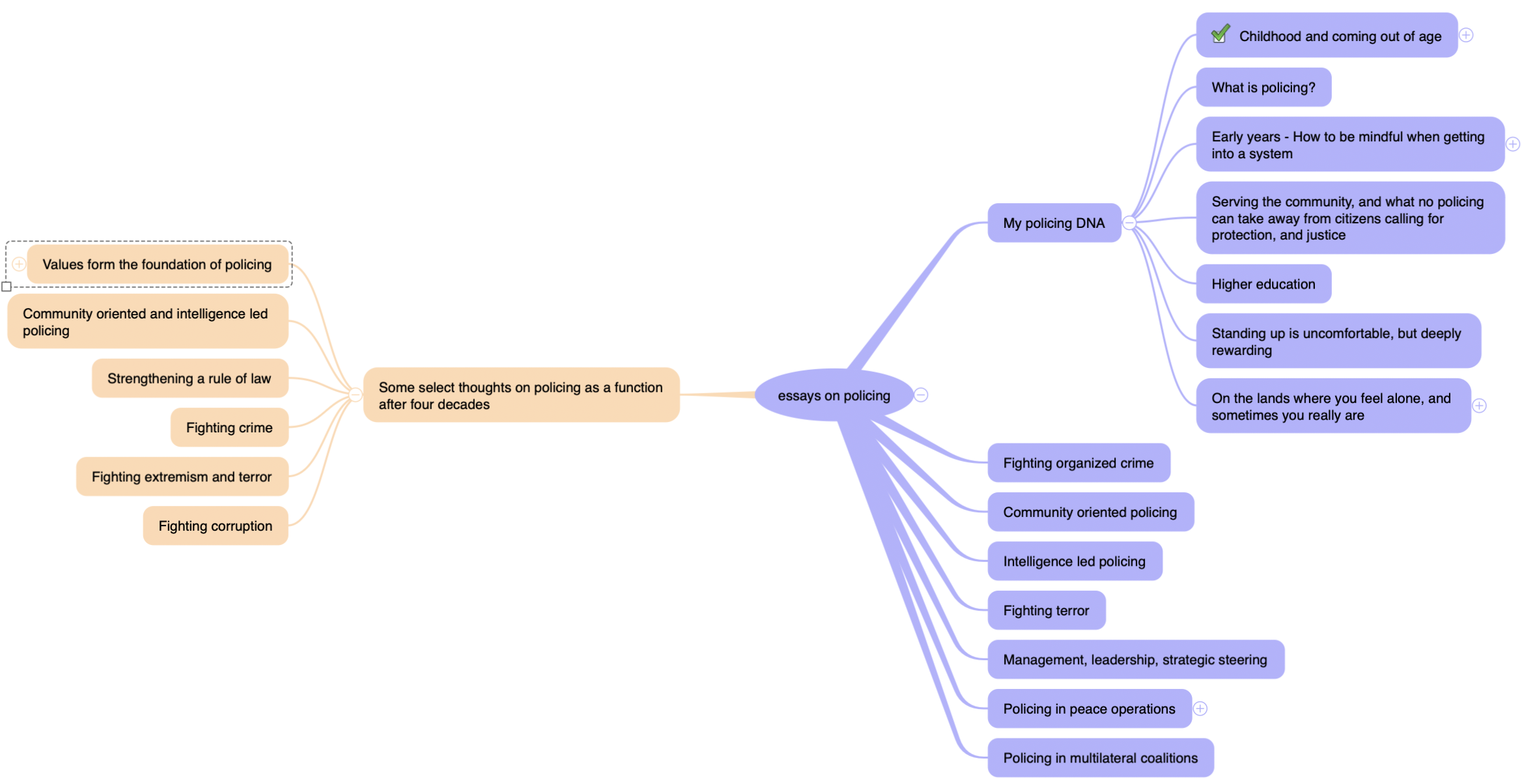
What you see above is an early attempt to structure my thoughts on policing using a mindmap. Behind some of these branches there are deeper levels which I have hidden here. By no means this early mindmap is complete, I am using it here as a conduit for a conclusion which came up when I attempted to cluster topical areas which could possibly be of relevance for these essays. At the end of this thought process I was left with one organising principle around which I could arrange a number of aspects showing up in this mindmap: What is integrity?

I started from there and thus the next few chapters reflect on “integrity“. In order to not make this a highly abstract tractise, I will look at it from the vantage point of my own experiences. They can not be generalised, but they may be an incentive for thinking. They somewhat focus on what I call “my policing DNA”.


Throughout those two decades of my own involvement in any international operation including larger uniformed police components I have seen two interdependent objectives. Of course, these two objectives do not stand in isolation from other objectives of such missions. But they can be identified in efforts under the umbrella of the United Nations, the European Union, the African Union, and others. These functions can be seen in mandates for peacekeeping, they are reflected in some civilian crisis management operations’ mandates, as well as in some United Nations’ Special Political Missions. They can be found in peace support operations of the African Union or missions of sub-regional organisations in Africa. Whichever language is being used in the respective mandates, they relate to

  1. To protect civilians
  2. To build national capacity in the field of security and the rule of law.

Of course, peace operations have several other core functions, and also some specific mandates which are unique to a single mission. However, in those international operations with larger uniformed police components these two core objectives can be found.

In addition, there are missions and operations within the framework of international organisations and also multi-lateral and bilateral efforts which involve policing expertise only in the field of capacity building for institutions in the field of security and the rule of law.

These capacity building efforts can continue over long periods of time and are, so to speak, handed over from one international activity to the next, on the long-winded road from conflict engagement towards peacekeeping, then peacebuilding, ultimately hopefully leading to lasting peace. In specific geographic contexts, such as for example the Western Balkans, these capacity building activities continue long after and have become an increasing part of integration efforts into the European Union. This also will hold true for other parts of South-Eastern Europe, such as for example Moldova and the Ukraine.

For each and every of these different categories of international activities we have witnessed what happens when support activities within both objectives, or one of them, were terminated too early, not implemented under the right assumptions and circumstances, or under political constraints and pressure, or when the overarching framework of international ambitions, the necessary political unity of key actors, unrealistic mission mandates, understaffing with expertise and numbers, or fragmentation of international activities, led to the break-down of complex and costly activities. I spare a list of relevant examples, because, that list would be shamefully long. No type of international assistance would get away without having a share in this sad compilation.

But what I would like to stress: There would be an equally long list of examples of successful missions, both related to the interim task of protecting civilians, and the task of supporting an acceptable and capable array of institutions in the field of policing and the rule of law. Also here, these success stories do not single out one or another form of international mission setup being more capable than other forms. I leave the question “Why is this so?” to academic research. On many occasions I have been subjected to interviews by researchers. So I do know that this work is out there.

I use the following arguments for the interrelation between the Protection of Civilians and Capacity Building:

a) The protection of civilians is a core responsibility of the State.

b) Protection of civilians under the mandate of international organisations or coalitions of the willing is a temporary substitution of this function of the State. Reasons can sit with that a State (1) should not, (2) does not want to, or (3) can not sufficiently exercise this protection, or any combination of these three factors. For clarity: There are predominantly military engagements “out there”, often of bilateral nature, which brand themselves “peacekeeping” and which, at least, do not fall under the scope of what I write about here. Personally, I refuse to name, for example, military detachments of the Russian Federation in some States in South East Europe, “peacekeeping”. They are instruments of political and military control, such as in Moldova, or elsewere.

c) Any efforts of international protection of civilians must be accompanied by support of capacity building in the field of security and justice, as otherwise there is no exit strategy for this temporary substitution.

That is why capacity-building sits at the core of any successful international assistance in situations of conflict, war, and post-conflict support. It must be done right, otherwise the mission runs into critical failure.

It is from there that I witnessed so many mandates, reports, inquiries, or statements carrying buzzwords such as “sustainable“, “local ownership“, “lasting impact“, and so many more.

In all those scenarios in which I would be asked whether we were successful in assisting in setting up credible institutions in the field of security and the rule of law, I would examine to which extent it was possible to nurture “integrity” within the work of individuals, groups, organisations, legal frameworks, leadership, management, and corporate identities. Personally, I would believe that this is the case for example in the Western Balkans.

There is a final reason for why I am attempting to look at international policing within peace operations, and policing at large, through the lens of attributes such as “integrity”: Catch-phrases like “sustainable establishment” and so many else include a time-dimension. Here, any assessment can become tricky. If one focuses on short time-spans, an assessment on “sustainability” does not make sense. If one looks at time-spans which are stretching over decades, “sustainability” can lead to depressing assessments if, and once, new conflict is emerging. Twenty years ago we started to put immense efforts into protecting civilians in Darfur. Fifteen years ago we began to assess, on request of key U.N. Member States, whether we had succeeded and could disengage. Since recently, we find the situation of Darfuri people where it was twenty years ago. You can say the same for Haiti, for example. We currently witness so many situations beyond the ability of peace operations to influence them leading to constant repetitions of cycles of violence with immense civilian suffering. West Africa, Central Africa, East Africa, you name it. Including the Middle East. I was in Rafah on occasion of the opening of the border crossing in November 2005 under the auspices of a EU monitoring mission, dubbed EUBAM Rafah. After the terror organisation Hamas took over the Gaza strip, our efforts stalled. Around the same time, I was in the West Bank, in a line of support of capacity building for the Palestinan Police through an EU civilian crisis management mission dubbed EUPOL COPPS. If one widens the aperture of the time lens too wide, sustainability answers can become very blurry.

Any assessment of why this is so would be drowning this writing. In taking a view using a lense named “integrity” I hope to inject a different, perhaps fresh, perspective. It will also allow me to make some comments, in later essays, on why short-term goals in capacity building do NOT work. As my friend and predecessor as U.N. Police Adviser Mark Kroeker used to say: “You can’t stand up a police organisation”. Like I, he also avoided to speak of “Police Forces”.

“Integrity” relates to values. Values give meaning, purpose, and support long-term development. Wherever we assist in capacity-building, our success depends on how we can support the establishment of a “DNA” which allows the implementation of policing according to some universally accepted values. Whilst this is true from an agnostic perspective for any set of values, here comes the first hard choice: Which values do we want to put front and center? Of course, being a peacekeeper, my own response comes without a split-second of thinking: The values of the Universal Declaration of Human Rights, and everything which followed throughout decades of development of a universal framework of the United Nations.

Next, I will try to examine this from a personal vantage point, my own socialisation into a German police organisation.

So, how did I find my own way into the police, and policing?


Stay tuned.

essays on policing – Bloss keine Spuren hinterlassen – setting the context


… for words can be communicative only between those who share similar experiences…

Alan Watts

essay

an analytic, interpretative, or critical literary composition usually much shorter and less systematic and formal than a dissertation or thesis and usually dealing with its subject from a limited and often personal point of view

“Bloss keine Spuren hinterlassen – Don’t leave traces behind”

A sub-title with a smile. A rhetorical device, a pun (humorous use of words with multiple meanings or words to create wordplay), both referring to what criminals would try in order to evade being caught, but also an attitude moving through the world without leaving an impact, or sometimes used ironically for police officers not doing the work they are expected to do. Not applicable to those officers who violate rules of engagement. These guys are astonishingly open, even in the age of body cameras adding to the ubiquitous street cams. An absolutely appalling example out of many can be found here. I’ll never stop being ashamed of these, and I met quite a few of them.


This collection of essays represents a part of a larger writing effort which has been ongoing for more than ten years now. To write these essays was only possible after I came to a certain point within my work on a project carrying the working title “After The Storm – Who Am I?”.

After The Storm – Who Am I?” is an unpublished memoir. The first third in it is about how I grew up, from the very first moments I can remember, until I left my family home, at the age of eighteen years. “essays on policing” pick up at the very moment when I left my parental home and became a police officer. 

From a methodological viewpoint, “essays on policing” are different from “After The Storm”. These essays deal with fundamental aspects of policing, how I was facing them early on, which lessons I took, and how this pervaded into my international work on policing. They try to capture statements which I have found relevant for what I would name “ethical policing”. “essays on policing” have values written all over them. Values relating to human and citizen rights, values related to democracy, values related to the essential role of a rule of law within an understanding which I will attempt to capture, and which is based on a definition of the rule of law developed by the United Nations. “essays on policing” reflect also on the work of some passionate individuals extending the work reflected within a universal notion of a rule of law, by attempting to come up with a universal notion of policing, an essence which would be acceptable for every Member State of the United Nations. It led to the Strategic Guidance Framework of the United Nations for international policing in peace operations. 

In that way, there is something like a twin-track approach in my larger work which becomes visible here. Whilst “essays on policing” is based on the successful professional path which I took after leaving my parental home, in “After The Storm – Who Am I?” the second out of three parts is dealing with my experiences in my personal life. I am locked in a never-ending debate with myself whether this should be published, or remain a personal notebook.

Ultimately, there may be another set of essays, if I manage to stick to my large plan: “essays on trauma and reconciliation” would attempt to capture both my private and my professional experiences with the impact of, and the lifelong consequences of, trauma. If I would manage, then those parts of the entire narrative would be out there which might contribute to storytelling on what my friends and I call “experience, strength, and hope”. I hope you, the reader, will find some things useful. Take it, and leave the rest.

Whether “After The Storm – Who Am I” remains unpublished, or not, my own work in this mothership project then would see its finishing line by describing how I entered into that phase of my life in which I am now. I changed the course ten years ago (at the time of this writing in October 2023), my awakening began there, and my writing began. The third part would deal with how I woke up and what happened on that bumpy road. How I realized what was wrong, from the outset on, and what impact the beginning, those early years I am writing about in the other project had on my survival strategies. I name them survival strategies, since I only thought they were life strategies, and I would not know how limited these strategies were.

In my professional life however, everything I learned in my early years was allowing me to become an ethical and successful police officer. But my path since ten years has made me more humble in why I do, professionally, what I do. The compassion and humility has increased, the attempt to be recognized for contributing  something important has gone down at the same time. I wish I can say, one day, that I got that entirely out of my system. It is one of the reasons why I ultimately decided against publishing a book. I have no interest in monetising this endeavor.

During these ten years I started to write this blog (https://durabile.me) on all things I feel strong about in the fields of peace&security, and trauma&reconciliation. Policing related topics were always a core part of this blog. And once I knew, in this long process of scattered writing on book projects, mixed with writing up memories in order to understand myself better, and to heal, and mixed up with writing stuff on my blog, I now reached the point where the first element can become publicly visible: To write about my experiences with policing, in the national and international work that I am doing since four and a half decades.

This is the framework in which my writing makes sense. Like it is helpful to know where the artist was when she painted a picture, in order to interpret the picture, it is useful to know that these essays are the first to be published. They are not the first I have been working on, though. The other work continues. One day at a time.

The developments in our contemporary global world of peace & security, and war & conflict, these developments make me feel it is perhaps useful to start with putting these “essays on policing” out. My policing views are global, as is my related experience. Perhaps my thoughts help in shaping your thinking, and also your contribution to forming the world we all would like to see, to preserve, and to be guardians of, for the sake of our children, and life iself.


In memory of Sven

December 06, 2000, a large number of people gathered on the stairs of the Pristina sports stadium in Kosovo. All those different uniforms on the picture were police uniforms. At least one representative from each Nation contributing police officers to the United Nations Interim Mission in Kosovo, also known as UNMIK, made it into this picture. Meaning that 53 different national police uniforms are on display here.

We did this in honor of the outgoing Police Commissioner, late Sven Frederiksen of Denmark. He was moved to tears. He also was deeply exhausted, had no energy left. A few of us brought him to the airport and I won’t forget his happy smile, knowing this time would be the final departure after a grueling tour of duty between 1999 and 2000.

In fall 2001 I visited Sven and his wife Annie in their summer house in Denmark. I was so glad to see him, he had lost some weight, had gained some energy, and Annie was visibly happy.

In Kosovo I had been Sven’s Deputy Police Commissioner for Operations, and I had left UNMIK five months after Sven left the Mission. I knew I wanted to go back, and so would I. A few months after I visited Sven I became Police Commissioner of the UNMIK Police.

Sven, on the other hand, had set his mind on the upcoming transition from the United Nations International Police Task Force IPTF in Bosnia & Hercegovina to a follow-on mission, the European Union Police Mission in Bosnia & Hercegovina, known as EUPM. Sven became the last Commissioner of the IPTF and first Head of Mission of the EUPM.

Also on the picture: Michael Jorsback of Sweden, UNMIK’s Deputy Police Commissioner for Administration. He left UNMIK in January 2001 to become the second person establishing the Office of the Police Adviser to the Secretary General of the United Nations in New York, after Halvor Hartz of Norway.

So, I arrived back in Pristina for the United Nations, Sven was in Sarajevo for the European Union, Michael was in New York for the U.N.

Late in January 2004 I was in Berlin, briefing a parliamentary committee on the work of the United Nations Police in Kosovo. It was during that time that I received news about Sven’s untimely death. He died in Sarajevo, at the age of 56 years.

 Sven was my first international boss, and had become a close friend. I followed him in his footsteps twice, in Kosovo, where I took the helm of UNMIK Police between 2002 and 2004, and in Bosnia&Hercegovina, where I continued with the work of Sven and two of his successors, between 2008 and 2012.

 I would follow Michael’s footsteps too. 2013 I was appointed as the United Nations Secretary General’s Police Adviser and I held that function until November 2017.

For Sven, on behalf of uncounted others from all over the World. Police, soldiers, civilians, those who need help, and those who assist them


Why these essays?

Since four and a half decades I am concerned with policing. Half of the time in a national police career, rising through the ranks and performing many different specific functions related to policing. 

Half of the time I have been doing something different. I have brought my policing expertise into international policy implemented by the United Nations or the European Union, or directly into German foreign policy. Efforts to contribute to help others. That’s the most simple way how I could describe it. Whether it was peacekeeping or peace building as understood by the United Nations, or civilian crisis management, a tool of the European Union’s Common Foreign and Security Policy, or in direct support of the German Federal Foreign Office, it always was, at it’s core, about helping others.

I use this simplification because the tools in the “international toolbox” of what we also name the Peace&Security Architecture, those tools change. Some have a long history with phases running through decades, such as U.N. Peacekeeping. NATO knows Peace Support Operations. Other regional organisations, such as the Organization for Security and Cooperation in Europe, or the African Union, have adopted their own terminology for operations of their own, often under a U.N. Security Council Mandate, or on direct invitation by a State requesting help. The European Union has civilian and military crisis management as a tool at their hands, either on invitation by States involved, or upon authorization by the U.N. Security Council.

In all these operations, policing plays a role, sometimes small, sometimes it was a very large role. Now times are fundamentally changing, and that feels pretty scary. I don’t know whether, in addition to adding to a public record, these experiences with peacekeeping throughout many decades make sense when, at the same time, elements of the international peace&security architecture are under severe threat to fall apart, to be ripped into pieces by individuals, networks, States, who do not adhere any longer to the underlying contract. The Charta of the United Nations itself has been challenged, recently. A member of the Permanent Five in the United Nations Security Council violated it through a War of Aggression against the Ukraine.

There also is conflict intervention, or what could be named peace enforcement. These operations exist as well in the post-World War II – architecture. These operations are meant to run under authorizations which ultimately refer to the Security Council of the United Nations. In certain cases, this legal cover of the United Nations’ highest body in the field of international peace and security was not there, because it was impossible to get it. Remember, the five permanent members of the U.N. Security Council can, and do, exercise vetos. Selfish reasons have become the predominant factor for these vetos. They nibble, bite, and rip at the DNA of the function of the U.N. Security Council, to safeguard international peace and order.

Whilst some peacekeeping operations with an executive mandate were, in my view, successful, they were sometimes preceeded by some form of international armed coercion during a conflict. As the Security Council was not able to authorize those, this haunts the discussion about the legitimacy of armed coercion of warring parties into peace, until today. By extension, the notion of “robust peacekeeping” later added. The international community comprised of diplomats and legal scholars worked on reconciling lessons learned from some efforts by creating a “Responsibility to Protect” (R2P) as a new international legal principle. At the same time, the capacity of the Security Council to work as expected in the United Nations’ Charta deteriorated. The principle of R2P exists since 2005 through the commitment of United Nations Member States. However, its practical application suffers heavily from the growing inability of the Security Council of the U.N. to resolve conflicts. The use of their veto rights by some of the Security Council Members increased over time in situations when the application of R2P would have been practically against the fundamental opposition of some of the permanent members of the Security Council with great power to allow national sovereignty issues being affected by this new principle. These Member Sates acted in national selfishness by blocking efforts to intervene in conflicts where we feared the possibility of genocide. Thus, currently R2P has had its heydays of discussion a long time ago. A very similar development happened around the establishment of the International Criminal Court ICC.

Back to peacekeeping, and compared with it, some more regional conceptual frameworks have a shorter history, and are also somewhat more vulnerable to change on shorter timelines, such as E.U. crisis management. There was a high level of ambition at the beginning, it has seen its share of many transformations, it struggled with criticism of having become less meaningful, and may be some new hopes for reviving its strength are more than dreams, but that will depend on credibility of implementation during very unstable times. Policing was strong in the E.U. field at the beginning, got less visible through integrated mission concepts over time, but its expertise is still alive. 

Then, sometimes when tools such as peacekeeping or other forms don’t work, there are coalition efforts. My work and travel related to Iraq and Afghanistan dealt with situations when military campaigns in both countries required more than military engagement. Inside these military coalitions there was a requirement for civilian capacity building almost immediately after the heavy military operations succeeded with some form of victory. At the same time international efforts within coalitions of willing States attempted to build up civilian capacity related to the aftermath of conflict and war in parallel to growing efforts of civilian capacity building inside military missions. Afghanistan is a prime example for such developments. Both in Iraq and Afghanistan there was heavy engagement on the policing side by many actors. It was very difficult, very challenging, and success was rare, and in my view, often unsustainable. Depending on the viewpoint, others may differ on this assessment.

I left international peacekeeping in November 2017 at the end of my tenure as United Nations Police Adviser. I continued with my contributing to German efforts to sustain an international order of peace and security with an assignment inside the German Federal Foreign Office. After my retirement as a police officer in January 2020, I continue to contribute my expertise into the work of the German Federal Foreign Office. Currently through a long-term project in the Western Balkans. To some extent, this project sits between the end of Peacebuilding and increasing European integration.

Over those past years after I left New York, I witnessed the development within the international framework of peace&security somewhat from an outsider perspective, meaning that I have to be careful with assessing current states of play. But I feel it is correct to say that I belong to those who deplore deeply an erosion of the capacity of the International Community to do things together. The less the unity of the International Community exists, the more likely nationalism and also conflict and war occur. We can see this, right now. And it makes also sense by turning the argument around: The more nationalism, the more disruption of international peace and security. At some point, the disruptive and devastating effects become self-fulfilling prophecies within a downward spiral. At the time of beginning to write these lines, I was even not sure about where the World stands when taking a larger view onto the war of aggression of the Russian Federation against the Ukraine. I was writing this introductory essay in February 2023. One year earlier this war in the Ukraine started. One morning I read Thomas L. Friedman’s OpEd in the New York Times titled “Year Two of the Ukraine War is Going to Get Scary”. At that time I wrote that I am sure I will need a few more months before even a first draft of my essays will be ready, and that, therefore, I will have an opportunity to do a reality check in hindsight, whether Thomas L. Friedman is right with assuming that a war between Great Powers is what may be looming, if we don’t find a way out. I agree with Friedman. We are either so close to an abyss, or we are already in free fall. I hope not, but I don’t now.

I am finishing writing these lines and publishing this essay by October 25, 2023. October 07, Hamas and other terrorist organizations unleashed a horrific terror attack with unspeakable atrocities against Israel, and Israeli people. The world is changing again. We try to stem ourselves against a tide of terror, violence, and war. Not even mentioning the erosion of democracy, terror, and civilian suffering in, for example, an increasing number of African States. In some of them I was twenty years ago. Like in Darfur, where people suffer again, as if these 20 years in between would never have happened.

In today’s visible and public discussions, international policing within peace operations therefore has a very small role to play, compared to twenty, or ten years ago. There is no discussion about it within war contexts, like in the Ukraine. There was little recognition about all policing efforts which we undertook in Afghanistan when things imploded there 2021. It was mostly a military view how we looked at the aftermath, and what went wrong. And where international policing still plays an important role, meaning in United Nations peace operations in Africa, the interest we collectively take in those struggling operations within the West has significantly decreased. Wagner mercenaries now roam freely in the international supermarkets in Bangui, Central African Republic, pushing shopping carts and lining up at the cashier together with international peacekeepers. Could a picture be more sad? I am so sorry for my many African friends. And MINUSMA in Mali is in the final stages of being thrown out of Mali by the military nomenclature cooperating with Wagner. What next?

So, is this a discussion about demise?

I don’t think this way. In my heart of hearts I am inspired by Buddhism. There, the Buddha says “All composite things are impermanent”. By that very logic, peacekeeping had its heydays, and currently it has not. International policing faces the same. But in Buddhism, especially in Tibetan forms of it, there is great emphasis on the transitional nature of everything. Things just simply change. The perception of a beginning or an end is, from that viewpoint, an illusion. I believe this is what we see today. Things we took for granted, they simply change. 

And it is up to us to be part of this process. Thus, my reflections on policing, and international policing, they are meant to be a tiny contribution to describing how it worked, and where it did not work, and may be why, so that there is a chance that we can preserve the great value that policing, done right, has in societies, in democracies, and in international support of peace & security, once we find a joint way ahead again.

A Long Summer – Creativity Refill

I took a long break from writing. I don’t write when I have doubts whether I have someting meaningful to say. So I spent a summer with introspection. Just sitting with my unease. Yesterday I felt the creative energy coming back for the first time. At the end of two weeks with my children here in Toronto I enjoy a second cup of coffee, the house still silent, this part of the World experiencing the beginning of a Saturday morning, my friends in Europe already moving into the afternoon, and I am opening the WordPress editor for the first time since months.

What happened leading to the end of my incommunicado? At the surface of it, it were two articles I read.


One relates to August 19, 2003, when the United Nations office in Baghdad was targeted in a suicide attack. Today, August 19, 2023, marks this day for the twentieth time. Sergio Viera de Mello, the Special Representative of the United Nations’ Secretary General, and 21 other people died in that attack. I belong to those who can’t forget this day, like many dear friends, in the United Nations, and beyond. I won’t forget Luis da Costa, personally. Many of my colleagues who serve or served in th UN have somebody dear to them whom they lost that day. The BBC article “How a suicide bomb attack changed the lives of UN aid workers” by Imogen Foulkes memorizes this horrible attack and reflects on how the attack changed the way the United Nations system is working, until today.

At the time of the attack I was working for the United Nations in my office in Pristina, Kosovo. I was the Police Commissioner of the United Nations Interim Mission in Kosovo by then. When this mission, dubbed UNMIK, was established in 1999, Kosovo was a place of severe post-war violence for several years to come. Like thousands of other UN staffers, we police officers would rent apartments for living amongst the population, and going to work using soft-skin vehicles and working from regular offices. May be fenced, may be some very normal security around, but we would literally live and work within the population, for the population. We would take risks of being attacked, I still have many pictures in my archive. But countries like mine, Germany, would be willing to send their police officers into an environment where we could find ourselves waking up to the aftermath of a bomb explosion nearby. In one of those many cases, a German police officer literally woke up one morning to discover two new holes in his living room: A rocket propelled grenade had punched an entry hole and an exit hole into his rental apartment. At no point I heard any serious request from Police Contributing Countries to withdraw police officers from the deployment into this mission. We stayed, like we did the same in previous missions, in Bosnia & Hercegovina, or elsewhere.

Later, in my time with Headquarters of the European Union or the United Nations, I would travel to Iraq, to Afghanistan, to Sudan/Darfur, to South Sudan, to Mali, the Central African Republic, to Somalia. In those places, I would meet police officers in so-called “Super Camps” or other protected compounds. I would move around with them in armored vehicles. My memories of travels outside of Baghdad’s Green Zone or outside the protected areas of Kabul include heaviest military protection. Yes, there still were the established Missions in which UN staff would live under more normal circumstances, such as in the Democratic Republic of Congo, or in Haiti, or Timor Leste, or Liberia, or Ivory Coast. But the world of the United Nations changed way more than only in relation to security. The BBC article says “In 2022 there were 235 attacks on aid workers, according to the Aid Worker Security Database, and 116 were killed.” Add the casualties amongst United Nations peacekeepers, I believe they are not even accounted for in this. Places like Mali and others have caused a human toll on United Nations staff that would have been unimaginable twenty years ago.

Like community policing, peacekeeping of the United Nations is about communication. It is about being temporarily rooted in a host population, in order to promote peace, to contribute to peace, and to develop the means of a host State in order to guarantee peace and security again. How do you do that through the thick protective glass shields of a heavy armored vehicle? I saw a convoy of armed UN vehicles moving slowly through a refugee camp in Darfur, stopping at the center, UN police officers getting out, protected by other officers with guns, sitting down with camp elders, then moving back into that convoy of armored turtles. Every day, once or twice. Walk in the shoes of those elders, think about how they may feel.

And like in the microcosm of daily operations, the inability to communicate achieving joint goals is also reflected within the United Nations Security Council. The erosion of jointness, whatever there was before, on the side of the five permament members of the Security Council has reached unprecedented levels. Those inside the system saw this storm coming for many years, if not decades. A toothless political instrument designed to be ultimatly the arbiter of peace and security on a global level is the product of countless defeats within that round chamber to achieve common positions which meaningfully legitimate the field work of the UN. As a consequence, not only behemoths like the UN Mission in the Democratic Republic of Congo suffer. Recently, the drawdown of one of the biggest UN Missions, in Mali, has begun. It just is the most recent case in a long line of withdrawals, some successful, some not. The most recent developments in Sudan’s Darfur area remind me of exactly what happened twenty years ago and led to the establishment of the African Union’s AMIS, and then UNAMID as it’s UN-successor. History moving in cycles? No progress, because a temporary halt of violence and decay is not exactly what we would name “sustainable” peace? One of the reasons why I fell silent, for some months. Watching the ever growing influence and presence of Wagner mercenaries, left and right of UN peacekeeping in the Sahel, and filling the void even more after Russian propaganda has successfully contributed to hollowing out democracies in Africa, to the advantage of autocratic leaders, power-hungry Generals and corrupt local elites. As a side-note, I see the defensive posture taken by Baltic States bordering Belarus, since parts of Wagner were stationed there in the aftermath of this most notable One-Day-Putsch attempt of Yevgeny Prigozhin.

Like terrorism aims at disrupting communication and sowing fear, establishing own versons of a so-called “truth”, the same is true for political processes of antagonisation, being the product of nationalism, being the product of reckless selfishness playing with the natural fear of human beings, establishing falsehoods, repeating lies as long as necessary so to become the “truth” for many. All of the above falls in line with a longer and larger development leading us to where we are, today. How do I explain this to my youngest children? By not stopping to tell stories, in order to establish memory, and context. It is not about attempting to revive the past, but to have meaningful informed context for how to operate in the Here and Now. I did this over the past two weeks here in Canada with my kids. Obviously, it gives me the energy for telling stories in my blog, again. It is not about getting my memories “out there”, again and again. It is about contributing to establishing context for those who will be at the helm of decision making nowadays, or soon. People like my children. Every parent shares that responsibility.

Not having contextual knowledge is one thing. Denial is the other. Which brings me to the other article, the second one.


How European Officials View a Possible Second Trump Term” is the second article. I read it in the New York Times this morning, August 19.

When I arrived in Toronto two weeks ago, catching up with my ex-wife casually, I was about to ask her how Canadians are looking at the series of ever expanding criminal indictments of Nr 45. I was stopped with a smile, but cold in my tracks: “If it is about Trump, I don’t want to hear it.”

When I travel in Europe, whether in South-East Europe, or in my country, Germany, discussions of the current state of affairs in the United States appear to be very detached from what I can see when focusing on U.S. domestic press and media. Sometimes it feels like the 45th U.S. Presidency has become an afterthought in Europe. Media reporting in European outlets which I follow are way different to the hype on CNN, MSNBC, and other media. Yes, I read liberal news, more or less sympathetic to the Democrat’s cause. I don’t make myself suffering from watching Fox News, or hate-mongering media outlets. My daily list of suggested videos on Youtube is reflecting that preference, too. I don’t want to have my list of suggestions become convoluted with hate, fear, anger, and lies.

Yes, there is a point in not to over indulge. Much of the American hype also leads to stoking emotions which keep me coming back to yet another piece of sensational news. But this is only one part of the story. The other part is, that as a concerned person informing myself through reading more of this stuff than, say, the average person, I get genuinely scared.

The NYT article talks about the subdued expression of grave concern amongst politicians and policymakers in Europe. Grave concern about the real possibility of a second term of office for Donald Trump. What it would mean, for the U.S., Europe, the support for the Ukraine in their fighting a war against a Russian aggressor, for relations between Super Powers including China and (still?) the U.S., for the European Union, other regional organisations such as the African Union, for the United Nations, and for principles based on the Charta of the United Nations, including the Rule of Law, first and foremost.

The article reports about an understandably subdued expression of fear by European leaders and diplomats. In politics, facing reality means being careful about closing doors, in the interest of the own constituency. It also means not to contribute to creating self-fulfilling prophecies. Lastly, it means not to play into the hands of adversaries by giving them the platform of antagonisation and hate which is their only objective.

Yet, there always is a cost attached to everything. The necessity to remain cautious and mindful, it also plays into the overwhelming wish of human psychology to deny reality. In European discussions with everyday people, there are those who do not know about the sheer monstrosity of hate and the open announcement of retribution and retaliation which comes from every sentence uttered by Nr. 45. And of course, I prefer to listen to people who are not right-wing extremists. It would take me a lot of energy to talk to somebody who openly supports the German right-wing extremists within the political party called “AfD”. Whilst I do not listen to those, I am under no illusion that their hate-mongering thinking and sometimes covert, sometimes more and more open action will literally explode in a scenario where Nr 45 would become Nr 47. Our challenge is to find ways of naming the reality as it is without invoking the same which sits at the heart of those extremist’s agenda: Ruling by fear, overruling the rule of law, establishing regime change, overcoming a system from within. Once more, I recall Germany’s history of how the Weimar Republic was defeated from within. By the way, it included the victimisation of own punishment and incarceration, after the so-called “Beer Hall Putsch“.

I am quoting Wikipedia here for ease of reference, though a bit longish: “The Beer Hall Putsch, also known as the Munich Putsch,[1][note 1] was a failed coup d’état by Nazi Party(Nationalsozialistische Deutsche Arbeiterpartei or NSDAP) leader Adolf HitlerGeneralquartiermeister Erich Ludendorffand other Kampfbund leaders in MunichBavaria, on 8–9 November 1923, during the Weimar Republic. Approximately two thousand Nazis marched on the Feldherrnhalle, in the city centre, but were confronted by a police cordon, which resulted in the deaths of 16 Nazi Party members and four police officers.[2]

Hitler escaped immediate arrest and was spirited off to safety in the countryside. After two days, he was arrested and charged with treason.[3]

The putsch brought Hitler to the attention of the German nation for the first time and generated front-page headlines in newspapers around the world. His arrest was followed by a 24-day trial, which was widely publicised and gave him a platform to express his nationalist sentiments to the nation. Hitler was found guilty of treason and sentenced to five years in Landsberg Prison,[note 2] where he dictated Mein Kampf to fellow prisoners Emil Maurice and Rudolf Hess.

Of course, I would NEVER EVER compare Nr. 45 with Adolf Hitler. NEVER EVER. But it is also fair to link you up with one for many references which may make you think yourself: “Donald Trump’s ex-wife once said Trump kept a book of Hitler’s speeches by his bed” is a reference to an article in “Business Insider” of September 1, 2015. It is just one of many results of a simple Google search, and references can be found in many reputable news outlets. What I do seriously believe is that Trump is actively using the indictments for his narrative, rather than trying to avoid them.

But back to denial: It is a common experience in which I have an in-depth personal share from many operational situations throughout my time with the United Nations and the European Union: Aside of those who are careful with their words so not to add to fear-mongering, there are those who elegantly snuff at worst-case scenarios, giving an impression as if they would have serious insider-knowledge, assuring you that your worst-case scenarios are but a paranoid dream not based on what they pretend to know. I witnessed too many situations where we woke up to a different reality. After that, those smart people quickly switch sides, pretend grave concern, joining those who say, exhaling moral authority: “How could that happen?”

I don’t say we will wake up in a different world next year. But I will say that chances are close to 50:50. If one only follows American polls, the sheer amount of those who simply stick to Nr 45 is overwhelming. The timidity of all Republican potential contenders of Trump for the Republican choice as Presidential candidate is deafening. The polled support of U.S. citizens supporting violent regime change counts a bit less than 20 Million. The shattered few remains of a healthy Republican core DNA will diminish with an almost unhearable “poof” once Nr 45 would win the race for the Republican candidacy. Retribution and cleansing the G.O.P. will follow as a first step. This scenario is already very much an emerging serious threat. From there, an election campaign would leave the great American people ever more divided and prepared for extremist action. Finally, just in case Nr 45 would become Nr 47, the immediate agenda would be nothing else than cleansing the Administration, everything would be about retribution, retaliation, and riddling the system with spineless brainless hateful self-serving cronies.

The Rule of Law would cease to exist, because I simply can not see the depth of resilience much longer which has brought amazing, brave, and highly skilled representatives of the justice system to where the U.S. is today. Just think about it: Donald J. Trump is defendant in four criminal cases with 91 charges (of which 44 are federal, 47 are state charges), alongside a huge number of co-conspirators. The four cases include the Jan. 6 election case, the classified documents case, the N.Y falsifying business records case, and the Georgia 2020 election case. In the Georgia case, Nr 45 and 18 others stand accused of violations of a powerful anti-racketeering law (RICO), which was solely created for enabling justice to arrest powerful Mafiosi. One of those who prided themselves for using the RICO provisions against the Mafia is now defendant under the same provisions: Rudy Giuliani.

I don’t think it is an over-statement to qualify the threat as being existential for the Rule of Law. The evidence fills whole Internet archives, and is now pouring into the courtrooms, through brave prosecutors, and brave judges. Unsurprisingly, the media is also abuzz with the judgement by doomsayers who assess the risk of indicting a former President as a threat to politics, and democratic governance. I disagree. This can not be tampered down by attempting to subdue the course of justice. Chances are that this would not change the battle for democracy at minimum, it may well be that it would be a serious blow in itself. There is no grey zone in here. It is about black and white, truth must stand up against lies, and the only chief principle is that we shall not fall into resentment, anger, and fear. Because this is what the other side wants.


Can I somewhat end my blog revival entry on a happy note, in case you’re still reading this?

Here is my current list of books I am reading. I bought myself a Kindle Scribe, and it has entirely changed the way I am reading. No books in my travel luggage. An amazing book-size screen. A battery-life for many weeks without even needing a charge.

I read “On The Origin Of Time” from Thomas Hertog. An amazing and equally mind-boggling book about Stephen Hawking’s final theory.

I read Zoe Kors’ “Radical Intimacy”, which is a great read within both the extended and the more narrow meaning of the word “intimacy”.

I read the classic text “The Prophet” by Khalil Gibran, (available in The Guttenberg Project open library).

In parallel I re-read “Psychoanalysis and Zen Buddhism” by Erich Fromm.

I am reading Pema Choedron’s amazing book “How We Live Is How We Die” for the fourth time.

I am reading “Polishing the Mirror” by Ram Dass, and I will continue with Daisetz Deitaro Suzukis’ book “Mysticism – Christian and Buddhist”.

Finally, and with great pleasure, I am re-reading a book which I read last time probably four decades ago: Frank Herbert’s “Dune”.

All of those justify an own decription of my impressions. May be I’ll do some, at a later stage. Not here. But reading healthy wholesome literature covering a spiritual connection with the World, from various angles of mystical tradition, and combining that with a well-written book like “On The Origin Of Time”, which ends with surprising statements about what we can not know by means of science, it is one of those things over the summer which allowed me to re-position myself, to re-center myself, and to find new creative energy here, again.


Finally, since I started with a 20-year memory, I am ending with another one, a personal anniversary: Tomorrow it will be the tenth time I am honouring a decision I took August 20, 2013. It marked the beginning of a path which ultimately allowed me to reconcile with my own complex PTSD. It allows me to explain personal experiences and context to my now teenager-children, without being overwhelmed by own emotions. Not that you got an impression that my writing got less intense, if you read the above. Yet, there is a difference between passion and strong emotions.

Grateful that I can detach better. Like taking several months of break from writing here, or on my book projects. Now, back to work. Like, in my job, finding convincing arguments why reducing the threat from small arms and light weapons is important, even when we face the opposite discussion in light of a war in Europe.

There always is a time post-conflict. Better prepare for it now.

Enforcing – Not the law – Enforcement gone criminal beyond imagination

Even after 45 years, I find it an ambitious and daunting task to write about policing. Because the issue at hand is not as easy and simple as it looks. It is not possible to do it out of context, meaning my own socialisation into a police organisation. My time inside policing and the larger unfolding of my work influenced my thinking, and my emotions.

Right now, my emotions go over board. I will say why, but before that I will say that I struggle with an enormous sadness, and I cope with anger and resentment. Anger and resentment are poison for me. I am what one could name a police officer who has seen more than a normal share of awfulness. In a situation in which I am operationally involved, I manage to stay calm. I describe this state of mind “going tactical”. But this is only a means to do what is expected from me, unbiased, professional, and allowing me to maintain safety and security for all involved. Especially victims.

But nothing in 45 years has led to that I get less upset, less sad, less tempted to give in into anger, than when I see blatant examples of violence and abuse by public officials, in their most atrocious forms.

So, what happened?


January 7, 2023, Tyre Nichols was stopped by police officers in Memphis, in the United States of America. Three days later, he died. He succumbed to wounds inflicted on him by police officers in a way which is even unimaginable when taking into account the circumstances of the deaths of Rodney King in Los Angeles, Michael Brown in Ferguson, and George Floyd in Minneapolis, and others, so many others.

It doesn’t matter that Tyre Nichols was a person of color. Neither it does that the police officers were all persons of color, too. It matters that they were police officers, public officials entrusted with the power to exert reasonable force, only if necessary, and only using appropriate levels of force. What makes this case standing out is that a combination of street cams and body cams worn by the officers themselves are documenting 26 minutes until medical assistance engaged, with Tyre Nichols brutally and for no reason at all being beaten to death, literally. Memphis police fired the officers involved, and others, including rescue services, were fired for gross negligence. The officers involved face murder charges.

You can see select reporting here, on NBC News, and here, on BBC News. You can see ONE FULL HOUR of bodycam and streetcam footage about these 26 minutes, for example, here, on NBC News.

I watched it. It broke my heart.


Today, January 31, 2023, the New York Times is releasing a story in the format of an “Opinion Video”. It is a video piece of the NYT, and it is titled “Authorities Used a Taser on Him 7 Times in 15 Minutes. Then He Died. Justice Never Came.

The NYT video starts with: “It’s one thing to imagine what happened. It’s another thing to see what happened. And it’s another thing to hear what happened.”

So, I watched it, too. I forced myself to the very end. It broke my heart, again. A friend of mine, passionate about the fight against violence by enforcement officers like I, refused to watch it to the end. It sickened her too much. Yet, if you can stomach it, I encourage you to watch the opinion video. It is outstanding in it’s making, and I won’t go into an account of it here.

It is the story of the death of Jerod Draper. Jerod was arrested in 2018, in southern Indiana. It does not matter that Jerod was a white male. The traffic stop, including his attempts to flee, and the subsequent arrest by the police, from what I can see in the video, and what is circumstantial in the reporting, seems to have been conducted correctly. Jerod, as it turned out, was intoxicated with methamphetamines. Turned out, he had OD’d, meaning, he took an overdose. Later examination would confirm that the was dying a slow overdose death for hours, and it is reasonable to believe that proper medical treatment would have saved his life.

The video includes the full documentation by a surveillance camera in the jail cell into which he was incarcerated. For reasons of his not injuring himself, he was put into a specific long-coated straight jacket, and he was tied to a specific chair for the maximum time permitted. He was violent to himself in a jail cell with no moving or destroyable parts. The massive intoxication made him banging his head against the cell walls, and much more.

I was beyond disbelief when seeing a group of several correction officers, some of which obviously also held roles of paramedic tasks, acting. Including tasering Jerod seven times in fifteen minutes, whilst his foot was stomped upon, and he was forced down by other staff. One expert consulted in this video puts it correctly: Jerod was tortured. He did, it would appear, not die from torture, or as a direct consequence of this atrocious behavior. He died because his methamphetamine overdose killed him, and he died because of absent medical emergency treatment.

Instead, he was tortured by staff that simply had one objective: Making sure he could not move, and would not be able to harm himself. I am struggling to apprehend thought processes which, in order to make him stopping to hurt himself, lead to pushing Jerod down, and applying a 50.000 Volt taser not in self-defense, but literally like a surgical instrument, on his limbs and his body. Seven.Times.In.Fifteen.Minutes.


I know I am talking about extreme cases. But it does not invalidate the argument which I am going to unfold.

In the BBC article on Tyre Nichols’s murder, Alexis Hoag-Fordjour, a professor at Brooklyn Law School and co-director of the Center for Criminal Justice is interviewed. She is quoted with the following: “Policing in this country is focused on control, subordination and violence – regardless of the race of the officer,” she said. “Society views black people as inherently dangerous and criminal… even if you have black people in the position of law enforcement, that doesn’t mean that proposition goes away.”

Now, I know I will write, am writing, “essays on policing”. No surprise in that police violence and abuse of power will feature in these essays. By far not from a U.S. perspective, my view on this is global. But it includes the sheer endless U.S. debate. If one adds the second article, where corrections officers are involved, the underlying rationale goes beyond policing.

Meaning, coming back to the title which I chose: I do see societies and cultures in which public officials are driven by an understanding of “enforcement” which, taken to its extreme, will not allow anything else than cowering down and hoping that gestures of subduing myself will hopefully lessen the chance of receiving more than a very unpleasant attitude of officers allowing no dissent. Go through U.S. immigration on airports, get into contact with cops, or face a private security officer anywhere in the United States.

It is this attitude, being part of what I call the “DNA” of policing, which increases the likelihood of instances of getting roughed up, or worse. Taken to its extreme, this is the attitude leading to the above horrible murder of Tyre Nichols, and actions of torture (yes, I agree with the expert in the video), which obviously raise severe questions of accountability in the case of Jerod Draper.


As long as we name it “law enforcement”, as long as I see police cars with light signals like “Stop – It’s The Law” (because, it doesn’t matter whether it is the law, it matters that I am able to explain why I am applying the law, and that I act proportionally). as long as we have this attitude in policing by police officers and police organisations (I personally refuse to talk about a “Police Force”), as long as enforcement is squarely at the heart of an understanding of policing, I feel we will continue to see no progress on police reform.

Police Reform is not starting with reforming the Police. It is starting with reforming the understanding of policing.

essays on policing – status update – initiation of work

In a few days I will celebrate my 65th birthday. I became a German police officer in the detective branch at the age of 18. Almost 44 years later, in January 2020, I was up for mandatory retirement. About half of these four decades I rose through the ranks of a national Police in Germany. The other half I spent abroad, in senior headquarter and field positions of the United Nations and the European Union. In these functions of UN peacekeeping and peacebuilding, and EU crisis management, policing always was a cornerstone of my work. In my current work as an adviser contracted by the German Federal Foreign Office, policing is an important element within a larger and holistic framework of support action, too.

So, 45 years of policing experience. Related to work in Germany, South-East and East Europe, the Middle East, Asia, Africa, the Carribean. Living in many places in Germany, and in Belgrade, Brussels, New York, Pristina, Sarajevo.


In my article “Seeing Deeper” I reflected on my personal experience with the fundamental shifts, including within the international peace&security architecture, over those two decades of my contribution to it. Of course, the historical timelines which are preceding the colossal changes of these days, they go way back. Some of those I witnessed in a national capacity, some during my international time. Events like, for example, the fall of the Berlin wall, or 9/11, they are examples for moments that we associate with being triggers for fundamental shifts. Sometimes they are. Sometimes they are just the coordinates in space-time where the underlying energies pop up with explosive momentum. Much later, through an analysis of United Nations peacekeeping, I would revisit the bigger picture in which some of these key events played a role, where they had an impact on what I was involved in at that time, the role of policing in peace operations. I have written about some specific aspects related to what we call “international policing” here.

Over those more than 23 years within an international context of peace&security, I witnessed times when there was a lot of enthusiasm about what policing could contribute to supporting peace processes. Policing, done right, is a key component for supporting processes towards lasting peace, and reconciliation. Therefore, support to the establishment of capable policing, deeply anchored in values and international principles and standards, can be a key enabler for lasting peace, and so much more. Think, for example, gender equality, protection of the vulnerable, protection of minorities, ensuring democratic forms of governance, contributing to justice, and in its very core, promoting human rights.

Because of the many years of my own involvement, I witnessed success and failure. The reasons for it are highly complex. Some sit with grappling to understand and to properly implement policing assistance. Some reasons sit way beyond and made it challenging for all actors with military, police, or civilian tasks, to deliver on what they were expected to. On the policing side, where some of my core experience sits, it includes that we, the so-called international community, struggled with making these policing contributions relevant. Sometimes our collective proverbial mouth was not where our money was. Sometimes the political design of international assistance in or after a conflict or war struggled with applying coherence to expectations, objectives and their implementation, either narrowly speaking for what policing could bring to the table, or related to the respective peace operation at large. When we were successful, we had to see that good news stories rarely stick, they are unfortunately not as visible as their bad-news-siblings. At the same time we saw the political development leading to the erosion of the peace&security architecture into its current deplorable state of affairs. This made it more and more difficult for any form of collective international assistance to prove its positive impact.

We now live in a period where a discussion about policing may feel very counter-intuitive compared to the huge focus on military engagement. Just recently, I argued that in my personal opinion it is time to make a decision to provide the Ukraine with heavy battle tanks. That’s not policing. What I am concerned with is to contribute to a discussion in which we do not loose sight about which ingredients are vital for a peaceful society, and that we include lessons from the past into how we want to move forward in a world in which previous rules of engagement may increasingly become outdated.


“essays on policing” is offering a thematically focused window into my work. My writing about my experiences with policing is not motivated by “setting a record straight about a past long gone”. It is not about a sad look back into the “good old times”. It is not about giving advice with an attitude.

It is about incentivizing a quest in order to find contributions to contemporary challenges, and there is no other way than also to make reference to how we did, and failed, or succeeded, during previous challenges. We can learn only by looking into the past, without getting stuck in it.

I feel the best format for doing this is to choose the writing format of essays. This format allows me to find a balance between solid research and truthful facts, and the inevitable personal and subjective element which forms an essential for my contribution. To some extent it will be a walk on the memoir side of things, but thematically grouped. It won’t be a linear historical account of my work experiences. I will jump back and forth, weaving a narrative for how I came to look at specific things from a vantage point of own experiences, good and bad. It hopefully allows me to stay humble. As I said, it is less about advice and more about storytelling within an ongoing discourse in which we all struggle to find meaningful ways forward, keeping us all together.


“essays on policing” is part of a larger set of writing projects. I have ideas for “essays on peace&security”, for “essays on trauma&reconciliation”. In all of them, there is a deep professional and a deep personal element of experience. Looking at the statistics of this blog, some of the articles which create the most, and the most longstanding interest, are about policing. It feels natural, therefore, to start here.

My plan is that this set of essays is forming a book. As a book, I do not plan to publish it here. I do not even know whether I go for self-publishing, or whether I find a publisher. I am not motivated by profit, but I won’t do it for free either. This is going to be intense work, and a lot of time and effort will go into it.

I plan to regularly update you on the project, here on this blog. Once the structure and the outline of planned content is presented here, my thoughts about how I want to publish, and how you could purchase the book, in case you’re interested, will become clear.

I am inviting you to participate. Please do so by sending me a mail: stefanfeller@mac.com.

Proceeds will go into the future of my youngest children. It will be a tiny part of my efforts to make up for time lost, because of my work, and to make good on where I failed to be sufficiently available for them, for reasons which only include my work, but go far beyond. But that will deserve a closer look within “essays on trauma&reconciliation”.

I am working on a dedicated page on this site where you track progress, and where I will describe the content of essays. Meanwhile, my writing here will continue to go all over the place.


Truth Wars

From the Cambridge Dictionary:

“truth – the quality of being true”

“the truth – the real facts about a situationevent, or person

“truth – statement or principle that is generally considered to be true

“truthfulness – the quality of being honest and not containing or telling any lies


From Wikipedia:

Truth is the property of being in accord with fact or reality


I guess I could go on and use definitions or descriptors from many other sources, and still there would be a sort of ambiguity reflected in the term “truth” that can’t be dissolved. Words such as “quality“, “real“, “facts“, “generally considered“, “being honest“, “lies“, they are a far cry away from an axiomatic meaning which would establish something like “an absolute truth” which can not be disputed by anyone, or any argument.

Looking at the above, truth is a relative term, and it requires consent between those who state that a thing, an event, a statement, a concept “is true”.

So, truth is not only a label, but also a relationship between conscious entities, such as human beings (but not only!) through consent, or agreement, or unfortunately also by unchallenged imposition, or through joint perception. For any non-colorblind person, “red” is “red” and “blue” is “blue”, despite the fact that I cannot prove that what I see as “blue” is seen the very same way by another person agreeing with me on labeling the color of a thing as being “blue”. There are people who, just for example, perceive colors and sounds VERY differently from the majority of humans: Chromesthesia or sound-to-color synesthesia is a type of synesthesia in which sound involuntarily evokes an experience of color, shape, and movement.” Those who have experience with substances such as LSD, or Psylocybin, will report about sound or especially music creating patterns and extremely detailed textures and colors, once one closes the eyes. It helps in understanding the relative truth of conventional perception, and the limitations coming from if I just assume that another person is assuming the same things being “true”.

If it is true for me that this color is “red”, it requires a consent with you to agree on labeling a perception the same way. In order to understand you, I need a certain degree of joint experiences, and languages being used in a similar or same way.


Is there something which is beyond a requirement to consent in order to be considered being “true”? Aren’t the facts from science undisputable? Isn’t mathematics something which is founded on axioms? So, looking up “Axiom” reveals the definition that “an axiompostulate, or assumption is a statement that is taken to be true, to serve as a premise or starting point for further reasoning and arguments.

Here we are again, using the term “true“, or “taken as true“, meaning that we have to consent on accepting some statement as being “true”. If I believe in a flat earth, my fellow flat-earthers and I will claim that it is true, and will not deviate, whichever scientific facts which I consider being true I throw at them.

I remember a science lesson at my high-school, probably around 1974. The teacher had invited two members of Jehova’s Witnesses into our class. We were invited to discuss their belief that the World has been created by their Creator roughly 6000 years ago (plus the almost fifty years between that discussion and today…). My friend Peter and I, who loved loved science, used every fact we knew about in our reasoning that, according to our knowledge, the Earth was roughly 4.5 billion years old, in a universe we nowadays believe has been evolved from a Big Bang 13.8 billion years ago. There was literally no way that we could penetrate their arguments and make them agreeing on some form of truth which would have established a consent between us and them. Neither could they convince us related to their version of Genesis, just mentioning.


So, as an intermediate thought: What does it mean if people in our current state of antagonisation say “Truth Matters”? What is the meaning behind a brand label created by Number 45, “Truth Social”?

It means nothing else than that consent on an unspecified number of qualities, beliefs, policies, worldviews, or else, is called upon. And at least “Truth Social” would be an example for a dogma such as “As long as you consent to my view, you are in line with my truth, and if you are not, I may even call you an Enemy of the State.” Truth as a means of control. Number 45 did this on countless occasions, and more recently he is hard-pressed by people who are attempting to establish even more radical forms of white supremacy, xenophobia, racism, and anti-semitism. Read in The Rolling Stone: “How Trump Got Trolled by a Couple of Fascists“.

So, when we talk about “Truth Matters”, is it about imposing my truth upon you, or finding a mutual platform of consent, through listening, empathising, understanding, agreeing, compromising, finding common denominators?


Before coming back to my last question, here another source of my personal belief system:

In the Buddhist teachings, there are Two Truths. …”there’s an idea that everything has two levels of truth, relative and absolute: how we experience life when we’re immersed in it, and how we experience it from a distance when we can get a vaster perspective” (Pema Chödrön – How We Live Is How We Die, 2022 Shambala Publications, Page 51).

Essentially, in my interpretation (sic! need of consent again…): Absolute truth is a concept from the spiritual realm, including, but not limited to, religious faith. Please note that in my view Buddhism is not a religion, but a spiritual source of wisdom. I don’t believe in a personalised God concept. But I am firmly rooted in a spiritual connection with Everything.

If you, the reader, would agree with me, then we would conclude that the world of phenomena has only relative truths, based on perceptions which are mutually held. The absolute is the realm of the spiritual world. However, if people claim they have understood the Absolute (Or claim God spoke to them), and they allow it to permeate into the world of phenomena, dogma is born: My truth is absolute. My God will protect my soldiers, and not your soldiers. My God says that women need to be veiled. My God allows me to fight a Holy War. Radical Muslim dogmatists have done that, radical Buddhist fundamentalists have done that, radical Hindu fundamentalists have done that, Christianity has its share of radical violent dogmatism and suppression and brutal violence, Judaism is not without such phenomena, no religion or spiritual belief framework is without shameful stains resulting from imposing an absolute truth on my fellow women and men, human beings of any sexual and gender identification, followers of a belief, and especially also children.


Where does this lead me to, here?

What I see is the widespread use of catchphrases such as “Truth Matters” with a reduced understanding as if there would be “one truth”, and that others fall victim to “untruthfulness”. That those who manipulate with lies do establish the opposite to truth. I don’t see it like that. I see it as the attempt of replacing “your truth” with “my truth”. I see it as an attempt to control the narrative, and through it, others.

That is why I continue to note that still, increasingly, and on a global level, we see antagonisation thriving, and collaboration and listening in an effort to understand the position of others diminishing.

When the Biden Administration took office, there was a refreshing silence for some time on Number 45. Nothing today is reminding of those few months. Everywhere I look, listen, watch, read, I see Trumps, Ye’s, Elons, Victors, Matteos, Björns, Vladimirs, and their copycats. And everywhere, the radicalisation leads to that the next copycat is more radical than the one before.

That’s why I choose “Truth Wars” as the title. Truth Wars do not require consent by argument, in such a violent scenario it matters that I succeed, by imposition and manipulation, not by accepting another person’s reality as equally relevant to mine.

What I see is that after a perceived “lull”, the Truth Wars have become even more radical. Racism, xenophobia, hate against transgender people, hate of and supremacy over women, anti-semitism, anti-muslim sentiments, they come closer to be part of the mainstream. As a part of a larger pattern of xenophobia, in the Western World the white hateful male lower middle-class and impoverished lower-class underdogs fall victim to pied pipers, some of them extremely privileged and dishonest.

What I also see is that we deploy force against force, loudness against loudness, control against the attempt to control. Literally every such concept is pouring gasoline on the firepit.


In my line of professional work, I support the consent between the six jurisdictions forming the Western Balkans, on the belief that fewer weapons, explosives, and ammunition, and more control over all licit aspects of them, and the fight against illicit aspects of using weapons, their ammunition, and explosives, is good for peace and security in these societies. As a consequence of this consent on a jointly held truth, these six jurisdictions (we name them jurisdictions, since Kosovo is not un-disputed amongst all of them and amongst others in relation to statehood, different to Albania, Bosnia &Hercegovina, Montenegro, North-Macedonia, and Serbia), these six jurisdictions communicate, collaborate, and cooperate highly joint in implementing policy and operations. They do this despite the fact that some of them have disputes on a political level, and that cultural, ethnical, and faith diversity creates this amazing and wonderful mix which has also seen violence, oppression, war and genocide when some considered their truth more supreme than the truth of others.

I am using this as a practical example for the opposite of what I have labeled “Truth Wars”. This is one of countless examples were people sit together and listen, and learn from each other, willing to do things jointly, whilst acknowledging that they do not agree on everything, for the sake of a higher objective, and advantages for all, instead of only for oneself.

Yet, the fundamental consent (sic: truth) on how to control Small Arms and Light Weapons could not be more different from, for example, the United States, where there is a widely held belief by many (don’t know whether they constitute a majority, and doubt it), that only the Second Amendment ensures the protection of the First Amendment. The accepted truth, and the consequences of it (exponentially more violence and unprecedented levels of mass shootings) are radically different, and this permeates literally into everything, including how for example policing concepts are being developed and implemented: It is not only about the need of police to protect themselves against an ubiquity of weapons; If citizens reject policing as something they want to give up their own weapons for, community oriented policing is VERY different in understanding, concept, and implementation.


If truth matters, it includes to accept that there are many different subjective truths. This allows for their coexistence, their learning from each other, their development, and ideally the growth of something that is more joint. So, very different to what we seem to nurture, or to fight, right now.

Collapse of the Afghan National Defense and Security Forces

Afghan Police, near Kunduz, December 2006. Picture taken by the author
Makeshift police checkpoint near Kunduz, used by the Afghan police pictured above. Picture taken by the author, December 2006

Summer 2021, both the Afghan National Government and the international presence in Afghanistan imploded, in whichever sequence and dependency from each other. The Taleban took control. First they promised a more liberal approach, compared with the situation of their first brutal regime, after the collapse of the Soviet invasion into Afghanistan.

In what feels like an endless stream of bad news since then, May 20, 2022 the Taliban’s Ministry for the Prevention of Vice and the Promotion of Virtue ordered that all women must wear a face veil in public, or risk punishment – which was extended to TV presenters. Here one German news coverage on it. Some women protested and refused in public appearances. It is the most recent of many bold and shameful steps imposing restrictions on women. Threats of punishment in case of non-compliance being doled out to the women, their employers, and the familiy members of these journalists led to that the female news presenters had to succumb under pressure.

Do we have the capacity to keep our public awareness focused on what happened in a country in Central Asia, and how we were, and are, collectively contributing to the suffering of its people, whilst a war broke out in the Ukraine?

Are we able to come up with a satisfactory joint assessment of what happened in Afghanistan?

When the catastrophic events of August 2021 occurred, just ten months ago, we were all shocked. Then, new catastrophic events unfolded, and sure this will affect our ability to invest enough time in grappling with an understanding about the complexity of two decades of international engagement, leading to what, seemingly, is a failure of epic dimensions. 24 August 2021 I argued here that we would benefit from a collective forward-looking assessment. Basing conclusions on what is publicly available, not having privileged insider information, the mileage may vary.


May 12, 2022, SIGAR issued an Evaluation Report in the form of an Interim Report: “SIGAR 22-22-IP Collapse of the Afghan National Defense and Security Forces: An Assessment of the Factors That Led to Its Demise“. Like other SIGAR-Reports, this one is available for the general global public.

SIGAR stands for “Special Inspector General for Afghanistan Reconstruction”. This is an Office created by the United States Congress in 2008, to provide independent and objective oversight of Afghanistan reconstruction projects and activities.

May 24, BBC headlined “Afghanistan: UK’s withdrawal a disaster, inquiry concludes“, reporting about the results of an inquiry of the United Kingdom’s Foreign Affairs Committee.

Germany is still preparing to conduct a full fledged and self-critical holistic assessment of what went wrong, and led to the catastrophic situation in Afghanistan during summer 2021.

SIGAR considers that “the single most important near-term factor in the ANDSF’s collapse was the U.S. decision to withdraw the U.S. military and contractors from Afghanistan through the U.S.-Taliban agreement in February 2020, signed under the Trump Administration and confirmed by President Biden in an April 2021 address to the nation.

The statement above is one of six factors which, according to SIGAR, accelerated the collapse of the Afghan Security and Defense Forces (ANDSF) in August 2021. Other factors identified are (2) the change in the U.S. military’s level of support to the ANDSF, (3) the ANDSF never achieving self-sustainment, (4) Afghan President Ashraf Ghani frequently changing ANDSF leaders and appointing loyalists, (5) the Afghan government’s failing to take responsibility for Afghan security through an implementation of a national security strategy, and (6) the Taliban’s military campaign effectively exploiting ANDSF weaknesses.


What is the “ANDSF”? The term ANDSF has been coined to describe what, in a simplification, can be understood as military, and police. If one looks “under the hood” of the development of policing and military capacities in Afghanistan, the number of different entities with abbreviations such as ANP for Afghan National Police, or others, looks more complicated. Using the term ANDSF, both military and policing capacities are being thrown into the same pot. Which is symptomatic for a problem that affected the support of Afghan reconstruction from the beginning.

Of course, SIGAR is taking a U.S. perspective in coming up with nine factors that have led to the situation that, to quote, “after 20 years and nearly $90 billion in U.S. security assistance, the ANDSF was ill-prepared to sustain security following a U.S. withdrawal.” Reading the SIGAR report, the U.S. views of the report may reflect parts of the fundamental problems which we all had, and all contributed to: The fragmentation of international efforts, and the seemingly unsurmountable challenges in facilitating a jointness of strategic viewpoints which would have allowed for, at the very least, more coherence than we witnessed.

In the summary section the report is listing nine factors, though only eight are numbered. SIGAR notes that “no country or agency had complete ownership of the ANDSF development mission, leading to an uncoordinated approach.”

Number 8 reads as follows: “(8) the U.S. and Afghan governments failed to develop a police force effective at providing justice and responsive to criminal activities that plagued the lives of Afghan citizens.”

Within the chapter “Background”, the report spends the three initial paragraphs on describing, in the briefest possible terms, how the United States began training the Afghan National Army ANA from 2002 onwards, and how “Coalition partners” accepted the responsibility for other efforts: “police reform (Germany), counternarcotics (United Kingdom), judicial reform (Italy), and disarmament, demobilization, and reintegration (Japan)“.

The report goes on by saying that, following a United Nations Report in 2004, “in 2005, the United States assumed the lead for developing the ANA and the ANP. In 2006, the U.S. military created CSTC-A as a temporary entity responsible for training, advising, assisting, and equipping the Afghan security forces.

This section is riddled with military terms, and this is indicative for the motivating rationale. Two sentences stand out proving this: “Meanwhile, the Afghan security forces lacked appropriate equipment, which threatened their combat readiness. According to a 2005 U.S. military report, some ANP units had less than 15 percent of the required weapons and communications systems on hand.

Meaning: ANP, the police, being assessed as being “combat ready”, by the U.S. military. It is indicative for what follows, within a sound, though U.S.-centered politico/military analysis of the factors leading to the developments culminating in August 2021. For many pages, the lingo is entirely military, whilst the collective term ANDSF is used for uniformed capacities of the Afghan State. Policing appears to become somewhat an annex. This continues mostly until page 16 of the report, where, for the first time, some substantial reference is made to police issues, by referring to “President Ghani replaced more than half of Afghanistan’s district police chiefs, along with almost all ANA corps commanders, the chief of the army, and the ministers of defense (once) and interior (twice).” After that, the term “police” is only getting some prominence on page 22 again, within a narrative describing Taleban efforts to coerce district police chiefs into surrendering.

Following this detailed narrative, the report explains on page 24 and following pages the nine factors which SIGAR assesses as contribution to “U.S. and Afghan government’s ineffectiveness and inefficiencies in reconstructing Afghanistan’s entire security sector over the 20-year mission.”

In explaining the first factor, namely that “no single country or agency had complete ownership of the ANDSF development” there is another long and self-critical assessment which includes the sentence “Lead responsibility for constructing the Afghan National Police was initially given to Germany in 2002, but was quickly transferred to State, and then to DOD.” This reads like this decision has been a U.S. decision, and that it was taken back. Insofar, the entire report is indicative of a catastrophic development which I witnessed also personally during 2006 and the following years, in my then capacity within the European Union External Action Service. Importantly, I do not challenge the factual correctness of this U.S. view, inside a U.S.-centered perception of what happened. But from all I have been part of, this view will not go unchallenged by others in the international community. For many, this was not a U.S. unilateral decision, like, “to give” lead responsibility to partners. There is a whole record of international conferences from the early years of the development which would describe this very differently. And at the same time, if an internal U.S. decision then “took this back”, my memories do not include neither clear communication, nor that there would have been consent. Riddled with uncommunicated issues, this certainly contributes to the correctly described chaos, in SIGAR’s report.

In explaining the seventh factor, namely that “the U.S. and Afghan governments failed to develop a police force effective at providing justice and responding to criminal activities that plagued the daily lives of Afghan citizens”, the report presents two disappointing paragraphs on page 31. Whilst remaining highly critical about history, reputation, and systemic shortfalls of policing concepts and the Afghan National Police in general, and rightly stressing the importance of community policing and law enforcement capabilities in general, there is an entire absence of mentioning any efforts, whether under German Lead Nation activities, other bilateral, or European Union, efforts which attempted to contribute to Afghanistan’s efforts developing policing concepts, capacities, and capabilities. They often clashed with the U.S. conceptual framework, and the entire SIGAR report in itself is pointing into the direction that this is a crucial part of what happened throughout 20 years.


Mindful of not overstepping mostly self-imposed limitations on how I would like to contribute to public discussion and opinion-making through the means of this little blog, I will, however, make a personal statement:

I have never counted them, but I believe the numbers of police officers who contributed to the effort providing Afghanistan with a capable Police, not a Police “Force”, go into the thousands.

Like all other of these thousands, we were in Afghanistan under the umbrella of Lead Nation concepts, such as the German Police Project Office GPPO, and its later successor, the German Police Project Team GPPT, under national deployments into Provincial Reconstruction Teams PRT or other forms of bilateral contributions, or embedded into military deployment, or under the European Union Civilian Crisis Management Mission to Afghanistan dubbed EUPOL AFGHANISTAN, or in the form of small scale advisory functions within the United Nations Mission UNAMA, and else.

None of this finds mentioning in the SIGAR report. In December 2006 I was leading a European Union Factfinding Mission which contributed to the establishment of EUPOL AFGHANISTAN. For the following years, I contributed to EU headquarters efforts making the EU contribution a part of the international efforts, and hoping for making a difference. Thus, I have personal memories of talks with highest representatives of the international and Afghan national authorities during that time, and they are indicative for the fundamental underlying problems which are outlined in the SIGAR report, as well as for the fact that even how this report is being written from a politico/military U.S.-centric perspective is profound testimony for some of the central elements which haunted us for 20 years. Collectively. I’m seriously stressing that this is, by no means, a criticism towards U.S. policy and implementation. I do stress that we collectively, all of us, were unable to find the coherence which any international assistance to the cause of Afghanistan required.

Many of these thousands of police women and men who have spent tours of duty in Afghanistan have invested hugely, putting lifes and personal relationships at risk, and they all have made friends with Afghani women and men. Many of us felt, like our military friends and colleagues who got attached to Afghanistan’s people, an enduring pain seeing our friends being in danger, having had to flee, to hide, to take duck and cover, attempting to escape from the brutal regime which the Taliban appear to reestablish, within some thinly veiled deception that is vanishing more and more. I am sure that the single-handed absence of any of these parts of the story, within this undoubtedly important SIGAR interim report, hurts many of us.

On a personal level, the experiences with, in, and around Afghanistan have been a key motivating factor to work on answering the question as to whether it is possible to come up with a universal denominator on what we all should, under the umbrella of the United Nations, understand as principles for policing. I have written about the United Nations Strategic Guidance Framework on this blog since its inception. Likewise, the recent article “On Coherence of International Assistance” is motivated by experiences including the international incoherence over 20 years in Afghanistan.


Conducting honest and self-critical assessments on two decades of international military and civilian presence in Afghanistan, following the events in the aftermath of September 11, 2001, is critically important. We need to establish fact-based knowledge how the failure and implosion of the Afghan system of governance under former President Ashraf Ghani was intertwined with the circumstances and the demise of international efforts in Afghanistan. For reasons of accountability, honesty, and as an element which at least will inform us how we can avoid future mistakes.

Starting with honest assessments, secondly a public discussion which assesses how we want to avoid this in the future, and thirdly visibly delivering on conclusions, these three steps together are necessary.

Demonstrating the strengths of a democratic understanding of accountability must be based on the principle that attraction is more important than promotion. Even more important is a collectively accepted international peace&security architecture centered around the United Nations providing perspectives for all of us, globally, and notwithstanding the different cultural, political and faith frameworks within the societies we live in.

National assessments such as the ones which I have referenced in this blog are for starters only. I wish I could be looking forward to an effort to get all of us, Afghanis and “Internationals”, into a concerted effort to come up with an analytical narrative to which we all agree. It may never happen, and it would be really very challenging, and depend on sound political commitment on the side of many.

But it would be more than worth it.

“We Have a Lot of Evidence” – Pressure Growing on Frontex Chief from Pushbacks Investigation – DER SPIEGEL reporting on an OLAF Investigation

The English version of the online edition of the German newspaper DER SPIEGEL today issued a comprehensive article on an investigation of the European Union’s anti-corruption agency OLAF, related to decisions and behavior of four senior managers of the EU’s Border agency FRONTEX. It appears that strong evidence -partly revealed in the article including through disturbing pictures- exists about inaction of FRONTEX, even alleged efforts to cover up illegal push-back activities of national border/coast guards of a Member State of the EU, violating international and EU law, forcing migrants and asylum seekers back into a non EU country, depriving them from their right to claim asylum and to subject themselves to due and legal scrutiny whether it can be granted, or not.

The article is a very good read, in terms of quality, and it is a very disturbing article, within a longer row of similar reporting in international media since long. But now, with the Head of OLAF presenting the findings to lawmakers in Brussels, the findings appear to be complete, and action on the findings need to be considered. This, of course, is a thorough technical process, whilst being profoundly political at the same time.

I do believe this matter needs to be taken forward not only with all due diligence, as thorough and unbiased as possible, and as fast as possible. Most importantly, I believe this process requires utmost transparency and dedication to holding individuals and agencies, whether national or international, publicly accountable.

Why? Not only because this should be good practice in democracies and nations adhering to the rule of law anyway. But also because otherwise we may add to a bad taste: The push-backs are alleged to have happened at the EU’s southern/southeastern border to the mediterranian sea. Persons attempting to reach the EU from there come from many countries and conflict zones, whether in Africa or in Asia, including Afghanistan.

At the same time of this reporting, the EU and her Member States undertake a terrific effort, to be praised and applauded in the highest terms possible, to welcome, host, cater for, and assist refugees from the Ukraine. Public opinion across the board is overwhelmingly supporting these refugees from the Ukraine, who have gone through nightmares, in the middle of Europe.

I have, looking into the many comments on social media, also noticed that sometimes there is an expression of fear that we all too easily forget those uncounted individuals who seek help in so many conflict zones a bit farther away, such as in Afghanistan, or in African countries.

I believe we have a chance here to rise to the opportunity and value the fundamental rights of refugees notwithstanding their origin, avoiding adding fuel to a claimed impression, whether true or not, that we care more about some than about others. Putting the alleged FRONTEX actions under public scrutiny, not sparing any effort to demonstrate this in all openness, will in my view be beneficial to make a public stand demonstrating how high we hold the universality of affected fundamental human rights of refugees, and persons who try to relocate or migrate for other reasons than fear from suppression, harm, and death.

Pushing them back, whether it is about cases like this one, or cases of alleged push-backs including brutalisation of migrants attempting to cross land borders into the EU, this is something we shall have zero-tolerance for.

On a request to establish a Peace Operation in the Ukraine

16 March 2022, the international news is reporting about a visit of the heads of the governments of the Czech Republic, Poland, and Slovenia to the Ukrainian government. Three weeks into a war of aggression against the Ukraine, prepared in a way meeting the immense security challenges, the highest officials of these governments traveled to Kyiv by train, meeting President Selenskyj of Ukraine. Amongst other, the delegation included Vice President Jaroslaw Kaczynski of Poland. Vice President Kaczynski went public following the meeting by demanding an armed “NATO Peace Operation”, acting with approval by the Ukrainian President, on Ukrainian territory. That request is generating a flurry of public comments, covering the full spectrum of why this would be very complicated, or unlikely, or way too early.

Time to have a select look on the state of peace operations, why current operations struggle, leading to some thoughts on basic preconditions for peace operations, ensuring the unfolding of civilian aid and assistance.

To start with a term the United Nations got used to: “Robust Peacekeeping” was coined some years ago within the United Nations. It was used even by highest officials to describe the environment in which Peacekeeping Operations (PKO) of the UN increasingly found themselves: Being tasked with peacekeeping where there is little or no peace to keep. There is a notion of exasperation and despair in this term which I so vividly remember from many speeches. In the doctrinal framework of the UN, “peacekeeping” sets in after a peace settlement has been achieved, or, after at least some ceasefire agreement has begun to take shape. PKO such as MINUSMA in Mali, or MINUSCA in the Central African Republic provide the painful experiences which forced peacekeepers to adapt to situations where their real raison d’etre was a lofty dream. Never before the UN lost so many lifes, and the UN tried to adapt by making PKO more robust. So, that’s how the term “Robust Peacekeeping” was born. Member States of the UN and the UN Secretariat even accepted a path of providing the PKO MONUSCO in the Democratic Republic of Congo with a specially equipped and trained military intervention brigade authorised to “neutralize” elements. A term used for describing offensive lethal operations, not limited to the objective of defending the PKO and its mandate. Much has been written about this extraordinary step going beyond the concept of armed military or police mission elements for self-defence and defense of the mandate in a UN PKO.

There always were some blurry lines between how the UN uses the term “peacekeeping”, NATO is using the term “peace support operation” (PSO), or, in a similar way, how the African Union (AU) describes their own engagement in Somalia through AMISOM. Yet, in broad strokes, there is a distinction between “peacekeeping”, “peace support”, and “peace enforcement”. The UN limits itself to “peacekeeping”, current missions of the European Union in the field of civilian and military crisis management follow that line, NATO has experience in “peace support” and certainly in “peace enforcement”, the AU in “peacekeeping” and “peace support”. All these missions broadly are “peace operations”.

Of course and by contrast, any use of the term “peacekeeping” by the Russian Federation in relation to the horrible invasion of, and war in, the Ukraine by Russia is not only misleading propaganda, but a blatant abuse of the term “peacekeeping”. Taken together with the use of the term “special military operation” it is trying to evade the accusation of a violation of the Charta of the UN: That Russia is waging war against another sovereign State, a Member State of the United Nations. In order to get a common position allowing 141 Member States to condemn, only 35 Member States to abstent, and just Belarus, North Korea, Eritrea, Russia and Syria to vote against, the Resolution had to speak of “military operations”. We often hear the phrase “being on the right side” today. On that right side, this military operation is a war. It is ongoing, and it is escalating, and there is no current publicly visible sign hinting towards a path of peace negotiations. Even talks about humanitarian corridors for evacuation of civilian populations utterly fail.

The fact that Russia appears, in addition to violating Art. 2 of the UN Charter, to commit war crimes against the civilian population in the Ukraine, stands separate. 16 March 2022, U.S. President Biden took the unprecendented step calling President Putin of Russia a “war criminal”. Taken the violation of the UN Charter and the alleged committment of acts constituting war crimes together, this is making the use of the term “peacekeeping” by the Russian Federation an insult to anyone who has worn a light blue UN beret, a dark blue EU beret, or the green beret of the African Union.

Vice President Kaczynski’s suggestion to establish a NATO peace operation needs to be specified in terms of what this would mean, and it never is too early to think about what comes ahead. In whichever way the catastrophe strangling the Ukrainians will unfold further, we shall never give up efforts and hope that this can be stopped. From what I understand from the public comments of Vice President Kaczynski, a “peace operation” would require a peace agreement, or a ceasefire declaration, meaning it is not “peace enforcement”. More likely, it would be understood as something resembling “robust peacekeeping”. Then, Russia, and [the Ukraine] would have to agree how to move forward on the incredibly winded road restoring peace & security. Note the square brackets: The Russian President decided to recognize the Donetsk and Luhansk People’s Republics declarations of independence just hours before starting his military operations, or, in my view, war. Which led to widespread international condemnation, in return. How a Peace Agreement, or the rationale for a ceasefire declaration would play out will be incredibly difficult, and any international mediation will be a nightmare. But nothing is more important in order to define a difference between a peace operation having a chance of supporting return to peace, and a peace operation where there is no peace to keep. It is the single defining difference for the immense suffering of human beings in the Ukraine.

Many also push against the idea of a NATO peace operation, for the obvious reasons which brought Vladimir Putin to the point of attacking the Ukraine, and demanding its demilitarisation. On top of it, he wants to decapitate the Ukrainian government, claiming a “denazification”. But that is another horrible story, another lie. Here the question would be, in case of any chance for a peace agreement or ceasefire declaration whatsoever, who the implementing organisation or entity would be that could be tasked with a peace operation. From what I have read, Vice President Kaczynski is rather pragmatic: It can be NATO, it can be others. So it can be the UN, the EU, OSCE, NATO, or any combination of those. All of those have done peace operations, in the form of peacekeeping operations of the UN, crisis management operations of the EU, peace support operations of NATO, peace enforcement operations of NATO, or OSCE missions.

As mentioned, it never is too early to begin thinking about what comes after. Too often the results from planning are less than optimal otherwise. Mistakes haunting the international community for years have been made right in the beginning, during the conceptualisation and design phase, and reasons do not only include unalterable facts of the political environment for these planners, but also severe shortcuts because of time constraints. The earlier the thought process and the better the results, the less suffering for people after this war is stopped.

It is suggested that this operation is including at least armed elements, provided with a possible mandate of armed self-defense. Nothing more specific, so far. Also not about which civilian tasks would require armed protection. The request for armed means especially makes a case for a mandate by the UN Security Council (UNSC), since obviously a sole request from the Ukraine would not suffice in the given dispute, and also specifically in light of a historical dispute on interventions, where there was no such mandate by the UNSC. Assuming no veto by any of the five permanent members, the implementation by any suitable international organisation would be possible.

Without a UNSC Resolution, any operation would not survive the first day of our coining it a “peace operation”. It would be treated as a military aggression, escalating the existing conflict, perhaps in dramatic ways. However, it is important to be clear that nothing like that could hope to fly under the brand name of “peace operation”.


Final thoughts on mandate elements of a “peace operation”: Little to nothing has been thought about in the public which elements such an operation would have (military, police, civilian). Nothing is clear in relation to that armed capability, how robust, for which purpose, and whether it will entail military elements only, or also police elements, and whether they would be robustly equipped too, and for which purpose.

On earlier occasions, this blog contains many articles which point towards the vast experience available in the field of international policing and its cooperation with military elements, both in the UN and the EU (including the External Action Service itself, but also specific initiatives started by groupings of EU Member States, such as the European Gendarmerie Force EGF and the Center of Excellence for Stability Police CoESPU). There also is institutional knowledge about these topics within the NATO Center of Excellence for Stability Police.