Special Political Missions and the Inclusion of International Policing

This is dry reading, just saying upfront. It’s important, though, for those who want to understand the big picture a bit better, getting an overview. Sorry, I took out all fancy things, as they are internal and I would need to get authorization for putting it here. Not that I would not get it. But it’s for a later stage. These are simply all facts that everybody can look up. I just compiled it, using my own words. If you managed to stay tuned reading on peacekeeping and peacebuilding, and conflict prevention, you will be rewarded with something putting it together with less dry words, soon. It’s like when I read one of my beloved books about quantum physics: The theoretical explanation sucks (my brain works differently, which is a nice excuse for that I was mostly like Calvin&Hobbes) but sometimes I need to hang in there… 

Here you go.

General aspects of conflict and mandates for SPM

Right at it’s beginning, the HIPPO report maps the continuum of UN peace operations as of today: It ranges from peacekeeping operations to special political missions, good offices, and mediation initiatives. The report identifies four essential shifts, one of which being that the full spectrum of peace operations must be used more flexibly to respond to changing needs on the ground⁠1.

In order to understand the interrelationship between peacekeeping operations PKO and special political missions SPM, a look into the normative framework of both is necessary. The Capstone Doctrine⁠2 aims to define the nature, scope and core business of UN PKO, whilst putting them into the larger continuum of peace operations. It’s guiding effect as a top-level policy document is limited to PKO. Peacekeeping is defined as a technique designed to preserve the peace, however fragile, where fighting has been halted, and to assist in implementing agreements achieved by the peacemakers. The Capstone Doctrine identifies “Conflict Prevention”, “Peacemaking”, “Peace enforcement”, and “Peacebuilding” as further building blocks within a range of activities undertaken to maintain peace and security. The Capstone Doctrine also identifies “grey areas⁠3” between these topical subjects.

Relevant to Special Political Missions, the grey areas between peacemaking, peacekeeping and peacebuilding become visible: SPM can be mandated anywhere except in the field of peacekeeping. The Capstone Doctrine elaborates the necessity of taking the interrelationship between peacekeeping and other forms of activities into account, but it does not provide guidance within those respective areas themselves, thus it does not provide guidance on SPM. This chapter’s relevance stems both from the fact that SPM can precede or succeed peacekeeping operations, or even coexist⁠4 with PKO.

In terms of historical development of what is, since the 1990s, known as Special Political Missions SPM, the SG’s first thematic report on SPM to the UN General Assembly as of July 29, 2013 is a core reference⁠5. And right at the beginning, the SG begins with stating that “at the heart of conflict, more often than not, are political issues.” This recognition is sitting at the heart of the HIPPO report of 2015, too. In the form of political missions, SPM go back in UN history to the early time of 1948, like peacekeeping operations do. In his report as of 2013, the SG describes the time between the late 1960s until the end of the Cold War (late 1980s) as a period of relative inactivity, and the following time until now as a “period of rediscovery post-cold war.” The report puts these missions into the areas of conflict prevention, peacemaking, and peacebuilding. The report also indicates that SPM over the two decades post-cold war grew significantly in number, size and the complexity of their mandates. Thus, as the SG’s report as of 2013 states itself, SPM and PKO followed a similar trajectory. The relevance for their interrelation, like seen in the graph from the 2008 Capstone Doctrine, becomes evident. This includes SPM development towards multidimensional mandates. Subsequently, the SG states that the SPM’s common reason of existence, preventing and resolving conflict, as well as helping Member States and parties to a conflict to build a sustainable peace is what defines these missions as “political”. It can be said that this does not establish a delineation to peacekeeping, taking into account the inherent political nature of those missions as well. It points towards the larger question of where contemporary SPM differentiate, at their political core, from contemporary PKO and points into the direction why the deployment of UNPOL, following a unified policy framework for their assistance, has become so relevant. One way or the other, the increased utilization of UNPOL in SPM testifies for the overall relevance of policing matters within UN efforts related to peace and security.

SPM exist in three main categories: special envoys; sanctions panels and monitoring groups; and field-based missions. The deployment of UNPOL into field-based SPM is a relatively young development, therefore, a narrative of SPM will only take this period into account. Contemporary SPM can serve (a) to promote reconciliation; (b) conducting mediation; (c) maintaining a sustained political dialogue; (d) provide electoral assistance and supporting efforts to prevent election-related violence; (e) coordinating donor assistance and mobilizing resources; (f) strengthening national capacities and supporting national priorities that are critical for a successful peacebuilding process, such as rule of law, security sector reform, disarmament, demobilization and reintegration, and mine action. Whilst the role of UNPOL expertise is obvious within category (f), there are other categories in which the expertise of UNPOL plays out being an important factor as well.

The SG’s thematic report as of 2013 points to another emerging area relevant to UNPOL, which holds true both for SPM and for PKO: According to the report, the operating environment of SPM is often affected by the instability coming from the effects of transnational crime and drug trafficking. Some SPM have mandates related to address transnational organized crime. It holds true for contemporary PKO too, and is well recognized. This important aspect of current and future challenges for UNPOL will be addressed in a separate chapter, looking at drivers of conflict, and threats to missions and their mandate implementation from serious and organized crime, corruption, violent extremism, and terror. But it points already at this stage towards the increasing role, and relevance, of United Nations international policing; the need to generate appropriate resources; provide a coherent normative framework; address the nexus between countries affected by conflict and regional dimensions; and partnerships with other international stakeholders.

The majority of all field-based SPM are deployed into Africa.

SPM and UNPOL

The contemporary environment in which many SPM find themselves in is very similar, often the same, as is the reality for PKO. In his 2015 report⁠6 on special political missions, the SG does refer to the same source of examination of peace operations, the HIPPO-report. He also sets the stage by using a narrative that holds true for both mission types: “The international peace and security landscape has deteriorated rapidly. Following two decades of consistent decline, the number of active civil wars increased almost threefold between 2007 and 2014. Today, the number of battle-related deaths and major civil wars is back at the level at which it was in the mid-1990s. The number of refugees and internally displaced persons around the world has reached a peak of 60 million people, and global humanitarian needs for 2015 are close to a record-setting $20 billion.” The cutting edge development, taking most recent developments into account, indicates also a sharp increase in the worldwide effects of violent extremism and terror, and the interrelation of civil war and terror with an unprecedented surge in migration.

Current status

The Department of Political Affairs currently maintains twenty-three field missions with the status “Special Political Missions” SPM worldwide. According to the Department’s website⁠7, political missions are part of a continuum of UN peace operations working in different stages of the conflict cycle. In some instances, following the signing of peace agreements, political missions overseen by the Department of Political Affairs during the stage of peace negotiations have been replaced by peacekeeping missions. In other instances, UN peacekeeping operations have given way to special political missions overseeing longer term peace-building activities.

The data available on UN websites is, as far as UNPOL deployments into SPM is concerned, inconsistent, and only partly available. Current UNPOL deployment into SPM is not documented on the DPKO website. According to a factsheet⁠8 maintained by the Department of Political Affairs, currently 293 uniformed personnel are deployed into SPM. On this factsheet DPA documents police deployments into UNAMA (4), UNAMI (0), UNIOGBIS (12), MENUB (0), UNSMIL (2), and UNSOM (5). This data is outdated, stemming from 2014.

Whilst DPA’s definition of SPM includes, inter alia, Special Envoys, the SPM UNOAU, or the United Nations Office to the African Union, is not mentioned on the DPA factsheet documentation of SPM. Rather, it features on the list of political missions of the Department’s main website⁠9.

UNPOL deployment into SPM in some more conceptual detail

In order to understand the interrelationship between UNPOL aspects within PKO and SPM to the extend necessary on a strategic level, some more detail needs to be given to specific deployments, in alphabetical order of the Mission acronyms.

BINUCA

The United Nations Integrated Peacebuilding Office in the Central African Republic was mandated to (1) support the implementation of a transitional process in the CAR; (2) support conflict prevention and humanitarian assistance; (3) support the extension of CAR State authority; (4) support the stabilization of the CAR security situation; (5) promote and protect human rights. As of April 10, 2014, BINUCA was subsumed in the UN PKO MINUSCA, the United Nations Multidimensional Integrated Stabilization Mission in the Central African Republic. The reason for this sat with the significantly deteriorating situation in the CAR throughout 2012 and 2013, leading to atrocities against the civilian population on a large scale, and fears of an imminent genocide. During the existence of the SPM BINUCA, the International Communities’ engagement included the establishment of an AU peace support operation MISCA, the bilateral military engagement of the French government, through the Operation SANGARIS, and the EU military crisis management operation EUFOR CAR. This paved the way for the United Nations decision to create MINUSCA, and to subsume the activities of BINUCA through MINUSCA. Thus, BINUCA did not only provide the political platform of engagement of the UN’s conflict prevention diplomacy, but at later stages was also used as the political and operational platform to deploy a large PKO including military, police, civilian, and political engagement in the CAR through peacekeeping. MINUSCA emerged from BINUCA, but at the same time had to re-hat the military and police capacities and capabilities of the AU’s MISCA. 

MENUB

The United Nations Electoral Observation Mission in Burundi started it’s operations on January 01, 2015, closing at the end of the same year, according to public UN documentation⁠11.

UNAMA

Since October 2002 until today, UNAMA is including a small UNPOL contingent. UNAMA is a Special Political Mission providing political good offices in Afghanistan, working with and supporting the government, supporting the process of peace and reconciliation, monitoring and promoting human rights and the protection of civilians in armed conflict, promoting good governance, and encouraging regional cooperation.

In its long-standing contribution to UNAMA, UNPOL has witnessed the early stages of the International Communities’ large, and very diversified response to support to establishing Afghan institutions in the field of the police. Both the international engagement and the development of the ANP and other security actors have been extremely complex. Afghanistan has seen large scale capacity building efforts for policing embedded into the US-led military fighting coalition, and into NATO efforts of civilian capacity building within a large military fighting force which partly co-existed, and later followed on to US-led coalition efforts. Bilateral efforts through States contributing to the implementation of the so-called “Petersberg Agreement” were following a concept of “lead-nations” responsible for the coordination of efforts in the field of security and justice. Reality saw challenges in relation to coordination, bilateralism included. In addition to this, the European Union established a police mission in the context of the EU’s civilian crisis management, EUPOL Afghanistan. This Mission began 2006 and is still ongoing.

UNAMI

The DPKO website data is documenting UNPOL deployment into the United Nations Assistance Mission in Iraq between August 2012 and April 2015, with a maximum of four police officers, including a Senior Police Adviser. The operating political environment, and especially the deteriorating security situation in Iraq, led to ceasing the deployment of UNPOL in 2015.

UNIOGBIS

The engagement of the UN through field-based activities of DPA in Guinea-Bissau is long-standing. The United Nations Peacebuilding Support Office in Guinea-Bissau UNOGBIS began its work in 1999. In 2009, it was succeeded by the United Nations Integrated Peacebuilding Office in Guinea-Bissau, UNIOGBIS. This SPM has a multidimensional mandate, inter alia rendering police capacity building assistance, including in the field of serious and organized crime. Due to the specific country situation and political, military, and crime-related history, UNIOGBIS’ activities  in relation to policing have multiple links with other UN Missions. UNIOGBIS closely works in partnership with PKO such as UNMIL, UNOCI, or previously with UNIPSIL and participates in activities that combine the different strengths of DPKO, DPA, UNODC, Interpol, and others.

The case of UNIOGBIS demonstrates the expansion of multidimensional UN mandates, requiring a very high degree of police expertise; the need, and emerging reality, of mission-based activities embedded into regional inter-mission cooperation and collaboration with a multiplicity of different actors; and the increasing and important role of UNPOL to conflict prevention, peacekeeping, and peacebuilding.

UNSMIL

The United Nations Support Mission for Libya is a SPM established in 2011. It is mandated to manage the process of democratic transition; to promote the rule of law and protect human rights; to restore public security, including through provision of appropriate strategic and technical advice and assistance to the Libyan government; to counter illicit proliferation of arms, and to coordinate international assistance.

For the purpose of this documentation, the highly complex situation in Libya, following the ending of 42 years under Qadhafi’s regime including through a coalition based military intervention, and the first free elections replacing the National Transitional Council, can not be described. Like in the above cases, both the specific situation in the country emerging from conflict, and the assistance by the International Community at large, bear similarities and carry country- and situation-specific differences. UNPOL, within UNSMIL’s mandate, contributed to rendering advice how to contribute to synergy and complementarity of action.

It was the deterioration of the political and security situation in Libya beginning in 2013 which led to both a relocation of large parts of UNSMIL, including the police component, outside the country itself, and to strategic adjustments which took the evolving situation into account. Due to the developments in the Region, the political process is fluid and, currently, fragile at best.

 UNSOM

The United Nations Assistance Mission in Somalia (UNSOM) was established in 2013, providing the United Nations “good offices” functions and a range of strategic policy advice in support of the Federal Government’s peace and reconciliation process. This SPM coexists with the United Nations Support Office for AMISOM, a logistical field operation to the African Union Mission in Somalia. The AU deploys AMISOM, a multidimensional Peace Support Operation. AMISOM includes a strong military fighting force, in order to reduce the threat posed by Al Shabaab and other armed opposition groups⁠12, and conducting a range of mandated tasks including assisting the Federal Government of Somalia in establishing conditions for effective and legitimate governance across Somalia. For this, AMISOM is also including an AU police component.

The United Nations UNPOL component within UNSOM is part of a larger unit which is strategically addressing the needs of Somalia within the field of security and the rule of law. The police components within UNSOM and AMISOM, on basis of a jointly defined understanding, cooperate closely, and in collaboration with Somali counterparts and consultation with the larger International Community.

The case of collaboration and attempting to deploy coherent assistance, between UNSOM and AMISOM, or the UN and the AU in Somalia, stands positively out. Whilst it is too early to gauge results, in a demanding, often deteriorating, very dangerous security environment, it is clearly an important step into the right direction.

Conclusions on SPM, and UNPOL

Simply looking at the reference made above to the structure of peace operations as mapped out in the Capstone Doctrine, and the mirroring statements within the SG’s reports on SPM since 2013, the requirement for an overarching conceptual framework policy on what UN international policing should bring to the table is becoming clear. The documentation of previous and current UNPOL activities, and the inter-relationship of UNPOL work in SPM with the respective work in PKO, adds. The conceptual clarity is maintained by the developing Strategic Guidance Framework, which is an extensive and labor intense work of the Police Division within DPKO, collaborating in the further development, amongst other, with DPA. It will be subject to a later chapter.

___________

1 HIPPO Report, executive summary, pg viii

2 United Nations Peacekeeping Operations – Principles and Guidelines, DPKO/DFS 2008; http://www.un.org/en/peacekeeping/documents/capstone_eng.pdf

3 Capstone Doctrine, pg. 19

4 Such as, for example, the PKO MONUSCO and the UN Special Envoy to the Great Lakes Region

5 Report of the SG on overall policy matters pertaining to special political missions: http://reliefweb.int/sites/reliefweb.int/files/resources/N1341359.pdf

Last access January 18, 2016

6 2015.09.30 Report of the SG on overall policy matters pertaining to special political missions: http://www.un.org/ga/search/view_doc.asp?symbol=a/70/400

7 http://www.un.org/undpa/in-the-field/overview

Access January 17, 2016

A factsheet is available under http://www.un.org/wcm/webdav/site/undpa/shared/undpa/pdf/ppbm.pdf

8 http://www.un.org/wcm/webdav/site/undpa/shared/undpa/pdf/ppbm.pdf

9 http://www.un.org/undpa/in-the-field/overview
10 https://menub.unmissions.org/en/about

11 http://amisom-au.org/amisom-mandate/

Raw Feelings

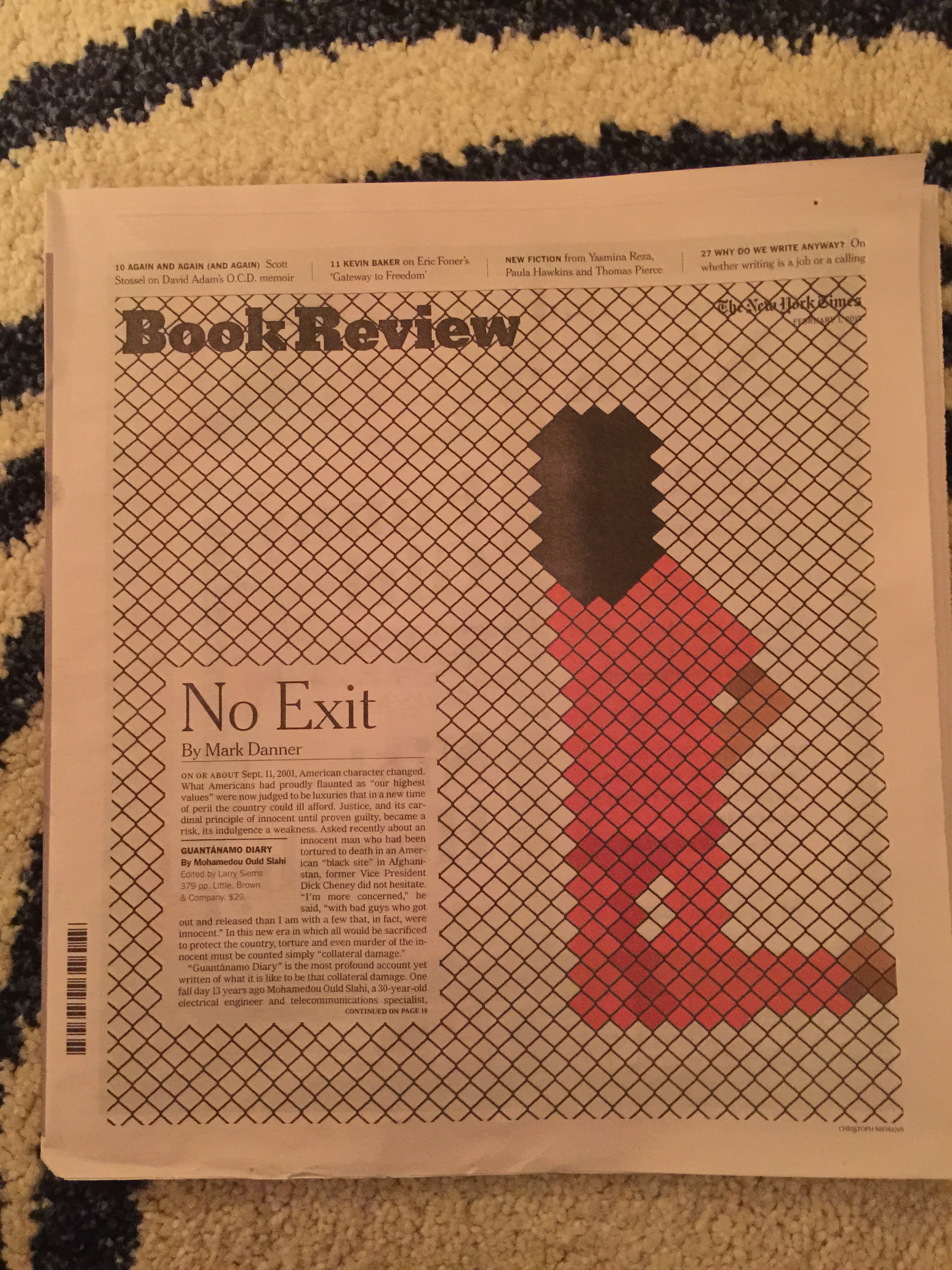
When I woke up this morning, this page  2015-02-01 06.18.54 of the New York Times’ weekend edition lay around openly. It carries the highly pixelated shape of a person in an orange jumpsuit, hands tied behind his back, on his knees.

It brought back immediately my memories of a specific moment yesterday. When the news exploded into the world that this black clothed butcher with the deep British accent, the executor of IS, had decapitated Kenji Goto, the Japanese journalist who had been captured earlier, I looked up the video that had been put on the web by IS. Here is a link to the news and facts from yesterday.

On the other hand, the open page of the NYT that I found this morning, it is about a book review: “Guantanamo Diary“, by Mohamedou Ould Slahi. Mark Danner reviews the book for NYT, starting with the following: “On or about Sept. 11, 2001, American character changed. What Americans had proudly flaunted as “our highest values” were now judged to be luxuries that in a new time of peril for the country could ill afford.”
The text continues, making reference also to former Vice President Dick Cheney, when asked recently about an innocent man been tortured to death in an American “black site”, did not hesitate. “I’m more concerned,” he said, “with bad guys who got out and released than I am with a few that, in fact, were innocent.”

I wrote about torture, cruelty, and why I believe that certain acts of utmost inhumanity need to be banished for all accounts and purposes, not leaving any ground for legal or ethical justification, earlier.

But here is the thing:

I would certainly claim that I am hardened by uncounted situations, and pictures and movies thereof, what human cruelty can do to others. Yet, none of those experiences leaves me cool, unaffected. Yesterday, I decided to look up the propaganda video of IS before it would be removed from the most accessible sites again. I wanted to understand more about what is referred to as a highly professional propaganda machinery. IS is acting through intense use of media, far away from amateurish make, brushed up with professional effects, using an identifiable style guide. So I assumed that this is not just a simple broadcasting of cruelty, but that it carries deliberate messages, likely tailored for different target groups.

Well, I am certainly having difficulties to understand those in the target group of potential supporters for whatever the cause of these devils are, I can’t really relate to the mindset of somebody who might be tempted to become what we name a “Foreign Terrorist Fighter” in the United Nations Security Council Resolution 2178 (2014).

But I do understand the feelings of those who are target of the antagonization which sits at the heart of this media strategy. I refuse to give these criminals the legitimacy they aspire, what they want to be seen as, like fighting for a caliphate with authority, brutally enforced legitimacy, and territory. I continue to name them torturers, heinous murderers, or, let me just be a little politically incorrect, heartless beings with no soul.

Felling better, having said that.

However, I also refuse to name them “animals”. That is a trick which is frequently used by those who want to establish legitimacy for their own unethical and horrible action. The Nazis created the word “Untermensch”, shamefully staining the German history. Many others did, and continue to do, exactly the same. By depriving somebody from being considered a human being, genocidaires and mass murderers can justify action that otherwise would be morally or ethically questionable, and it makes it easier for the killers who they need, to kill for them.

No, this butcher may be whatever curse I can find for him (feeling better thereafter), but he remains a human being. As such, my rules of the game apply for what I stand for: Humanity.

However:

When I saw the video yesterday, I was immediately overwhelmed by a complex mixture of feelings including rage, despair, deepest sadness, shock. I cried and needed to compose myself immediately again, because some children were in the other room.

From then on, I literally obsessed for hours, when ever I had a minute, about what I would do if I would get my hands on this black clad coward butcher. Yes, coward, because he is hiding his ugly face. I do not. I had all sorts of day dreams about how to torture this man, in detail.

It took me a hard time to recover into my spirituality, into not only understanding on an intellectual level that this is EXACTLY what they want us to feel, but also to admit on my spiritual level that any such retaliation would be wrong for all intents and purposes.

We only have one chance to demonstrate our values: By adhering to them. So I am talking about my values here.

I remember my father. I was young, and he would refer to Jesus’ sentence saying that if one gets slapped on one cheek, one should offer the other cheek to the offender, too. My father often said that he would have difficulties with that. Instead, he considered some situations justifying the principle “An Eye for an Eye”.

I have two answers, one with my heart, one with my brain:

My heart tells me that I would give up my soul, and my spirituality, if I would give in into ripping that butcher’s nails off his fingers and toes, one by one. Well, it gives me some relief thinking about it, though, frankly. But that’s about it, that’s about as far as I can go, and it already makes me praying for that this resentment is taken away from me with the help of my Higher Power.

Secondly, my brain tells me that this is exactly what these groups want us to feel: They thrive from this. Because, amongst other reasons, think about what they did, too: They requested 100 Million USD ransom money.

They are not only a bunch of terrorists. They belong to an organized crime organization, they capture people in order to make money in order to exercise power. They are true sociopaths, like every organized crime group is, because they give an ethical and moral damn about how to generate money, how to establish power. If they can make more money by legal means, they will just do that. If they can make more money by chopping heads off, well, they will just do that.

That is who they are. In their cold and well crafted strategy, they aim at taking our values away from us, by making us doing what they do.

They are sociopathic criminals. They don’t feel anything like empathy. So, we treat them as such. We apply the rule of law to them. Because that is what is protecting our values, and our humanity.

Never. Never again.

“Thank You” – Instead of “Yes, we succeeded!”

When I read the first breaking news on BBC on that “the case of a Saudi blogger sentenced to 1,000 lashes has been referred to the Supreme Court by the king’s office”, I shared it with my little group of personal friends on FaceBook immediately, and just adding the word “Thanks!!!” (http://www.bbc.co.uk/news/world-middle-east-30856403).

Referring to my previous blog entry “Je suis Charlie – Je suis Raef” I then thought about the issue a little more in depth.

Since the horrible attack and murders which began in Paris in the offices of the magazine “Charlie Hebdo” January 7, the world saw outrage and intense discussion. Millions gathered in Paris and elsewhere, demonstrating under the logo “Je suis Charlie”. Public discussion saw a wide range of positions, across various communities, including communities of faith. I find it noteworthy that important moderate voices came from everywhere, including, sometimes, from where I would not have expected it. Here is an example: http://m.huffpost.com/us/entry/6443530.

Friday, January 09, the Saudi blogger Raef Badawi received the first 50 lashes from a sentence of 1,000 lashes. The public outrage was immense. I referred to some in my recent blog entry, and I wrote “Je suis Charlie – Je suis Raef”.

January 14, the media began to report about a new cover illustration of Prophet Muhammad in the latest edition of Charlie Hebdo (http://mobile.nytimes.com/2015/01/15/world/middleeast/new-charlie-hebdo-muhammad-cartoon-stirs-muslim-anger-in-mideast.html?_r=0&referrer=).

Again, there was a wide spectrum of opinions flooding the blogs. Again, I also want to note that there were serious concerns offered in moderation, across the whole spectrum of communities. The above link serves as an example.

What I want to draw attention on here is the fact that, in my personal view, the decision of the Kingdom of Saudi Arabia carries remarkable signals, and I would hope that this is supporting a dialogue which I find extremely important. The world faces a lot of antagonisation right now. This escalation of antagonised, often radicalised, and very often very emotional expressions of outrage supports that views become polar. Polar views support a selective perception which makes us looking for more of the bad news, as we seek support for the position that each of us holds.

Meaning: Dialogue becomes more difficult.

So, here is my take on the news on Raef Badawi: I hope this goes widely noticed. I hope it’s not used in a triumphant manner. I hope it’s used as an example for that listening to each other really works.

And that is what we need more than anything else, right now. So, trusting that this decision is based on including the understanding that dialogue and willingness to understand are so important, I say “Thank you!”. The world never is black and white only, what ever some would want to suggest.

Je suis Charlie – Je suis Raef

May 15, 2014, the United Nations Office of the High Commissioner for Human Rights issued the following statement (http://www.un.org/apps/news/story.asp?NewsID=47797#.VLT9xkY8KJI ) on Raef Bandawi, a Saudi Arabian blogger who was sentenced to 10 years in prison, 1,000 lashes and a 1 million Saudi riyal fine:

“This outrageous conviction should be overturned and Mr. Badawi immediately released,” said the Special Rapporteur on freedom of religion, Heiner Bielefeldt; the Special Rapporteur on freedom of expression, Frank La Rue; the Special Rapporteur on torture, Juan E. Méndez; and the Chair-Rapporteur of the Working Group on Arbitrary Detention, Mads Andenas.”

But it is happening.

It started last Friday. Here is what, like many, The Times of India reports (http://m.timesofindia.com/world/middle-east/Saudi-blogger-lashed-in-public-for-insulting-Islam/articleshow/45824671.cms ):
“JEDDAH: Saudi blogger Raef Badawi was flogged in public Friday near a mosque in the Red Sea city of Jeddah, receiving 50 lashes for “insulting Islam”, witnesses said. In September, a Saudi court upheld a sentence of 10 years in prison and 1,000 lashes for Badawi, and he is expected to have 20 weekly whipping sessions until his punishment is complete. The United States, Amnesty International and Reporters Without Borders have denounced the flogging as a horrific form of punishment, and said Badawi was exercising his right to freedom of expression.”

This is why it is so incredibly important to continue with a public discussion on torture, following the release of the U.S. Senate’s report on coercive interrogation methods by the CIA amounting to torture: Cruelty is a family member of Torture, and I identified Sadism and Rape as other brothers and sisters in it, in earlier statements on this blog. The legitimacy of condemnation of such methods applied by others critically depends on how one deals with own behavior, and history. Once we allow ourselves to do whatever we want, disrespecting international Conventions, we mute ourselves when we are being confronted with outrageous action of others.

So, here is the US Department of State’s public statement ( http://m.state.gov/md235704.htm ) as of one week ago:

“Press Statement
Jen Psaki
Department Spokesperson
Washington, DC
January 8, 2015

We are greatly concerned by reports that human rights activist Raif Badawi will start facing the inhumane punishment of a 1,000 lashes, in addition to serving a 10-year sentence in prison for exercising his rights to freedom of expression and religion. The United States Government calls on Saudi authorities to cancel this brutal punishment and to review Badawi’s case and sentence. The United States strongly opposes laws, including apostasy laws, that restrict the exercise of these freedoms, and urges all countries to uphold these rights in practice.”

Yet, despite this and others joining in, it is happening. Raif Badawi received the first 50 lashes last Friday. Watch the crowd gathering, the video stops there, (thank you!): http://m.youtube.com/watch?v=ISRaSduJNOI

It will continue if hearts remain merciless. Every Friday he will be taken out of prison, displayed in public, receiving 50 more lashes. The American PEN organization decries it ( http://www.pen-international.org/newsitems/saudi-arabia-editor-raef-badawi-sentenced-to-1000-lashes-and-10-years-in-prison-plus-10-year-media-participation-ban/ ). It will bring his body to his limits, every Friday for the next twenty weeks. He may die.

And you know what?: On occasion of millions joining into last week’s demonstrations against the killing of fifteen journalists of Charlie Hebdo, the Ambassador of the Kingdom of Saudi Arabia joined the row of dignitaries, excellencies, and ordinary people, expressing their sadness and outrage. Exercising their right to be free expressing their opinions, journalists had been brutally killed by extremists who felt this is an insult of Islam. ( http://www.jewishjournal.com/hella_tel_aviv/item/the_10_biggest_hypocrites_marching_in_paris ).

So what is this about? Is it that you can say what ever you want as long as it is not against us?

I join the statement by the European Union ( http://eeas.europa.eu/statements-eeas/2014/150109_03_en.htm ).

Je suis Charlie. Je suis Raif. Et j’adore Senator Feinstein.

More links below.

http://m.ndtv.com/article/world/saudi-blogger-gets-first-installment-of-1000-lashes-for-insulting-islam-646541

To me, the most heartening one: http://m.huffpost.com/us/entry/6125244

Christmas reflections on peace, and peacekeeping

Kind of on the funny side: Spending my holidays in the wonderful and relatively peaceful environment of Maine.
Why “relatively”? Well, the local newspaper “The Bridgton News” always publishes items on the Bridgton Police Department Blotter. It’s an entire account of the past days’ activities of Brighton’s Finest. It’s our absolute favorite when we are here.

My best ones this time: “1:18 p.m. A car parked near the power lines on the Harrington Road turned out to belong to an environmental worker.”, followed by “4:33 p.m. An intoxicated patient came into the Emergency Room at Bridgton Hospital and then just walked out.”

My favorite early 2000 in Pristina, Kosovo, a little less than a year after the war of Milosevic against the Kosovo Liberation Army was ended through a NATO intervention: “Two cars were involved in a traffic accident downtown Pristina. The drivers accused each other of violating the traffic rules. Subsequently, one driver grabbed a rocket propelled grenade launcher from the trunk of his car and fired an RPG towards the other person. The RPG hit a building behind the car and caused major structural damage. NATO soldiers locked the area down. Investigations ongoing.”

Peace, and the disturbances of peace, are a very relative thing. I got used to news like the above, I have uncounted numbers of stories which, today, even sound funny, taken out of the severe context in which they happen.
Like the Bridgton police news do sound funny to me. Well, that’s relative too. It may well be that they sound funny to any guy visiting from Bed-Stuy, Brooklyn, New York.
Oh yes, I will never forget about the international police officer who woke up one morning, just finding an entry hole and an exit hole in two adjacent walls of his living room. A grenade had passed through during the night, without exploding. It was an intimidation of somebody targeting his landlord.

What I always struggled with is the fact that people who enjoy peace (including the profound type of peace in Bridgton…) have difficulties to accept that engaging in peacekeeping in areas where rocket propelled grenades are used to settle conflicts is necessary and requires engagement abroad.

Happy holidays, enjoy, everybody, where ever you are.

Learning: On My Blog

There are so many things that I want to write about these days. I wanted to write for many years and never found the time, or better, the energy. There always were excuses: Demanding work, things happening in my life. Subsequently, my archive of little notes that I am collecting for later processing, it grew. Stacking them away, in text collections, diaries, and else, they kind of disappeared, been put into a dusty corner on the mental den, so to say.
Now, with my decision to begin to write again, I am revisiting my mental den. It’s almost overwhelming, I have projects on accountability, on organized crime, on the nexus between organized crime and terror, on torture, on trauma and it’s profound effects on individuals, and then on groups and societies, and so much more.
When I begin to write on a complex issue, I usually go deep, beginning with analysis and definition, looking up references, stats, supporting material. That’s not what this blog should be all and only about. This blog may collect refined thoughts that then form the basis for deeper analysis, may be for articles, or books. This blog also needs to reflect what’s on my mind right now. Readers commenting (which I hope to see at some point, through promotion of this blog), may then contribute to my learning and refining.
So, that’s helpful, clearing my mind. Entries here need to focus on what’s happening right now, what I am thinking about right now, reflections on elements of larger and more complex issues. That will help keeping the read interesting, and writing will remain a creative and living process, one through which I will discover new connections between topical issues, and insights.
So let me prepare the next entry with some initial thoughts on denial processes. I read so much about this more recently, and there are so many highly actual and profound discussions in the public space where the problem with denial, it’s negative consequences, and the challenges to break denial up, can be seen. There are two highly interesting public debates here in the United States right now in which denial plays a role: The first discussion is about profiling with massive and negative effects on communities of black and colored people, through the combined system of political decisions and actions (War on Drugs), action of law enforcement, and action of the criminal justice system. The second discussion relates to the most recent report on abuse and (should I say alleged?) torture by the CIA.
As a professional police officer, both discussions deeply upset me, make me following up, and engaging in discussions. But all my international experience also includes tons of experience with the same structural effects of denial, in almost every part of my professional experience, and since some time, learning about what effects denial had, in my personal life, too.

Every journey has a beginning

So, this is it:

Today, I finished brushing up the initial design that I want to use, setting up the About-page, establishing security, what ever.

Yesterday, I finally decided to run a personal blog on those topics that define a good portion of my life. My experiences with, and within peace operations. My experiences with assisting in the establishment of sound, impartial, fair, accountable, humane, security and rule-of-law institutions. My experiences with conflict, and reconciliation. My experiences with trauma stemming from abuse, on individual, group, and societal level.

It´s been a while that I am using internet media not only for my daily consumption of news, but also to communicate what I do, in my official capacities. There have been various over the last fifteen years of international work, within my thirty-eight years of a police career. The latest one: Look up #UNPOL on Twitter.

I am brimming with experiences and topics that I want to explore which can not be voiced through channels which are defined through my professional relationship to one organisation, currently the United Nations, before that the European Union, before that the United Nations, before that policing in Germany, or any of them.

My experiences and questions run deeper, are often very personal and intense. That’s why I am switching the light on in this blog.

Stay connected, link up, if you find it useful, spread through links.

But first and foremost, please contribute to discussions, if you feel like that. Enjoy reading.