On the rule of law and trusting it in times of misinformation and manipulation spread using social media

I finished my reading of the book “How Civil Wars Start And How To Stop Them”, written by Barbara F. Walter (Crown, 2022, Ebook ISBN 9780593137796). I wrote about it in my article “Anocracies – And Thoughts on International Efforts Related to Conflict Prevention“. There I said that I was impressed with the detailed historical account on the many civil wars, and what political science learned about their predictability. I also said that I will comment less on the second part of the book, where the author is applying those experiences on the current state of affairs in the United States of America. But here is a brief personal impression:

Purely from an emotional perspective, the first part of the book felt gripping, the second part felt like something was missing. Because the first part tells the story of not only why things went haywire, but also how they went haywire. The first part of the book talks about catastrophies that happened. Because the current situation in the U.S. is troubling, and partly deeply concerning, but has NOT led to a worst case scenario (yet?), the book is speculative in this regard, because, simply, it has to.

The author attempts to come up with a future scenario of how a descent into civil war in the U.S. could look like. When I read it, it felt incomplete. It had to. I believe the scenario had to necessarily stay away from including a potential role of individual actors which brought us to the brink of that abyss. Otherwise the book would have become speculative and politically antagonizing. The role of “Number 45” is being described in how the U.S. witnessed it’s downgrading from a starling democracy into the field of anocracies. But the book’s scenario on possible further descent stays away from involving contemporary individual actors. An that is why the scenario feels hypothetical. The absence of this link allows for concluding that we are, perhaps, far away from seeing one of the most stable democracies of the world itching closer to internal chaos. Which we are not, as I believe.

Here are two recent news articles which may make you better understand where my concerns are, still allowing me to stay out of the same trap. Make your own conclusions on whether the future may bring us closer to worst-case, just by reading and thinking about this one, and this one. We are a far cry away from being out of trouble. The mid-term elections in the U.S. are coming up, I feel we are in for a very bumpy 2022. From a European perspective, the current stabilisation of transatlantic jointness is extremely fragile, depending on future development.

At one point I was wondering what would happen if a future presidential candidate would claim his right for using Twitter back. It feels like “You’re damned if he is allowed, and you’re damned if he is not”. The claim of the far-right that it is fighting a corrupt, even pedophile global cabale, including depicting the free press as the enemy of the people, it will see a new and even more intense replication: The next round of racism, xenophobia, white supremacy, male domination, conspiracy theories challenging the efforts to fight the pandemic, and global warming, attempting to establish a narrative fighting Western democracies, it is just coming up. And the use of social media will be pivotal for those who attack, and those who defend.

The jury is out how this unfolds. And then there is the nutshell of Barbara F. Walter’s point how a fragile and unstable further descent into becoming an anocracy can be turned around. Here, the author refers to a piece of work she was commissioned with in 2014, for the World Bank. Like other scholars, the author found three factors standing out by far as being critical for preventing descent into conflict and chaos, including civil war: (1) The Rule of Law; (2) Voice and Accountability; (3) Government effectiveness. So, we will have to think about how we translate these fundamentals into concrete action allowing people all over the world to trust the form of governance which we say is the best of all alternatives we have been able to come up with so far.

So, here we are again. It is why any effort getting us collectively out of the currently very troubled waters must look at the rule of law, which Walter describes as “the equal and impartial application of legal procedure”. I stick to the definition of the rule of law as adopted by the United Nations: “For the United Nations (UN) system, the rule of law is a principle of governance in which all persons, institutions and entities, public and private, including the State itself, are accountable to laws that are publicly promulgated, equally enforced and independently adjudicated, and which are consistent with international human rights norms and standards. It requires measures to ensure adherence to the principles of supremacy of the law, equality before the law, accountability to the law, fairness in the application of the law, separation of powers, participation in decision-making, legal certainty, avoidance of arbitrariness, and procedural and legal transparency.

However, my experience entails that in order to establish any rule of law, there needs to be a large consent of the respective society in how this principle is applied, and this consent must go beyond any larger factionalisation in that society. Any large faction of a society must accept this larger principle, rather than challenging the application of a rule of law as being biased, being imposed on them by other factions. Those who stir conflict for advancing their own objectives, they always will establish a narrative that there is no justice for their constituency. They will portray the rule of law as being a weapon wielded by their enemies against them. What these individuals do is to undermine the trust of their followers in a rule of law applied to their society as a whole. Which points to a second invisible feature of any successful establishing a rule of law: Trust.

It is about trust accepting the specific rule of law, for myself, and others, for the powerful and the less powerful. And it is about trusting that justice will always attempt to prevail, no matter how long it takes. Because very often, it can take a long time. And still, after many years, cases may be unresolved, often are. A society at large must trust the course which justice takes, even if individual members experience pain because their grievances are open and festering wounds for many years, before closure is possible, or sometimes even never.

For me, this challenge can be seen nowhere else with all clarity than in situations where I contributed to the efforts to re-establish a rule of law in a society where it had broken down. May be I will write more about a few of those experiences. Here it would be too long, because I want to finally focus again on the critical role of social media. Here is just one example:

There were two main ethnic factions in Kosovo before and after the violence ending in 1999. Under the UN Security Council Resolution 1244 Kosovo found herself with a majority and a minority faction, no form of own governance at all, and no rule of law beyond what UNSCR 1244 tasked us with. The Old had broken down and had to disengage. The New was not there. It was to be established, and being part of the international community engaging in assisting in finding a new New, I was representing the international interim police.

Whilst, on a technical level of developing policing, and helping a new Kosovo Police to emerge, being more and more successful, we found ourselves in a classical “Catch-22-situation”: All factions involved were blaming us not being able to provide security, and justice. Each side would accuse us to act on the interest of the other side’s agenda. And practically it meant that in case of any evidence of a severe crime which would allow us to make arrests, and prosecute suspects of grievious crime, there would not be a societal consent, or trust beyond factions. At least at the beginning. During those early years, any action by us leading to an arrest would be perceived by one faction as a biased, if not politically motivated, action in favor of the other faction. I have many examples for both factions.

I believe that, over time, some trust could be instilled. Not only that the Kosovan society at large moved forward towards healing from own wounds. Not only that our persistent sticking to a common rule of law for All slowly helped in setting some foundations for trust. Not only that the real success story is the work on the credibility of the Kosovo Police itself, establishing itself as a trusted actor within an emerging rule of law. But any development until today also shows how fragile this trust is. Including in recent times, operational situations can demonstrate how quickly old tensions, mistrust, and biased interpretation of events can break up. But what I want to demonstrate here is exactly that: That any rule of law is critical for peace&security in a society, and that this does go way beyond the technical application of such a principle.

It requires acceptance of that rule of law by a majority of all constituencies in a society, and it requires a sound trust in the equal application and adjucation of that rule of law, beyond personal grievances, and existing factions.

As said earlier (in my first blog article on this book), this holds true both for a society moving towards a rule of law, and it applies to a society where the efforts of trusting a rule of law are heavily undermined by the spreading of misinformation and fake news. Whether the society moves into a positive direction or a negative direction, it is the middle zone between the Old and the New which makes the situation most volatile.

All three factors mentioned by Barbara F. Walter, (1) The Rule of Law; (2) Voice and Accountability; (3) Government effectiveness played into any descent into chaos I have personally witnessed.

In 2022, the means to disrupt by using manipulative voice and amplifying non-accountability are a global challenge: Social media has become a bull-horn for those who know how to exploit fragility, and to further it.

So, how to translate Barbara F. Walter’s message, that civil wars can be avoided, into practice?

By taking responsibility for own action, and making our voices of reason being heard, day by day. Neil Young requested from Spotify to remove his music from the platform because Spotify is hosting “The Joe Rogan Experience”. Neil Young did not want to be on a platform which prominently features a protagonist for this type of spreading misinformation, lies, and manipulation, including wildest conspiracy theories about some mass-hypnosis being used by a global cabale enslaving citizens. Joni Mitchell followed suit, and she is not the only one.

This fight is taking us on a long haul, it is far from being over. Every personal contribution matters.
Anocracies – And Thoughts on International Efforts Related to Conflict Prevention

Anocracy or semi-democracy is, according to Wikipedia, a “form of government that is loosely defined as part democracy and part dictatorship, or as a “regime that mixes democratic with autocratic features.” Another definition classifies anocracy as “a regime that permits some means of participation through opposition group behavior but that has incomplete development of mechanisms to redress grievances.” The term “semi-democratic” is reserved for stable regimes that combine democratic and authoritarian elements. Scholars have also distinguished anocracies from autocracies and democracies in their capability to maintain authority, political dynamics, and policy agendas. Similarly, the regimes have democratic institutions that allow for nominal amounts of competition. Such regimes are particularly susceptible to outbreaks of armed conflict and unexpected or adverse changes in leadership.”


In my blog post “Under The Hood” I wrote that I had pre-ordered “How Civil Wars Start And How To Stop Them”, written by Barbara F. Walter (Crown, 2022, Ebook ISBN 9780593137796). After its publication date it got delivered (in my case as an Apple iBook). I am reading it now, and it is as good as it was assessed in that New York Times book recension. As it was said in that recension, Barbara F. Walter spends much of the first half of the book on a profound history of nearly every civil war haunting mankind in the past many decades before beginning to apply the results of academic research of political scientists on civil wars to the situation of the United States of America.

I am through the first half of the book, and inasmuch as I am now keenly reading her account of the more recent developments in the U.S., I am not intending to write on that subject matter. I have an opinion there, and I share the author’s risk assessment, but this public discourse is already ongoing in the U.S.: Look here and here.

I wanted to reflect on a few general observations that stem from the book’s solid comparative approach of recent situations which led to wide-spread violence, and the solid and vast description of the state of affairs of a number of contemporary nation states. After all, no country is exempted from the danger of plunging into wide-spread violence, just pretending “It can’t happen to us” is nothing less than dangerous denial and wishful thinking of the ostrich burying her head in the sand. In this, Barbara F. Walter’s book establishes itself in the same rational and academic realm as the books “Twilight of Democracy: The Seductive Lure of Authoritarianism” by Anne Applebaum and “Fascism: A Warning” by former U.S. Secretary of State Madeleine Albright.


My line of work has frequently put me into situations where we have wondered how one can measure the risk of a country or constituency descending into violent forms of conflict, including civil war. On several occasions I have been part of the international community’s peacekeeping efforts following the outbreak and the aftermath of civil war. Operationally and strategically I was part of such efforts in Kosovo under the United Nations’ mandate through Security Council Resolution 1244. Strategically I was part of such efforts in situations such as in Sudan, South Sudan, Mali, the Central African Republic, Somalia, and several more.

Then there is peacebuilding: How to make sure that a successful peacekeeping engagement finds its continuation through peacebuilding, and leads to a stable peaceful environment that will not relapse into conflict? That’s one of the elements of my current line of work, or why I was operationally working in Bosnia&Hercegovina, or strategically in headquarters of UN and EU on a large number of similar situations in greater Europe, the Middle East, Asia, Africa, and the Carribean.

Finally, there is conflict prevention: I often sat in meetings with like-minded peacekeepers and peacebuilders where we dealt with conflict prevention. Meaning to extinguish the fire when it was starting small, or even better: To help keeping things stable long before they reach critical mass of instability, and to find ways helping a country, or a constituency, in efforts to resolve disputes peacefully, and to succeed in that. Here I will not give examples. There were a number of cases in which I participated and where we could help in de-confliction of interests, and peaceful resolving of grievances. Those cases did not lead to bad-news-stories, in the general public they went almost entirely unrecognized, and good-news-stories sometimes can not be told in order to keep the good news continuing.

Those stories also don’t sell. Even in the “normal” world of crime, crime prevention does not attract the same interest by readers as the gruesome murder story does. Prevention is the silent humble sister of the guys and gals in military and police fatigues. Repression, threat, coercion, and the use of force, all too often these stories outrun any peaceful piece of news. This is the achilles-heel of prevention, and exponentially more so since the advent of social-media, whose algorithms prefer stories, fake or true, that create viral attention: Stories that create anger will always knock out the stories of crime that never happened. Even cute-cats-stories outrun every story about a conflict which never happened because we all did the right things.


In all those discussions on how to prevent conflict better, we asked ourselves how to asses and to measure the risk of conflict with hard numbered indicators. I remember reading the book “The Responsibility To Protect” by Gareth Evans. Evans, one of the chief architects of a concept called R2P, which tragically failed, at one point mentions the many efforts of academia to come up with a measurable set of indicators. He stated that for many years there was inconclusive academic research on that. In his book he mentioned that only one hard statistical fact could be boiled down: That conflict is much more likely in a country where there was one -more recently- before.

For years, I accepted that. Barbara F. Walter’s book has profoundly changed this view. May be I did personally not notice, or may be it is more of a late-breaking recognition, but according to Walter political science has made tremendous progress and has developed a sophisticated set of predictors, or risk indicators, based on sound bodies of empirical data in at least three very large and internationally recognized data-sets. In order to keep this a relatively easy read, I won’t go into details. The book is very captivating and it is very comprehensible. I truly enjoy the way how hard science is transformed into popular language by Barbara F. Walter. There is no need to undergo a 101 course in political sciences, so instead of summarizing a detailed book, I recommend reading it yourself.


Walter’s book has drawn my attention to three factors that increase the potential for, and are the reasons for, civil wars. Academic research appears to have managed to put these three factors into a rock-hard framework of statistical measurability: (1) Transitions from one system of governance to another system of governance; (2) Factionalisation in societies; (3) The drastic effects of social media.


(1) Transitions from one system of governance to another system of governance

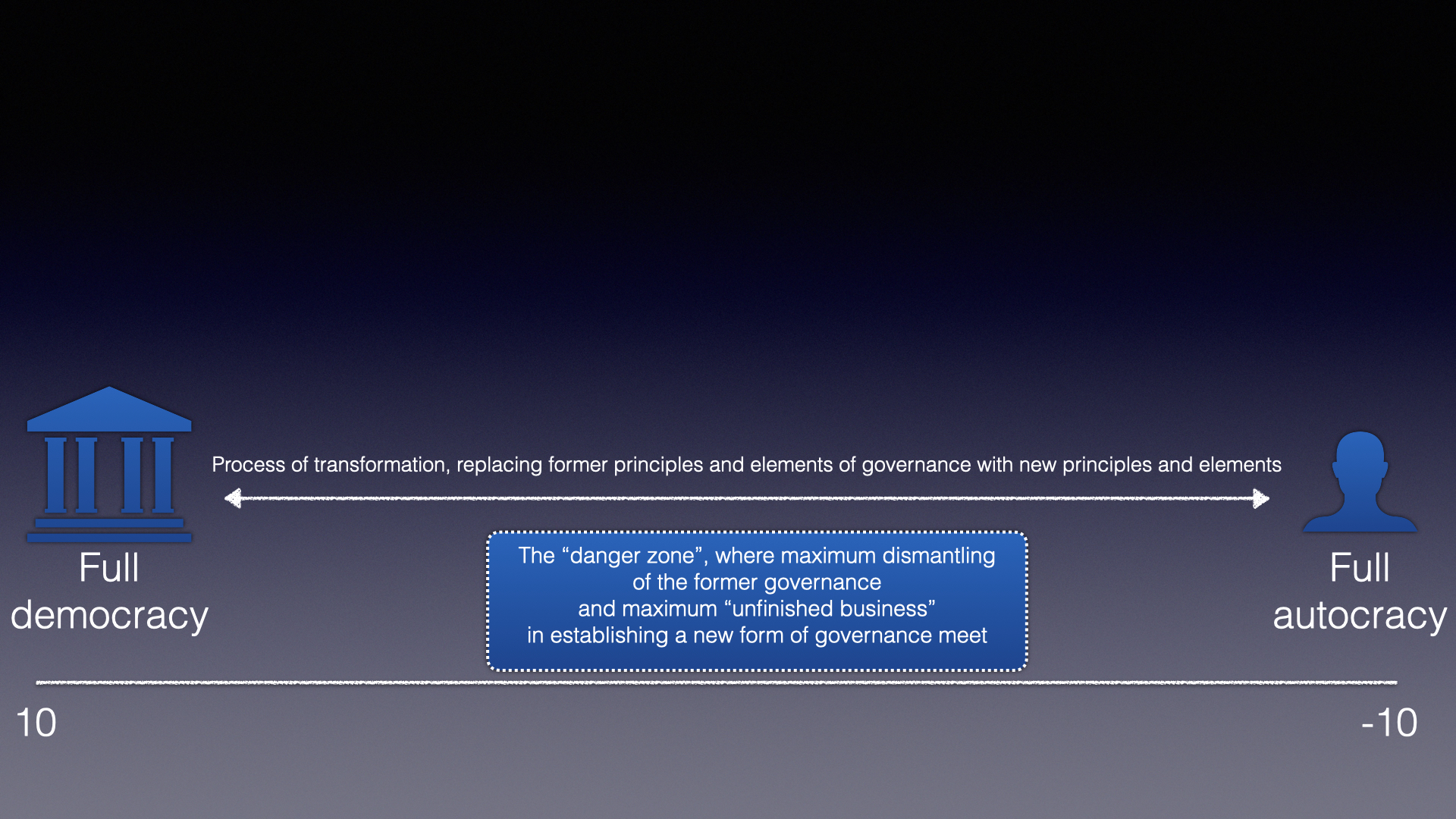
For me, one important contribution of Barbara F. Walter’s book sits with drawing attention to process, rather than a snapshot of a state of affairs in time. Any form of governance can be categorized, and put on a scale. A true representation of all common criteria for a democracy can put a State into a category of “best in class”. Another State can be a full representation of what we call an autocracy. That State would be on the opposite side of that scale. From the viewpoint of a true defender of democratic values, that would bring this State into the zone of “worst in class”. Of course, “the other side of the aisle” would disagree with that judgement, and there we are in a polarized discussion.

But the true focus of Barbara F. Walter is not on the snapshot where a State finds herself on such a scale. It is about the movement from one end to the other, in both directions, and it is about the speed of that process. A State can find herself on the path towards more autocratic forms of government, or on the path from autocratic governance towards democratic governance. Political science has established evidence for that the “middle zone” between one form of governance and another form of governance is the most dangerous and volatile area, and the faster the transitional process from democracy towards autocracy, or from autocracy to democracy, the more risk for wide-spread violence exists on a statistical level.

And this makes perfect sense. Here is my attempt to visualize it:

It means that the “door swings in both directions”: The risk of violence does not only exist in a situation where a country is slipping towards semi-autocratic or fully-autocratic forms of governance. The same risk exists in a situation where interested parties, supported by the international community for example, engage in promoting and establishing regime change towards democracy. Barbara F. Walter makes it clear that the risk for violence is highest when this process into either direction has placed the constituency in question into the middle zone, when transformational change is most unfinished, with the old being ripped down and the new not yet formed and rooted.

Secondly, science tells us that, again, the risk is quantifiably higher if the process of transformation is either too slow or too fast, for which there can be many reasons. From how I look at things from my own experience, it is scientific evidence for what happens when the international community pushes too fast, is compartmentalised in such efforts, displays not enough comprehensive depth in supporting transformational change, nor patience for a long-term coherent support approach based on vision and strategy. Which I often saw when international mandates and policy discussions were held unter terms such as “democratization”, or “state building”.


(2) Factionalisation in societies

The second aspect in Barbara F. Walter’s book is a comprehensive analysis of previous civil wars and the relation between constituencies moving into the “danger zone” of being an anocracy, and the existence of factions in these societies. Also here, the book is very comprehensive in giving a detailed account for a vast array of previous civil wars. In my reading this book, one aspect stood out: Any change of one system through which a state applies governance to citizens towards another set of governance rules inevitably leads to the demise of old elites and the struggle which is happening when new elites try to form, and old elites fight to participate in societal control, for their benefits. This is the second factor which makes the “danger zone” so volatile, and the book provides detailed analytical results to the question when, how, and why this leads to violence. I want to highlight one sentence:

“Remember, it’s not the desperately poor who start civil wars, but those who once had privilege and feel they are losing status they feel is rightfully theirs”.

Likewise I quote her account on a declassified CIA report from 2012: “Most insurgencies, the report notes, “pass through similar stages of development during their life cycle.” In the pre-insurgency phase, a group begins to identify a set of common grievances and build a collective identity around a gripping narrative—the story or myth that helps them rally supporters and justify their actions. They begin to recruit members, some of whom even travel abroad for training. They begin to stockpile arms and supplies.

I note that it is the last sentence which connects my current line of work with the larger picture.

Then Barbara F. Walter goes on to analyze the role of social media in contemporary conflicts:


(3) The drastic effects of social media

Social media acts like the proverbial gasoline poured on a fire. By now, many of us have begun to appreciate this very dark side of a technology which also has contributed so much to bringing us close together in a global world. The author’s account on how social media has been, and continues to be, systematically exploited by those who seek control, including by inciting violence, is nothing short of scathing criticism. Again, the book is unbiased by taking a very comprehensive view on situations of recent violence, and contemporary situations in countries all around the globe, within something which appears to be a rising global pattern of instability, emerging and brooding conflict. She refers to solid data that would allow to conclude that there is a clear connection between the exponential rise of volatile situations and war on one hand, and the the abuse of social media for that purpose on the other hand. It is here where the role of social media and its systematic and professional exploitation by reckless individuals and groups is pervasive. Whereas encouraging factionalism on religious, ethnic, racial, or any grounds has been the key defining modus operandi of individuals manipulating populations into fear and hate of the other, and the acceptance that “Dear Leader” may be the lesser evil, contemporary situations are characterised by a systematic manipulation of many, through some, using social media. The book demonstrates this in Myanmar, in countries in Europe including Eastern and Central Europe, and elsewhere, before even beginning to analyse what happened in the U.S. in recent years.

Our societies struggle with the question of how to apply accountability and regulative frameworks to this new phenomenon. Because, new it is: The effects of how social media can be used for manipulation, inciting hatred, and fueling violence, they may be just ten years old. But they are extremely transformative. And again, we see different approaches in relation to how to control social media in China or Russia, say compared to how open societies handle this challenge. But what we also see: Aspiring autocrats virtuously use social media to gain control. After that, these individuals will undertake everything to control the instrument they have used.

Because, they know better than anyone else how it can be used to their advantage, and against them.


This got long again. I leave it without conclusions, simply because there are so many. This is true for a paradigm change on how we consider engaging in conflict prevention in a world filled with old instruments of international order which require overhaul, or may be outdated if we don’t succeed in transforming them into effective tools. This is also true for how we accept our being affected by what we call “social media”. Personally, I feel this question may belong to the most important ones in our lifetime, in all aspects of our lives.

Under The Hood

Forgiveness says you are given another chance to make a new beginning.
DESMOND TUTU

This entire blog is about peace and security, trauma and reconciliation. It is my chosen overarching theme since I began writing.

Ultimately, in order to sustain lasting peace and security in a society, the society needs to be at peace with itself. The impact of traumatic situations and the societal ability to heal these, through reconciliation, is directly affecting the cohesion which is also often referred to as a “social contract”. The less cohesion in a society, the more likely the foundations of that agreement erode.

I pre-ordered “How Civil Wars Start And How To Stop Them”, written by Barbara F. Walter (Crown, 2022, Ebook ISBN 9780593137796). I read an article in the New York Times discussing this book and was immediately drawn to it. Of course, much attention is given to such topics because January 06, 2022 we also looked back on what happened one year earlier: The attacks on the U.S. Capitol by violent crowds, incited by an angry former U.S. President ready to rip everything into pieces and to burn the house to ashes when facing his power coming to an end.

I am specifically interested in understanding the author’s methodological approach. To quote from the New York Times article: “As a political scientist who has spent her career studying conflicts in other countries, she approaches her work methodically, patiently gathering her evidence before laying out her case. She spends the first half of the book explaining how civil wars have started in a number of places around the world, including the former Yugoslavia, the Philippines and Iraq.

So I began this blog entry by looking at my four terms “Peace, Security, Trauma, Reconciliation” with a focus on the January 06, 2021 Capitol riots:

There was no peaceful event, there was no security, there is massive traumatisation of an entire society, and there are huge challenges when it comes to reconciliation. The fabric of the U.S. society is critically wounded. Many, including the current President of the United States, have made that clear on occasion of the commemoration events. Others have blamed them for saying that, accusing them of dividing the very society they have undermined themselves. No matter on which side of the aisle one is, the fact of deep divisions in the society of the U.S. can not be disputed by anyone, because they all participate in it, blaming the respective other side.


Currently in every open society the fabric of consent appears to be at threat. We experience attacks from the outside and from the inside, and we have a large-scale public discourse about that. Attacks and covert efforts in a cyber-information-warfare do point back to actors from inside authoritarian systems, but not only: They include actors from within open societies, in an effort to overturn the systems of governance as they have been set up on grounds of the respective societal contract, enshrined in the relevant basic laws of these societies, their constitutional law. There is a blurry spider web of people and interest groups out there, networking on a global scale, who seem to diligently work on that.


We see societies with authoritarian leadership, heavily applying coercion, and whereever deemed useful, heavy violence against own constituencies. Whichever legitimacy, or sheer power, sits behind coercion into cohesion in those societies, the number of current examples of authoritarian regimes quelling opposition and unrest is considerable. Instability, public unrest, violent coercion of populations by a ruling structure, whether Central Asia, Africa, the Near, the Middle, and the Far East, the Americas, there are many examples.


We see societies with illiberate structures of governance that appear to be stable, sorts of. Big ones, and smaller ones.

We do speculate about the stability of the bigger ones, we suspect, or bluntly see them being in a game of stabilising themselves by dominating spheres of influence, and coercion, whilst at the same time being engaged in efforts destabilising opponents on the side of what we call open societies, including the so-called “West”.

We see smaller societies on their path to illiberate control that position themselves by jockeying for alliances, keeping options open, attempting to take advantage of being friendly to the one or the other, being ambigous.


That is how I came to suspect that the common denominator for all, on a global level, is about societal cohesion. On this level of analysis it is not about attacks of authoritarianism against democracy. It appears to be that notwithstanding the form of governance in many societies, we all struggle with societal cohesion. We all have the same problem, we only differ in how we deal with it.


With that in mind, I revisited my blog entry “Futuretelling” from April 2021. There I had written about the latest report published by the collective of American intelligence agencies: “Global Trends 2040”. The report “finds that the pandemic has proved to be “the most significant, singular global disruption since World War II,” with medical, political and security implications that will reverberate for years. That’s not sturm und drang. It’s the prologue to a far darker picture of what lies ahead.”

Five themes are identified in that assessment: (1) Global Challenges, (2) Fragmentation, (3) Disequilibrium, (4) Contestation, and (5) Adaption. I won’t repeat how I summarized the report in my previous artcle, but I do quote the following: Global challenges include climate change, disease, financial crises, and technology disruptions. The report states that they are likely to manifest more frequently and intensely in almost every region and country. Their impact on states and societies will create stress, or even catastrophic shock. The report assesses the current pandemic as “the most significant, singular global disruption since World War II, with health, economic, political, and security implications that will ripple for years to come.“


That’s huge, and overwhelming. So, what can each and everyone do, in our circles of life?

I am coming back to the basic motivation which I had when I began writing this article. Because it has not been reflected in any of the above, but I believe it is the essence of any individual contribution to finding new ways into cohesion. Lasting cohesion requires some form of consent. Which can only be achieved by talking to each other, and not at all by talking about each other. Talking about each other contributes to dissent. Often we see the dissent manifesting within a public discourse, and all our new contemporary mechanisms of discourse, especially social media, are designed to reinforce messages which achieve large public attention. Those messages are fueled by rage and anger. It is how these systems are set up.

They also function by establishing closed networks. Friends, followers, open or closed chat groups. The opposite to talk with each other is possible there. Stalking, mobbing, bullying, that all adds. Because any dissenting voice within such groups will be yelled at. Can even happen to Ted Cruz, by Tucker Carlson, recently. You stray off the party line, you will be punished.

We can not talk about divisiveness in divisive terms if we genuinely want to address it. Those who do, they purposefully do that in order to solidify it, rather than reverting back to consent. They want to impose a new consent, by manipulation and force.

In everyday life, this is difficult. Like all of us, I have concrete examples: I do not know anti-vaxxers in my circle of friends. Because I have begun to separate myself from any of those. Neither they want me to be part of their circle of friends. And once one enters into those social media groups where attitude to an issue is the polarizing theme, a subtle brainwashing is going on. If I stay, I have to have the same beliefs. They reinforce, and they isolate from any dialogue with others. Over time, own positions and beliefs will radicalize the longer one stays in these groups and circles. As if we would not know how this works. Have we forgotten about how sects do this, how people have difficulties getting out of the prison of Scientology, how difficult it is to de-radicalize people who have been caught in the web of ISIS? There is little difference in the psychology behind all this.

This, again, is happening “under the hood”, and that’s why I have chosen this title. We see the open manifestations of societal dissent. It is hard to quantify and qualify to which extent the invisible divisive lines have already permeated societies. It is fair to suspect these lines of division run much deeper than we see, or acknowledge.

So, I will be interested to see what Barbara F. Walter has to say on that. Because over the last two decades I have been living in societies which at some point broke into open conflict. Or I have been dealing with working for peace in countries which all of a sudden, and often to the surprise of the international community, experienced relapse into conflict and war.

This time, I get a sense it is increasingly about all of us, not about a country far away from us.

How can we identify the threat-level? But notwithstanding that, I firmly believe that nurturing the ability of individuals to listen to others with a dissenting opinion, in an effort to understand the other, rather than subjugating the other under the own doctrine, will be key.

That’s why this will be a momentous task for generations to come.

On Responsibilities of German Public Servants and on Covid-19 – An Open Letter to Hans-Georg Maaßen

Sehr geehrter Herr Hans-Georg Maaßen,

Die digitale Ausgabe der “Tagesschau” berichtet heute, am 03.01.2022 (Link hier) zu dem Umstand, dass Sie auf der sozialen Mediaplattform GETTR ein Video mit der Bildunterschrift “Bewegender Appell von Prof. Dr. Sucharit Bhakdi zur dringenden Notwendigkeit eines Covid-Impfverbots” geteilt haben. Die “Tagesschau” ist fuer ihre faktenbasierte und neutrale Berichterstattung so anerkannt, dass ich auf weitere Verifizierungen dieses Berichtes hier verzichten darf.

Das Video, das Sie demzufolge weiterverbreitet haben, wurde urspruenglich am 22. Dezember 2021 von dem emeritierten Mikrobiologie-Professor Bhakdi auf der Plattform “Rumble” veröffentlicht. Der oben erwaehnte Bericht der Tagesschau leitet in eine detaillierte Schilderung und Bewertung dieses Videos wie folgt ein: “Es traegt den Titel “Der Beweis ist da: Impfung zerstört Immunsystem”. Bhakdi beginnt seine Ausführungen in dem Video mit dem Appell, sich nicht mehr über Details zu streiten, vielmehr lägen die Fakten auf dem Tisch. Alle genbasierten Impfstoffe, gemeint sind mRNA-Vakzine, verursachten das gleiche Ergebnis, so Bhakdi. Das Immunsystem des Körpers werde zerstört. Basis für diese Behauptung sollen Proben aus 15 Obduktionen sein, die der Pathologe Arne Burkhardt untersucht habe.

Professor Bhakdi erklaert in diesem Video: “Sie töten unsere Kinder” […] “Ich halte das nicht aus”, fährt er fort – und kündigt an, “aus diesem verdammten Land” flüchten zu wollen, damit nicht auf “unseren” vierjährigen Sohn “geschossen” werde.”

Der faktenbasierten Berichterstattung der “Tagesschau” ist hoch anzurechnen, dass sie die zugrundeliegenden unbelegten Behauptungen und die vollstaendige Unserioesitaet der angeblichen Beweise, dass m-RNA Impfungen das menschliche Immunsystem zerstoeren, ausfuehrlich in diesem Bericht widerlegt.

Gleichfalls erlaeutert der Bericht, dass sich der fuer den pensionierten Pathologen Arne Burkhardt zustaendige Fachverband, die Deutsche Gesellschaft fuer Pathologie bereits vorher von Erklaerungen von Herrn Burkhardt distanziert hat, ebenso wie auch die Universitaet Mainz bezogen auf Herrn Bhakdi. Schlussendlich moechte ich hier erwaehnen, dass die Bildungsministerin Schleswig-Holsteins, Karin Prien, die zugleich Mitglied im Bundesvorstand der Christlich Demokratischen Union CDU ist, sich als Folge dieser Ereignisse fuer den Ausschluss von Ihnen, sehr geehrter Herr Maaßen, aus der Partei CDU ausspricht.


Sehr geehrter Herr Maaßen, nicht jeder kennt Sie, und mein Blog, auf dem ich meist in Englisch schreibe, wird weltweit gelesen. Daher darf ich hier kurz erklaeren, dass Sie in der Zeit von August 2012 bis November 2018 das Bundesamt fuer Verfassungsschutz geleitet haben. Sowohl waehrend Ihrer Amtsausuebung als auch in Ihrem spaeteren politischen Leben sind Ihnen eine Reihe hoch kontroverser Aeusserungen und Stellungnahmen zuzurechnen. Sie werden in Ihrer politischen Orientierung dem sehr rechten Fluegel der CDU zugerechnet. Sie scheinen erhebliche Sympathien in politischen Zirkeln zu geniessen, die rechts vom rechten Fluegel der CDU stehen. Die Verfassungskonformitaet mancher dieser Gruppierungen scheint ebenso erhebliche Fragen aufzuwerfen wie deren Naehe zu Verschwoerungstheoretikern und Covid-Realitaetsverweigerern.

Uns verbindet daher beinahe garnichts, allerdings eins: Wir beide sind Beamte. Sie sind politischer Beamter (im Ruhestand), ich bin Berufsbeamter (im Ruhestand). Vor Ihrer Zeit als politischer Beamter waren Sie im Uebrigen auch Berufsbeamter, einschliesslich in herausragenden Funktionen des Bundesinnenministeriums. Fuer mich gelten die in der Verfassung der Bundesrepublik Deutschland verankerten “hergebrachten Grundsaetze des Berufsbeamtentums”. Sie beinhalten die Pflicht zum inner- und ausserdienstlichen Wohlverhalten, im ausserdienstlichen Bereich gilt dies fuer mich auch im Ruhestand. Fuer mich gilt die Pflicht zur politischen Neutralitaet, fuer Sie als politischer Beamter vielleicht weniger. Aber eine generelle Wohlverhaltenspflicht kann sicherlich sowohl fuer Berufsbeamtinnen und -beamte wie auch fuer politische Beamtinnen und Beamte abgeleitet werden. Diensteide muessen ja auch von beiden Gruppen geleistet werden.


Zu dieser Wohlverhaltenspflicht gehoert ohne Frage, von der vorsaetzlichen oder grob fahrlaessigen Verbreitung evidenter Falschinformationen abzusehen, die zu schweren Fehlentscheidungen anderer Mitbuergerinnen und Mitbuerger mit fatalen Konsequenzen fuehren koennen. Je prominenter das -ehemals-bekleidete Amt und die damit gegebene “Prominenz” bzw. Gelegenheit zur oeffentlichen Einflussnahme auf Meinungsbildung, umso mehr ist Ihnen als Amtstraeger in herausragendendsten Funktionen diese Verpflichtung zuzumuten, und umso schwerwiegender der Vorwurf, wenn Sie es nicht tun.

Mit Ihrem Verhalten tragen Sie zu erheblichen Zweifeln und Aengsten in der Bevoelkerung bei. Sie schueren ohne jegliche Tatsachengrundlage Aengste, die zum Widerstand gegen Covid-19-Impfungen fuehren. Das ist verantwortungslos und sicher ein Grund fuer die Forderung von Ministerin Prien, obwohl auch aus ihrer Perspektive nicht allein wegen dieser Ereignisse, sondern eher ein Ausdruck der Haltung “Das Mass ist voll”.

Mein Argument kommt allerdings auf die von mir aufgefuehrte offenkundige Verletzung der Wohlverhaltenspflicht zurueck: Sie schueren Aengste, die sehr konkret zu Impfverweigerungen fuehren. Die Zahlen und Fakten sprechen fuer sich: (a) Die mittlerweile milliardenfach durchgefuehrten Impfungen sind sicher; (b) Impfungen reduzieren signifikant das Risiko, an Covid-19 zu erkranken und auch die Wahrscheinlichkeit der Transmission; (c) Impfungen reduzieren in erheblicher Weise das Risiko, Opfer einer schweren Erkrankung zu werden. Ersparen Sie mir, diesen offenen Brief mit endlosen Fussnoten zum Nachweis meiner Darstellung zu verlaengern. Vorsaetzlich falsche Aussagen wie die von Ihnen verbreiteten Behauptungen von Professor Bhakdi tragen also sehr konkret zu Krankheit, schwerem Leid und Tod anderer Menschen bei.

Daran moechte ich Sie hier erinnern.

Ich schliesse mit der Bemerkung, dass sich gerade in den letzten Tagen in meinem persoenlichen und beruflichen Umfeld erneut tragische Todesfaelle ereignet haben. In Anbetracht dessen, dass trotz intensivster Hygiene- und Schutzmassnahmen nun auch meine Familie in Kanada von Covid-Erkrankungen heimgesucht wird, kann ich nur dem Umstand danken, dass Alle vollstaendig durchgeimpft sind. Ich hoffe, dass Erkrankungen mild ablaufen.


Sehr geehrter Herr Maaßen, meine eigene Verpflichtung zum Wohlverhalten legt mir auf, diese oeffentliche Aussage zu Ihrem Verhalten in angemessener Form darzulegen. Ich denke aber, es ist mir auch zugestanden, Ihr Verhalten als unerhoert, inakzeptabel und in schaerfster Form verurteilungswuerdig zu qualifizieren.

Stefan Feller, Leitender Polizei/Kriminaldirektor a.D.

Indifference

December 5, 2021, the New York Times published a story “He Never Touched the Murder Weapon. Alabama Sentenced Him to Die.” It is a heartbreaking story with an introductory video pointing to a longer documentation which is available elsewhere on the Internet. The short video documents last minute phone calls made in an effort to stop a planned excecution, which is scheduled in 35 minutes. It involves the sister of the murder victim agreeing to help preventing an execution of a person she thinks is innocent in the murder of her brother.

Nathaniel Woods had been convicted 15 years earlier in connection with the shooting deaths of three police officers. The circumstances of his arrest for a misdemeanor involve his being in a drug house at the time of the police officer’s operation to arrest him. Yet, the story is about that Nathaniel Woods “never killed anyone”. To quote the article: “Alabama — one of 26 states where an accomplice can be sentenced to death, according to the American Civil Liberties Union — argued that Mr. Woods had intentionally lured the officers to their deaths. It did not have to prove that he actually killed anyone in seeking his conviction for capital murder.

The article is very detailed and complex, shedding light on a story of a person’s troubled upbringing and controversial life. You will read accounts of all sorts which will allow to take, emotionally, one or the other side of arguments whether, and why, Nathaniel Woods became victim of injustice. The New York Times finds a balanced approach detailing the personae of the real cop killer, the person who actually shot and killed three police officers in cold blood, even admitting this in interviews, exculpating Nathaniel Woods as a drug dealer who happened to be subject of police action executing an arrest warrant against him, but not being armed, not engaging in violence, just fleeing in horror as he witnessed the other drug dealer opening fire and going on a killing spree. Everything in this story can create arguments in favor or in opposition to his being sentenced to death.

To me, the story also demonstrates the enormous role of different interpretations of what one would consider “capital murder”. Not under any circumstances German criminal law would provide that Nathaniel Woods behavior would establish him perpetrating an act of capital murder. And German constitutional law does not allow capital punishment.

So, what makes me using this article for a piece in my blog under a headline “Indifference”?

To quote the article itself, and Bryan Stevenson therein: “The tragedy is that people like Nathaniel Woods become victims of our indifference to injustice,” said Bryan Stevenson, the executive director of the Equal Justice Initiative, a human rights organization based in Alabama. He added, “Being in the wrong place at the wrong time doesn’t make you someone who is evil.”

This sentence struck a cord. I often talk or write about the need to passionately promote values. Stressing compassion, and making an argument for standing up for justice, for truth, for rights, for democracy. Here is the other side to it, expressed in one sentence: The passion for upholding a value is confronted with the indifference to the opposite of that value. The very same thing happened when the 45th President of the United States, just shortly after his inauguration, sat for a TV interview in January 2017, stating into the cameras: “Torture works”. He didn’t say he condoned torture. But everyone felt (either encouraged or being disgusted and horrified) an unspoken belief that he did. People rarely noticed, perhaps because he just started to go on an ever escalating news cycle, using this modus operandi on countless occasions. But to me, it established the ultimate red line to cross.

The erosion of values does not happen because of the absence of those who promote them. The landslide is caused by a combination of those who actively undermine them, combined with those many who act in indifference. It is not about the silence of the sheep. It is about the selfishness which is inherent in indifference. – “Why bother? ” “Who cares?“Is it really that bad?”

Yes, it is.

By the way: After the inauguration of the new German Federal Government two days ago, the German news reported Viktor Orbán, the Prime Minister of Hungary, expressing his fear about a new German policy coming up, including being “pro-immigration”, and “gender-friendly”. Of course, he did not say that with a note of welcome, but as a statement of criticism. He also stated this in the State-controlled Hungarian media, read it here in the Hungarian Times. Of course we can have controversial discussions about immigration policies. But “gender-friendliness” as a topic of criticism inside the European Union?

Another red line. For me. It is about indifference which is allowing to get people away with demolition of values.

Sunday News Blues

Here are a few clustered “pieces of news” which I found myself reading about, and following on various other media, throughout the past couple of days:

  • Afghanistan related news continued to show up on my newsfeeds with a somewhat toned down tendency. Whilst still being a main topic, the fierceness and rage of those weeks in August is lessening. We become used to information about women being deprived from education and from participating in forms of public life, we seem to begin to resign into facing a reality where two decades of successful promotion of women’s rights are being wiped out within weeks. We become used to news about journalists being deprived from the freedom to report. We hear from the humanitarian community warning about an imminent desaster, and we learn about a Taleban government comprising our worst previous enemies. Sometimes I feel that government is just sitting it out: “Don’t produce too bad news about violations of human rights, the international media train will move on after a while.”
  • New news capable to create attention by producing feelings of being upset, being angry, they moved on to Mali. Already being a country where military control replaced civilian governance, within a growing set of West African countries moving away from democratic rules of governance, we now see a potential engagement of the Russian “Wagner Group” mercenaries, on request of the Malian ruling military class, and certainly on basis of profound Russian geo-strategic interests, leading to that France, Germany, and others raise questions of conditionality related to the engagement of our own military capacities, within the United Nations peacekeeping Mission MINUSMA, within EU-led military training missions, and through a multilateral set of counterterrorism forces operating in Mali, and the wider region. Feels like another looming implosion.
  • The most recent clash is a different one: France recalling her Ambassadors to the United States and to Australia for “consultations” after being completely kept in the dark on discussions that led to what now is coined AUKUS. A new alliance being formed in secrecy between the U.S., Australia, and the UK, in a global undertaking confronting China in the Indo-Pacific. A multi-billion deal delivering French conventionally-powered submarines to Australia being scrapped with nothing else than shortest notice, in favor of nuclear-powered submarine technology provided by the U.S., assisted by the UK. These news somewhat also feel like the bookends to a discussion in between, a discourse about the future of the North-Atlantic alliance, and the parallel soul-searching of the European Union where we have a place in all this, including through own military capacities and capabilities. A French President and a French Foreign Minister asking as to which extent there is an extension of abandonment which some hoped to be only temporary during the Trump administration, into the Biden administration. Everyone who is reading this will grasp at least a sense of how profound global alliances and interests are changing. In a different piece, for other channels, I reflected on how much this also affects the work of the United Nations, within the field of peace&security, through political and peacekeeping efforts. Just mentioning that, here. And lastly, at least I begin to make an argument about the emergence of the big picture which explains also why the hard decisions on leaving Afghanistan may have been made: It is about re-organizing political and military might along new geo-strategic lines, and not being timid when implementing it.
  • On a sarcastic note, then there also is rapper Nicki Minaj. For many, here is what CBS graced us with: “The White House has offered Nicki Minaj a call with a doctor, according to an official, after she expressed concerns this week about getting the COVID-19 vaccine. The rapper tweeted on Monday that she wants to do more research before getting vaccinated and claimed that a friend of her cousin’s had experienced adverse effects from it, which health officials have refuted. “My cousin in Trinidad won’t get the vaccine cuz his friend got it & became impotent. His testicles became swollen,” Minaj tweetedMonday. “His friend was weeks away from getting married, now the girl called off the wedding. So just pray on it & make sure you’re comfortable with ur decision, not bullied.” Well, sarcasm also reflecing on that this tweet provides a perfect example for how the media frenzy is providing opportunities for something which I am attempting to describe below.

The above almost arbitrary selection of newsbites which caught my attention yesterday and on this sunny and pleasantly chilly autumn morning in Belgrade, it made me thinking. Because, more often than not, my news selection leaves me with frustration, despair, worry. I know very well what these emotions do to me. If being allowed to go on the rampage, they make me restless and I find myself in a spiral of obsessive reading. My days may not be ending on a positive note then. Like in many other areas of my life, it is about emotional moderation, sometimes we call it emotional sobriety. There is a very thin line between compassion and obsession. If I don’t find a way into some form of loving non-attachment, I take everything personal.

I have to pick and choose amongst the thousands of pieces of information offered by my newsreader. The settings of this newsreader only subscribe to channels which I find interesting, acceptable, in line with my cultural and political belief system. So sorry, Fox News, Bild Zeitung, or alikes. Not subscribing. As a consequence, I have to accept a filtered view on the state of affairs because of my own choices. Solid journalism is not free from beliefs. A robotic emotionless and value-neutral set of information items does not exist. With every new reading, I am solidifying the neural pathways forming my own framework of how I see the world outside myself. With every piece of my writing here, I am doing the same.

The engineers and master-minds behind the advertising machinery and the machinery of political manipulation know about this. Walking in their shoes, I reckon they have at least two questions driving them when optimising their strategies:

  • How to keep people in an existing framework, sometimes also referred to as “ecosystem”? Cynical emphasis put on “eco”. I prefer “belief system” as being a bit more precise. If I go one step further, I would even question “belief” and replace it with “emotion”. Whether we talk about a preference to, say right-wing or left-wing political beliefs, or people using Android or iOS, or PCs or Macintoshs, or being a hard-core fan of BMW or Mercedes, it doesn’t matter. Examples are endless. It’s all about emotions, creating emotional attachment, and emotional dependency.
  • How to manage cross-overs, meaning, getting people moving over from one system to another? That, too, is all about emotions.

In a digital realm profoundly based on psychological knowledge how to manipulate, and how to exploit the neuroscience of addiction, Artificial Intelligence (AI) is a blessing for those performing Black Magic. As a consequence, I navigate to the best of my education and ability to at least identify some of the manipulation efforts which are ferociously thrown at me every time I enter the Internet. Not only my computer needs a firewall, my brain needs a firewall as well, allowing me to stay clear from malicious forms of manipulation and from fake news. This goes so much deeper than only avoiding spam and malware attacks. “Social engineering” is a term which had been coined by the hacker scene. But AI takes social engineering to a quantum leap, and a new meaning: Very much like the hacker uses some fake personal credibility through phone calls in order to gain entry, social media perverts the personal meaning of “friends”. One click allows me to request somebody to be my “friend”. Nobody does this free from emotions: Whether I ask somebody in person to be my friend, or I push a button, the emotional reaction is very similar, may be except for sociopaths. With that person’s accepting click, we’re done! I have a new friend, and it is creating an emotional reaction again. If, then, a friend tells me a story, I tend to believe, or to support the attitude behind. That’s what friends do, right?

AI aiming at getting me to become a member of a group of friends, or a “follower” of another category of people, called “influencers”, that’s the wizardry of really smart social engineering. By the way, as perverted the digital meaning of “friend” may be, as cynically clear is the meaning of “influencer”. An “influencer” does what the name is suggesting: Influencing. Not “reasoning”, “informing”, or “entertaining”, but “influencing”. Stomach this. I don’t want to be a friend, nor a follower of, say, Nicki Minaj (see above). My son is dreaming of becoming an “influencer”. Because it’s all about status. But then the opposite to “being an influencer” is “being influenced”. There both is a benign meaning given to it by the new generations of smartphone kids, and a very malicious one, covertly applied by those who manipulate for reasons of profit, or ideological, religious, or political agenda. For those less benign, it is about that content only serves one purpose: Generating a click. There is no difference between somebody using that in order to catch followers adoring long and carefully draped blond hair sitting on top of a rosy face, and somebody who does this in order to catch attention to some specific upper torso specifics.

Nicki Minaj’s boobie-trapped testicle-reasoning against Covid-19-vaccines contributes to fueling the mistrust of millions, and of course because it just is a fancy way for Nicki to create attention for her media circus. No accountability, or sense of responsibility, Ms. Minaj, taking into account the Covid-deaths, suffering, and infringements on the rights of vaccinated people? People who can not pay themselves into privileged high-society realms, now including space, since this weekend’s SpaceX Inspiration4 spaceflight of a billionaire with his three friends?

One of the reasons why democratic values are so much challenged these days: Democracy works best when people make educated choices, and when there is at least some pretention of that all of us are equal. At least that was the idea. If we don’t find a way back into this understanding, democracy may be shown the way to the exit door.

My personal choices in this new world include that I stay almost entirely away from social media sites, like Twitter, FaceBook, Instagram, Tic Toc. I also am extremely concerned about their impact on emotional health issues of teenagers. Parenting two teenagers who struggle heavily with this, like millions of other teenagers too, I need to put this aside for another blog entry.

Yes, I have a select set of Youtube channels and I actively use Youtube to broaden my views on things I am interested in. Yes, I have a LinkedIn profile which I use only in a very restricted manner. But mainly, my own subjective worldview is based on choices I make when reading news in the Internet, using my Newsreader. I try to avoid the worst honeytraps of manipulation, and to mitigate the remainder through educated choices.

I consider myself being moderately good at this. I am aware of that I am blessed with sound education, a very broad experience, a non-local life-style, and broad cross-cultural and inter-cultural experiences. In this, I belong to a global minority. This summer allowed me, again, to see this. I traveled for many months and I stayed on campsites all over Europe, making many experiences meeting people from all walks of life. Sourcing my information from verified channels makes me part of a minority.

It’s not only about the quality of the news sources. It also is about the depth and the width. In order to understand (or trying to) global events, I need to maintain a global perspective. In order to understand complexity and interdepedency of events, I need to inform myself about a large variety of topics. Otherwise, developments seem local, disconnected, and hard to understand. Many people who I have met don’t do that. They source their information from unverified sources, they show limited interest to what happens outside their neighborhood, they feel overwhelmed by the onslaught of complex bad news. But they all try to make meaning.

No surprise then how seductive the simplifications offered by pied pipers are. Threatening narratives sell on feeding grounds soaked with fear. This I have expressed in various pieces on my blog here, and I feel it is not enough. There is some more, but I struggle with how to describe it in a way that is making sense without becoming too lengthy in this piece.

But I would end with that people in democratic societies vote. We are one week away from German Federal elections. I keep fingers crossed. Until then, I’ll go for a forest walk now enjoying the beautiful Belgrade late summer.

Some questions on Afghanistan – And beyond

Like so many in my community, I feel an overwhelming helplessness in light of what is happening in Afghanistan during the recent months, weeks, and days. I am witnessing long and painful discussions about what one can do, in light of the sheer force with which the Taleban are overrunning cities, provinces, and are closing in on Kabul. The speed with which this is happening is scary.

Often these discussions are based on a solid layer of angry rambling about the rapidity of military withdrawal from Afghanistan, which has had immediate consequences for other, civilian, assistance which the international community has engaged in for almost twenty years now. Like, when the German military announced its withdrawal, being left with no other option in light of the U.S. decision and the subsequent trickling down into NATO deployments, it was a matter of weeks until end of April 2021 that the German bilateral assistance to capacity building for the Afghan policing services ended, after almost twenty years. Nothing was left behind.

Of course, and rightly so, there were pledges for continuing assistance to Afghan partners on the civilian, including policing, side. But then the conquering of more and more territory and cities by the Taleban happened at a speed which, according to media sources, took even military and intelligence planners by surprise. Now we are, within days, in a scenario where we read and hear about contingency plans on the side of diplomatic representations, reducing their staff to the minimum necessary core. We hear about U.S. negotiations with some Taleban representatives calling for sparing the U.S. Embassy in Kabul from retribution. We hear about calls by governments like the U.S., the UK, Germany, and many others, on their respective national citizens to leave Afghanistan as early as possible.

So we are redrawing the map of possible international assistance during a time which appears not to allow any meaningful forward planning. Everything is based on contingencies. And those calls on the Taleban that the international community will not support a caliphate, threatening the withdrawal of any financial assistance, as much as these statements are rightly put out, they give a futile impression. Diplomacy being the only means for the moment in order to influence the rapidly deteriorating situation, it struggles with credibility in itself. How much of a threat comes from statements like these when Taleban may look for alliances with other forces, and States? States and forces that do not stand for values which we promote, and have promoted in Afghanistan for almost two decades? Values like human rights, the inalienable right of self-determination for women, children, vulnerable groups and minorities? Values like individuals and communities represented through democratic forms of governance? And the values inherent to a rule of law based on international standards, individual and human rights, what about those?

Within the onslaught of written and video reporting about this, I saw news where Afghan women told reporters that they feel being abandoned by international partners. I can only sympathize. Whatever we may tell them, whatever explanation we come up with in relation to why there needed to be an end to an otherwise seemingly endless military intervention campaign, it does not take away this argument. Yes, vulnerable groups, communities, individuals, they rightly express their feeling that they have been left alone. Because this is true, no matter which rationale we use. We have left. And we have left them at the mercy of a movement which has imposed a brutal regime more than two decades ago. Shall we believe those spokespersons of the Taleban that this is not true these days? On my part, I won’t. In my view, this would be foolish. It would be the desperate attempt to close one’s eyes from an undesirable and shameful reality. I prefer not to. Trust comes from credible action. I have not seen any action on the Taleban side that would convince me that this is different, now.

So, aside of all arguments about why the military campaigns failed, or all arguments with which some attempt to say it wasn’t a failure, that we defeted Al Qaeda, and so on and so forth, aside of all dogma discussions on the failure of state building, I stick to the core of what I can see: The current situation likely deteriorates into further violations of human and individual rights for vulnerable individuals, groups, and women and children in the Afghan society. And these violations may occur on a massive scale. Why? Because we have seen that in the past, it’s as simple as that. We have seen it in Afghanistan, we have seen it in northern Mali, we have seen it in many places in the Middle East and Africa, we have seen it in a caliphate which was set up by IS. Do we really need to remind ourselves of the atrocities which have been coming along with radical fundamentalism? Do we need to open the archives of how a strictly imposed law of the Sharia looks like? Do we close our eyes on taking away the right of self-determination from women in Afghanistan? Do we blind ourselves about the fact that already now female children in Taleban-occupied territory can’t go to school any longer?


Whereever we live, people like me believe in promoting the values enshrined in the Universal Declaration of Human Rights, and the values of democracy and a rule of law as a system of governance. We see the international system of peace & security becoming more and more eroding, less able to act on a global consent, if at all, when confronted with a country moving away from these principles, or a movement attempting to subjugate an entire population under their cruel interpretation of reality. Whatever it is in addition, the Taleban movement is a fundamentalist movement of men entirely disrespecting values of female members of society, on grounds of an intepretation of Islam which is so far away from the wonderful and peaceful texts which also form a part of Islamic culture, and belief.

It is one thing to witness it from the outside. In Afghanistan, we were inside. We assumed responsibility of assistance, and we became accountable ourselves. So, it is very different to see such deterioration happening in Afghanistan because we took the decision to leave.

Time will tell whether we find a collaborative way forward. But what, if we fail in this, too? Which lesson will this present to those who are opposed to values which we, for a long time, considered to be universal? What does it mean to those values themselves?

In Buddhism, we talk about the temporary nature of all composite things. Do we see the Universal Declaration of Human Rights in its impermanence?

I have no wisdom to offer. But it looks like pointing towards the picture which is at the core of this blog: At some point, I think in 2015, staff members of the United Nations’ Headquarters in New York donned white clothes and gathered outside of the headquarters building. They formed a circle which then was photographed from the air.

The circle reads: “What r u doing for peace?”

Jalāl ad-Dīn Mohammad Rūmī is commonly known as “Rumi”. He lived in Balkh, now part of Afghanistan, in the 13th Century. One of be greatest Islamic mystic poets, I admire his work so much.

Here is my long-time favorite, also a part of how I set up my blog from the beginning on:

Out beyond ideas of wrongdoing 
and rightdoing there is a field.
I’ll meet you there.

When the soul lies down in that grass
the world is too full to talk about.” 

― Rumi

A different approach to upsetting news – Take away their demolition power – The glass is half full, not half empty

This morning, a German news story popped up. The report informs about the plans of Hungary‘s right-wing political party „Fidesz“ to institutionalize further discrimination against members of the LGBTQI-community. Prime Minister Victor Orban of Hungary, a Member State of the European Union, has tabled a law prohibiting educational programs, and any program advertising topics related to people and communities identifying anything other than heterosexual. Homophobia enshrined into law, if successful. Chances are, it may be.

According to the „Tagesschau“-report behind the link https://www.tagesschau.de/ausland/europa/ungarn-fidesz-homosexualitaet-101.html, educational programs at school that inform and sensibilisize for the rights and needs of minority groups identifying other than heterosexual shall be prohibited. Behind the acronym LGBTQI stand all who identify as lesbian, homosexual, bisexual, transsexual, queer, and intersexual. One of my beloved children would, as a consequence, be ostracized if being educated in Hungary. I dare say I am proud of the exceptionally human educational system of the country where they are being educated. They grow up in a country where they are encouraged to freely identify as whoever they feel they are.

Not in Hungary, or elsewhere where xenophobia and chauvinism continue to take alarming roots, in the middle of the European Union. Let me be clear: We have this everywhere, including in Germany. But a draft law planning to prohibit books, films, and other „content“, aiming at children and juveniles with the intent to prohibit depicting any form of sexuality deviating from heterosexuality, that is entirely another level of erosion of values based on democracy, the rule of law, and respect for human and individual values. I hope that there will be a strong reaction from Brussels. But the mere fact that such an attempt is made is deeply alarming.

As often, this report falls into the category of news which deeply upset me, make me sad, angry, resentful. There are many bits and pieces of such news in my draft folder. They relate to what happens with Muslim minorities in Myanmar, ethnic and religious minority groups in China, including reports about Chinese authorities forcefully subjecting members of that minority group to training Artificial Intelligence software to identify emotions on their faces, with even Microsoft ringing the alarm bells of Orwell‘s „1984“ taken to the the power of 2. My draft folder includes reports about widespread sexual harassment, sexual abuse, and rape, on a broad basis, perpetrators being Afghan Police commanders, victims being female Afghan police officers.

I could go on and on. Of course, the world is chock full with news like these. And these stories need to be told, as this is one vital precondition to act. „AAA“ stands for Awareness, Acceptance, and Action. All three terms are equally relevant.

But from personal experience I know what these stories do: Some people get numb. Some people get cynical. Some people get into a constant spiral of being upset. On the other side of the aisle, these stories positively feed the xenophobia and hate and intolerance of those who have already been caught in the webs of those pied pipers who appear to be a staple of contemporary times.

I name them pied pipers. They thrive off antagonisation. Many of them for ideological reasons. Some of them, including Nr 45 in the U.S., taking this method to the ultimate extreme: They don‘t care about content at all, they only care for the principle of always raising the stakes of antagonisation. This I will try to analyse in a future blog entry, because this method is both simple and complex, and there are people around who have copied this from Nr. 45. Mechanically it is simple: Just respond to anything with radical antagonisation. Psychologically, it is complex: Systematic gaslighting is including that one gaslights oneself. I have written about it here.

But what to do when everything is aimed at making you angry, because this in itself is the aim of the exercise? Does it mean one either becomes a „useful idiot“, as Lenin put it, by angrily responding (and thus doing exactly what the other side intended), or shutting up and thus becoming a member of the group of „silent lambs“? Does it lead to ever more resignation and the feeling of helplessness, harboring deep-seated resentment?

I believe there could be another path: Every story told about the cold heartless business of eroding hard-fought-for values should be accompanied by a story of hope, a profoundly positive story.

So I try this here.

—————————————————————————————-

Two days ago, I came back to Serbia after a stay in Germany and another stay in Bosnia & Herzegovina. I was timing my arrival, because my second Covid-19-vaccination was due this weekend.

Here is my story about how I got vaccinated in Serbia:

As a consequence of policy decisions, Serbia had secured considerable amounts of vaccines early on, whether Sinopharm, Sputnik, Pfizer, AstraZeneca, whatever. In difference to neighboring States in the region, and also in difference to, for example Germany, they had a large supply early on. Serbia‘s fast vaccination campaign got noticed internationally.

At the same time when own citizens began to receive their first shots (and not after), the Serbian government started to provide vaccines to the international diplomatic community in Serbia, but they wouldn’t stop there: A week or so after they had opened the possibility to get vaccinated to diplomatic missions, my landlord called me and said she had just watched the announcement on TV that the government was offering vaccines to anyone, including foreigners, as long as one had a foreign ID card and a Serbian phone number.

Mid March, on a Saturday morning, I traveled to the largest vaccination site on the Belgrade Fair compound. I approached a security guard, politely asking whether the information that I could get a shot as a foreigner with no residence in Serbia, would be correct. The guard went in, and came out a minute later with a young staffer, who introduced himself as „Ivan“. In the most friendly manner I have come across, Ivan took me through all registration, helped me arrive at the cubicle with a sign „AstraZeneca“ on it, and fifteen minutes after arriving at the fair I got my first vaccine shot. Ivan accompanied me to the rest area, we had a blast of small talk, and brought me back to the exit of the fair. We parted not without having exchanged contact details before. Since then, Ivan and I exchanged a few mails and planned on having a coffee at the latest when my second shot would be due, after 12 weeks.

Of course, this extraordinary experience made me so grateful. And this gratitude for a most personal experience of kindness also remained throughout the following weeks, when Serbia got credited for this unbuerocratic handling, when many people from neighboring countries of the Western Balkans, and even „vaccine tourists“ form EU countries, arrived at the Belgrade Fair. The public discussion included comments that this also could be seen as a smart public relations move by the Government. All reasonable, but the personal kindness was not an exception and went way beyond what could be named „professional courtesy“, and I heard of it many times.

Now, 11 weeks later I was in Sarajevo, preparing to come back to Belgrade, anticipating an eMail notifying me about my second appointment. With precision, I got this mail, and a text message on my phone. But before that, I received a mail from Ivan.

Ivan had noted the second vaccination date. He offered to help me again. Which I found more than kind, it was „super considerate“. So, two days ago, I met Ivan again. At the Belgrade Fair. And like the first time, I was met with most friendly staff all over the vaccination site, taking me through the second round of vaccination. After which, Ivan and I had planned to have a coffee.

On the way to the coffee place, Ivan greeted a friend, Marco. Friendly and outgoing like Ivan, I got into a conversation with Marco. This led to literally two hours of intense and wonderful time over several coffees, with both Ivan and Marco. Because, as it turned out, Marco had a story to tell which I also wanted to hear in its entirety.

Both Ivan and Marco are youth workers, engaged in supporting meaningful activities for young people. Ivan in Belgrade, Marco as part of a regional non-governmental organization operating in all six jurisdictions of the Western Balkans. As an NGO, I learned, they had gotten international recognition for their work on helping young people all over the Western Balkans, including in reconciling with the divisions which form part of the legacy of conflict and war.

I need to keep it short here, because this blog entry is already one of the longer ones. The work of this NGO will be subject to future blog entries anyway, as soon as I have learned more. But I already know that young people here are fighters for the future of the values that we sometimes feel others are eroding. The point which I want to make here: By chance, and simply because I was curious and open-minded, I learned about what young people here in this region of the world do in order to overcome pre-occupations, divisive nationalist language, and hate. They promote tolerance. They operate truly regional, stay out of politics, and emphasize their pride of being truly multi-ethnic.

They are the present, and the future here, so their stories need to be told. These others, including some pied pipers, those who try to control the news cycle, they may be part of the past, and not knowing it, yet. Telling positive stories, sometimes small, sometimes large, always wonderful, that may help.

Ivan, Marco, and I, we plan a dinner next week. I am going to ask them what they do in terms of LGBTQI rights, and their promotion. I am sure we are going to have another blast of a good conversation.

Which helps me a lot when I see bad news, next time.

The Easiest Way to Solve Global Warming

I recently added fiction to my writing toolset. Today, I am adding sarcasm, and that is the only comment to the below:

“I was informed by the director of NASA that they have found that the moon’s orbit is changing slightly, and so is the Earth’s orbit around the sun. And we know there’s been significant solar flare activity. And so is there anything that the National Forest Service or BLM can do to change the course of the moon’s orbit or the Earth’s orbit around the sun? Obviously, they would have profound effects on our climate.”

Congressman Louie Gohmert (Republican from Texas) in a hearing 09 June 2021 by the United States Congress House Natural Resources Committee, on which he occupies a seat.

https://gizmodo.com/congressman-asks-forest-service-to-change-the-course-of-1847065268

Futuretelling

The New York Times editorial board recently wrote about the latest report published by the collective of American intelligence agencies: “Global Trends 2040”. Since a while, such a report is being issued every four years, at the beginning of the term of a new U.S. administration. It aims to assess and to anticipate where the world will be headed over the next two decades. Released April 15, 2021 by the National Intelligence Council, quoting from the OpEd, the report “finds that the pandemic has proved to be “the most significant, singular global disruption since World War II,” with medical, political and security implications that will reverberate for years. That’s not sturm und drang. It’s the prologue to a far darker picture of what lies ahead.”

The report can be downloaded here, and it is a very interesting read. As the authors themselves make clear, “scenarios are not intended to be predictions but to widen the aperture as to the possibilities, exploring various combinations of how the structural forces, emerging dynamics, and key uncertainties could play out“. Noone can foretell, at least until now, the future by analysing the key dynamics of the past and the current situation. But even without the five scenarios which the report is drawing up, already the five general themes identified by the report are a valuable narrative and assessment themselves, not least because the report synthesizes intelligence methodology and information with a wide range of global consultations outside the intelligence community, inter alia including societal stakeholders and civil society.

148 pages can not be summarized correctly here. Neither I want to do this. Rather, I would like to create interest in reading it oneself, by reflecting a little bit, including through own thoughts, on the themes of the report.

Five themes are identified: (1) Global Challenges, (2) Fragmentation, (3) Disequilibrium, (4) Contestation, and (5) Adaption.


Global challenges include climate change, disease, financial crises, and technology disruptions. The report states that they are likely to manifest more frequently and intensely in almost every region and country. Their impact on states and societies will create stress, or even catastrophic shock. The report assesses the current pandemic as “the most significant, singular global disruption since World War II, with health, economic, political, and security implications that will ripple for years to come.

This assessment resonates a lot with what some, or increasingly many, of us begin to realize: The pandemic was not a temporary event which would cripple us for a few months until summer 2020. It is ongoing, and I belong to those who feel that it will not be gone for a longer period of time, despite all containment efforts, including lockdowns, and vaccinations. Moreover, I feel we might be in a transitory phase where “defiance meets acceptance”, where things have become a norm which we would not have believed to witness a few years ago. Last weekend, I walked over an empty promenade along the shores of the river Rhine. Provisional signs regulated that, between Friday 1 pm and Sunday 7 pm, as well as between 10am and 7pm on public holidays, this strip could only be used wearing a facemask. Boy, those who got self-righteous when seeing people without facemasks, how many of them would have raised their eyebrows when seeing Asian tourists wearing facemasks on airports, just a few years ago?

This example of weird and perhaps over-regulating buerocracy just being used as a picture for my feeling that we transition into a new normal, where the fabric of societies is becoming altered beyond a temporary timeline. The depth of any analysis needs to go deeper, but some of those changes which appear to be there to stay, they become slowly visible.

It is also true that over the past year or so, the pandemic discussion with all its horrific extremes, including through simply denying it, playing it down, glossing it over, inciting polarisation and anger, it all deflected from the big threat underneath: The threat through climate change. Nothing made this less urgent, we just stopped paying attention.

Fragmentation flows from these global challenges almost logically. Whilst each of these challenges is transnational, even global, the report also pays attention to a new “smallness”, as I would coin it. Psychologically even understandable: Overwhelming threats will lead to a reflex raising the shield, or “turtling up”. In my view, such a defensive reflex will also be increasingly accompanied by selfishness. Every self-protection is a selfish but necessary act, simply because it is about protecting myself. However, with many things perceived as being at threat, including medical and economic well-being, this may lead to an unwillingness to share, outside a limited and accepted circle. But we may also see that such a fragmentation, somehow, works, because it may not affect global trade or global communication. The Internet grew during the pandemic, and so did the transportation of goods. There are winners in the economy, Amazon being just one of those, and most visible for us when we pick up our jeans, underwear, or groceries on our own doorsteps.

Disequilibrium is the third theme of the report, flowing again from the previous, fragmentation. It may be less visible for many, especially during selfish times, but it carries enormous destructive potential. The report focusses on its effects in a widening gap between what societies, communities, and individuals expect from governance and services, and what they can deliver. Thus, the report addresses the credibility challenges which became apparent already before the crisis. Legitimacy of democratic governance, and credibility of elected officials in such a system, this is not something new since the beginning of last year. Neither is the profound inability of systems of international order providing peace, security, and other important issues enshrined in the sixteen Sustainable Development Goals of the United Nations. The pandemic may just have been the rocket fuel which incensed the already existing slow-burning wildfire. Like I said in my previous blog entry: Feels like a perfect storm.

Contestation is the fourth theme. We see it already. Wealthy societies pump their reserves into handling the crisis, and into the race of getting out on the other side in the best position for competing, on economical and power levels. But the report also identifies disruptive potential of contestation inside societies. In my view, these will just increase the intent of societies and states to stay competitive. In this regard then, wealthy societies will stand a much better chance. Poor societies will be left to their own devices of internal contestation. Conflict, violence, exodus, displacement, migration will have an effect on those more developed societies which, given all the above, might even lock themselves down even more. Lockdowns keeping others out. For me an interesting question: How will tourism develop? The more we can pay, the more likely we will spend our holidays in protected resorts? May be in wealthy societies we will see the “One Percenters” enjoy themselves in even more luxurious seclusion, those who always have been local and rural might not feel a difference at all, and the forces tearing things apart will be felt by the many in between?

Adaption being the final theme, I have the most diffiulties to identify with the anticipation, because it is so difficult to see where adaption will lead us to, locally, regionally, and globally. Of course, we will adapt. We already have begun. However:


My blog is about peace, security, trauma, and reconciliation. Somehow, all my entries here revolve around this set of topics. So, whilst I encourage to also read the scenarios in depth which form large parts of the main body of the report, I wanted to offer some thoughts just related to this introductory part of the report itself. Thoughts related to my focus.

The challenges for values, such as human and individual rights, democracy, the rule of law, they have only been growing over the past many years. The Covid-19-pandemic is pouring gasoline on this fire, and some of the developments become more visible for more people. The influencing factors which may lead to even more erosion during a time of new adaption, they are captured well in the five themes raised in the report. Not necessarily expressis verbis, but one can see it. Much will also receive more detail in the main body of the report, but in these introductory sections, these challenges are incorporated in a larger context, but are not made standing out for those who may only read executive summaries.

But taken together, global challenges, fragmentation, disequilibrium and contestation do pose significant risks to how we help an international system in its adaption and, at the same time, transfer as much of these values into it, these values which have meant so much for many of us for many decades. In a competitive world driven by economic and power contest on the one hand and more fragmentation on the other hand, maintaining these values is one of the big challenges. We can only maintain values “at home” if we also contribute to their promotion abroad. With a different phrase, Kemal Atatuerk said the same, or the European Union in their strategy documents from 2003. It stays true, however, and even more so today. Otherwise, gaps will be filled by others, and ultimately the usefulness of these values will also be questioned in any disequilibrium at home. Selfishness will lead to greed if others are more successful, with or without values like the above. Ultimately, forces which contest these values will grow.

So, in preparing for a new world order, it continues to be absolutely vital for us “at home”, wherever that is, and whatever it means, if we continue to share.

That is where we need visionary leaders, willing to take risks by maintaining that we need to share, even if the storm of anger from those who feel disenfranchised blows straight into their faces. We will see much more erosion, we have not reached rock-bottom yet.