On Defunding the Police – Entry Point

Not everything that can be faced can be changed, but nothing can be changed that is not faced.

JAMES BALDWIN


This will only be the first blog entry on this topic. I will go into the substance of how I look at this discussion in following articles. This one is intended to make clear how I look at the entire discussion, as a concerned individual and retired police officer, and a former United Nations Police Adviser. Thus, expect that my statements in subsequent articles will be as rational as I can be, and I reserve the emotional part motivating me for contributing to this discussion to this entry article. So, keep looking for follow-on to this writing, it will come soon. Expect the juice being inside a rational, but passionate debate contribution. I always try to stay away from partisan positions, except when it comes to underpinning values.

On values, I am very clearly partisan: I am United Nations hard-core, including all values on humanity represented by the UN, and developed within the UN-system. Which, by way of reminder, is the community of 193 Member States of the United Nations. We are the UN, as long as we contribute to the spirit of the UN, rather than disengaging from the UN. Like in the narrow context which will follow, engagement requires willingness to listen, rather than to yell. Any discussion which is lead in the spirit of finding consent requires to accept that it is legitimate for others to differ.

A friend of mine (who happens to be a journalist) suggested that I engage in the current discussion on policing and reforming the Police. He reminded me that, in 2014, I participated in a “Black Lives Matter” demonstration when I was living in New York (working as the UN Police Adviser). The picture is from December 13, 2014:
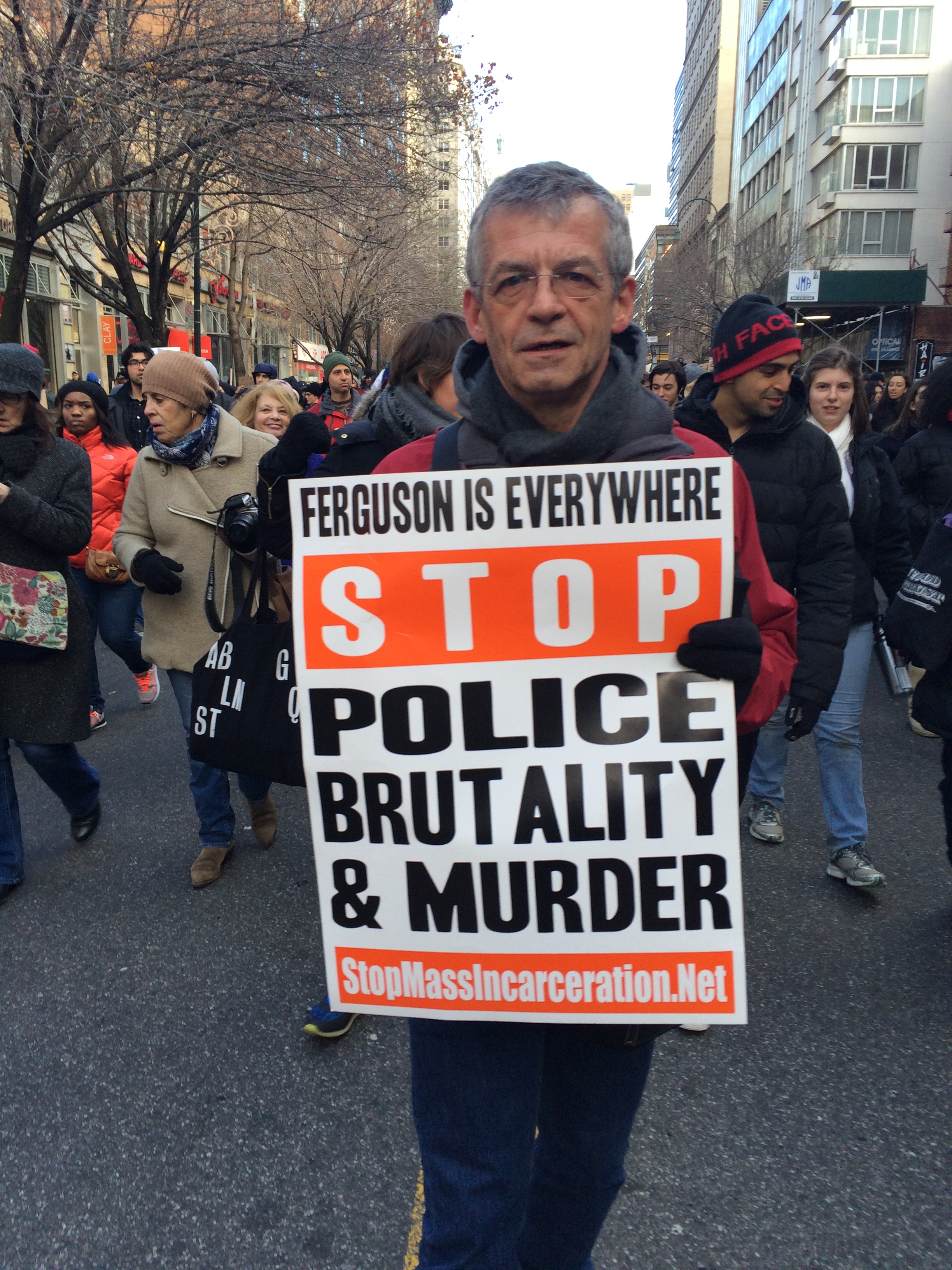
25B8A860-8474-470B-BE49-C1FE4896F235

August 9, 2014, Michael Brown had been shot dead by a Police officer, in Ferguson. Earlier, July 17, 2014, Eric Garner died after being put into a chokehold by a Police officer, in New York City. I am singling out two out of many events that led to renewed calls for reforming policing in the United States. Both in the U.S. and internationally, brutal instances of police abuse of power, including most serious crimes, sparked outrage leading to large and peaceful demonstrations. The “Black Lives Matter” movement stems from there. As a human being, and at that time being a temporary resident in the United States, I joined my fellow American friends in their peaceful call for addressing systemic racism reflected in the Criminal Justice system, and through abuse of power through individual police officers.

Already at that time the reform discussion on policing had much deeper roots, and there is a direct line connecting the history and those days of 2014 with what happens today, 2020. However, today the outrage is amplified, and there are signs that the calls for reforming policing, and the Police, are, finally being heard. Good.

Yes, peaceful demonstrations are proving that they are one of the most essential means and an inalienable right for citizens to participate in a democratic discourse about issues that matter.  And the subject matter of discussion is genuinely international: A friend of mine reported about participating in a demonstration in Berlin last weekend, with estimated 15.000 participants. It is one of many current events in Europe and elsewhere. Societies including my own German society have undertaken to conduct a self-critical discourse on the question as to which extent policing over here may also be unduly influenced by racial bias. Good.

Would all of that have happened without large-scale demonstrations? In my view, absolutely not. That is, by the way, why those who do resist these reforms, individually and institutionally, fear the demonstrations and thus attempt to label them with anything that would allow for discrediting intent of the demonstrations, manipulation of the course of the demonstrations and how they unfold, and the malicious labeling of individuals taking part in such demonstrations. These attempts are being conducted through manipulation, establishing and spreading unverified claims, false facts and lies, and using and spreading conspiracy-mongering strategies.

Most respected former U.S. public servants, including retired military officials are voicing their deepest concern about those who have adopted well-honed strategies practiced by systems and autocrats all over the World which have been criticised for exactly doing this by the very same United States of America. Good, because I hope the light can shine again, soon, and credible.

It looks like the peaceful demonstrations are here to stay. Good. Double down.

The range of topics in that discussion leading to these demonstrations is highly complex and beset with an enormous amount of emotions. It is about racial bias. It is about white supremacy. It is about countless cases of individual suffering and fear. It is about wrongful convictions, and a system of biased mass-incarceration, especially targeting communities of color. It is about the question how policing should be carried out, and how to hold police officers and other public officials accountable for their actions, including criminal actions. And much much more.

Within the current context of the United States, the contemporary development also can only be understood if put into the context of a society that is literally devouring itself, unraveled by a political partisan war ripping the fabric of consent into pieces about what is identifying and unifying all Americans, and what is so-called “un-American behavior”. It may well be that both sides blame the other for being un-American. The World is in disbelief. The ripples of instability stemming from this development have long arrived at the shores of Europe, Africa, Asia, and elsewhere. They bounce back from there, hitting the United States’s shores on the Atlantic and Pacific sides. Will that all calm down and settle into a new order, and will this be done with, or without violence?

Certainly, COVID-19 may have been a spark that set many things on fire. Fire? Not good in light of Global Warming. Oh yes, Global Warming is a fact. So, please, let us settle for consentual discussions allowing the young generations of this World to define our and their present, and their future.

These discussions need to be narrowed down. Topics have to be identified which can be taken forward, notwithstanding the complexity of the development as a whole. And in my view, it is extremely critical to take emotions out of these discussions, and to avoid antagonisation as much as possible. At the end of the day, a society needs to find an own consentual way forward in which positions converge into acceptable compromises. For, otherwise, there is no societal peace. And we do know that, without peace, there is no security. With no security, there is more heat. We can’t blame others for our own disengagement. But we always have the choice to engage. That’s why I am quoting James Baldwin.

This includes reforming policing, and the Police. After having settled on what policing is, the question how to implement it, follows second. Third then, one needs to consider how to fund what we want, and to re-allocate funding to where it is needed, and to stop funding of issues which run counter the implementation of what a society wants. So, in this third step, it is about de-funding, being part of a funding, and a reallocation-of-funding debate.

I should be clear: There is no way to establish a society with no self-policing of the rules that this society has given itself.

The violent death of George Floyd is a crime, one police officer is charged for second-degree murder and manslaughter. Three police officers are charged with aiding and abetting murder. George Floyd was subjected to police action after he was alleged to have used a counterfeit 20 USD bill for buying cigarettes. The police action ended in eight minutes and fourty-five seconds of suffering inflicted by some of the most cruel behavior I have seen in a while. And believe me, I have seen a lot.

It started with a counterfeit 20 USD bill. Why was Eric Garner being put into a chokehold, again? Proportionality of enforcement will be a point I will touch upon, later.

But I will say here that the reform discussion is triggered not by these few cases only, but because of the allegation that such behavior is systemic. That, also, makes it understandable why some try to argue that these actions are single cases. Which is not true. Truth matters, so look it up yourselves.

Another point in this first writing, attempting to look at the scope:
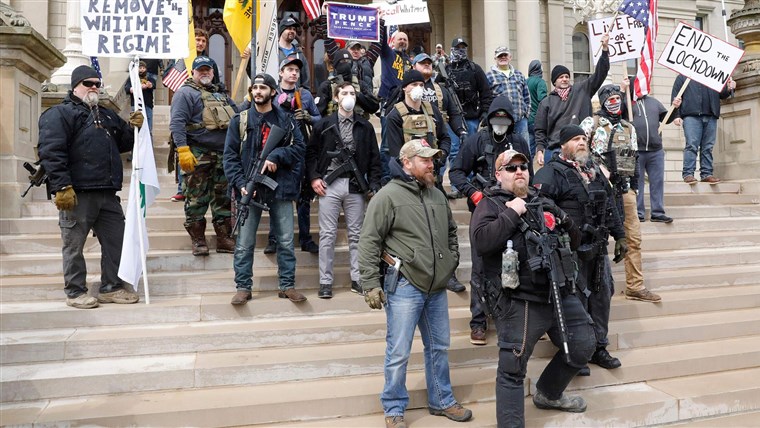
200415-michigan-protest-video-tease__415481.focal-760x428This picture was taken April 15, 2020, at Michigan Capitol

Of course I am respecting that the United States hang on to the Second Amendment. I have a personal opinion (horror and disbelief that people protest against the COVID-19 lockdown whilst carrying weapons of war), and I can also assure you that in Germany such an event would have led to as many SWAT-units as are available coming down on what would be considered a violation of strict weapons laws. But, of course, this is legal in America, thus the protest can be considered a peaceful protest.

The question I want to ask: Do you see one Afro-American person in that picture? Take a second and imagine all the individuals being black. And then, honestly, answer the question whether the indifferent action of the Police on occasion of that event would have been the same. Honestly, please!

Chances are the reaction would have been very different. That’s what I was saying in my post “Statement in Solidarity“: “Representative policing aims to ensure that the human rights of all people, without distinction of any kind such as race, colour, sex, language, religion, political or other opinion, national or social origin, property, birth or other status, are protected, promoted and respected and that police personnel sufficiently reflect the community they serve.” At this moment, an overwhelming majority of U.S. citizens believes that this is not the case. Instead, we are facing a cultural form of racism, different in argument from previous forms of biological racism, but on grounds of the same attitude and thinking of white supremacy.

Statement in Solidarity

Floyd

With the “Report of the Secretary General on United Nations policing” to the United Nations Security Council as of 10 November 2016 (S2016/952), the United Nations adopted, for the first time ever, a common understanding of the function of policing, and how it must be carried out by police and law enforcement officials. This understanding can be found in https://police.un.org/en/policy-united-nations-police-peacekeeping-operations-and-special-political-missions-2014, Sections 14 to 19.

Policing refers to a function of governance responsible for the prevention, detection and investigation of crime; protection of persons and property; and the maintenance of public order and safety. Police and law enforcement officials have the obligation to respect and protect human rights, including the right to life, liberty and security of the person, as guaranteed in the Universal Declaration of Human Rights and reaffirmed in the International Covenant on Civil and Political Rights and other relevant instruments.

Pursuant to the UN Code of Conduct for Law Enforcement Officials, police and other law enforcement officials are required, at all times, to fulfil the duty imposed upon them by law, by serving the community and by protecting all persons against illegal acts consistent with the high degree of responsibility required by their profession.

For the United Nations, the function of domestic policing must be entrusted to civil servants who are members of police or other law enforcement agencies of a national, regional or local government, within a legal framework that is based on the rule of law.

In accordance with United Nations standards, every police or other law enforcement agency should be representative of and responsive and accountable to the community it serves.

Representative policing aims to ensure that the human rights of all people, without distinction of any kind such as race, colour, sex, language, religion, political or other opinion, national or social origin, property, birth or other status, are protected, promoted and respected and that police personnel sufficiently reflect the community they serve. Fair and non-discriminatory recruitment and retention policies are expected to encourage, among other goals, an adequate participation of women and minority groups.

Responsive policing ensures that police respond to existing and emerging public needs and expectations, especially in preventing and detecting crime and maintaining public order and safety. Policing objectives are informed by the public safety concerns of the communities they serve and are attained lawfully, efficiently and effectively and in accordance with international norms and standards in crime prevention, criminal justice and human rights law.

Accountable policing means that police are accountable to the law, as are all individuals and institutions in States; that police are answerable to the public through the democratic and political institutions of the state, as well as through civilian democratic oversight bodies and mechanisms to improve community-police relations; that police are accountable for the way they use the resources allocated to them and that effective mechanisms are established for accountability over police conduct, including any allegations or established human rights violations committed by the police.

For the United Nations, the rule of law refers to a principle of governance in which all persons, institutions and entities, public and private, including the State itself, are accountable to laws that are publicly promulgated, equally enforced and independently adjudicated, and which are consistent with international human rights norms and standards. It requires, as well, measures to ensure adherence to the principles of supremacy of law, equality before the law, accountability to the law, fairness in the application of the law, separation of powers, participation in decision-making, legal certainty, avoidance of arbitrariness and procedural and legal transparency.


As one of the chief architects of this United Nations policy, I stand in solidarity with the countless citizens, in the United States of America and all over the World, who exercise their right to demonstrate peacefully. I join them in expressing utter outrage in the face of widespread racism, white supremacy, and a systemic and horrifying abuse of power including most serious and heinous crimes by police officials against communities and individuals of color, and minorities.

I call on my fellow police colleagues to stand in humility and in support of the communities they serve, to walk with them, and to protect them. The streets belong to citizens peacefully exercising their rights and enjoying their freedom. They are neither a battle-ground to be dominated, nor a place for curfews preventing peaceful citizens to exercise their most basic human and citizen’s rights, including the freedom of opinion and speech. Curfews can only be possible under most serious and temporary circumstances.

No public official shall use his or her power for violently pushing peaceful citizens aside.

I call on my fellow police leaders to exercise a strict no-tolerance-policy towards acts of violence and the systemic disrespect of police officials towards the communities they are obliged to serve. No zero-tolerance-policy against violence and criminal conduct is legitimate in a democratic society if those who are mandated to serve and to protect peaceful citizens show no respect to the law, to the values underpinning the laws, and to fellow citizens, themselves.

I commend those police officers who apologize to victims of police violence and abuse of power, but I also say: You must work long and hard to earn back the respect of those citizens who have lost faith in you. You are meant to protect, rather than to be an instrument of “law & order”.

My heart goes with all victims of police abuse of power and horrible crimes including murder, conducted by individual police officers, supported by a cruel and self-serving, selfish and dividing attitude by those who believe they can exercise unrestrained power, rather than fulfilling an obligation to serve all citizens who have democratically elected them.

I am saddened, ashamed, and deeply sorry. I hope we can all breathe together.


Stefan Feller, Former United Nations Police Adviser and Director of the Police Division (2013 – 2017).

Berlin and Belgrade, June 06, 2020

Obituary – James Le Mesurier – † 11. November 2019

Einsame Nacht

Die ihr meine Brüder seid,
Arme Menschen nah und ferne,
Die ihr im Bezirk der Sterne
Tröstung träumet eurem Leid,
Die ihr wortelos gefaltet
In die blass gestirnte Nacht
Schmale Dulderhände haltet,
Die ihr leidet, die ihr wacht,
Arme, irrende Gemeinde,
Schiffer ohne Stern und Glück –
Fremde, dennoch mir Vereinte,
Gebt mir meinen Gruss zurück.

Hermann Hesse, 1902

I have looked up quite a few translations of this poem into English. I have found none which would carry the same powerful emotional language this poem possesses in its native version. It is one of my timeless favorites since more than 45 years. Its subtle meaning makes me deciding to use it for this obituary.

Last year saw the untimely death of James Le Mesurier. November 11, he was found dead on a street in Istanbul. A link in German language: https://www.spiegel.de/politik/ausland/james-le-mesurier-fragen-und-antworten-zum-tod-des-weisshelme-gruenders-a-1296105.html. A link in English language: https://www.theguardian.com/world/2019/nov/13/james-le-mesurier-obituary.

Like many, including closest friends of mine, I was devastated learning about his death. I met James during my time as the Police Commissioner of the United Nations Mission in Kosovo, in 2002.

I worked closely with him. We shared a strong desire to contribute to ending the conflict there, working against the cycle of violence which still was a part of the reality back then, and for years ahead.

Beyond work, I got to know James as a compassionate human being, a humble person, never  making himself important, always being part of a team. I lost contact to him after I left Kosovo, in 2004.

Around 2013, James co-founded the White Helmets, together with AKUT, a Turkish disaster relief organisation. Today, there may be around 3000 White Helmets. Please watch the trailer of the award winning 2017 Netflix documentary about them: White Helmets. If you are interested in the full movie, head over to Netflix. But even if you just watch the trailer, it will already give you a sense of the incredible humanitarian work in which James engaged. I am working in the German Foreign Office. I am proud to say that my government is supporting the work of the White Helmets by political and financial means, and that we were shocked and saddened by his untimely death.

Much speculation sat around the circumstances of his passing away. I won’t engage in this. What I do note, however, is that James and his colleagues were subject to harassment and hate, because of their humanitarian engagement. When coming across evidence of chemical warfare against civilians, this evidence and video documentation was used in an investigation conducted by the United Nations. Governments in Damascus and Moscow subsequently launched a propaganda campaign including allegations that the video documentation was faked, and that the organisation would have ties to terrorist groups. According to Der Spiegel (see link above), the Syrian president threatened the White Helmets with comparing their fate with that of every terrorist: Either they lay down their weapons, or they will be liquidated. Which weapons was he talking about? Shovels, being used to rescue victims from the rubble, in the name of humanity? Bare hands?

James must be remembered as one example of how a person decides to stand up for values, and then taking action. Discrediting adversaries is one thing. Refusing accountability for attacks against the own population (link is an example of a UN investigative report following an attack with chemical weapons in Syria) and threatening those who help survivors to rescue other survivors belongs to the darkest chapters of inhumanity.

I miss James dearly.

2020

The link to this article, an opinion piece written by Madeleine Albright, has been sitting in my draft folder for this blog since April 2018. I am using it now, twenty months later. It has lost nothing of it’s relevance. The stakkato of hate, bigotry, white supremacy, disregard for the rule of law, bullying and forceful coercion, and shameless lies being thrown at 68 million followers on Twitter, and the rest of the World, has reached unimaginable levels.

Given the fatigue of many who have not found any other answer to what we are experiencing since 2017 (and before) than to say “What can we do?“, or “I am sick and tired of this, I do not want to hear from it any more!“, it has become ever more important to stay the course of standing up for truth and justice, humility, humanity, and caring for other beings.

One of the reasons why I was not writing on this opinion piece was that I felt that I ought to be careful with voicing a political opinion. Being a public servant in my home country, Germany, comes with obligations. Serving as an official grants me the protection against being fired for any other reason than severe misconduct, and it obliges me to conduct myself becoming in all my affairs. So, at that time, I decided not to write about the current incumbent of the office of the President of the United States.

Another reason was that my partner at that time, a well educated and liberal U.S. citizen, had told me that she did not want to even read about this person anymore, nor wasting her time discussing what was unfolding. This unsettled me. Because I felt that she wasn’t alone with this attitude, that many have given up raising their voice. I felt strongly that this is wrong, because it just leaves more space for those who vomit messages of hate and division. Yet, I accepted it.

I was living in the United States at that time. In August 2018, I returned to Germany, where I have been living since. And I am spending the last day of the year 2019 outside Berlin, escaping the fireworks and the noisy drunkenness, enjoying my RV, as they say in English, my little apartment on four wheels.

I am trying to make sense of all this development that I have been witnessing, and I have no formula explaining all this. It is way too complex for one convincing simple explanation. Because, of course, this is not about the U.S., or Germany, for that matter. Or Hungary. Or Italy. Or so many other places where nationalism is on the rise, and fascism is thriving ever so openly and without neither shame nor tolerance. There is absolutely no clear cut answer, it will take legions of historians decades from now to reduce the complexity of our current situation in hindsight and to come up with some big patterns about what happened, and why. If we survive until then.

Yet, it appears to me that exactly this overwhelming complexity, combined with instilling fear, is being used by the Great Simplifiers and Manipulators of this World to come up with easy and highly emotionalised messages of division, xenophobia, and rage.

It also is not about one of the most predictable persons I have ever witnessed. Nothing in the character of Donald Trump can surprise if one combines basic knowledge about narcissism, sociopathy in its most extreme form, and the fundamental personal insecurity which is so visible in what he says, how he says it, how his body language is telling the story he wants to hide. There is no reasoning, nor compromise. There is only rage and escalation. There are no friends, but only pawns, useful idiots, people in position of power to get along with, and foes. There is no point where this person will say: “I give in.” A person with this severe mental disorder is literally not capable to compromise. Rather than giving up, such a person will attempt to destroy everything. Such a person is unable to relate to other beings. That person’s only way of interaction is manipulation and coercion. I am feeling sorry for such people.

But what scares me is the silence of the lambs, combined with the willingness of many who claim to be part of the bedrock of democracy to subject themselves to the most severe form of self-mutilation: The removal of the spine. Shared principles stand in the way of selfishness, and this it seems: The unleashing of pure selfishness.

So, what do I have to say at the end of 2019? What can be said when many, if not all beacons of what we came to believe being the great achievements post World War II seem to fall apart, seem to be torn down, ripped into pieces? What can be the guiding principles which will allow us to navigate through the next decade, with 2019 filled to the brim with the ringing of alarm bells about a planet being on fire, and humankind seeming to be willing to accept inhumanity, and ever more so-called leaders unwilling to share this world amongst all, and displaying unwillingness to act responsible towards future generations?

I gave this answer to a group of students at a German university, a few weeks ago: If we do not know much about how the world is looking like tomorrow, and if we wonder about what is important, and what is less important, if we wonder about how we should engage, we must think deeply about the most fundamental values which we would like to preserve for the sake of our children, in any unknown scenario. And then, we must act according to these values. We do not need to be sages, university professors, people in powerful positions. We can carry out any function, take any role. We just have to live according to the principles we have wrestled from deep thinking. Just apply one basic rule: Do think for togetherness.

My eleven year old daughter wrote a letter to the King of Saudi Arabia. I am not posting it here. Just saying: She made me incredibly proud. In simple words, she made her values clear. And she turned them into action.

May 2020 be a year where we find ourselves discussing values, peacefully, and with willingness and ability to listen to the other, with love and compassion and the desire to understand the other being. And may we be guided by what we learn. Together.

Happy New Year.


Workshop “Implementing the Protection of Civilians Concept in UN Peace Operations”

December 12, 2019, I was invited as a panelist in a workshop with the above title, convening a number of experienced individuals providing a political, humanitarian, military, and policing perspective to one of the most demanding topics within the context of peace operations of the United Nations. The following is my contribution to this workshop, as a panelist.


The moderator of the panel in which I participated, provided the following framework

For our discussion, it would therefore be wonderful if you could speak for 10-12min, addressing from your own experience some of the points above, identifying concrete challenges and practical ways to overcome them – with the aim of providing advice for a potential stronger role of Germany in implementing POC . I would in particular encourage you to provide as many concrete examples as possible to illustrate the points to the audience.


I can not help but begin with asking four crucial questions, when we talk about “Protection of Civilians”. If we would jump immediately into military and policing aspects, I believe that we are repeating a mistake which I have witnessed being made all too often:


  • Protection by whom?
  • Protection for which reasons?
  • Protection against what?
  • Protection with which means?


Let me explain:


Protection by whom?


We usually say that the protection of the civilian population is a core responsibility of the State in question. And then I usually say: When a peacekeeping mission is mandated to protect civilians, this is a substitution for this responsibility, because the State in question can’t, doesn’t want to, or should not, exercise this responsibility, or any combination of these three reasons. I can give many examples, if it is useful, later on.

But we usually conclude from the fact that we substitute for a State responsibility that the State in question has been exercising this responsibility before, by means of a State apparatus including police, and military. Which is often not true. Quite often, the reach of the State and its organs is limited to urban areas, or the Capital. Like in Afghanistan, Yemen, to some extent Somalia, or in the northern parts of Mali, and for various reasons. Or there is, for example, Abyei, the “Box” between Sudan and South Sudan, where there is no State authority because the area is subject to unsolved political disputes.

The reality, however, is that very often, when there is no conflict, and no State authority, it does not mean that nobody exercises POC. We often disregard, or sometimes have difficulties to accept within the culture of our thinking, the relevance of tribal structures, or co-existing parallel frameworks affecting only parts of the population: Like two different frameworks in Nigeria, one for the Muslim part of the country, one for the non-Muslim part.

Why is this important? Because I often see the reflex in mandates that we talk about the extension of State authority, and meanwhile the peacekeepers exercise POC. Like in Mali. Well, in Kidal the extension of State authority from Bamako is not creating much enthusiasm, same in Somalia or in many other places.

So, when we start to protect within a flawed, but well-meant, political context, we run into problems: SRSGs, Force Commanders, and Police Commissioners. We can discuss that.


Protection for which reasons?


They are being slaughtered. They hide amongst piles of dead neighbors in Srebrenica, pretending to be dead. They are being raped and killed in the open, outside of the Gates of UN camps in South Sudan. They have no justice, nor order, in Abyei. They are target of extremists and terrorists in Kidal, Mopti, Gao, Timbuktu. They are being recruited as slaves or servants or child soldiers, in the DRC, or in Burkina Faso or Niger, as they were in Sierra Leone, or Liberia. They are subject to retaliation by the Kosovo Liberation Army after the Serb VJ and the MUP had to leave, as a consequence of the Military Technical Agreement in Kosovo. And on and on and on.

I said it: We substitute for the absence of protection. We do know from longstanding experience that successful substitution works better at the beginning, where we do not have more than, at best, initial operational capacity, and an enthusiastic population, as well as a somewhat muted group of former powerholders. Then we struggle with generating the necessary means, and meanwhile things get difficult for us for a million reasons. Sooner or later they don’t like us that much, any more. And then we see that there is no sustainable alternative to domestic protection of civilians. At times, or often, we realize that too late.

Substitution needs the implementation of capacity building from the very first day on, as an exit strategy. And here we run into a plethora of challenges. Let me pick two: We don’t like to talk to former militia and else, they may be subject to war crime investigations. But to whom do I talk? Or I heard, in Mali and in CAR: We can not do capacity building, because they have to run through their elections first. So, we delay capacity building. Or, in Mali, I saw that we got the responsibility to capacitate four different law enforcement branches. Unfortunately, the former group of Tuareg controlled by terrorists had taken away the police cars, radios, ripped the electricity cables from the police stations, and they used the cars for attacking the population during power cuts in the dark. And when I asked the international community to help not only with training, but with equipment, the response was very muted, to put it mildly. Or in Bangui: I saw the DG of the Police in his headquarters. A few pieces of paper from destroyed criminal archives were still floating around, a rusty skeleton of a police car stood on the compound, windows were broken, and the one AK 47 I saw I would not even have test-fired without standing behind a solid wall.


Protection against what?


Every police and military planner will ask this question first: What is the threat? Contemporary conflict environments are facing a dimension of threats which is very different from parties to a conflict having agreed to a peace agreement and still some flares of violence continue. Our environments include asymmetric threats, sometimes we talk about “non State actors”, but I talk about a complex web of interests between local and State powerholders, extremists, terrorists, organized crime, former warlords, rebellious military and police commanders, and and and. Any physical protection by police and military is being set into a political context where SRSGs need to talk and negotiate and exercise coercion and nurture agreements, but where stakeholders within the economy of crime and conflict tend not to talk openly to those SRSGs. Rather, they at best disregard the political, military and police means given to the peacekeepers. If these peacekeepers run across their interests, they are being targeted, and/or the population is, because if one wants to control a population, one needs to disrupt communication between those who protect them, and themselves. Then, offer some social services yourselves, and the Stockholm Syndrome will help deepening the divisions.

Protection requires communication between the protectors and the protected at the core. I will spare examples for the discussion.

Secondly, the threat is hybrid: On the extreme side, it is a military threat. On the other side of the spectrum, it may be a criminal threat, and a threat to order because of the absence of elements of order. But in the huge middle part of the spectrum of threats, these threats are hybrid. This does not allow for applying distinctly separate military and policing means. When the Bridge Watchers in Mitrovica-North had taken advantage of some foolish international police officers who thought they could flex their muscles, any international presence broke down. I flooded the place with short-sleeved police officers, under heavy area protection by KFOR and heavily armed Formed Police Units. Their task was to go where the Bridge Watchers were, and to talk to the population, and to shopkeepers. Explicitly, they had to disengage if subject to provocation. And they had to come back the next day, and the next day, and the next day. I can explain how we turned the situation around. Later.

So what I say is that military and police peacekeepers are within an extremely robust environment where they both need to exercise policing logic and means. This does not only require sufficient police, but also sufficient soldiers who are trained in policing logic, and it requires a joint structure of command. In my view, my friend Maqsood Ahmad, MilAd, and I, PolAd, were not successful in trying this in Bangui. Because neither Military Commanders nor Police Commanders were willing to trust each other under one chain of command. Neither when we gave it to the Police Commissioner, nor later on, after heavy violence, to the Force Commander.


Which leads to the last topic:

Protection with which means?


I will be brief, because this needs to be discussed:

  1. POC begins with a sound political understanding.
  2. Political leaders of peacekeeping operations need to make both Force Commanders and Police Commissioners a core element of their daily consultations. They need to hold these Commanders accountable for jointness, and they have to demonstrate leadership in checking on to which extent military and police leaders in peacekeeping operations work together, rather than only saying they do. SRSG have to reach out to both, and not to talk about “The Force”, meaning their military means, and the Police Commissioner as an annex. Likewise, a Police Commissioner who does not entrust policing tasks to military colleagues, and instead saying he needs more attention, and police officers, just hides behind this seemingly correct argument, instead of embracing the reality: He or she won’t get more officers, and even if there were enough, still there is a massive need of jointness of thinking and planning and implementing concepts to protect civilians. And if police and military leaders tell you that the respective counterpart doesn’t work with you, and you hear it from both leaders, fire them both.
  3. We can complain about the absence of enough police capacity for policing problems, it will not change. I have deliberately not commented on the POC strategy, and what I did between 2013 and 2017 to come up with a POC doctrine for UNPOL. The message that I want to get through at the end is that colleagues in green and blue fatigues with blue helmets are facing a challenge which they can only solve in unison. This needs to be reflected in training. I have repeatedly said: I don’t care about the color of the uniform. I care about the function to be implemented. In vast parts, this is about policing in a rough and dangerous environment. So, I suggest we overcome the hesitation that comes into play when military colleagues begin to think and to train like police. It is the single-most important challenge on the side of uniformed peacekeepers to overcome the divide between green and blue, and to be both green and blue in hearts and minds.

Ending a leave of absence

So, I left the blog mostly unattended for a long while now. When my time with the United Nations ended and I arrived in Germany, many things took surprising, and to quite some extent, unwanted turns. I needed time to process. A lot of time. That’s how life is, isn’t it? I embraced my inward journey, embraced my fears, embraced my pain, embraced my mourning. It did not leave me much energy for more, and it was good that way, because that is normal. Everything in life is a source of learning, every development, every person is a teacher to me.

There always is a connection between my personal development and my professional path. So, for me my experience with how much time is needed to go through a healthy mourning process also serves a deepening understanding about how much time is needed to coping with similar processes on the level of a community, and a society. It runs counter the impatience of fast-paced political processes in an ever more fragile world. We always need a reminder that a quick fix here, and a quick fix there is merely having the same effect than a small firepatch has on a bushfire. And in a firestorm we are, for sure.

Back to my personal process, there is not much I am sharing at this moment in time. But at some point recently I finally knew which shape my book that I am going to write will take. It will include all personal aspects, and professional aspects, weaved together into the story it is: My story. From time to time, I will post parts of it here. I will give up the restraint talking about personal developments, and attempting to focus only on the lessons I learned in relation to my professional work. I am ready for this. Because, I believe, there is a lot of hope in it. Experience, strength, and hope will be the elements of this book.

I will retire from my work as an active police officer after 43 years and six months at the end of January 2020. Some freedom of expressing myself comes with it. Not that I will do the usual “memoir thing”: Settling scores, or telling secrets, or going sensational or boasting. Not at all. But as a highly visible individual at the interface between technical issues of helping, and the political side of it, I also decided to be a little more muted. No need for this any more.

Retirement will not mean I will sit at the fireside. I am looking forward to an exciting new opportunity to contribute to peace and security for the next many years, and I will spend a considerable time of it in my beloved Balkans. I will live in Belgrade, and will travel my second home town Sarajevo, will be in Pristina, Skopje, Tirana, and Podgorica. I will be in Berlin. And I will enjoy a new form of working and being with friends at the same time.

I will start my new phase of writing with posting a speech I gave on the topic of Protection of Civilians, on occasion of a workshop here in Berlin in the Ministry of Defense, just recently. It drew quite some attention, and some colleagues advised me to share it more widely. So, that I will do, herewith.

A bone-crushing juggernaut

Should his own face in the mirror be too awful to contemplate (and it usually is), he might first take a look at the results normal people get from self-sufficiency. Everywhere he sees people filled with anger and fear, society breaking into warring fragments. Each fragment says to the others “We are right and you are wrong.” Every such pressure group, if it is strong enough, self-righteously imposes its will upon the rest. And everywhere the same thing is being done on an individual basis. The sum of all this mighty effort is less peace and less brotherhood than before. The philosophy of self-sufficiency is not paying off. Plainly enough, it is a bone-crushing juggernaut whose final achievement is ruin.”

Written by some very wise and fine people, in New York, 66 years ago

A High-level View on Reform Needs for Peace Operations

This article combines an analysis of current reform efforts, and reform needs that I see following my four previous posts on the impact of trauma on sustainable peace and reconciliation. So, partly, you will see language coming from there. Opposed to these four pieces, this one does not make reference to external sources through footnotes. If you want to “check the fact-checking” for my conclusions, read the more detailed analysis.

Since taking office January 2017, the UN Secretary General has made the reform of how the UN engages in the field of peace and security a top priority. His vision includes efforts to improve the complex architecture through which the many UN actors within the Secretariat and within UN agencies contribute. More importantly, it also includes improving the conceptual approach: A historically grown delineation between peacekeeping and peacebuilding efforts, with the latter following the former, is being gradually replaced by more integrated approaches which put conflict prevention at the fore. Sustained peace and security is the best approach to prevent relapse into renewed conflict.

In his own words, the SG describes the challenge in his report to the General Assembly and the Security Council on peacebuilding and sustaining peace: “An important breakthrough … was the recognition that efforts to sustain peace were necessary not only once conflict had broken out but also long beforehand, through the prevention of conflict and addressing its root causes. More countries have recently experienced violent conflict than at any time in nearly three decades. Forced displacement has reached unparalleled levels. In too many places, the cohesion of societies and the well-being of people are at risk. Building a common vision of society must involve paying attention to the causes of those problems. In the resolutions, it was recognized that the international community must redouble its efforts to support Member States in preventing crises that exact such unacceptable and growing human and financial tolls.

The Secretary General thus points at the inherent connection between well-being of people, the cohesion of societies, and the likelihood of violent conflict: Health, including mental health, and cohesion of communities and societies are inseparable. In the currently increasingly challenged global system, with a rise of populism, nationalism, disregard of achievements on human values and rights, and erosion of vital elements of democracy including the rule of law, international organizations such as the United Nations are experiencing distrust and at times open hostility. A credible implementation of the UN SG’s vision requires to give him utmost support.

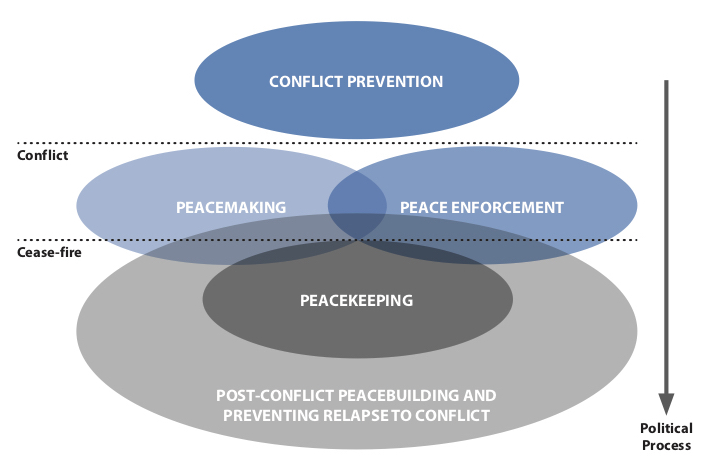
UN policy has not kept up with developments in peacekeeping, which has seen an increasing number of mandates that have changed the principles which have traditionally defined it as based on consent, limited use of force, and impartiality. The 2008 Capstone Doctrine sought, based on the findings and recommendations of the 2000 Brahimi Report, and on the aforementioned principles, to place peacekeeping within a spectrum of “Peace and Security Activities”, a “range of activities undertaken by the United Nations and other international actors to maintain peace and security throughout the world”.

Image0

Whilst the Capstone Doctrine places peacekeeping within a larger set of concepts, the other elements remain largely undefined policy wise. This is also true for UN Special Political Missions. As one of the consequences of a changed environment in which these missions operate, peacekeeping has focused more and more on the grey zone with peace enforcement, making it more difficult to create a distinction to peace enforcement which is required if one is to uphold the traditional principles of peacekeeping. Peacekeeping is challenged by having a conceptual identity that is less reflected in contemporary mandates. With regard to it’s current reform, there is a common tendency to focus on those parts of this reform that make operations fit for work in less benign environments where there is less and less consent of stakeholders with the presence of a UN operation that includes more coercive capabilities. As another consequence, the distinction between peacekeeping operations and special political missions, which have been growing over the years since then, has become more difficult as well. At the same time, no follow up to the Capstone Doctrine took place. The “scattershot, incoherent and occasionally contradictory or competitive international efforts as a significant source of failed peacebuilding efforts”, as described by the SG in his 18 January 2018 report, comes as no surprise.

The 2015 report of the “High-Level Independent Panel on United Nations Peace Operations”, in conjunction with the 2015 “Report of the Advisory Group of Experts for the 2015 Review of the United Nations Peacebuilding Architecture” have set the stage for the current reform activities. Yet, a unifying policy that would reflect the views of all stakeholders within the United Nations how best to combine existing tools under the primacy of the Secretary General’s vision of putting conflict prevention to the fore is not yet visible.

At the same time, again with the SG’s own words in his report as of 18 January 2018, “the 2030 Agenda for Sustainable Development contains the blueprint of the common vision of society towards which the world is trying to move. Inclusive and sustainable development not only is an end in itself but also happens to be the best defence against the risks of violent conflict. The 2030 Agenda also contains the promise to leave no one behind in the quest to build such societies.

It can, therefore, be argued that the reform vision of the UN requires a fundamental discussion about how to proceed with outdated and incomplete doctrine: Peace operations need to be more integrated, which is one of the objectives behind the SG’s reform initiative of the peace&security architecture of the UN Secretariat: The UN is currently implementing a new organizational setup. This absorbs most capacity that is not already consumed by operational needs. However, in order to drive change, in this fundamental discussion there is a need for guiding strategic principles for mandating peace operations, and how they integrate the political objectives of the UN and its constituency. Growing rifts between members of the UN Security Council, and between the driving forces of the Security Council and the general constituency represented in the UN General Assembly can significantly paralyze future success of this reform.

If identifying root causes of conflict, as stated by the SG, sits at the heart of conflict prevention activities, then identifying root causes for relapse into conflict is a core activity of conflict prevention as well. It has often been stated that, in order to get peacekeeping done right, important opportunities of assistance during the early “golden hours” need to be addressed better. This is true for transnational threats including the combined effects of transnational organized crime, violent extremism, and terrorism, but it is also true for early assistance to peacebuilding, which often is missing recognition in mandating peacekeeping operations. Even more then this is vital if a renewed strategy of the United Nations is meant to lead to more integration and coherence between what currently is understood as peacekeeping and as peacebuilding.

Innovative approaches are needed in support of the Secretary General’s vision to make the entire system fit for contributing to the 2030 Agenda for Sustainable Development. The context between conflict- and war related trauma of entire young generations and their caregivers through many forms of abuse on one hand, and the ability of communities and a society to move forward towards sustainable peace on the other hand, remains part of the scattershot activities of actors attempting to help, but without a guiding high-level policy.

At all times children have witnessed their fathers being killed and their mothers being brutally raped, and they have suffered from the same cruelties themselves, committed by armies, militias, gangs, and mobs. Children have been separated from their parents, endured unspeakable atrocities. This is the reality until today. Nowhere this is more devastating for communities and societies than when acts of severe war crimes or genocide are being committed. Generations suffer. Never before in human history the number of civilian casualties has outnumbered the military casualties as much as today. In contemporary conflicts, as much as 90 percent of casualties are among civilians, most of whom are women and children. Women in war-torn societies face specific and devastating forms of sexual violence, systematically deployed to achieve military or political objectives. It is in this context that entire traumatized generations emerge.

Children grow up with the consequences of what has been done to them and their parents, others again grow up with the knowledge that they are born because their mothers were raped. Raped mothers struggle with acceptance in patriarchal societies. Raped men even more. Children of rape, raised by a traumatized raped mother already struggling to love her unwanted child unconditionally, they also experience being pariahs in their communities. In all this suffering, childhood trauma is different from the trauma of adult survivors of conflict in that trauma is perceived as an event or a series of events in life for adults. It is defining the life of children. It is their never ending reality, and the younger they are, the fewer, if any, cognitive tools they have to comprehend what happens to them and to put it into a context of accountability of others. Mental health is severely affected by irreparable damage to the developing brain, and mitigating coping mechanisms within families or communities are dysfunctional or absent.

Sustained severe trauma through conflict-related violence profoundly impacts on the world of a toddler who has no concept of complex human relations. Subsequently, the adult survivor will suffer from a deformed capacity to establish healthy human relations. Because of neurophysiological damage inflicted by enduring trauma this is true for all cultures.

The International Community is also defined by the helplessness of many who care about humanity and decry the atrocities through soldiers, militia, gangs, mobs, violent extremists and international terrorists against civilian populations including children, whether in Syria, Yemen, Afghanistan, Iraq, Somalia, Sudan/Darfur, South Sudan, Central African Republic, Democratic of Congo, Burundi, Niger, Mali, Libya, recently Mozambique, Myanmar, and so many other places. Increasingly the divisions within the UN Security Council do not allow finding a common position that can be enforced. In cases of mandates being given to UN or partner organizations, we are confronted with an increasing inability to stop atrocities under our eyes, and to help countless trauma victims in the aftermath of conflict: Respect for ceasefires or commitment to peace agreements is as much waning as the acceptance of the UN itself, not least because of the disunity amongst those who constitute the UN: Member States, and especially the Security Council Members. Peace operations that can not sufficiently engage in deterring atrocities lose political credibility, such as in South Sudan, peace operations that engage in order to protect civilian populations with robust means, such as in Mali or the Democratic Republic of Congo find themselves being accused of bias, increasingly getting under fire themselves. The plight of civilians, especially children, continues. Billion-dollar peacekeeping operations get stuck in conflict where there is no peace to keep, losing capacity and credibility to contribute to peacebuilding.

Global migration of surviving traumatized young people throws them into the merciless arms of organized criminals and spills them into societies which are overwhelmed and increasingly hostile. Across the globe, whether in the U.S., Europe, or in Bangladesh facing refugees from Myanmar, traumatized children continue to experience severe traumatizing even in places they have been told might be their hope for a better future. Families with cruel abuse stories at their place of origin find themselves in another horror: The arrest of the adults and the forced and cruel separation of their infants, toddlers and children from them without any prospect to know how to maintain contact, or when they may be re-unified. Children who have been thrown on smuggler’s boats by their parents experience that a country denies access to a port of entry to vessels operated by aid organizations. Trauma becomes a constant fact of life. Alienation both on the side of victims and receiving host societies’ communities leads to “why bother” on either side. Antagonization leads to mutual resentment and hate. The spiral of conflict continues. Deported forced migrants come back to their country of origin, with little hope for peace, security, and some economic future. What do we know about the impact of mass trauma on children and adults by conflict and war? How well do we understand the connection between healing of individuals and communities, and societies, on the one hand and reconciliation as a core pre-condition for lasting peace?

On a high-level policy level, a much better appreciation of the damaging neurophysiological consequences of sustained childhood trauma within communities within and post conflict is necessary. A health-focused discussion needs to happen, recognizing the importance for peacebuilding efforts. Notwithstanding the different conditions created by different conflicts for whether, and how, the effects of severe trauma can be addressed through international assistance, its impact itself on communities and a society are deep. Whilst the crippling, life long, and intergenerational impact of trauma, especially during early childhood, on individual mental and physiological health is well documented and increasingly better understood, less knowledge exists about how it affects conflict- and post-conflict communities in different cultural settings. Even less studies have been undertaken on how such communities affected by large scale mental health deficiencies contribute to societal healing, or are supported in healing by those societies they exist in. Yet, any practitioner will agree on the relevance, perhaps with varying degrees of helplessness when it comes to the question how to help. Studies about how to overcome this within peace operations do not exist.

Closely connected to efforts raising awareness, a path towards identifying mitigating measures within peace operations needs to be charted. This is important in order to make a difference to the current situation: Practitioners and policy-makers acknowledging the problem in principle, but not sure about how to better and more holistically address it. However, the impact on building sustained peace, including through reconciliation, is critical. Therefore, the question must be how to incentivize an increased focus within support efforts for peace and security.

Without doubt, scattershot efforts to the best of the abilities of many actors do exist, including through humanitarian actors working in peace operations with so-called multi-dimensional mandates. An effort collecting views, practice, and potential best practice needs to be undertaken.

A new approach – Part Four in a series on Trauma and Conflict

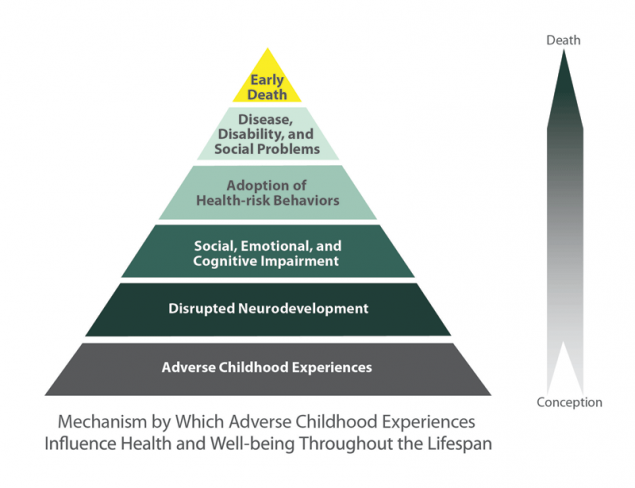
In Part I I have shown that pro-longed and intense trauma creates dysfunctionality in many forms, and that the impact of trauma during formative periods of brain development goes even deeper1.

ace_pyramid_lrg-medium.png

(Picture taken from: https://www.cdc.gov/violenceprevention/acestudy/about.html, retrieved June 27, 2018)

The longer a young child exposed to repeating trauma through forms of childhood abuse, the higher are both chances of, and the depth of, life-long badly damaging consequences. One very important reason for the unmitigated impact of trauma sits with that parents or caregivers either are the source of the child’s trauma (abuse of any form), or that they are not appropriately able to nurture a traumatized child.

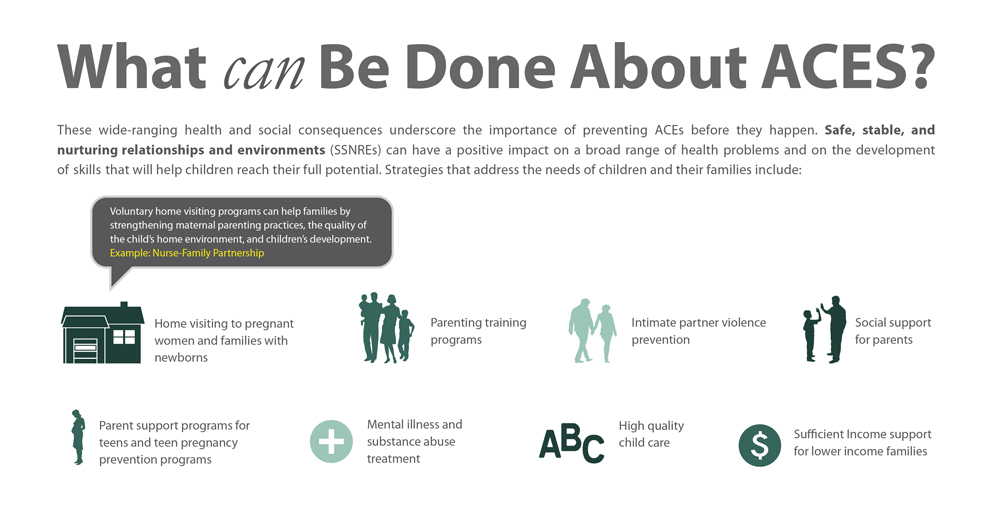
whatcanbedone

(Picture taken from: https://www.cdc.gov/violenceprevention/acestudy/about.html, retrieved June 27, 2018)

Children who, for example, get victimized by sexual abuse through third persons, depend on that their caregivers are able to respond appropriately. If they don’t or can’t, life-long dysfunctions include severe depression, compulsive pain medication leading to addiction, and a general struggle with building healthy relationships. Health problems can be severe, leading to premature death, including through substance abuse, and suicide.

In Part III I am referencing studies that confirm this for children who survive abuse in countless forms happening in conflict and war. There is evidence for that social relationships and the existence of culture-specific coping strategies, can mitigate the impact of trauma. Healing can happen. But where there is an absence of these mitigating factors, because the parents are traumatized themselves, and because cultural mechanisms struggle or have broken down entirely, dysfunctionality becomes a feature of communities and even an entire society. The plight of caregivers deprives the traumatized children from healing.

How can we expect that large percentages of trauma survivors do not influence the functioning of communities and societies? It might be difficult to find studies that confirm the relationship between trauma-induced life-long and inter-generational dysfunctional behavior on the level of entire communities and the ability of communities and a society to move to lasting peace including through its ability to reconcile. But simple logic tells that this is the case: Reconciliation is, as I have said, about restoring inner harmony, integrating memory and behavioral impact of trauma into a healthy form of living. Dysfunctional individuals can not contribute to restoring a healing and healthy community, as the community is made from these individuals who need to heal in order to contribute their healthiness to the Whole. My personal experiences in this regard, stemming from living in and visiting so many communities support this. So goes the experience of every health worker, every humanitarian, every peacekeeper. We do collectively know that a country relapses into internal conflict easier than plunging into an internal all-out conflict without having suffered from precedents. We do know that vulnerable communities in a weakened society are subject to efforts of violent extremism and international terrorism to establish control by a reign of terror.

How can we neglect a fact that is so obvious?

  • Is it because we have to mainstream the understanding of what trauma really does?
  • Is it because we are simply overwhelmed and do not know an answer to the question what could be done?
  • Is it, as I have shown, that we collectively fail to act appropriately on assisting complex systems to regain their balance?
  • Is it that we still have to act more boldly on the UN Secretary General’s vision and intent to put conflict prevention front and center? Effective peacebuilding is conflict-prevention, and thus it can not be emphasized, in my view, enough how important it is to factor early peacebuilding into peace operations. After all, the United Nation’s “Capstone Doctrine2” from 2008 emphasizes exactly that. But I know of no comprehensive follow-on to the Capstone Doctrine. It explicitly sets a framework for peacekeeping, within a larger realm that encompasses conflict prevention and peacebuilding. The larger realm remains insufficiently addressed since 2008.
  • Why is global policy not matching reality?

In the most recent comprehensive analysis of UN Peacekeeping Doctrine in book form3, “UN Peacekeeping Doctrine in a New Era: Adapting to Stabilisation, Protection and New Threats“, Chiyuki Aoi, Cedric de Coning, and John Karlsrud4 bring it to the point when they describe how mandates given to the most recent peacekeeping operations challenge the traditional UN peacekeeping principles. The authors argue that these missions operate without a peace agreement in place and that, as a result, the current focus is on projecting more force, including undertaking offensive operations at times, engaging in intelligence and using special weapons and tactics.

We have heard the UN Secretary General and his Undersecretaries constantly referring to that we deploy peacekeeping operations into environments where there is no peace to keep. In short, the focus which is absorbing almost all energy of policy- and decision makers is heavy on the military side. More or less the rest of all energy currently goes into reform efforts of the United Nations and UN peace operations. The above book makes the case that this development widens a gap between existing peacekeeping policy and practical developments on the ground. Anticipating that more of the same may come in Syria, Yemen, or elsewhere, this is of concern for the collective of twenty authors from all over the globe and with in-depth practical and academic perspective on peace operations of the UN.

Whilst my series here on trauma is not the place for a larger analysis of these developments, it can, however, be said that the development of policy how to effectively contribute to restoring peace and security runs breathtakingly behind the rapidly changing reality on the ground. This gap may contribute to challenges on advising political bodies, such as the Security Council, on what should be done, what needs to be done when being confronted with the heavy-handed conflicts of these days, and their consequences for communities and societies. Policy with no operational impact is as problematic as operational decisions based on outdated policy.

For example, I have repeatedly argued that we continue to miss the “golden hour” of early engagement through peacekeeping operations by not being provided with the necessary expertise to address the endemic consequences of emerging transnational crime influencing such peacekeeping processes negatively: “Let us get boots on the ground first” is a mantra that can often be heard. But the difficulties addressing root causes immediately makes it almost impossible to address emerging threats later.

If we engage with peacekeeping within a larger framework as we, I believe, have to, then we want to get it right. We want to see that the enormous effort, including the human tolls that we take, do effectively help getting communities and societies on a path to peace. It appears to me that those have a point who argue giving up the traditional division between peacekeeping and other forms of activities towards a unified term “peace operations”. The entire reform of the United Nations initiated by its current Secretary General is based on this.

In this series of articles I argue that the same is true for the impact of trauma on post-conflict development: We think reconciliation only later, we associate it with peace building. Like with emerging threats that include transnational organized crime, we appear to prioritize a select toolset which, though it is necessary at times, must be incomplete if it is not taking into account threats that can not be mitigated by military capacity. We postpone other action, or leave it to others, and it may be that we collectively fail to follow up.

Reconciliation empowers societies to chart their own way towards lasting peace. Whilst this is widely acknowledged, it would also appear that efforts of the assisting international community fostering this healing power have been futile. I have witnessed many discussions about how model processes, such as the South African path towards seeking truth and reconciliation, could be adopted for different post-conflict societies. But looking just at the very same country today, South Africa’s crisis of endemic corruption also demonstrates the relevance of a truly owned rule of law for a sustainable way forward. The relevance of security and rule of law for economic development, and vice versa, has become part of the core of contemporary multidimensional mandates of peace operations. What is missing is the recognition that reconciliation belongs to the critical needs from the outset on, too, and how to support it. Today, reconciliation is considered being part of a peacebuilding process, which may be emphasized later. The “paramedic approach” of peacekeeping operations focuses on protection of civilians and on political processes. Assistance to restoring security capacities is considered a secondary task which may require later action. Even more so, this is true for reconciliation. Parts of the process are recognized in what we call “transitional justice”, but even there we seem to fail seeing the relevance of deep trauma on individuals, communities, and the society as a whole.

The triangular relationship between providing security and order, applying criminal justice, and allowing meaningful penal management based on humanitarian principles and human rights is well known and often quoted as an example for the need for integrated thinking. However, the triangular relationship between governance, rule of law, and reconciliation is less strategized and even lesser operationalized.

2 In it’s own words, the Capstone Doctrine as of 2008 aims to define the nature, scope and core business of contemporary United Nations peacekeeping operations, which are usually deployed as one part of a much broader international effort to build a

sustainable peace in countries emerging from conflict. It identifies the comparative advantages and limitations of United Nations peacekeeping operations as a conflict management tool, and explains the basic principles that should guide their planning and conduct. In doing so, it reflects the primary lessons learned during the past sixty years of United Nations peacekeeping. It draws on landmark reports of the Secretary-General and legislative responses to these reports, as well as relevant resolutions and statements of the principal organs of the United Nations.

https://www.un.org/ruleoflaw/files/Capstone_Doctrine_ENG.pdf

3 UN Peacekeeping Doctrine in a New Era: Adapting to Stabilisation, Protection and New Threats (Global Institutions) (p. 1). Taylor and Francis. Kindle Edition; Loc 385

4 Ibid, Introduction – Addressing the emerging gap between concepts, doctrine, and practice in UN peacekeeping operations