I [am s]care[d] – Our common welfare should come first

On the featured picture: I asked the AI assistant to create a symbol expressing care and being scared at the same time.

It’s been a while, again. My last blog post On Aging dates back to July 21, 2024. If you read it, you will see a reference “Joe, I pray for you, you will make the right decision“. I meant that the incumbent President of the United States of America would hopefully make the right decision on whether to run for office again, or not. It was literally a few hours later that President Joe Biden announced to step out of the race. Which is pure coincidence. Mr. President, I will never ever forget your commanding voice in the Assembly of Bosnia&Hercegovina, when you reminded leaders, elected officials, politicians in Bosnia&Hercegovina of their duties to their constituencies, to their peoples: That their common welfare should come first. Not that I would feel it changed things in my beloved Bosnia&Hercegovina. But if I can’t forget Joe’s thunder, others may have felt that impact as well, and perhaps the memory will add to change, hopefully to the better, hopefully in not a too distant future.

What happened since President Biden’s decision to pass the baton to a younger generation, it was nothing short of a miracle. Vice President Harris’ nomination as the Democrat’s presidential candidate, the immediate launch of a ground-breaking political campaign, the positive energy and momentum, the rekindled hope and positivism, the difference between dark and hateful gloomy and self-centered fear-mongering and a bright and energetic appearance filled with passion, smiling, and profound substance, it could not have been starker. Moderate Republicans joining the Harris/Walz-Campaign, former civilian officials and retired highest military generals who served under Nr. 45 speaking out on Nr. 45 being fascist to the core, and him being perhaps the biggest contemporary threat, all of this is unprecedented. Despite the fact that numerous polling documented a huge shift in public sympathies towards Kamala Harris, it would appear the jury is still out on what is happening in less than two weeks, after one of the fiercest campaigning battles I have witnessed ever.

And sure, one of the ugliest campaigns ever, on the side of Nr. 45, including awkwardly dancing around for 39 minutes to some music playlist instead of campaigning by substance. A billionaire (Elon Musk, reportedly the richest man on the planet) jumping around on a podium behind Nr. 45, and doling out 1-Million-Dollar-Checks to voters in swing States. A running-mate for the office of the Vice President repeating insulting lies that Haitian migrants eat the cats in their neighborhoods. There is someone attempting to grab the highest office in the United States who acts following the principle “My welfare comes first and nothing else matters“.

Watching U.S. media closely, I am puzzled about how little is being reflected in German public broadcasting. At the time of this writing (October 23), I watched the news from the German “Tagesthemen” on the U.S. electoral battle. A battle it is. The report this morning left me frustrated. Reporting from rural Southern countryside with honest U.S. citizens emphasizing that all they expect is economics lowering their costs of living, some pictures of Nr. 45 handing out french fries at a local McDonalds, and a little bit of footage about Kamala’s intense campaigning. It all feels so awkward because of the paucity of reflection of what I see reflected in U.S. news.

Like, I’d like to see more on the brazen attempt of an “autocrat hopeful” to exact revenge on political opponents, to talk about the “enemy from within”, to attempt silencing media perceived as being hostile by threatening to revoke their licenses if he gets re-elected, to come up with every lunatic conspiracy theory under the sun, to lie, to incite hatred, to endanger legal migrants, to glorify the events of an insurrection on January 06, 2021 as the most peaceful patriotic event ever, not even to talk about his misogynist and xenophobic side, and his affinity for crude sexual remarks for opponents. Watching the bipartisan efforts attempting to make clear how monstrous the consequences of a re-election would be, it is heartening. To see Liz Cheney joining Kamala Harris in a conversation in Pennsylvania, wow. The reflection of all this in German news tastes pale, often dry. But may be that’s just me. Usually it’s just me. If so, I’m sorry. No, I’m not. I am scared.

I am reminded these days of David Faber’s book “Munich, 1938 – Appeasement and World War II“. I read it many years ago. It is still on my mind. For me, a member of generations growing up post World War II, there is no time for complacency when fascism raises its ugly face. It is not easy to define fascism, as I learned when I wrapped my mind around Umberto Eco’s fascinating set of three essays “How to Spot a Fascist“, also many years ago. But I can smell one when I see one. So I take Gen. Mark Milley, former U.S. Joint Chiefs of Staff serious, when he calls Nr. 45 a “fascist to the core“.

Anne Applebaum published her newest book “Autocracy, Inc. – The Dicators Who Want to Run the World“, and I am reading it right now. To quote Amazon’s book description: “All of us have in our minds a cartoon image of what an autocratic state looks like, with a bad man at the top. But in the 21st century, that cartoon bears little resemblance to reality. Nowadays, autocracies are run not by one bad guy, but by sophisticated networks composed of kleptocratic financial structures, security services and professional propagandists. The members of these networks are connected not only within a given country, but among many countries. The corrupt, state-controlled companies in one dictatorship do business with corrupt, state-controlled companies in another.” By the way, Anne has made it on the list of people degraded by Nr. 45. Which I take as a badge of honor.

I am reading the first chapters. And it strikes me how correct she is with the complicity between such self-serving networks, the cold calculating world of financial institutions, and the “double-speak” of the West, often saying one thing, and sometimes silently doing another thing. Or arguing one thing here, and the opposite thing elsewhere. When I listen to friends from the Middle East or Africa, I can so much understand their frustration, and often disbelief in truthfulness when we talk about values. Are we meaning what we are saying? Or are we measured by the consequences of hidden agendas? But inasmuch as I can fully understand the grievances by those who are really suffering from attempts of all sorts of networks preying on them, autocracies, kleptocracies, former colonial powers, own dictators and rulers, and so much more, I remain very concerned when I hear this complaint about “double speak” in conversations here in Germany, from people who slowly but visibly navigate towards the right, or the far right. Because what lies beyond, the extreme right, the fascist right, the angry sick phantasies of restoring the glory of a nationalistic approach, it never happens without a broader support within a larger constituency.

All this appears to be connected, globally.

It’s been three weeks since I listened, again, to Jay W., a fellow recovering friend in 12-Step-Recovery. I always enjoy seeing him in a Zoom window, surrounded by sometimes hundreds of other little pictures of my friends who connect from literally all over the world. Jay’s story began including when, at the age of roughly half a year old, his “mom went out of the door”, never returning. His father remarried and gave Jay away to another family when Jay was three years old. In Jay’s own words, this family locked him in a pitch-black closet, where he lived for the next three years. He slept, toileted, ate, existed in that closet. He was pulled out once a day to be washed, ritualistically tortured, and/or raped by three adults. When he was in the closet, all he wanted was the freedom of getting out of the dark, and when he was out of the closet, all he wanted was the safety and solitude of being back in the closet.

Jay’s story is the story of Jay and Nancy, his late wife, the love of his life. It is the story of “Jancy”, in Jay’s words. It is a story which you can read in his book “Relationship Resilience: Applying the 12 Traditions to Relationships“. Amazon’s review curtails the message of this book a bit: “This small work contains twelve powerful tools to guide couples to transform deep loving feelings into consistent loving behavior. The tools are loosely based on AA’s Twelve Traditions, and they work – quickly and transformatively – whether you are or are not in any 12-Step Program. These tools will change your relationship – whether you’re on the verge of breaking up, in a good partnership but wanting it to be better, or in a great relationship but always open to new tools to cultivate loving closeness.

Because, in this book, Jay does not only talk about personal relationships, like, family relationships, or intimate relationships. He is talking about any relationship. Whether professional, or private. Whether a spouse, or an employer/employee-relationship. Whether you love this person, or respect this person, or you suffer from this person, or hate this person, or are being subjected to hate.

Inasmuch as 12-Step-Recovery, based on the principles identified first by Alcoholic Anonymous, is based on those 12 Steps, there are the 12 Traditions as well. Many will say that the 12 Traditions guide the way how 12-Step-Groups are being organized, in the most fundamental democratic way you can ever imagine. But Jay is not the only one who is able to describe the power of the 12 Traditions in every aspect of life. Yet, his book contains the most recent demonstration. Like, TRADITION ONE – OUR COMMON WELFARE SHOULD COME FIRST.

I’ll leave it there. Read.The.Book. Love you, bro.
The Attack on Humanity by Terrorism: Blinding and manipulating through inciting hatred and fear on an unimaginable scale – The monster hides in plain sight

The featured picture: Memorial Site Concentration Camp Dachau – Germany. Picture taken by the author on occasion of visiting the site May 2019, with two dearest American friends.


Every parent has seen this: A child in devious mood, quickly checking that it is not being watched, then hitting his or her sibling. The sibling being attacked yells for Mom or Dad. The parent rushing in, trying to find out what happened, and the attacker claiming “Mom, she started it, not me!” Bullies on schoolyards do the same: They immediately accuse the victim of having started the fight when caught.

As parents, we would join in the common experience that this is a typical phase within childhood development. If we are wise, we would undertake all efforts not to be manipulated into taking one child’s side. If we are able to clearly identify what happened, and who started it, we would work towards an understanding that action has consequences, that own behavior leads to accountabilty. We love them both. We would work hard helping our children to gain values of coexistence, rather than domination. We would learn how to explain the need for compromise, and that any compromise includes giving something away in order to share getting something. Myself being a parent, I remember this vividly. It can be absolutely unnerving being confronted with two children who are locked into a fight, not capable to give up, and becoming furious that Mom or Dad does not take their side. It takes a lot of patience and diplomatic skills to navigate through these situations until both children are ready for a compromise. In more than one case, I messed it up. The consequence was turmoil, protracted fights, and pain on all sides. But if successful, peace is reestablished quickly. And at some point during their development coming out of age, former children will look back at their fighting memories with smiles and jokes.


Childish behavior? What does it have to do with the title of this blog entry?

Let me try to paint a larger picture before locking in on what, in another context, representatives of the United Nations have named actions “verging on pure evil“. With this wording AFP is quoting UN officials talking about the unimaginable suffering of Darfuri people again, twenty years after a genocide. They are at the brink of another one. I have written about it, here. Most of us don’t even see these news. We are transfixed by what is happening in Israel and the Palestine Territories. I want to write about action which has crossed the border into the realm of pure evil: The Hamas terror attack against Israel and Israeli civilians, October 07, 2023.

In order to create the link from childish “tit for tat” and “he started it, not me” kindergarden behavior to what appears to have exploded into fiery emotional antagonization making it difficult offering an argument calling for reason, I want to recall how used we have become to the application of this utterly childish behavior as a most devious tool of manipulation by adults, namely by adults who hold or held highest office, and how a cohort of followers is using this method for manipulating and controlling massive portions of entire societies. The trick is: Blame the other side, trick them into anger and hatred, and capitalize on it. After pointing this out, I will take it to its most recent extreme application: This time in the corner of terrorism. Because we are running the risk of being successfully blindfolded by the mastery of a plan coming straight from hell, emerging through the underground tunnels in Gaza.


The 45th President of the United States brought this childish logic of always blaming others to perfection in each and every argument. When accused of bullying behavior, he would point to others having started it. When held accountable for own actions, he would point to others, faking stories, hammering out endless lies about these peoples’ own alleged evil. We have been through endless years where this person simply followed one rule: Escalation. On uncounted occasions we found and find ourselves in a reality where every day reveals another outrageous attack which was previously considered to be unthinkable. He is not alone in that, and I am not even talking about his followers, I am talking about other Heads of State, Presidents, Dictators, Autocrats. My argument is that this form of behavior has become mainstream, on a global level. Ruling people, manipulating people, controlling people, by inciting hate, anxiety, anger, and locking them into a fake narrative through lies which stop any bipartisan communication cold in its tracks. Once I am not willing to listen to people with other views, because I am told they are the enemies, I have successfully been locked into a world being solely controlled by these pied pipers.

However, like in the case of Nr 45 and others, we still underestimate them. We try to find reasons, we may ridicule, laugh, minimise, deny. I take a different approach: I assume that people like Nr 45 or others are not just deranged, or are stuck in childish behavior, or may suffer from mental conditions including narcissism and psychopathy making them incapable to act differently. They may be all that, but I do believe they act in cold blood. I believe that Nr 45 knows exactly what he is doing. Currently he is playing the story of facing prison “for the American people” to absolute perfection. It doesn’t matter that every Democrat is laughing at that silly argument. It does matter that this story locks up millions of other people in a scenario justifying to demolish democracy, and being intolerant to anyone different from their fascist, xenophobic and misogynistic thinking. I believe there is a good chance he may succeed again, and this is openly discussed in mainstream media. Which will open the doors of hell. Again. Never before in my view it has been more important to remember lessons of history. We are about to make horrible mistakes, once more.


This modus operandi is not new, at all. Sect leaders do it. Dogmatic ideology and ultra-orthodox religion does it, within any faith I know. Hostage takers do it. Hitler did it. Children in insane family situations face the same, as victims. Rocker gangs, street gangs, mafia-type organisations, they all deploy these principles, partly or in full. And these are just a few examples, small and large. At the core, it is about mercilessly controlling others for the own benefit.

Terrorism and violent extremism is using the same approach. The list of contemporary examples is long and would stretch from Afghanistan to the Middle East, from East Africa to West Africa, I could name examples in the Carribean, in Middle, Central, and South America, in Europe, just from the list of country situations I have a personal experience with. Of course it would include Afghanistan, the Ukraine, and the history or even small contemporary pockets in the Balkans. Again, just examples. Do we pay attention to Africa?

But nothing leaves me more scared than what is happening since October 07, 2023, the day of a most horrific attack by Hamas against Israel and the Israeli people.


Why is that?

It was Hamas who launched a terror attack from hell. It were Hamas terrorists who equipped themselves with GoPro cameras, livestreaming their hunt for Israelis hiding in horror. Lifestreaming how they maimed and raped and killed them. Amplifying the lifestreaming done by ISIS a thousand times larger. It were Hamas terrorists who deliberately bragged and documented their murderous attack on innocent Israeli citizens, claiming unspeakable atrocities in messages sent back to their families on social media channels.

For me, one question sits front and center: Why have they done that? And my answer is: In order to maximise blind emotions by Israeli citizens, in order instill hatred in the Jewish community all over the world, in order to derange a beginning hopeful dialogue between Israel and Arabic States, and in order to outrage international friends and supporters of the Jewish community. Reminded of 9/11, I am. At the same time, Hamas did this in order to be seen in the world of their sympathisers and supporters, to instill raw emotions of lust for more cruelties. They simply calculated that, within weeks, nobody would remember these pictures, because the world would be flooded by picures of dead Palestinian children.

Why?

There is only one answer possible: The sheer size of this attack, it’s careful long-term planning in utmost secrecy, and its military-style execution serves one brutally calculated purpose: To incite blind fury in the Israeli society. Hamas has done this for no other purpose than to provoke the most massive attack against Palestinians in the Gaza strip possible. Hamas’ calculus includes not only hundreds of Israeli hostages. It includes 2 million hostages in the form of Palestinian citizens who have no chance other than to live with probably the most sophisticated network of tunnels that the world has ever seen. Those tunnels do not serve as protection for the Palestinian people. They don’t serve as food storage for the population, or as shelters for them. These tunnels serve the purpose of a terror organisation, allowing fighters to move in security, rest between combat, storing huge amounts of weapons and military equipment (and food for the fighters), and deliberately placing the entrances of these tunnels into buildings used by civilians.

Hamas wants the Israeli military to overreact. Hamas wants to see as many Palestinian civilians being killed as possible. Israel, struggling with the pain of a terror attack and death tolls paling much since the Holocaust, now struggles with how to exercise the right of self-defense and taking at the same time all reasonable precaution to avoid civilian casualties in a situation where the other party to this war is using an entire population not as a shield, but as victims in a strategy aiming to blame Israel for violations of international law on armed conflict. Hamas, not Israel, is fundamentally violating the responsibility of any government to protect their own citizens. Hamas is leaving Palestinian citizens no choice but to be in the cross-hairs of IDF military action. The newsrooms are filled with stories of Israeli intelligence operatives calling Palestinian people hours before a planned strike, guiding them by telling which buildings have to be evacuated, and how much time is left. The newsrooms are not filled with stories how Hamas fighters lay down their weapons during any temporary silence of the guns, helping their population to get out of the combat zone. They simply don’t do that, because they need, and want, the pictures of Palestinian dead people, the pictures of overcrowded hospitals. They don’t want to show the entrances into the tunnel network under those hospitals.

This does not mean that Israel somehow can gain a moral benefit. It does not take Israels’ responsibilities away at all, as many in highest functions and being friends of Israel have stated, including highest officials in my own government, with mindblowing clarity and standing at Israel’s side. Germany has a historic responsibility, until today.

But it does mean that under no circumstances Hamas shall be allowed to successfully victimise itself, executing a long-term strategy exactly aiming at that. In this, there is the connection to the childish bully, and autocrats and would-be autocrats.

It does mean that there is a direct consequence of Hamas’s strategic and operational decisions for those Palestinanian casualties, in addition to the havoc they caused on the side of Israeli citizens. Every Palestinian citizen killed is being killed because of deliberate and calculated decisions from Hamas political and military commanders who want to see exactly this happening, rather than taking precautionary measures in order to adhere with their own obligation to protect the citizens of Gaza.

Hamas and their supporters will do everything to keep this fact in hiding, though in plain sight. Whether Israel exercises caution during a strike and casualties have been unavoidable and in compliance with international law, or whether there will be operations gone out of control, in each and every case Hamas will use these pictures for deflecting from its own accountability, and outmaneuvering Israel, finding herself in the most awful “Catch 22” situation imaginable. Each action is aiming at raising fury of Israelis, and every ultra-orthodox jew taking the law into his or her own hands will be used to contribute to the narrative that the evil is Israel.

That is the evil. And it started with this devilish plan executed by Hamas. For that, Hames needs to be held accountable. Like everyone else who violates international law, including the law of armed conflict. There is no other way. But this was carefully planned and executed by Hamas, including killing their own population through this calculus.


Why am I so passionate about this?

In recent weeks I am confronted with a flood of passionate reactions. Many of which are entirely polarised. The list of reports of people demonstrating for the one cause or the other with peaceful means is endless, and global. The list of incidents of anti-semitic violence is horribly long in many countries. Anti-semitic sentiments are exploding. The list of demonstrations and actions in support of the Palestianian cause is including unacceptable violence, in places where this stokes yet another round of xenophobic reactions. Many countries experience this.

At the same time, I am witnessing an emotional energy in this affecting the day-to-day discussions of “ordinary” people exceeding by far anything I have witnessed in previous developments, like when the war in the Ukraine broke out. Most recently, it affected my own family. It feels like if one supports the Israeli case, only subdued mentioning of the suffering of innocent civilians on the Palestinian side minimises the risk of being suspected of supporting “their” cause. The same the other way round: Reminding of the fate of the Palestinian people seems not to be very compatible with, at the same time, expressing equal sympathies for Israeli victims.

Been there on so many other occasions of conflict. But this time it feels very explosive including in societies far away.

Sympathy and compassion for the suffering of innocent people is running the risk of becoming monopolised: Either one is on the Israeli side, or the Palestinian side. Very much the same way, demonstrations appear to focus on the one or the other narrative, or may be it’s the way how media is reporting about them. And the mantra of “Who started it?”, “Who is responsible for it?”, it often leads to fingerpointing towards the other side. A collective view appears to be difficult to argue.

I would dream of demonstrations in which Israeli and Palestianian victims, mourning their loved ones, stand in for the protection of their human rights together. And where Hamas is isolated. Punched out. By both sides. Accused of the sheer monstrosity of their decision how to set the world on fire. And where more than it already is happening, Israeli voices can be heard how they desperately try to exercise caution. And other voices making it clear that there is no space for human rights violations.

And above all, that there is no space for collective responsibility of both peoples for actions of individuals, or in the case of the Palestinian people, a terror organisation. That both people have a right and will to co-exist.

It was this discussion that Hamas wants to eradicate. Because Hamas wants to eradicate the State of Israel. To achieve this, they are ready to kill their own children.

I mourn every innocent victim of this endless cycle of putting the blame on others, including through a recent terror attack from hell’s underbelly. I wish we retain an ability to listen to each other, and to cultivate an attitude where I first and foremost look at my own accountability, before talking about the accountability of others.

That’s my yardstick.

Enforcing – Not the law – Enforcement gone criminal beyond imagination

Even after 45 years, I find it an ambitious and daunting task to write about policing. Because the issue at hand is not as easy and simple as it looks. It is not possible to do it out of context, meaning my own socialisation into a police organisation. My time inside policing and the larger unfolding of my work influenced my thinking, and my emotions.

Right now, my emotions go over board. I will say why, but before that I will say that I struggle with an enormous sadness, and I cope with anger and resentment. Anger and resentment are poison for me. I am what one could name a police officer who has seen more than a normal share of awfulness. In a situation in which I am operationally involved, I manage to stay calm. I describe this state of mind “going tactical”. But this is only a means to do what is expected from me, unbiased, professional, and allowing me to maintain safety and security for all involved. Especially victims.

But nothing in 45 years has led to that I get less upset, less sad, less tempted to give in into anger, than when I see blatant examples of violence and abuse by public officials, in their most atrocious forms.

So, what happened?


January 7, 2023, Tyre Nichols was stopped by police officers in Memphis, in the United States of America. Three days later, he died. He succumbed to wounds inflicted on him by police officers in a way which is even unimaginable when taking into account the circumstances of the deaths of Rodney King in Los Angeles, Michael Brown in Ferguson, and George Floyd in Minneapolis, and others, so many others.

It doesn’t matter that Tyre Nichols was a person of color. Neither it does that the police officers were all persons of color, too. It matters that they were police officers, public officials entrusted with the power to exert reasonable force, only if necessary, and only using appropriate levels of force. What makes this case standing out is that a combination of street cams and body cams worn by the officers themselves are documenting 26 minutes until medical assistance engaged, with Tyre Nichols brutally and for no reason at all being beaten to death, literally. Memphis police fired the officers involved, and others, including rescue services, were fired for gross negligence. The officers involved face murder charges.

You can see select reporting here, on NBC News, and here, on BBC News. You can see ONE FULL HOUR of bodycam and streetcam footage about these 26 minutes, for example, here, on NBC News.

I watched it. It broke my heart.


Today, January 31, 2023, the New York Times is releasing a story in the format of an “Opinion Video”. It is a video piece of the NYT, and it is titled “Authorities Used a Taser on Him 7 Times in 15 Minutes. Then He Died. Justice Never Came.

The NYT video starts with: “It’s one thing to imagine what happened. It’s another thing to see what happened. And it’s another thing to hear what happened.”

So, I watched it, too. I forced myself to the very end. It broke my heart, again. A friend of mine, passionate about the fight against violence by enforcement officers like I, refused to watch it to the end. It sickened her too much. Yet, if you can stomach it, I encourage you to watch the opinion video. It is outstanding in it’s making, and I won’t go into an account of it here.

It is the story of the death of Jerod Draper. Jerod was arrested in 2018, in southern Indiana. It does not matter that Jerod was a white male. The traffic stop, including his attempts to flee, and the subsequent arrest by the police, from what I can see in the video, and what is circumstantial in the reporting, seems to have been conducted correctly. Jerod, as it turned out, was intoxicated with methamphetamines. Turned out, he had OD’d, meaning, he took an overdose. Later examination would confirm that the was dying a slow overdose death for hours, and it is reasonable to believe that proper medical treatment would have saved his life.

The video includes the full documentation by a surveillance camera in the jail cell into which he was incarcerated. For reasons of his not injuring himself, he was put into a specific long-coated straight jacket, and he was tied to a specific chair for the maximum time permitted. He was violent to himself in a jail cell with no moving or destroyable parts. The massive intoxication made him banging his head against the cell walls, and much more.

I was beyond disbelief when seeing a group of several correction officers, some of which obviously also held roles of paramedic tasks, acting. Including tasering Jerod seven times in fifteen minutes, whilst his foot was stomped upon, and he was forced down by other staff. One expert consulted in this video puts it correctly: Jerod was tortured. He did, it would appear, not die from torture, or as a direct consequence of this atrocious behavior. He died because his methamphetamine overdose killed him, and he died because of absent medical emergency treatment.

Instead, he was tortured by staff that simply had one objective: Making sure he could not move, and would not be able to harm himself. I am struggling to apprehend thought processes which, in order to make him stopping to hurt himself, lead to pushing Jerod down, and applying a 50.000 Volt taser not in self-defense, but literally like a surgical instrument, on his limbs and his body. Seven.Times.In.Fifteen.Minutes.


I know I am talking about extreme cases. But it does not invalidate the argument which I am going to unfold.

In the BBC article on Tyre Nichols’s murder, Alexis Hoag-Fordjour, a professor at Brooklyn Law School and co-director of the Center for Criminal Justice is interviewed. She is quoted with the following: “Policing in this country is focused on control, subordination and violence – regardless of the race of the officer,” she said. “Society views black people as inherently dangerous and criminal… even if you have black people in the position of law enforcement, that doesn’t mean that proposition goes away.”

Now, I know I will write, am writing, “essays on policing”. No surprise in that police violence and abuse of power will feature in these essays. By far not from a U.S. perspective, my view on this is global. But it includes the sheer endless U.S. debate. If one adds the second article, where corrections officers are involved, the underlying rationale goes beyond policing.

Meaning, coming back to the title which I chose: I do see societies and cultures in which public officials are driven by an understanding of “enforcement” which, taken to its extreme, will not allow anything else than cowering down and hoping that gestures of subduing myself will hopefully lessen the chance of receiving more than a very unpleasant attitude of officers allowing no dissent. Go through U.S. immigration on airports, get into contact with cops, or face a private security officer anywhere in the United States.

It is this attitude, being part of what I call the “DNA” of policing, which increases the likelihood of instances of getting roughed up, or worse. Taken to its extreme, this is the attitude leading to the above horrible murder of Tyre Nichols, and actions of torture (yes, I agree with the expert in the video), which obviously raise severe questions of accountability in the case of Jerod Draper.


As long as we name it “law enforcement”, as long as I see police cars with light signals like “Stop – It’s The Law” (because, it doesn’t matter whether it is the law, it matters that I am able to explain why I am applying the law, and that I act proportionally). as long as we have this attitude in policing by police officers and police organisations (I personally refuse to talk about a “Police Force”), as long as enforcement is squarely at the heart of an understanding of policing, I feel we will continue to see no progress on police reform.

Police Reform is not starting with reforming the Police. It is starting with reforming the understanding of policing.

Following Up on Gaslighting – Why This Is So Dangerous – About Recent German Police Raids Related to Reichsbuerger

December 04, just four days ago, I wrote “The Reason For Storytelling: If You and I Don’t, Only Others Do – On Gaslighting Taken To a Global Level“. I referred to the outrageous remarks of the 45th President of the United States, with which he called for dissolving the Constitution of the United States. He continues to insist that widespread fraud and manipulation of the elections would have taken the Presidency away from him, claiming that the entire system of U.S. governance, the Democratic Party, and a cabale of secret networks is conspiring against “the people”. Until today he claims to be the rightful winner of the 2020 elections. On that basis he doubled down once more, and not for the last time, ever more eroding values and norms. The result just being a continuation of a discourse on the basis of outrage, and antagonisation. Like on so many occasions before, the world is waking up after such remarks with a new extreme, and because of that also a “new normal”. The next escalation, as always, is just around the corner.

The point of my concern continues to be that any strategy which is just explaining this as a M.O. of a sociopathic narcissistic individual is disregarding the wider picture: Of course a delusional persona with such disorders has no other means at hand. Such a person is simply not able to back down. If allowed, Nr. 45 will be like the Roman Emperor Nero. And I do remember having read that Nr. 45 studied Hitler’s “Mein Kampf”. People wrote about that book on his bedside table. From there, I also remember Hitlers “Beer Hall Putsch” in November 1923. Jailed after this putsch attempt, Hitler wrote “Mein Kampf”. I can’t help but think of January 6, 2021, as a possible prelude to the worse.

I made my choice to consider a red line being crossed a long time ago: January 26, 2017 Nr 45, newly elected to Presidential office, sat in front of TV cameras and said “Torture works“. We know what happened since then, it was just the beginning.

The point is, as said above, that everytime a line is crossed, something unimaginable has become the new order. This reality then permeates into the lifes of many people, not only into the minds of sick extremists, racists, anti-semites, conspiracy theorists. Society at large undergoes a shift in perception. It is there where the responsibility of the many kicks in. Disregarding, denying, ridiculing, minimising, instead of forcefully rejecting, it is the real factor in how previous norms erode.

No doubt, strategic minds on the side of hateful extremists (who are globally networked) know that, and use these tactics to perfection. In the concrete example at hand, the recent cycle started with a dinner of Ye and Fuentes in Mar-El-Lago. Next thing we saw was Nr. 45 throwing smoke grenades of minimising, and pretendiung innocence. Next thing were even more awful public statements from Ye, and Fuentes, in Alex Jones’ show. After which Nr. 45 then moved to calling for the dissolution of the Constitution. Finally, what we saw after that, was another interview of Ye, calling on Jewish people to forgive Hitler. He did so in a conversation with Proud Boys founder Gavin McInnes. If you google it, you also see what I said earlier: The number of hits in mainstream news where this was reported is huge. Another “new normal”. And this, let me be clear here, with a statement that, in Germany, would lead to prosecutors investigating a possible crime. To me, a sentence like this one is almost unspeakable. I am horrified, and I hope that Ye will pay a price for this. Unfortunately, I am not so optimistic. Instead, let me apologize to Jewish people, and assure we will undertake everything to not allow the real Holocaust being forgotten, minimised, denied, or justified.

The cool-minded analysis, meanwhile, needs to focus on the larger implications of norms being shifted. John Bolton is a former National Security Adviser to Nr. 45. I know him from his time as the U.S. Ambassador to the United Nations. Whilst I disagree with his rude Republican hawkishness which was painfully making life at the U.N. difficult during his Ambassadorship, I deeply credit his analytical skills. December 05, 2022, in an interview with NBC News, he called the former president’s declaration “an existential threat to the republic itself“. If you listen to the interview, everything counts, including what he only indicates: That, if Republican leadership does not denounce this behavior in full, consequences for democracy will be serious.


Why am I focusing on U.S. politics again?

Because, as I wrote in my earlier article, this gaslighting is working like a global set of echo-chambers. It reverberates, it transmits energy, it receives energy, and if the extremist movement manages to create something like “synergy in chaos”, it constitutes a global threat to democracy. May be the most severe we ever witnessed since World War II.

That is why I said: “So, one of my hypothetical thoughts is about whether there will be people on the far-right in Germany who think about how to establish a narrative that the German constitutional order is subject to removal from within, by justifying their resistance in saying that the government and the establishment is the enemy of what the Forefathers, the Founders of our Constitution, meant. This is not far-fetched, and it is the same logic.”

I drew a comparison to how post-WW II-Germany incorporated provisions into our German constitution in order to protect the Constitution from enemies within. In doing that, I referred to how the Nazis managed to overthrow the Constitution of Weimar, and I also linked a song “Kristallnaach”, performed by the German Rock Band “BAP” in the 1980s. “Kristallnaach” is a word in the dialect spoken in the German Region of Cologne. It refers to “Kristallnacht”. The BAP song itself compares xenophobia and fascism and violence which we observed in the 1980s with what happened throughout the real events of the “Reichskristallnacht Progrom” in November 1938. The song was visionary, and provocative in the 1980s, and entirely appropriate. Timeless. And moving me in 2016, when I thought about what was happening in the United States during that time.

If I look back onto those events from January 06, 2021, this was not so far-fetched. Looking onto those incendiary calls from Nr 45 a few days ago, for sure even less.

That was all on December 04, 2022, when I wrote that.

Of course, my thoughts about similar violent phantasies on the side of German far-right extremists are far from hypothetical, but at that moment I wanted to keep it in a thought-realm on far-right extremism, which is on the rise in Germany since a number of years. Like it is in other places in Europe, whether inside the European Union, whether in South-East Europe, or Eastern Europe. Or, in the United States. A number of my blog articles have referred to this awful global “ping-pong-game.” This rise of reactionary fascist xenophobic thinking, with a global attitude including to take rights away from women, and now going far beyond white supremacy by mainstreaming awful anti-semitism, it comes with many different facets. Recently, Indonesia decided on a law making extra-marital sex a crime. Just an example.

Well, a few days later, German and international news are filled with reporting about a huge raid by German authorities, under the lead of the “Generalbundesanwaltschaft”, in English the “German Federal Prosecution Office”.

Here are a few links to recent raids targeting suspected armed members of the far-right extremist Reichsbuerger-Bewegung: Tagesschau as of December 07 (GERMAN); German Federal Minister of the Interior in Tagesschau as of December 07 (GERMAN); Tagesschau on Reichsbuerger Background as of December 07 (GERMAN); Reporting on the German raid in BBC as of December 07 (ENGLISH); Reporting on the German raid in New York Times as of December 07 (ENGLISH).

The headline of The New York Times as of December 07 tells it all in one sentence: “Germany Arrests Dozens Suspected of Planning to Overthrow Government“.


What happened?

A German noble-man, together with a far-right female member of the German Parliament (also being a judge in Germany), soldiers and former soldiers, as far as I know also an individual with a history of being a police officer, overall as far as the public knows until today at least 25 persons are subject to an unprecedented investigation of German authorities. I’m not repeating the details here, since the article is already too long. But it looks not only like one of the largest raids in German history, involving more than 3000 police officers. It may look like the tip of an ice-berg. The Head of the Federal Intelligence Agency “Bundesverfassungsschutz” is quoted with estimating some 25.000 people radically poisoned by the “Reichsbuerger-Ideology”, with systematic efforts of at least at part of those to arm themselves, with plans of some of them for terrorist attacks, and plans for a larger putsch. At least some investigative links also point towards contacts with dubious Russian operatives.

An incredible story, and ongoing and likely widening. Being a police officer (retired) myself, I am, of course, proud of this vigilance. And certainly, more will be revealed.


Yet, this needs to be understood within the general context of where the shift of values brings us to, as I pointed out above. German President Frank-Walter Steinmeier is calling on more civic engagement preserving democratic values.

To quote him: Die Wehrhaftigkeit der Demokratie beweist sich auch darin, dass sich diejenigen, die anderer Meinung sind, die ein liberales, ein demokratisches, ein offenes Deutschland wollen, lauter äußern, als das gelegentlich der Fall ist.

In my translation: “The ability of democracy to protect itself is also a function of the extent with which those, who stand in for a liberal, democratic, and open Germany are speaking up with a louder voice than we see it, at times.”

That’s what I mean with the necessity to cultivate storytelling. And these are my humble small contributions.

Some Thoughts on “Never Forget”

The idea to this post goes back to late summer 2021. Since then, the text sat in my “drafts folder”. Now, one year later, with unprecedented developments happening in East Europe, it is time to pick it up again, to rewrite it according to what has happened since the Russian war of aggression began to rage through the Ukraine, and to finalise it.

September 09, 2021, I came across an article in Balkan Insight, titled “In the Balkans, Let Us Remember to Forget“. The somewhat contradicting title caught my attention. I was enjoying a late summer espresso in a Belgrade street cafe, looking back at living and traveling for more than a decade in the Western Balkans. I love being here, the Western Balkans are somewhat home to me, and I have made it a habit to always connect to the local neighborhoods and to listen to local friends. Like that day in September 2021, in Belgrade’s Innercity, when I had a conversation with a youth activist. Of course, the conversation touched on the question as to which extent people identifying with different nationalities do co-exist. Do they feel like belonging to something they share in common, other than an ever more distant past of an entity called Yugoslavia? How do they establish a joint identity, based on commonly shared memories? The assessment of my friend was somewhat sober: Young generations carry the same feeling of belonging to entities based on “ethnic” narratives. We spoke about how to learn to effectively talk to each other by listening. But the memories of those who talk to each other, including in young generations, they are very different from one place to another.


I spend a lot of time as a digital nomad. The great thing is that I happen to listen to new people everyday, meeting people from all walks of life. Academic discussions are rare, and when I explain what I do, I always struggle with making it as simple as possible.

When I travel to Kopacki Rit, a stunning nature reserve in East Croatia, I sometimes pass through the city of Vucovar, which has a wartime past of unspeakable atrocities. During 87 days of siege in 1991, the city was shelled into rubble by the Yugoslav People’s Army JNA. To quote Wikipedia: “The damage to Vukovar during the siege has been called the worst in Europe since World War II, drawing comparisons with Stalingrad.”

Today, you will see mostly new and non-descript buildings not telling anything about that time long gone. Believe me, under the surface the memories and tensions are still there. Also, I am not so sure any longer that the damage to Vukovar stands out the way it did when the Wikipedia article was written: The damage to cities, towns and villages in the Ukraine is increasing day by day.


If you happen to come to Mostar in Bosnia&Hercegovina as a tourist, you will marvel at the beauty of a historic town with the famously destroyed bridge nicely rebuilt. Not much will give away tension, and segregation. But people on one side of the bridge are identifying as Croats, on the other side as Bosniaks. Live there, and you will soon become aware of the segregation running underneath.


More visible is this segregation, of course, in Mitrovica in Kosovo, the northern part inhabited by Kosovo-Serbs, the southern parts by Kosovo-Albanians. I can not count how often I have been on the West Bridge between 2000 and 2004, with tensions and, at times, violence, flying high.


When, in 2008, I asked a friend in Bosnia&Hercegovina, whether we were still driving in East-Sarajevo or would already be close to central Sarajevo, he responded “No, we are still on our side”. My friend identifies as a Croat, and he was referring to a specific area through which the front-line of Bosnian defence moved forward and backward throughout Sarajevo’s siege by the JNA. He said this more than twenty years later, realized what he had just said, looked surprised, and apologised for his Freudian error. At the same time, our Nanny, who identifies as a Bosniak, would be scared when we were taking our children and her for a walk up at Trebevic, an area from where Serb snipers were killing Sarajevan citizens during the siege.


When, early after the beginning of Russia’s war against the Ukraine, in February and March 2022, I would talk to friends in Serbia, notably here in Belgrade, I would always hear them also talking about their memories of the NATO bombing campaign in 1999. Like with everyone else, including related to those examples I have used above, on Croatia, Bosnia&Hercegovina, and Kosovo, collective memories of the wartime past are still very present here in Serbia. The historical connotation in which those memories happen, they are different from place to place, and so is the narrative related to what happened, or whether it happened at all, why it happened, whether some of these events constitute acts of genocide, or whether things which happened were justified, and just.

But here is the thing which I note these days: There is a collective memory of the trauma which happens when civilian populations suffer, whether through a siege, of through a bombing campaign, or anything else. The memory of trauma and fear, the memory of injury and death, it persists, notwithstanding historical reasons, established narratives, or narratives attempting to falsify history. Whilst the article in Balkan Insight in 2021 is arguing the necessity also to forget, in order to support reconciliation, this is not yet the situation here: These memories are very present.

Over the last days, when I am having coffees with Serbian friends and when I bring up the situation in the Ukraine, their voices go very low. I will hear great sympathy for the suffering of the Ukrainian people, and I see expressions of pain on my friend’s faces. I will hear very clear voices telling me that indiscriminate shelling of the civilian population, that rape, murder, torture of Ukrainian’s by the Russian Army are upsetting my Serbian friends very much, that there is no justification for it, at all. There is a clear distancing from those acts of war crimes, crimes against humanity, other severe crimes. And it appears those feelings go deep. I always will hear references to the fear which my friends remember from their own trauma. Whether the bombing campaign here in Belgrade, whether the siege of Sarajevo. And I guess it is similar elsewhere.


This is where I close the loop between finishing this blog article which I have sitting in my draft folder since one year, and what is in my draft folder since a few days:

First, a select collection of links which I have been compiling:

https://www.bbc.com/news/world-europe-62922674

https://www.tagesschau.de/ausland/europa/isjum-ukraine-graeber-leichen-folter-101.html

https://www.bbc.com/news/world-europe-62931224

https://www.tagesschau.de/ausland/europa/selenskyj-ukraine-massengrab-103.html

https://www.bbc.com/news/world-europe-62945155

https://www.bbc.com/news/world-europe-63181475

I could go on an on, but I guess it is enough. From Bucha to Izium, one atrocity is piling on another war crime. To this, the indiscriminate bombing, rocketing, shelling over the past days, justified by the Russian President as revenge for the attack on the Crimean Bridge, it adds. I don’t want to throw even more links into the hodgepodge above, but it is especially this revenge action of the past days which clearly increases the feeling of people here of being upset.

When this war is over, Russia will be remembered for this. The long-term image of how we look at the Russian people will be severely damaged for a generation, or more. What this murderous Russian regime and the atrocities committed by the Russian army is doing pales anything we have seen on the European continent since the Yugoslav wars. The impact on the World order is so huge because one of the constituting powers defining the post WW2 order, dealing with the unimaginable atrocities committed by Germany, and others (notably including Russia), now tramples down the very foundations of what we collectively hoped to set up in the name of humanity.

Though genocide is genocide, and holding every nation accountable for systematic violations of the laws regulating armed conflict is a necessity of applying justice to violations of international laws, it has always been psychologically different to see these crimes being committed by nations far away, or so-called minor powers.

Yet, here we have a former superpower committing atrocities, whether in Chechnya, or in Syria, or through delegation to mercenaries in places like Africa or the Middle East. But the fact that this now is also happening in the very heart of Europe, with systemic occurrence and being part of a brutal plan of intimidation and oppression, it will haunt the individual Russian and the Russian society for decades to come. I was a child in post-war Germany and I have many individual memories about people from other nations neighbouring Germany hissing at me. As a little child, I wouldn’t understand. As a little child from Russia, they will not understand. Any process of reconciliation will last decades. And the responsibility for this, including criminal liability, lies with Russian leadership, including the person holding the office of President of the Russian Federation.

Yes, it is, in some ways, important to be able to forget, in order to forgive. But some things shall never be forgotten, otherwise the term “Never Again” becomes not only violated in so many cases, but becomes simply irrelevant. Whether it is the Holocaust, or the genocides of Srebrenica, Rwanda, or so many other places, or the crimes against humanity committed by Russia in the Ukraine, they shall never be forgotten.

Afghanistan – Rear-Mirror-View or Looking Ahead?

At the time of this writing (August 24, 2021), its been 11 days ago that I published my first thoughts on the catastrophic events unfolding in Afghanistan, and the shockwaves within the International Community beginning to grasp the extent of our collective failure. At that time, the Taleban stood at the gates of Kabul. Two days later, then Afghan President Ashraf Ghani fled Kabul and his country, reportedly with a lot of money, according to this report, 169 million USD in cash. Following the implosion of the government, Taleban fighters and Taleban political representatives were in Kabul in no time. Afghanistan fell, may be except a little pocket, the Panjshir Valley, which appears to be under Taleban siege for now. No need to recollect the events that followed that implosion and collective failure of the International Community, and the Afghan Government. They will haunt us for years to come. Today, the G7 are convening a virtual meeting, called in by the current G7 chair, the United Kingdom. Much, if not all, will be about pressing the U.S. President into extending the deadline for the presence of U.S. troops at Kabul International Airport. Germany participates in a frantic multinational evacuation mission for own citizens and Afghan individuals being at imminent threat for life and limb. Two days ago, Al Jazeera estimated the total number of evacuated people being roughly 28.000, “tens of thousands more [are] still waiting“.

The breadth of discussions on all channels in relation to what went wrong is overwhelming in the West. The depth of these discussions varies. Like many of my friends, I am glued to these news. I belong to those who do not appreciate too much those discussions and statements that are varying mixtures of a broad bunch of mostly backward looking reflections, struggling to find simple answers, palatable for the digestion by the wider and less informed general public, addressing an intractable complexity which festered into twenty years of incoherence of international efforts. Strategic incoherence, because of political incoherence. There is no way to implement coherence if there is a lack of it at the top. Politicians trying to giving meaning in hindsight, overlooking the rubbles of an endeavor which lost its inner compass for a million of reasons. Of course many of these statements come with the unfailing appreciation for the services and sacrifices of soldiers, and humanitarian workers. Sometimes I notice that the police officers who were in this seem to be mentioned as well. But the rear-mirror-view needs to be put aside. Because of this sheer complexity, finding meaningful answers may need so much time that their use for the immediate and mid-term future is very limited.

I have begun to filter my input by looking for honesty in statements, hoping for more humility, wanting to see more apologies, and less self-reflection on national reasons why we were all in this. Because, we all are in this. For many reasons, I like this interview by my “boss”, the German Minister for Foreign Affairs, because I am desperate for any sense of humility combined with visionary forward-looking statements, messages that give us a sense of hope that we will find a way forward, beyond rescuing as many as we can, shivering in relation to how those feel who will, almost inevitably, be left behind.


I feel sorry and sad beyond words.

I am upset about the humanitarian crisis on an unimaginable scale. I am bitter and horrified about the incoming news on alleged summary executions in places outside Kabul. Today, the top United Nations human rights official says she has received credible reports of serious violations committed by the Taliban in Afghanistan, including summary executions of civilians and restrictions on women and on protests against their rule. The executions appear to also include former government officials and members of police and military.

I began to write this article to get my personal context connecting me to the cause of the Afghan people out of the way. I wanted to explain briefly that I am not just a “concerned citizen”, but that, and how, I have been involved in everything since 2001, since the very beginning. Writing the above, I realised that my reflex simply was to add even more noise to the Rear-Mirror-View. So I’m not doing this.


In my line of actual work I have begun to analyse those implications coming from the catastrophic events which I can see, or anticipate, right now. The discussions which I had about it since a few days, they relate to the consequences of, again, an implosion of security, law and order, an implosion of governance, and all our experiences we have made with how crime, transnational organized crime, violent extremism and international terrorism thrive under conditions like these. We, or I, have seen this so often. At the same time, these discussions made clear that even this segment (crime&security) is only a small element of all possible implications of something which seems to be a catastrophic event, but by no means is a local event. The situation has uncounted interdependencies to other factors in our globalised world which contribute to further instability, and further failure.

That’s why I argue that we need to find vision, energy, compassion, strength, and humility for an urgent brainstorming which would advise us on what we can do, beyond rescue operations, inside Afghanistan, inside the Region, and in all kinds of regional neigborhoods, including Europe, and the European Union.

Fast, please. And together, please. Let us stop talking about “us” and “them”. This is not about the West. This is about us. All of us.

Raw Feelings

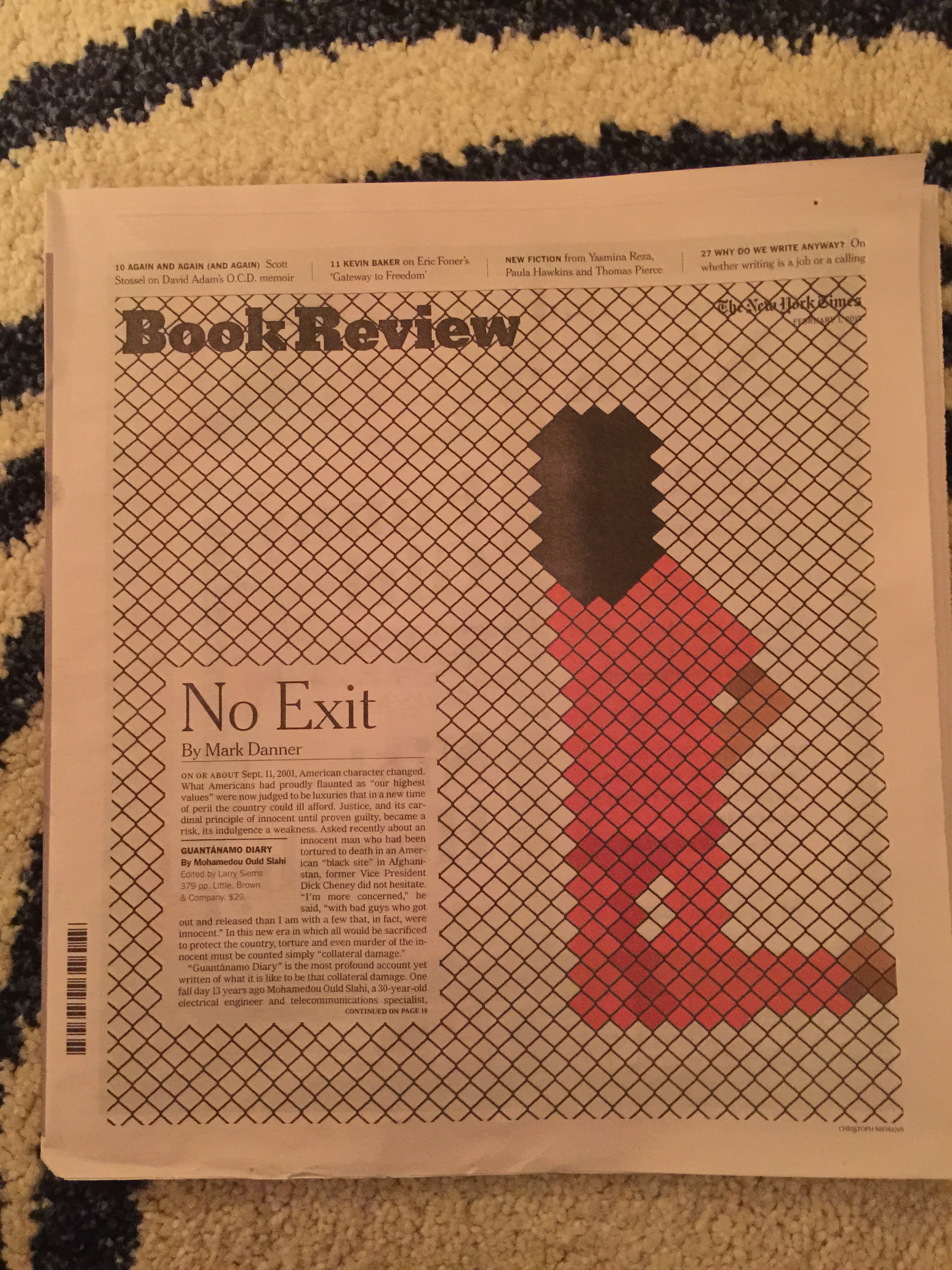
When I woke up this morning, this page  2015-02-01 06.18.54 of the New York Times’ weekend edition lay around openly. It carries the highly pixelated shape of a person in an orange jumpsuit, hands tied behind his back, on his knees.

It brought back immediately my memories of a specific moment yesterday. When the news exploded into the world that this black clothed butcher with the deep British accent, the executor of IS, had decapitated Kenji Goto, the Japanese journalist who had been captured earlier, I looked up the video that had been put on the web by IS. Here is a link to the news and facts from yesterday.

On the other hand, the open page of the NYT that I found this morning, it is about a book review: “Guantanamo Diary“, by Mohamedou Ould Slahi. Mark Danner reviews the book for NYT, starting with the following: “On or about Sept. 11, 2001, American character changed. What Americans had proudly flaunted as “our highest values” were now judged to be luxuries that in a new time of peril for the country could ill afford.”
The text continues, making reference also to former Vice President Dick Cheney, when asked recently about an innocent man been tortured to death in an American “black site”, did not hesitate. “I’m more concerned,” he said, “with bad guys who got out and released than I am with a few that, in fact, were innocent.”

I wrote about torture, cruelty, and why I believe that certain acts of utmost inhumanity need to be banished for all accounts and purposes, not leaving any ground for legal or ethical justification, earlier.

But here is the thing:

I would certainly claim that I am hardened by uncounted situations, and pictures and movies thereof, what human cruelty can do to others. Yet, none of those experiences leaves me cool, unaffected. Yesterday, I decided to look up the propaganda video of IS before it would be removed from the most accessible sites again. I wanted to understand more about what is referred to as a highly professional propaganda machinery. IS is acting through intense use of media, far away from amateurish make, brushed up with professional effects, using an identifiable style guide. So I assumed that this is not just a simple broadcasting of cruelty, but that it carries deliberate messages, likely tailored for different target groups.

Well, I am certainly having difficulties to understand those in the target group of potential supporters for whatever the cause of these devils are, I can’t really relate to the mindset of somebody who might be tempted to become what we name a “Foreign Terrorist Fighter” in the United Nations Security Council Resolution 2178 (2014).

But I do understand the feelings of those who are target of the antagonization which sits at the heart of this media strategy. I refuse to give these criminals the legitimacy they aspire, what they want to be seen as, like fighting for a caliphate with authority, brutally enforced legitimacy, and territory. I continue to name them torturers, heinous murderers, or, let me just be a little politically incorrect, heartless beings with no soul.

Felling better, having said that.

However, I also refuse to name them “animals”. That is a trick which is frequently used by those who want to establish legitimacy for their own unethical and horrible action. The Nazis created the word “Untermensch”, shamefully staining the German history. Many others did, and continue to do, exactly the same. By depriving somebody from being considered a human being, genocidaires and mass murderers can justify action that otherwise would be morally or ethically questionable, and it makes it easier for the killers who they need, to kill for them.

No, this butcher may be whatever curse I can find for him (feeling better thereafter), but he remains a human being. As such, my rules of the game apply for what I stand for: Humanity.

However:

When I saw the video yesterday, I was immediately overwhelmed by a complex mixture of feelings including rage, despair, deepest sadness, shock. I cried and needed to compose myself immediately again, because some children were in the other room.

From then on, I literally obsessed for hours, when ever I had a minute, about what I would do if I would get my hands on this black clad coward butcher. Yes, coward, because he is hiding his ugly face. I do not. I had all sorts of day dreams about how to torture this man, in detail.

It took me a hard time to recover into my spirituality, into not only understanding on an intellectual level that this is EXACTLY what they want us to feel, but also to admit on my spiritual level that any such retaliation would be wrong for all intents and purposes.

We only have one chance to demonstrate our values: By adhering to them. So I am talking about my values here.

I remember my father. I was young, and he would refer to Jesus’ sentence saying that if one gets slapped on one cheek, one should offer the other cheek to the offender, too. My father often said that he would have difficulties with that. Instead, he considered some situations justifying the principle “An Eye for an Eye”.

I have two answers, one with my heart, one with my brain:

My heart tells me that I would give up my soul, and my spirituality, if I would give in into ripping that butcher’s nails off his fingers and toes, one by one. Well, it gives me some relief thinking about it, though, frankly. But that’s about it, that’s about as far as I can go, and it already makes me praying for that this resentment is taken away from me with the help of my Higher Power.

Secondly, my brain tells me that this is exactly what these groups want us to feel: They thrive from this. Because, amongst other reasons, think about what they did, too: They requested 100 Million USD ransom money.

They are not only a bunch of terrorists. They belong to an organized crime organization, they capture people in order to make money in order to exercise power. They are true sociopaths, like every organized crime group is, because they give an ethical and moral damn about how to generate money, how to establish power. If they can make more money by legal means, they will just do that. If they can make more money by chopping heads off, well, they will just do that.

That is who they are. In their cold and well crafted strategy, they aim at taking our values away from us, by making us doing what they do.

They are sociopathic criminals. They don’t feel anything like empathy. So, we treat them as such. We apply the rule of law to them. Because that is what is protecting our values, and our humanity.

Never. Never again.

On Trauma, Children, and Societies

I introduced three categories of conditions in my previous blog entry (Trauma; addictive/compulsive behaviour; certain personality disorders), and three general categories of individuals who draw their appreciation of these conditions from their specific ability or inability to relate to them. Members of these categories either have never experienced one of these conditions personally, or they suffer from one or several of them, or they are in a state that I have named recovery.

It is possible that such a systematisation only fits a cultural context of Western societies. The perception of reality by a self-aware mind happens within a cultural context, though it may be influenced by some genetic predispositions. For sure the main influence is happening throughout childhood and adolescence, in every specific society. Literally all aspects of what an individual learns about where he or she belongs, what defines the identity within a group, a society, a culture, a belief system, a system of faith, it begins with education by parents and caregivers.

In my attempt to describe the context of trauma and my line of work, I have to appreciate that. I have to acknowledge that my approach; my way relating to it; my way of empathising with, for example, victims of trauma; my ideas about which impact the consequences of trauma have; my ideas how to assist in healing trauma; that all this happens within the framework of the societies of the type I grew up in. My appreciation is formed through education, through science, through value systems and belief systems to which I have been exposed, which form the Western world in which I live.

Let me explain this with a little example:

I came across an interesting statement (look here for one of several references) on the fundamental cultural context of healing, and assistance to it. In this piece, a Rwandan genocide survivor makes reference to healthcare professionals from Western countries, attempting to apply a Western approach to healing:

“You know, we had a lot of trouble with Western mental health workers who came here immediately after the genocide, and we had to ask some of them to leave…They came and their practice did not involve being outside in the sun like what you’re describing – which is, after all, where you begin to feel better. There was no music or drumming to get your blood flowing again when you’re depressed and you’re low and you need to have your blood flowing. There was no sense that everyone had taken the day off so that the entire community could come together to try to lift you up and bring you back to joy. There was no acknowledgement of the depression as something invasive and external that could actually be cast out of you again. Instead, they would take people one at a time into these dingy little rooms and have them sit around for an hour or so and talk about bad things that had happened to them. We had to get them to leave the country.”

Trauma experienced by adults is a well explored issue which has made it into public awareness. Scientific research has made tremendous progress in understanding how trauma impacts on the brain. The long form of the acronym PTSD, Post Traumatic Stress Disorder, is known by many. People share at least a little conceptual understanding. You and I have experiences within our families and networks of friends about the impact of trauma. My grand uncle never spoke about his experiences as a soldier during the most brutal World War I. My former father in law never ever opened up on his experiences during the Nazi Regime. Both of them were visibly and deeply affected.

I want to focus on what trauma does to young children: The impact of trauma on a child in its early or later stages of development is tremendous, in any society. What I say is that the way how societies deal with trauma may be specific to the societal and cultural context, but the fact that trauma happens to children, and has a deep effect, is common to all individuals in all societies who face violence and abuse of children, and their caregivers. Therefore, every society affected by conflict needs to address these effects of trauma in order to move on, and this way is specific to every society in question. There may be an universal framework for healing, but I suspect it is limited.

My personal experience would indicate that we empathise with the impact of violence and trauma on children, but we stop short from real acknowledgement of its lifelong consequences: It appears to me that we often deny, or disregard, its impact. This impact on life when somebody is exposed to early trauma is much more fundamental, and to some considerable extent unalterable. It may be that, in a mainstream discussion, we feel empathy, and pity, but we may wrongly expect that the child has to move on, on its way into adulthood, and as an adult.

As a matter of fact, no single child can do that.

Trauma requires support for healing. Any seriously traumatised individual is unlikely to undo the impact of trauma without support, and this is especially true for children. A child literally has no single tool which would enable it to support his or her own healing. A child completely depends on the support of caregivers. If these caregivers then are affected by massive trauma as well, they are becoming dysfunctional in many ways that affect their nurturing and educating children. Consequently, the child will almost certainly grow up becoming a dysfunctional adult. It’s a double whammy: Suffering from own trauma, being raised by traumatised caregivers. In societies that are affected by massive violence, including acts of genocide, including systematic use of rape and violence against women, children, and other vulnerable groups, as an instrument of conflict and war, this has catastrophic consequences: These societies form, from individual wounds, common wounds. These common wounds persist, their results are visible in generations of that society to come. They, in my experience, form the foundation for future relapse into violence.

No matter which society, no matter which culture, children are born with a clean slate. Certainly, genetic predisposition impacts on how children develop, but newborn always are, as Pia Mellody⁠1 describes it, valuable, vulnerable, imperfect, dependent, and immature. This is just one attempt to frame the initial condition a child is in, but it appears to be useful to me.

If you look at these categories, nurturing and raising of children means to assist them in moving from this highly dependent initial condition into interdependent adulthood. “Interdependent” means that an individual is able to function within a societal context, and doing so in a more or less healthy way. “Living healthy” always relates to quite some extent to what a peer group would generally consider to be appropriate.

Like all mammals, we learn what we need to know, how to be, how to act as an adult from caregivers. Instincts and genetically coded behaviour exist, but every mammal learns how to interact, how to hunt, how to relate to a peer group, through nurturing, play, and education. In our human case, it requires, give or take, twenty years. I believe that even in societies in which children take on roles that we, in Western societies, would consider appropriate only much later, this profoundly biological, psychological, and social, process simply requires that much time. No matter whether a society marries a girl early on to an adult, no matter from when on a child begins to take family responsibilities, or has to begin to work: Forming the adult self, able to function in any society in an appropriate interdependent manner, in our human case it takes time.

In a Western context, there is established clinical and therapeutic evidence for a group of symptoms that follow protracted and/or severe forms of abuse in childhood (which impact on a child as trauma). Citing one of many authors on this, Pia Mellody⁠2, I am not motivated by the topic of her specific book, a phenomenon called “codependence”, but by it’s healthy opposite, what I referred to above as “interdependence”. In her vast work, Pia Mellody identifies the following conditions as a consequence of the inability or impairment of an individual to act in an interdependent (healthy) way: (1) Negative control; (2) Resentment; (3) Distorted, or nonexistent spirituality; (4) Avoiding reality; (5) Impaired ability to sustain intimacy. Her work represents important experience in understanding a fundamental connection between childhood trauma, through physical or emotional abuse, and, what she calls “less than nurturing” education.

With more easy, but blunt words: Dysfunctional parents, unwillingly and often unknowingly, create dysfunctional children, who grow up becoming dysfunctional adults. So, how does a surviving parent, traumatised by the loss of loved ones, and traumatised as a victim of violence and abuse, educate a child in a way that this child becomes an interdependent healthy member of the society? How more complicated is this, if also that child itself has been subjected to unimaginable violence? I will write about sexual and gender based violence, or about slavery, and forming children into child soldiers, in later articles. But how does a child with such trauma wounds grow up, being taken care of by caregivers who struggle with recovery from trauma themselves?

Clinical experience in our Western societies establishes in almost all cases of childhood trauma a direct link into dysfunctional patterns including compulsive/addictive abuse of substances and/or behaviour, or developing physical or mental forms of illness. Cases of widespread abuse of alcohol or substances through the loss of cultural context, identification, collective low self-esteem, in subjugated minority communities come to my mind. I remember my knowledge about Australian aborigines, for example, but also the dysfunctional behaviour in ghetto communities that we all deal with as police officers. We allow, create, or accept, unhealthy conditions in minorities, and/or ghettos, and then we blame the members of those groups for the dysfunctional behaviour which is an inevitable consequence.

But aside that common experience, which has very concrete consequences for the community-oriented policing work in all our countries, in my line of work I see the huge numbers of victims of horrible violence, children and caregivers, after conflict, and genocide.

Which sets the stage for case studies, but before that, within a next instalment, for further quantification and qualification of the violence that is part of contemporary conflicts. I have case studies including my own experiences, like in Bosnia & Herzegovina on my mind, or, for example, Rwanda. But also case studies of ghetto situations, in countries of the Western world.

Now, finishing with a book recommendation. Read the memoirs of a child soldier. It is heartening, but it will go under your skin: “A Long Way Gone⁠3: Memoirs of a Boy Soldier, by Ishmael Beah”.

From Amazon’s book page: “This is how wars are fought now: by children, hopped-up on drugs and wielding AK-47s. Children have become soldiers of choice. In the more than fifty conflicts going on worldwide, it is estimated that there are some 300,000 child soldiers. Ishmael Beah used to be one of them.

What is war like through the eyes of a child soldier? How does one become a killer? How does one stop? Child soldiers have been profiled by journalists, and novelists have struggled to imagine their lives. But until now, there has not been a first-person account from someone who came through this hell and survived.

In A Long Way Gone, Beah, now twenty-five years old, tells a riveting story: how at the age of twelve, he fled attacking rebels and wandered a land rendered unrecognizable by violence. By thirteen, he’d been picked up by the government army, and Beah, at heart a gentle boy, found that he was capable of truly terrible acts. This is a rare and mesmerizing account, told with real literary force and heartbreaking honesty.

“My new friends have begun to suspect I haven’t told them the full story of my life.

‘Why did you leave Sierra Leone?’

‘Because there is a war.’

‘You mean, you saw people running around with guns and shooting each other?’

‘Yes, all the time.’

‘Cool.’

I smile a little.

‘You should tell us about it sometime.’

‘Yes, sometime.'”

1 Pia Mellody, With Andrea Wells Miller and J. Keith Miller; “Facing Codependence”, HarperCollins, 1989 and 2003, New York, ISBN 978-0-06-250589-7, page 63

2 Ibid, page 45

3 Beah, Ishmael (2006). A Long Way Gone: Memoirs of a Boy Soldier. New York: Sarah Crichton Books

“Thank You” – Instead of “Yes, we succeeded!”

When I read the first breaking news on BBC on that “the case of a Saudi blogger sentenced to 1,000 lashes has been referred to the Supreme Court by the king’s office”, I shared it with my little group of personal friends on FaceBook immediately, and just adding the word “Thanks!!!” (http://www.bbc.co.uk/news/world-middle-east-30856403).

Referring to my previous blog entry “Je suis Charlie – Je suis Raef” I then thought about the issue a little more in depth.

Since the horrible attack and murders which began in Paris in the offices of the magazine “Charlie Hebdo” January 7, the world saw outrage and intense discussion. Millions gathered in Paris and elsewhere, demonstrating under the logo “Je suis Charlie”. Public discussion saw a wide range of positions, across various communities, including communities of faith. I find it noteworthy that important moderate voices came from everywhere, including, sometimes, from where I would not have expected it. Here is an example: http://m.huffpost.com/us/entry/6443530.

Friday, January 09, the Saudi blogger Raef Badawi received the first 50 lashes from a sentence of 1,000 lashes. The public outrage was immense. I referred to some in my recent blog entry, and I wrote “Je suis Charlie – Je suis Raef”.

January 14, the media began to report about a new cover illustration of Prophet Muhammad in the latest edition of Charlie Hebdo (http://mobile.nytimes.com/2015/01/15/world/middleeast/new-charlie-hebdo-muhammad-cartoon-stirs-muslim-anger-in-mideast.html?_r=0&referrer=).

Again, there was a wide spectrum of opinions flooding the blogs. Again, I also want to note that there were serious concerns offered in moderation, across the whole spectrum of communities. The above link serves as an example.

What I want to draw attention on here is the fact that, in my personal view, the decision of the Kingdom of Saudi Arabia carries remarkable signals, and I would hope that this is supporting a dialogue which I find extremely important. The world faces a lot of antagonisation right now. This escalation of antagonised, often radicalised, and very often very emotional expressions of outrage supports that views become polar. Polar views support a selective perception which makes us looking for more of the bad news, as we seek support for the position that each of us holds.

Meaning: Dialogue becomes more difficult.

So, here is my take on the news on Raef Badawi: I hope this goes widely noticed. I hope it’s not used in a triumphant manner. I hope it’s used as an example for that listening to each other really works.

And that is what we need more than anything else, right now. So, trusting that this decision is based on including the understanding that dialogue and willingness to understand are so important, I say “Thank you!”. The world never is black and white only, what ever some would want to suggest.

Je suis Charlie – Je suis Raef

May 15, 2014, the United Nations Office of the High Commissioner for Human Rights issued the following statement (http://www.un.org/apps/news/story.asp?NewsID=47797#.VLT9xkY8KJI ) on Raef Bandawi, a Saudi Arabian blogger who was sentenced to 10 years in prison, 1,000 lashes and a 1 million Saudi riyal fine:

“This outrageous conviction should be overturned and Mr. Badawi immediately released,” said the Special Rapporteur on freedom of religion, Heiner Bielefeldt; the Special Rapporteur on freedom of expression, Frank La Rue; the Special Rapporteur on torture, Juan E. Méndez; and the Chair-Rapporteur of the Working Group on Arbitrary Detention, Mads Andenas.”

But it is happening.

It started last Friday. Here is what, like many, The Times of India reports (http://m.timesofindia.com/world/middle-east/Saudi-blogger-lashed-in-public-for-insulting-Islam/articleshow/45824671.cms ):
“JEDDAH: Saudi blogger Raef Badawi was flogged in public Friday near a mosque in the Red Sea city of Jeddah, receiving 50 lashes for “insulting Islam”, witnesses said. In September, a Saudi court upheld a sentence of 10 years in prison and 1,000 lashes for Badawi, and he is expected to have 20 weekly whipping sessions until his punishment is complete. The United States, Amnesty International and Reporters Without Borders have denounced the flogging as a horrific form of punishment, and said Badawi was exercising his right to freedom of expression.”

This is why it is so incredibly important to continue with a public discussion on torture, following the release of the U.S. Senate’s report on coercive interrogation methods by the CIA amounting to torture: Cruelty is a family member of Torture, and I identified Sadism and Rape as other brothers and sisters in it, in earlier statements on this blog. The legitimacy of condemnation of such methods applied by others critically depends on how one deals with own behavior, and history. Once we allow ourselves to do whatever we want, disrespecting international Conventions, we mute ourselves when we are being confronted with outrageous action of others.

So, here is the US Department of State’s public statement ( http://m.state.gov/md235704.htm ) as of one week ago:

“Press Statement
Jen Psaki
Department Spokesperson
Washington, DC
January 8, 2015

We are greatly concerned by reports that human rights activist Raif Badawi will start facing the inhumane punishment of a 1,000 lashes, in addition to serving a 10-year sentence in prison for exercising his rights to freedom of expression and religion. The United States Government calls on Saudi authorities to cancel this brutal punishment and to review Badawi’s case and sentence. The United States strongly opposes laws, including apostasy laws, that restrict the exercise of these freedoms, and urges all countries to uphold these rights in practice.”

Yet, despite this and others joining in, it is happening. Raif Badawi received the first 50 lashes last Friday. Watch the crowd gathering, the video stops there, (thank you!): http://m.youtube.com/watch?v=ISRaSduJNOI

It will continue if hearts remain merciless. Every Friday he will be taken out of prison, displayed in public, receiving 50 more lashes. The American PEN organization decries it ( http://www.pen-international.org/newsitems/saudi-arabia-editor-raef-badawi-sentenced-to-1000-lashes-and-10-years-in-prison-plus-10-year-media-participation-ban/ ). It will bring his body to his limits, every Friday for the next twenty weeks. He may die.

And you know what?: On occasion of millions joining into last week’s demonstrations against the killing of fifteen journalists of Charlie Hebdo, the Ambassador of the Kingdom of Saudi Arabia joined the row of dignitaries, excellencies, and ordinary people, expressing their sadness and outrage. Exercising their right to be free expressing their opinions, journalists had been brutally killed by extremists who felt this is an insult of Islam. ( http://www.jewishjournal.com/hella_tel_aviv/item/the_10_biggest_hypocrites_marching_in_paris ).

So what is this about? Is it that you can say what ever you want as long as it is not against us?

I join the statement by the European Union ( http://eeas.europa.eu/statements-eeas/2014/150109_03_en.htm ).

Je suis Charlie. Je suis Raif. Et j’adore Senator Feinstein.

More links below.

http://m.ndtv.com/article/world/saudi-blogger-gets-first-installment-of-1000-lashes-for-insulting-islam-646541

To me, the most heartening one: http://m.huffpost.com/us/entry/6125244