This post was published 04 February 2015 in the Huffington Post. It is a variation of what I said 23 December 2014, on this blog, carrying the title “Conflict, organised crime, extremism and terror, and corruption“. The difference is that the Huffington Post carries the views in my current capacity, endorsed by my Department, the Department of Peacekeeping Operations of the United Nations.
Terror
Raw Feelings
When I woke up this morning, this page 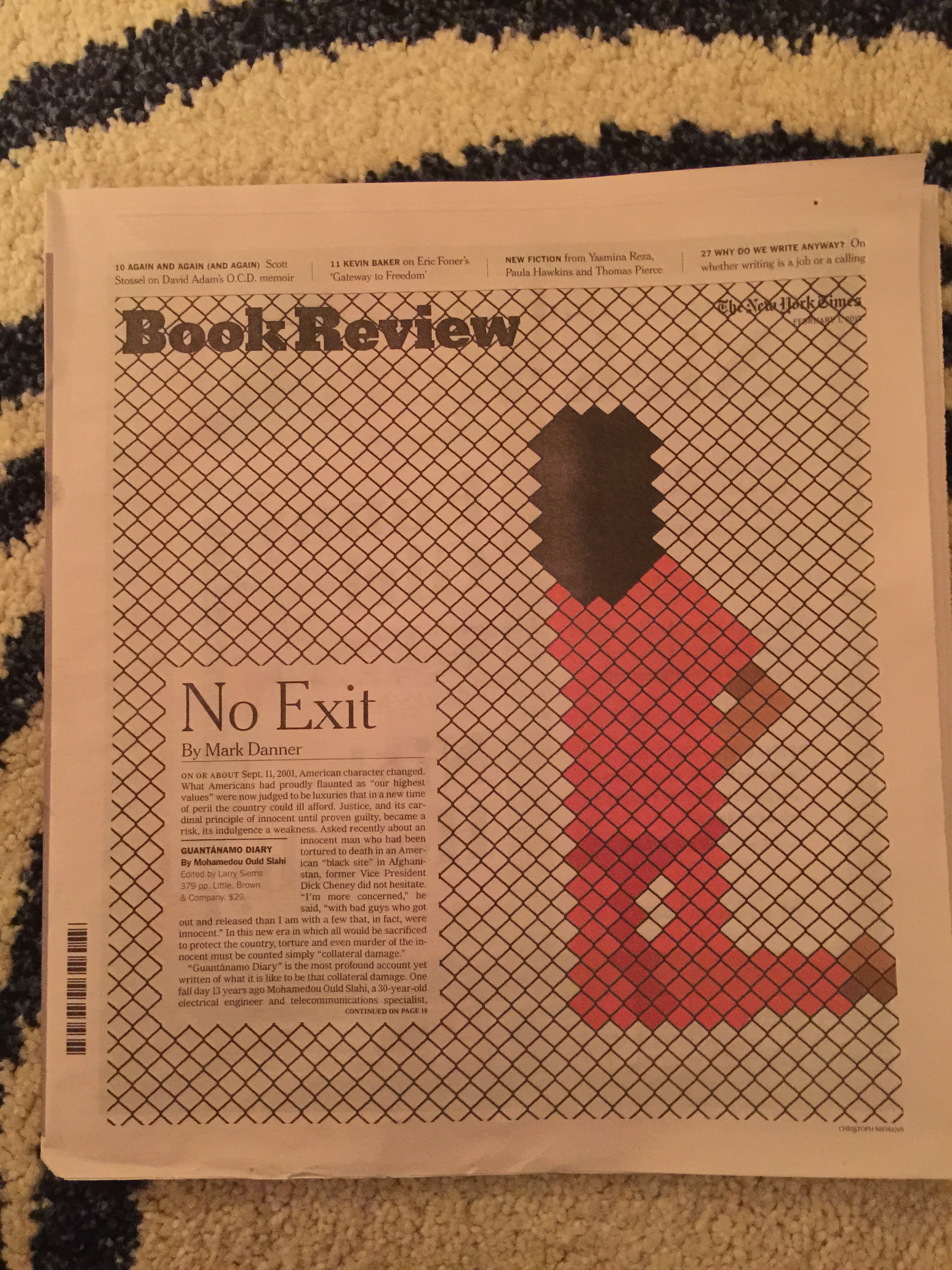 of the New York Times’ weekend edition lay around openly. It carries the highly pixelated shape of a person in an orange jumpsuit, hands tied behind his back, on his knees.
It brought back immediately my memories of a specific moment yesterday. When the news exploded into the world that this black clothed butcher with the deep British accent, the executor of IS, had decapitated Kenji Goto, the Japanese journalist who had been captured earlier, I looked up the video that had been put on the web by IS. Here is a link to the news and facts from yesterday.
On the other hand, the open page of the NYT that I found this morning, it is about a book review: “Guantanamo Diary“, by Mohamedou Ould Slahi. Mark Danner reviews the book for NYT, starting with the following: “On or about Sept. 11, 2001, American character changed. What Americans had proudly flaunted as “our highest values” were now judged to be luxuries that in a new time of peril for the country could ill afford.”
The text continues, making reference also to former Vice President Dick Cheney, when asked recently about an innocent man been tortured to death in an American “black site”, did not hesitate. “I’m more concerned,” he said, “with bad guys who got out and released than I am with a few that, in fact, were innocent.”
I wrote about torture, cruelty, and why I believe that certain acts of utmost inhumanity need to be banished for all accounts and purposes, not leaving any ground for legal or ethical justification, earlier.
But here is the thing:
I would certainly claim that I am hardened by uncounted situations, and pictures and movies thereof, what human cruelty can do to others. Yet, none of those experiences leaves me cool, unaffected. Yesterday, I decided to look up the propaganda video of IS before it would be removed from the most accessible sites again. I wanted to understand more about what is referred to as a highly professional propaganda machinery. IS is acting through intense use of media, far away from amateurish make, brushed up with professional effects, using an identifiable style guide. So I assumed that this is not just a simple broadcasting of cruelty, but that it carries deliberate messages, likely tailored for different target groups.
Well, I am certainly having difficulties to understand those in the target group of potential supporters for whatever the cause of these devils are, I can’t really relate to the mindset of somebody who might be tempted to become what we name a “Foreign Terrorist Fighter” in the United Nations Security Council Resolution 2178 (2014).
But I do understand the feelings of those who are target of the antagonization which sits at the heart of this media strategy. I refuse to give these criminals the legitimacy they aspire, what they want to be seen as, like fighting for a caliphate with authority, brutally enforced legitimacy, and territory. I continue to name them torturers, heinous murderers, or, let me just be a little politically incorrect, heartless beings with no soul.
Felling better, having said that.
However, I also refuse to name them “animals”. That is a trick which is frequently used by those who want to establish legitimacy for their own unethical and horrible action. The Nazis created the word “Untermensch”, shamefully staining the German history. Many others did, and continue to do, exactly the same. By depriving somebody from being considered a human being, genocidaires and mass murderers can justify action that otherwise would be morally or ethically questionable, and it makes it easier for the killers who they need, to kill for them.
No, this butcher may be whatever curse I can find for him (feeling better thereafter), but he remains a human being. As such, my rules of the game apply for what I stand for: Humanity.
However:
When I saw the video yesterday, I was immediately overwhelmed by a complex mixture of feelings including rage, despair, deepest sadness, shock. I cried and needed to compose myself immediately again, because some children were in the other room.
From then on, I literally obsessed for hours, when ever I had a minute, about what I would do if I would get my hands on this black clad coward butcher. Yes, coward, because he is hiding his ugly face. I do not. I had all sorts of day dreams about how to torture this man, in detail.
It took me a hard time to recover into my spirituality, into not only understanding on an intellectual level that this is EXACTLY what they want us to feel, but also to admit on my spiritual level that any such retaliation would be wrong for all intents and purposes.
We only have one chance to demonstrate our values: By adhering to them. So I am talking about my values here.
I remember my father. I was young, and he would refer to Jesus’ sentence saying that if one gets slapped on one cheek, one should offer the other cheek to the offender, too. My father often said that he would have difficulties with that. Instead, he considered some situations justifying the principle “An Eye for an Eye”.
I have two answers, one with my heart, one with my brain:
My heart tells me that I would give up my soul, and my spirituality, if I would give in into ripping that butcher’s nails off his fingers and toes, one by one. Well, it gives me some relief thinking about it, though, frankly. But that’s about it, that’s about as far as I can go, and it already makes me praying for that this resentment is taken away from me with the help of my Higher Power.
Secondly, my brain tells me that this is exactly what these groups want us to feel: They thrive from this. Because, amongst other reasons, think about what they did, too: They requested 100 Million USD ransom money.
They are not only a bunch of terrorists. They belong to an organized crime organization, they capture people in order to make money in order to exercise power. They are true sociopaths, like every organized crime group is, because they give an ethical and moral damn about how to generate money, how to establish power. If they can make more money by legal means, they will just do that. If they can make more money by chopping heads off, well, they will just do that.
That is who they are. In their cold and well crafted strategy, they aim at taking our values away from us, by making us doing what they do.
They are sociopathic criminals. They don’t feel anything like empathy. So, we treat them as such. We apply the rule of law to them. Because that is what is protecting our values, and our humanity.
Never. Never again.
Never Again – Never Forget
This is the fourth installment on coercion, and torture. What I want to address here is a broader context, including atrocities that haunt us, seemingly without end. History is full of shameful chapters where we did it again, and again, and again.
I ended my third entry with the question “How to argue that there are forms of coercion that need to be banned in their entirety?”. This is where I begin to take it up today.
In my line of work, the phrase “Never Again” is meaning a lot, used quite often, triggering many memories. Some of those memories relate to direct experiences with atrocities that I have witnessed. Some of them relate to atrocities that have set the stage for my desire to contribute to peace operations. Some of these do deeply affect the corporate conscience of the United Nations, in places where we failed to prevent atrocities, such as in Rwanda, and in Bosnia&Herzegovina. The earliest memories of wishing that it shall never happen again relate to the history of my country, Germany, before I was born. The history of my country, and how I was told, and learned about it, has formed main parts of my conscience.
In an earlier blog post, I referred to an Op Ed in the New York Times, Dec. 9, 2014, by Eric Fair: “I Can’t Be Forgiven for Abu Ghraib1”. Eric Fair, an Army veteran, was a contract interrogator in Iraq in 2004. In 2014, he was a Professor for creative writing at Lehigh University. Parts of his Op Ed deal with his revealing to his students what he did, in Iraq. He tortured. His Op Ed for sure is stirring up a lot of emotions, and I can only imagine that many of them will be very controversial, especially by those who have suffered from torture trauma, either being victims, or perpetrators (they too become victims, later on, may be even those with strong sociopathic traits2). Eric Fair ends the Op Ed with the following sentences: “In some future college classroom, a professor will require her students to read about the things this country did in the early years of the 21st century. She’ll assign portions of the Senate torture report. There will be blank stares and apathetic yawns. There will be essays and writing assignments. The students will come to know that this country isn’t always something to be proud of.”
Not even scratching the surface of the never ending row of atrocities in mankind’s history, how does “Never Again” work if we seem to constantly forget, and/or seem not to be able to abstain, even given the overwhelming testimony of what we are able to do to our brothers and sisters if we allow ourselves running unleashed?
What possible comfort can be drawn from a catch phrase that we so notoriously use, use it again, or may even use it for other situations whilst we stained our conscience ourselves?
Should we give that intent up?
For the record, I am not arguing this. I hear this sometimes, and in a more depressing mood this question can occur to me, too. Recently, I read an essay in “Harper’s Magazine3”, titled “Against Human Rights”, by Eric A. Posner, a professor at the University of Chicago Law School. This essay is so upsetting that I may dissect it at a later opportunity. It serves as an example for the, in my view, most dangerous rationale that would suggest that, because standing up for Human Rights allegedly did not work (which is untrue), the concept itself might be outdated (which is devilish).
As a child, and as a young adult, I believed in the notion that thousands of years of civilization had a cumulative effect, that somehow this effect would lead to a thicker cultural skin, that atrocities were less likely to happen, taking into account some societal learning. I may be excused for that naivety. I was a growing up teenager in a country that had not experienced war ever during my lifetime, had not participated in one. Neither I was confronted with actual atrocities we were committing, none that we had to actually suffer from. That all was part of a past long gone. During the 1970’s my political conscience began to grow. As a people, we were acutely conscious of the atrocities of the Holocaust that we had committed a few decades ago. This led to generations of young German citizens who had no direct experience with war, with killing, with torture, sadism, genocide.
The generations to which I relate, we grew up with a lot of guilt, and shame, for what our forefathers did. This type of German conscience was, and is, strong in saying “Never Again”. This is true until today, and it took me a very long time, and my direct exposition to the Hell that Mankind can create on Earth after I began to work in peace operations, to relate to why it is so incredibly important to uphold the call for “Never Again”. I can only speak for my generations, and I can only explain the context from what I experienced, and continue to experience, in some of the most brutal conflicts of today’s World. Whether there is a different conscience in younger people in Germany, very much along the lines of Eric Fair’s question at the end of his Op-Ed, I don’t exactly know.
However, this is precisely what Eric Fair is referring to: How can one ensure a remaining understanding, being part of a societal and individual conscience, that certain acts are acts of Hell on Earth, and that there simply shall not be any tolerance for them, justification of them, or committing them?
April 07, 2004 I attended a town hall meeting of the United Nations in Pristina, Kosovo. On this day, the United Nations commemorates the genocide that happened 1994 in Rwanda. Throughout approximately 100 days, Hutu extremists killed an estimated 500,000 to one million Tutsi and moderate Hutu.4”, as a consequence of a brutal, systematic, well organized genocide. For comprehensive reading, I recommend Lt. Gen. Romeo Daillaire, “Shake Hands With The Devil5”.
This April 07 in 2004 was a very special day for me: I was the Police Commissioner in charge of 4.500 international police officers and 6.500 Kosovo Police Service officers, within the United Nations Interim Mission in Kosovo. A little more than two weeks earlier, we had fought off three days of massive violence in Kosovo. There had been civil unrest on which some ring leaders had hooked up, deciding that it was now the time to drive the Serb minority population out of Kosovo. It was an attempted ethnic cleansing happening under the eyes of the United Nations and NATO. Together with our military NATO colleagues, my police officers and I engaged in fighting this off. Long story short, I claim that we succeeded. However, at the end of these three days we mourned killed and injured civilians, injured police officers and soldiers, a large new number of internally displaced persons, and the demolition of cultural Serb Orthodox heritage and uncounted Kosovo-Serb houses.
We were tired, shocked, recovering, regrouping. Within this deeply emotional phase, on April 07 we watched documentary about the Rwanda genocide. After watching this movie, the Principal Deputy of the Special Representative of the UN Secretary General, my friend Charles Brayshaw, was supposed to address us, assembled commemorating this genocide. He began with stating “Never Again”. As he wanted to continue his speech, his voice broke, tears were all over his face. He stopped, just with these two words. Because this is what we had lived up for during these three nightmare days. We had prevented it.
Yesterday, I walked the streets of Manhattan, on my way to a bookstore. It was cold, dark, a mixture of slush and rain was attempting to penetrate my coat. I thought about that I am growing 57 this month. I asked myself: “What is it that I want to see staying beyond? What will be the result of my contribution, when I die?”
All of a sudden I saw it: It’s not an accumulation of more. It’s about keeping the flame lit, to be a part of those who carry it.
There may be a future in which we will be able to fully commit to “Never Again”. But whether that is so, and when, we don’t know yet. However, one thing is clear: Until it will never happen again, it is about “Never Forget”.
That is why Eric Posner is wrong: The effects of the Universal Declaration of Human Rights may be disappointing, or not. I humbly disagree, but even more, abandoning them creates Hell on Earth. If we deprive people from inalienable human rights just because they have done this to us, we do not only enter into the “An Eye for an Eye” age again.
Rather, we allow the Doors of Armageddon to open.
2 As one of the most vivid examples for that even individuals with obviously strong sociopaths traits can be overwhelmed by a “gollum-like” recognition of what they have become, once their denial is broken up, watch the amazing documentary “The Act of Killing”. But beware, this goes under your skin! From the synopsis on the website http://theactofkilling.com: “…When the government of Indonesia was overthrown by the military in 1965, Anwar and his friends were promoted from small-time gangsters … to death squad leaders. They helped the army kill more than one million alleged communists, ethnic Chinese, and intellectuals in less than a year. As the executioner for the most notorious death squad in his city, Anwar himself killed hundreds of people with his own hands.
Today, Anwar is revered as a founding father of a right-wing paramilitary organization that grew out of the death squads. The organization is so powerful that its leaders include government ministers, and they are happy to boast about everything from corruption and election rigging to acts of genocide.
…Unlike ageing Nazis or Rwandan génocidaires, Anwar and his friends have not been forced by history to admit they participated in crimes against humanity. Instead, they have written their own triumphant history, becoming role models for millions of young paramilitaries. The Act of Killing is a journey into the memories and imaginations of the perpetrators, offering insight into the minds of mass killers. And The Act of Killing is a nightmarish vision of a frighteningly banal culture of impunity in which killers can joke about crimes against humanity on television chat shows, and celebrate moral disaster with the ease and grace of a soft shoe dance number.
3 Harper’s Magazine, Vol. 329, No. 1973, October 2014; http://www.harpers.org; Harper’s Magazine Foundation, 666 Broadway, New York, USA
4 http://en.wikipedia.org/wiki/Paul_Kagame
5 ISBN 0 09 947893 5
Conflict, organized crime, extremism and terror, and corruption
Within most of our peace operations, we face security and justice institutions being incapacitated by conflict. Achieving peace and security requires establishing sustainable governance in a community, nation, and State.
Whilst we do base our mandate implementation on the understanding of a specific local context and regional dimensions, we also acknowledge that every local or regional conflict is tied into a global context. It is important to better understand the global drivers of conflict, interconnected to each and any peace operation, a knowledge with which we can establish better foundations for achieving progress on the road towards sustainable peace and security. This includes an in-depth understanding of the level of collaboration of transnational organised crime with extremists and terrorists, on a fertile soil of corruption, including global, regional, and local, schemes of their operations.
Within the UN Secretary General’s key priorities, promoting a safer and more secure world features prominently. Ban Ki Moon calls on enhancing coherence and scale up counter-terrorism efforts, and addressing the heightened threat of organised crime, piracy and drug trafficking. The collaboration between transnational organised crime and extremism and terrorism is undermining legitimacy of governance in the interest of some, and against fundamental and inalienable human and individual rights of all. The collaboration between organised crime and forms of extremism and terror is more than a local or regional phenomenon, and it needs to be much better understood, on all levels, global, regional, and local.
New dimensions of violence, such as seen within horrible and seemingly senseless actions of “Islamic State IS”, “Boko Haram”, and others, have rekindled international outrage. Within organised crime however, organised crime groups such as, for example, “Los Zetas” in Mexico, or Central America’s criminal groups named “Maras”, are by no means different. All are united in their ideology and politics of establishing power and total influence. These organisations are unified in applying the sheerest form of evil: The utter absence of any respect for humanity. Behind horrible and seemingly senseless violence there is an emerging business model which connects all of them: The establishment of power including through a threat of horror. Homicide ratios per capita in some States affected by transnational organised crime go far beyond a ratio threshold that would indicate the existence a war-, conflict- or post-conflict-zone, such as the places where our peace operations are deployed.
Contemporary scholars and experts discuss which side, organised crime or terror, has adopted this strategy of reigning through massive violence from the other. Or, may be, there is just coincidence in its (re)emergence. However, we should consider that others might adopt similar strategies, and we shall not make a mistake by believing there is only similarity in the strategic application of evil: The business model of both transnational organised crime and terror is the same, in radically attacking all forms of governance that go counter to their own goal. The message is: If you are not with us, we will kill you, torture your loved ones, and we will do it without a blink of the eye.
Secondly, there is indication for a global collaboration between transnational organised crime and terror. Global interests of, for example, the South-American narco-cartels; regional African interests of groups facilitating trafficking in narcotics, weapons and human beings and illegal immigration; and interests of any form of violent extremism and terrorism meet where we deploy peacekeepers. The interests of such groups run counter to any governance, and our assistance to establishing it. We inflict on their goals. More recently, peacekeepers have come increasingly under direct attack because of our mandate to assist in restoring governance, peace, and security. In Mali alone, we have lost twenty-three peacekeepers since the end of June by the time of this writing. In short, looking at the reasons for this, we should not limit ourselves to looking at extremism and terror, alone.
It is important to take into account that the systematic application of seemingly senseless violence is one strategy, a very effective one, for creating antagonism and hatred, beyond fear. Newly emerging violent patterns of organised crime and terror do not only aim to mute, or to retaliate. Rather, violence is a tool supporting the feeding ground on which they thrive, and grow.
Enforcement action needs to be embedded into a profound and comprehensive strategy on a higher level: (1) To understand better the context of complex collaboration between organised crime and terror; (2) To be placed into an overarching strategy, within and beyond individual peace operations, so to avoid the antagonisation which is intended by the other side, and which will include a significant risk of us getting weaker and them getting stronger. (3) We need to find innovative ways to return to the sentence with which I began: We face security and justice institutions being incapacitated by conflict. Understanding the drivers of conflict better will allow us to calibrate what needs to be done to reduce the threats these institutions face from organised crime and terror.
 Stefan Feller