On Defunding the Police – Entry Point

Not everything that can be faced can be changed, but nothing can be changed that is not faced.

JAMES BALDWIN


This will only be the first blog entry on this topic. I will go into the substance of how I look at this discussion in following articles. This one is intended to make clear how I look at the entire discussion, as a concerned individual and retired police officer, and a former United Nations Police Adviser. Thus, expect that my statements in subsequent articles will be as rational as I can be, and I reserve the emotional part motivating me for contributing to this discussion to this entry article. So, keep looking for follow-on to this writing, it will come soon. Expect the juice being inside a rational, but passionate debate contribution. I always try to stay away from partisan positions, except when it comes to underpinning values.

On values, I am very clearly partisan: I am United Nations hard-core, including all values on humanity represented by the UN, and developed within the UN-system. Which, by way of reminder, is the community of 193 Member States of the United Nations. We are the UN, as long as we contribute to the spirit of the UN, rather than disengaging from the UN. Like in the narrow context which will follow, engagement requires willingness to listen, rather than to yell. Any discussion which is lead in the spirit of finding consent requires to accept that it is legitimate for others to differ.

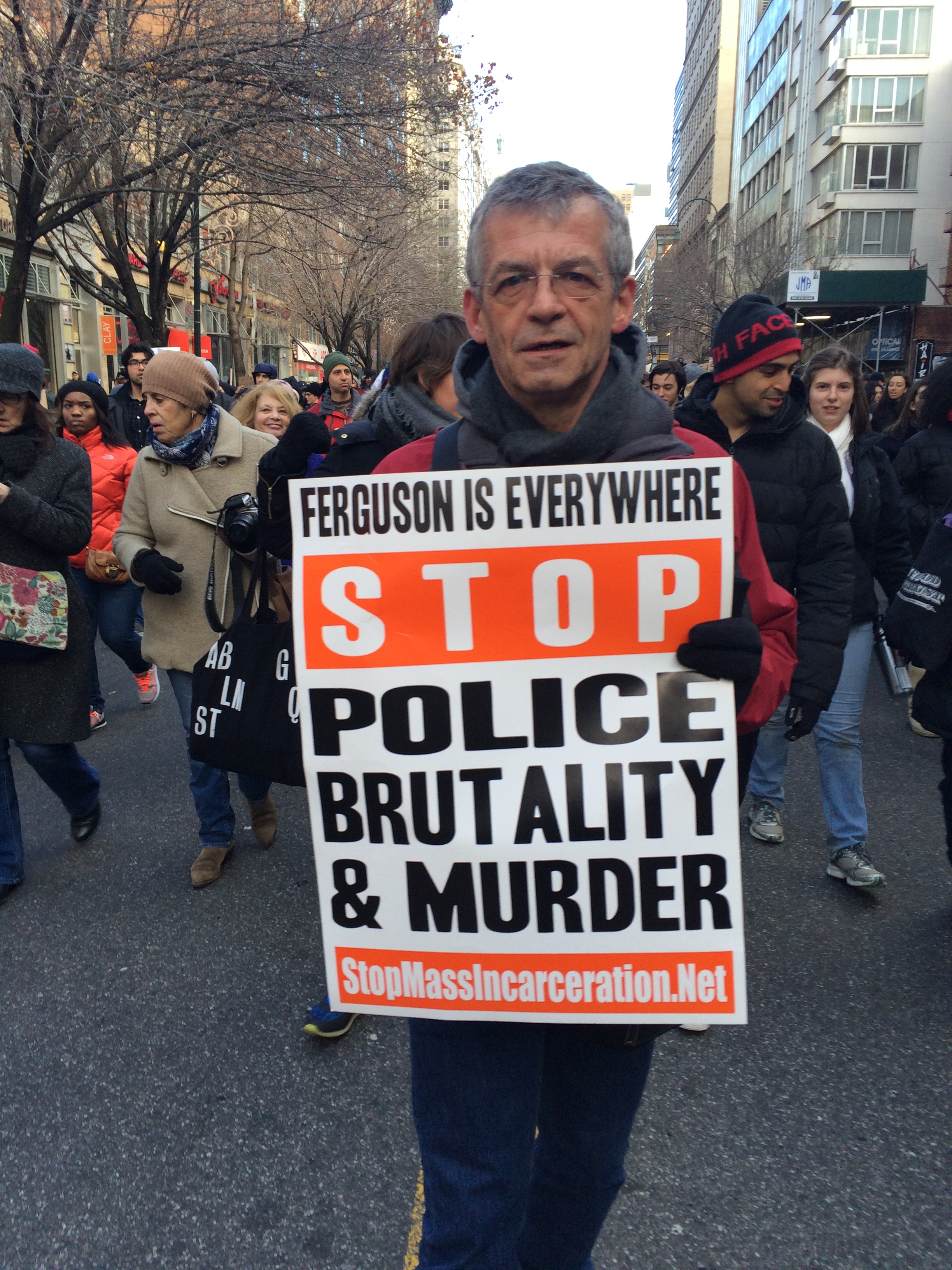
A friend of mine (who happens to be a journalist) suggested that I engage in the current discussion on policing and reforming the Police. He reminded me that, in 2014, I participated in a “Black Lives Matter” demonstration when I was living in New York (working as the UN Police Adviser). The picture is from December 13, 2014:
25B8A860-8474-470B-BE49-C1FE4896F235

August 9, 2014, Michael Brown had been shot dead by a Police officer, in Ferguson. Earlier, July 17, 2014, Eric Garner died after being put into a chokehold by a Police officer, in New York City. I am singling out two out of many events that led to renewed calls for reforming policing in the United States. Both in the U.S. and internationally, brutal instances of police abuse of power, including most serious crimes, sparked outrage leading to large and peaceful demonstrations. The “Black Lives Matter” movement stems from there. As a human being, and at that time being a temporary resident in the United States, I joined my fellow American friends in their peaceful call for addressing systemic racism reflected in the Criminal Justice system, and through abuse of power through individual police officers.

Already at that time the reform discussion on policing had much deeper roots, and there is a direct line connecting the history and those days of 2014 with what happens today, 2020. However, today the outrage is amplified, and there are signs that the calls for reforming policing, and the Police, are, finally being heard. Good.

Yes, peaceful demonstrations are proving that they are one of the most essential means and an inalienable right for citizens to participate in a democratic discourse about issues that matter.  And the subject matter of discussion is genuinely international: A friend of mine reported about participating in a demonstration in Berlin last weekend, with estimated 15.000 participants. It is one of many current events in Europe and elsewhere. Societies including my own German society have undertaken to conduct a self-critical discourse on the question as to which extent policing over here may also be unduly influenced by racial bias. Good.

Would all of that have happened without large-scale demonstrations? In my view, absolutely not. That is, by the way, why those who do resist these reforms, individually and institutionally, fear the demonstrations and thus attempt to label them with anything that would allow for discrediting intent of the demonstrations, manipulation of the course of the demonstrations and how they unfold, and the malicious labeling of individuals taking part in such demonstrations. These attempts are being conducted through manipulation, establishing and spreading unverified claims, false facts and lies, and using and spreading conspiracy-mongering strategies.

Most respected former U.S. public servants, including retired military officials are voicing their deepest concern about those who have adopted well-honed strategies practiced by systems and autocrats all over the World which have been criticised for exactly doing this by the very same United States of America. Good, because I hope the light can shine again, soon, and credible.

It looks like the peaceful demonstrations are here to stay. Good. Double down.

The range of topics in that discussion leading to these demonstrations is highly complex and beset with an enormous amount of emotions. It is about racial bias. It is about white supremacy. It is about countless cases of individual suffering and fear. It is about wrongful convictions, and a system of biased mass-incarceration, especially targeting communities of color. It is about the question how policing should be carried out, and how to hold police officers and other public officials accountable for their actions, including criminal actions. And much much more.

Within the current context of the United States, the contemporary development also can only be understood if put into the context of a society that is literally devouring itself, unraveled by a political partisan war ripping the fabric of consent into pieces about what is identifying and unifying all Americans, and what is so-called “un-American behavior”. It may well be that both sides blame the other for being un-American. The World is in disbelief. The ripples of instability stemming from this development have long arrived at the shores of Europe, Africa, Asia, and elsewhere. They bounce back from there, hitting the United States’s shores on the Atlantic and Pacific sides. Will that all calm down and settle into a new order, and will this be done with, or without violence?

Certainly, COVID-19 may have been a spark that set many things on fire. Fire? Not good in light of Global Warming. Oh yes, Global Warming is a fact. So, please, let us settle for consentual discussions allowing the young generations of this World to define our and their present, and their future.

These discussions need to be narrowed down. Topics have to be identified which can be taken forward, notwithstanding the complexity of the development as a whole. And in my view, it is extremely critical to take emotions out of these discussions, and to avoid antagonisation as much as possible. At the end of the day, a society needs to find an own consentual way forward in which positions converge into acceptable compromises. For, otherwise, there is no societal peace. And we do know that, without peace, there is no security. With no security, there is more heat. We can’t blame others for our own disengagement. But we always have the choice to engage. That’s why I am quoting James Baldwin.

This includes reforming policing, and the Police. After having settled on what policing is, the question how to implement it, follows second. Third then, one needs to consider how to fund what we want, and to re-allocate funding to where it is needed, and to stop funding of issues which run counter the implementation of what a society wants. So, in this third step, it is about de-funding, being part of a funding, and a reallocation-of-funding debate.

I should be clear: There is no way to establish a society with no self-policing of the rules that this society has given itself.

The violent death of George Floyd is a crime, one police officer is charged for second-degree murder and manslaughter. Three police officers are charged with aiding and abetting murder. George Floyd was subjected to police action after he was alleged to have used a counterfeit 20 USD bill for buying cigarettes. The police action ended in eight minutes and fourty-five seconds of suffering inflicted by some of the most cruel behavior I have seen in a while. And believe me, I have seen a lot.

It started with a counterfeit 20 USD bill. Why was Eric Garner being put into a chokehold, again? Proportionality of enforcement will be a point I will touch upon, later.

But I will say here that the reform discussion is triggered not by these few cases only, but because of the allegation that such behavior is systemic. That, also, makes it understandable why some try to argue that these actions are single cases. Which is not true. Truth matters, so look it up yourselves.

Another point in this first writing, attempting to look at the scope:
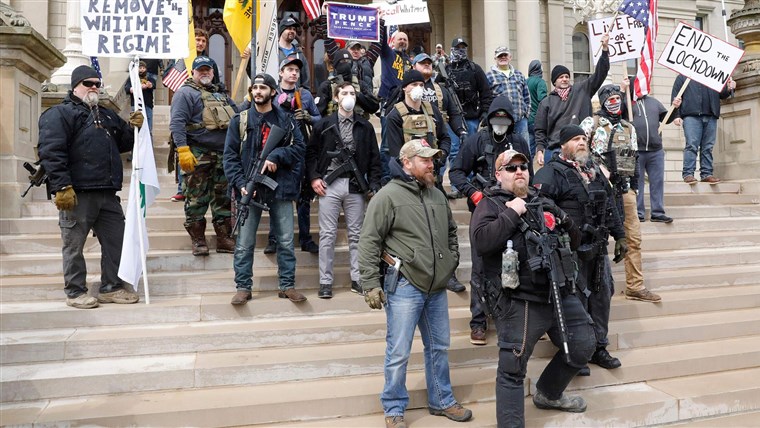
200415-michigan-protest-video-tease__415481.focal-760x428This picture was taken April 15, 2020, at Michigan Capitol

Of course I am respecting that the United States hang on to the Second Amendment. I have a personal opinion (horror and disbelief that people protest against the COVID-19 lockdown whilst carrying weapons of war), and I can also assure you that in Germany such an event would have led to as many SWAT-units as are available coming down on what would be considered a violation of strict weapons laws. But, of course, this is legal in America, thus the protest can be considered a peaceful protest.

The question I want to ask: Do you see one Afro-American person in that picture? Take a second and imagine all the individuals being black. And then, honestly, answer the question whether the indifferent action of the Police on occasion of that event would have been the same. Honestly, please!

Chances are the reaction would have been very different. That’s what I was saying in my post “Statement in Solidarity“: “Representative policing aims to ensure that the human rights of all people, without distinction of any kind such as race, colour, sex, language, religion, political or other opinion, national or social origin, property, birth or other status, are protected, promoted and respected and that police personnel sufficiently reflect the community they serve.” At this moment, an overwhelming majority of U.S. citizens believes that this is not the case. Instead, we are facing a cultural form of racism, different in argument from previous forms of biological racism, but on grounds of the same attitude and thinking of white supremacy.

Statement in Solidarity

Floyd

With the “Report of the Secretary General on United Nations policing” to the United Nations Security Council as of 10 November 2016 (S2016/952), the United Nations adopted, for the first time ever, a common understanding of the function of policing, and how it must be carried out by police and law enforcement officials. This understanding can be found in https://police.un.org/en/policy-united-nations-police-peacekeeping-operations-and-special-political-missions-2014, Sections 14 to 19.

Policing refers to a function of governance responsible for the prevention, detection and investigation of crime; protection of persons and property; and the maintenance of public order and safety. Police and law enforcement officials have the obligation to respect and protect human rights, including the right to life, liberty and security of the person, as guaranteed in the Universal Declaration of Human Rights and reaffirmed in the International Covenant on Civil and Political Rights and other relevant instruments.

Pursuant to the UN Code of Conduct for Law Enforcement Officials, police and other law enforcement officials are required, at all times, to fulfil the duty imposed upon them by law, by serving the community and by protecting all persons against illegal acts consistent with the high degree of responsibility required by their profession.

For the United Nations, the function of domestic policing must be entrusted to civil servants who are members of police or other law enforcement agencies of a national, regional or local government, within a legal framework that is based on the rule of law.

In accordance with United Nations standards, every police or other law enforcement agency should be representative of and responsive and accountable to the community it serves.

Representative policing aims to ensure that the human rights of all people, without distinction of any kind such as race, colour, sex, language, religion, political or other opinion, national or social origin, property, birth or other status, are protected, promoted and respected and that police personnel sufficiently reflect the community they serve. Fair and non-discriminatory recruitment and retention policies are expected to encourage, among other goals, an adequate participation of women and minority groups.

Responsive policing ensures that police respond to existing and emerging public needs and expectations, especially in preventing and detecting crime and maintaining public order and safety. Policing objectives are informed by the public safety concerns of the communities they serve and are attained lawfully, efficiently and effectively and in accordance with international norms and standards in crime prevention, criminal justice and human rights law.

Accountable policing means that police are accountable to the law, as are all individuals and institutions in States; that police are answerable to the public through the democratic and political institutions of the state, as well as through civilian democratic oversight bodies and mechanisms to improve community-police relations; that police are accountable for the way they use the resources allocated to them and that effective mechanisms are established for accountability over police conduct, including any allegations or established human rights violations committed by the police.

For the United Nations, the rule of law refers to a principle of governance in which all persons, institutions and entities, public and private, including the State itself, are accountable to laws that are publicly promulgated, equally enforced and independently adjudicated, and which are consistent with international human rights norms and standards. It requires, as well, measures to ensure adherence to the principles of supremacy of law, equality before the law, accountability to the law, fairness in the application of the law, separation of powers, participation in decision-making, legal certainty, avoidance of arbitrariness and procedural and legal transparency.


As one of the chief architects of this United Nations policy, I stand in solidarity with the countless citizens, in the United States of America and all over the World, who exercise their right to demonstrate peacefully. I join them in expressing utter outrage in the face of widespread racism, white supremacy, and a systemic and horrifying abuse of power including most serious and heinous crimes by police officials against communities and individuals of color, and minorities.

I call on my fellow police colleagues to stand in humility and in support of the communities they serve, to walk with them, and to protect them. The streets belong to citizens peacefully exercising their rights and enjoying their freedom. They are neither a battle-ground to be dominated, nor a place for curfews preventing peaceful citizens to exercise their most basic human and citizen’s rights, including the freedom of opinion and speech. Curfews can only be possible under most serious and temporary circumstances.

No public official shall use his or her power for violently pushing peaceful citizens aside.

I call on my fellow police leaders to exercise a strict no-tolerance-policy towards acts of violence and the systemic disrespect of police officials towards the communities they are obliged to serve. No zero-tolerance-policy against violence and criminal conduct is legitimate in a democratic society if those who are mandated to serve and to protect peaceful citizens show no respect to the law, to the values underpinning the laws, and to fellow citizens, themselves.

I commend those police officers who apologize to victims of police violence and abuse of power, but I also say: You must work long and hard to earn back the respect of those citizens who have lost faith in you. You are meant to protect, rather than to be an instrument of “law & order”.

My heart goes with all victims of police abuse of power and horrible crimes including murder, conducted by individual police officers, supported by a cruel and self-serving, selfish and dividing attitude by those who believe they can exercise unrestrained power, rather than fulfilling an obligation to serve all citizens who have democratically elected them.

I am saddened, ashamed, and deeply sorry. I hope we can all breathe together.


Stefan Feller, Former United Nations Police Adviser and Director of the Police Division (2013 – 2017).

Berlin and Belgrade, June 06, 2020

2020

The link to this article, an opinion piece written by Madeleine Albright, has been sitting in my draft folder for this blog since April 2018. I am using it now, twenty months later. It has lost nothing of it’s relevance. The stakkato of hate, bigotry, white supremacy, disregard for the rule of law, bullying and forceful coercion, and shameless lies being thrown at 68 million followers on Twitter, and the rest of the World, has reached unimaginable levels.

Given the fatigue of many who have not found any other answer to what we are experiencing since 2017 (and before) than to say “What can we do?“, or “I am sick and tired of this, I do not want to hear from it any more!“, it has become ever more important to stay the course of standing up for truth and justice, humility, humanity, and caring for other beings.

One of the reasons why I was not writing on this opinion piece was that I felt that I ought to be careful with voicing a political opinion. Being a public servant in my home country, Germany, comes with obligations. Serving as an official grants me the protection against being fired for any other reason than severe misconduct, and it obliges me to conduct myself becoming in all my affairs. So, at that time, I decided not to write about the current incumbent of the office of the President of the United States.

Another reason was that my partner at that time, a well educated and liberal U.S. citizen, had told me that she did not want to even read about this person anymore, nor wasting her time discussing what was unfolding. This unsettled me. Because I felt that she wasn’t alone with this attitude, that many have given up raising their voice. I felt strongly that this is wrong, because it just leaves more space for those who vomit messages of hate and division. Yet, I accepted it.

I was living in the United States at that time. In August 2018, I returned to Germany, where I have been living since. And I am spending the last day of the year 2019 outside Berlin, escaping the fireworks and the noisy drunkenness, enjoying my RV, as they say in English, my little apartment on four wheels.

I am trying to make sense of all this development that I have been witnessing, and I have no formula explaining all this. It is way too complex for one convincing simple explanation. Because, of course, this is not about the U.S., or Germany, for that matter. Or Hungary. Or Italy. Or so many other places where nationalism is on the rise, and fascism is thriving ever so openly and without neither shame nor tolerance. There is absolutely no clear cut answer, it will take legions of historians decades from now to reduce the complexity of our current situation in hindsight and to come up with some big patterns about what happened, and why. If we survive until then.

Yet, it appears to me that exactly this overwhelming complexity, combined with instilling fear, is being used by the Great Simplifiers and Manipulators of this World to come up with easy and highly emotionalised messages of division, xenophobia, and rage.

It also is not about one of the most predictable persons I have ever witnessed. Nothing in the character of Donald Trump can surprise if one combines basic knowledge about narcissism, sociopathy in its most extreme form, and the fundamental personal insecurity which is so visible in what he says, how he says it, how his body language is telling the story he wants to hide. There is no reasoning, nor compromise. There is only rage and escalation. There are no friends, but only pawns, useful idiots, people in position of power to get along with, and foes. There is no point where this person will say: “I give in.” A person with this severe mental disorder is literally not capable to compromise. Rather than giving up, such a person will attempt to destroy everything. Such a person is unable to relate to other beings. That person’s only way of interaction is manipulation and coercion. I am feeling sorry for such people.

But what scares me is the silence of the lambs, combined with the willingness of many who claim to be part of the bedrock of democracy to subject themselves to the most severe form of self-mutilation: The removal of the spine. Shared principles stand in the way of selfishness, and this it seems: The unleashing of pure selfishness.

So, what do I have to say at the end of 2019? What can be said when many, if not all beacons of what we came to believe being the great achievements post World War II seem to fall apart, seem to be torn down, ripped into pieces? What can be the guiding principles which will allow us to navigate through the next decade, with 2019 filled to the brim with the ringing of alarm bells about a planet being on fire, and humankind seeming to be willing to accept inhumanity, and ever more so-called leaders unwilling to share this world amongst all, and displaying unwillingness to act responsible towards future generations?

I gave this answer to a group of students at a German university, a few weeks ago: If we do not know much about how the world is looking like tomorrow, and if we wonder about what is important, and what is less important, if we wonder about how we should engage, we must think deeply about the most fundamental values which we would like to preserve for the sake of our children, in any unknown scenario. And then, we must act according to these values. We do not need to be sages, university professors, people in powerful positions. We can carry out any function, take any role. We just have to live according to the principles we have wrestled from deep thinking. Just apply one basic rule: Do think for togetherness.

My eleven year old daughter wrote a letter to the King of Saudi Arabia. I am not posting it here. Just saying: She made me incredibly proud. In simple words, she made her values clear. And she turned them into action.

May 2020 be a year where we find ourselves discussing values, peacefully, and with willingness and ability to listen to the other, with love and compassion and the desire to understand the other being. And may we be guided by what we learn. Together.

Happy New Year.


Workshop “Implementing the Protection of Civilians Concept in UN Peace Operations”

December 12, 2019, I was invited as a panelist in a workshop with the above title, convening a number of experienced individuals providing a political, humanitarian, military, and policing perspective to one of the most demanding topics within the context of peace operations of the United Nations. The following is my contribution to this workshop, as a panelist.


The moderator of the panel in which I participated, provided the following framework

For our discussion, it would therefore be wonderful if you could speak for 10-12min, addressing from your own experience some of the points above, identifying concrete challenges and practical ways to overcome them – with the aim of providing advice for a potential stronger role of Germany in implementing POC . I would in particular encourage you to provide as many concrete examples as possible to illustrate the points to the audience.


I can not help but begin with asking four crucial questions, when we talk about “Protection of Civilians”. If we would jump immediately into military and policing aspects, I believe that we are repeating a mistake which I have witnessed being made all too often:


  • Protection by whom?
  • Protection for which reasons?
  • Protection against what?
  • Protection with which means?


Let me explain:


Protection by whom?


We usually say that the protection of the civilian population is a core responsibility of the State in question. And then I usually say: When a peacekeeping mission is mandated to protect civilians, this is a substitution for this responsibility, because the State in question can’t, doesn’t want to, or should not, exercise this responsibility, or any combination of these three reasons. I can give many examples, if it is useful, later on.

But we usually conclude from the fact that we substitute for a State responsibility that the State in question has been exercising this responsibility before, by means of a State apparatus including police, and military. Which is often not true. Quite often, the reach of the State and its organs is limited to urban areas, or the Capital. Like in Afghanistan, Yemen, to some extent Somalia, or in the northern parts of Mali, and for various reasons. Or there is, for example, Abyei, the “Box” between Sudan and South Sudan, where there is no State authority because the area is subject to unsolved political disputes.

The reality, however, is that very often, when there is no conflict, and no State authority, it does not mean that nobody exercises POC. We often disregard, or sometimes have difficulties to accept within the culture of our thinking, the relevance of tribal structures, or co-existing parallel frameworks affecting only parts of the population: Like two different frameworks in Nigeria, one for the Muslim part of the country, one for the non-Muslim part.

Why is this important? Because I often see the reflex in mandates that we talk about the extension of State authority, and meanwhile the peacekeepers exercise POC. Like in Mali. Well, in Kidal the extension of State authority from Bamako is not creating much enthusiasm, same in Somalia or in many other places.

So, when we start to protect within a flawed, but well-meant, political context, we run into problems: SRSGs, Force Commanders, and Police Commissioners. We can discuss that.


Protection for which reasons?


They are being slaughtered. They hide amongst piles of dead neighbors in Srebrenica, pretending to be dead. They are being raped and killed in the open, outside of the Gates of UN camps in South Sudan. They have no justice, nor order, in Abyei. They are target of extremists and terrorists in Kidal, Mopti, Gao, Timbuktu. They are being recruited as slaves or servants or child soldiers, in the DRC, or in Burkina Faso or Niger, as they were in Sierra Leone, or Liberia. They are subject to retaliation by the Kosovo Liberation Army after the Serb VJ and the MUP had to leave, as a consequence of the Military Technical Agreement in Kosovo. And on and on and on.

I said it: We substitute for the absence of protection. We do know from longstanding experience that successful substitution works better at the beginning, where we do not have more than, at best, initial operational capacity, and an enthusiastic population, as well as a somewhat muted group of former powerholders. Then we struggle with generating the necessary means, and meanwhile things get difficult for us for a million reasons. Sooner or later they don’t like us that much, any more. And then we see that there is no sustainable alternative to domestic protection of civilians. At times, or often, we realize that too late.

Substitution needs the implementation of capacity building from the very first day on, as an exit strategy. And here we run into a plethora of challenges. Let me pick two: We don’t like to talk to former militia and else, they may be subject to war crime investigations. But to whom do I talk? Or I heard, in Mali and in CAR: We can not do capacity building, because they have to run through their elections first. So, we delay capacity building. Or, in Mali, I saw that we got the responsibility to capacitate four different law enforcement branches. Unfortunately, the former group of Tuareg controlled by terrorists had taken away the police cars, radios, ripped the electricity cables from the police stations, and they used the cars for attacking the population during power cuts in the dark. And when I asked the international community to help not only with training, but with equipment, the response was very muted, to put it mildly. Or in Bangui: I saw the DG of the Police in his headquarters. A few pieces of paper from destroyed criminal archives were still floating around, a rusty skeleton of a police car stood on the compound, windows were broken, and the one AK 47 I saw I would not even have test-fired without standing behind a solid wall.


Protection against what?


Every police and military planner will ask this question first: What is the threat? Contemporary conflict environments are facing a dimension of threats which is very different from parties to a conflict having agreed to a peace agreement and still some flares of violence continue. Our environments include asymmetric threats, sometimes we talk about “non State actors”, but I talk about a complex web of interests between local and State powerholders, extremists, terrorists, organized crime, former warlords, rebellious military and police commanders, and and and. Any physical protection by police and military is being set into a political context where SRSGs need to talk and negotiate and exercise coercion and nurture agreements, but where stakeholders within the economy of crime and conflict tend not to talk openly to those SRSGs. Rather, they at best disregard the political, military and police means given to the peacekeepers. If these peacekeepers run across their interests, they are being targeted, and/or the population is, because if one wants to control a population, one needs to disrupt communication between those who protect them, and themselves. Then, offer some social services yourselves, and the Stockholm Syndrome will help deepening the divisions.

Protection requires communication between the protectors and the protected at the core. I will spare examples for the discussion.

Secondly, the threat is hybrid: On the extreme side, it is a military threat. On the other side of the spectrum, it may be a criminal threat, and a threat to order because of the absence of elements of order. But in the huge middle part of the spectrum of threats, these threats are hybrid. This does not allow for applying distinctly separate military and policing means. When the Bridge Watchers in Mitrovica-North had taken advantage of some foolish international police officers who thought they could flex their muscles, any international presence broke down. I flooded the place with short-sleeved police officers, under heavy area protection by KFOR and heavily armed Formed Police Units. Their task was to go where the Bridge Watchers were, and to talk to the population, and to shopkeepers. Explicitly, they had to disengage if subject to provocation. And they had to come back the next day, and the next day, and the next day. I can explain how we turned the situation around. Later.

So what I say is that military and police peacekeepers are within an extremely robust environment where they both need to exercise policing logic and means. This does not only require sufficient police, but also sufficient soldiers who are trained in policing logic, and it requires a joint structure of command. In my view, my friend Maqsood Ahmad, MilAd, and I, PolAd, were not successful in trying this in Bangui. Because neither Military Commanders nor Police Commanders were willing to trust each other under one chain of command. Neither when we gave it to the Police Commissioner, nor later on, after heavy violence, to the Force Commander.


Which leads to the last topic:

Protection with which means?


I will be brief, because this needs to be discussed:

  1. POC begins with a sound political understanding.
  2. Political leaders of peacekeeping operations need to make both Force Commanders and Police Commissioners a core element of their daily consultations. They need to hold these Commanders accountable for jointness, and they have to demonstrate leadership in checking on to which extent military and police leaders in peacekeeping operations work together, rather than only saying they do. SRSG have to reach out to both, and not to talk about “The Force”, meaning their military means, and the Police Commissioner as an annex. Likewise, a Police Commissioner who does not entrust policing tasks to military colleagues, and instead saying he needs more attention, and police officers, just hides behind this seemingly correct argument, instead of embracing the reality: He or she won’t get more officers, and even if there were enough, still there is a massive need of jointness of thinking and planning and implementing concepts to protect civilians. And if police and military leaders tell you that the respective counterpart doesn’t work with you, and you hear it from both leaders, fire them both.
  3. We can complain about the absence of enough police capacity for policing problems, it will not change. I have deliberately not commented on the POC strategy, and what I did between 2013 and 2017 to come up with a POC doctrine for UNPOL. The message that I want to get through at the end is that colleagues in green and blue fatigues with blue helmets are facing a challenge which they can only solve in unison. This needs to be reflected in training. I have repeatedly said: I don’t care about the color of the uniform. I care about the function to be implemented. In vast parts, this is about policing in a rough and dangerous environment. So, I suggest we overcome the hesitation that comes into play when military colleagues begin to think and to train like police. It is the single-most important challenge on the side of uniformed peacekeepers to overcome the divide between green and blue, and to be both green and blue in hearts and minds.

A new approach – Part Four in a series on Trauma and Conflict

In Part I I have shown that pro-longed and intense trauma creates dysfunctionality in many forms, and that the impact of trauma during formative periods of brain development goes even deeper1.

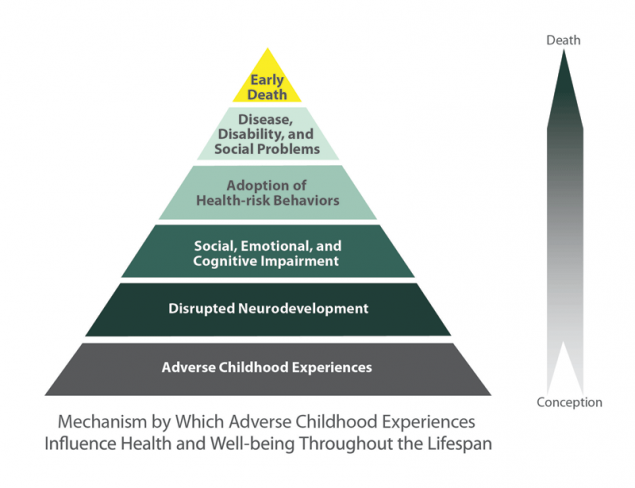
ace_pyramid_lrg-medium.png

(Picture taken from: https://www.cdc.gov/violenceprevention/acestudy/about.html, retrieved June 27, 2018)

The longer a young child exposed to repeating trauma through forms of childhood abuse, the higher are both chances of, and the depth of, life-long badly damaging consequences. One very important reason for the unmitigated impact of trauma sits with that parents or caregivers either are the source of the child’s trauma (abuse of any form), or that they are not appropriately able to nurture a traumatized child.

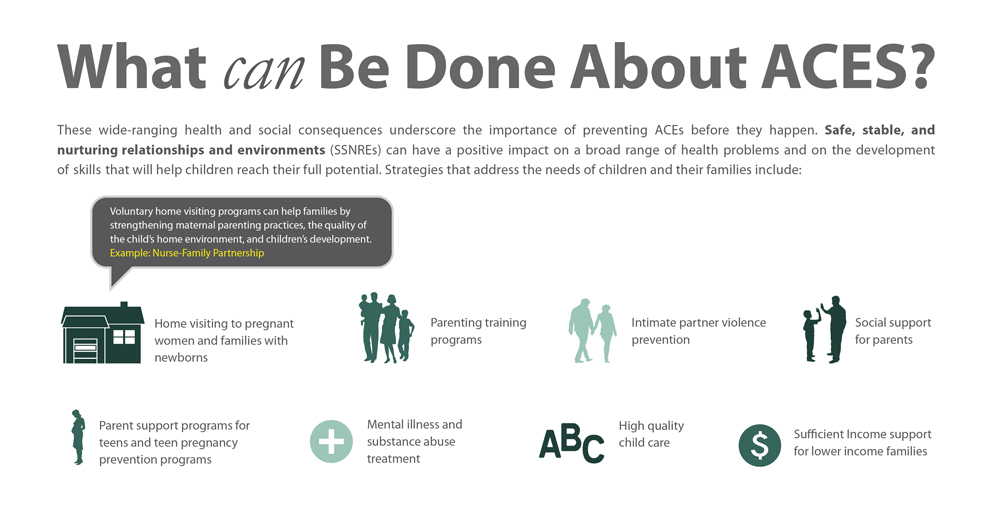
whatcanbedone

(Picture taken from: https://www.cdc.gov/violenceprevention/acestudy/about.html, retrieved June 27, 2018)

Children who, for example, get victimized by sexual abuse through third persons, depend on that their caregivers are able to respond appropriately. If they don’t or can’t, life-long dysfunctions include severe depression, compulsive pain medication leading to addiction, and a general struggle with building healthy relationships. Health problems can be severe, leading to premature death, including through substance abuse, and suicide.

In Part III I am referencing studies that confirm this for children who survive abuse in countless forms happening in conflict and war. There is evidence for that social relationships and the existence of culture-specific coping strategies, can mitigate the impact of trauma. Healing can happen. But where there is an absence of these mitigating factors, because the parents are traumatized themselves, and because cultural mechanisms struggle or have broken down entirely, dysfunctionality becomes a feature of communities and even an entire society. The plight of caregivers deprives the traumatized children from healing.

How can we expect that large percentages of trauma survivors do not influence the functioning of communities and societies? It might be difficult to find studies that confirm the relationship between trauma-induced life-long and inter-generational dysfunctional behavior on the level of entire communities and the ability of communities and a society to move to lasting peace including through its ability to reconcile. But simple logic tells that this is the case: Reconciliation is, as I have said, about restoring inner harmony, integrating memory and behavioral impact of trauma into a healthy form of living. Dysfunctional individuals can not contribute to restoring a healing and healthy community, as the community is made from these individuals who need to heal in order to contribute their healthiness to the Whole. My personal experiences in this regard, stemming from living in and visiting so many communities support this. So goes the experience of every health worker, every humanitarian, every peacekeeper. We do collectively know that a country relapses into internal conflict easier than plunging into an internal all-out conflict without having suffered from precedents. We do know that vulnerable communities in a weakened society are subject to efforts of violent extremism and international terrorism to establish control by a reign of terror.

How can we neglect a fact that is so obvious?

  • Is it because we have to mainstream the understanding of what trauma really does?
  • Is it because we are simply overwhelmed and do not know an answer to the question what could be done?
  • Is it, as I have shown, that we collectively fail to act appropriately on assisting complex systems to regain their balance?
  • Is it that we still have to act more boldly on the UN Secretary General’s vision and intent to put conflict prevention front and center? Effective peacebuilding is conflict-prevention, and thus it can not be emphasized, in my view, enough how important it is to factor early peacebuilding into peace operations. After all, the United Nation’s “Capstone Doctrine2” from 2008 emphasizes exactly that. But I know of no comprehensive follow-on to the Capstone Doctrine. It explicitly sets a framework for peacekeeping, within a larger realm that encompasses conflict prevention and peacebuilding. The larger realm remains insufficiently addressed since 2008.
  • Why is global policy not matching reality?

In the most recent comprehensive analysis of UN Peacekeeping Doctrine in book form3, “UN Peacekeeping Doctrine in a New Era: Adapting to Stabilisation, Protection and New Threats“, Chiyuki Aoi, Cedric de Coning, and John Karlsrud4 bring it to the point when they describe how mandates given to the most recent peacekeeping operations challenge the traditional UN peacekeeping principles. The authors argue that these missions operate without a peace agreement in place and that, as a result, the current focus is on projecting more force, including undertaking offensive operations at times, engaging in intelligence and using special weapons and tactics.

We have heard the UN Secretary General and his Undersecretaries constantly referring to that we deploy peacekeeping operations into environments where there is no peace to keep. In short, the focus which is absorbing almost all energy of policy- and decision makers is heavy on the military side. More or less the rest of all energy currently goes into reform efforts of the United Nations and UN peace operations. The above book makes the case that this development widens a gap between existing peacekeeping policy and practical developments on the ground. Anticipating that more of the same may come in Syria, Yemen, or elsewhere, this is of concern for the collective of twenty authors from all over the globe and with in-depth practical and academic perspective on peace operations of the UN.

Whilst my series here on trauma is not the place for a larger analysis of these developments, it can, however, be said that the development of policy how to effectively contribute to restoring peace and security runs breathtakingly behind the rapidly changing reality on the ground. This gap may contribute to challenges on advising political bodies, such as the Security Council, on what should be done, what needs to be done when being confronted with the heavy-handed conflicts of these days, and their consequences for communities and societies. Policy with no operational impact is as problematic as operational decisions based on outdated policy.

For example, I have repeatedly argued that we continue to miss the “golden hour” of early engagement through peacekeeping operations by not being provided with the necessary expertise to address the endemic consequences of emerging transnational crime influencing such peacekeeping processes negatively: “Let us get boots on the ground first” is a mantra that can often be heard. But the difficulties addressing root causes immediately makes it almost impossible to address emerging threats later.

If we engage with peacekeeping within a larger framework as we, I believe, have to, then we want to get it right. We want to see that the enormous effort, including the human tolls that we take, do effectively help getting communities and societies on a path to peace. It appears to me that those have a point who argue giving up the traditional division between peacekeeping and other forms of activities towards a unified term “peace operations”. The entire reform of the United Nations initiated by its current Secretary General is based on this.

In this series of articles I argue that the same is true for the impact of trauma on post-conflict development: We think reconciliation only later, we associate it with peace building. Like with emerging threats that include transnational organized crime, we appear to prioritize a select toolset which, though it is necessary at times, must be incomplete if it is not taking into account threats that can not be mitigated by military capacity. We postpone other action, or leave it to others, and it may be that we collectively fail to follow up.

Reconciliation empowers societies to chart their own way towards lasting peace. Whilst this is widely acknowledged, it would also appear that efforts of the assisting international community fostering this healing power have been futile. I have witnessed many discussions about how model processes, such as the South African path towards seeking truth and reconciliation, could be adopted for different post-conflict societies. But looking just at the very same country today, South Africa’s crisis of endemic corruption also demonstrates the relevance of a truly owned rule of law for a sustainable way forward. The relevance of security and rule of law for economic development, and vice versa, has become part of the core of contemporary multidimensional mandates of peace operations. What is missing is the recognition that reconciliation belongs to the critical needs from the outset on, too, and how to support it. Today, reconciliation is considered being part of a peacebuilding process, which may be emphasized later. The “paramedic approach” of peacekeeping operations focuses on protection of civilians and on political processes. Assistance to restoring security capacities is considered a secondary task which may require later action. Even more so, this is true for reconciliation. Parts of the process are recognized in what we call “transitional justice”, but even there we seem to fail seeing the relevance of deep trauma on individuals, communities, and the society as a whole.

The triangular relationship between providing security and order, applying criminal justice, and allowing meaningful penal management based on humanitarian principles and human rights is well known and often quoted as an example for the need for integrated thinking. However, the triangular relationship between governance, rule of law, and reconciliation is less strategized and even lesser operationalized.

2 In it’s own words, the Capstone Doctrine as of 2008 aims to define the nature, scope and core business of contemporary United Nations peacekeeping operations, which are usually deployed as one part of a much broader international effort to build a

sustainable peace in countries emerging from conflict. It identifies the comparative advantages and limitations of United Nations peacekeeping operations as a conflict management tool, and explains the basic principles that should guide their planning and conduct. In doing so, it reflects the primary lessons learned during the past sixty years of United Nations peacekeeping. It draws on landmark reports of the Secretary-General and legislative responses to these reports, as well as relevant resolutions and statements of the principal organs of the United Nations.

https://www.un.org/ruleoflaw/files/Capstone_Doctrine_ENG.pdf

3 UN Peacekeeping Doctrine in a New Era: Adapting to Stabilisation, Protection and New Threats (Global Institutions) (p. 1). Taylor and Francis. Kindle Edition; Loc 385

4 Ibid, Introduction – Addressing the emerging gap between concepts, doctrine, and practice in UN peacekeeping operations

Slaying the Hydra

This blog article for the Global Initiative Against Transnational Organized Crime is the more condensed and edited version of my previous article “Why global cooperation on peace and security is needed – An argument against divisiveness from the perspective of fighting organized crime.”

“UN Police – Slaying The Hydra, UN Police challenges to respond to organized crime” was published June 14, 2018 in the UN-TOC Watch section of the blog of the Global Initiative Against Transnational Organized Crime:

International policing must gear up to tackle the challenge of organized crime as a major transnational threat to peace and stability, otherwise the many-headed beast will continue to thrive.

During my five years as the police adviser to the UN, the UN Police did a lot to raise awareness about the importance of fighting transnational organized crime within the broader context of peace and security, as evidenced by two groundbreaking resolutions in 2014 and 2017. The message is simple: for conflict prevention, and for peacebuilding efforts to be successful, the relevance of organized crime must be understood, its threats identified and vulnerabilities mitigated.

In contemporary conflict environments, actors who are not party to ceasefire processes or peace agreements may threaten such efforts towards stability. Many belong to a nexus that links transnational organized crime, violent extremism and international terrorism. Organized crime takes advantage of conflict and war to counter law-enforcement efforts, while extremism and international terrorism use organized crime as a business model. Thus, efforts aimed at re-establishing governance are attacked by criminals and violent extremists. This is a menace for countries shaken by conflict, as peace depends on legitimate governance in which all communities find their space.

The consequences of transnational organized crime – such as trafficking in human beings, forms of exploitation and slavery, and trafficking in weapons or narcotics – may also contribute to the current global rise of nationalism and populism. And, more recently, peace operations have become a target themselves.

Organized crime and violent extremism not only weaken existing governance, they also establish their own governance systems. Islamic State is a case in point, being an extremist ideology that has imposed an entire bureaucratic, public-services and tax system. The organization also uses criminal enterprise to generate revenue, much of it transnational. Hence it can be difficult to distinguish between individuals and networks representing ‘classical’ transnational organized crime and violent extremists who benefit from it.

Diplomatic and military efforts are limited or rendered toothless given the complex nature of the organized-crime threat. Individual states and the international community struggle against a faceless, multidimensional and highly secretive enemy. Unlike Islamic State, which exploits a sophisticated media machine, transnational organized crime has no public voice; instead, it thrives on deception, bringing to mind the many-headed Hydra of Greek mythology, which proved almost impossible to slay.

When faced with this sort of complex challenge, the authorities often resort to efforts of disruption. But every experienced law-enforcement officer knows that disruption can never be more than a temporary alternative to the real objective: permanently disbanding the network. Multinational organizations need long-term strategies – something that tends not to come naturally to political processes. And neither foreign ministries nor military forces have experts on transnational organized crime, crime prevention, community-oriented policing or intelligence collection within a civilian legal framework. Responding to organized crime in complex settings requires careful, thoughtful engagement, capable of sustaining a long-term effort. Policing expertise is essential. However, this sort of expertise has often played second fiddle to military responses, often with negative consequences.

Transnational organized crime is like a highly complex technological system that functions through an untold number of connections and nodes. Similarly, responding to it, much like operating a complicated piece of machinery, necessitates a detailed understanding of how the system works, otherwise there is a risk of further destabilization and thriving illicit activity.


Strengthening the peacekeeping/law enforcement response to organized crime

In June 2016, ministers of the interior, chiefs of police and other high-level officials from more than 100 member states gathered at the UN headquarters for the first-ever summit of UN police chiefs. Participants called for the need to tackle transnational organized crime and deploy more specialist expertise – based on specific capacity gaps within national institutions and priorities requested by host states. They encouraged stronger partnerships between the UN Police, the African Union, the European Union, INTERPOL, EUROPOL, the emerging AFRIPOL, AMERIPOL, ASEANAPOL, the Organization for Security and Co-operation in Europe, the International Association of Chiefs of Police and other partner organizations. In June 2018, the UN will host the second UN Chiefs of Police Summit, which will aim to take stock and move forward on organized crime.

Meanwhile, Secretary General António Guterres argues that the future of peacekeeping operations is linked to UN Police and that more investment in this area will be essential. The same sentiment can be found in the 2016 European Union Global Strategy. The EU is working on getting EUROPOL closer to crisis management missions of the EU abroad. The recognition that experts on transnational organized crime need to be provided to support actions within a foreign-policy context is slowly growing, although I don’t see this reflected in national police budgets.

Between 2014 and 2016, the UN also finalized the policy of the Strategic Guidance Framework (SGF). This long-standing, worldwide effort, supported by a global network of law-enforcement professionals, enhances the effectiveness of the UN Police in peace operations. Mapping out the interdependency of community-oriented policing and intelligence-led policing is but one of many examples of how the SGF tackles the challenges presented by transnational threats, including that of organized crime. The SGF has become an internationally acknowledged reference point for how to strengthen host states’ law-enforcement capacities and capabilities, giving international policing a first-ever framework. Meanwhile, the establishment of a Serious and Organized Crime Team in the UN Police Division, and the creation of an entire network of focal points on transnational organized crime are examples of efforts to translate the SGF framework into practice.

Such efforts are key to an effective global response to a global threat. But there is no space for complacency. We need to be seriously concerned. We are witnessing the erosion of a willingness to think globally in the face of global challenges and threats, in an environment where no local event can be separated from the global, and vice versa – often with unforeseen consequences. But populism thrives on the pretence that there are easy solutions to the world’s problems and that those who say otherwise are merchants of ‘fake news’. Nationalist sentiment rolls back global and regional achievements, and presents a threat to more integration. And, at the extreme end of the scale, a new wave of fascist movements are intent on destroying what has been achieved by liberal societies, including the rule of law. I know of no examples in contemporary history where such assaults on the rule of law and increasing patterns of authoritarianism have not led to greater levels of organized crime and corruption.

Impressive steps have been made in bringing about a truly global approach to international policing. But these achievements can easily be wiped out. New and resolute thinking is now needed to prevent organized crime from benefiting from the erosion of the rule of law. We have to better acknowledge the complex effects of transnational crime on conflict and war; we have to acknowledge that inadequate efforts to deal with conflict, or to help rebuild post-conflict settings, nurture transnational crime’s ability to thrive.

Ultimately, fighting crime is a civilian core function within society. As the Global Initiative advocates, networks can only be fought by networks – in this case, networks of law-enforcement and criminal-justice organizations. In states and regions already weakened by conflict and war, transnational crime thrives and domestic law-enforcement partner organizations struggle. Whether through outright assistance or temporary international involvement, we have to help our partners from the outset. It requires our active commitment not only with diplomats and soldiers, but also with police and justice expertise. And it requires doing things together, including with national and international law-enforcement agencies.

Why global cooperation on peace and security is needed – An argument against divisiveness from the perspective of fighting organized crime

Over the past five years United Nations Police significantly increased the awareness of the impact of serious and organized crime on conflict and war. In two groundbreaking resolutions on policing, (2185/2014 and 2382/2017) the UN Security Council recognized the relevance of efforts supporting the fight against transnational organized crime within the continuum of peace and security. For conflict prevention, peace operations and peacebuilding efforts to become successful, its relevance must be understood.

It’s as simple as that: First comes the threat identification, followed by the identification of vulnerabilities. Then there must be decisive mitigation.

In contemporary conflict environments, asymmetric threats originate from actors who are not party to ceasefire processes or peace agreements. Add interlocutors to the mix who are involved into peace processes and have second and third agendas. The former have no interest in supporting peace processes, the latter’s commitment is limited by the extent to which their own, often hidden, agendas can be implemented. The entire initial process might become unidentifiable, leaving us with the question “How did we end up here?”

All of these actors belong to a nexus tying transnational crime, violent extremism and international terrorism together. They thrive on and create corruption. Organized crime uses conflict and war to counter enforcement efforts, and extremism and international terrorism use organized crime as a business model.

This is a menace for host-countries affected by conflict or shaken by war, as peace requires security and depends on legitimate governance in which all communities find their space. Thus, the efforts of reestablishing governance are attacked by criminals and violent extremists. More recently, peace operations have become a target themselves. Whether peace operations make it or break it in assisting in mitigating this threat is something direly felt by neighbors, or even neighboring regions: The threat affects whole regions and has global implications.

More than that: Rampant consequences of transnational organized crime, such as trafficking in human beings and forms of exploitation and slavery, trafficking in weapons, or narcotics, all have an impact on the global rise of nationalism and populism.

Organized crime and violent extremism do not only weaken existing governance, they also establish their own governance: We know all too well that criminal networks regularly control societal aspects of the life of people. The Islamic State is an example for an ideology establishing the whole gamut of a bureaucracy, public services and taxes. Such extremism again uses crime for generating revenue, and most of it is transnational. When we draw network-relationship-diagrammes, it is sometimes difficult to separate persons and networks representing “classical’ transnational organized crime and those on the side of violent extremism. However, the immense role of transnational crime is undeniable.

Diplomatic and military efforts are limited or rendered even toothless because of the complex nature of the threat: Committed actors in host States and the International Community struggle with a faceless, multidimensional and highly secretive enemy. Unlike Islamic State using the entire media machine, transnational organized crime has no public voice, but is uses deception. Ancient Greek mythology comes to mind, every decapitation of one head of the Hydra causes its replacement with two new heads. When we are faced with this complexity, we often resort to efforts of disruption. Every experienced law enforcement officer knows that disruption can never be more than a temporary alternative to the real objective: Disbanding the network.

International, regional and foreign national actors in the same theater of operations are faced with an extremely high degree of complexity. Formulating a mandate for action by multinational organizations is challenged right from the beginning by the need for long-term strategies to be factored in from the outset. That doesn’t come natural for political processes. Secondly, the effective implementation of mandates by multiple actors depends both on coherent political backing and having the right means. They are usually provided by member States. But neither foreign ministries nor the military has experts on transnational organized crime, crime prevention, community-oriented policing, and intelligence collection within a civilian legal framework. This leads, thirdly, to that we all are willing to acknowledge complexity, but we do not always accept the consequence: a resulting need for a gentle, thoughtful engagement, with highly capable expertise from the beginning, sustainable in its ability to adapt within a long-term support effort. Traditionally, this sort of expertise often comes second when political decision-makers hear it. The military is heard first.

Imagine a board with many instruments and switches, and you have almost no knowledge of most connections under the hood. Transnational crime is part of an unknown number of such connections. Would you use a careful approach, attempting to understand better before operating the switches? Would you apply gentle changes that can be corrected, reverted, fine tuned as you go and understand better? Or would you use a wrench? Would you say “Yes, that’s a complicated thing, that’s for later and for others, I’m using the wrench anyway because I lack finer tools.” For the hammer, all things look like nails. The result of inadequate action on complexity is often the opposite of what was intended: Further destabilization and illicit control thrive.

In reality this means that (1) we have to do better to acknowledge the complex effects of transnational crime on conflict and war and (2) we have to acknowledge that inadequate handling from the beginning of any effort to prevent or handle conflict, or to help re-building post-conflict, nurtures transnational crime’s ability to thrive.

Ultimately, fighting crime is a civilian core function within a society. As transnational crime is a network of networks affecting many societies, networks can only be fought by networks. In this case, networks of law enforcement and criminal justice organizations. But within States and regions weakened by conflict and war, transnational crime thrives and domestic law enforcement partner organizations struggle and are suffocated. Whether through outright assistance or temporary international executive involvement, we have to help our partners from the outset on. Because our partners they are, they are peers in dire need, undermined by the enemy. It requires our active commitment not only with diplomats and soldiers, but with a wide range of police and justice expertise. And it requires doing things together, including national and international law enforcement agencies.

In June 2016, Ministers of the Interior, Chiefs of Police and high-level officials from more than 100 Member States gathered at the United Nations Headquarters in New York. Organized by the Police Division of DPKO, this first ever summit of Police Chiefs under the United Nation’s umbrella (UN COPS) called, amongst other important issues, on tackling transnational organized crime, acknowledging the need to deploy more specialized expertise – based on specific capacity gaps of national institutions and priorities requested by host States. Participants encouraged fostering strengthened partnerships between the United Nations Police, the African Union, the European Union, INTERPOL, EUROPOL, the emerging AFRIPOL, AMERIPOL, ASEANAPOL, the Organization for Security and Co-operation in Europe, the International Association of Chiefs of Police and other partner organizations.

In June 2018, the United Nations will witness the second UN COPS, taking stock and moving forward, if possible. In the invitation, UN Secretary General Antonio Guterres states that the future of peacekeeping operations is linked to UN Police and that more investment in this area will be essential. The UN maps the context: “Violent conflict and global challenges, including organized crime, violence and extremism conducive to terrorism, affect the safety, security and livelihoods of communities. These challenges undermine rule of law institutions, as well as the ability of police to prevent, detect and investigate crime, protect persons and property, and maintain public order.

This statement goes far beyond peacekeeping: It is a global challenge of great urgency. The same can be found in the 2016 European Union Global Strategy. The EU is working on getting EUROPOL closer to crisis management missions of the EU abroad. The recognition that experts on transnational organized crime need to be provided to actions within a foreign policy context is slowly growing, but I don’t see it reflected in national police budgets.

Between 2014 and 2016 the United Nations finalized the policy of the Strategic Guidance Framework SGF (https://police.un.org/en/sgf). This longstanding and worldwide effort, supported by a global network of law enforcement professionals, enhances the effectiveness of UN police in peace operations. It presents a consistent approach to how UN Police works, and especially the provision of support to host-State police services. Mapping out the interdependency of community-oriented policing and intelligence-led policing is but one of many examples for how the SGF tackles the challenges presented by transnational threats including organized crime. Handbooks are being produced and command training is being rolled out. The SGF has become an internationally acknowledged reference point for how to strengthen host State’s law enforcement capacities and capabilities, giving international policing a first-ever framework.

Such efforts are key for a global response to a global threat.

There is, however, no space for complacency. As a matter of fact, there is space for serious concern. We witness the erosion of a willingness to think globally in light of global challenges and global threats. Ours are times in which no local event can be separated from global, and no global event can be separated from local consequences. Because our world is complex, these consequences show up in often unforeseen ways. But populism pretends that there are easy solutions to the World’s problems and that those who say otherwise are “fake news”. Nationalism rolls back global and regional achievements and presents a threat to more integration. On the extreme end, a new fascism attacks achievements of liberal societies, including the rule of law.

How would the rule of the powerful instead of the rule of law not translate into more organized crime and corruption? I know of no example in contemporary history where it would have not. We have come an impressive part of the way, but it can easily be reverted during these times. New and resolute thinking is required to prevent organized crime from benefiting from the erosion of the rule of law.

Hoch geschätzt und dringend benötigt: Deutsche Polizeifähigkeiten

https://peacelab.blog/2018/04/hoch-geschaetzt-und-dringend-benoetigt-deutsche-polizeifaehigkeiten

Believe it or not, from time to time I do relapse into my native language, especially when it comes to rallying support for international issues within a German political environment. So, those fluent in German: Enjoy!

The article was published on the blog “PeaceLab”. It is run by the Global Public Policy Institute GPPI – http://www.gppi.net/home/ (Yes, largely in English language) – in support of the development of bottom-up discussions informing German foreign policy decisions. The blog is run in co-operation with the German Federal Government.

Please add the blog to your sources of information, it’s awesome, and it’s not fake news.

Hoch geschätzt und dringend benötigt: Deutsche Polizeifähigkeiten

Deutschland leistet kritische Beiträge zur Reform und Stärkung der Vereinten Nationen sowie zur Weiterentwicklung der Europäischen Union und zur Vertiefung der gemeinsamen europäischen Identität. Deutsche Institutionen der Inneren Sicherheit beteiligen sich seit vielen Jahren an globaler Konfliktprävention, Friedenssicherung und Friedensaufbau, einem Schwerpunktthema deutscher Außenpolitik. Die Leitlinien der Bundesregierung “Krisen verhindern, Konflikte bewältigen, Frieden fördern” vom 14. Juni 2017 bilden einen überzeugenden Rahmen für eine konzeptionelle Diskussion von ressortübergreifenden Aspekten der Sicherheitssektorreform und der öffentlichen Verwaltung (Governance), aber auch für einen von Prinzipien und Werten geleiteten Diskurs: Die Leitlinien beziehen sich auf den im deutschen Grundgesetz verankerten Willen, als gleichberechtigtes Glied in einem vereinten Europa dem Frieden der Welt zu dienen. Sie zitieren die Charta der Vereinten Nationen, die in ihrer Einleitung die Entschlossenheit der Weltgemeinschaft zum Ausdruck bringt, “künftige Geschlechter vor der Geißel des Krieges zu bewahren”.

Globalisierung, Grundwerte und Vereinte Nationen zunehmend in Frage gestellt

Die 2016 und Anfang 2017 entwickelten Leitlinien analysieren zu Beginn diese Welt, die “aus den Fugen geraten” zu sein scheint. Was ist seit dieser Zeit noch deutlicher geworden?

  • Eine Grundannahme der Leitlinien ist die andauernde Globalisierung. Diese Entwicklung wird zunehmend von nationalistischen Strömungen bekämpft. Der grassierende und teilweise vorsätzlich vorangetriebene Zerfall einer auf gemeinsamen Werten basierenden Diskussionskultur ist hier besonders besorgniserregend. Nicht selten ersetzen Zorn und blinde Emotion Vernunft und Respekt für Wahrheit und kollektive Werte.
  • Die Bedeutung der Vereinten Nationen als Plattform einer globalen Willensbildung zu Fragen von Frieden und Sicherheit wird zunehmend infrage gestellt: Wie zu Zeiten des Kalten Krieges sind gemeinsame Positionen im Sicherheitsrat schwieriger zu erreichen und von nationalstaatlichen Interessen überlagert. Dies erschwert politische und technische Maßnahmen zur Stützung von Konfliktprävention, Friedenssicherung und Friedensaufbau zunehmend: Mandate für VN oder andere Organisationen wie EU und AU können nicht formuliert werden oder sind unangemessen und schwach. Nicht selten nutzen Mitgliedsstaaten unterschiedliche Maßstäbe. Eine entschlossene Unterstützung für mit politischen Widerständen und Angriffen konfrontierten Friedensmissionen wird immer schwieriger.
  • Wertediskussionen werden zunehmend durch machtpolitisch dominierte nationalstaatliche Positionen infrage gestellt: Die derzeitige global sichtbare Tendenz, Menschenrechts- und humanitäre Fragen wieder nachrangig zu diskutieren, erlebt man derzeit sehr konkret im täglichen VN-Alltag. Derartige Signale werden von anderer interessierter Seite genutzt, um die Legitimität von Institutionen der internationalen Strafjustiz zunehmend infrage zu stellen. Gleichzeitig nehmen unverhohlene Angriffe auf Grundwerte eines entwickelten Demokratieverständnisses einschließlich des Grundrechts auf Presse- und Meinungsfreiheit global zu. Dies wird in Krisenländern zunehmend als Einladung verstanden, Schutz, Wohlergehen und Humanität der eigenen Bevölkerung oder von Minderheiten und verletzlichen Gruppen mit Füßen zu treten, ohne Sanktionen befürchten zu müssen.
  • Die Zukunft und die Rolle der Europäischen Union wird von innen und außen kritisch hinterfragt.

Deutsche Außenpolitik: Aufgeben ist keine Alternative

So findet sich deutsche Politik international im Mittelpunkt von Hoffnungen und Ängsten wieder: Die Hoffnung auf eine starke Rolle Deutschlands in Erhalt und Fortentwicklung der europäischen Idee und in Stützung der Gründungswerte der Vereinten Nationen ist in gleichgesinnten internationalen Kreisen größer als vielleicht im Inland vermutet. Im Umkehrschluss fragen sich viele Partner Deutschlands mit Sorge, ob die als standfest wertverbundene und multilateral empfundene starke deutsche Außenpolitik fortdauern wird.

Die Konsequenzen für Art und Umfang von Unterstützungsmaßnahmen zur Stärkung und Reform des Sicherheitssektors und der öffentlichen Verwaltung in Krisen- und Konfliktgebieten müssen im Rahmen der politischen Willensbildung der Bundesregierung sorgfältig betrachtet werden: Nie war es wichtiger als heute, um den richtigen Weg für Friedensprävention, Friedensunterstützung und Friedensaufbau zu ringen.

Nie war es wichtiger als heute, um den richtigen Weg für Friedensprävention, Friedensunterstützung und Friedensaufbau zu ringen.

Aufgeben ist keine Alternative. Kohärente und wirksame nationale Beiträge erfordern politischen Konsens auf internationaler Ebene. Am Ende gilt das Primat der Politik für jegliche technische Unterstützung der Stärkung und Reform von Institutionen im Bereich der Sicherheit und des Rechts.

Keine Sicherheit ohne Grundwerte

Die Interessenkollision zwischen politischem Pragmatismus und Grundwerten des Handelns war schon immer herausfordernd. Die Unterstützung von Krisen- und Konfliktstaaten beim Aufbau und der Reform des Sicherheitssektors und der öffentlichen Verwaltung muss ihre Grenzen dort finden, wo Grundwerte der internationalen Staatengemeinschaft in ihrem Wesensgehalt beeinträchtigt sind: Sicherheit ohne Freiheit darf es ebenso wenig geben wie Freiheit und Sicherheit ohne humane und soziale Werte. Partnerschaftliche Unterstützung im Rahmen von Konfliktprävention muss auf einem durch alle Partner von Beginn an akzeptierten Werteverständnis aufsetzen. Das Einhalten dieser Vereinbarungen muss Bedingung für die Fortsetzung von Unterstützung sein. Ebenso setzt Friedenssicherung voraus, dass hieran beteiligte uniformierte und zivile Kräfte die Werte der Entsendeorganisationen vorleben: Friedenssicherung ohne Wertorientierung und ohne entschlossenes Handeln gegen eigene Mitarbeiter, die Menschenrechte verletzen, de-legitimiert sich.

In der VN-Polizeiabteilung haben wir zu dieser Werteorientierung in den letzten Jahren konzeptionell wesentliche Beiträge geleistet: Die Vereinten Nationen definieren “Polizeiarbeit” als eine Funktion öffentlicher Verwaltung, die Aufgaben im Bereich der Prävention, Feststellung und Ermittlung von Straftaten wahrnimmt, Personen und Eigentum schützt und öffentliche Sicherheit und Ordnung aufrechterhält. Aufgaben im Bereich der Polizei sollten Hoheitsträger wahrnehmen, die der Polizei oder anderen Strafverfolgungs- und Sicherheitsbehörden auf nationaler, regionaler oder lokaler Ebene angehören. Diese Behörden agieren in einem auf Prinzipien der Rechtsstaatlichkeit aufbauenden gesetzlichen Rahmen. Hoheitsträger von Polizei und anderen Strafverfolgungs- und Sicherheitsbehörden sind zur Einhaltung und zum Schutz von Menschenrechten verpflichtet.

Die Agenda des VN-Generalsekretärs ist eine Chance für die deutsche SSR-Strategie

Durch die Entwicklung im Bereich der Friedensoperationen der VN in den letzten Jahren wird die Unterstützung des Wiederaufbaus und die Stärkung von Polizei und Rechtsstaatsinstitutionen nun stärker betont. Jüngste Beispiele sind der Wandel von MINUSTAH zu MINUJUSTH in Haiti und die andauernde Transformation von UNAMID in Darfur (Sudan). Gleichzeitig betont der VN-Generalsekretär die große Bedeutung von Konfliktprävention und nachhaltigem Friedensaufbau. Die Reformanstrengungen der VN verfolgen die Verwirklichung eines integrierten ganzheitlichen Ansatzes: Ressortschranken innerhalb der VN sollen abgebaut werden. Welch’ eine Chance für eine deutsche Diskussion über eine ressortübergreifende Strategie!

Polizeifunktionen sind Kernfunktionen in allen Gesellschaften  

Trotz enormer Fortschritte in den letzten Jahren haben weder die Gremien der VN noch die Mitgliedsstaaten die inhaltliche Diskussion zur Bedeutung von Polizei- und Justizfragen sowie zur Reform des Sicherheitssektors entschlossen genug geführt. In meiner Arbeit habe ich die folgenden Punkte noch im letzten Jahr aus Anlass meiner Amtsübergabe formuliert:

Polizeifunktionen sind Kernfunktionen in allen Gesellschaften. Richtig verstanden und ausgeführt tragen sie zu Frieden, Sicherheit und Stabilität der Gesellschaft und der sie konstituierenden Gruppen bei. Auf dem Pfad von Friedenszerfall zu gewaltsamem Konflikt sind Institutionen der Sicherheit und des Rechts oft unter den ersten Tätern oder Opfern. Je widerstandsfähiger sie gegen politische Vereinnahmung sind, je standfester sie dem Schutz und der Sicherheit der Bevölkerung verpflichtet bleiben, umso größer ist die Chance, dass ein aufkommender Konflikt durch Dialog und Mediation bewältigt werden kann.

Dort, wo Prävention versagt hat, gehört bürgerorientierte und wehrhafte Polizeiarbeit zu den ersten Opfern. Daher ist es eine kritische Voraussetzung für jeden Friedensprozess, den Wiederaufbau einer gut funktionierenden Polizei zu unterstützen. Polizeiarbeit muss sich durch nationale und örtliche Akzeptanz und Beteiligung aller relevanten Gesellschaftsgruppen legitimieren. Wehrhaftigkeit gegen Diskriminierung, Rechtsstaatlichkeit allen Handelns, Gleichberechtigung aller Geschlechter und Repräsentation der örtlichen Gemeinschaften müssen von der ersten Stunde der Unterstützung im Vordergrund stehen.

Bereits Konfliktprävention muss Polizei stärken

Polizeifunktionen sind wesentlicher Teil des Immunsystems von Gesellschaften. Daher muss Konfliktprävention bereits konzeptionelle Beiträge zur Stärkung des Immunsystems beinhalten. Falls Friedenssicherung notwendig wird, muss die internationale Unterstützung zum Wiederaufbau von Polizei als Teil eines Rettungseinsatzes verstanden werden, der “die Blutung des schwerverletzten Patienten stoppt”. Um im Bild zu bleiben, schützt diese Ersthilfe die bedrohten und verletzten Gruppierungen verwundeter Gesellschaften und beugt Infektionen durch transnationale Bedrohungen wie schwere und organisierte Kriminalität, gewaltbereiter Extremismus und internationaler Terrorismus vor. Hilfe im Wiederaufbau muss dies bereits in der ersten Stunde berücksichtigen und auch den Boden für die folgenden Bemühungen zur Sicherheitssektorreform bereiten. Wie in den Leitlinien der Bundesregierung betont, ist der Weg von Konflikt zu nachhaltigem Frieden ein langwieriges Unterfangen. Daher muss der Stabilisierung nach Konfliktende ein nachhaltiger und lang andauernder Beitrag zur Restauration des “Immunsystems” folgen: Friedensförderung muss Unterstützung für die Reintegration von Sicherheitsorganen in regionale und internationale Sicherheitsmechanismen beinhalten.

Die Strategie der Bundesregierung muss VN-Polizei stärken

Eine ressortübergreifende Strategie der Bundesregierung muss die Rolle und Fähigkeiten der VN-Polizei in Konfliktprävention, Friedenssicherung und nachhaltiger Friedensförderung stärken: Obwohl Prävention das edelste aller Ziele ist, diktiert die Realität zunehmender Konflikte die entschiedene Stärkung fähiger Polizeikräfte der VN, um die Zivilbevölkerung zu schützen und den Wiederaufbau lokaler Institutionen der Sicherheit und des Rechts zu unterstützen. Wo frühzeitige und entschlossene Integration spezialisierter Polizeiexpertise versagt, ist der Friedensprozess selbst in Gefahr: Heutige Friedensmissionen sehen sich asymmetrischen Bedrohungen durch nichtstaatliche Akteure ausgesetzt, die weder Bestandteil von Friedensprozessen sind, noch ein Interesse an erfolgreicher Friedensarbeit haben oder Friedensabkommen respektieren. Organisierte Kriminalität nutzt Konflikt und Krieg; Extremismus und internationaler Terrorismus nutzen organisierte Kriminalität als Mittel zur Finanzierung und Kontrolle.

Spezialisierte deutsche Polizeiexpertise wird dringend benötigt

Internationale Polizeiarbeit unter dem Dach der VN, der EU oder der Afrikanischen Union trägt zur Friedensbildung bei und ist daher eine praktische Form der Konfliktprophylaxe und der Rückfallvermeidung. Wer die Herstellung akzeptabler Bedingungen für Sicherheit und Rechtsstaatlichkeit unterstützen möchte, hat keine Alternative: Die Leitlinien der Bundesregierung verdeutlichen die globalen Entwicklungen, die zu Flucht und Migration führen und von denen Extremismus, Gewalt und Kriminalität profitieren. Das Argument, dass Polizeiressourcen für den Einsatz “zu Hause” geplant und finanziert sind, und dass daher jeder Beitrag zu internationalen Friedensbemühungen der VN und auswärtigem Handeln der EU Ausnahme sein muss, geht fehl.

Spezialisierte deutsche Polizeiexpertise ist sowohl für VN-Polizei (von Prävention bis zum Friedensaufbau) als auch für SSR eine dringend benötigte Ressource.

Eine ressortübergreifende Strategie muss die systematische Stärkung spezialisierter Polizeifähigkeiten beinhalten. Deutschland genießt hier einen hervorragenden Ruf und deutsche Bemühungen, die Stärkung polizeilicher Fähigkeiten und Maßnahmen zur Reform des Sicherheitssektors miteinander zu integrieren, werden ausdrücklich wahrgenommen. SSR profitiert von breiter Akzeptanz erfolgreicher VN-Polizei-Unterstützung in Bevölkerung und Regierung. Spezialisierte deutsche Polizeiexpertise ist sowohl für VN-Polizei (von Prävention bis zum Friedensaufbau) als auch für SSR eine dringend benötigte Ressource.

Policing – Done Right

“When there is so much to be known, when there are so many fields of knowledge in which the same words are used with different meanings, when everyone knows a little about a great many things, it becomes increasingly difficult for anyone to know whether he knows what he is talking about or not. And in such circumstances, when we do not know, or when we do not know enough, we tend always to substitute emotions for thoughts.”

T.S. Eliot, “The Perfect Critic”; 1920, in: Jacobs, Alan. How to Think: A Survival Guide for a World at Odds (p. 22). The Crown Publishing Group; 2017.

The United Nations defines “policing” as a function of governance responsible for the prevention, detection and investigation of crime; the protection of persons and property; and the maintenance of public order and safety. Policing must be entrusted to civil servants who are members of police or other law enforcement agencies of national, regional or local governments, within a legal framework that is based on the rule of law. Police and law enforcement officials have the obligation to respect and protect human rights.

(1) Policing is a core function of communities and societies. Done right, it crucially contributes to peace and security for citizens. On the slippery slope from peace to conflict security institutions always show early signs of entanglement, in varying combinations becoming part of the emerging conflict, or a deliberate target. Security institutions that are resilient to undue political control and that understand their function as a commitment to citizens, actively contribute to conflict prevention and allow conflict resolution based on dialogue and mediation. Where prevention and resolution fail within an intra-state conflict, policing will be damaged. A restored policing function post-conflict is essential for sustainable peace and security. It must be based on consensual domestic ownership, gender and community representation, and prioritized early on after a conflict ends:

(2) Policing is part of a society’s immune system. Conflict prevention must include efforts strengthening the immune system of a society. Where conflict prevention fails, assistance to restoration of policing is the paramedic approach needed to stop the patient from bleeding, and to prevent wounded communities and societies from becoming infected by transnational threats, including serious and organized crime, violent extremism, and international terrorism. Where assistance to protection of civilians, and to capacity building of their immune system fails, affected societies and States struggle. More often than not they may end up riddled with endemic corruption, crime, and continued conflict. Threats for international peace and security thrive on this weakness. Finally, after post-conflict stabilization peace building must include efforts to sustain the restoration of a society’s immune system including through it’s integration into regional and international security mechanisms.

(3) Consequently, strengthening the role of UN policing in conflict prevention and in sustainable peace building on one hand and a more decisive and capable assistance of UN policing to the restoration of post-conflict domestic policing as a core function of modern peace operations on the other hand must be a priority. Where early and decisive efforts of today’s peace operations restoring domestic policing are not mandated or sufficiently resourced and politically prioritized, the peace process itself is at risk: In contemporary conflict environments asymmetric actors evolve who are not party to peace agreements, and who have neither interest in complying with peace processes nor respect for international actors supporting peace. They include transnational crime, violent extremism and international terrorism. These actors increasingly target the UN itself. Military responses alone fail against these, whilst policing provides no solitary answer against violent extremism and terrorism at the early stages of conflict intervention either: Robust peace operations require sufficiently resourced police and military capacities, able to act together. At the same time, any international activity that does not successfully assist in restoring domestic security capacity has no exit strategy, leading to getting stuck, or being defeated, on tactical, operational, strategic, and policy levels.

(4) Successful peace building prevents relapse and is practical conflict prevention. There is no alternative to helping struggling societies in creating conditions for safety, security, and justice. Taken together with other global developments the alternatives simply are displacement and migration as means to flee from insecurity and inhumane oppression. Extremism, violence, and crime, feed on this. United Nations Member States must fully embrace the appreciation that UN international policing needs decisive strengthening as part of a much broader strategy aiming to achieve Sustainable Development Goal SDG 16. The argument that policing resources are to be used in own domestic contexts is leaving a vast security dimension devoid that military means can not address, nor substitute.

(5) In 2015, the report of the High Level Independent on Peace Operations (HIPPO) confirmed UN Police as a critical component for peace operations. September 2015, UN Secretary General (UNSG) Ban Ki-moon presented the HIPPO-Report to the UN General Assembly and the UN Security Council, introducing it, inter alia, with the statement that “…Labels assigned to conflict – internal, inter-state, regional, ethnic or sectarian – have become increasingly irrelevant, as transnational forces of violent extremism and organized crime build on and abet local rivalries.

(6) As borders do not work against crime and terror, neither physically, and even more so not in cyber-space, policing in United Nations’ work on peace and security must become an accepted part of an ever more strengthened international dimension of policing, and it must meet the challenges presented by the global effects of the Internet: There is no local development without global effect any longer, and vice versa.

The Rule of Law

In what can be considered an unprecedented opinion-piece in the New York Times, former deputy attorney general Sally Yates raises a most serious concern: That the President of the United States is attempting to dismantle the rule of law. I don't know whether such an accusation against a sitting President has ever been raised before, nor it is my place to engage in this discussion.

However, being substantiated, or not, allegations of, and attempts to, undermine the rule of law have also been raised against other Heads of States of countries with a longstanding democratic tradition. Democratic governance serves the people who have decided to subject themselves to a system of elected political leaders, and institutions that hold everyone and themselves accountable to the law and the citizens. Any such system must be able to defend itself against external and internal threats. Both the rule of law and the freedom of press are indispensable for this. Eroding either, or both, has always ended in catastrophes.

If a former deputy attorney general publicly accuses the President of the United States of attempting to dismantle the rule of law, one can not prima facie assume it's fake news, or part of a witch hunt. As Sally Yates herself indicates, serious discussions about such concerns are risking to be drowned in "a daily barrage of alarming news". Moreover, the sheer intensity of distracting sensational noise, be it on social media such as Twitter, or elsewhere, numbs all of us. It is purposely meant to incapacitate, to suffocate, any responsible and accountable discussion. The "next thing" is meant to not allow focusing on "this thing", and checking on whether there is a "next thing" becomes obsessive, and addictive. Sensationalism becoming a weapon of warfare, politics become a soap opera filled with obscenities.

Democratic values, a rule of law applying equally to All, dignity, a culture of unemotional and fact-based discourse, all that and more can easily become a casualty in a firestorm of noise and emotional manipulation: Suggestions to rough up suspects in due course of an arrest, or to label criminals as "animals", serve only one purpose: De-humanization. What would you, mother or father, say if the police would bang your son's or daughter's head bloody against the roof of the police car, after an arrest following a, say, false allegation, and if the police would refer to being encouraged doing this by the President of your country? Where would you seek justice?

Peppering it up with sentences such as that criminal gangs have “transformed peaceful parks and beautiful quiet neighborhoods into bloodstained killing fields” is using mass-psychology in order to manipulate an already angry and emotionalized electorate. Goethe's Faust comes to mind: The ghosts that we called, now they won't go away and they will be haunting us: The divides between an angry electorate and increasingly frustrated opponents become greater day by day. Fueling it is playing with fire, the erosion of a common base may lead to waking up one day and wondering how we all got there.

Thus, it is heart-warming seeing the leadership of the law enforcement community standing up for values such as policing following the rule of law, and respecting human rights.

Ceterum censeo, Carthaginem delendam esse", so said a Cato the Elder, a senator of ancient Rome, in closing any speech in front of the Senate: "By the way, I am of the opinion that Carthage must be destroyed." It is a synonym for standing up for own convictions, no matter what.

Thus, I repeat the United Nation's definition of the rule of law below, and I congratulate, in my personal capacity, the courage of judges, prosecutors, and police chiefs, in affirming the public that the police and justice will stand up for the rule of law, and human rights, no matter what. Ceterum censeo: Torture does not work, and it is one of the most horrific atrocities of mankind.

For the United Nations, the rule of law refers to a principle of governance in which all persons, institutions and entities, public and private, including the State itself, are accountable to laws that are publicly promulgated, equally enforced and independently adjudicated, and which are consistent with international human rights norms and standards. It requires, as well, measures to ensure adherence to the principles of supremacy of law, equality before the law, accountability to the law, fairness in the application of the law, separation of powers, participation in decision-making, legal certainty, avoidance of arbitrariness and procedural and legal transparency.”