Anger, Rage, Fear – The Change of How We Consume News

I’d like to quote Anne Applebaum from her book “Twilight of Democracy -The Seductive Lure of Authoritarianism”, pages 110-114. At the end of this quotation you will find the same statement in relation to addictive manipulation by the likes of FaceBook, Google, and YouTube as I have been explaining in my blog article Add title – Start Writing. And just for the record, I wrote that blog entry before reading the below part in Anne Applebaum’s very insightful and readable book. Not because I’m claiming to be smart, but just to assure you I am not just copying and repeating something I have read. However, Anne Applebaum is smart. She is an American journalist and historian, not only with a distinguished history of publications, but with a very deep knowledge about European history and contemporary political and societal development. She spent vast stretches of her professional and private life in East- and West-Europe.

“In the more open societies of the West, we have become smug about our tolerance for conflicting points of view. But for much of our recent history, the actual range of those views was limited. Since 1945, the most important arguments have usually unfolded between the center right and the center left. As a result, the range of possible outcomes was narrow, especially in democracies like those in Scandinavia that were most inclined toward consensus. But even in the more raucious democracies, the field of battle was relatively well defined. In the United States, the strictures of the Cold War created bipartisan agreement around U.S. foreign policy. In many European countries, a commitment to the EU was a given. Most of all, the dominance of national television broadcasters – the BBC in Britain, the three networks in the United States – and broad-based newspapers that relied on broad-based advertising revenues meant that in most Western countries, most of the time, there was a single, national debate. Opinions diferred, but at least most people were arguing within agreed parameters.

That world has vanished. We now are living through a rapid shift in the way people transmit and receive political information – exactly the sort of communication revolution that has had profound political consequences in the past. All kinds of wonderful things flowed from the invention of the printing press in the fifteenth century: mass literacy, the spread of reliable knowledge, the end of the Catholic Church’s monopoly on information. But those same things also contributed to new divisions, to polarization and political change. The new technology made it possible for ordinary people to read the Bible, a change that helped inspire the Protestant Reformation – and, in turn, many decades of bloody religious wars. Martyrs were hanged, churches and villages sacked in a furious, righteous maelstrom that subsided only with the Enlightenment and the broad acceptance of religious tolerance.

The end of religious conflict was the beginning of other kinds of conflicts, between secular ideologies and national groups. Some of these also intensified after another change in the nature of communication: The invention of radio at the end of the monopoly of the printed word. Hitler and Stalin were among the first political leaders to understand how powerful this new medium could be. Democratic governments struggled, at first, to find ways to counter the language of demagogues that now reached people inside their homes. Anticipating how divisive broadcasting might become, the United Kingdom in 1922 created the BBC, which was explicitly designed from the beginning to reach all parts of the country, not only to “inform, educate, entertain” but also to join people together, not in a single set of opinions but in a single national conversation, one that would make democratic debate possible. Different answers were found in the United States, we are journalists accepted a regulatory framework, libel  laws, licensing rules for radio and television. President Franklin Roosevelt created the fireside chat, the form of communication better suited to the new medium.

Our new communications revolution has been far more rapid than anything we know from the fifteenth century, or even the twentieth. After the printing press was invented, it took many centuries for Europeans to become literate; after radio was invented, newspapers did not collapse. By contrast, the rapid shift in advertising money to Internet companies has, within a decade, severely damaged the ability of both newspapers and broadcasters to collect and present information. Many, though not all, have stopped reporting news altogether; many, though not all, will eventually cease to exist. The most common business model, based on advertising to the general public, meant that they were forced to serve general public interest and forced to maintain at least a theoretical commitment to objectivity. They could be biased, bland, and boring, but they filtered egregious conspiracy theories out of the debate. They were beholden to courts and regulators. Their journalists conformed to formal and informal ethical codes.

Above all, the old newspapers and broadcasters created the possibility of a single national conversation. In many advanced democracies there is now no common debate, let alone a common narrative. People have always had different opinions. Now they have different facts. At the same time, in an information sphere without authorities – political, cultural, moral – and no trusted sources, there is no easy way to distinguish between conspiracy theories and true stories. False, partisan, and often deliberately misleading narratives snow spread in digital wildfires, cascades of falsehood that move too fast for fact checkers to keep up. And even if they could, it no longer matters: a part of the public will never read or see fact-checking websites, and if they do they won’t believe them. Dominic Cummings’s Vote Leave campaign proved it was possible to lie, repeatedly, and to get away with it.

The issue is not merely one of false stories, incorrect facts, or even the election campaigns and spin doctors: the social media algorithms themselves encourage false perceptions of the world. People click on the news they want to hear; Facebook, YouTube, and Google then show them more of whatever it is that they already favor, whether it is a certain brand of soap or a particular form of politics. The algorithms radicalize those who use them too. If you click on perfectly legitimate anti-immigration YouTube sites, for example, these can lead you quickly, in just a few more clicks, to white nationalist sites and then to violent xenophobic sites. Because they have been designed to keep you online, the algorithms also favor emotions, especially anger and fear. And because the sites are addictive, they affect people in ways they don’t expect. Anger becomes a habit. Divisiveness becomes normal. Even with social media is not yet the primary news source for all Americans, it already helps shape how politicians and journalists interpret the world and portray it. Polarization has moved from the online world into reality.

The result is a hyper-partisanship that adds to the distrust of “normal” politics, “establishment” politicians, derided “experts”, and “mainstream” institutions – including courts, police, civil servants – and no wonder. As polarization increases, the employees of the state are invariably portrayed as having been “captured” by their opponents. It is not an accident that the Law and Justice Party in Poland, the Brexiteers in Britain, and the Trump administration in the United States have launched verbal assaults on civil servants and professional diplomats. It is not an accident that judges and courts and now the object of criticism, scrutiny, and anger in so many other places too. There can be no neutrality in a polarized world because there can be no nonpartisan or apolitical institutions.”

Part of my writing these days relates to the changes that have come with how our lifes are continuing to be transformed by social media. In this, the dense run-down from the 15th to the 20th and into the 21st century in the quotation above is brilliant. What becomes obvious to me (as we all establish our own interpretations of reality, I should only stay on my own side of the street) is to which extent the cohesion of a society and the underlying norms depend on some degree of “value-based order” in how news and opinion pieces are being narrated in that society. I would compare today’s technological development with some form of anarchy that is being usurped, exploited, and used for manipulation by individuals and groups with a deeply un-democratic attitude. The founding motto of the United Nations and the reasons for why it was created come to my mind: “Never Again”. History, once more, is repeating itself. But some things are profoundly new.

Also, again, the use of “algorithms” shows up. AI is, after all, a very complex and very specific form of an algorithm. It is a self-learning computer-based code that constantly changes itself within the framework of what it is directed to do: To turn input into a desired outcome. That outcome, at least for now, is defined by humans. I am still preparing something like a blog entry titled “AI For Dummies”.

However, speaking of those human engineers and their bosses who create and improve these forms of “social media”: As far as I know, they are also not only perfectly aware of but also purposefully using what we know about how to create addictive patterns of behavior. With addiction being something I do know a lot about. Because when I started to address my own compulsive self-harming behavior, I also began to dig deeper into the science of addiction. There are quite a few articles in my blog which carry that tag.

Deeper explanations may be for another article, but there is a direct link between emotions such as fear, anger, rage, and addiction. Every practising health professional and every recovering trauma survivor will tell you about it, and every student beyond freshman status, in fields such as addiction medicine, neuroscience or related will happily explain the inner workings within the brain that sit behind this connection. Like for “AI 101”, “Neurophysiology of Addiction 101” is for later. But I will say that forms of addictive compulsive behavior go way beyond a discourse of commoners in a society, and the proportion of individuals in a society being affected by this is including a vast number of people who just simply do not even know.

My friend from Long Island, New York State, decided to quit watching Cable News and reading blogs on contemporary U.S. politics. Shortly after the networks called Joe Biden the winner of these elections, she realized to which extent her usually peaceful life had gotten into a turmoil of fear and anger. She continued to watch the onslaught which is still fueling the news of CNN and others. She could not bear it any longer, and when she stopped watching, she felt withdrawal. She felt the same void which I described when I temporarily went off YouTube, once I realized to which extent my evenings had become endless hours of watching videos that were presented to me in endless succession because I had watched only one of them. Most recently, I looked up a new mini-drone, and it happened again: My YouTube homepage is overboarding with videos from vloggers putting that little technological marvel through its paces. And the more I watched, the more I got offered.

Now, this is a mechanism in order to sell products. Such as cute drones. So, the longer I continue to watch, the more likely I will buy one, right? Thats what these sites intend to do: Sell me more stuff. Those algorithms, they don’t care about whether I watch a video about a drone, or about a conspiracy theory, or a hate-speech by a politician. They will just present more of those, mercilessly, because they are just bits of computer-code. But when it comes to conspiracy theories, or hate-speech, I get presented with hate, divisiveness, anger. The increasing polarization that I see in traditional networks, it adds. If I don’t fall victim to wrong memories, news presentations by CNN, New York Times, Washington Post, they also became more polarised, often angry, the longer the onslaught by authoritarian politicians and their increasingly louder sycophants became. But these social media sites operate by attempting to get more and more of my screen time. Meaning I have less and less time for news that, at least to some degree, attempt to follow rules of value-based journalism. So, even if I want (which many don’t), I see less and less curated news, and more and more unspecified information and, simply, propaganda.

May be you want to watch this one, on propaganda. Its horrible and disturbing. Like this one. Or this one. Or you look up the OpEd of the Editorial Board of the Washington Post on the entire thing. But don’t blame me when you’re getting angry. Rather, try not to. Because I wrote on an earlier occasion that once somebody has made you angry, he or she has won over you.

I wrote to my friend: “When I get too upset about things (though rightfully), my mind is bordering insanity. Turning this into a positive statement, we need to learn from it. It is not about neglecting news, but learning to consume healthily, and more importantly contribute with our experiences to explaining what needs to change.”

If we want to experience peace and love, we need to practice it.

The feature picture of this article has been taken from https://discover.hubpages.com/health/Anger-and-Traumatic-Brain-Injury
Happy Thanksgiving, America – Meanwhile, Over Here

Happy Thanksgiving, America. This year, you are celebrating one of your most sacrosanct holidays under the weirdest of possible circumstances. Millions of people traveling to re-unite with family in the midst of a pandemic descending into disaster. Desperate for a sense of normalcy, craving to celebrate traditional values of homecoming to family and being grateful, you gather on airports, get on planes, playing a game of denial in assuring yourselves that you won’t be the ones who are carrying or getting the virus. Because a significant portion of you will. Or you may be believing the virus is a hoax, or not as dangerous as science says it is.

But in this game of russian roulette you are not holding the gun to your own head, at least not only. In banking on that you will escape that round in the chamber, you include the most vulnerable in your families into this game. Your parents and others in your family have not only grown to old age. They may also carry pre-existing conditions. Experts like Dr Fauci warning in strongest terms. I find it absolutely horrible to think about the tragic scenes that will occur, a few weeks later. Will they be buried in the sea of statistics, will those who have fallen victim to this collective denial just become more anonymous numbers in this collective shrugging of shoulders? Since I have friends and family in America, and not only in Canada or over here, in Germany and in Europe, I do care personally.

Meanwhile, over here, my father is hospitalized again in Bavaria. He is at old age, his health is deteriorating rapidly. And he is alone. Last time I was able to visit was this summer, when he was in another hospital. It was after the most intense lockdown in spring and I could only visit him under the strongest possible precautions. Distance. Desinfection. Masks. Time limitation. No hugs. Contact tracing. Like a little while later, when I quarantined for two weeks in Toronto in October in order to see my children after ten months of deprivation. Until I was released from quarantine, my children would visit me on the porch for a few minutes per day. Distance. Desinfection. Masks. Time limitation. No hugs. Contact tracing. It was almost unbearable for them, but we made it and the hugs thereafter, when I was allowed to enter their “bubble”, they felt a thousand times sweeter.

Winter is coming and I think that with the current Covid-19-situation I won’t be able to visit my lonely and scared father in the hospital. Meanwhile, my kids are in another lockdown in Toronto again. Also here, in Germany, the collective mechanism formed from Federal and State governments decided to double down on measures restricting us. Both in intensity, and in duration. The measures imposed in November do yield some success, we seem to be able to reverse the trend, but we are intensifying protective measures in order to protect the vulnerable and to make it until we have soaked ourselves in vaccines, collectively. And again, meanwhile, Happy Thanksgiving to all my friends in America. Be mindful, and be careful, will you?

You are not alone with all the crazies defying anything even resembling a minimum degree of logic and reasonable behavior. We have ’em crazies over here as well. The craziness is global. The virus is global. The pre-existing conditions for this craziness are global. I know for a fact that this did not start with the virus, the craziness was happily blossoming long before. Yet, it is frightening to see mass demonstrations in my beloved Berlin or Leipzig or in other cities, with thousands of what could be considered to be moderate citizens, expressing their frustration and scare, and sure their discontent or disapproval with decisions being made by the governments. This, in itself, is not crazy. It is absolutely what we want to see in a living and prospering democracy. But societal mainstream appears to allow mixing themselves in the wildest ways imaginable with far-right and far-left extremists. Conspiracy theorists throwing themselves happily into the bunch. In late spring I saw the same thing happening in Belgrade, where I am spending significant time. People got angry when the government, after the elections, planned to reinforce limitations, fearing the advent of the second wave.

Demonstrations in Germany were getting out of control in fall, people not respecting decisions on distance and mask-wearing that would allow for their exercising the fundamental right to demonstrate, and the right to express their opinions. People showing up (on purpose, thoughtless, uneducated, malicious, or what?) carrying a badge on their upper arms, of yellow color, with the words “not vaccinated” on them. Clearly a reference to the way how Jews were forced to identify themselves before and during the Holocaust. It left the Federal Government’s Commissioner for fighting Anti-Semitism speechless and outraged (German link here).

This is a bit of a rambling blog entry, as you may have noticed. I struggle with collecting all my thoughts on what is happening these days. Because meanwhile, others engage in pardoning turkeys two days ago, leaving the media being ripe with speculations about who might benefit from a last-minute Presidential pardon in human life. And there it is, the pardoning did not stop with two turkeys, it was the prelude for pardoning Michael Flynn, just yesterday.

I am no stranger to self-centered thinking combined with denial. It leads to progressively distorted and then delusional perceptions. The ensuing action always isolates, harms oneself, and harms others. Understanding the impact of this goes way beyond my appreciation of my personal root causes (trauma) and consequences (masking pain, rather than acknowleding it) in my own life, which I began to address many years ago. I believe that self-centeredness plays an important role in many things we see unfolding. Two days ago, I noted to myself: “The core of anti-democratic sentiments is founded on [collective] selfishness.”

I will stop here, for the moment, with a few links (1), (2), (3), (4) in German which I collected over the past days. Because, believing this development is “elsewhere” would be hypocritical.

I always talk about that we have to share this World. I am just off a two-days video-conference addressing joint efforts of the six jurisdictions in the Western Balkans (in alphabetical order): Belgrade (Serbia), Podgorica (Montenegro), Pristina (Kosovo), Sarajevo (Bosnia & Hercegovina), Skopje (North-Macedonia), and Tirana (Albania). My country has, together with others, again put money to where the mouth is, and action to words. In a team effort, and a true spirit of partnership and assistance. The impact of the Covid-19-pandemic has affected everything, on levels of individual fate, in terms of operational work, strategic work, political work, and regional cooperation. But at the end it became clear: We all stayed safe because of adhering to principles allowing us to get through this situation. Despite the shortfalls coming from the use of electronic conferencing instead of real meetings, we have seen that we are able to stay together.

That is what I am grateful for. Happy Thanksgiving. Stay healthy, safe, and grateful. Do not allow division and selfishness drive us into further madness. The best form of communication is listening to each other.

On a grey November day over here

“My personal view of this is, yes, it’s pathetic, yes it’s ridiculous,” Levin said. “However if you look at history, authoritarian and totalitarian regimes are born often when there’s some exit ramp out of democracy. And I’m sure a lot of the people involved at those times said, ‘Oh whatever, obviously they’re so completely breaking the rules that they’ll be stopped.’ But they aren’t.”

Rep. Andy Levin (D-Mich), quoted in The Washington Post, Nov. 20, 2020

The transactional death-threat to democracy

Here is a little cautionary tale. Entirely fictional. Any resemblance to existing persons unintentional. I just woke up with this dream and I quickly jotted it down.

I win. As a matter of fact, I told you that already: I told you I have won. I always tell you what is happening. Because I know how your minds work. I know that you can not see the real me, since I am masterminding you by controlling your emotions, by blinding you through your own fear, resentments, and hate, and your own hypocritical belief that you understand me. As if any non-sociopath would really be able to fully understand me. Well, there are some. I can’t bullshit other bullshitters.

It is so simple: (1) If I make you hate me, I have won over you. (2) If I make you hate those I want you to hate, I have won over you. I am a sociopath. I am an expert in this game, and most of you are my pawns. Some of you are helpful (Lenin named you guys the “useful idiots”), but as soon as you are not useful any longer, I will spit you out. By the way, I truly enjoy seeing you, along the ride, ripping your own spine out of your own body, and realizing too late how this has destroyed your lifes, and the lifes of those who love you. Because I am a sadist, too. And those who are my adversaries: I will smash you. Everyone else is entirely irrelevant for me. Just stay out of my way, except you have something I want. I am prepared to make a deal with you, but preferably I will take it away from you.

What I don’t want you to realize is that I give a damn about how you think a win is looking like. For me, winning is about getting the max of what is in for me. Because it is about me, not about democracy.

That is why things are simple for me, right now: I Just have to continue with what I have done all the time: Mounting more pressure, dumping more lies, firing more people, sowing more confusion and fear, answering any threat with just more escalation, never ever giving in, always responding to facts with yelling “Fake”. Making my adversaries feeling exasperated and their guts filled with the excruciating pain of helpless fury and anger.

Because, may be it works and I win and stay in office. But if I can’t, I will have made so many people angry with the mess I will have created that more and more people will blame my adversary (you know, the one who says he has won the elections). It is really easy! I smash and let people blame him. I just say “I fight for the will of the people”, whilst I really do nothing else than smashing things. I told you already, I am a sadist.

It will force my adversaries to make a deal with me. Do they really want to see 71 million voters being angry when prosecutors try to arrest me? And if I am lucky, I am going to be a double-winner: I am getting my deal, and I see my adversary being morally discredited because he had to give me the deal I forced him to hand over to me. Sadists love humiliating other people.

I will win by forcing people to make a deal with me. And until I get my deal, I will make 74 million people walk blind in their fear and hate, and I will make 71 million people walk blind in their triumph and hate.

So, I am doubling down. I fire people. I stack the levels underneath the top of departments with loyalists. I make sure that my adversary feels more and more pressure by wondering whether, and how much, of my doing can be undone. I don’t care about how much can be undone. I only care about my pokerface: Creating fear and anxiety, resentment, and hate on one side, and drunken triumph and hate on the other side. And by golly: There are so many things I can make difficult and smash. I don’t even need to plan it, they will come along my way and I just pick them, between twittlering, watching TV, flying on fancy aircrafts, having burgers, and playing golf.

So, I will push things to the melting point. And my adversary knows this already. Because he knows, he does something pretty smart. He deploys the best current weapon possible: Calmness, and showing he has a plan. I guess he knows that this weapon might loose it’s cutting edge soon. He might desperately need a cavalry coming in not too far from now.

But don’t forget, here is my secret, plain out in the open: In my world, I am better at smashing things than The Hulk is. I will never concede. And if you decide to smash me, chances are that this will turn against you. I will have divided you, and I will have conquered you. Because I incite your hate, instill your fears, make you blind with nervosity, so that I can feed off from your hate. It’s the oldest trick in the world.

I told you, I win. If only the nagging feeling would disappear that my adversaries understand this, that there are enough smart people understanding this as well, that they manage to keep things together, and that they have found my Achilles’ Heel.

Character matters

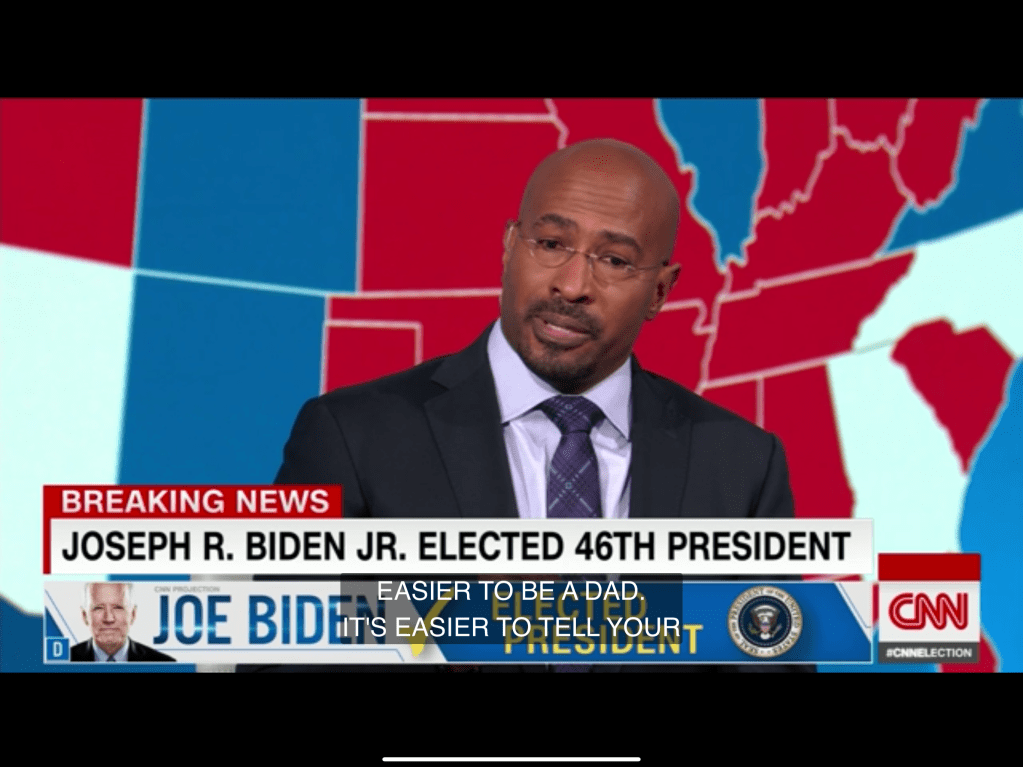
I’m writing this with tears in my eyes. Yes, it becomes easier now to say to our children: Character matters. Compassion matters. Love matters. Sharing this World matters. Humanity matters. The Rule of Law matters. Democracy matters.

It is easier to be a Dad…

Watch it yourself:

Van Jones fights back tears: Result shows character matters

This is the America that has our back. And thank you for reaching out to those who feel they lost. As a matter of fact, I hope that most of them will see that they won, too.

Others have a long way ahead until they can be trusted again. Action speaks louder than words, in this regard. But, please, let us stay humble, free from resentment, and steer away from hypocrisy.

Congrats, America. Congrats, Joe and Kamala. And Kamala: We are soooo proud of you. My daughter sure is.

Finally

My boss is very clear. There is no diplomatic coating if Heiko Maas, the German Foreign Minister, is calling out Donald Trump’s urging his supporters to vote twice as disturbing and unscrupulous behavior. Which it is.

I am glad we speak the truth, we do it with diplomatic language whereever we can, do not play into the antagonization game whereever possible, use moderate language instead of yelling, call on upholding human values including decency and truthfulness. I am also glad to see that we can be clear, crystal clear, saying “enough is enough”. Which it is.

https://www.spiegel.de/politik/deutschland/heiko-maas-wirft-donald-trump-ruchlosigkeit-im-wahlkampf-vor-a-b110069c-8888-4118-bb1c-f39cee51c59a

Or, for my English speaking friends:

https://www.newsweek.com/germanys-foreign-minister-calls-trump-urging-supporters-vote-twice-disturbing-unscrupulous-1529939

Never ever the Doomsday Clock was closer to twelve. Do not underestimate His Neediness and his minions.

Peace, democracy, safety and security, human rights, humanity, none of these come for free.

We have a responsibility to hold to the power of love that we know to be true, and to not allow the world around us to deaden that in ourselves. LUCAS JOHNSON

The summer of 2020

I will remember the summer of 2020 as that summer when COVID-19 wiped out large swaths of my plans to travel. I had planned to deepen friendships and was looking forward to my connection to family and loved ones. All live in different parts of this world. I imagined that I would regularly meet professional interlocutors by traveling all over the Western Balkans, I would travel to see friends, and I would contribute to nurturing the buds of a new relationship. I would form new memories, making it easier to live with the memories of those summers in the U.S. which I, until today, miss with excruciating pain. July 4th was a tough day for me.

So far, nothing like that has happened. Shortly after I arrived in my new center of working and living, Covid-19 struck. For a few weeks I had enjoyed meetings with new and old colleagues. Within a day or so in March, I saw them only in their home offices, on Zoom, and that is lasting until today. I found myself in an increasingly intense lockdown, organizing work from my own home office, structuring the day keeping me sane, in ways allowing me to get the basics done, including shopping, before the curfew hit, getting work done, staying in connection with friends and family, and not overdosing on Netflix during the evenings. A seemingly never ending string of weekend-long curfews culminated around christian and orthodox Easter, locking me into the routine of my apartment for days without end.

Everything happened on Zoom, WhatsApp, Signal, FaceTime, Skype, and using a myriad of other communication tools. There was a phase of enthusiasm at the beginning, both on the work side and the private side of things new forms of communication offered more intense opportunities to connect. But that began to wear out after a few weeks. People started to crave personal contacts. Everybody struggled with the fear of an economic downturn affecting the financial foundations of their lifes. I found myself increasingly dealing with mood swings, and planning when to travel to Germany was a nightmare of calculating when there would be the ideal slot, being able to travel, to self-quarantine on arrival, doing the things I needed to do in Germany, and traveling back to Belgrade hopefully with the least complications possible. My mind went into such a frantic mode that I began to be affected by not being able to decide, constantly worrying.

So, when the counter-measures to the pandemic which shut down the entire continent of Europe yielded success, the feeling of relief was incredible. I felt it personally, I was able to travel to a remote campsite in Croatia for two consecutive weekends, enjoying peace in nature on my own. Yet, my children in Toronto lived through extraordinary restrictions, and they do so until now. In Europe, temporary border control measures were lifted in the European Union, and here in the Western Balkans, people put their hope on being able to travel for holidays, and to travel into the EU by getting their regular visa again. I was hoping to travel to Bucharest in Romania, and until today this has not materialized. Like my children in Toronto, I saw my friend in Bucharest last time January this year. And once I travel to Germany again, with plans to see my father, I will have to be extremely vigilant taking his fragility at old age into account. His health is deteriorating.

Whilst hope kept me in limbo, I saw the figures of new infections rising again. We experience a second wave here in South-East Europe, almost everywhere registered new infections rise to the level where they were in spring. I worry again about when to travel for the summer time, which I plan to spend in Germany, and in Canada. Traveling just to neighboring Romania remains a distant dream. I have days where I feel overwhelmed by frustration, and only connection to my friends helps me accepting this new reality that is there to stay.

This is the regional picture, here in parts of Europe. Already this picture is overwhelmingly complex. In the United States the situation is much different, the pandemic is in full swing, currently out of control, and in the stranglehold of a cultural war. And though I believe that I pay attention to news on a global level, I see that my focus is on the developments in the so-called West. I see things being equally out of control in countries in Central and South America, and in Asia. In Africa, too: South Africa’s figures are going through the roof, whilst there are so many underdeveloped countries which I traveled and love where I doubt even the capacity to register new cases is there.

But the overhelming news I consume relate to Europe, and North America. Including obsessive paying attention to how one of the oldest democracies of this world is under attack from the inside, fighting for its life. It is mindblowing that even the person who is a main driver of this attack would agree with my statement. Because he says too that this attack is happening, but he, the attacker, brazenly blames the other side for everything. Madness. History is repeating itself, and with the legacy of what happened to my country ninety years ago, and with twenty years of personal experience with worst-case-scenarios all over the world, I have to be careful in not allowing my emotions taking over and coming up with Doomsday phantasies.

The anxieties and fear which I have described using my own personal example, they hold true for everyone on a global level. My example is the example of one within billions. The fear, the anxiety, the attempt to find entry points into understanding what is going on, the helplessness and the wish to control things, the anger and despair, the resentment, these are global commonalities. It creates a highly combustible mix, as we have seen on occasions of global movements against racism and police abuse of power. 

I also see that I am part of a privileged group of people who are educated, sticking to the guns of science and truth, and who have developed strong tools for not allowing irrational fear taking over. I am privileged through my global and longstanding experiences, and the knowledge how to carefully assess, and to contribute to complex situations. Many people do not enjoy these privileges, but they share the same fears, the same anger, the same resentment, and they crave to control the situation by being able to give meaning to what is happening.

This summer is presenting challenges for my fighting hard to separate my personal disappointments, fears and pain from my assessments on larger issues, like the pandemic, like global anxiety, or economic depression, like the global rise of authoritarians. Emotions can amplify each other: When pain, fear of the unknown, and the feeling of having no control hit, the result is more fear, and helplessness. The result is more anger and more anger fuels more resentment. Like everyone else, I want to make this unpleasant feeling go away.

When it comes to how emotions drive people, I use my personal example by saying that this is a summer when I found it increasingly challenging to turn anger into compassion. My personal experience helps me to understand how other fellow human beings struggle the same way during this summer: How hard it is to stay away from the ever more tempting wish to simplify things, to find explanations allowing for shifting the blame to others. How much the constant battle rhythm of indoctrination through lies, conspiracy theories, and manipulation establishes a fog meant to control people, by keeping them angry, and controlling the direction of their anger, and how to discharge it against an enemy being created by those who manipulate.

When someone defies the explosion of new cases in the U.S., rallying people for extremely divisive speech, some believe this is one of the last acts in this disgusting performance. But make no mistake, what is happening is cold-blooded calculation: It is about using the pent-up anger, locking people into a narrative that they are warriors for a higher cause, using the psychological effects of the Stockholm Syndrome in combination with the kick coming from openly defying social distancing and wearing masks, indulging into national pride and a false sense of freedom. National pride is being manipulated into nationalism, fascism is established by blaming the others for left-wing fascism. It is the oldest trick in history: Do something openly and claim that it is the other side doing it. Keep people in your walled garden (which is a mental prison) and shut down all channels of alternative explanations of the reality for them. One of the most cruel things, aside of open racism is the weaponization of the COVID-19 pandemic.

There are those who let down their guards by believing this will be over soon. History shows the power of victimization, combined with a relentless narrative based on lies and manipulation. Even in a best-case-scenario this won’t be over for a decade to come.

In this war, real people are dying already. And from all predictive modeling and experience with what happens when social distancing is abolished, there will be thousands more. Having contracted the Covid-19-virus, they will deny themselves the acknowledgement that they got it because the pied piper called on them.

I will remember the summer of 2020 as that summer when I, a pacifist and idealist hoping for change to the better, for the first time ever in my long life accepted that resisting the global nomenclatura of greed and unbounded selfishness may require to accept that standing up for this fight includes being prepared for that the nomenclatura fights back and that retreat is not an option, at great personal cost. And that we may have to accept tears and sorrow.


Police Reform – Bottom Up and Top Down

If somebody were to tell me that there is a kind of a universal blueprint which must be used for successful reform of police, I would be very suspicious. My experiences, good and bad, relate to addressing corruption and crime in medium size police precincts, warrior mentality in a police station under constant mental siege in a hostile environment, establishing community-oriented policing primacy in a large and diverse, yet national police organization, harmonising a joint understanding of service-oriented and accountable policing in extremely complex and diverse international executive policing environments, and in countless ways assisting jurisdictions ermerging and recovering from conflict in coming to terms with policing allowing to contribute to societal healing, and representing the communities they serve.

Nothing would allow me to refer to experiences how to alter policing in a setup where people estimate that a country has approximately 18.000 agencies responsible for policing. That is the situation in the United States of America, and that is the scope of the challenge over there. But I continue to stress that this is not about “Us and Them”. Rather, a critical examination of reform needs requires to take a self-critical look. It simply is a gargantuan task. Here just one from countless examples.

People take the streets all over the U.S. and globally in large numbers. Polls in the U.S. show that there is majority support for a profound change.

Not undertaking reform is not an option. Compared to the needs to change global bias and selfishness which expresses itself in so many forms, like racism and religious hatred, xenophobia, discriminating minorities, leaving impoverished societies to their own devices, or is depriving women or members of the LGBTQ community from equality in all its aspects, the task of reforming policing appears minuscule, though gargantuan in itself. I don’t want to ramble, but just the other day Greta Thunberg is reminding us, again, about tackling climate change being equal to tackling the Covid-19-pandemic.

We’ve got to shoulder this, otherwise we will be helpless and complicit bystanders: Anger never is a good adviser, but people are angry for many reasons these days, and on a profound level. Some actors follow the principle “If I can make you angry, I have already won over you.” If reactionary forces prevail in “weathering the storm”, muting the discussion and controlling it again, chances are that we may see chaos, rather than evolutionary development from which we collectively benefit. “Us and Them”-thinking will lead to a lot of collateral damage and we may wake up in a world one day which none of us wanted.

To find a meaningful entry point into a contribution, I suggest to look at a recent article “What happened when a city disbanded its Police”:

Two factors came together in Minneapolis which allowed for a sweeping reform of policing:

  1. Top Down: The commitment from highest leadership levels to embark on an undertaking with many risks, including risks for reputation and own job security;
  2. Bottom Up: A deep desire on a grass-root-level for change: Communities were fed up with the way how they were policed.

In my previous articles, I have reiterated where I stand on “how to police”. I have referred to a common denominator of policing: The United Nations’ “Strategic Guidance Framework” is incorporating principles such as the principle of community-orientend policing. I see the same principles at the heart of the re-design of policing which has been the result of a reform effort in Minneapolis.

The question how to design a police organization which is following such principles can lead to an evolutionary development of an existing organization, or, like here, to disbanding an existing police and to build a new one from scratch.

Both scenarios lead to disappointment amongst those who may feel that they have fallen victim to such a reform, like police officers who have lost their jobs, or police chiefs and leaders all the way down to first-line-supervisers who have been reassigned in course of the reform. The higher their numbers, the more difficult it will be to get the dissatisfaction voiced by them being absorbed within the discourse in a larger community, or society. One of the biggest mistakes of the Coalition Provisional Authority following the 2003 invasion of Iraq was “Coalition Provisional Authority Order Number 2″: It disbanded the Iraqi military, security, and intelligence infrastructure of President Saddam Hussein. Many of those who lost their jobs ended up becoming members of insurgency groups and terrorist organizations and networks which brought chaos and death over Iraq and the wider region.

Painful decisions which will always leave some feeling being on the side of those who have lost from reform require a thorough process of thinking before springing into “less-than-thought-through-action”. Of course, Iraq is not the U.S., or Europe, and American police is lightyears away from forces which have been instrumental in a brutal dictator’s oppression of his own population, but this is universal psychology and it is a classic example of a toll which can be directly tracked to decisions which have not been based on a carefully synchronised discourse “top down” and “bottom up”. In any large scale reform, antagonization must be mitigated, without loosing sight of the dedication to achieve a fundamental change. Otherwise, reform will be watered down into mediocrity at best, or will lead to cosmetic reform with no chances for sustainability of efforts, or being entirely outrun by reactionary forces resisting change.

That is why real reformers will be measured by 

  1. Whether, including the top-levels, they mean what they say, and put action to where their mouth is;
  2. Whether they lead an inclusive discourse, from the top down, rather than following the path of antagonization and radicalisation of an “Us-and-Them”-rhethoric;
  3. Whether they listen to communities on the ground, including permanent and more than symbolic engagement by top leaders, and base their reform decisions entirely on including communities on the ground into shaping a joint vision of the future;
  4.  Whether they are ready to rely on the participation of communities on the ground in all aspects of implementing a reform effort, holding themselves accountable to those communities which shape the form of policing which these communities want, for themselves.


In following blog entries, I will touch upon two other elements which I see for successful police reform: A reform of insufficient training, and representative policing, which needs to focus on the role of persons and communities of color, on minorities, and the role of women as agents of transformational change.


On Defunding the Police – Proportionality

Legitimacy:

Whether measures taken are legal and have been proportional

Whether agreed procedures have been respected

Whether there is accountability of the service and its personnel for their actions


June 14, 2020, I am waking up to an updated report from CNN about protesters flooding the streets of Atlanta after Rayshard Brooks, an Afro-American U.S. citizen was being shot dead Friday, June 12, by a white American Police officer. A restaurant was set ablaze, a highway was blocked by protesters. Police deploying tear gas, violent altercations in the video footage.

Whilst it is way too early to judge established facts about the circumstances of the killing of Rayshard Brooks in detail, I note that the officer has been terminated, a second officer was placed on administrative duty, Atlanta’s police chief stepped down and Atlanta’s mayor called for the officer who shot Brooks to be fired.

This morning I also read about the continuation of protests against racism and police violence all over the world, and about the discussions within societies over here in Europe about it, including my country, Germany. We have serious discussions over here on changing our constitution, related to the term “race”.

And I read about the emergence of violent right-wing extremists in London, I see pictures with them attacking police officers, and the police attempting to prevent altercations between right-wing extremist protesters and protesters of the Black-Life-Matters-movement.

For good measure, a friend of mine sending me an outstanding article from the NYT on Police Reform.

That is how I woke up.

I feel tired, upset, most of all I feel deeply saddened for another person dying at the hands of police officers in what would appear to be a serious violation of any application of proportionality of the use of force. I join those who say “Enough is enough, when does this end?”. I am upset about those who maintain these are single isolated cases. I can hear those already who will point towards Rayshard Brooks’ fight against being arrested, who will hold his fleeing from the police against him. It looks like he discharged a taser, which he took away from one officer, whilst fleeing, and I can hear those who will say “See…”.

Let me summarize from what I know from preliminary looking at reported facts: Someone is falling asleep in a car. The car does not move, but it is in the way of other cars wanting to use a parking lot, they have to drive around the car. A police patrol controls the car, the person who slept in the car is subjected to a test whether he is intoxicated. He fails the test. Again, the car is not moving. An altercation between the person and police officers can be seen on video footage, the officers attempting to arrest the person, the person violently refusing. At some point in the struggle, the person takes control over a taser which is part of a police officers’ personal equipment, and manages to run away. Police officers pursue him. He appears to discharge the taser in direction of the pursuing officers. He runs away. He is getting shot and killed.

I had already begun writing on an article on proportionality which I had started with the following sentence, a few days earlier:

June 11, 2020, CNN reported about Tulsa police releasing video footage of an arrest of two black teenagers being handcuffed for – you hear right – jaywalking. Not bystander videos, footage from the body cams of the police officers engaging the teenagers.

And now another example, pointing into the same direction: Where is the proportionality of police action, and to which extent does the police themselves contribute to escalating an action which then is justified for the use of disproportionate force? And why is this, in its overwhelming majority, happening to non-white persons? 

It is mind-boggling. In all my experience, it is systemic. The biased selection of persons of color being the subject of police control, it is an extremely well documented pattern. We have a corresponding discussion here in Europe about the question whether the police is biased by preferential selection of members of specific groups when deciding to take action: Minorities, persons of color, persons of Muslim faith, migrants. 

We also need to look at how the police is conducting themselves after deciding to engage in a situation. We name it “discretion in deciding whether to act” and “discretion in choosing the means with which to act“: The former: Does the police apply the same criteria for deciding to take action on equal criteria, notwithstanding, for example, the color of the skin? The latter: Is it more likely that the police will use excessive and disproportionate force, depending on the color of the skin?

Notwithstanding racial bias, the American policing system is very different from the system which I belong to, in terms of inherent readiness to apply force in all kinds of policing situations. I would say that the American system is very different in relation to when, and how, to apply force, from any system in the European Union. From my viewpoint, the entire system is based on an understanding of coercion by force which is entirely disproportionate. This, more often than not insanely disproportionate application of force perhaps is the single most contributing factor to escalation of violence in interactions between the police and citizens, and communities. Taken together with that the overwhelming number of persons subjected to it are black citizens, is justifying to state that American policing contributes to systemic measures of control of Afro-American communities. That is racism.

American policing is based on a culture which prefers flashing signs from police patrol cars such as “Stop – It’s the Law”, allowing officers to just hide behind “the law” instead of explaining why they are interacting with a citizen. A culture of control through a “Law and Order” attitude leaves no space for communication.

Cops are no saints. No public servants are. Being put into a position of power, individuals tend to exercise that power, and more often than not their reflex is to say: “Because I can”. In my police system, decades ago, we undertook deep rooted reform efforts addressing it: Being in a position of power requires, in our understanding, a profound humility, and a desire to use these powers only as a last resort. The opposite to it is trigger-happy-policing. And we make sure management is being held accountable to hold police officers accountable. Which is very challenging: Line supervisers tend to fraternise. Police Unions do. In the U.S., they even carry that attitude in their names: Fraternal Order. Management and leadership tends to avoid discomfort by standing up against a culture of fraternisation. After all, supervisers are human beings who prefer to be liked by their subordinates. Unfortunately,  it does not always work that way.

Twenty years ago I was at the helm of an international police comprised of roughly 4.500 officers from 53 United Nations Member States. In Kosovo, setting up executive policing whilst building the foundations of a new Kosovo Police provided a field laboratory in which all different national policing models and attitudes struggled to find a common denominator. We “were the law”, but which law? We were the police, but which police? We learned everything from scratch. The United States deployed roughly 500 police officers into this UN police, with colleagues from many different nations patrolling the streets, upholding order, investigating crime, making arrests.

And every single arrest carried out by American police officers, notwithstanding the circumstances, whether a murder, or a traffic citation, led to handcuffing.

Even more: Every single action leading to temporary restriction of movement of an individual, like, for identification purposes, or further establishing facts at a police station, was called an arrest. Which led to handcuffing. In this, the American policing attitude stood out compared to practice of literally any other national police contingent in this police organisation which we formed from scratch, with no available blueprint. 

This is where my work on a common denominator on policing started. The way we did it was by beginning to talk about these differences. Talking leads to compromises on all sides. My colleagues and friends from U.S. police departments lowered their threshold of when to engage using force. My German colleagues accepted standards they were not used to in their home country. We all benefited. And we established the groundwork of  an understanding of community-oriented policing which transpired into the new Kosovo Police. In this transformation, my fellow American colleagues were instrumental.

I tend to write articles which are too long. Not this one. Or too academic, too complicated. Not this one.

Proportionality of action is, at the end of the day, depending on the values which underpin a system of policing. By all means, the discussion of how to reform policing in America must be based on American values. But I am not sure whether the excessive readiness of the use of force within the entire American system of policing can be used as a gold-standard. In my view, the opposite is true. It is not representing American values. Otherwise, there would not be so much opposition against it. 

This can get out of control if people taking to the streets are not being heard. Every defiant cop thinking this storm can be weathered is part of a very explosive mix. I congratulate the Atlanta Police Commissioner to taking immediate and decisive action, and then to resign, in order to support the case for police reform. 


On Defunding the Police – Policing as a Function

Policing refers to a function of governance responsible for the prevention, detection and investigation of crime; protection of persons and property; and the maintenance of public order and safety. Police and law enforcement officials have the obligation to respect and protect human rights, including the right to life, liberty and security of the person, as guaranteed in the Universal Declaration of Human Rights and reaffirmed in the International Covenant on Civil and Political Rights and other relevant instruments.


Main argument

In this part I am presenting the argument that it is necessary to identify the core role of policing in a jurisdiction. Funding then needs to prioritize the effective and efficient implementation of that core role, and provide the means to ensure that policing is carried out within the framework of rules which reflect on the values that underpin that implementation of policing.

I also say that it is entirely common to look at which functions a police organization could carry out in addition to their core mandate. Of course, there is funding needed for this as well. However, responsible governance needs to make sure that additional tasks for a police department do not negatively affect the core mandate of that department. Responsible governance also has to question whether police is well-suited for additional tasks that may require specific, or different training. Police training is different from customs training, from military training, from training for correctional services, or from training for social services. Do not use a hammer for screws, or a screwdriver for nails. It destroys hammer, nail, screwdriver, and screws.

It is entirely legitimate to look at whether there would be better ways to implement the additional tasks given to a police organisation, by other means, such as strengthened social services. That, again, would require to re-allocate the necessary funding. Which is a form of defunding the police.

Thirdly, law enforcement needs to be equipped for carrying out its tasks. There is a direct line between the identification of “what” I want to do “how”, and what I decide to use as a technical means of assistance. If a police department decides to procure or to accept military style equipment for carrying out its tasks, that will change the attitude of officers in how they understand the task of policing. If that is leading to problems (which is evident in the United States), then reform efforts may lead to giving up purchase and use of military style equipment. Defunding the purchase of military equipment may allow both for funding core tasks of policing better (such as giving more resources to community-oriented policing), or free funds for support the work of other parts of government, such as social services.

Taken together, all three lines of what is named “defunding” are no reason to believe law enforcement and their staff would be “punished”. Instead, the reform leads to better policing, and more of it, and it leads to better other services of governance, such as social services.


Supporting arguments

It is all too easy to throw out the baby together with the used water in the bathtub if one doesn’t take the necessary time for a careful look.

The current debate about reforming policing has gone way beyond the borders of the United States of America, and it is happening on grounds of both long simmering discontent and because of current justified anger and immense outrage. Crimes such as the murder of George Floyd have triggered it, and the confrontational and at times horribly abusive handling of the protests by the system of governance is escalating it: It proves the case that something is flawed on a fundamental level. This in turn has led to so much growth of the protest movement in size that we may see, for the first time, a real chance for substantial change.

The sheer size of the demand to reform policing in its fundamental aspects is inevitably causing tension between those who advocate reform, and those who hold conservative views. That is good for a constructive democratic discourse.

Comparing how things are done elsewhere can help, as long as those who describe what they do elsewhere, and how they do it, don’t pretend that they have better ideas and solutions. We all cook with water, hypocrisy is poison to the debate.

I see, however, that there is an element in this discussion which goes beyond the constructive exchange of arguments in a reform discussion:

There are those who dig in. Reactionist forces attempt to quell the reform movement by a combination of (1) de-legitimizing reformers’ motivations; (2) de-legitimizing reformers as persons “per se” by demonizing them; and (3) pretending to associate with the cause, in order to take out the energy for change. The longer the successful application of this strategy, chances are that reform runs out of steam. And like events in 2016 allowed reactionists to boldly roll back honest and deep-looking reform efforts, the same threat is looming over 2020.

An example for de-legitimizing reformer’s motivations: Accuse them collectively and with no supporting evidence that they want to abolish the police entirely, or to de-construct the State.

An example for de-legitimizing reformers by demonizing them: Accuse them of anti-constitutional attitude, label them “radical left”, or even “domestic terrorists”, and freely make use of de-humanizing them, talking about “low-lifes”, “loosers”, or even worse.

An example for pretending to associate with the cause: Jump on the band-wagon of talking about how serious the problem is, express sympathies, be a bit emotional if you can, make sure to spread your hollow words of empathy and sympathy widely, say that you fully agree, throw in a “however”, and talk about anything but the core argument that leads to the reform necessity. Make no efforts to turn your pretended sympathies to the cause into any action.

So: What is the core argument?

The core is related to the question what the function of policing is about. No more, no less. A reform discourse needs to look at this one first.

Second comes the discussion about how (aka by which organizational means) the function of policing is implemented. Here, things become complicated, because the way how policing is being implemented is based on historical developments that are entirely localised. America’s culture is different from France, Germany, the United Kingdom, China, Russia, India, Pakistan, Sweden, Tanzania, South-Sudan, Jordan, Egypt. Or any of the 193 countries forming the United Nations. All are different. Because of their history.

But does it mean we can only talk about one country’s policing approach, and does it mean there is no possibility to come to a common denominator which we all agree upon? Do we have to engage in a never ending “My toy is fancier than yours”-debate?

The answer is: It is very much possible to come to a unified minimum understanding, because we have done and achieved exactly that. I have witnessed that, by participating in it. It took us give or take ten years from voicing the dream, through finding support, learning how to do it, until we had written it down and agreed. The result includes what I quoted in my “Statement of Solidarity“.

And this result is not a collection of lofty sentences. As the United Nations, we needed to put a common understanding of what is policing and how it should be done front and center, for purpose of maximum transparency: This is what you get when we help you, this is what we need you to agree upon when we help you, because we have a few red lines which we all must not cross in this partnership. This is what any UN Police officer will understand as her or his function, notwithstanding from where that officer comes. This is how we expect police officers to be trained before they deploy into a United Nations Mission meant to assist in handling a conflict, or recovering from conflict.

If you look up the entire work which began with the document I quoted from, you see that we broke it down into a detailed understanding: We do have a common understanding about how to carry out community-oriented policing. We share detailed understanding about intelligence-led policing. We do know what a tactical group of the Police, such as a company sized “Formed Police Unit” should do when protecting peaceful demonstrations, and how to engage with those who disturb the peace, become violent, carry out crimes. We do know how police should establish functions that ensure accountability towards the law and towards citizens. We do know how police officers should use force as the last resort.

We have written that all down, and much more. And all along the way, the United States of America was part of a truly global support for further development of this framework, stressing the need that it has to be operationalized through training. Which is what we do, all over the world, and including heavy support by the United States of America. For which I am grateful beyond words.

Does, therefore, police have to look the same anywhere? No. But it does mean that one always should look at whether we have gotten the implementation of the core function of policing right. You can assign additional functions of any kind. The discourse about whether this makes sense, or not, usually carries many practical and political arguments with weight in the specific local context. But it should always prioritize the question whether the additional tasks impede core tasks, and whether police departments are suitable and capable to carry out that task. Like any other profession, training and organization of work in the police creates specific mindsets, highly capable of implementing policing. But it does not mean that this mindset, or training, is the right one for the additional tasks that are being expected to be handled.

The way to ensure this is called management. And any reform of something which has taken root is no less than an art.

Sometimes, less tasks for the police will create much more satisfaction with results.