The Reason For Storytelling: If You and I Don’t, Only Others Do – On Gaslighting Taken To a Global Level

Around 1 percent of U.S. veterans of World War II remain alive to tell their stories. It is estimated that by the end of this decade, fewer than 10,000 will be left. The vast majority of Americans today are unused to enduring hardship for foreign policy choices, let alone the loss of life and wealth that direct conflict with China or Russia would bring.”

In a Guest Essay in the New York Times, titled “World War III Begins With Forgetting”, Stephen Wertheim made this point. I can relate.

Like: The fewer people remember, and talk about, the Holocaust and the horrifying evil done to the world by the Nazis and Adolf Hitler, the more it becomes, at least, possible to mystify and to glorify it, and using the most ridiculous of all arguments. Like Kanye West, who now goes by the name Ye. “The Hill” is just bearer of one of countless reports about an interview which he, accompanied by Nick Fuentes, one of the most atrocious racists of recent times, managed to place in a show hosted by the likewise awful racist and xenophobist Alex Jones. Old stuff. Except that the use of social media bullhorns and supporting media is taking it to new levels. Because, whether it is ridiculous or not to praise the architect of the Holocaust wrongly as the guy who invented highways, or the microphone, it does not matter. I have heard arguments like that from my late father in law of my second marriage, more than thirty years ago. There were no Social Media by then. Today, the matter is to get a radical message out, upping the ante, on a path to mainstreaming a “truth” which is not only unsupported by any evidence, but also suppressing any historical truth about what happened. My stomach would turn upside down when I would even quote what Ye said. But wherever on whichever dubious platform, such as Alex Jones’, such outrageous comments are made, within hours the message is also spread through any mainstream media. One side of them glorifying it, the other side vilifying it. For those intents and purposes behind the message itself, both work out very well.

Before I get to the gaslighting argument, upping even this ante, two other examples for why storytelling is so necessary, and which danger sits with when witnesses of horrifying events pass away in numbers: The older the Mothers of Srebenica get, the less can be done against the minimising narrative related to the horror of the Srebrenica genocide. I met the Mothers often, and I truly admire their relentless sticking to telling their stories of a genocide. This is not a function of their healing when they repeat to tell their stories. It is a sacrifice, for the good of keeping a memory alive as a cautionary tale. One day I took my visiting father with me. They are so kind, they offered him coffee and spoke with him just because he was an interested human being. No other intent, no benefit for them. My father cried and cried. Until today, more than twenty years later, he talks about the deep impact of his visiting them.

The same holds true for the genocide in Rwanda, and in uncounted other situations. The more people grow up who have no direct memory of what happened in Germany, in Bosnia&Hercegovina, in Rwanda, in Cambodia, in Stalin’s Russia, during the brutal McCarthyism and under Jim Crow in the United States, or in the Armenian genocide, or else, the less the voices of those can be mitigated who minimise, refute, deny. If context is not there, nothing describes the extent of atrocious behavior against the Uighurs, the suffering of minorities in Myanmar, and I need to end with “and and and”, because the list is so long.

Storytelling is a social function which can not be replaced by the noise on Social Media. Quite to the contrary, storytelling is one of the needed antidotes against the devastating effect which unhinged Social Media has. Because even the function of Social Media is subject to a gaslighting narrative, putting an unrestrained version of Twitter, for example, into a manipulative context of an alleged support of free speech, whilst the ulterior motive only is to make profit, and to increase own control.

By the way, I believe that there is a reason for why Number 45, since his account got reinstated by Elon, has not used this account ever since: Not only that this would take away from his own bullhorn (Truth Social), he does not need to use his old Twitter account, and can chose smartly when that time would be there. Simply because the message that his account got reinstated is already enough for gaining even more “followers”. These “followers” likely rise in numbers directly on “Truth Social”, and on connected accounts including on Twitter, as a direct consequence of the reinstatement.

When I grew up, “Followers” was used as a term for people following a certain religious or spiritual belief system. I still object against the manipulative use of terms such as “Friend” or “Follower” on social media. That’s why, in this tiny world of “Durabile”, my blog, I don’t care about how few people “follow” my blog here. What I care about is that the day before yesterday this blog surpassed the threshold of 10.000 reads within those 120 posts since 2014. It just tells me that my storytelling is a tiny contribution to the overall need of telling stories.

Because there is no absolute truth, and no objective truth, as I pointed out here. Now, I am quoting myself from that blog post: QUOTE “Truth as a means of control. Number 45 did this on countless occasions, and more recently he is hard-pressed by people who are attempting to establish even more radical forms of white supremacy, xenophobia, racism, and anti-semitism. Read in The Rolling Stone: “How Trump Got Trolled by a Couple of Fascists“. UNQUOTE

I wrote this post December 01. Four days before writing this post. At that time, I found the analysis relevant which is reflected in the article in “The Rollingstone”. Meaning, that Ye, Fuentes and likeminded people were on a path pressing Nr 45 into even more radical messages.

What happened since? In a few statements including on Truth Social, Nr. 45 did what we saw on many occasions when there was an uproar: He minimised. Distracted. Sold ambigous messages. Allowed messages that he wasn’t aware. That he did not know Fuentes.

I have no personal doubt that all this is part of the MO. Because, as always, the next attack is even more extreme. Meanwhile, inasmuch as I love Jimmy Kimmel, he and other well-minded Late Night Comedy hosts find themselves in the trap that each of their shows ridiculing Nr 45 helps him.

Which is what I want to end with here, today: I just read a story in the British BBC: Under the headline “Trump’s call for ‘end’ of constitution condemned by Democrats“, BBC is reporting on a message from Number 45 on his platform “Truth Social”. According to this report, the White House condemned former President Trump after he called for the termination of the U.S. constitution. I quote from BBC: QUOTE In the post, Mr Trump referred to vague allegations of “massive & widespread fraud and deception” and asked whether he should be immediately returned to power. “A Massive Fraud of this type and magnitude allows for the termination of all rules, regulations, and articles, even those found in the Constitution. Our great ‘Founders’ did not want, and would not condone, False & Fraudulent Elections!” he said. UNQUOTE Setting parts of the text in bold letters is done by me, not by BBC.

I can’t wait watching Jimmy Kimmel ridiculing Nr 45, but I mourn those months when he and others managed to find comedy topics which would not contribute to antagonism, by condemning it. May be I’ll write Jimmy’s staff an email.


This is unprecedented in contemporary history as I remember it. Since 2016 there is a history of statements in this blog concluding that it is getting worse before it gets better. But a former President of the United States fighting an accuse, possibly an indictment, for inciting sedition by establishing a narrative that is ripping down the foundations of the U.S. Constitution, this is unheard of.

There is a clause in the German Constitution sometimes named the “Stauffenberg clause“: “Gegen Jeden, der es unternimmt, diese Ordnung zu beseitigen, haben alle Deutschen das Recht auf Widerstand”. Or, in my translation: “Against anyone who is undertaking to remove this constitutional order, all Germans have the right to resist.” It can be found in Article 20, I grew up with, it’s part of my DNA and part of my pride. It’s one of the defining differences between today’s German Constitution and it’s predecessor before the Nazis demolished it: The Weimar Constitution. It is meant as a pillar, albeit, perhaps symbolic, in efforts to robustly protect a constitution from enemies within. Sometimes during 2016 I referred to it in discussions with friends on the U.S. Constitution. Then, with tears in my eyes, I played the song “Kristallnaach”, by the famous German Rockband BAP.

So, one of my hypothetical thoughts is about whether there will be people on the far-right in Germany who think about how to establish a narrative that the German constitutional order is subject to removal from within, by justifying their resistance in saying that the government and the establishment is the enemy of what the Forefathers, the Founders of our Constitution, meant. This is not far-fetched, and it is the same logic.

We have come this far in an approach of extremists in removing the foundations of contemporary democracies, and the rule of law. A few years ago, I would not have believed that one day I would read a report such as the one here on BBC. This has become the new normal, one and a half years before the next battle on presidential elections will begin, in 2024. So, my question is: What’s next, if this has already become the new normal now.

Of course, this question includes where those on the Republican side are, and which legal, ethical, and moral, responsibility they assume, by openly or tacitly condoning such a development. That, on one hand, is part of domestic politics in the U.S. in which I am only an external bystander. But over here, in Europe, we fight the same fight. And we are affected by what is happening “over there”. And vice versa.

We are in this together, only. There is no space for claiming “that’s not my business”, or for complacency. Each day, we are waking up with new worse news than before.

So, why all this under the headline “Storytelling”?

One of my next blog entries will talk about one of my recent books reads, “Dopamine Nation”, by Dr. Anna Lembke. Full quote of the book in my next article. But here is the connection: Within a universe of contemporary addictive sources of Dopamine release through substance and behavioral abuse, one key problem sits with Social Media. I will also refer to the challenges one of my children has with the addictive suffering using Tic Toc.

I believe we can not use Social Media for the kind of storytelling I mean in this blog. For many reasons which I will try to explain there. But for starters, Social Media does not support peaceful fact-based storytelling implicitly through it’s algorhythms. I have own examples, including this blog, or my Youtube channel. I stay away from inciting or upsetting messages and their promotion, as a consequence, nowhere in the suggestion lists of these sites any of my writing or my videos will come up.

There is a need not only to regulate Social Media, but also to devise strategies how storytelling remains a vital democratic and humble function of our societies and cultures. Storytelling is inherently local, or topological. It is unsensational, and personal. Peaceful, mindful, truthful, honest, personal storytelling. No rambling, no yelling involved.

I hope that I adhere to my own standards, here.

Distinguish The Signal From The Noise – Also feat.: The Long Term Impact of the Pandemic, and of Conflict and War

Setting the stage: From a conversation with my son

Yesterday afternoon I chatted with my son on FaceTime. He lives in Toronto and is fourteen years old. For him it was morning, and I was amazed seeing him preparing his own breakfast potatoes with an omelette. It looked so good on my phone screen that I could smell and taste it, I wished I would have been there. He promised to make me such a breakfast when I’m in Toronto in a few weeks time.

At one point, the casual conversation about what’s up veered into the parental part: “How’s School Coming On?” – “Good good”. – “Any details to share?” – “No, not really, it’s just good.” – “Do you like your new school?[The kids have entered high school education this summer] – “It’s okay, but have you ever heard somebody saying that school is a place you really enjoy?” – “I understand, fair enough. Wasn’t much different for me, when I was your age. But, just curious: Do you like what they teach you in physics? And what is it they teach you?” – “It’s okay, but I would love you to make more of your tiny explanatory pieces on physics, I always enjoy them.”

Guess what? I was flattered, felt these little pieces of work of mine make sense. I felt motivated to make more of them. Perhaps I will share some of this stuff on my Youtube channel “All Over The Place“. That’s the fun place in my writing and creating. Over here, at durabile.me, it’s more about the serious stuff I like to write about.

What everyone knows, including from own experience, and too often forgets: The importance of education for a society

Yes, school, as I told my son, is also something I remember in a similar way. Necessary, but not a place of daily rejoice, like, getting up and thinking “Yay, I can’t wait until being in class!“. Meeting my class mates always was a mixture of joy and anxiety, I was sort of like Charlie Brown, isolated in many ways, struggling to find friends and appreciation. Meeting my teachers, more often than not, was a mixed bag as well. The subject issues at school, mathematics, physics, chemistry, language, history, geography, some of the stuff I loved, some of the stuff I really struggled with. I could not shrug it off, like Calvin in the comic series “Calvin&Hobbes” does. I often strolled home with my head low between my shoulders, like Charlie Brown in the comic series “Peanuts”.

But it was necessary to learn, and I knew that. Necessary at the very least. Pleasant, preferably. Which is, certainly, part of the art of pedagogy: How to teach knowledge? Being effective in establishing knowledge also needs to mitigate unpleasant experiences. Not everyone of us has a Spartan mentality, like “what does not kill me makes me tougher”. The saying “School prepares for life”, often used and even more often abused, at it’s core it is, of course, true. What I learn at school, it becomes a defining part of everything thereafter. What I don’t learn defines my life in every aspect as well. And this is especially holding true for general skills which I acquire through education. I don’t have to be able to explain Richard Feynman’s quantum mathematics. But a general level of knowledge, combined with education in a general sense, it is setting the stage for anything to follow.

Enter Covid: Millions of children, and millions of their parents and caregivers were all of a sudden reminded of the educational role of schools, through their sudden absence as physical places to go. Places to gather. To socialise. To learn social skills. To be taught knowledge, and to become educated.

The continuing impact of Covid goes way beyond cases of long-Covid

October 24, 2022, the New York Times published an article “Math Scores Fell in Nearly Every State, and Reading Dipped on National Exam“. Here I am quoting the article’s beginning:

U.S. students in most states and across almost all demographic groups have experienced troubling setbacks in both math and reading, according to an authoritative national exam released on Monday, offering the most definitive indictment yet of the pandemic’s impact on millions of schoolchildren. In math, the results were especially devastating, representing the steepest declines ever recorded on the National Assessment of Educational Progress, known as the nation’s report card, which tests a broad sampling of fourth and eighth graders and dates to the early 1990s.

So, here we are with scientific results demonstrating the devastating combined impact of the pandemic and of how we needed to protect ourselves, collectively: In order to reduce casualties, and to reduce suffering by attempting to keep the medical system operational, we took tolls. Mental tolls, physical tolls, emotional tolls, cognitive behavioural tolls, and educational tolls.

Heavy tolls, like that on average, the number of fourth graders and eighth graders being proficient in math and reading took an exceptionally deep plunge towards an abyss. And what is indicative in the U.S. system, from my personal experience it’s true also in Canada, and from what I hear and witnessed in Europe, I have no indication it would be different here. I am sure that there is not a single country which found a mitigation strategy through a form of protracted exclusive home-schooling similarly effective in knowledge transfer as classroom-teaching is.

It is also correct to conclude that what holds true for math and reading is also holding true for general levels of education, social skills, and a general toolset which allows to traverse our contemporary world knowingly: By having a proficient knowledge about our own environment, we go beyond a collective capacity to be economically competitive: Knowledge allows us to make informed decisions, opposed to either making uniformed decisions, or being the proverbial sheep in the herd of individuals being manipulated by those who do, for own and for controlling reasons.

I also happen to think that there is the educational equivalent to what we observe in relation to the distribution of wealth in our societies: Like ever fewer people are getting more wealthy, and ever more people fall into low-income and also poverty, with a shrinking middle-class, the same certainly is true for the distribution of knowledge. If good jobs require a CV with reference to an Ivy-League-College-Education, if creating what drives our economic progress is in the hands of ever fewer people who understand the underlying science, or engineering, it will inevitably also contribute to the growing size of parts of a society which do not hold many economic resources.

But the damage goes further:

Proficient knowledge establishes a general capacity to distinguish the signal from the noise

The less I know in a general understanding about how the world is functionining, the more I am vulnerable for “Scharlatanerie”, and for all the messy speculative stuff from people who believe to know, do actually not know, and create noise, inaccurate information, wrong information, and deliberate misinformation. The last one for a variety of reasons, including attempting to control, but also because sensational stuff simply sells. It always did, in magazines. It increasingly does, on the digital media platforms of this Brave New World.

I’ll use an example, on my topics of scientific interest: I need a basic knowledge about how the James Webb Space Telescope JWST works, in order to filter out those sensational channels where people attract viewers by suggesting JWST has found proof for alien existence. I need a sound knowledge to stay with those channels informing me about most recent discussions in Quantum Mechanics, just to grasp the profound impact of why the 2022 Nobel Price has been awarded to Alain Aspect, John F. Clauser and Anton Zeilinger. My mind “explodes” (or implodes) when I try to understand the rationale which can be found on the Nobel Prize Website. But my general knowledge allows me to appreciate why the entire physics community is abuzz of profound discoveries to come which may, again, make previous knowledge obsolete. Previous knowledge which already has successfully made my mind imploding, just saying.

This is anything but an esoteric discussion. It is, in my view, one of the most crucial and often unappreciated topics in relation to how we protect values in our societies: Through education. At the same time, the relevance goes much beyond the impact of the Covid-19-pandemic.

In literally every conflict- or post-conflict-environment I have been working in, the devastating impact of conflict, violence, hatred, and demolition of infrastructure on the educational system has been larger than life. Where educational capacities remained crippled, or absent, the respective society remained unable to recover as much as everyone hoped. Which, in turn, led to many effects which created the next round of frustration, such as through migrating away, accepting corruption and crime, and a general path towards becoming more prone to the rule of the powerful, instead of the rule of law.

Concluding this one with a view on the war of aggression by Russia raging in the Ukraine: We see systematic attacks on critical infrastructure in the Ukraine, and that includes the shelling of schools and kindergardens. It has a terrible invisible effect: Deploying strategic blows against a society and country by sowing fear includes to make it difficult to uphold a daily life allowing to transmit knowledge to children, very similar to the effects of the pandemic.

There has been a press conference the other day with Ursula von der Leyen, President of the European Commission, and Olaf Scholz, Chancellor of the Federal Republic of Germany, arguing for a “Marschall Plan” for the restoration of civilian capacities in the Ukraine. It is really important news. The longer a society is incapacitated, whether through a pandemic, or conflict, the less the value of general education can be upheld in any country. In turn, fragility becomes systemic.

Some Thoughts on “Never Forget”

The idea to this post goes back to late summer 2021. Since then, the text sat in my “drafts folder”. Now, one year later, with unprecedented developments happening in East Europe, it is time to pick it up again, to rewrite it according to what has happened since the Russian war of aggression began to rage through the Ukraine, and to finalise it.

September 09, 2021, I came across an article in Balkan Insight, titled “In the Balkans, Let Us Remember to Forget“. The somewhat contradicting title caught my attention. I was enjoying a late summer espresso in a Belgrade street cafe, looking back at living and traveling for more than a decade in the Western Balkans. I love being here, the Western Balkans are somewhat home to me, and I have made it a habit to always connect to the local neighborhoods and to listen to local friends. Like that day in September 2021, in Belgrade’s Innercity, when I had a conversation with a youth activist. Of course, the conversation touched on the question as to which extent people identifying with different nationalities do co-exist. Do they feel like belonging to something they share in common, other than an ever more distant past of an entity called Yugoslavia? How do they establish a joint identity, based on commonly shared memories? The assessment of my friend was somewhat sober: Young generations carry the same feeling of belonging to entities based on “ethnic” narratives. We spoke about how to learn to effectively talk to each other by listening. But the memories of those who talk to each other, including in young generations, they are very different from one place to another.


I spend a lot of time as a digital nomad. The great thing is that I happen to listen to new people everyday, meeting people from all walks of life. Academic discussions are rare, and when I explain what I do, I always struggle with making it as simple as possible.

When I travel to Kopacki Rit, a stunning nature reserve in East Croatia, I sometimes pass through the city of Vucovar, which has a wartime past of unspeakable atrocities. During 87 days of siege in 1991, the city was shelled into rubble by the Yugoslav People’s Army JNA. To quote Wikipedia: “The damage to Vukovar during the siege has been called the worst in Europe since World War II, drawing comparisons with Stalingrad.”

Today, you will see mostly new and non-descript buildings not telling anything about that time long gone. Believe me, under the surface the memories and tensions are still there. Also, I am not so sure any longer that the damage to Vukovar stands out the way it did when the Wikipedia article was written: The damage to cities, towns and villages in the Ukraine is increasing day by day.


If you happen to come to Mostar in Bosnia&Hercegovina as a tourist, you will marvel at the beauty of a historic town with the famously destroyed bridge nicely rebuilt. Not much will give away tension, and segregation. But people on one side of the bridge are identifying as Croats, on the other side as Bosniaks. Live there, and you will soon become aware of the segregation running underneath.


More visible is this segregation, of course, in Mitrovica in Kosovo, the northern part inhabited by Kosovo-Serbs, the southern parts by Kosovo-Albanians. I can not count how often I have been on the West Bridge between 2000 and 2004, with tensions and, at times, violence, flying high.


When, in 2008, I asked a friend in Bosnia&Hercegovina, whether we were still driving in East-Sarajevo or would already be close to central Sarajevo, he responded “No, we are still on our side”. My friend identifies as a Croat, and he was referring to a specific area through which the front-line of Bosnian defence moved forward and backward throughout Sarajevo’s siege by the JNA. He said this more than twenty years later, realized what he had just said, looked surprised, and apologised for his Freudian error. At the same time, our Nanny, who identifies as a Bosniak, would be scared when we were taking our children and her for a walk up at Trebevic, an area from where Serb snipers were killing Sarajevan citizens during the siege.


When, early after the beginning of Russia’s war against the Ukraine, in February and March 2022, I would talk to friends in Serbia, notably here in Belgrade, I would always hear them also talking about their memories of the NATO bombing campaign in 1999. Like with everyone else, including related to those examples I have used above, on Croatia, Bosnia&Hercegovina, and Kosovo, collective memories of the wartime past are still very present here in Serbia. The historical connotation in which those memories happen, they are different from place to place, and so is the narrative related to what happened, or whether it happened at all, why it happened, whether some of these events constitute acts of genocide, or whether things which happened were justified, and just.

But here is the thing which I note these days: There is a collective memory of the trauma which happens when civilian populations suffer, whether through a siege, of through a bombing campaign, or anything else. The memory of trauma and fear, the memory of injury and death, it persists, notwithstanding historical reasons, established narratives, or narratives attempting to falsify history. Whilst the article in Balkan Insight in 2021 is arguing the necessity also to forget, in order to support reconciliation, this is not yet the situation here: These memories are very present.

Over the last days, when I am having coffees with Serbian friends and when I bring up the situation in the Ukraine, their voices go very low. I will hear great sympathy for the suffering of the Ukrainian people, and I see expressions of pain on my friend’s faces. I will hear very clear voices telling me that indiscriminate shelling of the civilian population, that rape, murder, torture of Ukrainian’s by the Russian Army are upsetting my Serbian friends very much, that there is no justification for it, at all. There is a clear distancing from those acts of war crimes, crimes against humanity, other severe crimes. And it appears those feelings go deep. I always will hear references to the fear which my friends remember from their own trauma. Whether the bombing campaign here in Belgrade, whether the siege of Sarajevo. And I guess it is similar elsewhere.


This is where I close the loop between finishing this blog article which I have sitting in my draft folder since one year, and what is in my draft folder since a few days:

First, a select collection of links which I have been compiling:

https://www.bbc.com/news/world-europe-62922674

https://www.tagesschau.de/ausland/europa/isjum-ukraine-graeber-leichen-folter-101.html

https://www.bbc.com/news/world-europe-62931224

https://www.tagesschau.de/ausland/europa/selenskyj-ukraine-massengrab-103.html

https://www.bbc.com/news/world-europe-62945155

https://www.bbc.com/news/world-europe-63181475

I could go on an on, but I guess it is enough. From Bucha to Izium, one atrocity is piling on another war crime. To this, the indiscriminate bombing, rocketing, shelling over the past days, justified by the Russian President as revenge for the attack on the Crimean Bridge, it adds. I don’t want to throw even more links into the hodgepodge above, but it is especially this revenge action of the past days which clearly increases the feeling of people here of being upset.

When this war is over, Russia will be remembered for this. The long-term image of how we look at the Russian people will be severely damaged for a generation, or more. What this murderous Russian regime and the atrocities committed by the Russian army is doing pales anything we have seen on the European continent since the Yugoslav wars. The impact on the World order is so huge because one of the constituting powers defining the post WW2 order, dealing with the unimaginable atrocities committed by Germany, and others (notably including Russia), now tramples down the very foundations of what we collectively hoped to set up in the name of humanity.

Though genocide is genocide, and holding every nation accountable for systematic violations of the laws regulating armed conflict is a necessity of applying justice to violations of international laws, it has always been psychologically different to see these crimes being committed by nations far away, or so-called minor powers.

Yet, here we have a former superpower committing atrocities, whether in Chechnya, or in Syria, or through delegation to mercenaries in places like Africa or the Middle East. But the fact that this now is also happening in the very heart of Europe, with systemic occurrence and being part of a brutal plan of intimidation and oppression, it will haunt the individual Russian and the Russian society for decades to come. I was a child in post-war Germany and I have many individual memories about people from other nations neighbouring Germany hissing at me. As a little child, I wouldn’t understand. As a little child from Russia, they will not understand. Any process of reconciliation will last decades. And the responsibility for this, including criminal liability, lies with Russian leadership, including the person holding the office of President of the Russian Federation.

Yes, it is, in some ways, important to be able to forget, in order to forgive. But some things shall never be forgotten, otherwise the term “Never Again” becomes not only violated in so many cases, but becomes simply irrelevant. Whether it is the Holocaust, or the genocides of Srebrenica, Rwanda, or so many other places, or the crimes against humanity committed by Russia in the Ukraine, they shall never be forgotten.

Justice Being Served

In my writing on the general theme of my blog – Peace & Security, Trauma & Reconciliation – I often attempt to create a conduit from the impact of personal trauma towards the effects which it has on the scale of communities, or societies. You can find some comprehensive thoughts on this in my articles on (1) the impact of trauma on individuals, (2) the trauma of children in conflict and war, and (3) the impact of trauma on communities and societies ravaged by conflict and war.

On occasion of a few other articles I have also mentioned that this is not only academic writing, but that my own processing of personal trauma is entangled with this process. It is a source of personal experience, a source of strong personal motivation, but also a source of profoundly subjective views. Objective viewpoints, entirely separating the observer from the observed, they are impossible, not only in quantum mechanics. From quantum physics we know that in literally no aspect of examining and explaining the world the observer can be separated from the observed. In human sciences we know this, of course, too. The knowledge about this fact is forcing me to always step back and critically examine my own attempts to come up with the best shot at how I try to make sense of this world.

One morning end of January 2022 I woke up after a good nights sleep. I managed to keep my busy thoughts silent during the first minutes, enjoying my morning routine of making the first coffee, feeding my cat, and beginning my day with a little mindfulness exercise. It worked pretty well, I began my day in calmness.

After which I went into my morning routine of reading the news, over my second coffee. This story showed up on my screen: “DR Congo court sentences 51 in trial over 2017 murder of UN experts“, from the French news agency France24. A few minutes later, my balanced approach towards the day, a Sunday morning, was over. I had to sit down and to understand why I was feeling complex emotions, and a strong nausea in my stomach. Over the years I have learned to better understand these signs of a traumatic reaction. In such a situation I try to sit still and to embrace this reaction in a gentle way, instead of mentally running away from it.

There are reasons why I reacted so strongly. I am connected to this story. I was involved in attempts from United Nations Headquarters’ in New York to deal with this horrific murder. I had privileged sight on videos taken by some of the perpetrators, documenting the last minutes and seconds before and when these U.N. experts were killed. I was involved in efforts investigating this situation, and such involvement happened on so many other awful occasions before in my line of work: My more than two decades of international work include a huge amount of personal trauma I have happily piled up. I do know that this leads to a mechanism called re-enactment. I am re-enacting my own previous trauma. My work on this since many years has given me tools with which I can mitigate the effects.

I remember those days in 2017 with all diplomatic efforts on highest levels conveying the message that we, the international community of humanitarians, peacekeepers, diplomats, expected justice being served. I remember my boss of that time, a United Nations Undersecretary General, reporting to us after he returned from a field visit to the Democratic Republic of Congo. He had left the message with Congolese politicians that “this will not go away easily”, that it requires a sustained effort to bring the perpetrators to justice.

I also remember that I assessed the chances for justice being served under extraordinary circumstances as being slim. I contributed to our efforts assisting investigative authorities, sending own forensic experts working in my Division, helping Congolese investigators and prosecutors. Over time, hopes of seeing this crime being solved and perpetrators being sentenced, it faded. Until I saw this story, end of January 2022, give or take five years after the brutal murder act.

02 May 2022, I am working on a set of texts which I will partially or entirely publish here, depending on whether the statements in these texts have a connection to my general theme of this blog (see above). In this context, I am working on explaining why, in my experience, there is literally no memory of any situation I have been in which does not have links to the emotions I felt at the time of the event. One hypothesis I am following in this context is that these emotions can de-link from the events which caused them. As “emotional memories” with no connection to an event causing them, they “linger around”, come up when triggered, influencing my emotional and cognitive setup. This, I suspect, is especially true in situations when I am exposed to what we call “trauma”.

Which would explain the feeling of grave nausea when I read the article about Congolese authorities sentencing 51 individuals connected to that murder which I, like many other events in my professional career, can not forget.

My next blog article will include thoughts on the inseparability of emotions and perceptions, communication, and memory. It will be pretty methodical, I hope I can make that one an interesting read.

In this view, this draft article which I found unfinished when opening my WordPress editor, it is a teaser on more general observations to come.

But I’m ending here by stating that justice can be served, and like here, it may contribute to my healing. As a matter of fact, it does. I must continue to believe in this, and whilst I have no sight on how professional the investigation and application of the legal process by Congolese authorities has been, or whether there was negligence, faultiness, or willful instrumentalisation of legal due process, I must believe that justice is possible as a concept, and as a part of reality, and that hopefully the real perpetrators have been sentenced.

There are new atrocities happening in 2022. As happened all those years in between, whether in Myanmar, Afghanistan, now the Ukraine, in so many places in the Middle East and Africa, and elsewhere. I must continue to believe in the possibility of individual and collective justice, otherwise there are only new wounds, but no healing, and no scars.

Waking Up in a New World?

Some have suggested that we woke up in a new world February 24, 2022, when Russia began its invasion into Ukraine. Not the first time that I heard that, and by far not limited to September 11, 2001.

Some have suggested that we will forever remember where we were when the news about the Russian war machine attacking the Ukraine broke. Not the first time I heard sentences like these either, and beyond September 11, 2001 there are quite a few terrible events which will ever stay connected to memories where I was at that specific moment in time.

Of course, there is symbolism in sentences like these. There are strong emotions connected to them. But did we really wake up in something entirely new, entirely surprising, after Vladimir Putin of the Russian Federation oversaw the reckless and brutal invasion of a sovereign State? After yet another rambling speech filled with alleged historical grief, fake justifications, malicious lies, and mind-blowing threats against all those who would stand in his way, including reminding us all of military nuclear capabilities at his command?

Fear, anger, rage and resentment, the feeling of being powerless need to be processed. When such feelings are affecting decision-making, results can be catastrophic. But which frameworks guide us? Science? Religion? Value-based secular concepts including human rights, the rule of law, democratic values? Pragmatism and the power of economics, and capitalism? The pure selfishness of autocracies, xenophobia, chauvinism, fascism? The conflicts surfacing over the past years are happening within a context of chaotic competition and fierce fight between these frameworks, some of which are conceptual, some of which are pure expressions of the wish to rule and to dominate. From that vantage point, the war against the Ukraine has not marked a waking-up in a new world. It is a new element in a line of events which we can see unfolding over the past many years.

In reality, the war in the Ukraine marks another severe attack against existing value systems which we got used to, and often took for granted, since the end of World War II. We seem to live in a cauldron with boiling ingredients. Little we know what will dissolve, and what will emerge, or whether the whole thing explodes.

Today, April 18, some of us celebrate Easter Monday. Others will celebrate Easter a little later. Other’s won’t at all, observing different symbolic events within the systems of belief and faith which they are connected to. I have read articles where authors argued why globalisation is coming to an end, and I have read articles reasoning the opposite. Which common perspective can we give to our children, holding true for all of us, notwithstanding our faith, or being agnostics, notwithstanding our cultural and historical affiliations?

Over the course of the past weeks much happened. The war against the Ukraine turned into a horror story of war crimes, crimes against humanity, and bottomless individual suffering. The world is in shock, witnessing human suffering and atrocities which European soil has not seen in decades.

By the way, Europe hasnt’ seen this, other parts of the world have seen a lot of it. Just saying, with my light-blue United Nations’ beret on.

Newsfeeds are still filled with the pandemic, but since a little while I notice that those plastic shields disappeared from counters in my grocery store, that bus lines carry people increasingly not wearing a mask, subtly making those who still do a minority.

Between February 28 and today, I traveled to Bucharest in Romania from Belgrade in Serbia, flew to Toronto in Canada, returned to Bucharest and Belgrade, traveled to Bavaria in Germany and from there to Sarajewo in Bosnia&Herzegovina. After a few days in Belgrade again, I am now celebrating the spring weather during an extended weekend in my campervan in East Croatia. With the ubiquitous Internet, I can do my work from everywhere. With my bank card I can pay for my groceries anywhere without the need of physical local currency. My digital equipment allows me to be in constant contact with those in my life who I love. A highly sophisticated set of two state-of-the-art batteries allows me to be entirely autonomous, “off-grid”. My solar panels on the roof refill the batteries after a few hours of daylight. Meanwhile, all along this journey, a set of highly calibrated vaccine shots kept Covid-19 at bay, being the result of incredible bio-science. In due course of almost two weeks, daily rapid-tests, offered for free in Bavaria, allowed me to visit my father in the hospital without endangering him, or others. Just an effort of fifteen minutes, a printed result, no significant effort at all. High-tech breathing masks did their magic, too.

Literally every aspect of my life benefits from cutting edge science, including quantum physics driving my batteries, solar panels, computer equipment, smartphones. The practical application of Einstein’s Theory of General Relativity allows me to use a global system of satellites and to punch the coordinates of the grocery store in Vukovar, Croatia, into Google Maps and to start my trip from Belgrade without even one single worry. The extent to which this almost incomprehensible science drives literally every aspect of our lifes today, it is mindblowing.

The same science is being used in precision-bombs, missile-defence systems, in conventional and nuclear components of warfare. It is being used within an information warfare for misinformation and spreading lies. In extremis, people who believe the world is flat and populated by a bunch of necrophiles and child molestors keeping us in captivity, people who attack science as a means of subjugation, they use smartphones for spreading this ugly mess.

Natural science like physics, chemistry, mathematics appears to be limited to being a tool being capable to help us in finding answers how we shape the present and the future of our world from an ethical, or moral imperative.

I don’t want to ramble about religion, out of a deep respect in that people believe in their faiths. But if religion is being used for praying for my soldiers, keeping them out of harms way and victorious, if prayers are being used to ask for the enemy being destroyed, isn’t that just an extension of Janis Joplin’s song “Dear God, please buy me a Mercedes Benz”? Crimes against humanity have been/are being committed under the flag of all great and minor religions that ever existed in this world. What does this mean for the billions of human beings who seek moral and ethical guidance in their daily lifes? Religion, claiming to have universal and eternal answers for fundamentals of why we are, and why we are here, is unable to provide those answers, like science is unable to. But religion always was a powerful tool for societal control. Where does this leave me in this cauldron?

When I began writing this blog entry, I was driven by questions which I had after I finished reading the book “Six Impossible Things – The Mystery Of The Quantum World” by John Gribbin (eBook, you can look it up under https://itunes.apple.com/WebObjects/MZStore.woa/wa/viewBook?id=1521733116 ). Since roughly a hundred years now, we are using highly precise mathematics of quantum physics without which none of the technological or pharmaceutical or other medical achievements would be possible. But the book is one of those which take me on a rollercoaster of entirely incomprehensible phenomena of nature on its smallest scale. John Gribbin attempts to describe the six major attempts to come to terms with why nature is producing these results. But until now, we only know how to calculate the math, but we have no idea why everything is, as it is.

That’s when I began to think about what a book like this one means to somebody who has never had an interest in understanding the quantum and the cosmological scale of the world. I am torturing my fascinated brain with this since I have been a young boy. But, meaning no disrespect, most people I am meeting would simply shut down after attempting to read one page of this book. Yet, they will use smartphones for spreading their beliefs why the world is as it is, including being highly critical to science itself. There are great pieces of Science Fiction attempting to describe this contradiction, most recently I watched examples of this in “The Foundation” series on Apple+.

But ultimately, I am sitting here on an Easter Monday morning, confronted with the eternal question how all this makes sense in a world which, despite of all technological achievements, and despite a track record of 3.500 years of humanity finding peaceful answers to life questions, we still kill each other, rape each other, hate each other, dominate each other, subjugate each other, control each other.

So, this blog piece is ending with an answer solely applicable to me: My own actions and decisions matter, and there is no way how I can think of making my decisions and actions contingent on those of others. The childish blamegame “But the others have begun”, that argument which I used when my parents scolded me for a fight with my brothers, I have seen it to a ridiculous extent including by former U.S. President Nr 45, by autocrats, and other pied pipers.

Think. Act responsible. Feel compassion. Start with yourself.

Happy Easter.

“We Have a Lot of Evidence” – Pressure Growing on Frontex Chief from Pushbacks Investigation – DER SPIEGEL reporting on an OLAF Investigation

The English version of the online edition of the German newspaper DER SPIEGEL today issued a comprehensive article on an investigation of the European Union’s anti-corruption agency OLAF, related to decisions and behavior of four senior managers of the EU’s Border agency FRONTEX. It appears that strong evidence -partly revealed in the article including through disturbing pictures- exists about inaction of FRONTEX, even alleged efforts to cover up illegal push-back activities of national border/coast guards of a Member State of the EU, violating international and EU law, forcing migrants and asylum seekers back into a non EU country, depriving them from their right to claim asylum and to subject themselves to due and legal scrutiny whether it can be granted, or not.

The article is a very good read, in terms of quality, and it is a very disturbing article, within a longer row of similar reporting in international media since long. But now, with the Head of OLAF presenting the findings to lawmakers in Brussels, the findings appear to be complete, and action on the findings need to be considered. This, of course, is a thorough technical process, whilst being profoundly political at the same time.

I do believe this matter needs to be taken forward not only with all due diligence, as thorough and unbiased as possible, and as fast as possible. Most importantly, I believe this process requires utmost transparency and dedication to holding individuals and agencies, whether national or international, publicly accountable.

Why? Not only because this should be good practice in democracies and nations adhering to the rule of law anyway. But also because otherwise we may add to a bad taste: The push-backs are alleged to have happened at the EU’s southern/southeastern border to the mediterranian sea. Persons attempting to reach the EU from there come from many countries and conflict zones, whether in Africa or in Asia, including Afghanistan.

At the same time of this reporting, the EU and her Member States undertake a terrific effort, to be praised and applauded in the highest terms possible, to welcome, host, cater for, and assist refugees from the Ukraine. Public opinion across the board is overwhelmingly supporting these refugees from the Ukraine, who have gone through nightmares, in the middle of Europe.

I have, looking into the many comments on social media, also noticed that sometimes there is an expression of fear that we all too easily forget those uncounted individuals who seek help in so many conflict zones a bit farther away, such as in Afghanistan, or in African countries.

I believe we have a chance here to rise to the opportunity and value the fundamental rights of refugees notwithstanding their origin, avoiding adding fuel to a claimed impression, whether true or not, that we care more about some than about others. Putting the alleged FRONTEX actions under public scrutiny, not sparing any effort to demonstrate this in all openness, will in my view be beneficial to make a public stand demonstrating how high we hold the universality of affected fundamental human rights of refugees, and persons who try to relocate or migrate for other reasons than fear from suppression, harm, and death.

Pushing them back, whether it is about cases like this one, or cases of alleged push-backs including brutalisation of migrants attempting to cross land borders into the EU, this is something we shall have zero-tolerance for.

On the rule of law and trusting it in times of misinformation and manipulation spread using social media

I finished my reading of the book “How Civil Wars Start And How To Stop Them”, written by Barbara F. Walter (Crown, 2022, Ebook ISBN 9780593137796). I wrote about it in my article “Anocracies – And Thoughts on International Efforts Related to Conflict Prevention“. There I said that I was impressed with the detailed historical account on the many civil wars, and what political science learned about their predictability. I also said that I will comment less on the second part of the book, where the author is applying those experiences on the current state of affairs in the United States of America. But here is a brief personal impression:

Purely from an emotional perspective, the first part of the book felt gripping, the second part felt like something was missing. Because the first part tells the story of not only why things went haywire, but also how they went haywire. The first part of the book talks about catastrophies that happened. Because the current situation in the U.S. is troubling, and partly deeply concerning, but has NOT led to a worst case scenario (yet?), the book is speculative in this regard, because, simply, it has to.

The author attempts to come up with a future scenario of how a descent into civil war in the U.S. could look like. When I read it, it felt incomplete. It had to. I believe the scenario had to necessarily stay away from including a potential role of individual actors which brought us to the brink of that abyss. Otherwise the book would have become speculative and politically antagonizing. The role of “Number 45” is being described in how the U.S. witnessed it’s downgrading from a starling democracy into the field of anocracies. But the book’s scenario on possible further descent stays away from involving contemporary individual actors. An that is why the scenario feels hypothetical. The absence of this link allows for concluding that we are, perhaps, far away from seeing one of the most stable democracies of the world itching closer to internal chaos. Which we are not, as I believe.

Here are two recent news articles which may make you better understand where my concerns are, still allowing me to stay out of the same trap. Make your own conclusions on whether the future may bring us closer to worst-case, just by reading and thinking about this one, and this one. We are a far cry away from being out of trouble. The mid-term elections in the U.S. are coming up, I feel we are in for a very bumpy 2022. From a European perspective, the current stabilisation of transatlantic jointness is extremely fragile, depending on future development.

At one point I was wondering what would happen if a future presidential candidate would claim his right for using Twitter back. It feels like “You’re damned if he is allowed, and you’re damned if he is not”. The claim of the far-right that it is fighting a corrupt, even pedophile global cabale, including depicting the free press as the enemy of the people, it will see a new and even more intense replication: The next round of racism, xenophobia, white supremacy, male domination, conspiracy theories challenging the efforts to fight the pandemic, and global warming, attempting to establish a narrative fighting Western democracies, it is just coming up. And the use of social media will be pivotal for those who attack, and those who defend.

The jury is out how this unfolds. And then there is the nutshell of Barbara F. Walter’s point how a fragile and unstable further descent into becoming an anocracy can be turned around. Here, the author refers to a piece of work she was commissioned with in 2014, for the World Bank. Like other scholars, the author found three factors standing out by far as being critical for preventing descent into conflict and chaos, including civil war: (1) The Rule of Law; (2) Voice and Accountability; (3) Government effectiveness. So, we will have to think about how we translate these fundamentals into concrete action allowing people all over the world to trust the form of governance which we say is the best of all alternatives we have been able to come up with so far.

So, here we are again. It is why any effort getting us collectively out of the currently very troubled waters must look at the rule of law, which Walter describes as “the equal and impartial application of legal procedure”. I stick to the definition of the rule of law as adopted by the United Nations: “For the United Nations (UN) system, the rule of law is a principle of governance in which all persons, institutions and entities, public and private, including the State itself, are accountable to laws that are publicly promulgated, equally enforced and independently adjudicated, and which are consistent with international human rights norms and standards. It requires measures to ensure adherence to the principles of supremacy of the law, equality before the law, accountability to the law, fairness in the application of the law, separation of powers, participation in decision-making, legal certainty, avoidance of arbitrariness, and procedural and legal transparency.

However, my experience entails that in order to establish any rule of law, there needs to be a large consent of the respective society in how this principle is applied, and this consent must go beyond any larger factionalisation in that society. Any large faction of a society must accept this larger principle, rather than challenging the application of a rule of law as being biased, being imposed on them by other factions. Those who stir conflict for advancing their own objectives, they always will establish a narrative that there is no justice for their constituency. They will portray the rule of law as being a weapon wielded by their enemies against them. What these individuals do is to undermine the trust of their followers in a rule of law applied to their society as a whole. Which points to a second invisible feature of any successful establishing a rule of law: Trust.

It is about trust accepting the specific rule of law, for myself, and others, for the powerful and the less powerful. And it is about trusting that justice will always attempt to prevail, no matter how long it takes. Because very often, it can take a long time. And still, after many years, cases may be unresolved, often are. A society at large must trust the course which justice takes, even if individual members experience pain because their grievances are open and festering wounds for many years, before closure is possible, or sometimes even never.

For me, this challenge can be seen nowhere else with all clarity than in situations where I contributed to the efforts to re-establish a rule of law in a society where it had broken down. May be I will write more about a few of those experiences. Here it would be too long, because I want to finally focus again on the critical role of social media. Here is just one example:

There were two main ethnic factions in Kosovo before and after the violence ending in 1999. Under the UN Security Council Resolution 1244 Kosovo found herself with a majority and a minority faction, no form of own governance at all, and no rule of law beyond what UNSCR 1244 tasked us with. The Old had broken down and had to disengage. The New was not there. It was to be established, and being part of the international community engaging in assisting in finding a new New, I was representing the international interim police.

Whilst, on a technical level of developing policing, and helping a new Kosovo Police to emerge, being more and more successful, we found ourselves in a classical “Catch-22-situation”: All factions involved were blaming us not being able to provide security, and justice. Each side would accuse us to act on the interest of the other side’s agenda. And practically it meant that in case of any evidence of a severe crime which would allow us to make arrests, and prosecute suspects of grievious crime, there would not be a societal consent, or trust beyond factions. At least at the beginning. During those early years, any action by us leading to an arrest would be perceived by one faction as a biased, if not politically motivated, action in favor of the other faction. I have many examples for both factions.

I believe that, over time, some trust could be instilled. Not only that the Kosovan society at large moved forward towards healing from own wounds. Not only that our persistent sticking to a common rule of law for All slowly helped in setting some foundations for trust. Not only that the real success story is the work on the credibility of the Kosovo Police itself, establishing itself as a trusted actor within an emerging rule of law. But any development until today also shows how fragile this trust is. Including in recent times, operational situations can demonstrate how quickly old tensions, mistrust, and biased interpretation of events can break up. But what I want to demonstrate here is exactly that: That any rule of law is critical for peace&security in a society, and that this does go way beyond the technical application of such a principle.

It requires acceptance of that rule of law by a majority of all constituencies in a society, and it requires a sound trust in the equal application and adjucation of that rule of law, beyond personal grievances, and existing factions.

As said earlier (in my first blog article on this book), this holds true both for a society moving towards a rule of law, and it applies to a society where the efforts of trusting a rule of law are heavily undermined by the spreading of misinformation and fake news. Whether the society moves into a positive direction or a negative direction, it is the middle zone between the Old and the New which makes the situation most volatile.

All three factors mentioned by Barbara F. Walter, (1) The Rule of Law; (2) Voice and Accountability; (3) Government effectiveness played into any descent into chaos I have personally witnessed.

In 2022, the means to disrupt by using manipulative voice and amplifying non-accountability are a global challenge: Social media has become a bull-horn for those who know how to exploit fragility, and to further it.

So, how to translate Barbara F. Walter’s message, that civil wars can be avoided, into practice?

By taking responsibility for own action, and making our voices of reason being heard, day by day. Neil Young requested from Spotify to remove his music from the platform because Spotify is hosting “The Joe Rogan Experience”. Neil Young did not want to be on a platform which prominently features a protagonist for this type of spreading misinformation, lies, and manipulation, including wildest conspiracy theories about some mass-hypnosis being used by a global cabale enslaving citizens. Joni Mitchell followed suit, and she is not the only one.

This fight is taking us on a long haul, it is far from being over. Every personal contribution matters.

Anocracies – And Thoughts on International Efforts Related to Conflict Prevention

Anocracy or semi-democracy is, according to Wikipedia, a “form of government that is loosely defined as part democracy and part dictatorship, or as a “regime that mixes democratic with autocratic features.” Another definition classifies anocracy as “a regime that permits some means of participation through opposition group behavior but that has incomplete development of mechanisms to redress grievances.” The term “semi-democratic” is reserved for stable regimes that combine democratic and authoritarian elements. Scholars have also distinguished anocracies from autocracies and democracies in their capability to maintain authority, political dynamics, and policy agendas. Similarly, the regimes have democratic institutions that allow for nominal amounts of competition. Such regimes are particularly susceptible to outbreaks of armed conflict and unexpected or adverse changes in leadership.”


In my blog post “Under The Hood” I wrote that I had pre-ordered “How Civil Wars Start And How To Stop Them”, written by Barbara F. Walter (Crown, 2022, Ebook ISBN 9780593137796). After its publication date it got delivered (in my case as an Apple iBook). I am reading it now, and it is as good as it was assessed in that New York Times book recension. As it was said in that recension, Barbara F. Walter spends much of the first half of the book on a profound history of nearly every civil war haunting mankind in the past many decades before beginning to apply the results of academic research of political scientists on civil wars to the situation of the United States of America.

I am through the first half of the book, and inasmuch as I am now keenly reading her account of the more recent developments in the U.S., I am not intending to write on that subject matter. I have an opinion there, and I share the author’s risk assessment, but this public discourse is already ongoing in the U.S.: Look here and here.

I wanted to reflect on a few general observations that stem from the book’s solid comparative approach of recent situations which led to wide-spread violence, and the solid and vast description of the state of affairs of a number of contemporary nation states. After all, no country is exempted from the danger of plunging into wide-spread violence, just pretending “It can’t happen to us” is nothing less than dangerous denial and wishful thinking of the ostrich burying her head in the sand. In this, Barbara F. Walter’s book establishes itself in the same rational and academic realm as the books “Twilight of Democracy: The Seductive Lure of Authoritarianism” by Anne Applebaum and “Fascism: A Warning” by former U.S. Secretary of State Madeleine Albright.


My line of work has frequently put me into situations where we have wondered how one can measure the risk of a country or constituency descending into violent forms of conflict, including civil war. On several occasions I have been part of the international community’s peacekeeping efforts following the outbreak and the aftermath of civil war. Operationally and strategically I was part of such efforts in Kosovo under the United Nations’ mandate through Security Council Resolution 1244. Strategically I was part of such efforts in situations such as in Sudan, South Sudan, Mali, the Central African Republic, Somalia, and several more.

Then there is peacebuilding: How to make sure that a successful peacekeeping engagement finds its continuation through peacebuilding, and leads to a stable peaceful environment that will not relapse into conflict? That’s one of the elements of my current line of work, or why I was operationally working in Bosnia&Hercegovina, or strategically in headquarters of UN and EU on a large number of similar situations in greater Europe, the Middle East, Asia, Africa, and the Carribean.

Finally, there is conflict prevention: I often sat in meetings with like-minded peacekeepers and peacebuilders where we dealt with conflict prevention. Meaning to extinguish the fire when it was starting small, or even better: To help keeping things stable long before they reach critical mass of instability, and to find ways helping a country, or a constituency, in efforts to resolve disputes peacefully, and to succeed in that. Here I will not give examples. There were a number of cases in which I participated and where we could help in de-confliction of interests, and peaceful resolving of grievances. Those cases did not lead to bad-news-stories, in the general public they went almost entirely unrecognized, and good-news-stories sometimes can not be told in order to keep the good news continuing.

Those stories also don’t sell. Even in the “normal” world of crime, crime prevention does not attract the same interest by readers as the gruesome murder story does. Prevention is the silent humble sister of the guys and gals in military and police fatigues. Repression, threat, coercion, and the use of force, all too often these stories outrun any peaceful piece of news. This is the achilles-heel of prevention, and exponentially more so since the advent of social-media, whose algorithms prefer stories, fake or true, that create viral attention: Stories that create anger will always knock out the stories of crime that never happened. Even cute-cats-stories outrun every story about a conflict which never happened because we all did the right things.


In all those discussions on how to prevent conflict better, we asked ourselves how to asses and to measure the risk of conflict with hard numbered indicators. I remember reading the book “The Responsibility To Protect” by Gareth Evans. Evans, one of the chief architects of a concept called R2P, which tragically failed, at one point mentions the many efforts of academia to come up with a measurable set of indicators. He stated that for many years there was inconclusive academic research on that. In his book he mentioned that only one hard statistical fact could be boiled down: That conflict is much more likely in a country where there was one -more recently- before.

For years, I accepted that. Barbara F. Walter’s book has profoundly changed this view. May be I did personally not notice, or may be it is more of a late-breaking recognition, but according to Walter political science has made tremendous progress and has developed a sophisticated set of predictors, or risk indicators, based on sound bodies of empirical data in at least three very large and internationally recognized data-sets. In order to keep this a relatively easy read, I won’t go into details. The book is very captivating and it is very comprehensible. I truly enjoy the way how hard science is transformed into popular language by Barbara F. Walter. There is no need to undergo a 101 course in political sciences, so instead of summarizing a detailed book, I recommend reading it yourself.


Walter’s book has drawn my attention to three factors that increase the potential for, and are the reasons for, civil wars. Academic research appears to have managed to put these three factors into a rock-hard framework of statistical measurability: (1) Transitions from one system of governance to another system of governance; (2) Factionalisation in societies; (3) The drastic effects of social media.


(1) Transitions from one system of governance to another system of governance

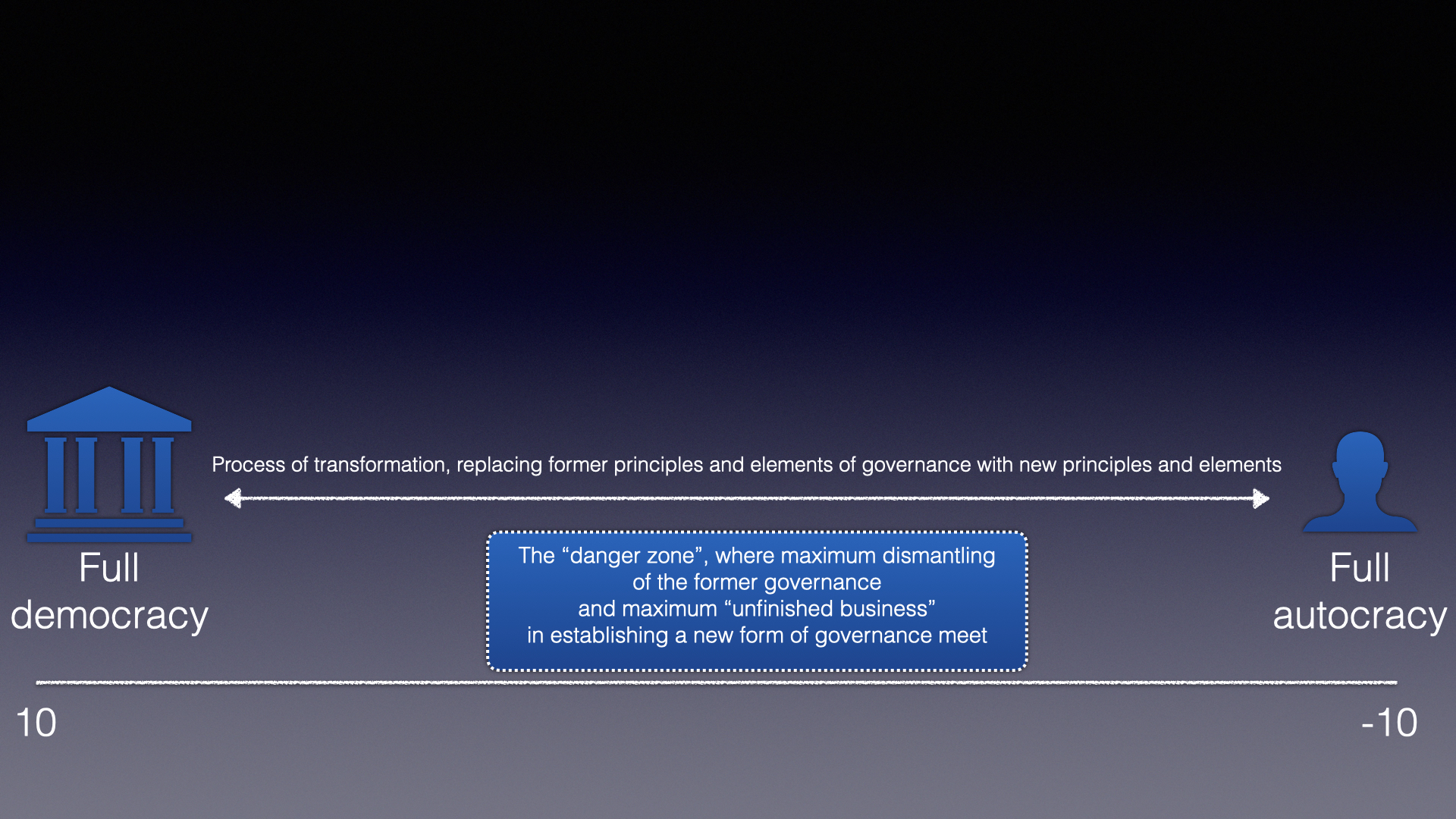
For me, one important contribution of Barbara F. Walter’s book sits with drawing attention to process, rather than a snapshot of a state of affairs in time. Any form of governance can be categorized, and put on a scale. A true representation of all common criteria for a democracy can put a State into a category of “best in class”. Another State can be a full representation of what we call an autocracy. That State would be on the opposite side of that scale. From the viewpoint of a true defender of democratic values, that would bring this State into the zone of “worst in class”. Of course, “the other side of the aisle” would disagree with that judgement, and there we are in a polarized discussion.

But the true focus of Barbara F. Walter is not on the snapshot where a State finds herself on such a scale. It is about the movement from one end to the other, in both directions, and it is about the speed of that process. A State can find herself on the path towards more autocratic forms of government, or on the path from autocratic governance towards democratic governance. Political science has established evidence for that the “middle zone” between one form of governance and another form of governance is the most dangerous and volatile area, and the faster the transitional process from democracy towards autocracy, or from autocracy to democracy, the more risk for wide-spread violence exists on a statistical level.

And this makes perfect sense. Here is my attempt to visualize it:

It means that the “door swings in both directions”: The risk of violence does not only exist in a situation where a country is slipping towards semi-autocratic or fully-autocratic forms of governance. The same risk exists in a situation where interested parties, supported by the international community for example, engage in promoting and establishing regime change towards democracy. Barbara F. Walter makes it clear that the risk for violence is highest when this process into either direction has placed the constituency in question into the middle zone, when transformational change is most unfinished, with the old being ripped down and the new not yet formed and rooted.

Secondly, science tells us that, again, the risk is quantifiably higher if the process of transformation is either too slow or too fast, for which there can be many reasons. From how I look at things from my own experience, it is scientific evidence for what happens when the international community pushes too fast, is compartmentalised in such efforts, displays not enough comprehensive depth in supporting transformational change, nor patience for a long-term coherent support approach based on vision and strategy. Which I often saw when international mandates and policy discussions were held unter terms such as “democratization”, or “state building”.


(2) Factionalisation in societies

The second aspect in Barbara F. Walter’s book is a comprehensive analysis of previous civil wars and the relation between constituencies moving into the “danger zone” of being an anocracy, and the existence of factions in these societies. Also here, the book is very comprehensive in giving a detailed account for a vast array of previous civil wars. In my reading this book, one aspect stood out: Any change of one system through which a state applies governance to citizens towards another set of governance rules inevitably leads to the demise of old elites and the struggle which is happening when new elites try to form, and old elites fight to participate in societal control, for their benefits. This is the second factor which makes the “danger zone” so volatile, and the book provides detailed analytical results to the question when, how, and why this leads to violence. I want to highlight one sentence:

“Remember, it’s not the desperately poor who start civil wars, but those who once had privilege and feel they are losing status they feel is rightfully theirs”.

Likewise I quote her account on a declassified CIA report from 2012: “Most insurgencies, the report notes, “pass through similar stages of development during their life cycle.” In the pre-insurgency phase, a group begins to identify a set of common grievances and build a collective identity around a gripping narrative—the story or myth that helps them rally supporters and justify their actions. They begin to recruit members, some of whom even travel abroad for training. They begin to stockpile arms and supplies.

I note that it is the last sentence which connects my current line of work with the larger picture.

Then Barbara F. Walter goes on to analyze the role of social media in contemporary conflicts:


(3) The drastic effects of social media

Social media acts like the proverbial gasoline poured on a fire. By now, many of us have begun to appreciate this very dark side of a technology which also has contributed so much to bringing us close together in a global world. The author’s account on how social media has been, and continues to be, systematically exploited by those who seek control, including by inciting violence, is nothing short of scathing criticism. Again, the book is unbiased by taking a very comprehensive view on situations of recent violence, and contemporary situations in countries all around the globe, within something which appears to be a rising global pattern of instability, emerging and brooding conflict. She refers to solid data that would allow to conclude that there is a clear connection between the exponential rise of volatile situations and war on one hand, and the the abuse of social media for that purpose on the other hand. It is here where the role of social media and its systematic and professional exploitation by reckless individuals and groups is pervasive. Whereas encouraging factionalism on religious, ethnic, racial, or any grounds has been the key defining modus operandi of individuals manipulating populations into fear and hate of the other, and the acceptance that “Dear Leader” may be the lesser evil, contemporary situations are characterised by a systematic manipulation of many, through some, using social media. The book demonstrates this in Myanmar, in countries in Europe including Eastern and Central Europe, and elsewhere, before even beginning to analyse what happened in the U.S. in recent years.

Our societies struggle with the question of how to apply accountability and regulative frameworks to this new phenomenon. Because, new it is: The effects of how social media can be used for manipulation, inciting hatred, and fueling violence, they may be just ten years old. But they are extremely transformative. And again, we see different approaches in relation to how to control social media in China or Russia, say compared to how open societies handle this challenge. But what we also see: Aspiring autocrats virtuously use social media to gain control. After that, these individuals will undertake everything to control the instrument they have used.

Because, they know better than anyone else how it can be used to their advantage, and against them.


This got long again. I leave it without conclusions, simply because there are so many. This is true for a paradigm change on how we consider engaging in conflict prevention in a world filled with old instruments of international order which require overhaul, or may be outdated if we don’t succeed in transforming them into effective tools. This is also true for how we accept our being affected by what we call “social media”. Personally, I feel this question may belong to the most important ones in our lifetime, in all aspects of our lives.

Afghanistan – Rear-Mirror-View or Looking Ahead?

At the time of this writing (August 24, 2021), its been 11 days ago that I published my first thoughts on the catastrophic events unfolding in Afghanistan, and the shockwaves within the International Community beginning to grasp the extent of our collective failure. At that time, the Taleban stood at the gates of Kabul. Two days later, then Afghan President Ashraf Ghani fled Kabul and his country, reportedly with a lot of money, according to this report, 169 million USD in cash. Following the implosion of the government, Taleban fighters and Taleban political representatives were in Kabul in no time. Afghanistan fell, may be except a little pocket, the Panjshir Valley, which appears to be under Taleban siege for now. No need to recollect the events that followed that implosion and collective failure of the International Community, and the Afghan Government. They will haunt us for years to come. Today, the G7 are convening a virtual meeting, called in by the current G7 chair, the United Kingdom. Much, if not all, will be about pressing the U.S. President into extending the deadline for the presence of U.S. troops at Kabul International Airport. Germany participates in a frantic multinational evacuation mission for own citizens and Afghan individuals being at imminent threat for life and limb. Two days ago, Al Jazeera estimated the total number of evacuated people being roughly 28.000, “tens of thousands more [are] still waiting“.

The breadth of discussions on all channels in relation to what went wrong is overwhelming in the West. The depth of these discussions varies. Like many of my friends, I am glued to these news. I belong to those who do not appreciate too much those discussions and statements that are varying mixtures of a broad bunch of mostly backward looking reflections, struggling to find simple answers, palatable for the digestion by the wider and less informed general public, addressing an intractable complexity which festered into twenty years of incoherence of international efforts. Strategic incoherence, because of political incoherence. There is no way to implement coherence if there is a lack of it at the top. Politicians trying to giving meaning in hindsight, overlooking the rubbles of an endeavor which lost its inner compass for a million of reasons. Of course many of these statements come with the unfailing appreciation for the services and sacrifices of soldiers, and humanitarian workers. Sometimes I notice that the police officers who were in this seem to be mentioned as well. But the rear-mirror-view needs to be put aside. Because of this sheer complexity, finding meaningful answers may need so much time that their use for the immediate and mid-term future is very limited.

I have begun to filter my input by looking for honesty in statements, hoping for more humility, wanting to see more apologies, and less self-reflection on national reasons why we were all in this. Because, we all are in this. For many reasons, I like this interview by my “boss”, the German Minister for Foreign Affairs, because I am desperate for any sense of humility combined with visionary forward-looking statements, messages that give us a sense of hope that we will find a way forward, beyond rescuing as many as we can, shivering in relation to how those feel who will, almost inevitably, be left behind.


I feel sorry and sad beyond words.

I am upset about the humanitarian crisis on an unimaginable scale. I am bitter and horrified about the incoming news on alleged summary executions in places outside Kabul. Today, the top United Nations human rights official says she has received credible reports of serious violations committed by the Taliban in Afghanistan, including summary executions of civilians and restrictions on women and on protests against their rule. The executions appear to also include former government officials and members of police and military.

I began to write this article to get my personal context connecting me to the cause of the Afghan people out of the way. I wanted to explain briefly that I am not just a “concerned citizen”, but that, and how, I have been involved in everything since 2001, since the very beginning. Writing the above, I realised that my reflex simply was to add even more noise to the Rear-Mirror-View. So I’m not doing this.


In my line of actual work I have begun to analyse those implications coming from the catastrophic events which I can see, or anticipate, right now. The discussions which I had about it since a few days, they relate to the consequences of, again, an implosion of security, law and order, an implosion of governance, and all our experiences we have made with how crime, transnational organized crime, violent extremism and international terrorism thrive under conditions like these. We, or I, have seen this so often. At the same time, these discussions made clear that even this segment (crime&security) is only a small element of all possible implications of something which seems to be a catastrophic event, but by no means is a local event. The situation has uncounted interdependencies to other factors in our globalised world which contribute to further instability, and further failure.

That’s why I argue that we need to find vision, energy, compassion, strength, and humility for an urgent brainstorming which would advise us on what we can do, beyond rescue operations, inside Afghanistan, inside the Region, and in all kinds of regional neigborhoods, including Europe, and the European Union.

Fast, please. And together, please. Let us stop talking about “us” and “them”. This is not about the West. This is about us. All of us.