I [am s]care[d] – Our common welfare should come first

On the featured picture: I asked the AI assistant to create a symbol expressing care and being scared at the same time.

It’s been a while, again. My last blog post On Aging dates back to July 21, 2024. If you read it, you will see a reference “Joe, I pray for you, you will make the right decision“. I meant that the incumbent President of the United States of America would hopefully make the right decision on whether to run for office again, or not. It was literally a few hours later that President Joe Biden announced to step out of the race. Which is pure coincidence. Mr. President, I will never ever forget your commanding voice in the Assembly of Bosnia&Hercegovina, when you reminded leaders, elected officials, politicians in Bosnia&Hercegovina of their duties to their constituencies, to their peoples: That their common welfare should come first. Not that I would feel it changed things in my beloved Bosnia&Hercegovina. But if I can’t forget Joe’s thunder, others may have felt that impact as well, and perhaps the memory will add to change, hopefully to the better, hopefully in not a too distant future.

What happened since President Biden’s decision to pass the baton to a younger generation, it was nothing short of a miracle. Vice President Harris’ nomination as the Democrat’s presidential candidate, the immediate launch of a ground-breaking political campaign, the positive energy and momentum, the rekindled hope and positivism, the difference between dark and hateful gloomy and self-centered fear-mongering and a bright and energetic appearance filled with passion, smiling, and profound substance, it could not have been starker. Moderate Republicans joining the Harris/Walz-Campaign, former civilian officials and retired highest military generals who served under Nr. 45 speaking out on Nr. 45 being fascist to the core, and him being perhaps the biggest contemporary threat, all of this is unprecedented. Despite the fact that numerous polling documented a huge shift in public sympathies towards Kamala Harris, it would appear the jury is still out on what is happening in less than two weeks, after one of the fiercest campaigning battles I have witnessed ever.

And sure, one of the ugliest campaigns ever, on the side of Nr. 45, including awkwardly dancing around for 39 minutes to some music playlist instead of campaigning by substance. A billionaire (Elon Musk, reportedly the richest man on the planet) jumping around on a podium behind Nr. 45, and doling out 1-Million-Dollar-Checks to voters in swing States. A running-mate for the office of the Vice President repeating insulting lies that Haitian migrants eat the cats in their neighborhoods. There is someone attempting to grab the highest office in the United States who acts following the principle “My welfare comes first and nothing else matters“.

Watching U.S. media closely, I am puzzled about how little is being reflected in German public broadcasting. At the time of this writing (October 23), I watched the news from the German “Tagesthemen” on the U.S. electoral battle. A battle it is. The report this morning left me frustrated. Reporting from rural Southern countryside with honest U.S. citizens emphasizing that all they expect is economics lowering their costs of living, some pictures of Nr. 45 handing out french fries at a local McDonalds, and a little bit of footage about Kamala’s intense campaigning. It all feels so awkward because of the paucity of reflection of what I see reflected in U.S. news.

Like, I’d like to see more on the brazen attempt of an “autocrat hopeful” to exact revenge on political opponents, to talk about the “enemy from within”, to attempt silencing media perceived as being hostile by threatening to revoke their licenses if he gets re-elected, to come up with every lunatic conspiracy theory under the sun, to lie, to incite hatred, to endanger legal migrants, to glorify the events of an insurrection on January 06, 2021 as the most peaceful patriotic event ever, not even to talk about his misogynist and xenophobic side, and his affinity for crude sexual remarks for opponents. Watching the bipartisan efforts attempting to make clear how monstrous the consequences of a re-election would be, it is heartening. To see Liz Cheney joining Kamala Harris in a conversation in Pennsylvania, wow. The reflection of all this in German news tastes pale, often dry. But may be that’s just me. Usually it’s just me. If so, I’m sorry. No, I’m not. I am scared.

I am reminded these days of David Faber’s book “Munich, 1938 – Appeasement and World War II“. I read it many years ago. It is still on my mind. For me, a member of generations growing up post World War II, there is no time for complacency when fascism raises its ugly face. It is not easy to define fascism, as I learned when I wrapped my mind around Umberto Eco’s fascinating set of three essays “How to Spot a Fascist“, also many years ago. But I can smell one when I see one. So I take Gen. Mark Milley, former U.S. Joint Chiefs of Staff serious, when he calls Nr. 45 a “fascist to the core“.

Anne Applebaum published her newest book “Autocracy, Inc. – The Dicators Who Want to Run the World“, and I am reading it right now. To quote Amazon’s book description: “All of us have in our minds a cartoon image of what an autocratic state looks like, with a bad man at the top. But in the 21st century, that cartoon bears little resemblance to reality. Nowadays, autocracies are run not by one bad guy, but by sophisticated networks composed of kleptocratic financial structures, security services and professional propagandists. The members of these networks are connected not only within a given country, but among many countries. The corrupt, state-controlled companies in one dictatorship do business with corrupt, state-controlled companies in another.” By the way, Anne has made it on the list of people degraded by Nr. 45. Which I take as a badge of honor.

I am reading the first chapters. And it strikes me how correct she is with the complicity between such self-serving networks, the cold calculating world of financial institutions, and the “double-speak” of the West, often saying one thing, and sometimes silently doing another thing. Or arguing one thing here, and the opposite thing elsewhere. When I listen to friends from the Middle East or Africa, I can so much understand their frustration, and often disbelief in truthfulness when we talk about values. Are we meaning what we are saying? Or are we measured by the consequences of hidden agendas? But inasmuch as I can fully understand the grievances by those who are really suffering from attempts of all sorts of networks preying on them, autocracies, kleptocracies, former colonial powers, own dictators and rulers, and so much more, I remain very concerned when I hear this complaint about “double speak” in conversations here in Germany, from people who slowly but visibly navigate towards the right, or the far right. Because what lies beyond, the extreme right, the fascist right, the angry sick phantasies of restoring the glory of a nationalistic approach, it never happens without a broader support within a larger constituency.

All this appears to be connected, globally.

It’s been three weeks since I listened, again, to Jay W., a fellow recovering friend in 12-Step-Recovery. I always enjoy seeing him in a Zoom window, surrounded by sometimes hundreds of other little pictures of my friends who connect from literally all over the world. Jay’s story began including when, at the age of roughly half a year old, his “mom went out of the door”, never returning. His father remarried and gave Jay away to another family when Jay was three years old. In Jay’s own words, this family locked him in a pitch-black closet, where he lived for the next three years. He slept, toileted, ate, existed in that closet. He was pulled out once a day to be washed, ritualistically tortured, and/or raped by three adults. When he was in the closet, all he wanted was the freedom of getting out of the dark, and when he was out of the closet, all he wanted was the safety and solitude of being back in the closet.

Jay’s story is the story of Jay and Nancy, his late wife, the love of his life. It is the story of “Jancy”, in Jay’s words. It is a story which you can read in his book “Relationship Resilience: Applying the 12 Traditions to Relationships“. Amazon’s review curtails the message of this book a bit: “This small work contains twelve powerful tools to guide couples to transform deep loving feelings into consistent loving behavior. The tools are loosely based on AA’s Twelve Traditions, and they work – quickly and transformatively – whether you are or are not in any 12-Step Program. These tools will change your relationship – whether you’re on the verge of breaking up, in a good partnership but wanting it to be better, or in a great relationship but always open to new tools to cultivate loving closeness.

Because, in this book, Jay does not only talk about personal relationships, like, family relationships, or intimate relationships. He is talking about any relationship. Whether professional, or private. Whether a spouse, or an employer/employee-relationship. Whether you love this person, or respect this person, or you suffer from this person, or hate this person, or are being subjected to hate.

Inasmuch as 12-Step-Recovery, based on the principles identified first by Alcoholic Anonymous, is based on those 12 Steps, there are the 12 Traditions as well. Many will say that the 12 Traditions guide the way how 12-Step-Groups are being organized, in the most fundamental democratic way you can ever imagine. But Jay is not the only one who is able to describe the power of the 12 Traditions in every aspect of life. Yet, his book contains the most recent demonstration. Like, TRADITION ONE – OUR COMMON WELFARE SHOULD COME FIRST.

I’ll leave it there. Read.The.Book. Love you, bro.

Shutting Down – On Disassociation, Feeling Overwhelmed and Powerless, Retreating, and Denial

On the featured picture: The Class of 76 of my High School. I’m in there, too. Almost invisible in the background.

I grew up with Peter Gabriel’s towering work, whether in “Genesis”, or with Gabriel’s later solo phases of artistic development. One of my all-time favourites songs is “Signal To Noise”. Here are the lyrics:

You know the way that things go

When what you fight for starts to fall

And in that fuzzy picture

The writing stands out on the wall

So clearly on the wall

Send out the signals, deep and loud

And in this place can you reassure me

With a touch, a smile while the cradle’s burning

All the while the world is turning to noise

Oh, the more that it’s surrounding us

The more that it destroys

Turn up the signal

Wipe out the noise

Send out the signals, deep and loud

Man, I’m losing sound and sight

Of all those who can tell me wrong from right

When all things beautiful and bright sink in the night

Yet there’s still there’s something in my heart

That can find a way to make a start

To turn up the signal

Wipe out the noise

Wipe out the noise

Wipe out the noise

You know that’s it

You know that’s it

You know that’s it

Receive and transmit

Receive and transmit

Receive and transmit

No receive and transmit

No receive

Receive and transmit

Receive and transmit

Receive and transmit

Receive and transmit”

Let the lyrics sink in first and consider whether, and how, you relate. Then take in the soundscape of the song. Here is a reference to the epic musical performance in it’s original version: Peter Gabriel – Signal To Noise – 2003 Original via Youtube: https://www.youtube.com/watch?v=1zM7QaPiwqE. And here a live version featuring the combination of Gabriel’s rock band, combined with the great Nusrat Fateh Ali Khan surrounded by his fellow performers: https://www.youtube.com/watch?v=B5KcEy3y23w. Consider how you feel, against your own memories of the time growing up with his music. Or against the background of your memories of the early 2000’s. Or against your cultural positions or affinities. Or against your current mood, whether you are depressed and feeling hopeless, or feeling hopeful. Or not knowing how you are feeling at all.

 In all cases you will come to own specific contexts of how you relate to the lyrics, the soundscape, and the combination of a rock ballad with arabic tunes and sounds, and visuals.


As always on my blog, I am after something like common patterns. In this case, I am trying to wrap my mind around an impression which I have: That there is a rapidly increasing and all-pervasive desire of shutting down which I come across in many personal conversations, and which I suspect, with some personal heuristical indication, appears to be increasingly endemic at least in those societal contexts in which I live and move around.


Since a very long time, I am no stranger to feelings as they are expressed in these lines, the way I personally relate to them. This song is part of a playlist on my devices which I continue to listen to all over again, since many years. Like with any piece of art, my emotional relationship to it is based on the context of my personal memories, the way I grew up, the way I relate to the iconic music of my defining young years, the Rock music of the late Sixties and early Seventies which later made me select which performers I would follow, and what kind of new music I would let in, and where I simply wasn’t interested at all, and how I come back to my defining Classic Rock music as I grow older. Yes, of course, this is how nostalgic feelings develop, too. A friend for many years, who is considerably younger than I am, shares some favorite music with me every day during these weeks advancing the Christmas Holidays. That music is so different, and I relate so differently.

But I am also putting this masterpiece into my personal and professional context of history and experiences which include many severely traumatising events which I have had to process, and continue to do so. I do know a great many people who struggle with that they have gotten stuck in this trauma process, so I will offer an important word of optimism from the outset on. Because if you read the lyrics, they end with an impression that there is no way forward. Yet, there is one. It is a long and arduous process, but a promising one, always requiring outside help. I do strongly recommend professional help being part of it. I am not suffering from my trauma past. Not any longer. As far as I can tell. My processing work continues. But there is hope, and there is a way. I have integrated my past, welcome it, do not regret it, am not stuck in it. But I relate very much to the feeling of utter hopelessness which I listen to in conversations with an increasing amount of people who appear to have been on a different trajectory of lifetime developments than I have been and who seemed to have led lifes with much less trauma-induced self-harming behavior than I have. Until relatively recently that is.

And I feel much has begun with the Covid-19 pandemic.


In most simple terms, trauma is a consequence of harmful events. A trauma literally is a wound. Trauma is not the triggering event, but its consequence. Physical wounds, emotional wounds, cognitive wounds, spiritual wounds. That is why medical doctors describe wounds using the word “trauma”, like in the case of “concussion trauma”. In the very same way events create wounds in the brain.

The body-brain-relationship on cognitive level includes that physical wounds, trauma in the body, creates mirroring wounds in the neurophysiological setup of the brain. The brain reflects the sensoric input through constant neuronal change. Like every part of our body, for example, has a mirroring section in the neuronal setup of our brains, changes to this body, even temporary changes like through wounds will be reflected in the neuronal setup of our brains, and in a way that you can see on an MRI scanner or using other devices.

But it also goes the other way round. Not only that physical injuries create their mirror-representations in the brain, cognitive injuries will also become visible in the body. Traumatising events can leave the body seemingly unharmed, but not the mind, and then as a consequence of the complex reaction to trauma, the wound in the mind becomes visible on the “outside”, through behavior, or also through somatic consequences. We even name them “psychosomatic”. Think headaches, ulcer, strokes, cardiac arrests, and myriads of other forms of the mind-body-interrelationship which constitutes us. If I go any deeper, I will already have to be selective in describing the many interrelated consequences of trauma. If you think deeply, you will recognize that any border between “body” and “mind” is artificial. It literally is All One.

That is why it is so wrong, and so dangerous, to perhaps minimize, or belittle, psychosomatic illnesses. Like as if “just being stronger” would be a remedy. Using the same “logic”, less educated people will belittle traumatisation as a “desease of the weak”. Nothing could be more wrong.

Harmful events creating trauma can be “one-of-a-kind” but severe. Or cumulative by constant, but may be with less severe events forming a chain. Or in its most extreme forms, trauma can be the consequence of a repetition of severe events, each of which in itself would already constitute heavy traumatization but where the repetition creates devastating results. Like as if you would use a hammer and constantly bang on the concussion which you already got from the first time when the hammer hit your hand incidentially, and not the nail which your hand was holding against the wood. 

You would never do that, would you? Hammering on the same wound all over again which you received in the first place? Pretty unheard of? Not really. Think of cases of severe mental illness, where people can’t keep themselves from banging their head against a wall, for example. Or take self-abusive sexual behavior re-enacting severe trauma from earlier abuse. The Internet is chock-full with videos of it, simple Google-searches show. In addition, many browser histories will be filled with such searches.

The conduit especially visible in the last example which I use in the previous paragraph is: In cases of mental trauma the mind often goes into re-enactment-mode, meaning that people with an initial trauma for example in early childhood will develop a life pattern of seeking situations in which they unknowingly or knowingly expose themselves to trauma, over and over again. I only began to understand that at the age of 55 years. I was not aware of this pattern, and it took quite a while until I reached an initial position from which I began to appreciate the consequences of my patterns on a cognitive level. That includes, importantly, people whose depression is masked to the extent that they even don’t know they suffer from it.

So, the first half if my interpretation of that song is one in which Peter Gabriel expresses the feeling that hope is drowning, then he expresses a glimpse of hope: Man, I’m losing sound and sight Of all those who can tell me wrong from right When all things beautiful and bright sink in the night Yet there’s still there’s something in my heart That can find a way to make a start.


Was I too early offering a glimpse of hope for instances in which all things bright seem to disappear, when even pain relief doesn’t work any longer? Because Gabriel’s lyrics include that, towards the end, hope seems to disappear. “No receive“. The signal seems to be lost, drowned in the noise of things falling apart. People who do not have personal experience with depression will have a hard time to even relate on a cognitive level.

Without a deeper investigation, my feeling is that an increasing number of people is experiencing what Peter Gabriel is expressing. A word of academic caution: Even if I can give testimony that in the overwhelming number of conversations which I have, people confirm that they feel numb, angry, depressed, helpless, just wanting to shut off communication and retreating to a beautiful peaceful place, it still is nothing else than my selective subjective experience. 

But I travel a lot, I talk with friends, colleagues, and random people in societies all over the world. What I hear is often the same: It feels like a tendency to increased and enduring depressed feelings. Conversations communicate a struggle with hopelessness, feeling overhwelmed, feeling helpless, feeling exasperation and desperation. And there is anger, all over these conversations. Sometimes visible. Sometimes repressed and masked. Just listen long enough and deeply, you will see the repressed hidden anger.

It is not that I’m stuck in something myself and therefore selectively only talk to people who feel “like me”. My recovery from trauma and it’s life-long consequences, including systematic re-enactment of trauma by exposing myself to more of it, it is based on experiential wisdom which is confirmed by cutting edge science, whether psychology, psychotherapy, trauma-treatment, or the vast knowledge coming from neuroscience. It includes that I always remind myself to remember the codeword H.A.L.T.: Never get too Hungry, Angry, Lonely, or Tired. 

In this context, emphasis on “angry”, and on “lonely”.

Living my time- and science-tested recovery way-of-life I work very hard on practicing positive attitudes and principles of living. I deeply know what anger, resentment, fear, and the feeling of helplessness can do and to which dark places it can get lead. 

Do people who have never had to recognize severe trauma know how much they have been traumatized? The word “traumatised” may often be used in superficial conversations, without a deeper understanding. It mainstreamed into conversations, before, during, and after the Covid-19-pandemic. Does the intellectual knowledge of the fact that one received severe trauma help, on deeper levels? My personal experience is confirmed by science: No, intellectual knowledge does not necessarily help. A typical response is: “I can fix it myself. I just have to change the circumstances. I don’t have to change myself. I’ll just fix it”. Of course this will prove wrong with no exception. The path from intellectual acknowledgement of own traumatisation towards a deeper understanding creating the willingness to seek and to receive help, it usually is a long-winded path with many injuries to oneself and to loved ones until one is able to recognize this fact. Until then, even those who try to be helpful will stand in the way when they will not submit to the victim’s expectation to be helped in fixing the environment, instead of helping to address the real roots of what individuals have to change within themselves, in order to embark on a path of healing. Witnessing the path down to rock bottom, not being able to help someone to avoid it, especially in the case of people one loves dearly, it can be heartbreaking. Being pushed aside as a consequence of the paranoid level of self-protection which has arisen in a traumatised person using every survival strategy under the sun in order to find relief from a pain too big to be acknowledged by oneself, it is a tough experience. Giving in, meeting the expectations of a suffering trauma survivor to stay stuck, or to believe that it is the circumstances, and not oneself who has to change, it moves any supporting person from the side of solutions to the side of problems. It is called co-dependence.


How many of us have experienced radical trauma during the pandemic? Each of us has own memories which we have neatly put into a mental closet. How many of us remember the traumatic isolation? Sure, I also know people who will report that they enjoyed the solitude. But many suffered from a deprivation of social contacts on an unprecedented level. Others suffered from trauma through the stress which Covid-19 brought into their private lifes, locking them up in one place, amplifying the catastrophic way of interaction in unhealthy relationships and abusive situations with no means to escape. Domestic violence increased. Cases of suicide and attempted suicide increased. The impact on children during a period of their lifes requiring social contact to peers has been catastrophic, and there is ample scientific research on this, whilst long-term impact studies necessarily are only in their infancy. Our lifes only started to normalize less than two years ago. Few people remind us of these times by still wearing masks in public. It seems like we have muted our traumatic memories to the maximum. For now. Just think how societies would react if a new serious wave of a pandemic would lead to a medical recommendation to repeat the containment measures which we applied from 2020 onwards. Literally everyone whom I present with this hypothetical scenario responds with “Unthinkable”.

Now, the next conduit: Remember how we witnessed the escalative proliferation of conspiracy theories at the same time, and fueled by the pandemic, and with some politicians and a bunch of crazy people pouring gasoline on the wildfire?

Talking about the meaninglessness of “truth” has become the new normal. Who would have not said you’re crazy if one would have described today’s reality to you just, say, less than ten years ago? Since 2014, this blog alone carries many examples of developments which always “upped the ante”. Until now with no peak in sight. We live in societies in which the deterioration of mannered attitude and bi-partisan discussion culture progressed into something where people will roll their eyes and say “Again? Please give me a break!” Or where people have taken sides and can’t talk to the other side any longer. Or where they have a hard time even acknowledging that the other side has a point, or can at least sense the shoes the other side is wearing.

Which is a another pointer towards a human attitude which also is a typical consequence of trauma reflected in earlier paragraphs of this writing: Denial.

Another one is Anger. Anger in it’s repressed forms as a consequence of trauma. Anger as a strong emotion used for control and manipulation. Anger as one of the key emotions exploited in social media and through algorhythms on basis of Artificial Intelligence. Remember what I wrote about H.A.L.T.?


Cypher: You know, I know this steak doesn’t exist. I know that when I put it in my mouth, the Matrix is telling my brain that it is juicy and delicious. After nine years, you know what I realize?

[Takes a bite of steak]

Cypher: Ignorance is bliss.

Cypher in the iconic movie “The Matrix” about the Grace of Ignorance 


Can anyone relate to pure figures of suffering?

The scene with Cypher as quoted above is the most incredible way how to bite into a piece of juicy steak I have ever seen in any movie. Watch it.

Remember the statistics and figures with daily, sometimes hourly global development of how the Covid-19-virus rampaged through the World? The figures of infections, the figures of infection-related deaths, and then a year later on the figures of vaccinations, and how we struggled to see a relationship between vaccinations and a downward trend in infection-related deaths? Remember the denial, and how our societies were ripped into vaccination-supporters and vaccination-deniers, and how militant this discussion was, partly? How the fact whether someone was supporting or refusing vaccinations ripped through families? I remember a conversation where someone in my family spoke about a vaccination-denier who got severely sick, almost dying, from Covid-19. I could hear a subdued element of “Schadenfreude”. And remember how we needed to exemplify suffering through singling out individual stories of suffering in order to grasp the extent of what was happening, on a massive, global scale?

That was 2020 and 2021. Remember the numbers blowing your mind related to the suffering of people in Afghanistan after the implosion of all international activities there in 2021? An implosion and withdrawal which came, at least for many, without clear signs. And in any case, notwithstanding how premeditated it was, in its execution it happened fast, not in steps allowing to adjust policy of withdrawal. And then there was the highly unanticipated progress of the Taliban, taking over large swaths of Afghanistan, and then Kabul, much to their own surprise even. Do you remember the figures of casualties on the side of civilians? Or do you, more than that, remember the pictures from Kabul airport, and the individual stories of people. Do you remember the stories of Afghan women? How often do you read about the suffering of Afghan women, these days? Are you aware of the refusal of the Taleban, but not only them, related to the figures, and the facts of human rights violations? Have you been exposed to stories of denial, like it was the case with Covid-19? Stories of distortion and manipulation of facts, and conspiracy theories, and blaming the respective other side, singling out and protecting own decisions in a collaborative catastrophy with many factors needed to be taken into account, whilst people were looking for simple answers to yet another shocking and traumatising chain of events?

That was 2020 and 2021. Remember the numbers blowing your mind, of the suffering of people in the Ukraine, following the ongoing onslaught and the suffering through displacement, deportation of children, forced adoption, the war crimes and the crimes against humanity in occupied territory of the Ukraine, in 2022, whilst people in late 2021 would still dispute the intentions of an autocratic leader, Vladimir Putin? Who was helped in his disinformation campaign not only by denial and wishful thinking on the side of the West, but also through people like Nr 45 in the U.S., who until today sings songs of praise related to him, and to the dictatorial killer in North Korea, and an autocratic leader in China? Do you remember the statistics, and how we needed to create empathy which can not be reflected in numbers, by flooding the news with individual stories of suffering, and heroism, of the Ukrainian people?

Were you, at that time in 2022, still able to pay attention to Afghanistan? Were you, by then, able to also take in the sheer numbers of suffering of people in other parts of the World, less relevant to your own local and regional neighourhood? Like in Africa, just as an example?

That was 2020 and 2021 and 2022. What does the figure “1.200” do to you, on a level of empathic relating to suffering, when Hamas unleashed unimaginable terror, atrocities, murder, maiming, raping, mutilating Isaeli citizens October 07, 2023? The international news were only able to create understanding through individual stories, bordering, sometimes overstepping the limits of what can be put into press and TV by responsible media. Very much unlike the video streaming and glorification undertaken by Hamas. Almost immediately, despite the fact that I am almost not present at all on social media, I received messages from friends who had friends in Israel who, in their outrage and unimaginable pain even justified thinking about retaliation, and corporate responsibility of the Palestinian people. Reasonable words of caution against such holding a people responsible on a collective level drowned in the anger, fury, despair, pain. And in a specific German context which is visible in previous articles on this blog, it also began to deeply affect the German society, both related to how we deal with our Holocaust past and our collective responsibility to protect the Israeli State and its citizens, and how we experienced the consequences within our own multi-cultural setup which includes citizens and residents and temporary residents and people granted asylum who live in Germany, constituting parts of the German society.

What does the figure “18.000” do to you, related to the rough and daily increasing estimation of death tolls of Palestinian civilians? Except, that the collective figure of “1.200” and “18.000” defies any reference model which you had from previous news, where the decrying of massive suffering was already stressing your tolerance. Again, you are confronted with unimaginable suffering as reported in individual stories which are needed in any reporting, in order to make you being able to relate on an empathy level. Do you belong to those who have already forgotten the Covid-19-casualties and the suffering in Afghanistan and who barely think about the numbers as we digested them from the Ukraine just a year earlier?

In this section of my long writing, I want to make the point how deeply this collective development, taken together, has been traumatising us on a societal level. Pandemic, Afghanistan, Ukraine, Israel and Palestine, I often hear “What will come next?”. Almost no capacity left for appreciating suffering in other parts of the World. We take this in within an onslaught of news which still includes more, including climate change and natural catastrophes, including worrying political developments. And each of these news stories scare the hell out of us.

And please remember what I wrote earlier: Brains are highly social organs, and in addition to what trauma on an individual level does to us on a neurophysiological level, the same is true when we mourn the loss of a relative, or a loved one, or experience heart-break. And the same is true with our societal connections.

Each of the developments above has led to individual and societal traumatisation on a level which I have not witnessed in my personal lifetime, in this life. Can’t remember what happened in my previous lifes. Maybe I am blessed.


Leading to my final part of dealing with typical reactions to trauma, beyond being wounded, becoming numb, becoming angry, entering into denial: Another important effect of trauma, because of the way the survival mechanisms in our brains work, is shutting down.

This, I believe, I personally witness more recently, and especially since October 07, 2023. Remember the following lines from Peter Gabriel’s song: ” Man, I’m losing sound and sight Of all those who can tell me wrong from right When all things beautiful and bright sink in the night“.

I feel we are ripped into pieces because we loose orientation. We can not compare 1.200 and 18.000, since every single life is invaluable. Where is the guidance on a question like “How many civilian casualties compose a violation of the responsibility of a Party to a War to protect the civilian population?” How do we stomach numbers according to which more than 70% of the Palestinian population are internally displaced, mostly having no shelter, no food, no water, at the brink of starvation, with almost no medical provisions?

In many discussions which I am part of, I can feel how this rips us into pieces. Not only in a specific German context. You can read about it in great detail and masterfully written in this essay in the “New Yorker“, which was sent to me by my nephew (the one who wrote a response to my blog article). Please, if you can, follow the link. But this rupture includes all of us, including the United Nations, for example. Please, also read the OpEd by Michelle Nunn, Tjada D’Oyen McKenna, Jan Egeland, Abby Maxman, Jeremy Konyndyk and Janti Soeripto, titled “Why the U.S. Must Change Course on Gaza Today“.

Ms. Nunn is president and chief executive of CARE USA. Ms. McKenna is chief executive of Mercy Corps. Mr. Egeland is secretary general of the Norwegian Refugee Council. Ms. Maxman is president and chief executive of Oxfam America. Mr. Konyndyk is president of Refugees International. Ms. Soeripto is president and chief executive of Save the Children U.S. – How much higher can you get in the international humanitarian community?

This OpEd is heartbreaking in it’s own right. Because it struggles with some of the questions which are part of this long essay of mine.


I need to conclude on “Shutting Down”, being part of my title for this blog entry, too: I am increasingly confronted with statements like “I can’t bear this any more”, or “I don’t want to hear about it any more”, or “I want to leave to an island where I can just live a simple life, leaving all this behind”.

I can understand this reaction.

I also note reactions like regressing into familiar local contexts. In these cases people shut their eyes and ears, because they can’t bear the emotional pain any longer, and regress into a combination of denial, and self-serving domestic points. Like, “See, I understand all this, but is anyone talking about what is happening in my neighborhood?”.

I also can understand this, though I am fiercely calling for remaining compassionate and understanding for a global interconnection of events. No domestic problem can be solved without taking the global interconnection into account.

Finally, I note denial, regression, fake news, conspiracy theories, and radicalisation as a pattern which emerges also from the desire to find simplified answers to seemingly intractable problems. This is mixed with pure selfishness, egotism, and malice.

Whilst I appreciate the mechanics behind it, I can not even begin to understand this, nor tolerate it. Also this extremism, on the left and the right, narrowing the focus of observing problems to the point of almost becoming deaf and blind for anything outside the own area of interest, it both is a consequence of the long story on trauma which I have written down here, and at the same time it acts like an escalating agent. It puts gasoline on the wildfire which has become a global storm.


That is why shutting down must be fought with all individual and collective means. Without empathy, compassion, and the attempt to lovingly understand and to support collective values, we are literally doomed.
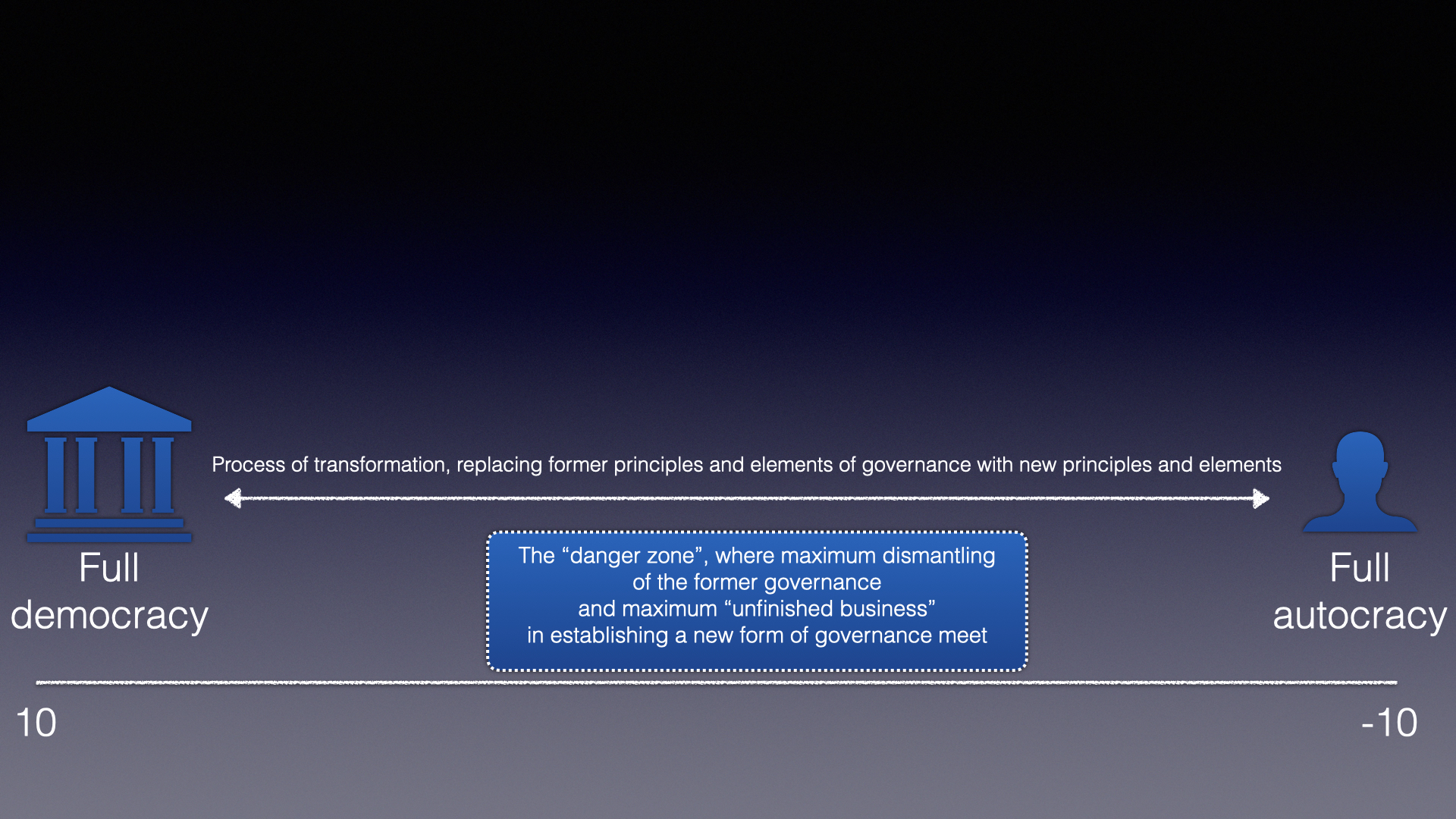
Following Up on Gaslighting – Why This Is So Dangerous – About Recent German Police Raids Related to Reichsbuerger

December 04, just four days ago, I wrote “The Reason For Storytelling: If You and I Don’t, Only Others Do – On Gaslighting Taken To a Global Level“. I referred to the outrageous remarks of the 45th President of the United States, with which he called for dissolving the Constitution of the United States. He continues to insist that widespread fraud and manipulation of the elections would have taken the Presidency away from him, claiming that the entire system of U.S. governance, the Democratic Party, and a cabale of secret networks is conspiring against “the people”. Until today he claims to be the rightful winner of the 2020 elections. On that basis he doubled down once more, and not for the last time, ever more eroding values and norms. The result just being a continuation of a discourse on the basis of outrage, and antagonisation. Like on so many occasions before, the world is waking up after such remarks with a new extreme, and because of that also a “new normal”. The next escalation, as always, is just around the corner.

The point of my concern continues to be that any strategy which is just explaining this as a M.O. of a sociopathic narcissistic individual is disregarding the wider picture: Of course a delusional persona with such disorders has no other means at hand. Such a person is simply not able to back down. If allowed, Nr. 45 will be like the Roman Emperor Nero. And I do remember having read that Nr. 45 studied Hitler’s “Mein Kampf”. People wrote about that book on his bedside table. From there, I also remember Hitlers “Beer Hall Putsch” in November 1923. Jailed after this putsch attempt, Hitler wrote “Mein Kampf”. I can’t help but think of January 6, 2021, as a possible prelude to the worse.

I made my choice to consider a red line being crossed a long time ago: January 26, 2017 Nr 45, newly elected to Presidential office, sat in front of TV cameras and said “Torture works“. We know what happened since then, it was just the beginning.

The point is, as said above, that everytime a line is crossed, something unimaginable has become the new order. This reality then permeates into the lifes of many people, not only into the minds of sick extremists, racists, anti-semites, conspiracy theorists. Society at large undergoes a shift in perception. It is there where the responsibility of the many kicks in. Disregarding, denying, ridiculing, minimising, instead of forcefully rejecting, it is the real factor in how previous norms erode.

No doubt, strategic minds on the side of hateful extremists (who are globally networked) know that, and use these tactics to perfection. In the concrete example at hand, the recent cycle started with a dinner of Ye and Fuentes in Mar-El-Lago. Next thing we saw was Nr. 45 throwing smoke grenades of minimising, and pretendiung innocence. Next thing were even more awful public statements from Ye, and Fuentes, in Alex Jones’ show. After which Nr. 45 then moved to calling for the dissolution of the Constitution. Finally, what we saw after that, was another interview of Ye, calling on Jewish people to forgive Hitler. He did so in a conversation with Proud Boys founder Gavin McInnes. If you google it, you also see what I said earlier: The number of hits in mainstream news where this was reported is huge. Another “new normal”. And this, let me be clear here, with a statement that, in Germany, would lead to prosecutors investigating a possible crime. To me, a sentence like this one is almost unspeakable. I am horrified, and I hope that Ye will pay a price for this. Unfortunately, I am not so optimistic. Instead, let me apologize to Jewish people, and assure we will undertake everything to not allow the real Holocaust being forgotten, minimised, denied, or justified.

The cool-minded analysis, meanwhile, needs to focus on the larger implications of norms being shifted. John Bolton is a former National Security Adviser to Nr. 45. I know him from his time as the U.S. Ambassador to the United Nations. Whilst I disagree with his rude Republican hawkishness which was painfully making life at the U.N. difficult during his Ambassadorship, I deeply credit his analytical skills. December 05, 2022, in an interview with NBC News, he called the former president’s declaration “an existential threat to the republic itself“. If you listen to the interview, everything counts, including what he only indicates: That, if Republican leadership does not denounce this behavior in full, consequences for democracy will be serious.


Why am I focusing on U.S. politics again?

Because, as I wrote in my earlier article, this gaslighting is working like a global set of echo-chambers. It reverberates, it transmits energy, it receives energy, and if the extremist movement manages to create something like “synergy in chaos”, it constitutes a global threat to democracy. May be the most severe we ever witnessed since World War II.

That is why I said: “So, one of my hypothetical thoughts is about whether there will be people on the far-right in Germany who think about how to establish a narrative that the German constitutional order is subject to removal from within, by justifying their resistance in saying that the government and the establishment is the enemy of what the Forefathers, the Founders of our Constitution, meant. This is not far-fetched, and it is the same logic.”

I drew a comparison to how post-WW II-Germany incorporated provisions into our German constitution in order to protect the Constitution from enemies within. In doing that, I referred to how the Nazis managed to overthrow the Constitution of Weimar, and I also linked a song “Kristallnaach”, performed by the German Rock Band “BAP” in the 1980s. “Kristallnaach” is a word in the dialect spoken in the German Region of Cologne. It refers to “Kristallnacht”. The BAP song itself compares xenophobia and fascism and violence which we observed in the 1980s with what happened throughout the real events of the “Reichskristallnacht Progrom” in November 1938. The song was visionary, and provocative in the 1980s, and entirely appropriate. Timeless. And moving me in 2016, when I thought about what was happening in the United States during that time.

If I look back onto those events from January 06, 2021, this was not so far-fetched. Looking onto those incendiary calls from Nr 45 a few days ago, for sure even less.

That was all on December 04, 2022, when I wrote that.

Of course, my thoughts about similar violent phantasies on the side of German far-right extremists are far from hypothetical, but at that moment I wanted to keep it in a thought-realm on far-right extremism, which is on the rise in Germany since a number of years. Like it is in other places in Europe, whether inside the European Union, whether in South-East Europe, or Eastern Europe. Or, in the United States. A number of my blog articles have referred to this awful global “ping-pong-game.” This rise of reactionary fascist xenophobic thinking, with a global attitude including to take rights away from women, and now going far beyond white supremacy by mainstreaming awful anti-semitism, it comes with many different facets. Recently, Indonesia decided on a law making extra-marital sex a crime. Just an example.

Well, a few days later, German and international news are filled with reporting about a huge raid by German authorities, under the lead of the “Generalbundesanwaltschaft”, in English the “German Federal Prosecution Office”.

Here are a few links to recent raids targeting suspected armed members of the far-right extremist Reichsbuerger-Bewegung: Tagesschau as of December 07 (GERMAN); German Federal Minister of the Interior in Tagesschau as of December 07 (GERMAN); Tagesschau on Reichsbuerger Background as of December 07 (GERMAN); Reporting on the German raid in BBC as of December 07 (ENGLISH); Reporting on the German raid in New York Times as of December 07 (ENGLISH).

The headline of The New York Times as of December 07 tells it all in one sentence: “Germany Arrests Dozens Suspected of Planning to Overthrow Government“.


What happened?

A German noble-man, together with a far-right female member of the German Parliament (also being a judge in Germany), soldiers and former soldiers, as far as I know also an individual with a history of being a police officer, overall as far as the public knows until today at least 25 persons are subject to an unprecedented investigation of German authorities. I’m not repeating the details here, since the article is already too long. But it looks not only like one of the largest raids in German history, involving more than 3000 police officers. It may look like the tip of an ice-berg. The Head of the Federal Intelligence Agency “Bundesverfassungsschutz” is quoted with estimating some 25.000 people radically poisoned by the “Reichsbuerger-Ideology”, with systematic efforts of at least at part of those to arm themselves, with plans of some of them for terrorist attacks, and plans for a larger putsch. At least some investigative links also point towards contacts with dubious Russian operatives.

An incredible story, and ongoing and likely widening. Being a police officer (retired) myself, I am, of course, proud of this vigilance. And certainly, more will be revealed.


Yet, this needs to be understood within the general context of where the shift of values brings us to, as I pointed out above. German President Frank-Walter Steinmeier is calling on more civic engagement preserving democratic values.

To quote him: Die Wehrhaftigkeit der Demokratie beweist sich auch darin, dass sich diejenigen, die anderer Meinung sind, die ein liberales, ein demokratisches, ein offenes Deutschland wollen, lauter äußern, als das gelegentlich der Fall ist.

In my translation: “The ability of democracy to protect itself is also a function of the extent with which those, who stand in for a liberal, democratic, and open Germany are speaking up with a louder voice than we see it, at times.”

That’s what I mean with the necessity to cultivate storytelling. And these are my humble small contributions.

The Reason For Storytelling: If You and I Don’t, Only Others Do – On Gaslighting Taken To a Global Level

Around 1 percent of U.S. veterans of World War II remain alive to tell their stories. It is estimated that by the end of this decade, fewer than 10,000 will be left. The vast majority of Americans today are unused to enduring hardship for foreign policy choices, let alone the loss of life and wealth that direct conflict with China or Russia would bring.”

In a Guest Essay in the New York Times, titled “World War III Begins With Forgetting”, Stephen Wertheim made this point. I can relate.

Like: The fewer people remember, and talk about, the Holocaust and the horrifying evil done to the world by the Nazis and Adolf Hitler, the more it becomes, at least, possible to mystify and to glorify it, and using the most ridiculous of all arguments. Like Kanye West, who now goes by the name Ye. “The Hill” is just bearer of one of countless reports about an interview which he, accompanied by Nick Fuentes, one of the most atrocious racists of recent times, managed to place in a show hosted by the likewise awful racist and xenophobist Alex Jones. Old stuff. Except that the use of social media bullhorns and supporting media is taking it to new levels. Because, whether it is ridiculous or not to praise the architect of the Holocaust wrongly as the guy who invented highways, or the microphone, it does not matter. I have heard arguments like that from my late father in law of my second marriage, more than thirty years ago. There were no Social Media by then. Today, the matter is to get a radical message out, upping the ante, on a path to mainstreaming a “truth” which is not only unsupported by any evidence, but also suppressing any historical truth about what happened. My stomach would turn upside down when I would even quote what Ye said. But wherever on whichever dubious platform, such as Alex Jones’, such outrageous comments are made, within hours the message is also spread through any mainstream media. One side of them glorifying it, the other side vilifying it. For those intents and purposes behind the message itself, both work out very well.

Before I get to the gaslighting argument, upping even this ante, two other examples for why storytelling is so necessary, and which danger sits with when witnesses of horrifying events pass away in numbers: The older the Mothers of Srebenica get, the less can be done against the minimising narrative related to the horror of the Srebrenica genocide. I met the Mothers often, and I truly admire their relentless sticking to telling their stories of a genocide. This is not a function of their healing when they repeat to tell their stories. It is a sacrifice, for the good of keeping a memory alive as a cautionary tale. One day I took my visiting father with me. They are so kind, they offered him coffee and spoke with him just because he was an interested human being. No other intent, no benefit for them. My father cried and cried. Until today, more than twenty years later, he talks about the deep impact of his visiting them.

The same holds true for the genocide in Rwanda, and in uncounted other situations. The more people grow up who have no direct memory of what happened in Germany, in Bosnia&Hercegovina, in Rwanda, in Cambodia, in Stalin’s Russia, during the brutal McCarthyism and under Jim Crow in the United States, or in the Armenian genocide, or else, the less the voices of those can be mitigated who minimise, refute, deny. If context is not there, nothing describes the extent of atrocious behavior against the Uighurs, the suffering of minorities in Myanmar, and I need to end with “and and and”, because the list is so long.

Storytelling is a social function which can not be replaced by the noise on Social Media. Quite to the contrary, storytelling is one of the needed antidotes against the devastating effect which unhinged Social Media has. Because even the function of Social Media is subject to a gaslighting narrative, putting an unrestrained version of Twitter, for example, into a manipulative context of an alleged support of free speech, whilst the ulterior motive only is to make profit, and to increase own control.

By the way, I believe that there is a reason for why Number 45, since his account got reinstated by Elon, has not used this account ever since: Not only that this would take away from his own bullhorn (Truth Social), he does not need to use his old Twitter account, and can chose smartly when that time would be there. Simply because the message that his account got reinstated is already enough for gaining even more “followers”. These “followers” likely rise in numbers directly on “Truth Social”, and on connected accounts including on Twitter, as a direct consequence of the reinstatement.

When I grew up, “Followers” was used as a term for people following a certain religious or spiritual belief system. I still object against the manipulative use of terms such as “Friend” or “Follower” on social media. That’s why, in this tiny world of “Durabile”, my blog, I don’t care about how few people “follow” my blog here. What I care about is that the day before yesterday this blog surpassed the threshold of 10.000 reads within those 120 posts since 2014. It just tells me that my storytelling is a tiny contribution to the overall need of telling stories.

Because there is no absolute truth, and no objective truth, as I pointed out here. Now, I am quoting myself from that blog post: QUOTE “Truth as a means of control. Number 45 did this on countless occasions, and more recently he is hard-pressed by people who are attempting to establish even more radical forms of white supremacy, xenophobia, racism, and anti-semitism. Read in The Rolling Stone: “How Trump Got Trolled by a Couple of Fascists“. UNQUOTE

I wrote this post December 01. Four days before writing this post. At that time, I found the analysis relevant which is reflected in the article in “The Rollingstone”. Meaning, that Ye, Fuentes and likeminded people were on a path pressing Nr 45 into even more radical messages.

What happened since? In a few statements including on Truth Social, Nr. 45 did what we saw on many occasions when there was an uproar: He minimised. Distracted. Sold ambigous messages. Allowed messages that he wasn’t aware. That he did not know Fuentes.

I have no personal doubt that all this is part of the MO. Because, as always, the next attack is even more extreme. Meanwhile, inasmuch as I love Jimmy Kimmel, he and other well-minded Late Night Comedy hosts find themselves in the trap that each of their shows ridiculing Nr 45 helps him.

Which is what I want to end with here, today: I just read a story in the British BBC: Under the headline “Trump’s call for ‘end’ of constitution condemned by Democrats“, BBC is reporting on a message from Number 45 on his platform “Truth Social”. According to this report, the White House condemned former President Trump after he called for the termination of the U.S. constitution. I quote from BBC: QUOTE In the post, Mr Trump referred to vague allegations of “massive & widespread fraud and deception” and asked whether he should be immediately returned to power. “A Massive Fraud of this type and magnitude allows for the termination of all rules, regulations, and articles, even those found in the Constitution. Our great ‘Founders’ did not want, and would not condone, False & Fraudulent Elections!” he said. UNQUOTE Setting parts of the text in bold letters is done by me, not by BBC.

I can’t wait watching Jimmy Kimmel ridiculing Nr 45, but I mourn those months when he and others managed to find comedy topics which would not contribute to antagonism, by condemning it. May be I’ll write Jimmy’s staff an email.


This is unprecedented in contemporary history as I remember it. Since 2016 there is a history of statements in this blog concluding that it is getting worse before it gets better. But a former President of the United States fighting an accuse, possibly an indictment, for inciting sedition by establishing a narrative that is ripping down the foundations of the U.S. Constitution, this is unheard of.

There is a clause in the German Constitution sometimes named the “Stauffenberg clause“: “Gegen Jeden, der es unternimmt, diese Ordnung zu beseitigen, haben alle Deutschen das Recht auf Widerstand”. Or, in my translation: “Against anyone who is undertaking to remove this constitutional order, all Germans have the right to resist.” It can be found in Article 20, I grew up with, it’s part of my DNA and part of my pride. It’s one of the defining differences between today’s German Constitution and it’s predecessor before the Nazis demolished it: The Weimar Constitution. It is meant as a pillar, albeit, perhaps symbolic, in efforts to robustly protect a constitution from enemies within. Sometimes during 2016 I referred to it in discussions with friends on the U.S. Constitution. Then, with tears in my eyes, I played the song “Kristallnaach”, by the famous German Rockband BAP.

So, one of my hypothetical thoughts is about whether there will be people on the far-right in Germany who think about how to establish a narrative that the German constitutional order is subject to removal from within, by justifying their resistance in saying that the government and the establishment is the enemy of what the Forefathers, the Founders of our Constitution, meant. This is not far-fetched, and it is the same logic.

We have come this far in an approach of extremists in removing the foundations of contemporary democracies, and the rule of law. A few years ago, I would not have believed that one day I would read a report such as the one here on BBC. This has become the new normal, one and a half years before the next battle on presidential elections will begin, in 2024. So, my question is: What’s next, if this has already become the new normal now.

Of course, this question includes where those on the Republican side are, and which legal, ethical, and moral, responsibility they assume, by openly or tacitly condoning such a development. That, on one hand, is part of domestic politics in the U.S. in which I am only an external bystander. But over here, in Europe, we fight the same fight. And we are affected by what is happening “over there”. And vice versa.

We are in this together, only. There is no space for claiming “that’s not my business”, or for complacency. Each day, we are waking up with new worse news than before.

So, why all this under the headline “Storytelling”?

One of my next blog entries will talk about one of my recent books reads, “Dopamine Nation”, by Dr. Anna Lembke. Full quote of the book in my next article. But here is the connection: Within a universe of contemporary addictive sources of Dopamine release through substance and behavioral abuse, one key problem sits with Social Media. I will also refer to the challenges one of my children has with the addictive suffering using Tic Toc.

I believe we can not use Social Media for the kind of storytelling I mean in this blog. For many reasons which I will try to explain there. But for starters, Social Media does not support peaceful fact-based storytelling implicitly through it’s algorhythms. I have own examples, including this blog, or my Youtube channel. I stay away from inciting or upsetting messages and their promotion, as a consequence, nowhere in the suggestion lists of these sites any of my writing or my videos will come up.

There is a need not only to regulate Social Media, but also to devise strategies how storytelling remains a vital democratic and humble function of our societies and cultures. Storytelling is inherently local, or topological. It is unsensational, and personal. Peaceful, mindful, truthful, honest, personal storytelling. No rambling, no yelling involved.

I hope that I adhere to my own standards, here.

Truth Wars

From the Cambridge Dictionary:

“truth – the quality of being true”

“the truth – the real facts about a situationevent, or person

“truth – statement or principle that is generally considered to be true

“truthfulness – the quality of being honest and not containing or telling any lies


From Wikipedia:

Truth is the property of being in accord with fact or reality


I guess I could go on and use definitions or descriptors from many other sources, and still there would be a sort of ambiguity reflected in the term “truth” that can’t be dissolved. Words such as “quality“, “real“, “facts“, “generally considered“, “being honest“, “lies“, they are a far cry away from an axiomatic meaning which would establish something like “an absolute truth” which can not be disputed by anyone, or any argument.

Looking at the above, truth is a relative term, and it requires consent between those who state that a thing, an event, a statement, a concept “is true”.

So, truth is not only a label, but also a relationship between conscious entities, such as human beings (but not only!) through consent, or agreement, or unfortunately also by unchallenged imposition, or through joint perception. For any non-colorblind person, “red” is “red” and “blue” is “blue”, despite the fact that I cannot prove that what I see as “blue” is seen the very same way by another person agreeing with me on labeling the color of a thing as being “blue”. There are people who, just for example, perceive colors and sounds VERY differently from the majority of humans: Chromesthesia or sound-to-color synesthesia is a type of synesthesia in which sound involuntarily evokes an experience of color, shape, and movement.” Those who have experience with substances such as LSD, or Psylocybin, will report about sound or especially music creating patterns and extremely detailed textures and colors, once one closes the eyes. It helps in understanding the relative truth of conventional perception, and the limitations coming from if I just assume that another person is assuming the same things being “true”.

If it is true for me that this color is “red”, it requires a consent with you to agree on labeling a perception the same way. In order to understand you, I need a certain degree of joint experiences, and languages being used in a similar or same way.


Is there something which is beyond a requirement to consent in order to be considered being “true”? Aren’t the facts from science undisputable? Isn’t mathematics something which is founded on axioms? So, looking up “Axiom” reveals the definition that “an axiompostulate, or assumption is a statement that is taken to be true, to serve as a premise or starting point for further reasoning and arguments.

Here we are again, using the term “true“, or “taken as true“, meaning that we have to consent on accepting some statement as being “true”. If I believe in a flat earth, my fellow flat-earthers and I will claim that it is true, and will not deviate, whichever scientific facts which I consider being true I throw at them.

I remember a science lesson at my high-school, probably around 1974. The teacher had invited two members of Jehova’s Witnesses into our class. We were invited to discuss their belief that the World has been created by their Creator roughly 6000 years ago (plus the almost fifty years between that discussion and today…). My friend Peter and I, who loved loved science, used every fact we knew about in our reasoning that, according to our knowledge, the Earth was roughly 4.5 billion years old, in a universe we nowadays believe has been evolved from a Big Bang 13.8 billion years ago. There was literally no way that we could penetrate their arguments and make them agreeing on some form of truth which would have established a consent between us and them. Neither could they convince us related to their version of Genesis, just mentioning.


So, as an intermediate thought: What does it mean if people in our current state of antagonisation say “Truth Matters”? What is the meaning behind a brand label created by Number 45, “Truth Social”?

It means nothing else than that consent on an unspecified number of qualities, beliefs, policies, worldviews, or else, is called upon. And at least “Truth Social” would be an example for a dogma such as “As long as you consent to my view, you are in line with my truth, and if you are not, I may even call you an Enemy of the State.” Truth as a means of control. Number 45 did this on countless occasions, and more recently he is hard-pressed by people who are attempting to establish even more radical forms of white supremacy, xenophobia, racism, and anti-semitism. Read in The Rolling Stone: “How Trump Got Trolled by a Couple of Fascists“.

So, when we talk about “Truth Matters”, is it about imposing my truth upon you, or finding a mutual platform of consent, through listening, empathising, understanding, agreeing, compromising, finding common denominators?


Before coming back to my last question, here another source of my personal belief system:

In the Buddhist teachings, there are Two Truths. …”there’s an idea that everything has two levels of truth, relative and absolute: how we experience life when we’re immersed in it, and how we experience it from a distance when we can get a vaster perspective” (Pema Chödrön – How We Live Is How We Die, 2022 Shambala Publications, Page 51).

Essentially, in my interpretation (sic! need of consent again…): Absolute truth is a concept from the spiritual realm, including, but not limited to, religious faith. Please note that in my view Buddhism is not a religion, but a spiritual source of wisdom. I don’t believe in a personalised God concept. But I am firmly rooted in a spiritual connection with Everything.

If you, the reader, would agree with me, then we would conclude that the world of phenomena has only relative truths, based on perceptions which are mutually held. The absolute is the realm of the spiritual world. However, if people claim they have understood the Absolute (Or claim God spoke to them), and they allow it to permeate into the world of phenomena, dogma is born: My truth is absolute. My God will protect my soldiers, and not your soldiers. My God says that women need to be veiled. My God allows me to fight a Holy War. Radical Muslim dogmatists have done that, radical Buddhist fundamentalists have done that, radical Hindu fundamentalists have done that, Christianity has its share of radical violent dogmatism and suppression and brutal violence, Judaism is not without such phenomena, no religion or spiritual belief framework is without shameful stains resulting from imposing an absolute truth on my fellow women and men, human beings of any sexual and gender identification, followers of a belief, and especially also children.


Where does this lead me to, here?

What I see is the widespread use of catchphrases such as “Truth Matters” with a reduced understanding as if there would be “one truth”, and that others fall victim to “untruthfulness”. That those who manipulate with lies do establish the opposite to truth. I don’t see it like that. I see it as the attempt of replacing “your truth” with “my truth”. I see it as an attempt to control the narrative, and through it, others.

That is why I continue to note that still, increasingly, and on a global level, we see antagonisation thriving, and collaboration and listening in an effort to understand the position of others diminishing.

When the Biden Administration took office, there was a refreshing silence for some time on Number 45. Nothing today is reminding of those few months. Everywhere I look, listen, watch, read, I see Trumps, Ye’s, Elons, Victors, Matteos, Björns, Vladimirs, and their copycats. And everywhere, the radicalisation leads to that the next copycat is more radical than the one before.

That’s why I choose “Truth Wars” as the title. Truth Wars do not require consent by argument, in such a violent scenario it matters that I succeed, by imposition and manipulation, not by accepting another person’s reality as equally relevant to mine.

What I see is that after a perceived “lull”, the Truth Wars have become even more radical. Racism, xenophobia, hate against transgender people, hate of and supremacy over women, anti-semitism, anti-muslim sentiments, they come closer to be part of the mainstream. As a part of a larger pattern of xenophobia, in the Western World the white hateful male lower middle-class and impoverished lower-class underdogs fall victim to pied pipers, some of them extremely privileged and dishonest.

What I also see is that we deploy force against force, loudness against loudness, control against the attempt to control. Literally every such concept is pouring gasoline on the firepit.


In my line of professional work, I support the consent between the six jurisdictions forming the Western Balkans, on the belief that fewer weapons, explosives, and ammunition, and more control over all licit aspects of them, and the fight against illicit aspects of using weapons, their ammunition, and explosives, is good for peace and security in these societies. As a consequence of this consent on a jointly held truth, these six jurisdictions (we name them jurisdictions, since Kosovo is not un-disputed amongst all of them and amongst others in relation to statehood, different to Albania, Bosnia &Hercegovina, Montenegro, North-Macedonia, and Serbia), these six jurisdictions communicate, collaborate, and cooperate highly joint in implementing policy and operations. They do this despite the fact that some of them have disputes on a political level, and that cultural, ethnical, and faith diversity creates this amazing and wonderful mix which has also seen violence, oppression, war and genocide when some considered their truth more supreme than the truth of others.

I am using this as a practical example for the opposite of what I have labeled “Truth Wars”. This is one of countless examples were people sit together and listen, and learn from each other, willing to do things jointly, whilst acknowledging that they do not agree on everything, for the sake of a higher objective, and advantages for all, instead of only for oneself.

Yet, the fundamental consent (sic: truth) on how to control Small Arms and Light Weapons could not be more different from, for example, the United States, where there is a widely held belief by many (don’t know whether they constitute a majority, and doubt it), that only the Second Amendment ensures the protection of the First Amendment. The accepted truth, and the consequences of it (exponentially more violence and unprecedented levels of mass shootings) are radically different, and this permeates literally into everything, including how for example policing concepts are being developed and implemented: It is not only about the need of police to protect themselves against an ubiquity of weapons; If citizens reject policing as something they want to give up their own weapons for, community oriented policing is VERY different in understanding, concept, and implementation.


If truth matters, it includes to accept that there are many different subjective truths. This allows for their coexistence, their learning from each other, their development, and ideally the growth of something that is more joint. So, very different to what we seem to nurture, or to fight, right now.

Waking Up in a New World?

Some have suggested that we woke up in a new world February 24, 2022, when Russia began its invasion into Ukraine. Not the first time that I heard that, and by far not limited to September 11, 2001.

Some have suggested that we will forever remember where we were when the news about the Russian war machine attacking the Ukraine broke. Not the first time I heard sentences like these either, and beyond September 11, 2001 there are quite a few terrible events which will ever stay connected to memories where I was at that specific moment in time.

Of course, there is symbolism in sentences like these. There are strong emotions connected to them. But did we really wake up in something entirely new, entirely surprising, after Vladimir Putin of the Russian Federation oversaw the reckless and brutal invasion of a sovereign State? After yet another rambling speech filled with alleged historical grief, fake justifications, malicious lies, and mind-blowing threats against all those who would stand in his way, including reminding us all of military nuclear capabilities at his command?

Fear, anger, rage and resentment, the feeling of being powerless need to be processed. When such feelings are affecting decision-making, results can be catastrophic. But which frameworks guide us? Science? Religion? Value-based secular concepts including human rights, the rule of law, democratic values? Pragmatism and the power of economics, and capitalism? The pure selfishness of autocracies, xenophobia, chauvinism, fascism? The conflicts surfacing over the past years are happening within a context of chaotic competition and fierce fight between these frameworks, some of which are conceptual, some of which are pure expressions of the wish to rule and to dominate. From that vantage point, the war against the Ukraine has not marked a waking-up in a new world. It is a new element in a line of events which we can see unfolding over the past many years.

In reality, the war in the Ukraine marks another severe attack against existing value systems which we got used to, and often took for granted, since the end of World War II. We seem to live in a cauldron with boiling ingredients. Little we know what will dissolve, and what will emerge, or whether the whole thing explodes.

Today, April 18, some of us celebrate Easter Monday. Others will celebrate Easter a little later. Other’s won’t at all, observing different symbolic events within the systems of belief and faith which they are connected to. I have read articles where authors argued why globalisation is coming to an end, and I have read articles reasoning the opposite. Which common perspective can we give to our children, holding true for all of us, notwithstanding our faith, or being agnostics, notwithstanding our cultural and historical affiliations?

Over the course of the past weeks much happened. The war against the Ukraine turned into a horror story of war crimes, crimes against humanity, and bottomless individual suffering. The world is in shock, witnessing human suffering and atrocities which European soil has not seen in decades.

By the way, Europe hasnt’ seen this, other parts of the world have seen a lot of it. Just saying, with my light-blue United Nations’ beret on.

Newsfeeds are still filled with the pandemic, but since a little while I notice that those plastic shields disappeared from counters in my grocery store, that bus lines carry people increasingly not wearing a mask, subtly making those who still do a minority.

Between February 28 and today, I traveled to Bucharest in Romania from Belgrade in Serbia, flew to Toronto in Canada, returned to Bucharest and Belgrade, traveled to Bavaria in Germany and from there to Sarajewo in Bosnia&Herzegovina. After a few days in Belgrade again, I am now celebrating the spring weather during an extended weekend in my campervan in East Croatia. With the ubiquitous Internet, I can do my work from everywhere. With my bank card I can pay for my groceries anywhere without the need of physical local currency. My digital equipment allows me to be in constant contact with those in my life who I love. A highly sophisticated set of two state-of-the-art batteries allows me to be entirely autonomous, “off-grid”. My solar panels on the roof refill the batteries after a few hours of daylight. Meanwhile, all along this journey, a set of highly calibrated vaccine shots kept Covid-19 at bay, being the result of incredible bio-science. In due course of almost two weeks, daily rapid-tests, offered for free in Bavaria, allowed me to visit my father in the hospital without endangering him, or others. Just an effort of fifteen minutes, a printed result, no significant effort at all. High-tech breathing masks did their magic, too.

Literally every aspect of my life benefits from cutting edge science, including quantum physics driving my batteries, solar panels, computer equipment, smartphones. The practical application of Einstein’s Theory of General Relativity allows me to use a global system of satellites and to punch the coordinates of the grocery store in Vukovar, Croatia, into Google Maps and to start my trip from Belgrade without even one single worry. The extent to which this almost incomprehensible science drives literally every aspect of our lifes today, it is mindblowing.

The same science is being used in precision-bombs, missile-defence systems, in conventional and nuclear components of warfare. It is being used within an information warfare for misinformation and spreading lies. In extremis, people who believe the world is flat and populated by a bunch of necrophiles and child molestors keeping us in captivity, people who attack science as a means of subjugation, they use smartphones for spreading this ugly mess.

Natural science like physics, chemistry, mathematics appears to be limited to being a tool being capable to help us in finding answers how we shape the present and the future of our world from an ethical, or moral imperative.

I don’t want to ramble about religion, out of a deep respect in that people believe in their faiths. But if religion is being used for praying for my soldiers, keeping them out of harms way and victorious, if prayers are being used to ask for the enemy being destroyed, isn’t that just an extension of Janis Joplin’s song “Dear God, please buy me a Mercedes Benz”? Crimes against humanity have been/are being committed under the flag of all great and minor religions that ever existed in this world. What does this mean for the billions of human beings who seek moral and ethical guidance in their daily lifes? Religion, claiming to have universal and eternal answers for fundamentals of why we are, and why we are here, is unable to provide those answers, like science is unable to. But religion always was a powerful tool for societal control. Where does this leave me in this cauldron?

When I began writing this blog entry, I was driven by questions which I had after I finished reading the book “Six Impossible Things – The Mystery Of The Quantum World” by John Gribbin (eBook, you can look it up under https://itunes.apple.com/WebObjects/MZStore.woa/wa/viewBook?id=1521733116 ). Since roughly a hundred years now, we are using highly precise mathematics of quantum physics without which none of the technological or pharmaceutical or other medical achievements would be possible. But the book is one of those which take me on a rollercoaster of entirely incomprehensible phenomena of nature on its smallest scale. John Gribbin attempts to describe the six major attempts to come to terms with why nature is producing these results. But until now, we only know how to calculate the math, but we have no idea why everything is, as it is.

That’s when I began to think about what a book like this one means to somebody who has never had an interest in understanding the quantum and the cosmological scale of the world. I am torturing my fascinated brain with this since I have been a young boy. But, meaning no disrespect, most people I am meeting would simply shut down after attempting to read one page of this book. Yet, they will use smartphones for spreading their beliefs why the world is as it is, including being highly critical to science itself. There are great pieces of Science Fiction attempting to describe this contradiction, most recently I watched examples of this in “The Foundation” series on Apple+.

But ultimately, I am sitting here on an Easter Monday morning, confronted with the eternal question how all this makes sense in a world which, despite of all technological achievements, and despite a track record of 3.500 years of humanity finding peaceful answers to life questions, we still kill each other, rape each other, hate each other, dominate each other, subjugate each other, control each other.

So, this blog piece is ending with an answer solely applicable to me: My own actions and decisions matter, and there is no way how I can think of making my decisions and actions contingent on those of others. The childish blamegame “But the others have begun”, that argument which I used when my parents scolded me for a fight with my brothers, I have seen it to a ridiculous extent including by former U.S. President Nr 45, by autocrats, and other pied pipers.

Think. Act responsible. Feel compassion. Start with yourself.

Happy Easter.

On the rule of law and trusting it in times of misinformation and manipulation spread using social media

I finished my reading of the book “How Civil Wars Start And How To Stop Them”, written by Barbara F. Walter (Crown, 2022, Ebook ISBN 9780593137796). I wrote about it in my article “Anocracies – And Thoughts on International Efforts Related to Conflict Prevention“. There I said that I was impressed with the detailed historical account on the many civil wars, and what political science learned about their predictability. I also said that I will comment less on the second part of the book, where the author is applying those experiences on the current state of affairs in the United States of America. But here is a brief personal impression:

Purely from an emotional perspective, the first part of the book felt gripping, the second part felt like something was missing. Because the first part tells the story of not only why things went haywire, but also how they went haywire. The first part of the book talks about catastrophies that happened. Because the current situation in the U.S. is troubling, and partly deeply concerning, but has NOT led to a worst case scenario (yet?), the book is speculative in this regard, because, simply, it has to.

The author attempts to come up with a future scenario of how a descent into civil war in the U.S. could look like. When I read it, it felt incomplete. It had to. I believe the scenario had to necessarily stay away from including a potential role of individual actors which brought us to the brink of that abyss. Otherwise the book would have become speculative and politically antagonizing. The role of “Number 45” is being described in how the U.S. witnessed it’s downgrading from a starling democracy into the field of anocracies. But the book’s scenario on possible further descent stays away from involving contemporary individual actors. An that is why the scenario feels hypothetical. The absence of this link allows for concluding that we are, perhaps, far away from seeing one of the most stable democracies of the world itching closer to internal chaos. Which we are not, as I believe.

Here are two recent news articles which may make you better understand where my concerns are, still allowing me to stay out of the same trap. Make your own conclusions on whether the future may bring us closer to worst-case, just by reading and thinking about this one, and this one. We are a far cry away from being out of trouble. The mid-term elections in the U.S. are coming up, I feel we are in for a very bumpy 2022. From a European perspective, the current stabilisation of transatlantic jointness is extremely fragile, depending on future development.

At one point I was wondering what would happen if a future presidential candidate would claim his right for using Twitter back. It feels like “You’re damned if he is allowed, and you’re damned if he is not”. The claim of the far-right that it is fighting a corrupt, even pedophile global cabale, including depicting the free press as the enemy of the people, it will see a new and even more intense replication: The next round of racism, xenophobia, white supremacy, male domination, conspiracy theories challenging the efforts to fight the pandemic, and global warming, attempting to establish a narrative fighting Western democracies, it is just coming up. And the use of social media will be pivotal for those who attack, and those who defend.

The jury is out how this unfolds. And then there is the nutshell of Barbara F. Walter’s point how a fragile and unstable further descent into becoming an anocracy can be turned around. Here, the author refers to a piece of work she was commissioned with in 2014, for the World Bank. Like other scholars, the author found three factors standing out by far as being critical for preventing descent into conflict and chaos, including civil war: (1) The Rule of Law; (2) Voice and Accountability; (3) Government effectiveness. So, we will have to think about how we translate these fundamentals into concrete action allowing people all over the world to trust the form of governance which we say is the best of all alternatives we have been able to come up with so far.

So, here we are again. It is why any effort getting us collectively out of the currently very troubled waters must look at the rule of law, which Walter describes as “the equal and impartial application of legal procedure”. I stick to the definition of the rule of law as adopted by the United Nations: “For the United Nations (UN) system, the rule of law is a principle of governance in which all persons, institutions and entities, public and private, including the State itself, are accountable to laws that are publicly promulgated, equally enforced and independently adjudicated, and which are consistent with international human rights norms and standards. It requires measures to ensure adherence to the principles of supremacy of the law, equality before the law, accountability to the law, fairness in the application of the law, separation of powers, participation in decision-making, legal certainty, avoidance of arbitrariness, and procedural and legal transparency.

However, my experience entails that in order to establish any rule of law, there needs to be a large consent of the respective society in how this principle is applied, and this consent must go beyond any larger factionalisation in that society. Any large faction of a society must accept this larger principle, rather than challenging the application of a rule of law as being biased, being imposed on them by other factions. Those who stir conflict for advancing their own objectives, they always will establish a narrative that there is no justice for their constituency. They will portray the rule of law as being a weapon wielded by their enemies against them. What these individuals do is to undermine the trust of their followers in a rule of law applied to their society as a whole. Which points to a second invisible feature of any successful establishing a rule of law: Trust.

It is about trust accepting the specific rule of law, for myself, and others, for the powerful and the less powerful. And it is about trusting that justice will always attempt to prevail, no matter how long it takes. Because very often, it can take a long time. And still, after many years, cases may be unresolved, often are. A society at large must trust the course which justice takes, even if individual members experience pain because their grievances are open and festering wounds for many years, before closure is possible, or sometimes even never.

For me, this challenge can be seen nowhere else with all clarity than in situations where I contributed to the efforts to re-establish a rule of law in a society where it had broken down. May be I will write more about a few of those experiences. Here it would be too long, because I want to finally focus again on the critical role of social media. Here is just one example:

There were two main ethnic factions in Kosovo before and after the violence ending in 1999. Under the UN Security Council Resolution 1244 Kosovo found herself with a majority and a minority faction, no form of own governance at all, and no rule of law beyond what UNSCR 1244 tasked us with. The Old had broken down and had to disengage. The New was not there. It was to be established, and being part of the international community engaging in assisting in finding a new New, I was representing the international interim police.

Whilst, on a technical level of developing policing, and helping a new Kosovo Police to emerge, being more and more successful, we found ourselves in a classical “Catch-22-situation”: All factions involved were blaming us not being able to provide security, and justice. Each side would accuse us to act on the interest of the other side’s agenda. And practically it meant that in case of any evidence of a severe crime which would allow us to make arrests, and prosecute suspects of grievious crime, there would not be a societal consent, or trust beyond factions. At least at the beginning. During those early years, any action by us leading to an arrest would be perceived by one faction as a biased, if not politically motivated, action in favor of the other faction. I have many examples for both factions.

I believe that, over time, some trust could be instilled. Not only that the Kosovan society at large moved forward towards healing from own wounds. Not only that our persistent sticking to a common rule of law for All slowly helped in setting some foundations for trust. Not only that the real success story is the work on the credibility of the Kosovo Police itself, establishing itself as a trusted actor within an emerging rule of law. But any development until today also shows how fragile this trust is. Including in recent times, operational situations can demonstrate how quickly old tensions, mistrust, and biased interpretation of events can break up. But what I want to demonstrate here is exactly that: That any rule of law is critical for peace&security in a society, and that this does go way beyond the technical application of such a principle.

It requires acceptance of that rule of law by a majority of all constituencies in a society, and it requires a sound trust in the equal application and adjucation of that rule of law, beyond personal grievances, and existing factions.

As said earlier (in my first blog article on this book), this holds true both for a society moving towards a rule of law, and it applies to a society where the efforts of trusting a rule of law are heavily undermined by the spreading of misinformation and fake news. Whether the society moves into a positive direction or a negative direction, it is the middle zone between the Old and the New which makes the situation most volatile.

All three factors mentioned by Barbara F. Walter, (1) The Rule of Law; (2) Voice and Accountability; (3) Government effectiveness played into any descent into chaos I have personally witnessed.

In 2022, the means to disrupt by using manipulative voice and amplifying non-accountability are a global challenge: Social media has become a bull-horn for those who know how to exploit fragility, and to further it.

So, how to translate Barbara F. Walter’s message, that civil wars can be avoided, into practice?

By taking responsibility for own action, and making our voices of reason being heard, day by day. Neil Young requested from Spotify to remove his music from the platform because Spotify is hosting “The Joe Rogan Experience”. Neil Young did not want to be on a platform which prominently features a protagonist for this type of spreading misinformation, lies, and manipulation, including wildest conspiracy theories about some mass-hypnosis being used by a global cabale enslaving citizens. Joni Mitchell followed suit, and she is not the only one.

This fight is taking us on a long haul, it is far from being over. Every personal contribution matters.

Anocracies – And Thoughts on International Efforts Related to Conflict Prevention

Anocracy or semi-democracy is, according to Wikipedia, a “form of government that is loosely defined as part democracy and part dictatorship, or as a “regime that mixes democratic with autocratic features.” Another definition classifies anocracy as “a regime that permits some means of participation through opposition group behavior but that has incomplete development of mechanisms to redress grievances.” The term “semi-democratic” is reserved for stable regimes that combine democratic and authoritarian elements. Scholars have also distinguished anocracies from autocracies and democracies in their capability to maintain authority, political dynamics, and policy agendas. Similarly, the regimes have democratic institutions that allow for nominal amounts of competition. Such regimes are particularly susceptible to outbreaks of armed conflict and unexpected or adverse changes in leadership.”


In my blog post “Under The Hood” I wrote that I had pre-ordered “How Civil Wars Start And How To Stop Them”, written by Barbara F. Walter (Crown, 2022, Ebook ISBN 9780593137796). After its publication date it got delivered (in my case as an Apple iBook). I am reading it now, and it is as good as it was assessed in that New York Times book recension. As it was said in that recension, Barbara F. Walter spends much of the first half of the book on a profound history of nearly every civil war haunting mankind in the past many decades before beginning to apply the results of academic research of political scientists on civil wars to the situation of the United States of America.

I am through the first half of the book, and inasmuch as I am now keenly reading her account of the more recent developments in the U.S., I am not intending to write on that subject matter. I have an opinion there, and I share the author’s risk assessment, but this public discourse is already ongoing in the U.S.: Look here and here.

I wanted to reflect on a few general observations that stem from the book’s solid comparative approach of recent situations which led to wide-spread violence, and the solid and vast description of the state of affairs of a number of contemporary nation states. After all, no country is exempted from the danger of plunging into wide-spread violence, just pretending “It can’t happen to us” is nothing less than dangerous denial and wishful thinking of the ostrich burying her head in the sand. In this, Barbara F. Walter’s book establishes itself in the same rational and academic realm as the books “Twilight of Democracy: The Seductive Lure of Authoritarianism” by Anne Applebaum and “Fascism: A Warning” by former U.S. Secretary of State Madeleine Albright.


My line of work has frequently put me into situations where we have wondered how one can measure the risk of a country or constituency descending into violent forms of conflict, including civil war. On several occasions I have been part of the international community’s peacekeeping efforts following the outbreak and the aftermath of civil war. Operationally and strategically I was part of such efforts in Kosovo under the United Nations’ mandate through Security Council Resolution 1244. Strategically I was part of such efforts in situations such as in Sudan, South Sudan, Mali, the Central African Republic, Somalia, and several more.

Then there is peacebuilding: How to make sure that a successful peacekeeping engagement finds its continuation through peacebuilding, and leads to a stable peaceful environment that will not relapse into conflict? That’s one of the elements of my current line of work, or why I was operationally working in Bosnia&Hercegovina, or strategically in headquarters of UN and EU on a large number of similar situations in greater Europe, the Middle East, Asia, Africa, and the Carribean.

Finally, there is conflict prevention: I often sat in meetings with like-minded peacekeepers and peacebuilders where we dealt with conflict prevention. Meaning to extinguish the fire when it was starting small, or even better: To help keeping things stable long before they reach critical mass of instability, and to find ways helping a country, or a constituency, in efforts to resolve disputes peacefully, and to succeed in that. Here I will not give examples. There were a number of cases in which I participated and where we could help in de-confliction of interests, and peaceful resolving of grievances. Those cases did not lead to bad-news-stories, in the general public they went almost entirely unrecognized, and good-news-stories sometimes can not be told in order to keep the good news continuing.

Those stories also don’t sell. Even in the “normal” world of crime, crime prevention does not attract the same interest by readers as the gruesome murder story does. Prevention is the silent humble sister of the guys and gals in military and police fatigues. Repression, threat, coercion, and the use of force, all too often these stories outrun any peaceful piece of news. This is the achilles-heel of prevention, and exponentially more so since the advent of social-media, whose algorithms prefer stories, fake or true, that create viral attention: Stories that create anger will always knock out the stories of crime that never happened. Even cute-cats-stories outrun every story about a conflict which never happened because we all did the right things.


In all those discussions on how to prevent conflict better, we asked ourselves how to asses and to measure the risk of conflict with hard numbered indicators. I remember reading the book “The Responsibility To Protect” by Gareth Evans. Evans, one of the chief architects of a concept called R2P, which tragically failed, at one point mentions the many efforts of academia to come up with a measurable set of indicators. He stated that for many years there was inconclusive academic research on that. In his book he mentioned that only one hard statistical fact could be boiled down: That conflict is much more likely in a country where there was one -more recently- before.

For years, I accepted that. Barbara F. Walter’s book has profoundly changed this view. May be I did personally not notice, or may be it is more of a late-breaking recognition, but according to Walter political science has made tremendous progress and has developed a sophisticated set of predictors, or risk indicators, based on sound bodies of empirical data in at least three very large and internationally recognized data-sets. In order to keep this a relatively easy read, I won’t go into details. The book is very captivating and it is very comprehensible. I truly enjoy the way how hard science is transformed into popular language by Barbara F. Walter. There is no need to undergo a 101 course in political sciences, so instead of summarizing a detailed book, I recommend reading it yourself.


Walter’s book has drawn my attention to three factors that increase the potential for, and are the reasons for, civil wars. Academic research appears to have managed to put these three factors into a rock-hard framework of statistical measurability: (1) Transitions from one system of governance to another system of governance; (2) Factionalisation in societies; (3) The drastic effects of social media.


(1) Transitions from one system of governance to another system of governance

For me, one important contribution of Barbara F. Walter’s book sits with drawing attention to process, rather than a snapshot of a state of affairs in time. Any form of governance can be categorized, and put on a scale. A true representation of all common criteria for a democracy can put a State into a category of “best in class”. Another State can be a full representation of what we call an autocracy. That State would be on the opposite side of that scale. From the viewpoint of a true defender of democratic values, that would bring this State into the zone of “worst in class”. Of course, “the other side of the aisle” would disagree with that judgement, and there we are in a polarized discussion.

But the true focus of Barbara F. Walter is not on the snapshot where a State finds herself on such a scale. It is about the movement from one end to the other, in both directions, and it is about the speed of that process. A State can find herself on the path towards more autocratic forms of government, or on the path from autocratic governance towards democratic governance. Political science has established evidence for that the “middle zone” between one form of governance and another form of governance is the most dangerous and volatile area, and the faster the transitional process from democracy towards autocracy, or from autocracy to democracy, the more risk for wide-spread violence exists on a statistical level.

And this makes perfect sense. Here is my attempt to visualize it:

It means that the “door swings in both directions”: The risk of violence does not only exist in a situation where a country is slipping towards semi-autocratic or fully-autocratic forms of governance. The same risk exists in a situation where interested parties, supported by the international community for example, engage in promoting and establishing regime change towards democracy. Barbara F. Walter makes it clear that the risk for violence is highest when this process into either direction has placed the constituency in question into the middle zone, when transformational change is most unfinished, with the old being ripped down and the new not yet formed and rooted.

Secondly, science tells us that, again, the risk is quantifiably higher if the process of transformation is either too slow or too fast, for which there can be many reasons. From how I look at things from my own experience, it is scientific evidence for what happens when the international community pushes too fast, is compartmentalised in such efforts, displays not enough comprehensive depth in supporting transformational change, nor patience for a long-term coherent support approach based on vision and strategy. Which I often saw when international mandates and policy discussions were held unter terms such as “democratization”, or “state building”.


(2) Factionalisation in societies

The second aspect in Barbara F. Walter’s book is a comprehensive analysis of previous civil wars and the relation between constituencies moving into the “danger zone” of being an anocracy, and the existence of factions in these societies. Also here, the book is very comprehensive in giving a detailed account for a vast array of previous civil wars. In my reading this book, one aspect stood out: Any change of one system through which a state applies governance to citizens towards another set of governance rules inevitably leads to the demise of old elites and the struggle which is happening when new elites try to form, and old elites fight to participate in societal control, for their benefits. This is the second factor which makes the “danger zone” so volatile, and the book provides detailed analytical results to the question when, how, and why this leads to violence. I want to highlight one sentence:

“Remember, it’s not the desperately poor who start civil wars, but those who once had privilege and feel they are losing status they feel is rightfully theirs”.

Likewise I quote her account on a declassified CIA report from 2012: “Most insurgencies, the report notes, “pass through similar stages of development during their life cycle.” In the pre-insurgency phase, a group begins to identify a set of common grievances and build a collective identity around a gripping narrative—the story or myth that helps them rally supporters and justify their actions. They begin to recruit members, some of whom even travel abroad for training. They begin to stockpile arms and supplies.

I note that it is the last sentence which connects my current line of work with the larger picture.

Then Barbara F. Walter goes on to analyze the role of social media in contemporary conflicts:


(3) The drastic effects of social media

Social media acts like the proverbial gasoline poured on a fire. By now, many of us have begun to appreciate this very dark side of a technology which also has contributed so much to bringing us close together in a global world. The author’s account on how social media has been, and continues to be, systematically exploited by those who seek control, including by inciting violence, is nothing short of scathing criticism. Again, the book is unbiased by taking a very comprehensive view on situations of recent violence, and contemporary situations in countries all around the globe, within something which appears to be a rising global pattern of instability, emerging and brooding conflict. She refers to solid data that would allow to conclude that there is a clear connection between the exponential rise of volatile situations and war on one hand, and the the abuse of social media for that purpose on the other hand. It is here where the role of social media and its systematic and professional exploitation by reckless individuals and groups is pervasive. Whereas encouraging factionalism on religious, ethnic, racial, or any grounds has been the key defining modus operandi of individuals manipulating populations into fear and hate of the other, and the acceptance that “Dear Leader” may be the lesser evil, contemporary situations are characterised by a systematic manipulation of many, through some, using social media. The book demonstrates this in Myanmar, in countries in Europe including Eastern and Central Europe, and elsewhere, before even beginning to analyse what happened in the U.S. in recent years.

Our societies struggle with the question of how to apply accountability and regulative frameworks to this new phenomenon. Because, new it is: The effects of how social media can be used for manipulation, inciting hatred, and fueling violence, they may be just ten years old. But they are extremely transformative. And again, we see different approaches in relation to how to control social media in China or Russia, say compared to how open societies handle this challenge. But what we also see: Aspiring autocrats virtuously use social media to gain control. After that, these individuals will undertake everything to control the instrument they have used.

Because, they know better than anyone else how it can be used to their advantage, and against them.


This got long again. I leave it without conclusions, simply because there are so many. This is true for a paradigm change on how we consider engaging in conflict prevention in a world filled with old instruments of international order which require overhaul, or may be outdated if we don’t succeed in transforming them into effective tools. This is also true for how we accept our being affected by what we call “social media”. Personally, I feel this question may belong to the most important ones in our lifetime, in all aspects of our lives.

A different approach to upsetting news – Take away their demolition power – The glass is half full, not half empty

This morning, a German news story popped up. The report informs about the plans of Hungary‘s right-wing political party „Fidesz“ to institutionalize further discrimination against members of the LGBTQI-community. Prime Minister Victor Orban of Hungary, a Member State of the European Union, has tabled a law prohibiting educational programs, and any program advertising topics related to people and communities identifying anything other than heterosexual. Homophobia enshrined into law, if successful. Chances are, it may be.

According to the „Tagesschau“-report behind the link https://www.tagesschau.de/ausland/europa/ungarn-fidesz-homosexualitaet-101.html, educational programs at school that inform and sensibilisize for the rights and needs of minority groups identifying other than heterosexual shall be prohibited. Behind the acronym LGBTQI stand all who identify as lesbian, homosexual, bisexual, transsexual, queer, and intersexual. One of my beloved children would, as a consequence, be ostracized if being educated in Hungary. I dare say I am proud of the exceptionally human educational system of the country where they are being educated. They grow up in a country where they are encouraged to freely identify as whoever they feel they are.

Not in Hungary, or elsewhere where xenophobia and chauvinism continue to take alarming roots, in the middle of the European Union. Let me be clear: We have this everywhere, including in Germany. But a draft law planning to prohibit books, films, and other „content“, aiming at children and juveniles with the intent to prohibit depicting any form of sexuality deviating from heterosexuality, that is entirely another level of erosion of values based on democracy, the rule of law, and respect for human and individual values. I hope that there will be a strong reaction from Brussels. But the mere fact that such an attempt is made is deeply alarming.

As often, this report falls into the category of news which deeply upset me, make me sad, angry, resentful. There are many bits and pieces of such news in my draft folder. They relate to what happens with Muslim minorities in Myanmar, ethnic and religious minority groups in China, including reports about Chinese authorities forcefully subjecting members of that minority group to training Artificial Intelligence software to identify emotions on their faces, with even Microsoft ringing the alarm bells of Orwell‘s „1984“ taken to the the power of 2. My draft folder includes reports about widespread sexual harassment, sexual abuse, and rape, on a broad basis, perpetrators being Afghan Police commanders, victims being female Afghan police officers.

I could go on and on. Of course, the world is chock full with news like these. And these stories need to be told, as this is one vital precondition to act. „AAA“ stands for Awareness, Acceptance, and Action. All three terms are equally relevant.

But from personal experience I know what these stories do: Some people get numb. Some people get cynical. Some people get into a constant spiral of being upset. On the other side of the aisle, these stories positively feed the xenophobia and hate and intolerance of those who have already been caught in the webs of those pied pipers who appear to be a staple of contemporary times.

I name them pied pipers. They thrive off antagonisation. Many of them for ideological reasons. Some of them, including Nr 45 in the U.S., taking this method to the ultimate extreme: They don‘t care about content at all, they only care for the principle of always raising the stakes of antagonisation. This I will try to analyse in a future blog entry, because this method is both simple and complex, and there are people around who have copied this from Nr. 45. Mechanically it is simple: Just respond to anything with radical antagonisation. Psychologically, it is complex: Systematic gaslighting is including that one gaslights oneself. I have written about it here.

But what to do when everything is aimed at making you angry, because this in itself is the aim of the exercise? Does it mean one either becomes a „useful idiot“, as Lenin put it, by angrily responding (and thus doing exactly what the other side intended), or shutting up and thus becoming a member of the group of „silent lambs“? Does it lead to ever more resignation and the feeling of helplessness, harboring deep-seated resentment?

I believe there could be another path: Every story told about the cold heartless business of eroding hard-fought-for values should be accompanied by a story of hope, a profoundly positive story.

So I try this here.

—————————————————————————————-

Two days ago, I came back to Serbia after a stay in Germany and another stay in Bosnia & Herzegovina. I was timing my arrival, because my second Covid-19-vaccination was due this weekend.

Here is my story about how I got vaccinated in Serbia:

As a consequence of policy decisions, Serbia had secured considerable amounts of vaccines early on, whether Sinopharm, Sputnik, Pfizer, AstraZeneca, whatever. In difference to neighboring States in the region, and also in difference to, for example Germany, they had a large supply early on. Serbia‘s fast vaccination campaign got noticed internationally.

At the same time when own citizens began to receive their first shots (and not after), the Serbian government started to provide vaccines to the international diplomatic community in Serbia, but they wouldn’t stop there: A week or so after they had opened the possibility to get vaccinated to diplomatic missions, my landlord called me and said she had just watched the announcement on TV that the government was offering vaccines to anyone, including foreigners, as long as one had a foreign ID card and a Serbian phone number.

Mid March, on a Saturday morning, I traveled to the largest vaccination site on the Belgrade Fair compound. I approached a security guard, politely asking whether the information that I could get a shot as a foreigner with no residence in Serbia, would be correct. The guard went in, and came out a minute later with a young staffer, who introduced himself as „Ivan“. In the most friendly manner I have come across, Ivan took me through all registration, helped me arrive at the cubicle with a sign „AstraZeneca“ on it, and fifteen minutes after arriving at the fair I got my first vaccine shot. Ivan accompanied me to the rest area, we had a blast of small talk, and brought me back to the exit of the fair. We parted not without having exchanged contact details before. Since then, Ivan and I exchanged a few mails and planned on having a coffee at the latest when my second shot would be due, after 12 weeks.

Of course, this extraordinary experience made me so grateful. And this gratitude for a most personal experience of kindness also remained throughout the following weeks, when Serbia got credited for this unbuerocratic handling, when many people from neighboring countries of the Western Balkans, and even „vaccine tourists“ form EU countries, arrived at the Belgrade Fair. The public discussion included comments that this also could be seen as a smart public relations move by the Government. All reasonable, but the personal kindness was not an exception and went way beyond what could be named „professional courtesy“, and I heard of it many times.

Now, 11 weeks later I was in Sarajevo, preparing to come back to Belgrade, anticipating an eMail notifying me about my second appointment. With precision, I got this mail, and a text message on my phone. But before that, I received a mail from Ivan.

Ivan had noted the second vaccination date. He offered to help me again. Which I found more than kind, it was „super considerate“. So, two days ago, I met Ivan again. At the Belgrade Fair. And like the first time, I was met with most friendly staff all over the vaccination site, taking me through the second round of vaccination. After which, Ivan and I had planned to have a coffee.

On the way to the coffee place, Ivan greeted a friend, Marco. Friendly and outgoing like Ivan, I got into a conversation with Marco. This led to literally two hours of intense and wonderful time over several coffees, with both Ivan and Marco. Because, as it turned out, Marco had a story to tell which I also wanted to hear in its entirety.

Both Ivan and Marco are youth workers, engaged in supporting meaningful activities for young people. Ivan in Belgrade, Marco as part of a regional non-governmental organization operating in all six jurisdictions of the Western Balkans. As an NGO, I learned, they had gotten international recognition for their work on helping young people all over the Western Balkans, including in reconciling with the divisions which form part of the legacy of conflict and war.

I need to keep it short here, because this blog entry is already one of the longer ones. The work of this NGO will be subject to future blog entries anyway, as soon as I have learned more. But I already know that young people here are fighters for the future of the values that we sometimes feel others are eroding. The point which I want to make here: By chance, and simply because I was curious and open-minded, I learned about what young people here in this region of the world do in order to overcome pre-occupations, divisive nationalist language, and hate. They promote tolerance. They operate truly regional, stay out of politics, and emphasize their pride of being truly multi-ethnic.

They are the present, and the future here, so their stories need to be told. These others, including some pied pipers, those who try to control the news cycle, they may be part of the past, and not knowing it, yet. Telling positive stories, sometimes small, sometimes large, always wonderful, that may help.

Ivan, Marco, and I, we plan a dinner next week. I am going to ask them what they do in terms of LGBTQI rights, and their promotion. I am sure we are going to have another blast of a good conversation.

Which helps me a lot when I see bad news, next time.