On the rule of law and trusting it in times of misinformation and manipulation spread using social media

I finished my reading of the book “How Civil Wars Start And How To Stop Them”, written by Barbara F. Walter (Crown, 2022, Ebook ISBN 9780593137796). I wrote about it in my article “Anocracies – And Thoughts on International Efforts Related to Conflict Prevention“. There I said that I was impressed with the detailed historical account on the many civil wars, and what political science learned about their predictability. I also said that I will comment less on the second part of the book, where the author is applying those experiences on the current state of affairs in the United States of America. But here is a brief personal impression:

Purely from an emotional perspective, the first part of the book felt gripping, the second part felt like something was missing. Because the first part tells the story of not only why things went haywire, but also how they went haywire. The first part of the book talks about catastrophies that happened. Because the current situation in the U.S. is troubling, and partly deeply concerning, but has NOT led to a worst case scenario (yet?), the book is speculative in this regard, because, simply, it has to.

The author attempts to come up with a future scenario of how a descent into civil war in the U.S. could look like. When I read it, it felt incomplete. It had to. I believe the scenario had to necessarily stay away from including a potential role of individual actors which brought us to the brink of that abyss. Otherwise the book would have become speculative and politically antagonizing. The role of “Number 45” is being described in how the U.S. witnessed it’s downgrading from a starling democracy into the field of anocracies. But the book’s scenario on possible further descent stays away from involving contemporary individual actors. An that is why the scenario feels hypothetical. The absence of this link allows for concluding that we are, perhaps, far away from seeing one of the most stable democracies of the world itching closer to internal chaos. Which we are not, as I believe.

Here are two recent news articles which may make you better understand where my concerns are, still allowing me to stay out of the same trap. Make your own conclusions on whether the future may bring us closer to worst-case, just by reading and thinking about this one, and this one. We are a far cry away from being out of trouble. The mid-term elections in the U.S. are coming up, I feel we are in for a very bumpy 2022. From a European perspective, the current stabilisation of transatlantic jointness is extremely fragile, depending on future development.

At one point I was wondering what would happen if a future presidential candidate would claim his right for using Twitter back. It feels like “You’re damned if he is allowed, and you’re damned if he is not”. The claim of the far-right that it is fighting a corrupt, even pedophile global cabale, including depicting the free press as the enemy of the people, it will see a new and even more intense replication: The next round of racism, xenophobia, white supremacy, male domination, conspiracy theories challenging the efforts to fight the pandemic, and global warming, attempting to establish a narrative fighting Western democracies, it is just coming up. And the use of social media will be pivotal for those who attack, and those who defend.

The jury is out how this unfolds. And then there is the nutshell of Barbara F. Walter’s point how a fragile and unstable further descent into becoming an anocracy can be turned around. Here, the author refers to a piece of work she was commissioned with in 2014, for the World Bank. Like other scholars, the author found three factors standing out by far as being critical for preventing descent into conflict and chaos, including civil war: (1) The Rule of Law; (2) Voice and Accountability; (3) Government effectiveness. So, we will have to think about how we translate these fundamentals into concrete action allowing people all over the world to trust the form of governance which we say is the best of all alternatives we have been able to come up with so far.

So, here we are again. It is why any effort getting us collectively out of the currently very troubled waters must look at the rule of law, which Walter describes as “the equal and impartial application of legal procedure”. I stick to the definition of the rule of law as adopted by the United Nations: “For the United Nations (UN) system, the rule of law is a principle of governance in which all persons, institutions and entities, public and private, including the State itself, are accountable to laws that are publicly promulgated, equally enforced and independently adjudicated, and which are consistent with international human rights norms and standards. It requires measures to ensure adherence to the principles of supremacy of the law, equality before the law, accountability to the law, fairness in the application of the law, separation of powers, participation in decision-making, legal certainty, avoidance of arbitrariness, and procedural and legal transparency.

However, my experience entails that in order to establish any rule of law, there needs to be a large consent of the respective society in how this principle is applied, and this consent must go beyond any larger factionalisation in that society. Any large faction of a society must accept this larger principle, rather than challenging the application of a rule of law as being biased, being imposed on them by other factions. Those who stir conflict for advancing their own objectives, they always will establish a narrative that there is no justice for their constituency. They will portray the rule of law as being a weapon wielded by their enemies against them. What these individuals do is to undermine the trust of their followers in a rule of law applied to their society as a whole. Which points to a second invisible feature of any successful establishing a rule of law: Trust.

It is about trust accepting the specific rule of law, for myself, and others, for the powerful and the less powerful. And it is about trusting that justice will always attempt to prevail, no matter how long it takes. Because very often, it can take a long time. And still, after many years, cases may be unresolved, often are. A society at large must trust the course which justice takes, even if individual members experience pain because their grievances are open and festering wounds for many years, before closure is possible, or sometimes even never.

For me, this challenge can be seen nowhere else with all clarity than in situations where I contributed to the efforts to re-establish a rule of law in a society where it had broken down. May be I will write more about a few of those experiences. Here it would be too long, because I want to finally focus again on the critical role of social media. Here is just one example:

There were two main ethnic factions in Kosovo before and after the violence ending in 1999. Under the UN Security Council Resolution 1244 Kosovo found herself with a majority and a minority faction, no form of own governance at all, and no rule of law beyond what UNSCR 1244 tasked us with. The Old had broken down and had to disengage. The New was not there. It was to be established, and being part of the international community engaging in assisting in finding a new New, I was representing the international interim police.

Whilst, on a technical level of developing policing, and helping a new Kosovo Police to emerge, being more and more successful, we found ourselves in a classical “Catch-22-situation”: All factions involved were blaming us not being able to provide security, and justice. Each side would accuse us to act on the interest of the other side’s agenda. And practically it meant that in case of any evidence of a severe crime which would allow us to make arrests, and prosecute suspects of grievious crime, there would not be a societal consent, or trust beyond factions. At least at the beginning. During those early years, any action by us leading to an arrest would be perceived by one faction as a biased, if not politically motivated, action in favor of the other faction. I have many examples for both factions.

I believe that, over time, some trust could be instilled. Not only that the Kosovan society at large moved forward towards healing from own wounds. Not only that our persistent sticking to a common rule of law for All slowly helped in setting some foundations for trust. Not only that the real success story is the work on the credibility of the Kosovo Police itself, establishing itself as a trusted actor within an emerging rule of law. But any development until today also shows how fragile this trust is. Including in recent times, operational situations can demonstrate how quickly old tensions, mistrust, and biased interpretation of events can break up. But what I want to demonstrate here is exactly that: That any rule of law is critical for peace&security in a society, and that this does go way beyond the technical application of such a principle.

It requires acceptance of that rule of law by a majority of all constituencies in a society, and it requires a sound trust in the equal application and adjucation of that rule of law, beyond personal grievances, and existing factions.

As said earlier (in my first blog article on this book), this holds true both for a society moving towards a rule of law, and it applies to a society where the efforts of trusting a rule of law are heavily undermined by the spreading of misinformation and fake news. Whether the society moves into a positive direction or a negative direction, it is the middle zone between the Old and the New which makes the situation most volatile.

All three factors mentioned by Barbara F. Walter, (1) The Rule of Law; (2) Voice and Accountability; (3) Government effectiveness played into any descent into chaos I have personally witnessed.

In 2022, the means to disrupt by using manipulative voice and amplifying non-accountability are a global challenge: Social media has become a bull-horn for those who know how to exploit fragility, and to further it.

So, how to translate Barbara F. Walter’s message, that civil wars can be avoided, into practice?

By taking responsibility for own action, and making our voices of reason being heard, day by day. Neil Young requested from Spotify to remove his music from the platform because Spotify is hosting “The Joe Rogan Experience”. Neil Young did not want to be on a platform which prominently features a protagonist for this type of spreading misinformation, lies, and manipulation, including wildest conspiracy theories about some mass-hypnosis being used by a global cabale enslaving citizens. Joni Mitchell followed suit, and she is not the only one.

This fight is taking us on a long haul, it is far from being over. Every personal contribution matters.
To Serve and To Protect

Yesterday my friend shared a story from the Washington Post with me. Under the headline “Kentucky Senate votes to criminalize insulting police in way that could cause ‘violent response’“, the digital edition of the newspaper reported on March 12 on a bill which passed the State Senate.

I quote from the article:

The bill, passed two days before the anniversary of the fatal police shooting of Breonna Taylor, would make it a misdemeanor to taunt or challenge an officer with words or gestures “that would have a direct tendency to provoke a violent response from the perspective of a reasonable and prudent person.” Conviction would be punishable by up to 90 days in jail and fines of up to $250.

State Sen. Danny Carroll (R), who sponsored the bill, said it would enable officers to arrest someone inflaming them before the encounter turns violent. The provision is meant to apply to comments that are “obviously designed to elicit a response from the officer — something to push them to making a mistake, pushing them to violence,” he said, although courts would have the final say in interpreting the rule.

“You don’t have a right to accost a police officer,” Carroll said.”


Apart from the mindblowing detail of the bill itself (I looked up the link above), think about it: In Kentucky it will constitute a crime if I use words or gestures towards a police officer which, in the interpretation of this or another officer, could be deemed provocative, to the extent that my words or gesture may lead to a “tendency for a violent response” by that police offficer.

As my friend wrote: “It implies cops have no self-control and are inherently violent. If I was a cop, I would be livid.”

It turns any people-centered policing understanding upside down. Don’t touch that cop. Don’t even look into his or her face. Keep your head down. Keep your hands down. Respond politely with “Yes Sir”. Do what you’re told, it is the law. Anything else may lead to that the copmachine is turning violent. Or that the cop now can arrest you beforehand, in order to avoid becoming violent.

This is escalative “enforcement of the law”-attitude at its worst. It leads to that “enforcement” is nothing else than exerting control. No need for consensus, no need for explanation, no need for communication. Why communicate, why listen, why explain? It is enough to arrest anybody standing in the way of law enforcement officers.

Don’t call this policing, please. You may call it controlling. Policing is based on consent, and applying force is the last resort.

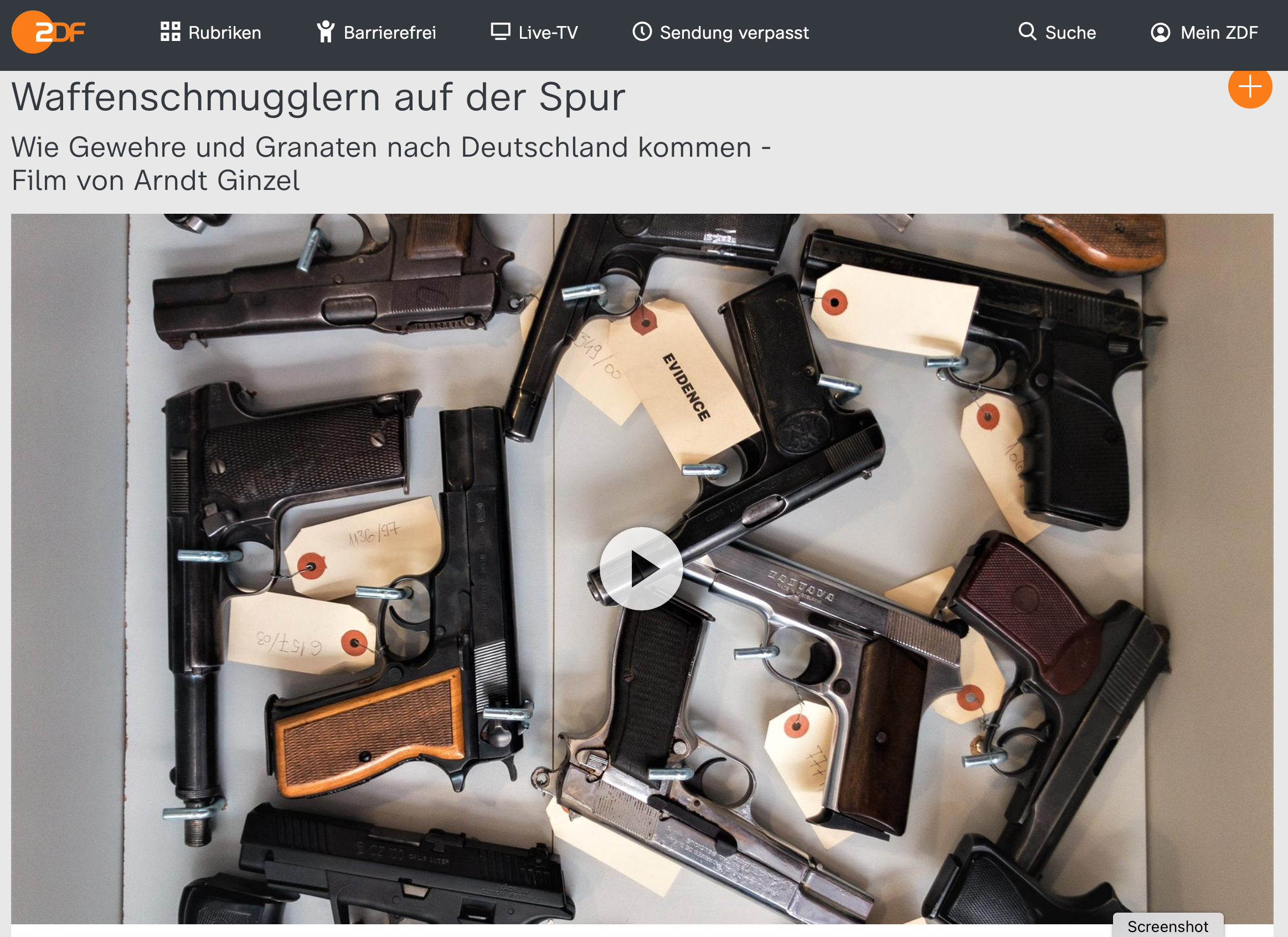
Schulfunk – Waffenschmugglern auf der Spur – Tracking weapons traffickers

Schulfunk – An almost forgotten German expression from my childhood: Starting as a radio broadcasting service 70 years ago, meant to contribute to re-educating post-war Germany, Schulfunk developed into effective knowledge transfer, supplementing school education. Contemporary follow-on programs still exist, but the ancient label “Schulfunk” may get forgotten at some point. Today, it is about public broadcasters serving on their obligation to contribute to fact-based educational programs.

In a more sarcastic sense, I labeled any True Crime movie, or fictional reporting about crime, and movies about detectives solving crime cases, “Schulfunk”. Starting my professional career as a detective police officer myself, I was never too much interested in spending my evenings watching True Crime stories, or detective fiction. I found these stories too much detached from reality. Believe it or not, I preferred, and prefer until today, Science Fiction and Fantasy movies. Everyone has a weirdo side, right?

So, starting off a little bit on the funny side this morning, the screenshot below is about a piece of investigative journalism which was broadcasted by the German news channel “ZDF” March 24, 2021. Until March 24, 2023, you can watch this piece using the following link: https://www.zdf.de/dokumentation/zdfzoom/zdfzoom-waffenschmugglern-auf-der-spur-100.html

It pretty much is about my current line of work. It is in German language, but my small complaint sits with another issue, not the language.

Part of why I sarcastically labeled crime stories “Schulfunk”, distancing myself a little bit, has to do with the drama which appears to be a necessary part of broadcasting. Whether TV, movies on the big screen, or Youtube, nothing goes without music, and nothing goes without some sensational takes with which the subject matter at hand is presented in a way causing interest on the side of people looking for something to watch.

I get it, it is part of the human nature. I used it myself, when I was designing media campaigns for my colleagues and friends in Bosnia & Herzegovina during my time as Head of the European Union Police Mission. Just on a personal note, I find the dramatic music in this piece about weapons trafficking from the Western Balkans a little bit too heavy for my personal taste.

But after getting that out the way, I just wanted to reference this piece of journalism in my blog. And I wanted to do this without too much commenting, explaining, or describing my part in the work of my government, together with colleagues from France, and the European Union, in supporting the implementation of a strategic initiative which the six jurisdictions of the Western Balkans have agreed upon themselves. (We talk about jurisdictions, instead of States, in order to include Kosovo under the United Nations Resolution 1244 within a politically sensitive context).


If you want to understand what the Roadmap for a sustainable solution to the illegal possession, misuse and trafficking of SALW and their ammunition in the Western Balkans by 2024, is about, I would invite you to begin with browsing the website of SEESAC (https://www.seesac.org). SEESAC is the South Eastern and Eastern Europe Clearinghouse for the Control of Small Arms and Light Weapons. It holds an instrumental role in supporting the implementation of this Roadmap, which was jointly developed by the Western Balkans Authorities, under the auspices of Germany and France, in coordination with the European Union, and with SEESAC’s technical assistance.

The Roadmap is the most comprehensive arms control exercise in the region, covering all key aspects from securing the stockpiles of weapons and ammunition to mainstreaming gender in SALW control and countering firearms trafficking. It represents a firm commitment to addressing the threats posed by the misuse and illicit possession of weapons in the Western Balkans and Europe at large and is a result of strong cooperation on SALW control in the region which SEESAC has fostered since 2002.


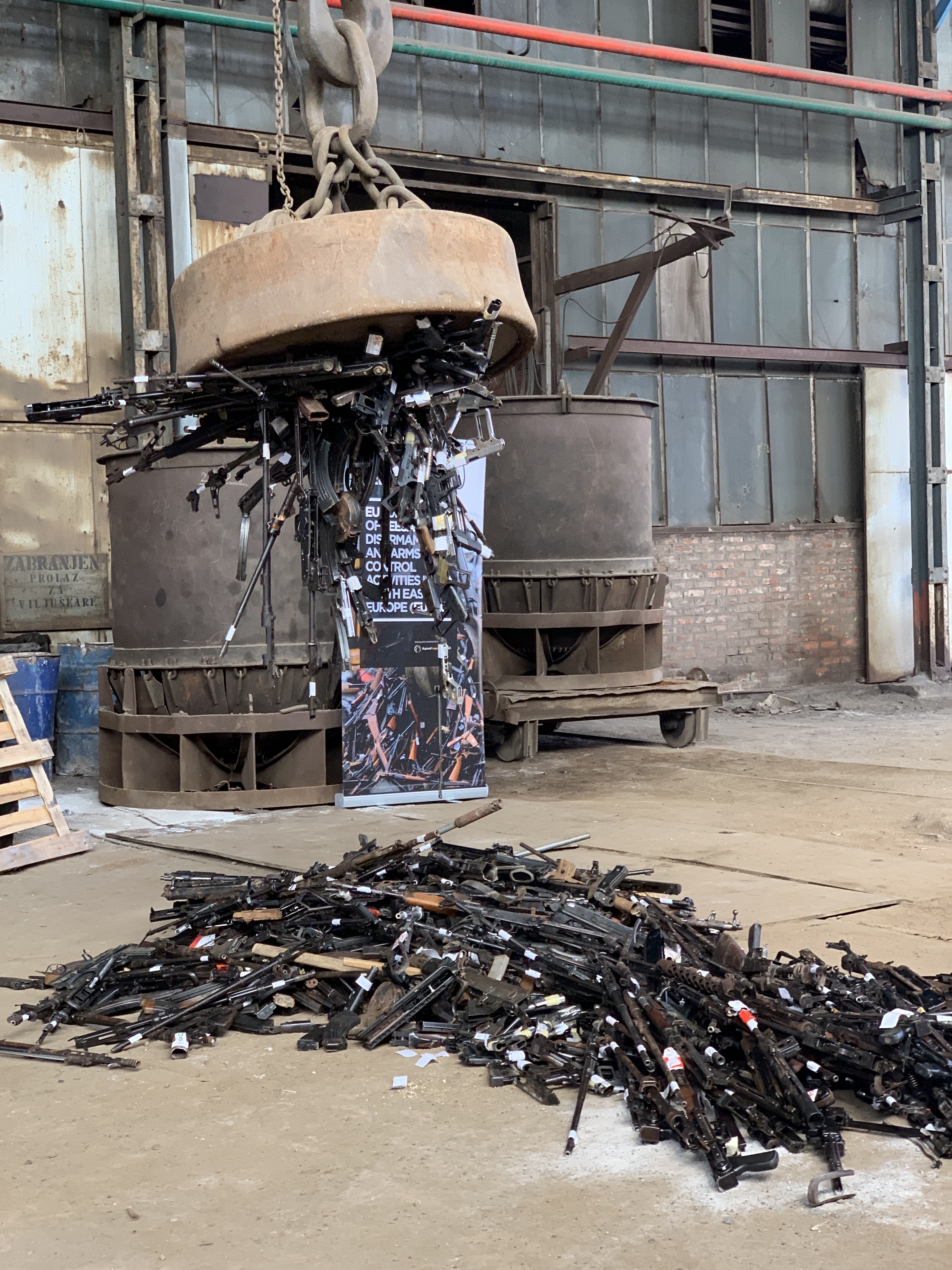
I especially like the final stretches of the reportage. After some good investigative work attempting to make connections between trafficking of weapons, ammunition and explosives through crime and organised criminal groups on the one side and some disturbing indications about some of these weapons and explosives ending up increasingly in the hands of right-wing extremists in Germany, the documentary ends with explaining the Roadmap which I referenced above. Bojana Balon, the Head of SEESAC, is being interviewed. And some impressive pictures deal with what we prefer to do with these weapons: Seizing them, and destroying them.

So, in the best tradition of the gun with the knot in its barrel which you find on the compound of United Nations Headquarters, here a few pictures. No need to reference any copyright, I took all these pictures myself.

Police Reform – Bottom Up and Top Down

If somebody were to tell me that there is a kind of a universal blueprint which must be used for successful reform of police, I would be very suspicious. My experiences, good and bad, relate to addressing corruption and crime in medium size police precincts, warrior mentality in a police station under constant mental siege in a hostile environment, establishing community-oriented policing primacy in a large and diverse, yet national police organization, harmonising a joint understanding of service-oriented and accountable policing in extremely complex and diverse international executive policing environments, and in countless ways assisting jurisdictions ermerging and recovering from conflict in coming to terms with policing allowing to contribute to societal healing, and representing the communities they serve.

Nothing would allow me to refer to experiences how to alter policing in a setup where people estimate that a country has approximately 18.000 agencies responsible for policing. That is the situation in the United States of America, and that is the scope of the challenge over there. But I continue to stress that this is not about “Us and Them”. Rather, a critical examination of reform needs requires to take a self-critical look. It simply is a gargantuan task. Here just one from countless examples.

People take the streets all over the U.S. and globally in large numbers. Polls in the U.S. show that there is majority support for a profound change.

Not undertaking reform is not an option. Compared to the needs to change global bias and selfishness which expresses itself in so many forms, like racism and religious hatred, xenophobia, discriminating minorities, leaving impoverished societies to their own devices, or is depriving women or members of the LGBTQ community from equality in all its aspects, the task of reforming policing appears minuscule, though gargantuan in itself. I don’t want to ramble, but just the other day Greta Thunberg is reminding us, again, about tackling climate change being equal to tackling the Covid-19-pandemic.

We’ve got to shoulder this, otherwise we will be helpless and complicit bystanders: Anger never is a good adviser, but people are angry for many reasons these days, and on a profound level. Some actors follow the principle “If I can make you angry, I have already won over you.” If reactionary forces prevail in “weathering the storm”, muting the discussion and controlling it again, chances are that we may see chaos, rather than evolutionary development from which we collectively benefit. “Us and Them”-thinking will lead to a lot of collateral damage and we may wake up in a world one day which none of us wanted.

To find a meaningful entry point into a contribution, I suggest to look at a recent article “What happened when a city disbanded its Police”:

Two factors came together in Minneapolis which allowed for a sweeping reform of policing:

  1. Top Down: The commitment from highest leadership levels to embark on an undertaking with many risks, including risks for reputation and own job security;
  2. Bottom Up: A deep desire on a grass-root-level for change: Communities were fed up with the way how they were policed.

In my previous articles, I have reiterated where I stand on “how to police”. I have referred to a common denominator of policing: The United Nations’ “Strategic Guidance Framework” is incorporating principles such as the principle of community-orientend policing. I see the same principles at the heart of the re-design of policing which has been the result of a reform effort in Minneapolis.

The question how to design a police organization which is following such principles can lead to an evolutionary development of an existing organization, or, like here, to disbanding an existing police and to build a new one from scratch.

Both scenarios lead to disappointment amongst those who may feel that they have fallen victim to such a reform, like police officers who have lost their jobs, or police chiefs and leaders all the way down to first-line-supervisers who have been reassigned in course of the reform. The higher their numbers, the more difficult it will be to get the dissatisfaction voiced by them being absorbed within the discourse in a larger community, or society. One of the biggest mistakes of the Coalition Provisional Authority following the 2003 invasion of Iraq was “Coalition Provisional Authority Order Number 2″: It disbanded the Iraqi military, security, and intelligence infrastructure of President Saddam Hussein. Many of those who lost their jobs ended up becoming members of insurgency groups and terrorist organizations and networks which brought chaos and death over Iraq and the wider region.

Painful decisions which will always leave some feeling being on the side of those who have lost from reform require a thorough process of thinking before springing into “less-than-thought-through-action”. Of course, Iraq is not the U.S., or Europe, and American police is lightyears away from forces which have been instrumental in a brutal dictator’s oppression of his own population, but this is universal psychology and it is a classic example of a toll which can be directly tracked to decisions which have not been based on a carefully synchronised discourse “top down” and “bottom up”. In any large scale reform, antagonization must be mitigated, without loosing sight of the dedication to achieve a fundamental change. Otherwise, reform will be watered down into mediocrity at best, or will lead to cosmetic reform with no chances for sustainability of efforts, or being entirely outrun by reactionary forces resisting change.

That is why real reformers will be measured by 

  1. Whether, including the top-levels, they mean what they say, and put action to where their mouth is;
  2. Whether they lead an inclusive discourse, from the top down, rather than following the path of antagonization and radicalisation of an “Us-and-Them”-rhethoric;
  3. Whether they listen to communities on the ground, including permanent and more than symbolic engagement by top leaders, and base their reform decisions entirely on including communities on the ground into shaping a joint vision of the future;
  4.  Whether they are ready to rely on the participation of communities on the ground in all aspects of implementing a reform effort, holding themselves accountable to those communities which shape the form of policing which these communities want, for themselves.


In following blog entries, I will touch upon two other elements which I see for successful police reform: A reform of insufficient training, and representative policing, which needs to focus on the role of persons and communities of color, on minorities, and the role of women as agents of transformational change.


On Defunding the Police – Proportionality

Legitimacy:

Whether measures taken are legal and have been proportional

Whether agreed procedures have been respected

Whether there is accountability of the service and its personnel for their actions


June 14, 2020, I am waking up to an updated report from CNN about protesters flooding the streets of Atlanta after Rayshard Brooks, an Afro-American U.S. citizen was being shot dead Friday, June 12, by a white American Police officer. A restaurant was set ablaze, a highway was blocked by protesters. Police deploying tear gas, violent altercations in the video footage.

Whilst it is way too early to judge established facts about the circumstances of the killing of Rayshard Brooks in detail, I note that the officer has been terminated, a second officer was placed on administrative duty, Atlanta’s police chief stepped down and Atlanta’s mayor called for the officer who shot Brooks to be fired.

This morning I also read about the continuation of protests against racism and police violence all over the world, and about the discussions within societies over here in Europe about it, including my country, Germany. We have serious discussions over here on changing our constitution, related to the term “race”.

And I read about the emergence of violent right-wing extremists in London, I see pictures with them attacking police officers, and the police attempting to prevent altercations between right-wing extremist protesters and protesters of the Black-Life-Matters-movement.

For good measure, a friend of mine sending me an outstanding article from the NYT on Police Reform.

That is how I woke up.

I feel tired, upset, most of all I feel deeply saddened for another person dying at the hands of police officers in what would appear to be a serious violation of any application of proportionality of the use of force. I join those who say “Enough is enough, when does this end?”. I am upset about those who maintain these are single isolated cases. I can hear those already who will point towards Rayshard Brooks’ fight against being arrested, who will hold his fleeing from the police against him. It looks like he discharged a taser, which he took away from one officer, whilst fleeing, and I can hear those who will say “See…”.

Let me summarize from what I know from preliminary looking at reported facts: Someone is falling asleep in a car. The car does not move, but it is in the way of other cars wanting to use a parking lot, they have to drive around the car. A police patrol controls the car, the person who slept in the car is subjected to a test whether he is intoxicated. He fails the test. Again, the car is not moving. An altercation between the person and police officers can be seen on video footage, the officers attempting to arrest the person, the person violently refusing. At some point in the struggle, the person takes control over a taser which is part of a police officers’ personal equipment, and manages to run away. Police officers pursue him. He appears to discharge the taser in direction of the pursuing officers. He runs away. He is getting shot and killed.

I had already begun writing on an article on proportionality which I had started with the following sentence, a few days earlier:

June 11, 2020, CNN reported about Tulsa police releasing video footage of an arrest of two black teenagers being handcuffed for – you hear right – jaywalking. Not bystander videos, footage from the body cams of the police officers engaging the teenagers.

And now another example, pointing into the same direction: Where is the proportionality of police action, and to which extent does the police themselves contribute to escalating an action which then is justified for the use of disproportionate force? And why is this, in its overwhelming majority, happening to non-white persons? 

It is mind-boggling. In all my experience, it is systemic. The biased selection of persons of color being the subject of police control, it is an extremely well documented pattern. We have a corresponding discussion here in Europe about the question whether the police is biased by preferential selection of members of specific groups when deciding to take action: Minorities, persons of color, persons of Muslim faith, migrants. 

We also need to look at how the police is conducting themselves after deciding to engage in a situation. We name it “discretion in deciding whether to act” and “discretion in choosing the means with which to act“: The former: Does the police apply the same criteria for deciding to take action on equal criteria, notwithstanding, for example, the color of the skin? The latter: Is it more likely that the police will use excessive and disproportionate force, depending on the color of the skin?

Notwithstanding racial bias, the American policing system is very different from the system which I belong to, in terms of inherent readiness to apply force in all kinds of policing situations. I would say that the American system is very different in relation to when, and how, to apply force, from any system in the European Union. From my viewpoint, the entire system is based on an understanding of coercion by force which is entirely disproportionate. This, more often than not insanely disproportionate application of force perhaps is the single most contributing factor to escalation of violence in interactions between the police and citizens, and communities. Taken together with that the overwhelming number of persons subjected to it are black citizens, is justifying to state that American policing contributes to systemic measures of control of Afro-American communities. That is racism.

American policing is based on a culture which prefers flashing signs from police patrol cars such as “Stop – It’s the Law”, allowing officers to just hide behind “the law” instead of explaining why they are interacting with a citizen. A culture of control through a “Law and Order” attitude leaves no space for communication.

Cops are no saints. No public servants are. Being put into a position of power, individuals tend to exercise that power, and more often than not their reflex is to say: “Because I can”. In my police system, decades ago, we undertook deep rooted reform efforts addressing it: Being in a position of power requires, in our understanding, a profound humility, and a desire to use these powers only as a last resort. The opposite to it is trigger-happy-policing. And we make sure management is being held accountable to hold police officers accountable. Which is very challenging: Line supervisers tend to fraternise. Police Unions do. In the U.S., they even carry that attitude in their names: Fraternal Order. Management and leadership tends to avoid discomfort by standing up against a culture of fraternisation. After all, supervisers are human beings who prefer to be liked by their subordinates. Unfortunately,  it does not always work that way.

Twenty years ago I was at the helm of an international police comprised of roughly 4.500 officers from 53 United Nations Member States. In Kosovo, setting up executive policing whilst building the foundations of a new Kosovo Police provided a field laboratory in which all different national policing models and attitudes struggled to find a common denominator. We “were the law”, but which law? We were the police, but which police? We learned everything from scratch. The United States deployed roughly 500 police officers into this UN police, with colleagues from many different nations patrolling the streets, upholding order, investigating crime, making arrests.

And every single arrest carried out by American police officers, notwithstanding the circumstances, whether a murder, or a traffic citation, led to handcuffing.

Even more: Every single action leading to temporary restriction of movement of an individual, like, for identification purposes, or further establishing facts at a police station, was called an arrest. Which led to handcuffing. In this, the American policing attitude stood out compared to practice of literally any other national police contingent in this police organisation which we formed from scratch, with no available blueprint. 

This is where my work on a common denominator on policing started. The way we did it was by beginning to talk about these differences. Talking leads to compromises on all sides. My colleagues and friends from U.S. police departments lowered their threshold of when to engage using force. My German colleagues accepted standards they were not used to in their home country. We all benefited. And we established the groundwork of  an understanding of community-oriented policing which transpired into the new Kosovo Police. In this transformation, my fellow American colleagues were instrumental.

I tend to write articles which are too long. Not this one. Or too academic, too complicated. Not this one.

Proportionality of action is, at the end of the day, depending on the values which underpin a system of policing. By all means, the discussion of how to reform policing in America must be based on American values. But I am not sure whether the excessive readiness of the use of force within the entire American system of policing can be used as a gold-standard. In my view, the opposite is true. It is not representing American values. Otherwise, there would not be so much opposition against it. 

This can get out of control if people taking to the streets are not being heard. Every defiant cop thinking this storm can be weathered is part of a very explosive mix. I congratulate the Atlanta Police Commissioner to taking immediate and decisive action, and then to resign, in order to support the case for police reform. 


On Defunding the Police – Policing as a Function

Policing refers to a function of governance responsible for the prevention, detection and investigation of crime; protection of persons and property; and the maintenance of public order and safety. Police and law enforcement officials have the obligation to respect and protect human rights, including the right to life, liberty and security of the person, as guaranteed in the Universal Declaration of Human Rights and reaffirmed in the International Covenant on Civil and Political Rights and other relevant instruments.


Main argument

In this part I am presenting the argument that it is necessary to identify the core role of policing in a jurisdiction. Funding then needs to prioritize the effective and efficient implementation of that core role, and provide the means to ensure that policing is carried out within the framework of rules which reflect on the values that underpin that implementation of policing.

I also say that it is entirely common to look at which functions a police organization could carry out in addition to their core mandate. Of course, there is funding needed for this as well. However, responsible governance needs to make sure that additional tasks for a police department do not negatively affect the core mandate of that department. Responsible governance also has to question whether police is well-suited for additional tasks that may require specific, or different training. Police training is different from customs training, from military training, from training for correctional services, or from training for social services. Do not use a hammer for screws, or a screwdriver for nails. It destroys hammer, nail, screwdriver, and screws.

It is entirely legitimate to look at whether there would be better ways to implement the additional tasks given to a police organisation, by other means, such as strengthened social services. That, again, would require to re-allocate the necessary funding. Which is a form of defunding the police.

Thirdly, law enforcement needs to be equipped for carrying out its tasks. There is a direct line between the identification of “what” I want to do “how”, and what I decide to use as a technical means of assistance. If a police department decides to procure or to accept military style equipment for carrying out its tasks, that will change the attitude of officers in how they understand the task of policing. If that is leading to problems (which is evident in the United States), then reform efforts may lead to giving up purchase and use of military style equipment. Defunding the purchase of military equipment may allow both for funding core tasks of policing better (such as giving more resources to community-oriented policing), or free funds for support the work of other parts of government, such as social services.

Taken together, all three lines of what is named “defunding” are no reason to believe law enforcement and their staff would be “punished”. Instead, the reform leads to better policing, and more of it, and it leads to better other services of governance, such as social services.


Supporting arguments

It is all too easy to throw out the baby together with the used water in the bathtub if one doesn’t take the necessary time for a careful look.

The current debate about reforming policing has gone way beyond the borders of the United States of America, and it is happening on grounds of both long simmering discontent and because of current justified anger and immense outrage. Crimes such as the murder of George Floyd have triggered it, and the confrontational and at times horribly abusive handling of the protests by the system of governance is escalating it: It proves the case that something is flawed on a fundamental level. This in turn has led to so much growth of the protest movement in size that we may see, for the first time, a real chance for substantial change.

The sheer size of the demand to reform policing in its fundamental aspects is inevitably causing tension between those who advocate reform, and those who hold conservative views. That is good for a constructive democratic discourse.

Comparing how things are done elsewhere can help, as long as those who describe what they do elsewhere, and how they do it, don’t pretend that they have better ideas and solutions. We all cook with water, hypocrisy is poison to the debate.

I see, however, that there is an element in this discussion which goes beyond the constructive exchange of arguments in a reform discussion:

There are those who dig in. Reactionist forces attempt to quell the reform movement by a combination of (1) de-legitimizing reformers’ motivations; (2) de-legitimizing reformers as persons “per se” by demonizing them; and (3) pretending to associate with the cause, in order to take out the energy for change. The longer the successful application of this strategy, chances are that reform runs out of steam. And like events in 2016 allowed reactionists to boldly roll back honest and deep-looking reform efforts, the same threat is looming over 2020.

An example for de-legitimizing reformer’s motivations: Accuse them collectively and with no supporting evidence that they want to abolish the police entirely, or to de-construct the State.

An example for de-legitimizing reformers by demonizing them: Accuse them of anti-constitutional attitude, label them “radical left”, or even “domestic terrorists”, and freely make use of de-humanizing them, talking about “low-lifes”, “loosers”, or even worse.

An example for pretending to associate with the cause: Jump on the band-wagon of talking about how serious the problem is, express sympathies, be a bit emotional if you can, make sure to spread your hollow words of empathy and sympathy widely, say that you fully agree, throw in a “however”, and talk about anything but the core argument that leads to the reform necessity. Make no efforts to turn your pretended sympathies to the cause into any action.

So: What is the core argument?

The core is related to the question what the function of policing is about. No more, no less. A reform discourse needs to look at this one first.

Second comes the discussion about how (aka by which organizational means) the function of policing is implemented. Here, things become complicated, because the way how policing is being implemented is based on historical developments that are entirely localised. America’s culture is different from France, Germany, the United Kingdom, China, Russia, India, Pakistan, Sweden, Tanzania, South-Sudan, Jordan, Egypt. Or any of the 193 countries forming the United Nations. All are different. Because of their history.

But does it mean we can only talk about one country’s policing approach, and does it mean there is no possibility to come to a common denominator which we all agree upon? Do we have to engage in a never ending “My toy is fancier than yours”-debate?

The answer is: It is very much possible to come to a unified minimum understanding, because we have done and achieved exactly that. I have witnessed that, by participating in it. It took us give or take ten years from voicing the dream, through finding support, learning how to do it, until we had written it down and agreed. The result includes what I quoted in my “Statement of Solidarity“.

And this result is not a collection of lofty sentences. As the United Nations, we needed to put a common understanding of what is policing and how it should be done front and center, for purpose of maximum transparency: This is what you get when we help you, this is what we need you to agree upon when we help you, because we have a few red lines which we all must not cross in this partnership. This is what any UN Police officer will understand as her or his function, notwithstanding from where that officer comes. This is how we expect police officers to be trained before they deploy into a United Nations Mission meant to assist in handling a conflict, or recovering from conflict.

If you look up the entire work which began with the document I quoted from, you see that we broke it down into a detailed understanding: We do have a common understanding about how to carry out community-oriented policing. We share detailed understanding about intelligence-led policing. We do know what a tactical group of the Police, such as a company sized “Formed Police Unit” should do when protecting peaceful demonstrations, and how to engage with those who disturb the peace, become violent, carry out crimes. We do know how police should establish functions that ensure accountability towards the law and towards citizens. We do know how police officers should use force as the last resort.

We have written that all down, and much more. And all along the way, the United States of America was part of a truly global support for further development of this framework, stressing the need that it has to be operationalized through training. Which is what we do, all over the world, and including heavy support by the United States of America. For which I am grateful beyond words.

Does, therefore, police have to look the same anywhere? No. But it does mean that one always should look at whether we have gotten the implementation of the core function of policing right. You can assign additional functions of any kind. The discourse about whether this makes sense, or not, usually carries many practical and political arguments with weight in the specific local context. But it should always prioritize the question whether the additional tasks impede core tasks, and whether police departments are suitable and capable to carry out that task. Like any other profession, training and organization of work in the police creates specific mindsets, highly capable of implementing policing. But it does not mean that this mindset, or training, is the right one for the additional tasks that are being expected to be handled.

The way to ensure this is called management. And any reform of something which has taken root is no less than an art.

Sometimes, less tasks for the police will create much more satisfaction with results.

On Defunding the Police – Entry Point

Not everything that can be faced can be changed, but nothing can be changed that is not faced.

JAMES BALDWIN


This will only be the first blog entry on this topic. I will go into the substance of how I look at this discussion in following articles. This one is intended to make clear how I look at the entire discussion, as a concerned individual and retired police officer, and a former United Nations Police Adviser. Thus, expect that my statements in subsequent articles will be as rational as I can be, and I reserve the emotional part motivating me for contributing to this discussion to this entry article. So, keep looking for follow-on to this writing, it will come soon. Expect the juice being inside a rational, but passionate debate contribution. I always try to stay away from partisan positions, except when it comes to underpinning values.

On values, I am very clearly partisan: I am United Nations hard-core, including all values on humanity represented by the UN, and developed within the UN-system. Which, by way of reminder, is the community of 193 Member States of the United Nations. We are the UN, as long as we contribute to the spirit of the UN, rather than disengaging from the UN. Like in the narrow context which will follow, engagement requires willingness to listen, rather than to yell. Any discussion which is lead in the spirit of finding consent requires to accept that it is legitimate for others to differ.

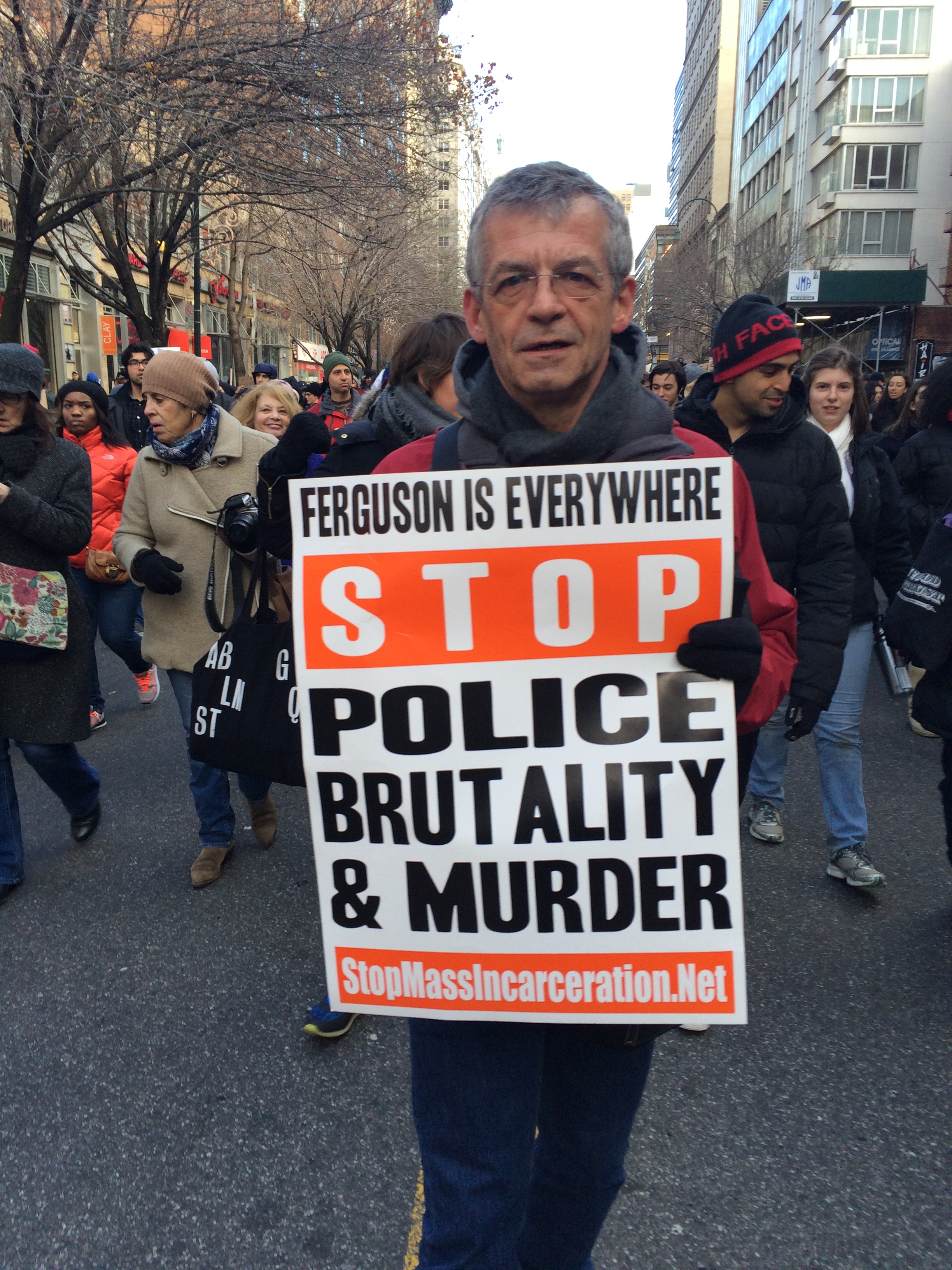
A friend of mine (who happens to be a journalist) suggested that I engage in the current discussion on policing and reforming the Police. He reminded me that, in 2014, I participated in a “Black Lives Matter” demonstration when I was living in New York (working as the UN Police Adviser). The picture is from December 13, 2014:

25B8A860-8474-470B-BE49-C1FE4896F235

August 9, 2014, Michael Brown had been shot dead by a Police officer, in Ferguson. Earlier, July 17, 2014, Eric Garner died after being put into a chokehold by a Police officer, in New York City. I am singling out two out of many events that led to renewed calls for reforming policing in the United States. Both in the U.S. and internationally, brutal instances of police abuse of power, including most serious crimes, sparked outrage leading to large and peaceful demonstrations. The “Black Lives Matter” movement stems from there. As a human being, and at that time being a temporary resident in the United States, I joined my fellow American friends in their peaceful call for addressing systemic racism reflected in the Criminal Justice system, and through abuse of power through individual police officers.

Already at that time the reform discussion on policing had much deeper roots, and there is a direct line connecting the history and those days of 2014 with what happens today, 2020. However, today the outrage is amplified, and there are signs that the calls for reforming policing, and the Police, are, finally being heard. Good.

Yes, peaceful demonstrations are proving that they are one of the most essential means and an inalienable right for citizens to participate in a democratic discourse about issues that matter.  And the subject matter of discussion is genuinely international: A friend of mine reported about participating in a demonstration in Berlin last weekend, with estimated 15.000 participants. It is one of many current events in Europe and elsewhere. Societies including my own German society have undertaken to conduct a self-critical discourse on the question as to which extent policing over here may also be unduly influenced by racial bias. Good.

Would all of that have happened without large-scale demonstrations? In my view, absolutely not. That is, by the way, why those who do resist these reforms, individually and institutionally, fear the demonstrations and thus attempt to label them with anything that would allow for discrediting intent of the demonstrations, manipulation of the course of the demonstrations and how they unfold, and the malicious labeling of individuals taking part in such demonstrations. These attempts are being conducted through manipulation, establishing and spreading unverified claims, false facts and lies, and using and spreading conspiracy-mongering strategies.

Most respected former U.S. public servants, including retired military officials are voicing their deepest concern about those who have adopted well-honed strategies practiced by systems and autocrats all over the World which have been criticised for exactly doing this by the very same United States of America. Good, because I hope the light can shine again, soon, and credible.

It looks like the peaceful demonstrations are here to stay. Good. Double down.

The range of topics in that discussion leading to these demonstrations is highly complex and beset with an enormous amount of emotions. It is about racial bias. It is about white supremacy. It is about countless cases of individual suffering and fear. It is about wrongful convictions, and a system of biased mass-incarceration, especially targeting communities of color. It is about the question how policing should be carried out, and how to hold police officers and other public officials accountable for their actions, including criminal actions. And much much more.

Within the current context of the United States, the contemporary development also can only be understood if put into the context of a society that is literally devouring itself, unraveled by a political partisan war ripping the fabric of consent into pieces about what is identifying and unifying all Americans, and what is so-called “un-American behavior”. It may well be that both sides blame the other for being un-American. The World is in disbelief. The ripples of instability stemming from this development have long arrived at the shores of Europe, Africa, Asia, and elsewhere. They bounce back from there, hitting the United States’s shores on the Atlantic and Pacific sides. Will that all calm down and settle into a new order, and will this be done with, or without violence?

Certainly, COVID-19 may have been a spark that set many things on fire. Fire? Not good in light of Global Warming. Oh yes, Global Warming is a fact. So, please, let us settle for consentual discussions allowing the young generations of this World to define our and their present, and their future.

These discussions need to be narrowed down. Topics have to be identified which can be taken forward, notwithstanding the complexity of the development as a whole. And in my view, it is extremely critical to take emotions out of these discussions, and to avoid antagonisation as much as possible. At the end of the day, a society needs to find an own consentual way forward in which positions converge into acceptable compromises. For, otherwise, there is no societal peace. And we do know that, without peace, there is no security. With no security, there is more heat. We can’t blame others for our own disengagement. But we always have the choice to engage. That’s why I am quoting James Baldwin.

This includes reforming policing, and the Police. After having settled on what policing is, the question how to implement it, follows second. Third then, one needs to consider how to fund what we want, and to re-allocate funding to where it is needed, and to stop funding of issues which run counter the implementation of what a society wants. So, in this third step, it is about de-funding, being part of a funding, and a reallocation-of-funding debate.

I should be clear: There is no way to establish a society with no self-policing of the rules that this society has given itself.

The violent death of George Floyd is a crime, one police officer is charged for second-degree murder and manslaughter. Three police officers are charged with aiding and abetting murder. George Floyd was subjected to police action after he was alleged to have used a counterfeit 20 USD bill for buying cigarettes. The police action ended in eight minutes and fourty-five seconds of suffering inflicted by some of the most cruel behavior I have seen in a while. And believe me, I have seen a lot.

It started with a counterfeit 20 USD bill. Why was Eric Garner being put into a chokehold, again? Proportionality of enforcement will be a point I will touch upon, later.

But I will say here that the reform discussion is triggered not by these few cases only, but because of the allegation that such behavior is systemic. That, also, makes it understandable why some try to argue that these actions are single cases. Which is not true. Truth matters, so look it up yourselves.

Another point in this first writing, attempting to look at the scope:

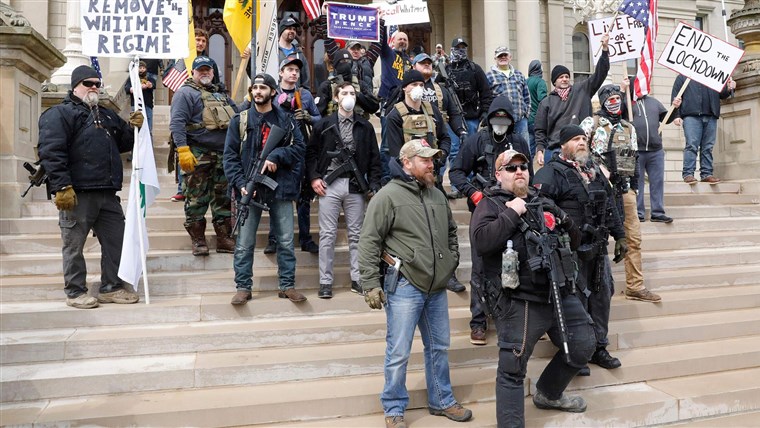
200415-michigan-protest-video-tease__415481.focal-760x428This picture was taken April 15, 2020, at Michigan Capitol

Of course I am respecting that the United States hang on to the Second Amendment. I have a personal opinion (horror and disbelief that people protest against the COVID-19 lockdown whilst carrying weapons of war), and I can also assure you that in Germany such an event would have led to as many SWAT-units as are available coming down on what would be considered a violation of strict weapons laws. But, of course, this is legal in America, thus the protest can be considered a peaceful protest.

The question I want to ask: Do you see one Afro-American person in that picture? Take a second and imagine all the individuals being black. And then, honestly, answer the question whether the indifferent action of the Police on occasion of that event would have been the same. Honestly, please!

Chances are the reaction would have been very different. That’s what I was saying in my post “Statement in Solidarity“: “Representative policing aims to ensure that the human rights of all people, without distinction of any kind such as race, colour, sex, language, religion, political or other opinion, national or social origin, property, birth or other status, are protected, promoted and respected and that police personnel sufficiently reflect the community they serve.” At this moment, an overwhelming majority of U.S. citizens believes that this is not the case. Instead, we are facing a cultural form of racism, different in argument from previous forms of biological racism, but on grounds of the same attitude and thinking of white supremacy.

Statement in Solidarity

Floyd

With the “Report of the Secretary General on United Nations policing” to the United Nations Security Council as of 10 November 2016 (S2016/952), the United Nations adopted, for the first time ever, a common understanding of the function of policing, and how it must be carried out by police and law enforcement officials. This understanding can be found in https://police.un.org/en/policy-united-nations-police-peacekeeping-operations-and-special-political-missions-2014, Sections 14 to 19.

Policing refers to a function of governance responsible for the prevention, detection and investigation of crime; protection of persons and property; and the maintenance of public order and safety. Police and law enforcement officials have the obligation to respect and protect human rights, including the right to life, liberty and security of the person, as guaranteed in the Universal Declaration of Human Rights and reaffirmed in the International Covenant on Civil and Political Rights and other relevant instruments.

Pursuant to the UN Code of Conduct for Law Enforcement Officials, police and other law enforcement officials are required, at all times, to fulfil the duty imposed upon them by law, by serving the community and by protecting all persons against illegal acts consistent with the high degree of responsibility required by their profession.

For the United Nations, the function of domestic policing must be entrusted to civil servants who are members of police or other law enforcement agencies of a national, regional or local government, within a legal framework that is based on the rule of law.

In accordance with United Nations standards, every police or other law enforcement agency should be representative of and responsive and accountable to the community it serves.

Representative policing aims to ensure that the human rights of all people, without distinction of any kind such as race, colour, sex, language, religion, political or other opinion, national or social origin, property, birth or other status, are protected, promoted and respected and that police personnel sufficiently reflect the community they serve. Fair and non-discriminatory recruitment and retention policies are expected to encourage, among other goals, an adequate participation of women and minority groups.

Responsive policing ensures that police respond to existing and emerging public needs and expectations, especially in preventing and detecting crime and maintaining public order and safety. Policing objectives are informed by the public safety concerns of the communities they serve and are attained lawfully, efficiently and effectively and in accordance with international norms and standards in crime prevention, criminal justice and human rights law.

Accountable policing means that police are accountable to the law, as are all individuals and institutions in States; that police are answerable to the public through the democratic and political institutions of the state, as well as through civilian democratic oversight bodies and mechanisms to improve community-police relations; that police are accountable for the way they use the resources allocated to them and that effective mechanisms are established for accountability over police conduct, including any allegations or established human rights violations committed by the police.

For the United Nations, the rule of law refers to a principle of governance in which all persons, institutions and entities, public and private, including the State itself, are accountable to laws that are publicly promulgated, equally enforced and independently adjudicated, and which are consistent with international human rights norms and standards. It requires, as well, measures to ensure adherence to the principles of supremacy of law, equality before the law, accountability to the law, fairness in the application of the law, separation of powers, participation in decision-making, legal certainty, avoidance of arbitrariness and procedural and legal transparency.


As one of the chief architects of this United Nations policy, I stand in solidarity with the countless citizens, in the United States of America and all over the World, who exercise their right to demonstrate peacefully. I join them in expressing utter outrage in the face of widespread racism, white supremacy, and a systemic and horrifying abuse of power including most serious and heinous crimes by police officials against communities and individuals of color, and minorities.

I call on my fellow police colleagues to stand in humility and in support of the communities they serve, to walk with them, and to protect them. The streets belong to citizens peacefully exercising their rights and enjoying their freedom. They are neither a battle-ground to be dominated, nor a place for curfews preventing peaceful citizens to exercise their most basic human and citizen’s rights, including the freedom of opinion and speech. Curfews can only be possible under most serious and temporary circumstances.

No public official shall use his or her power for violently pushing peaceful citizens aside.

I call on my fellow police leaders to exercise a strict no-tolerance-policy towards acts of violence and the systemic disrespect of police officials towards the communities they are obliged to serve. No zero-tolerance-policy against violence and criminal conduct is legitimate in a democratic society if those who are mandated to serve and to protect peaceful citizens show no respect to the law, to the values underpinning the laws, and to fellow citizens, themselves.

I commend those police officers who apologize to victims of police violence and abuse of power, but I also say: You must work long and hard to earn back the respect of those citizens who have lost faith in you. You are meant to protect, rather than to be an instrument of “law & order”.

My heart goes with all victims of police abuse of power and horrible crimes including murder, conducted by individual police officers, supported by a cruel and self-serving, selfish and dividing attitude by those who believe they can exercise unrestrained power, rather than fulfilling an obligation to serve all citizens who have democratically elected them.

I am saddened, ashamed, and deeply sorry. I hope we can all breathe together.


Stefan Feller, Former United Nations Police Adviser and Director of the Police Division (2013 – 2017).

Berlin and Belgrade, June 06, 2020

Workshop “Implementing the Protection of Civilians Concept in UN Peace Operations”

December 12, 2019, I was invited as a panelist in a workshop with the above title, convening a number of experienced individuals providing a political, humanitarian, military, and policing perspective to one of the most demanding topics within the context of peace operations of the United Nations. The following is my contribution to this workshop, as a panelist.


The moderator of the panel in which I participated, provided the following framework

For our discussion, it would therefore be wonderful if you could speak for 10-12min, addressing from your own experience some of the points above, identifying concrete challenges and practical ways to overcome them – with the aim of providing advice for a potential stronger role of Germany in implementing POC . I would in particular encourage you to provide as many concrete examples as possible to illustrate the points to the audience.


I can not help but begin with asking four crucial questions, when we talk about “Protection of Civilians”. If we would jump immediately into military and policing aspects, I believe that we are repeating a mistake which I have witnessed being made all too often:


  • Protection by whom?
  • Protection for which reasons?
  • Protection against what?
  • Protection with which means?


Let me explain:


Protection by whom?


We usually say that the protection of the civilian population is a core responsibility of the State in question. And then I usually say: When a peacekeeping mission is mandated to protect civilians, this is a substitution for this responsibility, because the State in question can’t, doesn’t want to, or should not, exercise this responsibility, or any combination of these three reasons. I can give many examples, if it is useful, later on.

But we usually conclude from the fact that we substitute for a State responsibility that the State in question has been exercising this responsibility before, by means of a State apparatus including police, and military. Which is often not true. Quite often, the reach of the State and its organs is limited to urban areas, or the Capital. Like in Afghanistan, Yemen, to some extent Somalia, or in the northern parts of Mali, and for various reasons. Or there is, for example, Abyei, the “Box” between Sudan and South Sudan, where there is no State authority because the area is subject to unsolved political disputes.

The reality, however, is that very often, when there is no conflict, and no State authority, it does not mean that nobody exercises POC. We often disregard, or sometimes have difficulties to accept within the culture of our thinking, the relevance of tribal structures, or co-existing parallel frameworks affecting only parts of the population: Like two different frameworks in Nigeria, one for the Muslim part of the country, one for the non-Muslim part.

Why is this important? Because I often see the reflex in mandates that we talk about the extension of State authority, and meanwhile the peacekeepers exercise POC. Like in Mali. Well, in Kidal the extension of State authority from Bamako is not creating much enthusiasm, same in Somalia or in many other places.

So, when we start to protect within a flawed, but well-meant, political context, we run into problems: SRSGs, Force Commanders, and Police Commissioners. We can discuss that.


Protection for which reasons?


They are being slaughtered. They hide amongst piles of dead neighbors in Srebrenica, pretending to be dead. They are being raped and killed in the open, outside of the Gates of UN camps in South Sudan. They have no justice, nor order, in Abyei. They are target of extremists and terrorists in Kidal, Mopti, Gao, Timbuktu. They are being recruited as slaves or servants or child soldiers, in the DRC, or in Burkina Faso or Niger, as they were in Sierra Leone, or Liberia. They are subject to retaliation by the Kosovo Liberation Army after the Serb VJ and the MUP had to leave, as a consequence of the Military Technical Agreement in Kosovo. And on and on and on.

I said it: We substitute for the absence of protection. We do know from longstanding experience that successful substitution works better at the beginning, where we do not have more than, at best, initial operational capacity, and an enthusiastic population, as well as a somewhat muted group of former powerholders. Then we struggle with generating the necessary means, and meanwhile things get difficult for us for a million reasons. Sooner or later they don’t like us that much, any more. And then we see that there is no sustainable alternative to domestic protection of civilians. At times, or often, we realize that too late.

Substitution needs the implementation of capacity building from the very first day on, as an exit strategy. And here we run into a plethora of challenges. Let me pick two: We don’t like to talk to former militia and else, they may be subject to war crime investigations. But to whom do I talk? Or I heard, in Mali and in CAR: We can not do capacity building, because they have to run through their elections first. So, we delay capacity building. Or, in Mali, I saw that we got the responsibility to capacitate four different law enforcement branches. Unfortunately, the former group of Tuareg controlled by terrorists had taken away the police cars, radios, ripped the electricity cables from the police stations, and they used the cars for attacking the population during power cuts in the dark. And when I asked the international community to help not only with training, but with equipment, the response was very muted, to put it mildly. Or in Bangui: I saw the DG of the Police in his headquarters. A few pieces of paper from destroyed criminal archives were still floating around, a rusty skeleton of a police car stood on the compound, windows were broken, and the one AK 47 I saw I would not even have test-fired without standing behind a solid wall.


Protection against what?


Every police and military planner will ask this question first: What is the threat? Contemporary conflict environments are facing a dimension of threats which is very different from parties to a conflict having agreed to a peace agreement and still some flares of violence continue. Our environments include asymmetric threats, sometimes we talk about “non State actors”, but I talk about a complex web of interests between local and State powerholders, extremists, terrorists, organized crime, former warlords, rebellious military and police commanders, and and and. Any physical protection by police and military is being set into a political context where SRSGs need to talk and negotiate and exercise coercion and nurture agreements, but where stakeholders within the economy of crime and conflict tend not to talk openly to those SRSGs. Rather, they at best disregard the political, military and police means given to the peacekeepers. If these peacekeepers run across their interests, they are being targeted, and/or the population is, because if one wants to control a population, one needs to disrupt communication between those who protect them, and themselves. Then, offer some social services yourselves, and the Stockholm Syndrome will help deepening the divisions.

Protection requires communication between the protectors and the protected at the core. I will spare examples for the discussion.

Secondly, the threat is hybrid: On the extreme side, it is a military threat. On the other side of the spectrum, it may be a criminal threat, and a threat to order because of the absence of elements of order. But in the huge middle part of the spectrum of threats, these threats are hybrid. This does not allow for applying distinctly separate military and policing means. When the Bridge Watchers in Mitrovica-North had taken advantage of some foolish international police officers who thought they could flex their muscles, any international presence broke down. I flooded the place with short-sleeved police officers, under heavy area protection by KFOR and heavily armed Formed Police Units. Their task was to go where the Bridge Watchers were, and to talk to the population, and to shopkeepers. Explicitly, they had to disengage if subject to provocation. And they had to come back the next day, and the next day, and the next day. I can explain how we turned the situation around. Later.

So what I say is that military and police peacekeepers are within an extremely robust environment where they both need to exercise policing logic and means. This does not only require sufficient police, but also sufficient soldiers who are trained in policing logic, and it requires a joint structure of command. In my view, my friend Maqsood Ahmad, MilAd, and I, PolAd, were not successful in trying this in Bangui. Because neither Military Commanders nor Police Commanders were willing to trust each other under one chain of command. Neither when we gave it to the Police Commissioner, nor later on, after heavy violence, to the Force Commander.


Which leads to the last topic:

Protection with which means?


I will be brief, because this needs to be discussed:

  1. POC begins with a sound political understanding.
  2. Political leaders of peacekeeping operations need to make both Force Commanders and Police Commissioners a core element of their daily consultations. They need to hold these Commanders accountable for jointness, and they have to demonstrate leadership in checking on to which extent military and police leaders in peacekeeping operations work together, rather than only saying they do. SRSG have to reach out to both, and not to talk about “The Force”, meaning their military means, and the Police Commissioner as an annex. Likewise, a Police Commissioner who does not entrust policing tasks to military colleagues, and instead saying he needs more attention, and police officers, just hides behind this seemingly correct argument, instead of embracing the reality: He or she won’t get more officers, and even if there were enough, still there is a massive need of jointness of thinking and planning and implementing concepts to protect civilians. And if police and military leaders tell you that the respective counterpart doesn’t work with you, and you hear it from both leaders, fire them both.
  3. We can complain about the absence of enough police capacity for policing problems, it will not change. I have deliberately not commented on the POC strategy, and what I did between 2013 and 2017 to come up with a POC doctrine for UNPOL. The message that I want to get through at the end is that colleagues in green and blue fatigues with blue helmets are facing a challenge which they can only solve in unison. This needs to be reflected in training. I have repeatedly said: I don’t care about the color of the uniform. I care about the function to be implemented. In vast parts, this is about policing in a rough and dangerous environment. So, I suggest we overcome the hesitation that comes into play when military colleagues begin to think and to train like police. It is the single-most important challenge on the side of uniformed peacekeepers to overcome the divide between green and blue, and to be both green and blue in hearts and minds.