The featured image: AI interpreting and visualising the content of my blog entry.
Having read three chapters of Anne Applebaum’s latest book, “Autocracy Inc.,” I found myself compelled to restart my reading. It appears that I had inadvertently lost the narrative thread she is skillfully weaving, which explores the intricate dynamics of collaboration between autocratic structures and the silent, covert, or misguided collaborations that exist within societies that self-identify as part of the West or those that embrace concepts such as democracy, the rule of law, and fundamental human rights.
There’s this cliché about the bully at school: The guy who picks on weaker children in his or her class. He dominates the weaker guy in a menacing way, towering over him, threatening him, or even beating him up. He takes away whatever the bully wants or simply destroys things the weak guy holds dear. We’ve seen this all, whether in the comic Calvin & Hobbes, where Calvin is abused by the bully Moe, or in any Hollywood movie, where the underdog either gets beaten up or suddenly rises to beat up the bully.
Pretty binary stuff, isn’t it? The victim either loses the fight or rises to the challenge for various reasons, including whilst discovering his superpowers, as depicted in numerous movies, such as those in the Marvel Cinematic Universe and the DC Universe. Alternatively, the person with superpowers rescues someone from a bully. I personally enjoy the movie “Venom,” particularly the scene where the bully is a man extorting the owner of a corner store, Mrs. Chen. In this scene, Eddie Brock/Venom emerges to the rescue, unleashing a complex mix of emotions on the side of moviegoers, including fun, anger, joy in exacting revenge and retaliation, intertwined with disgust at the sight of Venom biting heads off. There are countless variations of this theme in pop culture, and these movies are exceptionally adept at evoking profound emotions that resonate with us all, often without our ability to fully comprehend the appeal of such content. However, it’s important to note that these movies primarily tap into purest emotions that we all identify with.
On one hand, as moviegoers, we despise the bully. We identify with the victim, we experience anger when the bully gets away with their actions and satisfaction when they are punished or meet their demise. On the other hand, there’s a crowd that often remains in the background: The bully’s followers. These are the individuals who surround the bully. In some movies, you’ll see a cute girl asking the bully why they’re doing that. In other movies, this person will be almost as mean as the bully themselves. Or this person will stay in the bully’s orbit, feeling a bit of pity for the victim. Sometimes there is a girl who pities the victim and later becomes the victim’s girlfriend after the underdog has finally stood up against or taken revenge on the bully. Again, there are many different variations of this same meme.
My primary question is how and why a bully can get away with their actions. Imagine a bully who constantly abuses others but has no followers. Is this even possible? A stone-cold sociopath who bullies while everyone around them walks away, clearly expressing their aversion for the bully, taking the victim’s side, or simply ignoring the bully when they’re abusing someone, no longer fits the typical image of a bully. It’s more like something out of Hannibal Lecter’s world.
A bully always has a base of followers under their control. They need followers, and they design their actions to keep those followers in their orbit and to increase their number.
The concept of a bully necessitates at least three elements: the bully, the victim (which may even be wrongly labeled as the person attacking the bully), and the bully’s circle of followers. However, there are more: the sea of people who are indifferent, and those who dislike the bully. For the bully, this combined group encompasses both potential future followers and individuals to be labeled as potential enemies. Anyone who doesn’t fall into either category is utterly uninteresting to the bully.
The followers serve as a primary motivation for the bully, who seeks to exert control over them and expand their number, aligning it with their desired objectives. In a school setting, the goal is to accumulate as many followers as possible within a specific class, as it represents the domain within which the bully exerts their influence. Conversely, in a national context, the group encompasses the entire population.
The followers are the ones who empower the bully, but this group is more complex. The bully gains influence over their followers, and typically, the bully is driven by controlling their circle of followers and expanding their support base. In essence, the existence of the bully is contingent upon the presence of those who willingly follow them. In turn, the motivations and actions of these people also have a substantial influence on the bully. In many ways, the bully is the protagonist who is most visible. Which puts the followers second, with some sticking out into the limelight, but most of them staying second or third row. Yet, it is this group which has taken the decision to side with the bully. The interaction between a bully and a group of followers is more complex than that between a pied piper and the children he is marching into doom. People in a bully’s orbit have their own agendas, dreams, motivations, delusions, and rationalizations.
From some point on, the bully and that individuals’ followership develop a corporate identity. History shows that from this point on, individual accountability for consequences of actions becomes very difficult to establish.
As a German national born 14 years after the end of WW II, I witnessed firsthand how painful it was for a society to grapple with the question of moral responsibility of the uncounted individuals who were part of the system producing the Holocaust. As a child, a teenager, and as adult I witnessed the disbelief of people from other societies how a system could be overwhelmed, like when the Republic of Weimar was finished off by the NSDAP, Hitlers’ political party. Those who had not witnessed how this works, they had profound difficulties grappling with some appreciation. It is easier to label persons as malevolent and evil than to acccept that every normal person is vulnerable to becoming complicit.
As a police officer engaging in international work of the UN and the EU in the aftermath of conflict giving birth to war crimes, crimes against humanity and genocide, I always was confronted with the mantra of “Never Again”. I also witnessed firsthand the same process in other societies as I had seen it in post-war Germany: Processes of denial of collective responsibility, they run, just for example, deep related to the Srebrenica genocide. Which is but one example of so many.
Sunday, 27.10., Nr. 45 held one of his last big rally events in the final days of this U.S. election cycle, at New York’s Madison Square Garden. Before His Majesty’s speech, a long procession of members of the Trump Bully Club walked up to the microphones, spitting out every possible hate and disgust imaginable: Against Haitian immigrants in Springfield, Ohio. Symbolic references against Black Americans. Derogatory elements against Palestinians, and anti-semitic jokes. Rude attacks against Vice President Kamala Harris. Transphobia against the LGBTQI community. Vitriol against immigrants at large. See a summary in The Guardian: https://www.theguardian.com/us-news/2024/oct/31/six-racist-bigoted-comments-trump-madison-square-garden
Of course, followed by the Bully in Chief himself. Who, in an interview with Tucker Carlson attacked Liz Cheney, daughter of former Vice President Dick Cheney, with suggesting she should be put in front of a military firing squad: “She’s a radical war hawk. Let’s put her with a rifle standing there with nine barrels shooting at her, OK?” He talks about Liz Cheney who is standing up, like a growing number of senior republican figures including from Trump’s own administration, against a second term of Trump as a U.S. President. To which Nr. 45 responds by talking about the “Enemy from Within”, making it abundantly clear what he will do when he would have a chance: Exacting revenge, and retaliation, by bending the rule of law into a rule of Donald Trump.
All that against a background of people NOT leaving the arena in disgust. People laughing, applauding, clapping.
Wednesday, 06.11., we wake up with the knowledge who is going to be Nr. 47. My children expressing profound shock and disbelief, and despair. Walking into the neighborhood cafe here in suburbian Toronto, there is only one topic. My phone flooded with European messages of disbelief. A joint feeling of emotional hangover.
At the time of this writing, the still ongoing ballot count includes 71.544.343 votes for Nr 45, and bringing him over the threshold of 270 electoral votes he needs for becoming Nr 47. Currently, he has won won 276.
Democracy at its best. Putting on record that the American people, in their majority, have voted for a future President who has taken down all norms of civilised behavior. Europeans rattled, worried, scared, or jubilating (depending on the same question like in the U.S., on which side of this polarized battle of civilisation they have chosen to stand). Make no mistake: We have our own devils in Europe.
To be continued. Everything changes, and this one will, too.
On the featured picture: I asked the AI assistant to create a symbol expressing care and being scared at the same time.
It’s been a while, again. My last blog post “On Aging“ dates back to July 21, 2024. If you read it, you will see a reference “Joe, I pray for you, you will make the right decision“. I meant that the incumbent President of the United States of America would hopefully make the right decision on whether to run for office again, or not. It was literally a few hours later that President Joe Biden announced to step out of the race. Which is pure coincidence. Mr. President, I will never ever forget your commanding voice in the Assembly of Bosnia&Hercegovina, when you reminded leaders, elected officials, politicians in Bosnia&Hercegovina of their duties to their constituencies, to their peoples: That their common welfare should come first. Not that I would feel it changed things in my beloved Bosnia&Hercegovina. But if I can’t forget Joe’s thunder, others may have felt that impact as well, and perhaps the memory will add to change, hopefully to the better, hopefully in not a too distant future.
What happened since President Biden’s decision to pass the baton to a younger generation, it was nothing short of a miracle. Vice President Harris’ nomination as the Democrat’s presidential candidate, the immediate launch of a ground-breaking political campaign, the positive energy and momentum, the rekindled hope and positivism, the difference between dark and hateful gloomy and self-centered fear-mongering and a bright and energetic appearance filled with passion, smiling, and profound substance, it could not have been starker. Moderate Republicans joining the Harris/Walz-Campaign, former civilian officials and retired highest military generals who served under Nr. 45 speaking out on Nr. 45 being fascist to the core, and him being perhaps the biggest contemporary threat, all of this is unprecedented. Despite the fact that numerous polling documented a huge shift in public sympathies towards Kamala Harris, it would appear the jury is still out on what is happening in less than two weeks, after one of the fiercest campaigning battles I have witnessed ever.
And sure, one of the ugliest campaigns ever, on the side of Nr. 45, including awkwardly dancing around for 39 minutes to some music playlist instead of campaigning by substance. A billionaire (Elon Musk, reportedly the richest man on the planet) jumping around on a podium behind Nr. 45, and doling out 1-Million-Dollar-Checks to voters in swing States. A running-mate for the office of the Vice President repeating insulting lies that Haitian migrants eat the cats in their neighborhoods. There is someone attempting to grab the highest office in the United States who acts following the principle “My welfare comes first and nothing else matters“.
Watching U.S. media closely, I am puzzled about how little is being reflected in German public broadcasting. At the time of this writing (October 23), I watched the news from the German “Tagesthemen” on the U.S. electoral battle. A battle it is. The report this morning left me frustrated. Reporting from rural Southern countryside with honest U.S. citizens emphasizing that all they expect is economics lowering their costs of living, some pictures of Nr. 45 handing out french fries at a local McDonalds, and a little bit of footage about Kamala’s intense campaigning. It all feels so awkward because of the paucity of reflection of what I see reflected in U.S. news.
Like, I’d like to see more on the brazen attempt of an “autocrat hopeful” to exact revenge on political opponents, to talk about the “enemy from within”, to attempt silencing media perceived as being hostile by threatening to revoke their licenses if he gets re-elected, to come up with every lunatic conspiracy theory under the sun, to lie, to incite hatred, to endanger legal migrants, to glorify the events of an insurrection on January 06, 2021 as the most peaceful patriotic event ever, not even to talk about his misogynist and xenophobic side, and his affinity for crude sexual remarks for opponents. Watching the bipartisan efforts attempting to make clear how monstrous the consequences of a re-election would be, it is heartening. To see Liz Cheney joining Kamala Harris in a conversation in Pennsylvania, wow. The reflection of all this in German news tastes pale, often dry. But may be that’s just me. Usually it’s just me. If so, I’m sorry. No, I’m not. I am scared.
I am reminded these days of David Faber’s book “Munich, 1938 – Appeasement and World War II“. I read it many years ago. It is still on my mind. For me, a member of generations growing up post World War II, there is no time for complacency when fascism raises its ugly face. It is not easy to define fascism, as I learned when I wrapped my mind around Umberto Eco’s fascinating set of three essays “How to Spot a Fascist“, also many years ago. But I can smell one when I see one. So I take Gen. Mark Milley, former U.S. Joint Chiefs of Staff serious, when he calls Nr. 45 a “fascist to the core“.
Anne Applebaum published her newest book “Autocracy, Inc. – The Dicators Who Want to Run the World“, and I am reading it right now. To quote Amazon’s book description: “All of us have in our minds a cartoon image of what an autocratic state looks like, with a bad man at the top. But in the 21st century, that cartoon bears little resemblance to reality. Nowadays, autocracies are run not by one bad guy, but by sophisticated networks composed of kleptocratic financial structures, security services and professional propagandists. The members of these networks are connected not only within a given country, but among many countries. The corrupt, state-controlled companies in one dictatorship do business with corrupt, state-controlled companies in another.” By the way, Anne has made it on the list of people degraded by Nr. 45. Which I take as a badge of honor.
I am reading the first chapters. And it strikes me how correct she is with the complicity between such self-serving networks, the cold calculating world of financial institutions, and the “double-speak” of the West, often saying one thing, and sometimes silently doing another thing. Or arguing one thing here, and the opposite thing elsewhere. When I listen to friends from the Middle East or Africa, I can so much understand their frustration, and often disbelief in truthfulness when we talk about values. Are we meaning what we are saying? Or are we measured by the consequences of hidden agendas? But inasmuch as I can fully understand the grievances by those who are really suffering from attempts of all sorts of networks preying on them, autocracies, kleptocracies, former colonial powers, own dictators and rulers, and so much more, I remain very concerned when I hear this complaint about “double speak” in conversations here in Germany, from people who slowly but visibly navigate towards the right, or the far right. Because what lies beyond, the extreme right, the fascist right, the angry sick phantasies of restoring the glory of a nationalistic approach, it never happens without a broader support within a larger constituency.
All this appears to be connected, globally.
It’s been three weeks since I listened, again, to Jay W., a fellow recovering friend in 12-Step-Recovery. I always enjoy seeing him in a Zoom window, surrounded by sometimes hundreds of other little pictures of my friends who connect from literally all over the world. Jay’s story began including when, at the age of roughly half a year old, his “mom went out of the door”, never returning. His father remarried and gave Jay away to another family when Jay was three years old. In Jay’s own words, this family locked him in a pitch-black closet, where he lived for the next three years. He slept, toileted, ate, existed in that closet. He was pulled out once a day to be washed, ritualistically tortured, and/or raped by three adults. When he was in the closet, all he wanted was the freedom of getting out of the dark, and when he was out of the closet, all he wanted was the safety and solitude of being back in the closet.
Jay’s story is the story of Jay and Nancy, his late wife, the love of his life. It is the story of “Jancy”, in Jay’s words. It is a story which you can read in his book “Relationship Resilience: Applying the 12 Traditions to Relationships“. Amazon’s review curtails the message of this book a bit: “This small work contains twelve powerful tools to guide couples to transform deep loving feelings into consistent loving behavior. The tools are loosely based on AA’s Twelve Traditions, and they work – quickly and transformatively – whether you are or are not in any 12-Step Program. These tools will change your relationship – whether you’re on the verge of breaking up, in a good partnership but wanting it to be better, or in a great relationship but always open to new tools to cultivate loving closeness.“
Because, in this book, Jay does not only talk about personal relationships, like, family relationships, or intimate relationships. He is talking about any relationship. Whether professional, or private. Whether a spouse, or an employer/employee-relationship. Whether you love this person, or respect this person, or you suffer from this person, or hate this person, or are being subjected to hate.
Inasmuch as 12-Step-Recovery, based on the principles identified first by Alcoholic Anonymous, is based on those 12 Steps, there are the 12 Traditions as well. Many will say that the 12 Traditions guide the way how 12-Step-Groups are being organized, in the most fundamental democratic way you can ever imagine. But Jay is not the only one who is able to describe the power of the 12 Traditions in every aspect of life. Yet, his book contains the most recent demonstration. Like, TRADITION ONE – OUR COMMON WELFARE SHOULD COME FIRST.
I’ll leave it there. Read.The.Book. Love you, bro.
On the picture: Taken by the author in a refugee camp in Darfur, June 2005
Ambassador Linda Thomas-Greenfield is the United States Ambassador to the United Nations. Today, March 18, 2024, the New York Times published a Guest Essay by her, titled “The Unforgivable Silence on Sudan“.
I render the platform of my small blog for sharing her powerful message.
She starts her essay with her impressions on occasion of her visit to a makeshift hospital in Adré, Chad. Chad is neighboring the Sudan. There she met young Sudanese refugees who were being treated for acute malnutrition. When she was in that hospital, all she heard was “an eerie silence”. The silence of human beings who are even too weak to utter sounds, who are too weak to cry.
In some recent blog entries on the situation of civilians in Ukraine’s war zone and of civilians suffering on both sides after the terror attack of Hamas’ against Israel and Israel’s military response fighting the terror organization Hamas in the Gaza Strip, I wondered how many news about terrible suffering of human beings can be taken in even by the most compassionate human beings. Reflecting on my perception of global news, I wondered about the underwhelming reporting on the re-occurrence of one of the most severe human tragedies of the past two decades, in Sudan’s Darfur Region.
Having been there on many occasions between 2005 and 2016, I remembered the public outrage and the humanitarian calls, including by celebrities who, from early on, helped broadcasting a message of compassion which supported a massive humanitarian intervention, and one of the largest peacekeeping operations of contemporary times to follow. Certainly, the human tragedy in Darfur left an imprint on public conscience in the West at that time. And of course, as is always the case, the public attention moved on, whilst the humanitarian and peacekeeping efforts were in for the long haul. AMIS, the African Union Mission, and UNAMID, the succeeding hybrid mission jointly led by African Union and United Nations, formed an intense part of my work both in the European Union and in the United Nations over almost fifteen years.
When the United Nations Security Council, pressed by some of it’s members, decided to wind down the peacekeeping efforts at the end of 2020, those news were not making big headlines. Outside of the community of humanitarians and practitioners in the field of international peace and security, not many people noted it.
Enter the situation just three years after, and with a brutal civil war re-ocurring in Sudan. To quote Ambassador Thomas-Greenfield reporting about her experience with the sound of silence:
“Twenty years earlier I had visited the same town and met with Sudanese refugees who fled violence in Darfur, where the janjaweed militia, with backing from Omar al-Bashir’s brutal authoritarian regime, carried out a genocidal campaign of mass killing, rape and pillage.
Today, civil war has once again turned Sudan into a living hell. But even after aid groups designated the country’s humanitarian crisis to be among the world’s worst, little attention or help has gone to the Sudanese people.”
On previous occasions I reflected on an impression that an increasing number of people appears to feel overwhelmed by the battlerhythm of horrific news. For about the last two hours, I tried to walk in the shoes of friends in Africa, or the Middle East, who very understandably perceive policymaking in the West as biased. Because, quite frankly, it is. Not only “others” are biased. We all are. But in this antagonistic struggle between systems there are real loosers. People in areas like Sudan’s Darfur Region are at the receiving end.
People like in Darfur certainly feel forgotten in their suffering. When some of them, together with others from poverty-stricken and terror-riddled areas of Africa manage to end up in human trafficking networks at the Mediterranean shores of North Africa, when they perish on their perilous journey to European shores, the reports about their fate have become a regular part in the battle-rhythm of incessant bad news to which many of us, perhaps, listen less and less. When people manage to reach European shores, whether they escape from famine, or have reasons of economic migration, they may arrive as unwelcome strangers, to put it mildly.
A former President of the United States is using an increasingly bellicose rethoric of de-humanization and labeling any migrant at the Southern U.S. border either as criminal, or being let loose from mental health institutions, or being a terrorist. Which, is, looking at some language and sentiments harbored in Europe, perhaps only some of the most extreme expression of hostility which seems to become the new normal. We have it everywhere. If we can’t prevent it from spreading, that is.
Ambassador Thomas-Greenfield’s Guest Essay is pointing towards the culmination of what she calls “Unforgivable Silence”:
“For almost a year, I have been pushing the United Nations Security Council to speak out. On March 8, the Council finally called for an immediate cessation of hostilities. This is a positive step, but it is not nearly enough — and it does not change the fact that the international community and media outlets have been largely quiet.
The world’s silence and inaction need to end, and end now.“
Of course I am privileged, I thought when I was enjoying my second cup of coffee outside of my caravan in Berlin, looking back on one month of travel. I racked up roughly 20.000 kilometers, or 12.500 miles, I stayed in Serbia, Canada, Kosovo, Albania, and Germany, I passed through Hungary and Slovakia, I slept over in the Czech Republic. I sat on planes and I traveled for many days with my campervan. Except for the Canada travel by air, my faithful cat friend Tigger accompanied me everywhere.
Christian Christmas celebrations are over, the Orthodox community is still looking forward to it January 06. These are the days in between. New Year’s Eve is quickly advancing. Winter solistice has just passed less than two weeks ago, sun is coming up late in the morning and darkness settles in at a time when I would just go for another afternoon swim during summertime, with six to seven more hours of daylight to go. Right now, forest paths are muddy, nature is in its deepest state of hibernation, leaves on the ground are wet and often greyish. Road surfaces barely dry up. On my way through Hungary, Slovakia and the Czech Republic I passed through heavy blizzards and made myself comfy for the night in a parking lot thickly covered with snow. Passing Prague, the snow all but disappeared. Traveling northbound through Dresden to Berlin just the occasional heavy rain, strong winds, grey nature. One of my self-made worries which I had tried to keep at bay for weeks was related to the consequences of a winter storm which had passed through Berlin early December. Loads of snow had brought the tent down which I have attached to my caravan. There was nothing I could do from thousands of kilometers away, except for a mental exercise not to allow my crazy and often restless mind to plunge into another reason for worrying just about everything. When I arrived in Berlin, removing the puddles of water from the tent’s collapsed roof and putting new pressure on the pylon-system stabilising the tent was all I had to do. Five minutes work, and the tent was up again. Weeks of worry were proven unnecessary. My mind was desperate to find a new thing to worry about, and I tried to keep that at bay.
At the beginning of December I prepared for my travel to Toronto. Going through errands which always were a ton easier than they felt, I followed my usual morning routine of having a breakfast in my favorite street cafe in Belgrade. I listened to my neighbors who started to be occupied by the upcoming Serbian elections. Some of them muttered that they would hope for a change in the political system, voices filled with frustration. One of the waiters in my cafe, conversing with me in English with a thick Russian accent, was asking me how life is in Germany. Expressing hope that somehow, some day, he would also end up in Germany. Less frustration in his voice, more something like the hopes that you express when you have a dream. A life dream, since people like this waiter are very young. They know from which circumstances they are coming from, and the future is better anywhere else.
Sometimes I jokingly say that I am an old fart. Which is true to some extent. Physically I am approaching 66 years of age. Yet, the way of life I have choosen, it keeps me agile. For everything in life there is a bill to be paid, the currency in which I pay my dues is restlessness and the constant thinking about how long I will still be able to do this, and what will happen when I will get really old. Remaining as much as possible in a state of gratitude allows me to see how artificial this constant battle is, my mind telling me what I don’t have. When I manage to see, instead, what is given to me, restlessness and dissatisfaction vanish. At least for a while. When I look around myself, I see many people being affected by the same thing which I cope with: I always compare what I have with what my mind is telling me I should have. I compare my current situation with my past, my mind selectively produces memories of residences, houses, fancy cars with a driver, important jobs with status and acknowledgement, business class flights and five-star hotels. Or I compare what I have with what I would like to enjoy like others. When I allow it, it creates a near-constant state of dissatisfaction. In that state I compare my simple apartment with old furniture with the houses my brothers have, or I used to have. In that state I don’t see the freedom of my vagabond life with a campervan and a caravan, instead I obsess about the next better option, the next better thing to have, another job giving me more financial leverage. When I listen to people who look at my lifestyle with admiration, I see that everything comes from comparison, keeping everyone out of the moment. When I then manage to look back with honesty, I remember how unhappy I was. How much I sedated myself, and how unavailable for really meaningful relationships I was.
It feels like we want to constantly compare our own situation with that of others. And since months now, I am trying to find an answer to the question whether there are psychological limits to the ability of feeling empathy for others: The onslaught of news about people who have not even a tiny fraction of what any of us has, it leads to an increasing number of conversations where I hear “But what about me and my needs?” A question which I hear in multiple variations, sometimes with an expression of helpless shame for uttering such an emotion, and sadness, sometimes with an expression of anger and fury. Is it possible that in a situation of “information overload” related to the suffering of other people, a shut-down mechanism emerges which makes people feel: “I can’t listen to this anymore“? Is it possible that, in order to internally justify such a thought then, people must find an argument like “But look around here! There is so much broken here, in my society, why are politicians not taking care of this“? Bold forms of this argument include the exclamation of desperation by saying “We can not always only help others!“
Is it possible that this presents a platform for right-wing forces to run this meme, and to wreak havoc on the ability to empathise with others, by playing the selfish card, a nationalist card, a card where they fuel negative emotions?
When I have conversations about this with my friends in my network, we quickly identify the gasoline which fuels this fire: Egotism. Because it is also correct to say, for example: Germany is one of the most powerful economies around, and with yet a relatively stable political system. We have a responsibility to help others, and by the way, if we don’t, it also will play out very bad for ourselves if all around us is crumbling.
Since the beginning of my international career 24 years ago, at any given time when I came “home”, to Germany, I felt that complaints about own misery were on a level which I could not understand any longer, comparing it with the effects of conflict and war in those areas I was working and living in, or the poverty-stricken perspectiveless of people in societies in which I contributed to assistance, or the frustration of people in the claws of nomenclaturae sucking the life-blood from any perspective of change, compelling people into compliance with a system of multi-layered corruption.
And, beyond Germany, is this a desease affecting the societies of the Western World?
Gratitude. I had a pinched nerve in my lower back when I started my travel to Toronto. Economy class seat, of course in the middle, not an aisle or window seat, squeezed in between two big persons. I had passed through the luxurious business class section on the way to my seat, thinking about the many times when I had the privilege to enjoy a spacious seat, and good food. Now I saw the faces of bored business class travelers when I passed through, and their annoyance when loads of economy class travelers disturbed their serenity. Sitting tight with a painful back, I sensed the travel stress of all others around me. Moving into some form of gratitude, I suddenly recognised that my two big neighbors felt uneasy about taking up so much space, and that they did what they could to give me space. If I would have aggressively claimed my space, I wouldn’t have noticed that. So, instead of an internal battle in which I would have thought about the misery of economy travel, I thought about the fact that one such travel brought me 8.500 kilometers westbound within hours. I was grateful to have an opportunity to see my children.
Arriving in Toronto, poor me (the economy class traveler with undeserved back pain) moved through immigration in minutes. Then, poor me decided to immediately pick up the new fancy MacBook Air 15 which I had ordered in advance at the Apple Store. Canadian prices for that gadget are so attractive. So I stopped at Toronto Eaton Center, the whole place in full Christmas decoration, North America style. Noticing homeless people in the shadow and hiding in corners, and fancy customers strolling through the high-end shopping mall, a trademark sign of Toronto, I picked up this new fancy gadget, immediately back in a cab then and arriving with almost no delay at the place where my children live. Grateful and happy, after a big hello by two teenagers, I fell asleep, privileged to cross one entire ocean in order to see my children, more or less every two or three months. My ex-wife also being grateful that now it was her turn to disengage from parental duties, for a little while.
I could complain about the combination of severe back-pain and jet lag which I experienced during the following days. I won’t. Instead, I recall the quality time of bonding with teenagers at different stages of their tumultous process of preparing to come out of age. I recall amazing talks about empathy in dark times with one of my children. I recall just being there, with nothing I could do, witnessing the pain of the first heartbreak experienced by the other child. I tried just to empathise, not being the parent giving advise, or meddling with the affairs of a teenager who had not intention to talk about this experience with a parent.
Coming back to the invisibilities in a high-powered society like the one my children live in. Living costs in Toronto are extraordinarily high. So has to be the income then, in order to make a living. Those people live in the neighborhoods like the one of my children. I see them coming out of their houses, getting into their SUV’s. Stopping at the neighborhood cafeteria on their way dropping off the kids at school.
Poor me, meanwhile, was limping through the house one evening, the pinched nerve was really incapacitating me. Poor me sat down and opened the fancy new MacBook Air. Domino Pizza has a near-perfect website. Geo-locating my area code, it directed me to the closest pizzeria. Ordering three pizzas, entering credit card details, tipping in advance in order to have “contactless delivery”, the website told me who the person was who fired up the oven and I could see the progress. Once things were out for delivery, a map would show me the exact position of the car on its way to our house. Ping. The very moment I limped out on the porch, the car arrived, I took control over the delivery. I enjoyed pizza with two children more or less bent over their cell-phones, their eyes glued to the Tic-Toc-streams.
Over the next days, I started to pay attention to this invisible layer of society, the low-wage-jobs which made it possible to enjoy such a luxury of, for example, pizza-delivery. Or ordering stuff on Amazon and to have it on our porch next day. I watched the nannies pushing the strollers with babies. I watched the people silently examining the litter boxes for collectible recycables. I watched the people warming up in the shopping malls, and I saw the legion of food-delivery drivers. I tried to imagine their lifes. To walk in their shoes.
Canada is a society with a lot of social compassion, and a lot of empathy. I’d love to live there. Yes, my lovely children, I just can’t, because I need to work the way I do. Go figure and watch this hidden layer of society in the United States, by contrast. And inasmuch as this new global wave of nationalism and xenophobia might be rooted in disenfranchised lower middle class and lower class portions of societies, I feel that the desease of a lack of empathy and of nationalism and xenophobia might be perfectly sitting smack-in-the middle of well-educated middle class people. It does not feel like a bottom-up uprising of the disenfranchised. It feels like memes are being spread by people who are well-educated, and not poor. I guess I am not the only one who can easily name a few examples for this in our own networks of people we know.
I left Canada eight days later. With a cured back and a new fancy MacBook Air 15. With tremendous sadness about leaving my children behind. On two flights with much better seating arrangements. Well, no sleep, though, which made the five hours layover in Frankfurt a difficult thing. Poor me. Arriving in Belgrade, I settled in my little old apartment and contacted my friends in the “Cat Pension”. Milos and Svetlana love Tigger, and he loves them and the other guest cats. Milos made everything happen to immediately put Tigger into his box and to drive to my place. With Tigger back home, I could witness real gratitude: My cat friend would not stop purring for two days, he would roll over in front of me ever so often, he would literally snuggle up in my arms for the next two nights.
I had five days to go. Five days to cure my jetlag from two times 8.500 kilometers, to finish some work preparation, to clean the van, load up the van, fill up the freshwater tank, activate the heating system. Five days to arrive from a different world, in a different world. My usual constant, my beacon of orientation: My street cafe. And back in European time zone, I could re-establish the pattern of frequent communication with friends, and friends in my recovery network.
One of them lives in South Africa. Another one in Scotland. A third one in Slovenia. Just examples, my friends live all over the world. For us, exercises in gratitude are key for our well-being. So, poor me, in a not so fancy apartment, witnessed the effort of staying grateful in the case of someone who lives on social subsidies, has no job, is coping with life and working hard on developing a positive attitude whilst being in a situation which, compared to mine, is so different. This friend of mine works hard on getting rid of fury, resentment, sadness, feelings of powerlessness. It does not make him or her rich. It will not immediately help in his or her economic troubles. Eventually, it will work. It always does. Like it does “this trick” for me. Well, waking up sometimes still sucks. But I manage to get better on that one too, one day at a time.
Empathy means to be able to listen to another friend of mine who really struggles with a massive depression, and the medication not working, without being brought down myself. Empathy means to just be there, sometimes, and to tell another person that, just today, that persons eyes look lively and good. Even if that person does not feel that way, the information about this is important. Because it will help loosen up the emotional pain. Sometimes, empathy is nothing else than pure love of being there for someone, with no means at your hands other than your sheer presence. Because, if I would would feel such emotional pain, I would want that for me. Just friends being there. And guess what, poor me: I do enjoy that. The very same friend would do everything the same way when it would me my turn to suffer from depression.
Sometimes, empathy means to completely let go, like in the case of one friend of mine.
Yet, poor me went through these five days worrying about each and everything, planning the travel to important work in Tirana, and how to plan the Christmas time, and how to travel. And how to tell another friend that I would not follow her invitation for spending Christmas at her place. Because, on one hand, I needed to take care of my collapsed tent. On the other hand, that travel would have added another 1.200 kilometers between Belgrade and Berlin. And thirdly, poor me wanted to be at a place where poor me would not be a guest, but feel “home”. Which is the caravan where Tigger and I live in Berlin. Not in misery, it is a fancy new caravan. And it is located in one of the most beautiful nature areas around Berlin’s lakes. Poor me.
So, five days later I shut the apartment door. Tigger being happy in the warm van, we traveled from Belgrade to Merdare. Which is in Serbia close to the border with Kosovo, in case you acknowledge Kosovo’s statehood. If you don’t, which Serbia and also a number of other States including some in the European Union do not, then Merdare sits at the Administrative Boundary Line separating Serbia and Kosovo, a former province of Serbia, under international mandate regulated with United Nations Security Council Resolution 1244.
The very same UN Resolution which brought me to Kosovo early 2000.
The border crossing/boundary crossing is run through Integrated Border Management where both Serbian and Kosovan police and customs officers sit in one huge building which was erected and paid by the European Union. I was on my way to Tirana in Albania, and I wanted to do this travel in two days, in order to be easy on me. Having crossed the border, I decided that I would stay in Gracanica for the night. Gracanica is located directly at the fringes of Pristina, Kosovo’s capital. It is a village half-mixed between Kosovo-Albanian and Kosovo-Serb portions, with a core of Gracanica, surrounding a famous orthodox monastry, still constituting somewhat a Kosovo-Serb enclave. I lived in Gracanica for several years in the aftermath of conflict. Much of my work also included preventing violence in these enclaves, and also at times coming from them. It was all about the protection of civilians after conflict and war.
So, my travel from Merdare to Podujevo, from there to Kosovo Polje, and from there through Pristina and into Gracanica, it always fills me with memories. Many of them being awful memories. But also paying attention to what is happening currently, I saw the business of economic progress, mixed with old vehicles, tractors, and carts still pulled either by old machines or even by mules. New since one year or so: Every now and then, at the entry lane of a fuel station, I saw single women, young women, standing there. They always seem to be on the phone. For the passing traveler, it would look like they are waiting to be picked up by a relative or friend. If you look closely, you will notice that they will, for half a second, establish eye contact with you. As soon as you don’t pay further attention, the eye-contact will end. If you would, instead, slow down, you would see them for who they are: Sex-workers. Of the same kind like I can see them in Romania, from Dobreta Turnu Severin towards Craiova, for example.
Why do I mention it? To me, the phenomenon in its visibility was relatively new. It might not be. But this kind of prostitution is the prostitution of the poorest of the poorest. Of course it is managed by pimps, and of course this is part of organised crime. The sex-workers themselves: The poorest of the poorest. And the phenomenon in itself another example for those hidden layers in societies. Layers that we often do not notice. Exept when we want to. Except when we use them. The food-delivery guys, the nannies, or the sex-workers. Just as a matter of precaution, and for the record: Don’t.Do.It!
I do include a “please”. Because I have empathy for them. A lot.
With the sun setting, I arrived at my favorite place, a little hotel, called “Hotel Gracanica”, overlooking wide open fields towards Lipjan. The hotel has nice rooms, a swimming pool, a really nice garden, and space for campervans. It always is a big and friendly hello when I show up there, letting Tigger jump out of the van, happily enjoying another familiar place he loves, sniffing out the vegetable garden.
I was the only guest. The friendly staff firing up the kitchen only for me. So I had a good meal, nice simple conversations, and a night in my van on a secure compound, instead of renting a hotel room. The night was cold outside, my van cozy and warm and lit with warm lights inside. My gratitude included that, and the connection to the WiFi. These people are not rich, nor fancy. They are welcoming. They will speak fluently Albanian and Serbian, and they will use both languages as needed. With me, they will speak English. They are humble. That’s why I always come back. And its only these little details, like the easy-going use of both Albanian and Serbian language, which tell me, an insider, the story of change in Kosovo. Change does not happen overnight. It takes generations. Meanwhile, all who help and assist, they need patience, and they need to be very humble, far off from hypocrisy or impatience. Often enough, our own limitations and impatience sit at the core of why sustainability of peace and reconciliation could not be achieved.
Next day, rested and with a nice little breakfast in my belly, Tigger and I took the travel from Pristina to Tirana. I have little to report about that, because the only thing, really the only thing, to talk about is the marvelous landscape when traveling through the high and snow-clad mountains. Advancing the mountains from Prizren in southern Kosovo already is breathtaking. Passing Morina Border Crossing and traversing through Albania is providing stunning views. Another little detail: Once through, the temperature almost immediately jumped up from sub-zero to mediterranean t-shirt weather.
Poor me arrived in a van at the Rogner Hotel, a five-star hotel in the center of Tirana. Poor me, with the help of colleagues, had secured that I did not have to lodge in a five-star-room, like the more than 80 other participants in the conference marathon to follow, but that a hotel employee jumped into my van and talked me through the small streets towards the garden entrance of the hotel. There was lot of Police around, and a large demonstration adjacent to the Hotel. The employee guiding me explained that this was a protest against the government. Later during conference evenings, I would listen to friends who cursed the mayor of Tirana. Go, walk the town, see the sprawling development of buildings, make your own judgement. Albania is in a critical battle against corruption and on establishing a deeply rooted rule-of-law, on her way towards the European Union. I belong to those who believe Albania will succeed. Because of the Albanian friends I have. I am impressed by their passion and dedication and professionalism.
Tigger and I ended up with my camper van in the stunning backyard garden of a five-star hotel, where my autonomous van would sit for the next four nights. Heaven for Tigger. Convenient for me, because I could just walk into the conferences, receptions, meeting rooms, breakfast rooms, lunches. Of course, in a suit. Of course, well showered (my van has a nice shower). Yet, poor me telling me whether this would be okay.
I decided not to listen to poor me. Here is the thing: If you take your time and listen to employees in Tirana in a five-star-environment, you will also get the story including poverty in that country. On another occasion of an earlier conference in 2023, I had combined my travel with stopping over in most rural places in Albania. The combination of poverty, simplicity, and friendliness was overwhelming.
Just saying, poor me: Be grateful.
I don’t write about my work often, here. It’s complicated. It’s boring for some of you. It’s about long-term strategies, and a real support to local and regional development. It is not exciting for those who look for bad news stories, because it is the opposite. If you really want, really want, dive into it over here. It is a globally recognised example for how roadmap-based initiatives to control small arms and light weapons make a real difference.
I am biased, of course. Because I have dedicated much of my time since the beginning of 2020 to this endeavor. I don’t want to put it into the bag in which you would also find all things which form the cradle of all civilisations. It is, in many ways, an ordinary undertaking with a limited scope. In many other ways, it is not. One of the most-read entries in my blog is called “On Coherence of International Assistance“. It captures my views on why this work is so successful, on a very abstract and strategic level. In the context of this blog, I want to say something different.
For the tenth time since 2018, a conference room in the Western Balkans was filled with more than 100 participants. Six high-capacity delegations from Belgrade, Podgorica, Pristina, Sarajevo, Skopje, and Tirana, comprised of ministerial officials, law-enforcement and custom officials, prosecutors. High-level delegations from Brussels, Paris, Berlin, and other donor representatives. International organisations such as UNDP, UNODC, OSCE, NATO, EUROPOL and EMPACT in the room, or online. Civil society present.
For.The.Tenth.Time. Implementing, and assisting, a strategic roadmap which ties the six juridictions forming the Western Balkans together. Delegations from those six capitals reporting their own progress in implementing efforts curbing the impact of small arms and light weapons, and intently listening to the reports of their fellow partners. There is a reason why we only refer to “jurisdictions” and name them only by the name of their Capitals. That we do not allow any symbol or name or flag denominating an entity in the room. Because it completely allows that all talk with each other, and we do not get into any of this political tension which we otherwise would witness, and which would make our work impossible.
All of these ten conferences have also seen six local conferences in their preparation. The energy and dedication is not capped by the length of this endeavor. Instead, all six jurisdictions meticulously work on the identification of the strategy for the next five years. They permanently try to find entry points into increased regional cooperation, and at the same time both from their side and the side of the European Union the resulting cooperation is bringing the Region and the European Union ever closer together, in the realm of this topic.
If you would scan the Internet news on such stories of success, you would hardly be successful. Because in the onslaught of negative news, good news are either not recognised, or news outlets would not even bother with reporting on it. And funny enough, sometimes we are even happy about it, because it keeps a technical process of astonishing success away from political antagonisation.
That is as far as I wanted to report about these four days in this blog entry. I just wonder how we can find ways to counter the news which make us depressed, helpless, angry, sad, overwelmed. How we can nurture a culture which also sees the good news, and not only the funny cat stories on YouTube, or the Tic Toc shorts which are meant to keep you in the advertising ecosystem.
This entire initiative is, from a specific viewpoint, a prime example of how, for example, Germany is taking part, and also leading, a support initiative which is meant to help others. And though there is also quite some financial support in it, it is much much more, and it is an example for what others, as I also pointed out earlier, put into question. May be the answer is simple. Helping others is a guarantor for own stability.
Let me come back to “poor me”, once more, and in my final travel report.
Poor me had contracted a serious cold in Tirana (Covid-test is negative). Yet, poor me decided to travel back to Belgrade in one go. Ten hours. Exhausted but happy, I arrived in Belgrade.
Poor me wanted to rest, but also could not get rid of restlessness. So it was only too short after arriving in Belgrade that poor me loaded up the van again. That is how my travel report began in the first paragraphs. That is how I moved through Hungary, Slovakia, and the Czech Republic.
Which constitutes my final comments:
Unlike last time, when arriving at the Serbian border with Hungary, there were no colons of migrants walking up and down the highway stretch. Also there were no military vehicles pointing their guns towards Serbia, on the Serbian side. No helicopters any more. But still, meticulous controlling of every car for illegal migrants on the side of Hungary. The intense cross-border efforts to fight organised crime trafficking migrants had an effect. Well, as always in fighting crime, the effect is to push crime away from one area. It will show up elsewhere. With the same victims. Repressive forms of fighting crime are not able to address root causes. They only can support zero-tolerance, and deterrence. But they do not operate at the root level.
Like last time, exiting Hungary and entering Slovakia was not possible without being flagged down and with polite police officers doing a visual inspection whether my van would carry illegal migrants. The same would happen, like last time, when leaving Slovakia and entering the Czech Republic. This time, approaching Usti Nad Ladem and the German border, I was not flagged down by a police vehicle with blue lights, inspecting my van for illegal migrants. But after the German border, a semi-permanent Police checkpoint forced every vehicle to slow down to walking speed. This time, I was waved through. “A Merry Festive Season” I exclaimed, they smiled, thanked me, and wished me the same.
Ending one day after I began this blog writing, and way too many coffees later, I can report that I am almost alone on my campsite. Most other permanent campers seem to enjoy the Season from the warmth of their homes. I don’t miss the two guys who I overheard in October, when these temporary migration-control measures were established, including Germany announcing to do this at the Polish and the Swiss border. These two guys said: “Now there won’t be any Muslim passing through Poland to Germany any longer”. For the sake of my inner peace, I did not vomit. I just left, because some things one can not control.
At the end, and against this background, special greetings go to my nephew and his Egyptian wife. My nephew converted to Islam. He was very easy on this. And his only reason was that he was so seriously trying to respect the cultural context of the family of his wonderful wife. If you ever come to know Egyptian culture, you will have a glimpse of appreciation what that meant for her parents.
If you, instead, harbor resentments, or would like to make derogatory comments, let me mention that my pregnant mother, a Protestant, was forced to accept at the time of marrying my Catholic father, in 1957, that I and any future children would be baptised Catholic. Otherwise the catholic priest would not have married my parents.
Think about that.
Be grateful. Be compassionate. Cultivate empathy. Before you die. Start now. You don’t know how much time is left to you to become a happy person. Hope you had a good Christmas. I did not put up XMas decorations, I could not get myself into it, with so many children dying in war, whether in the Ukraine, or in Israel/Palestine or Palestine/Israel, in Africa, or elsewhere. And have a peaceful New Year’s celebration. 2024 will not get better. In addition to all the unbearable suffering for which we need empathy, we will need to put every energy into resilience. 2024 the United States democracy will be put to a stress test that has the potential to rip it apart. Donald Trump, President Nr 45, the undisputed contender in the field of Republican candidates for the 47th President of the United States, has already made clear what we can expect.
Migrants are poisoning the blood of our country, he said.
With that, after 20.000 kilometers of migration, being a guest at most places, I end here.
Happy Holidays.
On this picture: I took this in a park in Tirana, December 2023
On the featured picture: The Class of 76 of my High School. I’m in there, too. Almost invisible in the background.
I grew up with Peter Gabriel’s towering work, whether in “Genesis”, or with Gabriel’s later solo phases of artistic development. One of my all-time favourites songs is “Signal To Noise”. Here are the lyrics:
“You know the way that things go
When what you fight for starts to fall
And in that fuzzy picture
The writing stands out on the wall
So clearly on the wall
Send out the signals, deep and loud
And in this place can you reassure me
With a touch, a smile while the cradle’s burning
All the while the world is turning to noise
Oh, the more that it’s surrounding us
The more that it destroys
Turn up the signal
Wipe out the noise
Send out the signals, deep and loud
Man, I’m losing sound and sight
Of all those who can tell me wrong from right
When all things beautiful and bright sink in the night
Yet there’s still there’s something in my heart
That can find a way to make a start
To turn up the signal
Wipe out the noise
Wipe out the noise
Wipe out the noise
You know that’s it
You know that’s it
You know that’s it
Receive and transmit
Receive and transmit
Receive and transmit
No receive and transmit
No receive
Receive and transmit
Receive and transmit
Receive and transmit
Receive and transmit”
Let the lyrics sink in first and consider whether, and how, you relate. Then take in the soundscape of the song. Here is a reference to the epic musical performance in it’s original version: Peter Gabriel – Signal To Noise – 2003 Original via Youtube: https://www.youtube.com/watch?v=1zM7QaPiwqE. And here a live version featuring the combination of Gabriel’s rock band, combined with the great Nusrat Fateh Ali Khan surrounded by his fellow performers: https://www.youtube.com/watch?v=B5KcEy3y23w. Consider how you feel, against your own memories of the time growing up with his music. Or against the background of your memories of the early 2000’s. Or against your cultural positions or affinities. Or against your current mood, whether you are depressed and feeling hopeless, or feeling hopeful. Or not knowing how you are feeling at all.
In all cases you will come to own specific contexts of how you relate to the lyrics, the soundscape, and the combination of a rock ballad with arabic tunes and sounds, and visuals.
As always on my blog, I am after something like common patterns. In this case, I am trying to wrap my mind around an impression which I have: That there is a rapidly increasing and all-pervasive desire of shutting down which I come across in many personal conversations, and which I suspect, with some personal heuristical indication, appears to be increasingly endemic at least in those societal contexts in which I live and move around.
Since a very long time, I am no stranger to feelings as they are expressed in these lines, the way I personally relate to them. This song is part of a playlist on my devices which I continue to listen to all over again, since many years. Like with any piece of art, my emotional relationship to it is based on the context of my personal memories, the way I grew up, the way I relate to the iconic music of my defining young years, the Rock music of the late Sixties and early Seventies which later made me select which performers I would follow, and what kind of new music I would let in, and where I simply wasn’t interested at all, and how I come back to my defining Classic Rock music as I grow older. Yes, of course, this is how nostalgic feelings develop, too. A friend for many years, who is considerably younger than I am, shares some favorite music with me every day during these weeks advancing the Christmas Holidays. That music is so different, and I relate so differently.
But I am also putting this masterpiece into my personal and professional context of history and experiences which include many severely traumatising events which I have had to process, and continue to do so. I do know a great many people who struggle with that they have gotten stuck in this trauma process, so I will offer an important word of optimism from the outset on. Because if you read the lyrics, they end with an impression that there is no way forward. Yet, there is one. It is a long and arduous process, but a promising one, always requiring outside help. I do strongly recommend professional help being part of it. I am not suffering from my trauma past. Not any longer. As far as I can tell. My processing work continues. But there is hope, and there is a way. I have integrated my past, welcome it, do not regret it, am not stuck in it. But I relate very much to the feeling of utter hopelessness which I listen to in conversations with an increasing amount of people who appear to have been on a different trajectory of lifetime developments than I have been and who seemed to have led lifes with much less trauma-induced self-harming behavior than I have. Until relatively recently that is.
And I feel much has begun with the Covid-19 pandemic.
In most simple terms, trauma is a consequence of harmful events. A trauma literally is a wound. Trauma is not the triggering event, but its consequence. Physical wounds, emotional wounds, cognitive wounds, spiritual wounds. That is why medical doctors describe wounds using the word “trauma”, like in the case of “concussion trauma”. In the very same way events create wounds in the brain.
The body-brain-relationship on cognitive level includes that physical wounds, trauma in the body, creates mirroring wounds in the neurophysiological setup of the brain. The brain reflects the sensoric input through constant neuronal change. Like every part of our body, for example, has a mirroring section in the neuronal setup of our brains, changes to this body, even temporary changes like through wounds will be reflected in the neuronal setup of our brains, and in a way that you can see on an MRI scanner or using other devices.
But it also goes the other way round. Not only that physical injuries create their mirror-representations in the brain, cognitive injuries will also become visible in the body. Traumatising events can leave the body seemingly unharmed, but not the mind, and then as a consequence of the complex reaction to trauma, the wound in the mind becomes visible on the “outside”, through behavior, or also through somatic consequences. We even name them “psychosomatic”. Think headaches, ulcer, strokes, cardiac arrests, and myriads of other forms of the mind-body-interrelationship which constitutes us. If I go any deeper, I will already have to be selective in describing the many interrelated consequences of trauma. If you think deeply, you will recognize that any border between “body” and “mind” is artificial. It literally is All One.
That is why it is so wrong, and so dangerous, to perhaps minimize, or belittle, psychosomatic illnesses. Like as if “just being stronger” would be a remedy. Using the same “logic”, less educated people will belittle traumatisation as a “desease of the weak”. Nothing could be more wrong.
Harmful events creating trauma can be “one-of-a-kind” but severe. Or cumulative by constant, but may be with less severe events forming a chain. Or in its most extreme forms, trauma can be the consequence of a repetition of severe events, each of which in itself would already constitute heavy traumatization but where the repetition creates devastating results. Like as if you would use a hammer and constantly bang on the concussion which you already got from the first time when the hammer hit your hand incidentially, and not the nail which your hand was holding against the wood.
You would never do that, would you? Hammering on the same wound all over again which you received in the first place? Pretty unheard of? Not really. Think of cases of severe mental illness, where people can’t keep themselves from banging their head against a wall, for example. Or take self-abusive sexual behavior re-enacting severe trauma from earlier abuse. The Internet is chock-full with videos of it, simple Google-searches show. In addition, many browser histories will be filled with such searches.
The conduit especially visible in the last example which I use in the previous paragraph is: In cases of mental trauma the mind often goes into re-enactment-mode, meaning that people with an initial trauma for example in early childhood will develop a life pattern of seeking situations in which they unknowingly or knowingly expose themselves to trauma, over and over again. I only began to understand that at the age of 55 years. I was not aware of this pattern, and it took quite a while until I reached an initial position from which I began to appreciate the consequences of my patterns on a cognitive level. That includes, importantly, people whose depression is masked to the extent that they even don’t know they suffer from it.
So, the first half if my interpretation of that song is one in which Peter Gabriel expresses the feeling that hope is drowning, then he expresses a glimpse of hope: Man, I’m losing sound and sightOf all those who can tell me wrong from rightWhen all things beautiful and bright sink in the nightYet there’s still there’s something in my heartThat can find a way to make a start.
Was I too early offering a glimpse of hope for instances in which all things bright seem to disappear, when even pain relief doesn’t work any longer? Because Gabriel’s lyrics include that, towards the end, hope seems to disappear. “No receive“. The signal seems to be lost, drowned in the noise of things falling apart. People who do not have personal experience with depression will have a hard time to even relate on a cognitive level.
Without a deeper investigation, my feeling is that an increasing number of people is experiencing what Peter Gabriel is expressing. A word of academic caution: Even if I can give testimony that in the overwhelming number of conversations which I have, people confirm that they feel numb, angry, depressed, helpless, just wanting to shut off communication and retreating to a beautiful peaceful place, it still is nothing else than my selective subjective experience.
But I travel a lot, I talk with friends, colleagues, and random people in societies all over the world. What I hear is often the same: It feels like a tendency to increased and enduring depressed feelings. Conversations communicate a struggle with hopelessness, feeling overhwelmed, feeling helpless, feeling exasperation and desperation. And there is anger, all over these conversations. Sometimes visible. Sometimes repressed and masked. Just listen long enough and deeply, you will see the repressed hidden anger.
It is not that I’m stuck in something myself and therefore selectively only talk to people who feel “like me”. My recovery from trauma and it’s life-long consequences, including systematic re-enactment of trauma by exposing myself to more of it, it is based on experiential wisdom which is confirmed by cutting edge science, whether psychology, psychotherapy, trauma-treatment, or the vast knowledge coming from neuroscience. It includes thatI always remind myself to remember the codeword H.A.L.T.: Never get too Hungry, Angry, Lonely, or Tired.
In this context, emphasis on “angry”, and on “lonely”.
Living my time- and science-tested recovery way-of-life I work very hard on practicing positive attitudes and principles of living. I deeply know what anger, resentment, fear, and the feeling of helplessness can do and to which dark places it can get lead.
Do people who have never had to recognize severe trauma know how much they have been traumatized? The word “traumatised” may often be used in superficial conversations, without a deeper understanding. It mainstreamed into conversations, before, during, and after the Covid-19-pandemic. Does the intellectual knowledge of the fact that one received severe trauma help, on deeper levels? My personal experience is confirmed by science: No, intellectual knowledge does not necessarily help. A typical response is: “I can fix it myself. I just have to change the circumstances. I don’t have to change myself. I’ll just fix it”. Of course this will prove wrong with no exception. The path from intellectual acknowledgement of own traumatisation towards a deeper understanding creating the willingness to seek and to receive help, it usually is a long-winded path with many injuries to oneself and to loved ones until one is able to recognize this fact. Until then, even those who try to be helpful will stand in the way when they will not submit to the victim’s expectation to be helped in fixing the environment, instead of helping to address the real roots of what individuals have to change within themselves, in order to embark on a path of healing. Witnessing the path down to rock bottom, not being able to help someone to avoid it, especially in the case of people one loves dearly, it can be heartbreaking. Being pushed aside as a consequence of the paranoid level of self-protection which has arisen in a traumatised person using every survival strategy under the sun in order to find relief from a pain too big to be acknowledged by oneself, it is a tough experience. Giving in, meeting the expectations of a suffering trauma survivor to stay stuck, or to believe that it is the circumstances, and not oneself who has to change, it moves any supporting person from the side of solutions to the side of problems. It is called co-dependence.
How many of us have experienced radical trauma during the pandemic? Each of us has own memories which we have neatly put into a mental closet. How many of us remember the traumatic isolation? Sure, I also know people who will report that they enjoyed the solitude. But many suffered from a deprivation of social contacts on an unprecedented level. Others suffered from trauma through the stress which Covid-19 brought into their private lifes, locking them up in one place, amplifying the catastrophic way of interaction in unhealthy relationships and abusive situations with no means to escape. Domestic violence increased. Cases of suicide and attempted suicide increased. The impact on children during a period of their lifes requiring social contact to peers has been catastrophic, and there is ample scientific research on this, whilst long-term impact studies necessarily are only in their infancy. Our lifes only started to normalize less than two years ago. Few people remind us of these times by still wearing masks in public. It seems like we have muted our traumatic memories to the maximum. For now. Just think how societies would react if a new serious wave of a pandemic would lead to a medical recommendation to repeat the containment measures which we applied from 2020 onwards. Literally everyone whom I present with this hypothetical scenario responds with “Unthinkable”.
Now, the next conduit: Remember how we witnessed the escalative proliferation of conspiracy theories at the same time, and fueled by the pandemic, and with some politicians and a bunch of crazy people pouring gasoline on the wildfire?
Talking about the meaninglessness of “truth” has become the new normal. Who would have not said you’re crazy if one would have described today’s reality to you just, say, less than ten years ago? Since 2014, this blog alone carries many examples of developments which always “upped the ante”. Until now with no peak in sight. We live in societies in which the deterioration of mannered attitude and bi-partisan discussion culture progressed into something where people will roll their eyes and say “Again? Please give me a break!” Or where people have taken sides and can’t talk to the other side any longer. Or where they have a hard time even acknowledging that the other side has a point, or can at least sense the shoes the other side is wearing.
Which is a another pointer towards a human attitude which also is a typical consequence of trauma reflected in earlier paragraphs of this writing: Denial.
Another one is Anger. Anger in it’s repressed forms as a consequence of trauma. Anger as a strong emotion used for control and manipulation. Anger as one of the key emotions exploited in social media and through algorhythms on basis of Artificial Intelligence. Remember what I wrote about H.A.L.T.?
Cypher: You know, I know this steak doesn’t exist. I know that when I put it in my mouth, the Matrix is telling my brain that it is juicy and delicious. After nine years, you know what I realize?
The scene with Cypher as quoted above is the most incredible way how to bite into a piece of juicy steak I have ever seen in any movie. Watch it.
Remember the statistics and figures with daily, sometimes hourly global development of how the Covid-19-virus rampaged through the World? The figures of infections, the figures of infection-related deaths, and then a year later on the figures of vaccinations, and how we struggled to see a relationship between vaccinations and a downward trend in infection-related deaths? Remember the denial, and how our societies were ripped into vaccination-supporters and vaccination-deniers, and how militant this discussion was, partly? How the fact whether someone was supporting or refusing vaccinations ripped through families? I remember a conversation where someone in my family spoke about a vaccination-denier who got severely sick, almost dying, from Covid-19. I could hear a subdued element of “Schadenfreude”. And remember how we needed to exemplify suffering through singling out individual stories of suffering in order to grasp the extent of what was happening, on a massive, global scale?
That was 2020 and 2021. Remember the numbers blowing your mind related to the suffering of people in Afghanistan after the implosion of all international activities there in 2021? An implosion and withdrawal which came, at least for many, without clear signs. And in any case, notwithstanding how premeditated it was, in its execution it happened fast, not in steps allowing to adjust policy of withdrawal. And then there was the highly unanticipated progress of the Taliban, taking over large swaths of Afghanistan, and then Kabul, much to their own surprise even. Do you remember the figures of casualties on the side of civilians? Or do you, more than that, remember the pictures from Kabul airport, and the individual stories of people. Do you remember the stories of Afghan women? How often do you read about the suffering of Afghan women, these days? Are you aware of the refusal of the Taleban, but not only them, related to the figures, and the facts of human rights violations? Have you been exposed to stories of denial, like it was the case with Covid-19? Stories of distortion and manipulation of facts, and conspiracy theories, and blaming the respective other side, singling out and protecting own decisions in a collaborative catastrophy with many factors needed to be taken into account, whilst people were looking for simple answers to yet another shocking and traumatising chain of events?
That was 2020 and 2021. Remember the numbers blowing your mind, of the suffering of people in the Ukraine, following the ongoing onslaught and the suffering through displacement, deportation of children, forced adoption, the war crimes and the crimes against humanity in occupied territory of the Ukraine, in 2022, whilst people in late 2021 would still dispute the intentions of an autocratic leader, Vladimir Putin? Who was helped in his disinformation campaign not only by denial and wishful thinking on the side of the West, but also through people like Nr 45 in the U.S., who until today sings songs of praise related to him, and to the dictatorial killer in North Korea, and an autocratic leader in China? Do you remember the statistics, and how we needed to create empathy which can not be reflected in numbers, by flooding the news with individual stories of suffering, and heroism, of the Ukrainian people?
Were you, at that time in 2022, still able to pay attention to Afghanistan? Were you, by then, able to also take in the sheer numbers of suffering of people in other parts of the World, less relevant to your own local and regional neighourhood? Like in Africa, just as an example?
That was 2020 and 2021 and 2022. What does the figure “1.200” do to you, on a level of empathic relating to suffering, when Hamas unleashed unimaginable terror, atrocities, murder, maiming, raping, mutilating Isaeli citizens October 07, 2023? The international news were only able to create understanding through individual stories, bordering, sometimes overstepping the limits of what can be put into press and TV by responsible media. Very much unlike the video streaming and glorification undertaken by Hamas. Almost immediately, despite the fact that I am almost not present at all on social media, I received messages from friends who had friends in Israel who, in their outrage and unimaginable pain even justified thinking about retaliation, and corporate responsibility of the Palestinian people. Reasonable words of caution against such holding a people responsible on a collective level drowned in the anger, fury, despair, pain. And in a specific German context which is visible in previous articles on this blog, it also began to deeply affect the German society, both related to how we deal with our Holocaust past and our collective responsibility to protect the Israeli State and its citizens, and how we experienced the consequences within our own multi-cultural setup which includes citizens and residents and temporary residents and people granted asylum who live in Germany, constituting parts of the German society.
What does the figure “18.000” do to you, related to the rough and daily increasing estimation of death tolls of Palestinian civilians? Except, that the collective figure of “1.200” and “18.000” defies any reference model which you had from previous news, where the decrying of massive suffering was already stressing your tolerance. Again, you are confronted with unimaginable suffering as reported in individual stories which are needed in any reporting, in order to make you being able to relate on an empathy level. Do you belong to those who have already forgotten the Covid-19-casualties and the suffering in Afghanistan and who barely think about the numbers as we digested them from the Ukraine just a year earlier?
In this section of my long writing, I want to make the point how deeply this collective development, taken together, has been traumatising us on a societal level. Pandemic, Afghanistan, Ukraine, Israel and Palestine, I often hear “What will come next?”. Almost no capacity left for appreciating suffering in other parts of the World. We take this in within an onslaught of news which still includes more, including climate change and natural catastrophes, including worrying political developments. And each of these news stories scare the hell out of us.
And please remember what I wrote earlier: Brains are highly social organs, and in addition to what trauma on an individual level does to us on a neurophysiological level, the same is true when we mourn the loss of a relative, or a loved one, or experience heart-break. And the same is true with our societal connections.
Each of the developments above has led to individual and societal traumatisation on a level which I have not witnessed in my personal lifetime, in this life. Can’t remember what happened in my previous lifes. Maybe I am blessed.
Leading to my final part of dealing with typical reactions to trauma, beyond being wounded, becoming numb, becoming angry, entering into denial: Another important effect of trauma, because of the way the survival mechanisms in our brains work, is shutting down.
This, I believe, I personally witness more recently, and especially since October 07, 2023. Remember the following lines from Peter Gabriel’s song: ” Man, I’m losing sound and sightOf all those who can tell me wrong from rightWhen all things beautiful and bright sink in the night“.
I feel we are ripped into pieces because we loose orientation. We can not compare 1.200 and 18.000, since every single life is invaluable. Where is the guidance on a question like “How many civilian casualties compose a violation of the responsibility of a Party to a War to protect the civilian population?” How do we stomach numbers according to which more than 70% of the Palestinian population are internally displaced, mostly having no shelter, no food, no water, at the brink of starvation, with almost no medical provisions?
In many discussions which I am part of, I can feel how this rips us into pieces. Not only in a specific German context. You can read about it in great detail and masterfully written in this essay in the “New Yorker“, which was sent to me by my nephew (the one who wrote a response to my blog article). Please, if you can, follow the link. But this rupture includes all of us, including the United Nations, for example. Please, also read the OpEd by Michelle Nunn, Tjada D’Oyen McKenna, Jan Egeland, Abby Maxman, Jeremy Konyndyk and Janti Soeripto, titled “Why the U.S. Must Change Course on Gaza Today“.
Ms. Nunn is president and chief executive of CARE USA. Ms. McKenna is chief executive of Mercy Corps. Mr. Egeland is secretary general of the Norwegian Refugee Council. Ms. Maxman is president and chief executive of Oxfam America. Mr. Konyndyk is president of Refugees International. Ms. Soeripto is president and chief executive of Save the Children U.S. – How much higher can you get in the international humanitarian community?
This OpEd is heartbreaking in it’s own right. Because it struggles with some of the questions which are part of this long essay of mine.
I need to conclude on “Shutting Down”, being part of my title for this blog entry, too: I am increasingly confronted with statements like “I can’t bear this any more”, or “I don’t want to hear about it any more”, or “I want to leave to an island where I can just live a simple life, leaving all this behind”.
I can understand this reaction.
I also note reactions like regressing into familiar local contexts. In these cases people shut their eyes and ears, because they can’t bear the emotional pain any longer, and regress into a combination of denial, and self-serving domestic points. Like, “See, I understand all this, but is anyone talking about what is happening in my neighborhood?”.
I also can understand this, though I am fiercely calling for remaining compassionate and understanding for a global interconnection of events. No domestic problem can be solved without taking the global interconnection into account.
Finally, I note denial, regression, fake news, conspiracy theories, and radicalisation as a pattern which emerges also from the desire to find simplified answers to seemingly intractable problems. This is mixed with pure selfishness, egotism, and malice.
Whilst I appreciate the mechanics behind it, I can not even begin to understand this, nor tolerate it. Also this extremism, on the left and the right, narrowing the focus of observing problems to the point of almost becoming deaf and blind for anything outside the own area of interest, it both is a consequence of the long story on trauma which I have written down here, and at the same time it acts like an escalating agent. It puts gasoline on the wildfire which has become a global storm.
That is why shutting down must be fought with all individual and collective means. Without empathy, compassion, and the attempt to lovingly understand and to support collective values, we are literally doomed.
On the featured picture: Art by Eva-Maria Horstick, arteve.de. Part of a series created by using AI-tools. Eva was in the final preparations for an exposition in Israel when the Hamas attack October 07 created mass casualties, suffering, despair, trauma, and the grounds for even more suffering. Her project in Israel is on hold with no certainty whether it has a future, or not.
If one reads these posts in a sequential manner, the complexity of the topics at hand becomes apparent. May be even overwhelming. Sometimes I feel they can become confusing. After all, we all try to make sense of our environment.
Making sense of information is what brains do for a living. Here is a book recommendation: “Livewired: The Inside Story of the Ever-Changing Brain” by David Eagleman (Canongate Books; Main edition – 1 July 2021). It is fascinating. I may have my own difficulties to accept the comparison of animal brains (including our own) with all-purpose-computing devices, but on a neurophysiological level it is correct for sensory and at least some higher cognitive functions. Whether this includes what we name “awareness” is subject to research, but we don’t know this yet. Which could make me getting lost in talking about Artificial Intelligence, but I won’t, except for using a blog picture which has been created using AI-Tools. Look at more of it here: arteve.de. Sometimes I think awareness is holding a key stitching so many confusing topics together.
Brains do constantly work on making sense of any sensory input, and I think the same is true for any sort of cognitive input by means of abstract forms of information, beyond what we process through our five senses. To operate in this world requires an ability to conclude on what is happening “around us”. Like we make sense of optical input through our eyes, we are also wired to interpret the information which is reaching us through communication, through news, chatter, gossip.
Meaning: We construct a representation of the world around us. If you read David Eagleman”s newest book, or the one I have been referring to in other blog entries, “The Brain”, you will appreciate that what we perceive as “the outer world” in reality is a construct inside our brain. Using this comparison, it is easy to accept that, for example, our visual representation of the world around us is limited to that part of the electromagnetic spectrum which we call “visible light” (telling, that name, isn’t it?). Same with acoustic input: We don’t hear what bats hear, or cats, or dogs, (ultra high frequencies) or elephants (ultra low frequencies). We construct our inner representation of what we call the “outer world” through the possibilities andlimitations of our sensory input. The brain is agnostic where this input comes from. Throw input data on a brain, it will automatically work on making sense of it. Eagleman’s book offers fascinating insight into how this can lead to replacement or even enhancement of capabilities to create an inner world which we mistakenly equal with the outer world.
The same is true for processing information about the world as we have created it with our constructs which hold larger groups or societies together. We try to make sense of all sorts of data, and information. With that, we establish something which we then may call “truth”. Which is a treacherous word. In the realm of the fabrics for societal cohesion there is no space for “objective truth”. Rather it is about concepts which compete with each other. Terms used in social media such as “influencer” and “follower” are bluntly revealing this. Donald Trump’s choice of “Truth Social” as a brand name for his own bullhorn social media platform is telling: It’s about my truth, not your truth. Which renders any coherent use of the term “truth” very fragile, at least.
The interpretation of, say, visual information on physical objects in our environment is relatively stable: As long as the light gets reflected from an apple, even different lighting conditions will usually make me “see” an apple. Not a peach, not a shoe, not a snake, but an apple. Information encoded in light reflected from physical objects is less prone to manipulation, though it is possible. By contrast, the interpretation of data about our highly complex individual, social and political relationships, the interpretation of concepts which have no physical representation in the world (for example law, human rights, cultural norms, spiritual or religious or secular beliefs) is highly dependent on a great number of factors manipulating the result about what we believe to understand. There seems not to be one reality which could be universally accepted by all. There seem to be many competing “realities”. For one, thirty years ago I decided to prefer Apple computers and to ridicule Windows computers. It sticks, until today. Once you’re locked into one explanation of reality, it is very hard to stay open-minded enough to look at information which appears to go against the foundations of what you have decided to “follow”. Which is where “influencing” comes in: It is meant to get you into this select perception, and preferably to keep you there.
What do people make with this fact? How do I live with the recognition that my interpretation of my environment is fundamentally different from anybody else’s interpretation, but that none is holding a universal truth?
The brain is a highly social organ: It can not survive without other brains. It needs connections, it needs proximity to and synchronicity with other brains, it constantly does one thing: Establishing a framework of reference which does make sense within a shared reality with others. The hermit in a mountain cave who lives a solitary life and is able to come to autonomous attitudes and conclusions through “deep thinking” is a highly idealised concept, appealing only to very rare individuals. And even a hermit had to grow up in a social context before deciding to choose solitary self-confinement. The reality is: We depend on belonging to groups, for the sanity of our own mind depends on it. We can’t do without “influencing“ and “following”, all of us. That is also why I believe the pandemic created a global mental depression through massive deprivation of brains from what they need, and why I put the pandemic into the row of destabilising developments of the current world order: The effects contribute to our global development until today.
And again, why am I asking this question against the context I started with above?
It has to do with what is stressing our societal cohesion, in many different societies: Can I empathise with suffering of people without having to be on “one side, or the other side”? Can I acknowledge, as my nephew and I suggest from different vantage points, that we acknowledge suffering equally, and not limited to the fate of one group? Look at hashtags on Tic Toc: #istandwithisrael, and #istandwithpalestine appear to be mutually exclusive. Just one example for an attitude leading to “If you’re not with me, you’re against me.” Why do people follow such a foolish logic?
How do I make sense of data, information, conclusions, interpretations, efforts to manipulate, by reducing complexity and establishing an explanatory pattern? Are there any principles which can help guiding me on a higher plane of consciousness?
In attempting to avoid a futile and not-so-competent academic discourse, I am sure, however, that one crucial factor in how we interpret the world around us is what I would call “simplification”, or “categorization”, or “reduction”. Brains are highly specialised in identifiying patterns in incoming data or information, and that has been useful since the emergence of the pre-frontal cortex many millennia ago. What is setting Homo Sapiens apart from our ancestors may also be what is haunting us most: Any categorization reduces complexity, but also limits our appreciation about what happens. Whilst we have achieved an outstanding and evolutionary unique ability creating mental concepts which allow for cohesion of larger groups and societies, we still use the same hardware (our brains) for reducing complexity, and establishing peer connections with others. From there, competition arises, which is a good concept. But also intolerance arises. And conflict. And yes, we have developed fancy tools far more powerful than sticks and stones for successfully killing other fellow human beings. Have we missed out on developing commensurate tools allowing for empathy and compassion beyond the peer groups we have been born into, drawn into, chosen to belong to?
I don’t think so. Wisdom traditions hold these values since thousands of years. Which, against the evolutionary context of our brain development, still is a drop in the bucket. Meaning: The development and cultivation of compassion and empathy in a contemporary context is subject to evolution, too.
We have to work on this. Hard. Otherwise we will be history ourselves.
On the picture: Concentration Camp Memorial Site Dachau – Picture taken by the author
Nils is my nephew. Between him and me there are, give or take, three decades in age. Ever since I can remember we are very close. Souls don’t know age difference.
He is living in Neukölln, a district of Berlin known for its energy from its multi-cultural scene, or should I say “scenes”, because like neighboring Kreuzberg, it’s diversity is hard to describe, but wonderful to experience: Spend a spring or summer evening there in street cafes, with a view overlooking waterways and cobblestone scenery, vibrant international people gathering, discussing, having fun, it’s quite magic.
Mariam from Egypt and Nils from Germany are married. Last time I visited, I lost myself in their hospitality, our discussions, lovely Arab food and I had to rush back to my campsite in the “deep southeast” of Berlin (former East-Berlin) before the gates were closing.
I find it gripping. Nils has put his finger on a very uncomfortable truth here. So, read it. Observe your emotions when you read it. It’s important to do that. I will follow on in another blog entry.
“Dear Uncle,
I appreciate your post and share your perspective on the horrific loss of life at the hands of Hamas. October 7 is still in our memories and as time progresses I would like to add two perspectives: on Germany and its domestic discourse, and on the conflict itself.
In the weeks after Hamas’ horrific attack on innocent civilians and the ensuing violence in Palestine, I have come to doubt whether we, as Germans, have fully grasped the lessons of our own history. Germany’s historic guilt for the Shoah and WWII enshrined the principle ‘never again’ in our cultural identity. Never again must Jewish life be endangered by violence, in Germany and elsewhere in the world. I appreciate this lesson and its importance becomes ever more urgent as we witness a surge of anti-Semitic violence. It is deplorable and, primarily, a problem of our own making that Jewish life in Germany is threatened by hate crimes. After all, the Federal Criminal Police Office reports that 85% of anti-Semitic hate crimes are committed by native Germans.
Looking at the German public discourse I am very much worried that we reduce the painful lesson of our history selectively. “Never again” must signify “never again for anyone”, regardless of your ethnicity, religion or constructed social identities. Yet we are witnessing a massive shift in political discourse as migrant life is increasingly criminalized by means of legislation and law enforcement, whether in schools, workplaces, or on the streets. We focus heavily on language [is Hamas a terror organisation or a government, is a protest chant insinuating other meaning, is it fair to classify Israeli policies as Apartheid] that we fail to have a genuine discussion about the events on the ground. Jewish and Palestinian voices are loud and clear on these issues, we have so far failed to listen.
In Berlin, Israelis and Palestinians, Jews and Muslims call for a ceasefire and a two-state solution, side by side. In this sense your dream is a reality today. However, your dream takes a bizarre if not sinister turn looking at the arrests by German police of Jewish individuals with anti- or left-Zionist beliefs for sedition as they speak out against the violence in Gaza. Yes, German police arrests Jewish life for using the right to freedom of expression on German soil. Civil society organisations such as Oyoun that created cross-cultural spaces for difficult conversations between Arabs and Jews have had funding and therefore their life lines removed. Artists and cultural workers from the Global South that create truly special alliances with Arabs and Jews and imagine shared futures are being cancelled, forced to resign, or refuse to appear in public from fear of reprisals or being slandered by the German press. Empathy flourishes at the heart of civil society, yet politicians and decision-makers from right and traditionally left-of-centre parties defame and dismantle these non-German perspectives.
Instead, we have a narrative that ignores all of these voices and portrays the two sides as irreconcilable. It seems too uncomfortable for the German public to be called upon by Jewish and Arab groups demanding equal rights for Israelis and Palestinians. It seems so uncomfortable that opinions that challenge this status quo are silenced for sedition or other charges. Meanwhile German mainstream public and private media does their part in communicating only a very narrow perspective on the conflict. Hateful celebrations of a small number of people in the aftermath of the Hamas’ attacks were amplified. Cross-cultural protests, the attitude of protesters and their slogans are misrepresented and racial prejudices are spread. At the same time, media reports about Arabs and Jews in Germany and abroad as a homogenous mass and juxtaposes their interests and needs. This enables alt-right discourses and strengthens their political parties, such as the AfD.
What does that mean for the health of our own democracy and values of Enlightenment?
Palestinian and Arab life in Germany was removed of their right to freedom of expression in the first weeks of October. Children are prohibited from wearing the Kufija or show a Palestinian flag in school, criminalising their identity instead of engaging them on important discussions. Longstanding slogans of civil rights movements are being taken out of context and criminalized, in public spaces and in protests. German muslims and migrants are expected to verbally distance themselves from Hamas in every public and private conversation, fostering that people with a specific background need to prove themselves or cannot be trusted. Do I need to justify myself in every conversation that I am in fact not a Nazi, despite my identity?
The result is a slow erosion of political cultural and rights in Germany today. And reality is unfortunately as harsh as it sounds: non-European migrant and German communities, whether from the Middle East or elsewhere, feel unsafe as their social and political realities are marginalized, criminalized, and their fundamental freedoms restricted.
Stefan, the lessons of “never again” stipulate that the dignity and integrity of ALL life should guide our actions. We must call out injustice wherever it occurs. Israel’s defense against Hamas’ attacks is a logical response to a vile assault on our shared humanity. Let us remind ourselves that Palestinians themselves do not favour Hamas, with only 27% of Gaza’s residents supporting Hamas before October 7. This figure is comparable to German’s support for the right-wing and anti-constitutional party AfD in Germany.
The massive loss of Palestinian life is a direct result from the horrific assaults of Hamas in Israel’s soil. Yet as we look at Gaza and the West Bank today, we cannot overlook and excuse the Israeli government’s collective punishment of Palestinian life at the hand of a government that rejects a two-state solution, builds settlements at an alarming rate and openly endorses apartheid policies. The dehumanizing rhetoric adopted by Israeli officials pave the way for mass atrocities. We witness this today as we observe an unprecedented destruction of civilian infrastructure and loss of life in Gaza. In the West Bank, settler violence flourishes under the protection of the Israeli Defence Force. Back home, in safety and privilege, we label any criticism of Israel as anti-Semitic, no matter if such criticism is vocalized by human rights organizations, governments, the UN or even Jewish-Israeli opposition to the Netanjahu government.
Why can’t we condemn the injustices in the West Bank, the collective punishment in Gaza, and Hamas’s heinous attacks with equal vigor? To what extend are we enabling an apartheid regime that solidifies its control under the guise of war? Why are Palestinians and Arabs not allowed to mourn their dead and voice their outrage with the collective punishment of Palestinian life? Why are we, as Germans with a Nazi history, so focused on Palestinians denouncing Hamas and anti-Semitism while arresting Jewish individuals demanding equality and safety for everyone? As a nation with a complex history, why can’t we engage the multifaceted reality of the Israel-Palestine conflict with empathy and dialogue for both sides? Why can’t we understand that Palestinians cannot pay for our own atrocities?
As per international law, neutral bystanders of crimes against humanity and severe human rights violations bear responsibility. Germany is politically not neutral in this conflict and its military exports to Israel are up nearly 10-fold. We stigmatize Jewish and migrant lives due to our inability to critically engage with our past and our allies. It is uncomfortable to us Germans with Nazi history to look in the mirror and critically reflect for fear of standing on the wrong side of history. Our solidarity with and historic responsibility for Jewish life must not lead us down a path of supporting violence and denying another people’s right to self-determination. We risk betraying our fundamental principles of human dignity and democratic freedoms in reaction to our historical traumas. We alienate and disrespect Jewish perspectives, German and non-German people of color and, in the process, thereof, risk losing our own humanity.
Uncle, I appreciate the conversation that you have started. We are the generations that follow the Shoah and the atrocities of World War II. It is our historic responsibility to uphold and apply its lessons to all life, to uphold their dignity and integrity in Germany and abroad.”
Note as of 25 November: Very small editorial corrections on request from Nils for clarity. Since the blog post has been up since one day and has been read, and since these are not grammar corrections, here the corrections for transparency:
a) German muslims and migrants are expected to verbally distance themselves from Hamas…
b) Do I need to justify myself abroad (remove word)…
c) non-European migrant and German communities…
d) We alienate and disrespect diverse Jewish perspectives, German and non-German people of color and…
Featured picture: Mushrooms in autumn, Berlin, taken by the author, 2023
I spent almost two weeks in Berlin. The golden autumn colours of early November have been replaced by the grey/brown colors of a few remaining leaves which will soon be gone as well, leaving the remaining green only for the the firs, and a few bushes. The dark winter time has arrived, rain is dripping off the trees, the pedestrian’s walkways are covered with layers of sticky leaves, less and less fresh mushrooms pop up in the woods, walking in the forest needs to be done early afternoon, otherwise I would need a torch. I am starting this blog entry shortly before 4 pm, and daylight is fading. Since this night the raindrops hammered away on the roof of my caravan, the heating system humming along, coffee will soon be replaced by herbal tea for the cozy evening. My cat friend just enjoying the time he is spending with me, or checking the rainy neighborhood, then coming back for yet another snooze. This winter I am, at least for the moment, doing better with the depression attacks which always come with the darker season. In my conversations with other people in my life I frequently hear about depressive mood swings. The reasons not only being related to the darker afternoons and long nights: Frequently I will listen to the despair and feeling of utter hopelessness which seems to come with the never-ending stream of troublesome and often horrific news about human suffering. I do also suspect that long-term impact from the Covid-19-pandemic plays an important part in all that. As far as I know, our scientific understanding of it has grown significantly.
Yet, I am doing mostly okay, and I am preparing for my two-days-travel back to Belgrade. Almost done with my house-cleaning and preparation of my campervan, I am now sitting here processing some pieces for writing. Each of them not seeming to warrant an entire article. But all of them somewhat relevant. So I try to establish a conduit of sorts which I want to put on the blog before moving towards the next installment in the series of “essays on policing“.
On De-humanization, and on Getting The Ducks Into One Line
I said that I am doing relatively okay, despite the following quotations:
“We pledge to you that we will root out the communists, Marxists, fascists and the radical left thugs that live like vermin within the confines of our country…
“The threat from outside forces is far less sinister, dangerous and grave than the threat from within. Our threat is from within. Because if you have a capable, competent, smart, tough leader, Russia, China, North Korea, they’re not going to want to play with us.”
“those who try to make that ridiculous assertion are clearly snowflakes grasping for anything because they are suffering from … and their entire existence will be crushed when … returns to …”
“…undocumented immigrants are “poisoning the blood of our country.”
Who said that?
Number 1, 2, and 4 are quotations from the former President of the United States, Donald Trump, including on occasion of a Veteran’s Day Speech he gave November 10, 2023. The Washington Post reported under the headline “Trump calls political enemies ‘vermin,’ echoing dictators Hitler, Mussolini“. Number 3 is attributed to Steven Cheung, a Trump campaign spokesman, after media was following up on the comments above.
Other articles, such as in the New York Times, make reference to openly discussed plans to creating giant camps, “a vastly expanded network that would facilitate the deportation of millions of undocumented immigrants, including longtime residents with deep ties to communities”.
Nr 45, in unison with his minions, is extremely articulate about using every power available to crush enemies, their wifes, and their families. Reports are out that right-wing organisations such as the Heritage Foundation are in possession of vetting lists with tens of thousands of names of individuals considered to be loyal to Trump, with the aim to install them in every corner of Federal administrative agencies, the Department of Justice, the Department of State, and the Department of Defense.
People appear to get either excited about this, or tired. CNN’s Jack Tapper was very clear in one comment where he said that this is the open attack to get the Republican Party in line. Because: Who is crying foul related to such comments, aggression, retribution, and vengeance? Not many. In a recent article I wrote about this. The obvious next and strategic blow is aiming at getting the Republican ducks into a line. Dissent will not be tolerated once Nr 45 is the official party candidate for the job as Nr 47. Tapper literally likened the Grand Old Party to the only institution which can stop the demolition of democratic values as it is unleashed by an upcoming autocratic leader. Of course, there still will be an election, and we may be lucky to get away without the ultimate consequences. But, do we know that? And does it justify complacency, or denial? Certainly not.
The use of terms like “vermin” then leads to the historic responsibility which Germany bears for the consequences of Nazi-Germany’s crimes against humanity. The Holocaust has put Germany into a role where, what we call “Staatsraeson”, leads to a strong supporting role to Israel which Germany has taken after the Hamas Terror Attacks of October 07, 2023. Chancellor Scholz stated “The security of Israel is German Staatsraeson”. Meaning that Germany recognizes Israels’ right to self-defense, and the following actions in the Gaza-strip.
Which, in my experience, is a conflict and war with a potential of antagonisation ripping through the German and other societies like none I have witnessed in a long time.
When I look at the human suffering of civilians in Israel, and in Palestine, and in conflicts and civil wars in the Ukraine, so many places in Africa, and so much more, at one point I raised the question: “How open do I have to keep the path to my soul in order to stay compassionate and loving for all those who are victims of brutal violence, conflict, oppression, and war?” I genuinely feel like this, in order to stay out of crippling inertia and depression. But one answer which I got was “I can’t keep my soul open much longer, I can not bear this.” So, is this a reflex of emotional and spiritual survival? Will such a reflex lead to shutting down our mercy and compassion, and lead to a simplified world where we will be selective in our compassion, selective in our support to universal values?
I came across a Youtube video produced through an interview with Yuval Noah Harari, one of my favorite authors, a historian and professor in the Department of History at the Hebrew University of Jerusalem. This is an amazing piece of media work, and it describes in a very intense way why we moved from a relatively peaceful period into a current period of conflict and war. Harari and the authors explain in vivid presentations why the demise of a current world order (arguing a monopolar world order before this time of conflict) is leading into chaos, and dissolution of international instruments of stability and order. I strongly recommend watching it, it is a nine-minute piece and Harari is very clear about the imminent threat to humanity as a whole if we don’t find a way out, and back to common values.
And, on a more personal note, a continuation of my article on “The Attack on Humanity by Terrorism: Blinding and manipulating through inciting hatred and fear on a unimaginable scale – The monster hides in plain sight” might come up, perhaps in a form of a discourse, attempting to bridge the divide. Because standing in against terror, standing in for human rights, it does not mean to be on either one or the other side, which is the devious result from Hamas’ mastermind plan. By the way, in my previous blog article I mentioned that Hamas’ aim will be to make the attack on Israeli citizens forgotten. Here a link to a Hamas political leader denying that Hamas attacked innocent Israeli citizens, but only conscripts, despite the overwhelming footage which included old people, women, children.
Somewhat related to the above, and somewhat a comment for a new paragraph is the following, and I quote from a BBC article:
“Then in 2006, Hamas kidnapped a soldier, 19-year-old Gilad Shalit, in a cross-border raid. His father, Noam, led a painful five-year campaign to bring him home, stressing the “unwritten contract” between the state and its conscripts.
Benjamin Netanyahu, the prime minister – then as now – signed off on the biggest ever prisoner exchange for a single soldier. More than a thousand inmates were released including Yahya Sinwar, who went on to lead Hamas in Gaza, and apparently masterminded the 7 October attacks.“
Emphasis by italic and bold letters are all mine.
The very same way, but may be a thousand times more grave, we may see future terror leaders coming from what is happening right now. Some may say: “See, this is why the response to this attack is wrong.” I do say: This is part of the devilish logic which has been masterminded by Hamas, because it is not leaving Israel with any alternative to responding with military means. As I said, this does not give Israel a free reign unshackled from restraints by international law. It simply means that whatever Israel does, Hamas’ logic aims at disruption of communication and future violence. Another question which I have heard from a friend: When the Ukraine was attacked, all of us welcomed Ukrainian refugees. Where is the response of the Arab world, taking in people from Gaza? That includes the painful question why the Rafah border crossing is kept close by Egypt. I am not an expert, nor my friend is. But the question is valid. And unnerving.
Yet, how can I fare relatively well despite such news?
Here is a book recommendation: “In Love With The World – A Monk’s Journey Through the Bardos of Living and Dying” by Helen Tworkov and Yongey Mingyur Rinpoche. Here is a link to Amazon, but you can buy it everywhere. I enjoyed it thoroughly on my Kindle, though.
I don’t know how you will feel when reading this book. I can imagine that you might retract, because it is about Life and Death, Living and Dying, Dying and Living. I have no writing skills to even summarize it. To me, it is mindblowing, and gripping. It is about Mingyur’s begin of a four-year wandering-retreat which he went on in 2015, in his Tibetan Buddhist monastic tradition. It is a wonderful story filled with details about his experiences after leaving a protected monastry environment, exposing himself to the loud, noisy, dirty and poor street life of India. I wonder how he could remember all these details which make up a story creating most colorful images in my phantasy. It is a book with a unique approach to mix daily experience with Buddhist thinking and tradition. It is a book in which he gets poisoned by rotten food and almost dies. Most of all, it is a book describing his experiences during this process of a near-death-experience.
For Tibetan Buddhism life and death are an endless series of “Bardos”, or transitions. Trillions of beginnings and endings in daily life, bigger ones through changes throughout one’s life, and the great Bardo of coming into this life as well as leaving this life. Which is, in Buddhism, something I can not appropriately describe. Some would name it birth-death-rebirth, except if you leave this cycle of constant involuntary rebirth by awakening. Of course, this is a profoundly spiritual belief without any ability to prove it by means of science. Of course, it is one of many ways how to make sense, except you are utterly atheist. But like Pema Choedron’s book “How We Live Is How We Die”, Mingyur Rinpoche’s book is filled with practical wisdom of how to apply the profoundly human principles of compassion and love, which, in my view, sit at the spiritual root of what we have labeled Human Rights. This book helps in accepting there is literally no permanence at all in life.
The book is one of the reasons for why I am doing relatively well.
Alright. Now my head is free for the finishing touches on the next “essay on policing”, which will focus on some very personal experiences which I made on my path towards integrity.
I took a long break from writing. I don’t write when I have doubts whether I have someting meaningful to say. So I spent a summer with introspection. Just sitting with my unease. Yesterday I felt the creative energy coming back for the first time. At the end of two weeks with my children here in Toronto I enjoy a second cup of coffee, the house still silent, this part of the World experiencing the beginning of a Saturday morning, my friends in Europe already moving into the afternoon, and I am opening the WordPress editor for the first time since months.
What happened leading to the end of my incommunicado? At the surface of it, it were two articles I read.
One relates to August 19, 2003, when the United Nations office in Baghdad was targeted in a suicide attack. Today, August 19, 2023, marks this day for the twentieth time. Sergio Viera de Mello, the Special Representative of the United Nations’ Secretary General, and 21 other people died in that attack. I belong to those who can’t forget this day, like many dear friends, in the United Nations, and beyond. I won’t forget Luis da Costa, personally. Many of my colleagues who serve or served in th UN have somebody dear to them whom they lost that day. The BBC article “How a suicide bomb attack changed the lives of UN aid workers” by Imogen Foulkes memorizes this horrible attack and reflects on how the attack changed the way the United Nations system is working, until today.
At the time of the attack I was working for the United Nations in my office in Pristina, Kosovo. I was the Police Commissioner of the United Nations Interim Mission in Kosovo by then. When this mission, dubbed UNMIK, was established in 1999, Kosovo was a place of severe post-war violence for several years to come. Like thousands of other UN staffers, we police officers would rent apartments for living amongst the population, and going to work using soft-skin vehicles and working from regular offices. May be fenced, may be some very normal security around, but we would literally live and work within the population, for the population. We would take risks of being attacked, I still have many pictures in my archive. But countries like mine, Germany, would be willing to send their police officers into an environment where we could find ourselves waking up to the aftermath of a bomb explosion nearby. In one of those many cases, a German police officer literally woke up one morning to discover two new holes in his living room: A rocket propelled grenade had punched an entry hole and an exit hole into his rental apartment. At no point I heard any serious request from Police Contributing Countries to withdraw police officers from the deployment into this mission. We stayed, like we did the same in previous missions, in Bosnia & Hercegovina, or elsewhere.
Later, in my time with Headquarters of the European Union or the United Nations, I would travel to Iraq, to Afghanistan, to Sudan/Darfur, to South Sudan, to Mali, the Central African Republic, to Somalia. In those places, I would meet police officers in so-called “Super Camps” or other protected compounds. I would move around with them in armored vehicles. My memories of travels outside of Baghdad’s Green Zone or outside the protected areas of Kabul include heaviest military protection. Yes, there still were the established Missions in which UN staff would live under more normal circumstances, such as in the Democratic Republic of Congo, or in Haiti, or Timor Leste, or Liberia, or Ivory Coast. But the world of the United Nations changed way more than only in relation to security. The BBC article says “In 2022 there were 235 attacks on aid workers, according to the Aid Worker Security Database, and 116 were killed.” Add the casualties amongst United Nations peacekeepers, I believe they are not even accounted for in this. Places like Mali and others have caused a human toll on United Nations staff that would have been unimaginable twenty years ago.
Like community policing, peacekeeping of the United Nations is about communication. It is about being temporarily rooted in a host population, in order to promote peace, to contribute to peace, and to develop the means of a host State in order to guarantee peace and security again. How do you do that through the thick protective glass shields of a heavy armored vehicle? I saw a convoy of armed UN vehicles moving slowly through a refugee camp in Darfur, stopping at the center, UN police officers getting out, protected by other officers with guns, sitting down with camp elders, then moving back into that convoy of armored turtles. Every day, once or twice. Walk in the shoes of those elders, think about how they may feel.
And like in the microcosm of daily operations, the inability to communicate achieving joint goals is also reflected within the United Nations Security Council. The erosion of jointness, whatever there was before, on the side of the five permament members of the Security Council has reached unprecedented levels. Those inside the system saw this storm coming for many years, if not decades. A toothless political instrument designed to be ultimatly the arbiter of peace and security on a global level is the product of countless defeats within that round chamber to achieve common positions which meaningfully legitimate the field work of the UN. As a consequence, not only behemoths like the UN Mission in the Democratic Republic of Congo suffer. Recently, the drawdown of one of the biggest UN Missions, in Mali, has begun. It just is the most recent case in a long line of withdrawals, some successful, some not. The most recent developments in Sudan’s Darfur area remind me of exactly what happened twenty years ago and led to the establishment of the African Union’s AMIS, and then UNAMID as it’s UN-successor. History moving in cycles? No progress, because a temporary halt of violence and decay is not exactly what we would name “sustainable” peace? One of the reasons why I fell silent, for some months. Watching the ever growing influence and presence of Wagner mercenaries, left and right of UN peacekeeping in the Sahel, and filling the void even more after Russian propaganda has successfully contributed to hollowing out democracies in Africa, to the advantage of autocratic leaders, power-hungry Generals and corrupt local elites. As a side-note, I see the defensive posture taken by Baltic States bordering Belarus, since parts of Wagner were stationed there in the aftermath of this most notable One-Day-Putsch attempt of Yevgeny Prigozhin.
Like terrorism aims at disrupting communication and sowing fear, establishing own versons of a so-called “truth”, the same is true for political processes of antagonisation, being the product of nationalism, being the product of reckless selfishness playing with the natural fear of human beings, establishing falsehoods, repeating lies as long as necessary so to become the “truth” for many. All of the above falls in line with a longer and larger development leading us to where we are, today. How do I explain this to my youngest children? By not stopping to tell stories, in order to establish memory, and context. It is not about attempting to revive the past, but to have meaningful informed context for how to operate in the Here and Now. I did this over the past two weeks here in Canada with my kids. Obviously, it gives me the energy for telling stories in my blog, again. It is not about getting my memories “out there”, again and again. It is about contributing to establishing context for those who will be at the helm of decision making nowadays, or soon. People like my children. Every parent shares that responsibility.
Not having contextual knowledge is one thing. Denial is the other. Which brings me to the other article, the second one.
When I arrived in Toronto two weeks ago, catching up with my ex-wife casually, I was about to ask her how Canadians are looking at the series of ever expanding criminal indictments of Nr 45. I was stopped with a smile, but cold in my tracks: “If it is about Trump, I don’t want to hear it.”
When I travel in Europe, whether in South-East Europe, or in my country, Germany, discussions of the current state of affairs in the United States appear to be very detached from what I can see when focusing on U.S. domestic press and media. Sometimes it feels like the 45th U.S. Presidency has become an afterthought in Europe. Media reporting in European outlets which I follow are way different to the hype on CNN, MSNBC, and other media. Yes, I read liberal news, more or less sympathetic to the Democrat’s cause. I don’t make myself suffering from watching Fox News, or hate-mongering media outlets. My daily list of suggested videos on Youtube is reflecting that preference, too. I don’t want to have my list of suggestions become convoluted with hate, fear, anger, and lies.
Yes, there is a point in not to over indulge. Much of the American hype also leads to stoking emotions which keep me coming back to yet another piece of sensational news. But this is only one part of the story. The other part is, that as a concerned person informing myself through reading more of this stuff than, say, the average person, I get genuinely scared.
The NYT article talks about the subdued expression of grave concern amongst politicians and policymakers in Europe. Grave concern about the real possibility of a second term of office for Donald Trump. What it would mean, for the U.S., Europe, the support for the Ukraine in their fighting a war against a Russian aggressor, for relations between Super Powers including China and (still?) the U.S., for the European Union, other regional organisations such as the African Union, for the United Nations, and for principles based on the Charta of the United Nations, including the Rule of Law, first and foremost.
The article reports about an understandably subdued expression of fear by European leaders and diplomats. In politics, facing reality means being careful about closing doors, in the interest of the own constituency. It also means not to contribute to creating self-fulfilling prophecies. Lastly, it means not to play into the hands of adversaries by giving them the platform of antagonisation and hate which is their only objective.
Yet, there always is a cost attached to everything. The necessity to remain cautious and mindful, it also plays into the overwhelming wish of human psychology to deny reality. In European discussions with everyday people, there are those who do not know about the sheer monstrosity of hate and the open announcement of retribution and retaliation which comes from every sentence uttered by Nr. 45. And of course, I prefer to listen to people who are not right-wing extremists. It would take me a lot of energy to talk to somebody who openly supports the German right-wing extremists within the political party called “AfD”. Whilst I do not listen to those, I am under no illusion that their hate-mongering thinking and sometimes covert, sometimes more and more open action will literally explode in a scenario where Nr 45 would become Nr 47. Our challenge is to find ways of naming the reality as it is without invoking the same which sits at the heart of those extremist’s agenda: Ruling by fear, overruling the rule of law, establishing regime change, overcoming a system from within. Once more, I recall Germany’s history of how the Weimar Republic was defeated from within. By the way, it included the victimisation of own punishment and incarceration, after the so-called “Beer Hall Putsch“.
Hitler escaped immediate arrest and was spirited off to safety in the countryside. After two days, he was arrested and charged with treason.[3]
The putsch brought Hitler to the attention of the German nation for the first time and generated front-page headlines in newspapers around the world. His arrest was followed by a 24-day trial, which was widely publicised and gave him a platform to express his nationalist sentiments to the nation. Hitler was found guilty of treason and sentenced to five years in Landsberg Prison,[note 2] where he dictated Mein Kampf to fellow prisoners Emil Maurice and Rudolf Hess.“
Of course, I would NEVER EVER compare Nr. 45 with Adolf Hitler. NEVER EVER. But it is also fair to link you up with one for many references which may make you think yourself: “Donald Trump’s ex-wife once said Trump kept a book of Hitler’s speeches by his bed” is a reference to an article in “Business Insider” of September 1, 2015. It is just one of many results of a simple Google search, and references can be found in many reputable news outlets. What I do seriously believe is that Trump is actively using the indictments for his narrative, rather than trying to avoid them.
But back to denial: It is a common experience in which I have an in-depth personal share from many operational situations throughout my time with the United Nations and the European Union: Aside of those who are careful with their words so not to add to fear-mongering, there are those who elegantly snuff at worst-case scenarios, giving an impression as if they would have serious insider-knowledge, assuring you that your worst-case scenarios are but a paranoid dream not based on what they pretend to know. I witnessed too many situations where we woke up to a different reality. After that, those smart people quickly switch sides, pretend grave concern, joining those who say, exhaling moral authority: “How could that happen?”
I don’t say we will wake up in a different world next year. But I will say that chances are close to 50:50. If one only follows American polls, the sheer amount of those who simply stick to Nr 45 is overwhelming. The timidity of all Republican potential contenders of Trump for the Republican choice as Presidential candidate is deafening. The polled support of U.S. citizens supporting violent regime change counts a bit less than 20 Million. The shattered few remains of a healthy Republican core DNA will diminish with an almost unhearable “poof” once Nr 45 would win the race for the Republican candidacy. Retribution and cleansing the G.O.P. will follow as a first step. This scenario is already very much an emerging serious threat. From there, an election campaign would leave the great American people ever more divided and prepared for extremist action. Finally, just in case Nr 45 would become Nr 47, the immediate agenda would be nothing else than cleansing the Administration, everything would be about retribution, retaliation, and riddling the system with spineless brainless hateful self-serving cronies.
The Rule of Law would cease to exist, because I simply can not see the depth of resilience much longer which has brought amazing, brave, and highly skilled representatives of the justice system to where the U.S. is today. Just think about it: Donald J. Trump is defendant in four criminal cases with 91 charges (of which 44 are federal, 47 are state charges), alongside a huge number of co-conspirators. The four cases include the Jan. 6 election case, the classified documents case, the N.Y falsifying business records case, and the Georgia 2020 election case. In the Georgia case, Nr 45 and 18 others stand accused of violations of a powerful anti-racketeering law (RICO), which was solely created for enabling justice to arrest powerful Mafiosi. One of those who prided themselves for using the RICO provisions against the Mafia is now defendant under the same provisions: Rudy Giuliani.
I don’t think it is an over-statement to qualify the threat as being existential for the Rule of Law. The evidence fills whole Internet archives, and is now pouring into the courtrooms, through brave prosecutors, and brave judges. Unsurprisingly, the media is also abuzz with the judgement by doomsayers who assess the risk of indicting a former President as a threat to politics, and democratic governance. I disagree. This can not be tampered down by attempting to subdue the course of justice. Chances are that this would not change the battle for democracy at minimum, it may well be that it would be a serious blow in itself. There is no grey zone in here. It is about black and white, truth must stand up against lies, and the only chief principle is that we shall not fall into resentment, anger, and fear. Because this is what the other side wants.
Can I somewhat end my blog revival entry on a happy note, in case you’re still reading this?
Here is my current list of books I am reading. I bought myself a Kindle Scribe, and it has entirely changed the way I am reading. No books in my travel luggage. An amazing book-size screen. A battery-life for many weeks without even needing a charge.
I read “On The Origin Of Time” from Thomas Hertog. An amazing and equally mind-boggling book about Stephen Hawking’s final theory.
I read Zoe Kors’ “Radical Intimacy”, which is a great read within both the extended and the more narrow meaning of the word “intimacy”.
I read the classic text “The Prophet” by Khalil Gibran, (available in The Guttenberg Project open library).
In parallel I re-read “Psychoanalysis and Zen Buddhism” by Erich Fromm.
I am reading Pema Choedron’s amazing book “How We Live Is How We Die” for the fourth time.
I am reading “Polishing the Mirror” by Ram Dass, and I will continue with Daisetz Deitaro Suzukis’ book “Mysticism – Christian and Buddhist”.
Finally, and with great pleasure, I am re-reading a book which I read last time probably four decades ago: Frank Herbert’s “Dune”.
All of those justify an own decription of my impressions. May be I’ll do some, at a later stage. Not here. But reading healthy wholesome literature covering a spiritual connection with the World, from various angles of mystical tradition, and combining that with a well-written book like “On The Origin Of Time”, which ends with surprising statements about what we can not know by means of science, it is one of those things over the summer which allowed me to re-position myself, to re-center myself, and to find new creative energy here, again.
Finally, since I started with a 20-year memory, I am ending with another one, a personal anniversary: Tomorrow it will be the tenth time I am honouring a decision I took August 20, 2013. It marked the beginning of a path which ultimately allowed me to reconcile with my own complex PTSD. It allows me to explain personal experiences and context to my now teenager-children, without being overwhelmed by own emotions. Not that you got an impression that my writing got less intense, if you read the above. Yet, there is a difference between passion and strong emotions.
Grateful that I can detach better. Like taking several months of break from writing here, or on my book projects. Now, back to work. Like, in my job, finding convincing arguments why reducing the threat from small arms and light weapons is important, even when we face the opposite discussion in light of a war in Europe.
There always is a time post-conflict. Better prepare for it now.
Prelude: My French friend with whom I wanted to meet this morning, discussing work over coffee, got sick. Sending him a “Get Well”, and using the time alone with my coffee for a piece I wanted to “put out there”.
There have been many articles and comments in the media about an expectation towards Germany to “lead”. Same on the side of politics. Whether related to States bordering the Ukraine, Belarus, and the Russian Federation, or the discussions and reflections in the U.S. media, and elsewhere. Commentators were quick to point to a perceived, or alleged unwillingness or inability on the side of the German Chancellor to make a decisive move. In the most recent case, as we all remember, it is about supplying the Ukraine with German made main battle tanks. Before that, it was about medium sized battle tanks (like the “Marder”), or about armoured vehicles, or about defensive air systems. Of course, there also was the unfortunate communication at the beginning, helping the Ukraine by sending 5000 protective helmets. And yes, there is an embarrassing element in that. In the scheme of things I wanted to quickly write about, the last one is collateral damage, or an anectotal side story. However, even this unfortunate communication by the former Defense Minister of Germany had a positive impact: Waking up to a new reality is not an easy thing to do. Hawkish thinking will have a home-run. Those who cling to an effort thinking about peace as it was before things changed, they will become defensive. Ruptures will loom, and these can be exploited by malicious actors, inside a system (extremists and enemies of the constitutional foundation of a system), inside a framework of collaboration and cooperation, (of course I am talking about the EU and about NATO), and outside (like the Russian Federation, but not only).
Only history will tell us whether we handle things cautiously, or too cautiously. But the principle we follow is that we don’t go it alone.
I am not involved into policymaking and strategies how to handle the situation which includes a War of Aggression against the Ukraine. But I see this principle in every aspect of my own work, and in every aspect of German governance that I can reasonably make conclusions about, on basis of what I see in publicly available information. I believe this is more than anecdotal evidence for that this is a principle of German policy within the context of all things E.U, all things NATO, and all things U.N.
Where I can simply state that I know we do it this way is within the context of our support to an initiative of the six jurisdictions of the Western Balkans to come to grips with all aspects related to Small Arms and Light Weapons. I see this “DNA” reflected in everything, how we support ownership, how we support it in close collaboration with the Regional Cooperation Council RCC, together with France in a so-called Franco-German initiative which sits at the roots of this support since 2014 within the “Berlin Process”, and how we do it together with all relevant actors inside the European Union, namely the European Union External Action Service, the European Commission’s Directorate General for Neighborhood, and the European Commission’s Directorate General for Migration & Home Affairs. And on the other side of the equation, how we support our jointness by empowering implementing organisations, be them part of the United Nations family (UNDP and UNODC), be them part of the Organisation for Security and Cooperation in Europe OSCE, be them structures inside NATO.
The above complexity just in order to demonstrate how complex a process in which we don’t go it alone can be. There is, on all levels, a tremendous effort behind the principle of not going it alone. And much of it is almost invisible to the public, hungry for bad news. But without revealing internal stuff, it looks like we are getting assessments confirming the success sitting behind practically applying principles such as real assistance to others, and not to go it alone.
Allow me also to make a brief point on what some commentators refer to as some historic reasons for this German attitude. They talk about the German history of how we came out of our own darkest times, the most shameful parts of German history, the Holocaust. Which, after all, was the horror after the Nazis managed to wrestle control away from the previous system of governance. Nazi Germany was the product of an inside job destroying the Republic of Weimar, including a successful brazen attack on the Weimar Constitution. In my senior police education, I was once asked to write up the similarities and differences of the Weimar Constitution with the “German Grundgesetz”, the basic law we gave ourselves after Word War II, which we kept open through a preamble in which we promised to never give up on re-unification, and which we then carried over into the German constitution, our basic law, of today. Nutshell: The German basic law is founded on a DNA which can already be found in the Constitution of Weimar, including human and citizen’s rights. Part of the post-Holocaust effort in designing a new basic law was to enshrine provisions making it more difficult, or hopefully even impossible, to hollow it out from the inside.
In all this German “DNA” there is reflection of the responsibility that we promised to ourselves, to victims, and to the World at large, to never allow this happening again.
This is a vital part of our own constitutional immune system against the danger stemming from if power goes rogue. This is why we don’t go it alone.
And to see a practical detail about how serious we are in this, look at this German article in the German news “Tagesschau” from today: “Im Holocaust erlebten ukrainische Juden grenzenlose Grausamkeit” is the title of a piece from today. In German language, the German Tagesschau is reflecting on Babyn Jar, located in Kviev. Over the duration of the German Nazi occupation of the Ukraine, this place suffered from the killing of more than 100.000 Jews by the Nazi regime. It peaked with two days during which at least 33.771 human beings were killed by the German Nazis.
With responsibility, humility, and no hesitation the German news report about this during a time of war in the Ukraine, during a time which includes that Germany has, just two days ago, also agreed to enlarge our already large military assistance to the Ukraine by sending own main battle tanks, and allowing other Nations to send their own German-made Leopard-II-tanks, too.
My work over the past 23 years has brought me to places of mass murder, genocide, and any unthinkable crime against humanity. Not bragging here. But making the point that I witnessed so many efforts to come to terms with that own shameful legacy. Some did well. Visit the genocide memorial in Kigali, Rwanda, for example, like I did on two occasions. Some struggle. Listen to the different voices on the Srebenica genocide, for example. Some deny, and threaten consequences to anyone who begs to differ from the public line of unaccountability. Look at the situation with the Uyghurs in China, or the Armenian genocide early on during the last century.
Taking collective action in the interest of, and service of, peace does not leave any wiggle room for taking own full responsibility, and requires to not going it alone.
That’s what we do.
The picture was taken by myself in May 2019. I was visiting the Dachau Concentration Camp with beloved American, German, and Egyptian friends.

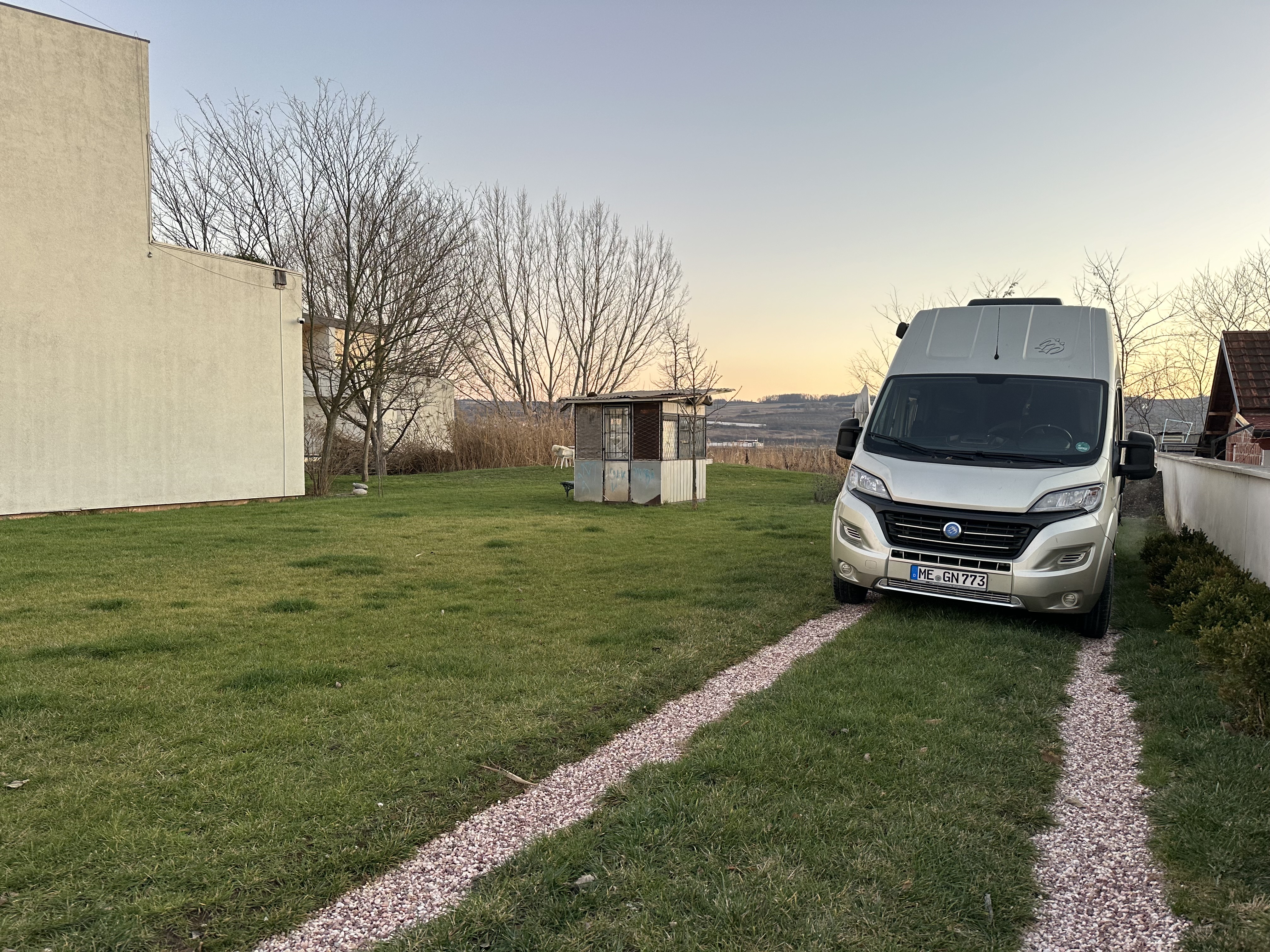
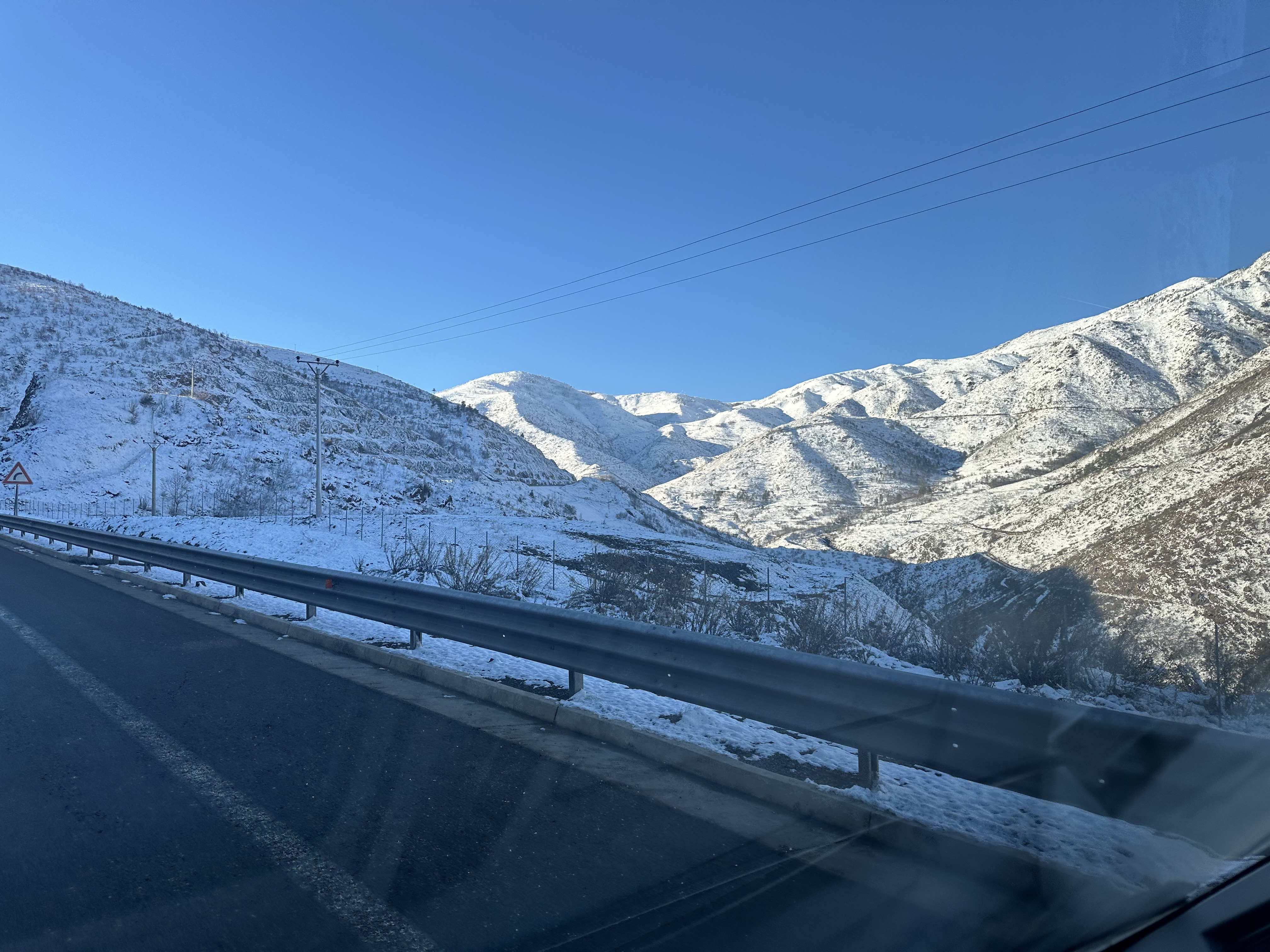

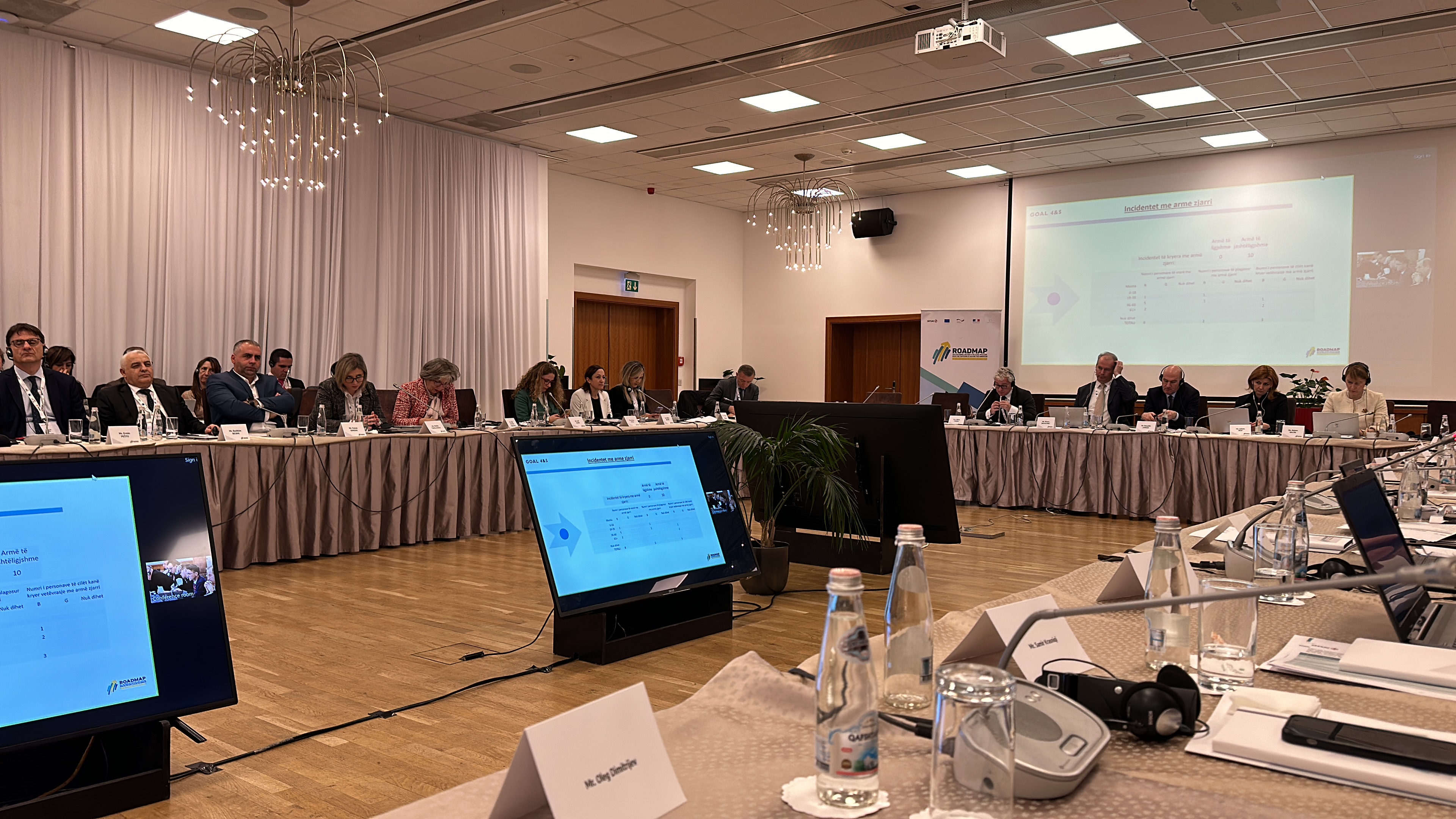
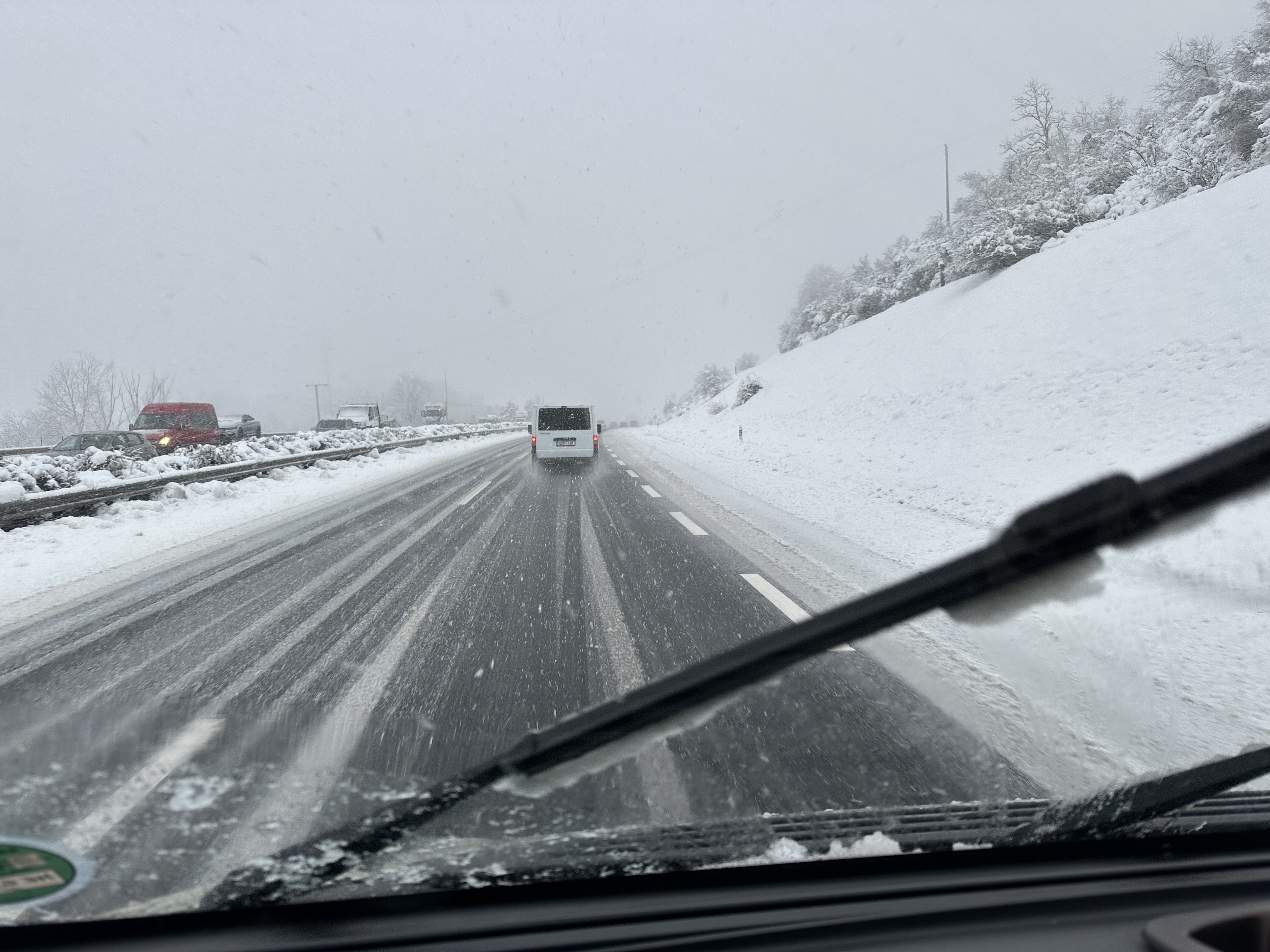
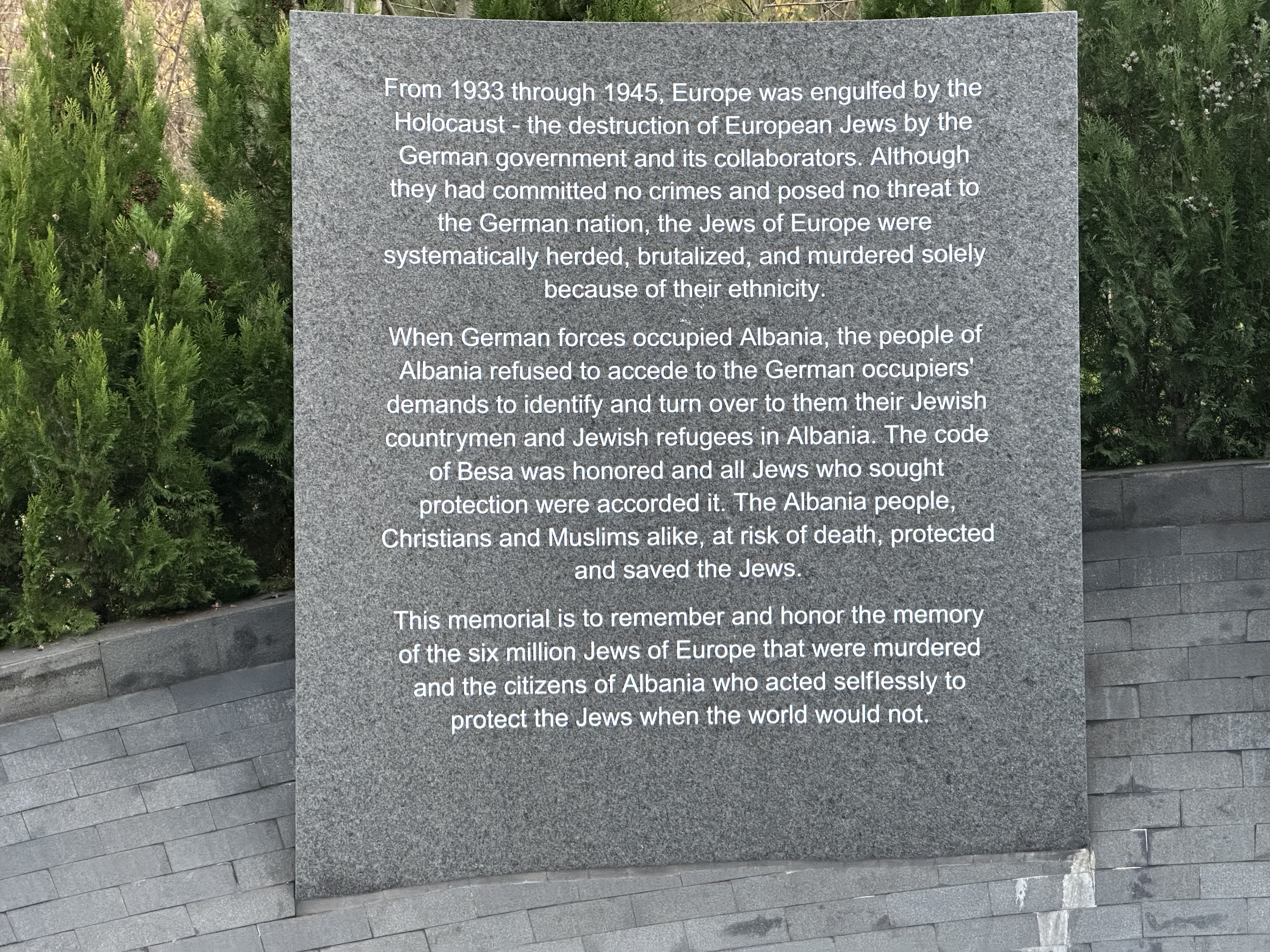
 Stefan Feller