Shutting Down – On Disassociation, Feeling Overwhelmed and Powerless, Retreating, and Denial

On the featured picture: The Class of 76 of my High School. I’m in there, too. Almost invisible in the background.

I grew up with Peter Gabriel’s towering work, whether in “Genesis”, or with Gabriel’s later solo phases of artistic development. One of my all-time favourites songs is “Signal To Noise”. Here are the lyrics:

You know the way that things go

When what you fight for starts to fall

And in that fuzzy picture

The writing stands out on the wall

So clearly on the wall

Send out the signals, deep and loud

And in this place can you reassure me

With a touch, a smile while the cradle’s burning

All the while the world is turning to noise

Oh, the more that it’s surrounding us

The more that it destroys

Turn up the signal

Wipe out the noise

Send out the signals, deep and loud

Man, I’m losing sound and sight

Of all those who can tell me wrong from right

When all things beautiful and bright sink in the night

Yet there’s still there’s something in my heart

That can find a way to make a start

To turn up the signal

Wipe out the noise

Wipe out the noise

Wipe out the noise

You know that’s it

You know that’s it

You know that’s it

Receive and transmit

Receive and transmit

Receive and transmit

No receive and transmit

No receive

Receive and transmit

Receive and transmit

Receive and transmit

Receive and transmit”

Let the lyrics sink in first and consider whether, and how, you relate. Then take in the soundscape of the song. Here is a reference to the epic musical performance in it’s original version: Peter Gabriel – Signal To Noise – 2003 Original via Youtube: https://www.youtube.com/watch?v=1zM7QaPiwqE. And here a live version featuring the combination of Gabriel’s rock band, combined with the great Nusrat Fateh Ali Khan surrounded by his fellow performers: https://www.youtube.com/watch?v=B5KcEy3y23w. Consider how you feel, against your own memories of the time growing up with his music. Or against the background of your memories of the early 2000’s. Or against your cultural positions or affinities. Or against your current mood, whether you are depressed and feeling hopeless, or feeling hopeful. Or not knowing how you are feeling at all.

 In all cases you will come to own specific contexts of how you relate to the lyrics, the soundscape, and the combination of a rock ballad with arabic tunes and sounds, and visuals.


As always on my blog, I am after something like common patterns. In this case, I am trying to wrap my mind around an impression which I have: That there is a rapidly increasing and all-pervasive desire of shutting down which I come across in many personal conversations, and which I suspect, with some personal heuristical indication, appears to be increasingly endemic at least in those societal contexts in which I live and move around.


Since a very long time, I am no stranger to feelings as they are expressed in these lines, the way I personally relate to them. This song is part of a playlist on my devices which I continue to listen to all over again, since many years. Like with any piece of art, my emotional relationship to it is based on the context of my personal memories, the way I grew up, the way I relate to the iconic music of my defining young years, the Rock music of the late Sixties and early Seventies which later made me select which performers I would follow, and what kind of new music I would let in, and where I simply wasn’t interested at all, and how I come back to my defining Classic Rock music as I grow older. Yes, of course, this is how nostalgic feelings develop, too. A friend for many years, who is considerably younger than I am, shares some favorite music with me every day during these weeks advancing the Christmas Holidays. That music is so different, and I relate so differently.

But I am also putting this masterpiece into my personal and professional context of history and experiences which include many severely traumatising events which I have had to process, and continue to do so. I do know a great many people who struggle with that they have gotten stuck in this trauma process, so I will offer an important word of optimism from the outset on. Because if you read the lyrics, they end with an impression that there is no way forward. Yet, there is one. It is a long and arduous process, but a promising one, always requiring outside help. I do strongly recommend professional help being part of it. I am not suffering from my trauma past. Not any longer. As far as I can tell. My processing work continues. But there is hope, and there is a way. I have integrated my past, welcome it, do not regret it, am not stuck in it. But I relate very much to the feeling of utter hopelessness which I listen to in conversations with an increasing amount of people who appear to have been on a different trajectory of lifetime developments than I have been and who seemed to have led lifes with much less trauma-induced self-harming behavior than I have. Until relatively recently that is.

And I feel much has begun with the Covid-19 pandemic.


In most simple terms, trauma is a consequence of harmful events. A trauma literally is a wound. Trauma is not the triggering event, but its consequence. Physical wounds, emotional wounds, cognitive wounds, spiritual wounds. That is why medical doctors describe wounds using the word “trauma”, like in the case of “concussion trauma”. In the very same way events create wounds in the brain.

The body-brain-relationship on cognitive level includes that physical wounds, trauma in the body, creates mirroring wounds in the neurophysiological setup of the brain. The brain reflects the sensoric input through constant neuronal change. Like every part of our body, for example, has a mirroring section in the neuronal setup of our brains, changes to this body, even temporary changes like through wounds will be reflected in the neuronal setup of our brains, and in a way that you can see on an MRI scanner or using other devices.

But it also goes the other way round. Not only that physical injuries create their mirror-representations in the brain, cognitive injuries will also become visible in the body. Traumatising events can leave the body seemingly unharmed, but not the mind, and then as a consequence of the complex reaction to trauma, the wound in the mind becomes visible on the “outside”, through behavior, or also through somatic consequences. We even name them “psychosomatic”. Think headaches, ulcer, strokes, cardiac arrests, and myriads of other forms of the mind-body-interrelationship which constitutes us. If I go any deeper, I will already have to be selective in describing the many interrelated consequences of trauma. If you think deeply, you will recognize that any border between “body” and “mind” is artificial. It literally is All One.

That is why it is so wrong, and so dangerous, to perhaps minimize, or belittle, psychosomatic illnesses. Like as if “just being stronger” would be a remedy. Using the same “logic”, less educated people will belittle traumatisation as a “desease of the weak”. Nothing could be more wrong.

Harmful events creating trauma can be “one-of-a-kind” but severe. Or cumulative by constant, but may be with less severe events forming a chain. Or in its most extreme forms, trauma can be the consequence of a repetition of severe events, each of which in itself would already constitute heavy traumatization but where the repetition creates devastating results. Like as if you would use a hammer and constantly bang on the concussion which you already got from the first time when the hammer hit your hand incidentially, and not the nail which your hand was holding against the wood. 

You would never do that, would you? Hammering on the same wound all over again which you received in the first place? Pretty unheard of? Not really. Think of cases of severe mental illness, where people can’t keep themselves from banging their head against a wall, for example. Or take self-abusive sexual behavior re-enacting severe trauma from earlier abuse. The Internet is chock-full with videos of it, simple Google-searches show. In addition, many browser histories will be filled with such searches.

The conduit especially visible in the last example which I use in the previous paragraph is: In cases of mental trauma the mind often goes into re-enactment-mode, meaning that people with an initial trauma for example in early childhood will develop a life pattern of seeking situations in which they unknowingly or knowingly expose themselves to trauma, over and over again. I only began to understand that at the age of 55 years. I was not aware of this pattern, and it took quite a while until I reached an initial position from which I began to appreciate the consequences of my patterns on a cognitive level. That includes, importantly, people whose depression is masked to the extent that they even don’t know they suffer from it.

So, the first half if my interpretation of that song is one in which Peter Gabriel expresses the feeling that hope is drowning, then he expresses a glimpse of hope: Man, I’m losing sound and sight Of all those who can tell me wrong from right When all things beautiful and bright sink in the night Yet there’s still there’s something in my heart That can find a way to make a start.


Was I too early offering a glimpse of hope for instances in which all things bright seem to disappear, when even pain relief doesn’t work any longer? Because Gabriel’s lyrics include that, towards the end, hope seems to disappear. “No receive“. The signal seems to be lost, drowned in the noise of things falling apart. People who do not have personal experience with depression will have a hard time to even relate on a cognitive level.

Without a deeper investigation, my feeling is that an increasing number of people is experiencing what Peter Gabriel is expressing. A word of academic caution: Even if I can give testimony that in the overwhelming number of conversations which I have, people confirm that they feel numb, angry, depressed, helpless, just wanting to shut off communication and retreating to a beautiful peaceful place, it still is nothing else than my selective subjective experience. 

But I travel a lot, I talk with friends, colleagues, and random people in societies all over the world. What I hear is often the same: It feels like a tendency to increased and enduring depressed feelings. Conversations communicate a struggle with hopelessness, feeling overhwelmed, feeling helpless, feeling exasperation and desperation. And there is anger, all over these conversations. Sometimes visible. Sometimes repressed and masked. Just listen long enough and deeply, you will see the repressed hidden anger.

It is not that I’m stuck in something myself and therefore selectively only talk to people who feel “like me”. My recovery from trauma and it’s life-long consequences, including systematic re-enactment of trauma by exposing myself to more of it, it is based on experiential wisdom which is confirmed by cutting edge science, whether psychology, psychotherapy, trauma-treatment, or the vast knowledge coming from neuroscience. It includes that I always remind myself to remember the codeword H.A.L.T.: Never get too Hungry, Angry, Lonely, or Tired. 

In this context, emphasis on “angry”, and on “lonely”.

Living my time- and science-tested recovery way-of-life I work very hard on practicing positive attitudes and principles of living. I deeply know what anger, resentment, fear, and the feeling of helplessness can do and to which dark places it can get lead. 

Do people who have never had to recognize severe trauma know how much they have been traumatized? The word “traumatised” may often be used in superficial conversations, without a deeper understanding. It mainstreamed into conversations, before, during, and after the Covid-19-pandemic. Does the intellectual knowledge of the fact that one received severe trauma help, on deeper levels? My personal experience is confirmed by science: No, intellectual knowledge does not necessarily help. A typical response is: “I can fix it myself. I just have to change the circumstances. I don’t have to change myself. I’ll just fix it”. Of course this will prove wrong with no exception. The path from intellectual acknowledgement of own traumatisation towards a deeper understanding creating the willingness to seek and to receive help, it usually is a long-winded path with many injuries to oneself and to loved ones until one is able to recognize this fact. Until then, even those who try to be helpful will stand in the way when they will not submit to the victim’s expectation to be helped in fixing the environment, instead of helping to address the real roots of what individuals have to change within themselves, in order to embark on a path of healing. Witnessing the path down to rock bottom, not being able to help someone to avoid it, especially in the case of people one loves dearly, it can be heartbreaking. Being pushed aside as a consequence of the paranoid level of self-protection which has arisen in a traumatised person using every survival strategy under the sun in order to find relief from a pain too big to be acknowledged by oneself, it is a tough experience. Giving in, meeting the expectations of a suffering trauma survivor to stay stuck, or to believe that it is the circumstances, and not oneself who has to change, it moves any supporting person from the side of solutions to the side of problems. It is called co-dependence.


How many of us have experienced radical trauma during the pandemic? Each of us has own memories which we have neatly put into a mental closet. How many of us remember the traumatic isolation? Sure, I also know people who will report that they enjoyed the solitude. But many suffered from a deprivation of social contacts on an unprecedented level. Others suffered from trauma through the stress which Covid-19 brought into their private lifes, locking them up in one place, amplifying the catastrophic way of interaction in unhealthy relationships and abusive situations with no means to escape. Domestic violence increased. Cases of suicide and attempted suicide increased. The impact on children during a period of their lifes requiring social contact to peers has been catastrophic, and there is ample scientific research on this, whilst long-term impact studies necessarily are only in their infancy. Our lifes only started to normalize less than two years ago. Few people remind us of these times by still wearing masks in public. It seems like we have muted our traumatic memories to the maximum. For now. Just think how societies would react if a new serious wave of a pandemic would lead to a medical recommendation to repeat the containment measures which we applied from 2020 onwards. Literally everyone whom I present with this hypothetical scenario responds with “Unthinkable”.

Now, the next conduit: Remember how we witnessed the escalative proliferation of conspiracy theories at the same time, and fueled by the pandemic, and with some politicians and a bunch of crazy people pouring gasoline on the wildfire?

Talking about the meaninglessness of “truth” has become the new normal. Who would have not said you’re crazy if one would have described today’s reality to you just, say, less than ten years ago? Since 2014, this blog alone carries many examples of developments which always “upped the ante”. Until now with no peak in sight. We live in societies in which the deterioration of mannered attitude and bi-partisan discussion culture progressed into something where people will roll their eyes and say “Again? Please give me a break!” Or where people have taken sides and can’t talk to the other side any longer. Or where they have a hard time even acknowledging that the other side has a point, or can at least sense the shoes the other side is wearing.

Which is a another pointer towards a human attitude which also is a typical consequence of trauma reflected in earlier paragraphs of this writing: Denial.

Another one is Anger. Anger in it’s repressed forms as a consequence of trauma. Anger as a strong emotion used for control and manipulation. Anger as one of the key emotions exploited in social media and through algorhythms on basis of Artificial Intelligence. Remember what I wrote about H.A.L.T.?


Cypher: You know, I know this steak doesn’t exist. I know that when I put it in my mouth, the Matrix is telling my brain that it is juicy and delicious. After nine years, you know what I realize?

[Takes a bite of steak]

Cypher: Ignorance is bliss.

Cypher in the iconic movie “The Matrix” about the Grace of Ignorance 


Can anyone relate to pure figures of suffering?

The scene with Cypher as quoted above is the most incredible way how to bite into a piece of juicy steak I have ever seen in any movie. Watch it.

Remember the statistics and figures with daily, sometimes hourly global development of how the Covid-19-virus rampaged through the World? The figures of infections, the figures of infection-related deaths, and then a year later on the figures of vaccinations, and how we struggled to see a relationship between vaccinations and a downward trend in infection-related deaths? Remember the denial, and how our societies were ripped into vaccination-supporters and vaccination-deniers, and how militant this discussion was, partly? How the fact whether someone was supporting or refusing vaccinations ripped through families? I remember a conversation where someone in my family spoke about a vaccination-denier who got severely sick, almost dying, from Covid-19. I could hear a subdued element of “Schadenfreude”. And remember how we needed to exemplify suffering through singling out individual stories of suffering in order to grasp the extent of what was happening, on a massive, global scale?

That was 2020 and 2021. Remember the numbers blowing your mind related to the suffering of people in Afghanistan after the implosion of all international activities there in 2021? An implosion and withdrawal which came, at least for many, without clear signs. And in any case, notwithstanding how premeditated it was, in its execution it happened fast, not in steps allowing to adjust policy of withdrawal. And then there was the highly unanticipated progress of the Taliban, taking over large swaths of Afghanistan, and then Kabul, much to their own surprise even. Do you remember the figures of casualties on the side of civilians? Or do you, more than that, remember the pictures from Kabul airport, and the individual stories of people. Do you remember the stories of Afghan women? How often do you read about the suffering of Afghan women, these days? Are you aware of the refusal of the Taleban, but not only them, related to the figures, and the facts of human rights violations? Have you been exposed to stories of denial, like it was the case with Covid-19? Stories of distortion and manipulation of facts, and conspiracy theories, and blaming the respective other side, singling out and protecting own decisions in a collaborative catastrophy with many factors needed to be taken into account, whilst people were looking for simple answers to yet another shocking and traumatising chain of events?

That was 2020 and 2021. Remember the numbers blowing your mind, of the suffering of people in the Ukraine, following the ongoing onslaught and the suffering through displacement, deportation of children, forced adoption, the war crimes and the crimes against humanity in occupied territory of the Ukraine, in 2022, whilst people in late 2021 would still dispute the intentions of an autocratic leader, Vladimir Putin? Who was helped in his disinformation campaign not only by denial and wishful thinking on the side of the West, but also through people like Nr 45 in the U.S., who until today sings songs of praise related to him, and to the dictatorial killer in North Korea, and an autocratic leader in China? Do you remember the statistics, and how we needed to create empathy which can not be reflected in numbers, by flooding the news with individual stories of suffering, and heroism, of the Ukrainian people?

Were you, at that time in 2022, still able to pay attention to Afghanistan? Were you, by then, able to also take in the sheer numbers of suffering of people in other parts of the World, less relevant to your own local and regional neighourhood? Like in Africa, just as an example?

That was 2020 and 2021 and 2022. What does the figure “1.200” do to you, on a level of empathic relating to suffering, when Hamas unleashed unimaginable terror, atrocities, murder, maiming, raping, mutilating Isaeli citizens October 07, 2023? The international news were only able to create understanding through individual stories, bordering, sometimes overstepping the limits of what can be put into press and TV by responsible media. Very much unlike the video streaming and glorification undertaken by Hamas. Almost immediately, despite the fact that I am almost not present at all on social media, I received messages from friends who had friends in Israel who, in their outrage and unimaginable pain even justified thinking about retaliation, and corporate responsibility of the Palestinian people. Reasonable words of caution against such holding a people responsible on a collective level drowned in the anger, fury, despair, pain. And in a specific German context which is visible in previous articles on this blog, it also began to deeply affect the German society, both related to how we deal with our Holocaust past and our collective responsibility to protect the Israeli State and its citizens, and how we experienced the consequences within our own multi-cultural setup which includes citizens and residents and temporary residents and people granted asylum who live in Germany, constituting parts of the German society.

What does the figure “18.000” do to you, related to the rough and daily increasing estimation of death tolls of Palestinian civilians? Except, that the collective figure of “1.200” and “18.000” defies any reference model which you had from previous news, where the decrying of massive suffering was already stressing your tolerance. Again, you are confronted with unimaginable suffering as reported in individual stories which are needed in any reporting, in order to make you being able to relate on an empathy level. Do you belong to those who have already forgotten the Covid-19-casualties and the suffering in Afghanistan and who barely think about the numbers as we digested them from the Ukraine just a year earlier?

In this section of my long writing, I want to make the point how deeply this collective development, taken together, has been traumatising us on a societal level. Pandemic, Afghanistan, Ukraine, Israel and Palestine, I often hear “What will come next?”. Almost no capacity left for appreciating suffering in other parts of the World. We take this in within an onslaught of news which still includes more, including climate change and natural catastrophes, including worrying political developments. And each of these news stories scare the hell out of us.

And please remember what I wrote earlier: Brains are highly social organs, and in addition to what trauma on an individual level does to us on a neurophysiological level, the same is true when we mourn the loss of a relative, or a loved one, or experience heart-break. And the same is true with our societal connections.

Each of the developments above has led to individual and societal traumatisation on a level which I have not witnessed in my personal lifetime, in this life. Can’t remember what happened in my previous lifes. Maybe I am blessed.


Leading to my final part of dealing with typical reactions to trauma, beyond being wounded, becoming numb, becoming angry, entering into denial: Another important effect of trauma, because of the way the survival mechanisms in our brains work, is shutting down.

This, I believe, I personally witness more recently, and especially since October 07, 2023. Remember the following lines from Peter Gabriel’s song: ” Man, I’m losing sound and sight Of all those who can tell me wrong from right When all things beautiful and bright sink in the night“.

I feel we are ripped into pieces because we loose orientation. We can not compare 1.200 and 18.000, since every single life is invaluable. Where is the guidance on a question like “How many civilian casualties compose a violation of the responsibility of a Party to a War to protect the civilian population?” How do we stomach numbers according to which more than 70% of the Palestinian population are internally displaced, mostly having no shelter, no food, no water, at the brink of starvation, with almost no medical provisions?

In many discussions which I am part of, I can feel how this rips us into pieces. Not only in a specific German context. You can read about it in great detail and masterfully written in this essay in the “New Yorker“, which was sent to me by my nephew (the one who wrote a response to my blog article). Please, if you can, follow the link. But this rupture includes all of us, including the United Nations, for example. Please, also read the OpEd by Michelle Nunn, Tjada D’Oyen McKenna, Jan Egeland, Abby Maxman, Jeremy Konyndyk and Janti Soeripto, titled “Why the U.S. Must Change Course on Gaza Today“.

Ms. Nunn is president and chief executive of CARE USA. Ms. McKenna is chief executive of Mercy Corps. Mr. Egeland is secretary general of the Norwegian Refugee Council. Ms. Maxman is president and chief executive of Oxfam America. Mr. Konyndyk is president of Refugees International. Ms. Soeripto is president and chief executive of Save the Children U.S. – How much higher can you get in the international humanitarian community?

This OpEd is heartbreaking in it’s own right. Because it struggles with some of the questions which are part of this long essay of mine.


I need to conclude on “Shutting Down”, being part of my title for this blog entry, too: I am increasingly confronted with statements like “I can’t bear this any more”, or “I don’t want to hear about it any more”, or “I want to leave to an island where I can just live a simple life, leaving all this behind”.

I can understand this reaction.

I also note reactions like regressing into familiar local contexts. In these cases people shut their eyes and ears, because they can’t bear the emotional pain any longer, and regress into a combination of denial, and self-serving domestic points. Like, “See, I understand all this, but is anyone talking about what is happening in my neighborhood?”.

I also can understand this, though I am fiercely calling for remaining compassionate and understanding for a global interconnection of events. No domestic problem can be solved without taking the global interconnection into account.

Finally, I note denial, regression, fake news, conspiracy theories, and radicalisation as a pattern which emerges also from the desire to find simplified answers to seemingly intractable problems. This is mixed with pure selfishness, egotism, and malice.

Whilst I appreciate the mechanics behind it, I can not even begin to understand this, nor tolerate it. Also this extremism, on the left and the right, narrowing the focus of observing problems to the point of almost becoming deaf and blind for anything outside the own area of interest, it both is a consequence of the long story on trauma which I have written down here, and at the same time it acts like an escalating agent. It puts gasoline on the wildfire which has become a global storm.


That is why shutting down must be fought with all individual and collective means. Without empathy, compassion, and the attempt to lovingly understand and to support collective values, we are literally doomed.

Predictability in Complex Environments – Cognitive Bias Codex

April 20, 2021 I wrote a blog post “Futuretelling” on occasion of media informing about the report “Global Trends 2040”, a product of the collective of American intelligence agencies, issued then on occasion of a new Presidential administration (the Biden administration) taking the helm. I’d like to revisit the issue, almost one and a half years later.


“Global Trends 2040” revolves around five core assessments:

Global challenges include climate change, disease, financial crises, and technology disruptions. The report stated that they are likely to manifest more frequently and intensely in almost every region and country. Their impact on states and societies will create stress, or even catastrophic shock. The report assessed the pandemic as “the most significant, singular global disruption since World War II, with health, economic, political, and security implications that will ripple for years to come.

Fragmentation flows from the predicted transnational or global challenges. Overwhelming threats will lead to a reflex breaking apart, or threatening, globalisation.

Disequilibrium was the third theme of the report. The report focusses on its effects in a widening gap between what societies, communities, and individuals expect from governance and services, and what they can deliver. Doubts in the benefits of democratic governance, the profound inability of systems of international order to provide peace, security, and other important challenges to the sixteen Sustainable Development Goals of the United Nations create a perfect storm.

Contestation was the fourth theme. Wealthy societies pump their reserves into handling the crisis, and into the race of getting out on the other side in the best position for competing, on economical and power levels. Conflict, violence, exodus, displacement, migration will have an effect on more developed societies. In a way, this amplifies fragmentation and antagonisation.

Adaption being the final theme, it means that profound changes will ultimately end in a new equilibrium. The question is how such a new system state may look like. Or, how much of our current one is left, and what will be the new reality.

To me, the core statement of “Global Trends 2040” is that we are passing through a phase of profound global system change, or paradigm change.


That was spring 2021. “Global Trends 2040” was written during the Covid-19 pandemic, so it was somewhat easy for the authors to qualify an existing pandemic as “the most significant, singular global disruption since World War II“. Then, summer 2021 brought the catastrophic events around the takeover of Afghanistan by the Taleban, and a crushing defeat of the West’s ambitions for Afghanistan over two decades. Spring 2022 saw the beginning of a war of aggression by the Russian Federation against the Ukraine. Motivation and publicly voiced rationale by the Russian President went, from the outset on, far beyond his claims related to the Ukraine, and related to overthrow the Ukrainian government. From the West’s perspective it is an attack against the West, it’s systems and it’s values. The Russian President describes this as a threat against Russia, claiming to act in self-defense. Of course, I have a clear position here joining those who state this is a brazen and aggressive move attempting to overthrow an existing order, and violating fundamental principles enshrined in international treaties. But on various occasions since then I have also acknowledged that it depends on where people live, and which cultural and historical ties they have grown up with, whether they join this assessment, or blame the West. This is a war on multiple levels, including information warfare, a war of systems against each other, a war of economies, a war of dogma how to prevail, and to govern. The physical battlefields are local or regional, information warfare happens in cyberspace, and the conflict is ultimately global.

So I wonder how the events of 2021 and 2022 would have been reflected in the wording of the report issued in spring 2021, if these events would already have been on the books of history by the time of writing. If already the pandemic posed the greatest disruption since WWII, it has only gotten worse since then.

With lightning speed, the World is continuing to change. Nobody would have anticipated, even in early spring 2021, that the situation went so haywire in summer 2021 in Afghanistan. And after that, if someone would have asked “What’s next?”, I doubt many people would have anticipated the developments in the Ukraine bringing us closer to World War III. May be, many years in the future, historians will assess that we already were in WW III. Because, even the forms and shapes of warfare have changed. Some of it started in 2001, when we began to see consequences of asymmetric warfare. And at that time, people would have found it unimaginabe that we would see conventional armies battling each other, on European soil, 21 years later.

What else do we know about battlefields of such larger warfare? I could go on about Asia and the ever increasing tension between China and Taiwan, just recently blowing up again on occasion of Nancy Pelosi’s visit to Taiwan, bringing likelihood of yet another massive conflict into the equation. I could refer to how we all, internationally, after 9/11/2001 made critical assessments related to terrorist attacks against nuclear power plants. Now we are finding ourselves in a situation where Russian military forces conduct their attacks using the biggest nuclear powerplant in mainland Europe as a shield. Of course, following the same logic as outlined above, two sides accuse each other of being responsible for it. From a perspective of the threat being real, and grave, even this mutual accusation, being part of information warfare, adds to how scary the situation has become.

The Doomsday Clock has, once again, moved closer to 12, with the UN Secretary General telling us August 07, 2022, that the risk of nuclear confrontation is back after decades.

I could refer to the many developments in Africa, and since I am not a paid professional analyst with own staffing resources, my list of critical developments in the World would be highly selective, and certainly biased. Of course, it would include a whole chapter on instability in the Western Balkans, where I spend much of my time.

So, what can be said about “What’s next?” now, mid summer 2022?


The almost natural reflex is about looking around and to assess specific situations, specific countries or regions, and to attempt making predictions about how things may remain stable, or not. But more often than not, previous developments have taught us that destabilisation, system change, conflict and war occur almost to the surprise of professional analysts, and intelligence systems. The short term developments may be subject to correct analysis, like intelligence organisations unequivocally warned about Russia being serious about invading the Ukraine, once there was enough evidential data. But that was a short-term prediction, being put out into the public domain only from end of 2021 onwards, also in order to convince those who still, until February 23, 2022, doubted that Russia would follow-through on building up her military power alongside the borders of the Ukraine. Did we have enough data to predict this already, say in April 2021, at the time when “Global Trends 2040” was issued? From what I know through publicly avalable information, I would doubt it. So, this is not about “I told you so”.

The same will be the case related to anything up in the future, any new conflict development, where we then, again, will ask ourselves with hindsight whether we would have been able to predict it. In a highly complex and unstable environment, the fault-lines of where conflict arises next, and which physical or virtual dimension it takes, are difficult to predict medium-term, and impossible to predict long-term.

However, this makes the highly abstract level of “Global Trends 2040”, which I summarised above so profoundly valuable. Because, whilst we cannot be sure about “What’s next?”, we can be reasonably certain about that we have not reached rock-bottom. “Global Trends 2040” predicts a fundamental paradigm change and a war of systems, not a state of “rock bottom” from where things might recover to an old or only slightly changed equilibrium.


One of my favorite Youtube channels is called “Veritasium”. The channel is run by Derek Muller. Veritasium is covering a broad range of subjects, based on scientific evidence. According to its own website, “Veritasium is a channel of science and engineering videos featuring experiments, expert interviews, cool demos, and discussions with the public about everything science.” You will find a vlog as of August 2, 2022 there, called “The 4 things it takes to be an expert“. This piece is amazing:

In attempting to answer the question which experts have real expertise, the vlog includes a long list of references related to scientific evidence for its statements. The four things that make somebody a real expert, in ANY field of expertise, are based on long and ardous training, the vlog talks of a rule of thumb of 10.000 hours. In order to become an expert, one has to go through many repeated attempts with feedback. At one point of the video, Veritasium refers to a sample of 284 people who make their living on offering analysis or commenting on complex issues related to politcal and economic trends. These people were followed and questioned over two decades. The results, in a nutshell, are sobering. Any so-called expert with only education, but without extended feedback loops, was doing terribly. These “experts” were not significantly better in their predictions than non-specialists.

Watch the vlog. But what is the issue here? At least, that we have to be very careful in attempting to make predictions. And secondly, that we need to have a healthy and limited expectation in relation to what pundits will tell us. In my own self-assessment, I would certainly qualify for the 10.000 hour rule in relation to my own field of expertise (peace & security). But it would not make me believe that I would be able to find anything more than short-term answers to the question “What’s next?”.

Something which is called “cognitive bias” adds to the problem. This is what is behind the picture attached to this blog, and you can find the picture in wikipedia’s list of 188 cognitive biases, grouped into categories and rendered by John Manoogian III. In essence, according to the website teachthought, “a cognitive bias is an inherent thinking ‘blind spot’ that reduces thinking accuracy and results inaccurate–and often irrational–conclusions.” The graphical summary is listing 180 (!!) of them.

With having said that on our limitations to predict the future reliably, I will finally come back again to “Global Trends 2040”. What I, in sum, subscribe to, is the general statement about a time of system change which “Global Trends 2040” has, in my view correctly, deducted from available assessed information, which we call intelligence.

After President Nr 45 of the United States of America took power, I would find it comparatively easy to anticipate the scenarios that were possible to happen, and my worst case scenarios were pretty much along the lines of what we witnessed, until including January 06, 2021, and what we see coming up as a continuing threat for democracy in the United States, until today.

But compared with the complexity of fragility which we experience, this prediction was a piece of cake, since it was largely based on a psychological analysis of a person with multiple personality disorders, adding perhaps some deeper understanding about American society because I was embedded there for five years and listened and learned a lot.

Asking the question “What’s next” related to what we experience since then, I only know it will get worse, but I don’t know how, meaning “What’s next”. This is not a Doomsday attitude. Rather, it is a personal statement about the gravity of the situation we are finding ourselves in, these days.

Blip

It’s been a while since my last writing over here. Unlike blogs which require to be kept alive because of a business model of any sorts, by keeping the readership (or in case of vlogs, the viewership) being supplied with a constant stream of interesting pieces, this blog is for when I feel I have something I want to say. Whether it is interesting for the reader, well, you decide that. I also felt I had written a lot in a short period of time, recently.

This one is about a blip. This blip:

You will find this one, and more, here: https://web.mit.edu/sahughes/www/sounds.html

If you have had the patience to wait some 13 seconds until the blip finally becomes audible, you had the patience to witness a cosmic event, with gravitational waves from the merger of two Black Holes, recorded by some of the most amazing technology on Earth, LIGO, and transformed into a sound wave. Two monsters of the universe. At the center of them physics as we know it is breaking down, so we can’t explain the innermost workings. They were circling around each other, in ever closer orbit, until they merged. That blip, representing gravitational waves which have traveled for billions of years before reaching our finest detectors, it is testimony to some of the most massive energy bursts we know about in the observable universe. Many say correctly that it also gives testimony to the precision of modern day applied physics. True. But read about Black Holes, or Neutron Stars, or else, and the size of what is out there may perhaps rightsize the perception of our big achievements.

Am I becoming a physicist now?

Well, as on uncounted occasions before, these days I am trying to wrap my mind around the cutting-edge findings in quantum mechanics and general relativity. Moving forward and backward through what we explore on smallest and on largest scales of the universe as we believe to understand its “workings”.

Each time I do this, I end up somewhat exhausted, blown away, baffled about the complexity of mathematics which I don’t understand, but also feeling a fundamental sense of appreciation on a, perhaps, more intuitive level. I still am the child who, five or six decades ago, looked at the sky, wondered what was there, and walking into the public library after Sunday’s mass and coming home with a selection of science books, and science fiction books. Ever since I have been wondering what this is all about, limited in my understanding, and equipped with never ending curiosity asking known questions again and again, and discovering new questions which drive me further. Sometimes mad and crazy, but mostly further.

So, today’s recommended read: A Universe from Nothing — Lawrence M. Krauss.

The extent to which everything we learn about the fundamental forces and conditions of nature is governing literally everything in our daily life is extraordinary, and mostly not understood by many people. Whether we believe in a flat earth or in real science; Whether we manipulate truth or seek to find it; Whether we adhere to universal values of humanity or not; Whether we live a life in entire denial of global warming, or are concerned about the future of our children, nature on Earth, or the planet at large: We all live with and use technology which fundamentally exists only because of an understanding of physics which is almost incomprehensible for most of us. Just look at your smartphone. You will be able to explain most things related to how you are using it. Explaining how it works may be a much bigger challenge, often enough an impossibility.

Some may say “Why bother about what these eggheads say? I care only about what is useful for me.” Some say “Let them work away, writing up these crazy formulae, but God forbid if they are in my way.”

For the universe at large, the relevance of this denial and selfishness is smaller than minuscule. If we blow it up, the blip of that event will transverse the universe at the speed of light, and some distant future observer on Kepler-B 1423a will write a scientific paper in some language and logic unbeknownst to us, attempting to conclude what caused the blip. That alien scientist will note that the energy transferred through “that blip” indicates the explosion of a little planet, very unlike the billion times stronger energy released through a Black Hole merging event.

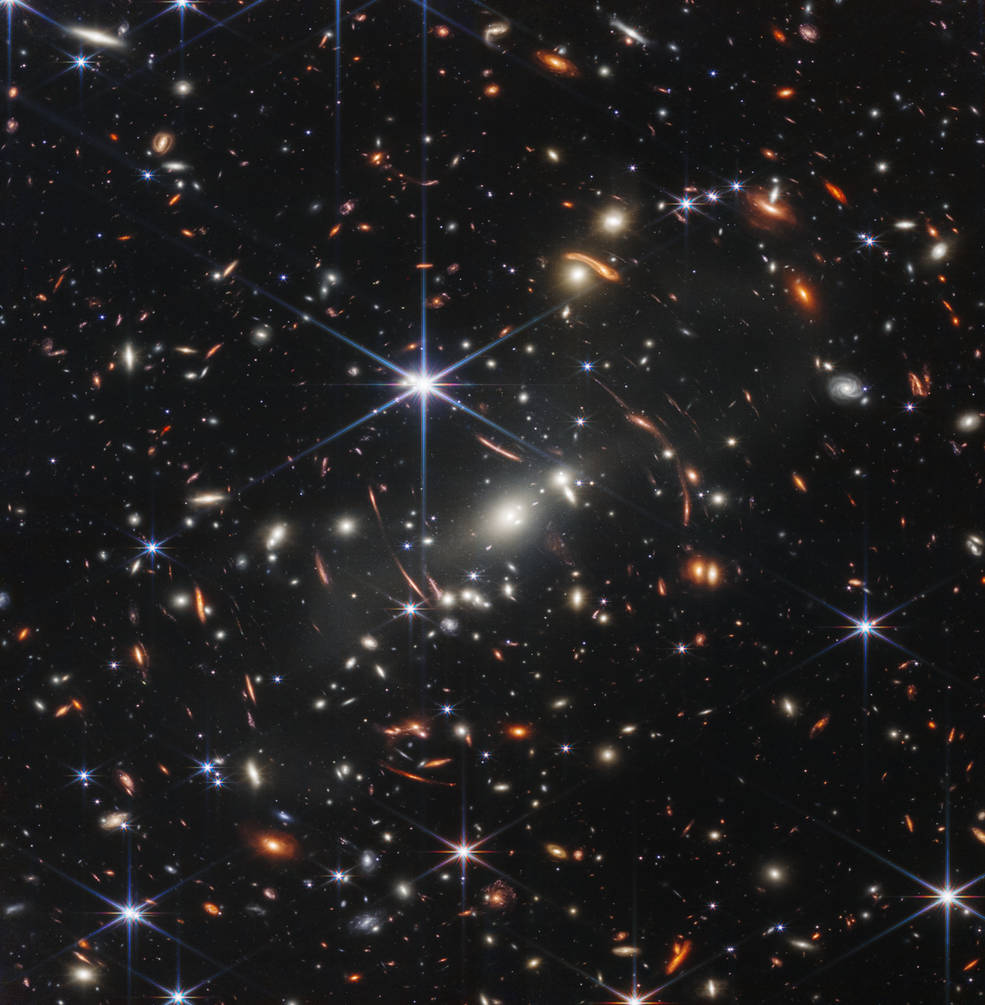
Another piece of extraordinary technology has made it into the main news stream: Like the Hubble Telescope before, the James Webb Space Telescope JWST is making the headlines. On the eve of the first public release of JWST’s first images, U.S. President Joe Biden was presented with one of them:

If you take a grain of rice and hold it up between two fingers, extending your arm towards the sky, the area which will be covered by this little grain of rice contains all the information similar to the picture above. Meaning, if you cover your entire perspective of the sky with such grains of rice at arms length, and you would be able to look through the Earth and do the same for the entire three-dimensional sphere that is the sky, the number of pictures like this one would equal the number of rice corns you have to use for this exercise. And with the exception of a few foreground stars, what you see in pictures like these are galaxies. Each of them containing billions of stars. According to our now ever firmer knowledge about the prevalence of planet forming around suns, there will be more planets circling around suns than there are suns in galaxies. And we talk about hundreds of billions of galaxies in the observable universe, at least.

I grew up with the hubris thinking that we may be alone in the universe. I can’t even emphasize how ridiculous such a thought is, in my view. But the period during which our observable universe has presented conditions which allow life to form as we know it, this may be the case since a few billion years. On a scale of the universe, civilisations like ours are a speck of dust, and I believe there are many of them.

If we blow ours up, oh well, will the universe notice?

Well, I am leaving the field of science here, and I will say the universe will cry because of our failure to do what we are supposed to do. Contributing to the beauty of this universe, rather than to our own selfishness.

Blip.


“With The Help of Social Media Memories Can Be Erased“ – Considerations on the Relativity of Truth

Preface: I read the interview with Maria Ressa (see below) and began to express my thoughts about social media manipulation during a few days in Bucharest. It turned out not to be an easy-going process, I was struggling with something that I now identify as the question “Can I find an objective truth?” In a way this felt to me like an extension of my thinking which I began with Part 1 – 3 grappling with aspects of “perception”.

The following travel to Toronto, including some severe jetlag, didn’t help me feeling comfortable with the results of my thought processes, so I let the issue lingering in my drafts folder. Now, with some rest and witnessing a beautiful spring morning in Ontario, I’ll try it again.

What is truth?

Maria Ressa has been awarded the Nobel Price for Peace in 2021, together with Dmitry Muratov, for their efforts to safeguard freedom of expression, which is a precondition for democracy and lasting peace. Her journalist work is including 20 years as a correspondent and investigative reporter. The title of this blog entry includes a quote from her.

12.02.2022, the German online portal of the news broadcast “Tagesthemen” carried an interview with Maria Ressa on occasion of the Philippine Presidential elections. The elections were won by Ferdinand “Bongbong” Marcos jr., son of the late Dictator Ferdinand Marcos sr., who ruled the country between 1965 and 1986, until he was finally ousted. Together with his family and his cronies, he stands for decades of authoritarian reign, massive corruption, and reckless brutality. The family fled their country with an estimated 10bn USD. A good summary on occasion of the 2022 elections can be found in this BBC piece.

For context: The outgoing President of the Philippines, Rodrigo Duterte leaves a reign of shame for history, too. Most remembered will be the wave of extra-judicial killings with which he allowed the Police to mutate into a murderous gang, killing scores of people, pretending that a strong-armed fight against drug kings would necessitate this and that there would not be a need for due judicial process. I remember U.S. President Nr. 45 speaking admirably of Duterte. Which in itself does not make Duterte a likeable person, Nr 45 also fell in love with North-Korea’s dictator, and, well, his docile relationship with Vladimir Putin will never be forgotten either. Pied pipers.

The core message of Maria Ressa in this German article is that memories of decades of history can be erased, if social media is masterfully used. Not only that memory can be changed, that alternate versions of the same historical events can be created, no, Ressa says that corporate memories can be erased by social media manipulation. Disinformation campaigns on an industrial scale allow that, according to her. The BBC article quoted above would also indicate a manipulation aiming at changing the perception of history by “Bongbong” and associates for at least the last ten years.

Of course, an interview shortened for the digestion of the general public can not provide the same evidence as academic research would do. But for my thoughts it appears to be enough to rely both on the journalistic ethics behind two renowned public broadcasters and on the fact that a credible investigative journalist won the World’s most prestigious award.

The past years have established a large body of evidence that social media is used systematically for manipulation of public opinion on a gargantuan scale. Many will remember the impact of such activities in the run-up of U.S. presidential elections, 2016. The litany of actual examples would be too long to read. December 2020 I wrote about one example, explaining a NATO study on aspects of this topic.

The case of the Philippine Presidential elections is frightening. Bongbong Marcos has won in a landslide election, not by a margin. No need for Bongbong even to prepare for challenging an election as being manipulated, and to contest it. According to Ressa, Bongbong’s victory is based on a manipulation of the electorate on an industrial scale. On lies that create a narrative of Ferdinand Marcos sr. being a hero, the greatest leader of the Philippine Nation ever, and that his son, if he will win the elections, will give the money back to the poor. We will see whether he will do that. My experience would tell me that chances are slim if the whole election is already based on an epic manipulation of historical reality.

The overwhelming victory appears, strictly speaking by counting the votes, sound. Yet, the manipulation sits straight in front of our eyes: Democracy has been defeated with a never-ending stream of content on social media re-branding the image of the Marcos’ family. Phillipinos were told that the dictatorial regime was a golden age, free of crime. Which is pretty much the opposite of what is on historical record.

But, is there something like one common repository of historical records? That’s what I am struggling with here: Is there something like an objective truth?

In an Address to the Prussian Academy of Sciences in Berlin on January 27th, 1921 on Geometry and Experience, Albert Einstein elaborates on the relationship between the laws of mathematics and reality: “As far as the laws of mathematics refer to reality, they are not certain; and as far as they are certain, they do not refer to reality.” (Project Gutenberg eBooks, “Sidelights on Relativity”, EBook #7333).

In the case of historical truths I would transfrom this sentence into “As far as a historical record refers to reality, it is not certain; and as far as such a record is certain, it does not refer to reality.”

This leaves many people very confused. In my belonging to a group of people, I do establish and participate in a historical context about what happened which is based on a common framework through which the members of this group identify. If the framework is very different between two or several different groups of people, their interpretation of what happened in the past can have little or no common grounds. And always when two or several different explanations clash in a discourse, we try to identify an objective yardstick against which we construct our argument why we believe we hold the truth. And we fail on agreeing on the same yardstick, the same objective measuring rod. The results can include so many divergent views, like two different groups entirely disagreeing on whether historical events were constituting a genocide, or not. The result being that the shared reality of such different groups differs in so fundamental ways that coexistence is the best option, always with the threat of violent discourse looming.


There is nothing new in the above. The new aspect, insofar as my writing goes, relates to the claim that systematic social media manipulation can entirely change the public record of history. Again, the past is filled with examples how systematic disinformation campaigns can establish new perceived realities within a group. Being a German national, I like to refer to disinformation campaigns undertaken by the ilk surrounding Hitler. Goebbels for sure is an example of masterful application of deceit and the use of manipulation in order to control the German populace.

But is there something new stemming from the ubiquity of social media of these days? If the general method of manipulation through disinformation is a tool which has been used for millenia in order to control populations for the benefit of a ruling elite, what is the new dimension which comes from social media?

Maria Ressa, in that “Tagesthemen” interview, also refers to the manipulation machine used by Russia in relation to the situation on the Krim, and in the Ukraine: She claims that the first step is about oppression, and the second step is about extinguishing memory. Based upon the experiences she has made in her home country, the Phillipines, she anticipates the same method being utilised in the context of Russias intent to aggressively usurp the Ukraine. She claims that social media have the effect to divide and to radicalise. Thus, she challenges the argument that social media is a tool vital for guaranteeing the freedom of speech. Instead of being used to allow free speech, according to her the algorithms used by Twitter, FaceBook, Tic Toc, and so many more, they make sure that priority will be given to content which is distributed broadly, preferably even virally. Of course, this is the ad-driven business-model behind social media enterprises. According to Ressa, therefore the distribution of facts will always loose against the distribution of lies, hate, and resentment. Drowning the news related to factual reporting, Ressa then states that the result is an entire loss of a shared reality.

The yardstick of a common historical record has unalterably changed, the division has been established, power can be exerted by controlling the perceived reality. Ressa makes the case for a global threat for values including democracy, but she also hints at, perhaps in my view, the biggest threat of our contemporary times: That we will disagree about the climate crisis as a consequence of global warming.

Which is, probably, on top of the list of global challenges which require a joint reality framework holding true for all people and nations on this globe.


As so often, I have no simple answer. Because there simply is no simple answer at all. We tend to simplify, and to go to extremes. Which always amplifies the problem once a complex system is brought out of its previous delicate state of balance, whilst we do not know how to create a new balance, instead of the entire system collapsing.

So, who is right? Maria Ressa with claiming that social media has the potential to destroy realities, and the underlying framework allowing for democracy, or Elon Musk, who has repeatedly tweeted that taking Nr 45 off Twitter has been one of the biggest mistakes, and that this is all about guaranteeing the freedom of speech?

I am still navigating through the depths of this question, and personal consequences. Should I maintain my Twitter account (which is a microscopic grain of sand in the Twitterverse) once Musk owns Twitter? What I know is that I would be extremely careful about listening to a person who happens to be the richest person in the world, who is able to just buy a social media firm in a snap, take it off from the stock market in order to make the changes of his liking, and then to put it back on the stock market. Why should I trust somebody who has one single intention: Using things for a business model based on profitmaking? Why should I believe that a statement about freedom of opinion is unbiased, if the motivation behind is purely enterprise-driven, and the methodology being used is taking every single accountability mechanism offline?

Also not new. But for me, the new thing is that one person has the potential to make a decision that has global implications on a level unheard of in history, whilst any mechanisms of public accountability appear to be on national level, and to some extent on a level of international organisations, but where the credibility of these international organisations is under massive systematic attack.

I will tell you if I stay on Twitter.

On the rule of law and trusting it in times of misinformation and manipulation spread using social media

I finished my reading of the book “How Civil Wars Start And How To Stop Them”, written by Barbara F. Walter (Crown, 2022, Ebook ISBN 9780593137796). I wrote about it in my article “Anocracies – And Thoughts on International Efforts Related to Conflict Prevention“. There I said that I was impressed with the detailed historical account on the many civil wars, and what political science learned about their predictability. I also said that I will comment less on the second part of the book, where the author is applying those experiences on the current state of affairs in the United States of America. But here is a brief personal impression:

Purely from an emotional perspective, the first part of the book felt gripping, the second part felt like something was missing. Because the first part tells the story of not only why things went haywire, but also how they went haywire. The first part of the book talks about catastrophies that happened. Because the current situation in the U.S. is troubling, and partly deeply concerning, but has NOT led to a worst case scenario (yet?), the book is speculative in this regard, because, simply, it has to.

The author attempts to come up with a future scenario of how a descent into civil war in the U.S. could look like. When I read it, it felt incomplete. It had to. I believe the scenario had to necessarily stay away from including a potential role of individual actors which brought us to the brink of that abyss. Otherwise the book would have become speculative and politically antagonizing. The role of “Number 45” is being described in how the U.S. witnessed it’s downgrading from a starling democracy into the field of anocracies. But the book’s scenario on possible further descent stays away from involving contemporary individual actors. An that is why the scenario feels hypothetical. The absence of this link allows for concluding that we are, perhaps, far away from seeing one of the most stable democracies of the world itching closer to internal chaos. Which we are not, as I believe.

Here are two recent news articles which may make you better understand where my concerns are, still allowing me to stay out of the same trap. Make your own conclusions on whether the future may bring us closer to worst-case, just by reading and thinking about this one, and this one. We are a far cry away from being out of trouble. The mid-term elections in the U.S. are coming up, I feel we are in for a very bumpy 2022. From a European perspective, the current stabilisation of transatlantic jointness is extremely fragile, depending on future development.

At one point I was wondering what would happen if a future presidential candidate would claim his right for using Twitter back. It feels like “You’re damned if he is allowed, and you’re damned if he is not”. The claim of the far-right that it is fighting a corrupt, even pedophile global cabale, including depicting the free press as the enemy of the people, it will see a new and even more intense replication: The next round of racism, xenophobia, white supremacy, male domination, conspiracy theories challenging the efforts to fight the pandemic, and global warming, attempting to establish a narrative fighting Western democracies, it is just coming up. And the use of social media will be pivotal for those who attack, and those who defend.

The jury is out how this unfolds. And then there is the nutshell of Barbara F. Walter’s point how a fragile and unstable further descent into becoming an anocracy can be turned around. Here, the author refers to a piece of work she was commissioned with in 2014, for the World Bank. Like other scholars, the author found three factors standing out by far as being critical for preventing descent into conflict and chaos, including civil war: (1) The Rule of Law; (2) Voice and Accountability; (3) Government effectiveness. So, we will have to think about how we translate these fundamentals into concrete action allowing people all over the world to trust the form of governance which we say is the best of all alternatives we have been able to come up with so far.

So, here we are again. It is why any effort getting us collectively out of the currently very troubled waters must look at the rule of law, which Walter describes as “the equal and impartial application of legal procedure”. I stick to the definition of the rule of law as adopted by the United Nations: “For the United Nations (UN) system, the rule of law is a principle of governance in which all persons, institutions and entities, public and private, including the State itself, are accountable to laws that are publicly promulgated, equally enforced and independently adjudicated, and which are consistent with international human rights norms and standards. It requires measures to ensure adherence to the principles of supremacy of the law, equality before the law, accountability to the law, fairness in the application of the law, separation of powers, participation in decision-making, legal certainty, avoidance of arbitrariness, and procedural and legal transparency.

However, my experience entails that in order to establish any rule of law, there needs to be a large consent of the respective society in how this principle is applied, and this consent must go beyond any larger factionalisation in that society. Any large faction of a society must accept this larger principle, rather than challenging the application of a rule of law as being biased, being imposed on them by other factions. Those who stir conflict for advancing their own objectives, they always will establish a narrative that there is no justice for their constituency. They will portray the rule of law as being a weapon wielded by their enemies against them. What these individuals do is to undermine the trust of their followers in a rule of law applied to their society as a whole. Which points to a second invisible feature of any successful establishing a rule of law: Trust.

It is about trust accepting the specific rule of law, for myself, and others, for the powerful and the less powerful. And it is about trusting that justice will always attempt to prevail, no matter how long it takes. Because very often, it can take a long time. And still, after many years, cases may be unresolved, often are. A society at large must trust the course which justice takes, even if individual members experience pain because their grievances are open and festering wounds for many years, before closure is possible, or sometimes even never.

For me, this challenge can be seen nowhere else with all clarity than in situations where I contributed to the efforts to re-establish a rule of law in a society where it had broken down. May be I will write more about a few of those experiences. Here it would be too long, because I want to finally focus again on the critical role of social media. Here is just one example:

There were two main ethnic factions in Kosovo before and after the violence ending in 1999. Under the UN Security Council Resolution 1244 Kosovo found herself with a majority and a minority faction, no form of own governance at all, and no rule of law beyond what UNSCR 1244 tasked us with. The Old had broken down and had to disengage. The New was not there. It was to be established, and being part of the international community engaging in assisting in finding a new New, I was representing the international interim police.

Whilst, on a technical level of developing policing, and helping a new Kosovo Police to emerge, being more and more successful, we found ourselves in a classical “Catch-22-situation”: All factions involved were blaming us not being able to provide security, and justice. Each side would accuse us to act on the interest of the other side’s agenda. And practically it meant that in case of any evidence of a severe crime which would allow us to make arrests, and prosecute suspects of grievious crime, there would not be a societal consent, or trust beyond factions. At least at the beginning. During those early years, any action by us leading to an arrest would be perceived by one faction as a biased, if not politically motivated, action in favor of the other faction. I have many examples for both factions.

I believe that, over time, some trust could be instilled. Not only that the Kosovan society at large moved forward towards healing from own wounds. Not only that our persistent sticking to a common rule of law for All slowly helped in setting some foundations for trust. Not only that the real success story is the work on the credibility of the Kosovo Police itself, establishing itself as a trusted actor within an emerging rule of law. But any development until today also shows how fragile this trust is. Including in recent times, operational situations can demonstrate how quickly old tensions, mistrust, and biased interpretation of events can break up. But what I want to demonstrate here is exactly that: That any rule of law is critical for peace&security in a society, and that this does go way beyond the technical application of such a principle.

It requires acceptance of that rule of law by a majority of all constituencies in a society, and it requires a sound trust in the equal application and adjucation of that rule of law, beyond personal grievances, and existing factions.

As said earlier (in my first blog article on this book), this holds true both for a society moving towards a rule of law, and it applies to a society where the efforts of trusting a rule of law are heavily undermined by the spreading of misinformation and fake news. Whether the society moves into a positive direction or a negative direction, it is the middle zone between the Old and the New which makes the situation most volatile.

All three factors mentioned by Barbara F. Walter, (1) The Rule of Law; (2) Voice and Accountability; (3) Government effectiveness played into any descent into chaos I have personally witnessed.

In 2022, the means to disrupt by using manipulative voice and amplifying non-accountability are a global challenge: Social media has become a bull-horn for those who know how to exploit fragility, and to further it.

So, how to translate Barbara F. Walter’s message, that civil wars can be avoided, into practice?

By taking responsibility for own action, and making our voices of reason being heard, day by day. Neil Young requested from Spotify to remove his music from the platform because Spotify is hosting “The Joe Rogan Experience”. Neil Young did not want to be on a platform which prominently features a protagonist for this type of spreading misinformation, lies, and manipulation, including wildest conspiracy theories about some mass-hypnosis being used by a global cabale enslaving citizens. Joni Mitchell followed suit, and she is not the only one.

This fight is taking us on a long haul, it is far from being over. Every personal contribution matters.

Under The Hood

Forgiveness says you are given another chance to make a new beginning.
DESMOND TUTU

This entire blog is about peace and security, trauma and reconciliation. It is my chosen overarching theme since I began writing.

Ultimately, in order to sustain lasting peace and security in a society, the society needs to be at peace with itself. The impact of traumatic situations and the societal ability to heal these, through reconciliation, is directly affecting the cohesion which is also often referred to as a “social contract”. The less cohesion in a society, the more likely the foundations of that agreement erode.

I pre-ordered “How Civil Wars Start And How To Stop Them”, written by Barbara F. Walter (Crown, 2022, Ebook ISBN 9780593137796). I read an article in the New York Times discussing this book and was immediately drawn to it. Of course, much attention is given to such topics because January 06, 2022 we also looked back on what happened one year earlier: The attacks on the U.S. Capitol by violent crowds, incited by an angry former U.S. President ready to rip everything into pieces and to burn the house to ashes when facing his power coming to an end.

I am specifically interested in understanding the author’s methodological approach. To quote from the New York Times article: “As a political scientist who has spent her career studying conflicts in other countries, she approaches her work methodically, patiently gathering her evidence before laying out her case. She spends the first half of the book explaining how civil wars have started in a number of places around the world, including the former Yugoslavia, the Philippines and Iraq.

So I began this blog entry by looking at my four terms “Peace, Security, Trauma, Reconciliation” with a focus on the January 06, 2021 Capitol riots:

There was no peaceful event, there was no security, there is massive traumatisation of an entire society, and there are huge challenges when it comes to reconciliation. The fabric of the U.S. society is critically wounded. Many, including the current President of the United States, have made that clear on occasion of the commemoration events. Others have blamed them for saying that, accusing them of dividing the very society they have undermined themselves. No matter on which side of the aisle one is, the fact of deep divisions in the society of the U.S. can not be disputed by anyone, because they all participate in it, blaming the respective other side.


Currently in every open society the fabric of consent appears to be at threat. We experience attacks from the outside and from the inside, and we have a large-scale public discourse about that. Attacks and covert efforts in a cyber-information-warfare do point back to actors from inside authoritarian systems, but not only: They include actors from within open societies, in an effort to overturn the systems of governance as they have been set up on grounds of the respective societal contract, enshrined in the relevant basic laws of these societies, their constitutional law. There is a blurry spider web of people and interest groups out there, networking on a global scale, who seem to diligently work on that.


We see societies with authoritarian leadership, heavily applying coercion, and whereever deemed useful, heavy violence against own constituencies. Whichever legitimacy, or sheer power, sits behind coercion into cohesion in those societies, the number of current examples of authoritarian regimes quelling opposition and unrest is considerable. Instability, public unrest, violent coercion of populations by a ruling structure, whether Central Asia, Africa, the Near, the Middle, and the Far East, the Americas, there are many examples.


We see societies with illiberate structures of governance that appear to be stable, sorts of. Big ones, and smaller ones.

We do speculate about the stability of the bigger ones, we suspect, or bluntly see them being in a game of stabilising themselves by dominating spheres of influence, and coercion, whilst at the same time being engaged in efforts destabilising opponents on the side of what we call open societies, including the so-called “West”.

We see smaller societies on their path to illiberate control that position themselves by jockeying for alliances, keeping options open, attempting to take advantage of being friendly to the one or the other, being ambigous.


That is how I came to suspect that the common denominator for all, on a global level, is about societal cohesion. On this level of analysis it is not about attacks of authoritarianism against democracy. It appears to be that notwithstanding the form of governance in many societies, we all struggle with societal cohesion. We all have the same problem, we only differ in how we deal with it.


With that in mind, I revisited my blog entry “Futuretelling” from April 2021. There I had written about the latest report published by the collective of American intelligence agencies: “Global Trends 2040”. The report “finds that the pandemic has proved to be “the most significant, singular global disruption since World War II,” with medical, political and security implications that will reverberate for years. That’s not sturm und drang. It’s the prologue to a far darker picture of what lies ahead.”

Five themes are identified in that assessment: (1) Global Challenges, (2) Fragmentation, (3) Disequilibrium, (4) Contestation, and (5) Adaption. I won’t repeat how I summarized the report in my previous artcle, but I do quote the following: Global challenges include climate change, disease, financial crises, and technology disruptions. The report states that they are likely to manifest more frequently and intensely in almost every region and country. Their impact on states and societies will create stress, or even catastrophic shock. The report assesses the current pandemic as “the most significant, singular global disruption since World War II, with health, economic, political, and security implications that will ripple for years to come.“


That’s huge, and overwhelming. So, what can each and everyone do, in our circles of life?

I am coming back to the basic motivation which I had when I began writing this article. Because it has not been reflected in any of the above, but I believe it is the essence of any individual contribution to finding new ways into cohesion. Lasting cohesion requires some form of consent. Which can only be achieved by talking to each other, and not at all by talking about each other. Talking about each other contributes to dissent. Often we see the dissent manifesting within a public discourse, and all our new contemporary mechanisms of discourse, especially social media, are designed to reinforce messages which achieve large public attention. Those messages are fueled by rage and anger. It is how these systems are set up.

They also function by establishing closed networks. Friends, followers, open or closed chat groups. The opposite to talk with each other is possible there. Stalking, mobbing, bullying, that all adds. Because any dissenting voice within such groups will be yelled at. Can even happen to Ted Cruz, by Tucker Carlson, recently. You stray off the party line, you will be punished.

We can not talk about divisiveness in divisive terms if we genuinely want to address it. Those who do, they purposefully do that in order to solidify it, rather than reverting back to consent. They want to impose a new consent, by manipulation and force.

In everyday life, this is difficult. Like all of us, I have concrete examples: I do not know anti-vaxxers in my circle of friends. Because I have begun to separate myself from any of those. Neither they want me to be part of their circle of friends. And once one enters into those social media groups where attitude to an issue is the polarizing theme, a subtle brainwashing is going on. If I stay, I have to have the same beliefs. They reinforce, and they isolate from any dialogue with others. Over time, own positions and beliefs will radicalize the longer one stays in these groups and circles. As if we would not know how this works. Have we forgotten about how sects do this, how people have difficulties getting out of the prison of Scientology, how difficult it is to de-radicalize people who have been caught in the web of ISIS? There is little difference in the psychology behind all this.

This, again, is happening “under the hood”, and that’s why I have chosen this title. We see the open manifestations of societal dissent. It is hard to quantify and qualify to which extent the invisible divisive lines have already permeated societies. It is fair to suspect these lines of division run much deeper than we see, or acknowledge.

So, I will be interested to see what Barbara F. Walter has to say on that. Because over the last two decades I have been living in societies which at some point broke into open conflict. Or I have been dealing with working for peace in countries which all of a sudden, and often to the surprise of the international community, experienced relapse into conflict and war.

This time, I get a sense it is increasingly about all of us, not about a country far away from us.

How can we identify the threat-level? But notwithstanding that, I firmly believe that nurturing the ability of individuals to listen to others with a dissenting opinion, in an effort to understand the other, rather than subjugating the other under the own doctrine, will be key.

That’s why this will be a momentous task for generations to come.

The Easiest Way to Solve Global Warming

I recently added fiction to my writing toolset. Today, I am adding sarcasm, and that is the only comment to the below:

“I was informed by the director of NASA that they have found that the moon’s orbit is changing slightly, and so is the Earth’s orbit around the sun. And we know there’s been significant solar flare activity. And so is there anything that the National Forest Service or BLM can do to change the course of the moon’s orbit or the Earth’s orbit around the sun? Obviously, they would have profound effects on our climate.”

Congressman Louie Gohmert (Republican from Texas) in a hearing 09 June 2021 by the United States Congress House Natural Resources Committee, on which he occupies a seat.

https://gizmodo.com/congressman-asks-forest-service-to-change-the-course-of-1847065268