Truth Wars

From the Cambridge Dictionary:

“truth – the quality of being true”

“the truth – the real facts about a situationevent, or person

“truth – statement or principle that is generally considered to be true

“truthfulness – the quality of being honest and not containing or telling any lies


From Wikipedia:

Truth is the property of being in accord with fact or reality


I guess I could go on and use definitions or descriptors from many other sources, and still there would be a sort of ambiguity reflected in the term “truth” that can’t be dissolved. Words such as “quality“, “real“, “facts“, “generally considered“, “being honest“, “lies“, they are a far cry away from an axiomatic meaning which would establish something like “an absolute truth” which can not be disputed by anyone, or any argument.

Looking at the above, truth is a relative term, and it requires consent between those who state that a thing, an event, a statement, a concept “is true”.

So, truth is not only a label, but also a relationship between conscious entities, such as human beings (but not only!) through consent, or agreement, or unfortunately also by unchallenged imposition, or through joint perception. For any non-colorblind person, “red” is “red” and “blue” is “blue”, despite the fact that I cannot prove that what I see as “blue” is seen the very same way by another person agreeing with me on labeling the color of a thing as being “blue”. There are people who, just for example, perceive colors and sounds VERY differently from the majority of humans: Chromesthesia or sound-to-color synesthesia is a type of synesthesia in which sound involuntarily evokes an experience of color, shape, and movement.” Those who have experience with substances such as LSD, or Psylocybin, will report about sound or especially music creating patterns and extremely detailed textures and colors, once one closes the eyes. It helps in understanding the relative truth of conventional perception, and the limitations coming from if I just assume that another person is assuming the same things being “true”.

If it is true for me that this color is “red”, it requires a consent with you to agree on labeling a perception the same way. In order to understand you, I need a certain degree of joint experiences, and languages being used in a similar or same way.


Is there something which is beyond a requirement to consent in order to be considered being “true”? Aren’t the facts from science undisputable? Isn’t mathematics something which is founded on axioms? So, looking up “Axiom” reveals the definition that “an axiompostulate, or assumption is a statement that is taken to be true, to serve as a premise or starting point for further reasoning and arguments.

Here we are again, using the term “true“, or “taken as true“, meaning that we have to consent on accepting some statement as being “true”. If I believe in a flat earth, my fellow flat-earthers and I will claim that it is true, and will not deviate, whichever scientific facts which I consider being true I throw at them.

I remember a science lesson at my high-school, probably around 1974. The teacher had invited two members of Jehova’s Witnesses into our class. We were invited to discuss their belief that the World has been created by their Creator roughly 6000 years ago (plus the almost fifty years between that discussion and today…). My friend Peter and I, who loved loved science, used every fact we knew about in our reasoning that, according to our knowledge, the Earth was roughly 4.5 billion years old, in a universe we nowadays believe has been evolved from a Big Bang 13.8 billion years ago. There was literally no way that we could penetrate their arguments and make them agreeing on some form of truth which would have established a consent between us and them. Neither could they convince us related to their version of Genesis, just mentioning.


So, as an intermediate thought: What does it mean if people in our current state of antagonisation say “Truth Matters”? What is the meaning behind a brand label created by Number 45, “Truth Social”?

It means nothing else than that consent on an unspecified number of qualities, beliefs, policies, worldviews, or else, is called upon. And at least “Truth Social” would be an example for a dogma such as “As long as you consent to my view, you are in line with my truth, and if you are not, I may even call you an Enemy of the State.” Truth as a means of control. Number 45 did this on countless occasions, and more recently he is hard-pressed by people who are attempting to establish even more radical forms of white supremacy, xenophobia, racism, and anti-semitism. Read in The Rolling Stone: “How Trump Got Trolled by a Couple of Fascists“.

So, when we talk about “Truth Matters”, is it about imposing my truth upon you, or finding a mutual platform of consent, through listening, empathising, understanding, agreeing, compromising, finding common denominators?


Before coming back to my last question, here another source of my personal belief system:

In the Buddhist teachings, there are Two Truths. …”there’s an idea that everything has two levels of truth, relative and absolute: how we experience life when we’re immersed in it, and how we experience it from a distance when we can get a vaster perspective” (Pema Chödrön – How We Live Is How We Die, 2022 Shambala Publications, Page 51).

Essentially, in my interpretation (sic! need of consent again…): Absolute truth is a concept from the spiritual realm, including, but not limited to, religious faith. Please note that in my view Buddhism is not a religion, but a spiritual source of wisdom. I don’t believe in a personalised God concept. But I am firmly rooted in a spiritual connection with Everything.

If you, the reader, would agree with me, then we would conclude that the world of phenomena has only relative truths, based on perceptions which are mutually held. The absolute is the realm of the spiritual world. However, if people claim they have understood the Absolute (Or claim God spoke to them), and they allow it to permeate into the world of phenomena, dogma is born: My truth is absolute. My God will protect my soldiers, and not your soldiers. My God says that women need to be veiled. My God allows me to fight a Holy War. Radical Muslim dogmatists have done that, radical Buddhist fundamentalists have done that, radical Hindu fundamentalists have done that, Christianity has its share of radical violent dogmatism and suppression and brutal violence, Judaism is not without such phenomena, no religion or spiritual belief framework is without shameful stains resulting from imposing an absolute truth on my fellow women and men, human beings of any sexual and gender identification, followers of a belief, and especially also children.


Where does this lead me to, here?

What I see is the widespread use of catchphrases such as “Truth Matters” with a reduced understanding as if there would be “one truth”, and that others fall victim to “untruthfulness”. That those who manipulate with lies do establish the opposite to truth. I don’t see it like that. I see it as the attempt of replacing “your truth” with “my truth”. I see it as an attempt to control the narrative, and through it, others.

That is why I continue to note that still, increasingly, and on a global level, we see antagonisation thriving, and collaboration and listening in an effort to understand the position of others diminishing.

When the Biden Administration took office, there was a refreshing silence for some time on Number 45. Nothing today is reminding of those few months. Everywhere I look, listen, watch, read, I see Trumps, Ye’s, Elons, Victors, Matteos, Björns, Vladimirs, and their copycats. And everywhere, the radicalisation leads to that the next copycat is more radical than the one before.

That’s why I choose “Truth Wars” as the title. Truth Wars do not require consent by argument, in such a violent scenario it matters that I succeed, by imposition and manipulation, not by accepting another person’s reality as equally relevant to mine.

What I see is that after a perceived “lull”, the Truth Wars have become even more radical. Racism, xenophobia, hate against transgender people, hate of and supremacy over women, anti-semitism, anti-muslim sentiments, they come closer to be part of the mainstream. As a part of a larger pattern of xenophobia, in the Western World the white hateful male lower middle-class and impoverished lower-class underdogs fall victim to pied pipers, some of them extremely privileged and dishonest.

What I also see is that we deploy force against force, loudness against loudness, control against the attempt to control. Literally every such concept is pouring gasoline on the firepit.


In my line of professional work, I support the consent between the six jurisdictions forming the Western Balkans, on the belief that fewer weapons, explosives, and ammunition, and more control over all licit aspects of them, and the fight against illicit aspects of using weapons, their ammunition, and explosives, is good for peace and security in these societies. As a consequence of this consent on a jointly held truth, these six jurisdictions (we name them jurisdictions, since Kosovo is not un-disputed amongst all of them and amongst others in relation to statehood, different to Albania, Bosnia &Hercegovina, Montenegro, North-Macedonia, and Serbia), these six jurisdictions communicate, collaborate, and cooperate highly joint in implementing policy and operations. They do this despite the fact that some of them have disputes on a political level, and that cultural, ethnical, and faith diversity creates this amazing and wonderful mix which has also seen violence, oppression, war and genocide when some considered their truth more supreme than the truth of others.

I am using this as a practical example for the opposite of what I have labeled “Truth Wars”. This is one of countless examples were people sit together and listen, and learn from each other, willing to do things jointly, whilst acknowledging that they do not agree on everything, for the sake of a higher objective, and advantages for all, instead of only for oneself.

Yet, the fundamental consent (sic: truth) on how to control Small Arms and Light Weapons could not be more different from, for example, the United States, where there is a widely held belief by many (don’t know whether they constitute a majority, and doubt it), that only the Second Amendment ensures the protection of the First Amendment. The accepted truth, and the consequences of it (exponentially more violence and unprecedented levels of mass shootings) are radically different, and this permeates literally into everything, including how for example policing concepts are being developed and implemented: It is not only about the need of police to protect themselves against an ubiquity of weapons; If citizens reject policing as something they want to give up their own weapons for, community oriented policing is VERY different in understanding, concept, and implementation.


If truth matters, it includes to accept that there are many different subjective truths. This allows for their coexistence, their learning from each other, their development, and ideally the growth of something that is more joint. So, very different to what we seem to nurture, or to fight, right now.

One Love

I am not getting into the shameful decision of FIFA’s threat of on-field punishment for players forcing World Cup teams to back down and abandon a plan for their captains to wear armbands seen as a rebuke to host nation Qatar’s human rights record. It is all over the news, it is deeply upsetting, and here just one of the many references, for accuracy and the record. I am no fan of soccer anyway and I am not following the World Cup.

However: Here is a report in the German “Tagesschau”. A German sports journalist, Claudia Neumann, is reporting from Qatar wearing a t-shirt in rainbow colors. Taking a stand. At the same time the report is mentioning that a Danish reporter, Jon Pagh, was preparing a live transmission in front of the Hotel hosting the Danish soccer team, wearing a One Love armband. Pagh is quoted with a Tweet in which he describes being approached by a Police officer ordering him to remove the armband. The report also mentions how a U.S. journalist, Grant Wahl, was held and harassed by security forces for half an hour and requested to take off a t-shirt in rainbow colors.

That’s the point: The symbol points towards a bad human rights record. Police ordering to remove it is an infringement of the basic human right to freely express an opinion. Which is a testament for a bad human rights record.

German Security authorities warn about the use of apps on smartphones which are requested to be installed by everyone who is traveling to Qatar in order to attend the World Cup. There is strong suspicion that these apps are capable to entirely control functions on the phone from reading out storage to listening in into phone conversations.

The way how to dress is regulated (at least no rainbow colors).

What’s next, and why am I making a point here? Because it is important not to get used to stories like these. I am a (now retired) police officer. All my life I also appreciated that there is an inherent mistrust towards police officers, especially amongst young people. Like, I am having such discussion here in Toronto with my teenaged children. For them, cops are carrying a label of enforcing rules of the State, often perceived as an all intrusive State. Of course, they will add, it is different with Dad. And I could leave it with that. Heck no!

Like I have done in other articles, here is the United Nations definition of policing: ” Policing refers to a function of governance responsible for the prevention, detection and investigation of crime; protection of persons and property; and the maintenance of public order and safety. Police and law enforcement officials have the obligation to respect and protect human rights, including the right to life, liberty and security of the person, as guaranteed in the Universal Declaration of Human Rights and reaffirmed in the International Covenant on Civil and Political Rights and other relevant instruments.

So, it is not about Dad being different. It is about a universal yardstick, establishing a minimum framework of how we promote human rights in all our affairs. Shrugging shoulders only leads to getting used to the erosion of fundamental human rights, and concepts how to protect them.

The calm voices of the many need to continue making that point. Over and over again. Stopping to remind equals giving more space to those who continue to chip away from fundamental achievements we have been working hard on for many decades.

Let’s be a little more precise if we talk about “the people”, Mr. Elon Musk, shall we?

Until recently, I occcupied a tiny teeny microscopic corner in the Twitterverse. In any list of Twitter accounts I would have been placed rock-bottom. My Twitter-presence was just a means allowing me to click on external links which would require me to log in into Twitter.

Two weeks ago I announced on my Linkedin-Account that I am letting the bird go because I don’t want to be any part of a story of unhinged narcissism combined with pure capitalism disguised behind a concept of so-called long-termism.

The two weeks since then have been, mildly put, interesting. The purposefully chaotic sledgehammer-approach of Mr. Musk ripping through Twitter has been all over the news. I had a hard time finding a way keeping myself updated about what was going on in relation to Twitter and its role in public discourse and communication, and at the same time to avoid being sucked in into endless replications of upsetting stories combined with the ubiquitous display of Mr. Musk’s face. I tried not to get emotionally touched by the topic, because there is an insidous purpose behind an approach that keeps people glued to emotionally upsetting stories, combined with the personalisation of messages connected to faces: If you don’t mind to combine your public persona with negative and upsetting antagonising news and opinions, chances are that your internet presence on social media is sky-rocketing.

It is an alternative to “sex sells”, or the smart way how some video-bloggers combine the display of female body parts with entirely unrelated blog-content in the same way as classic advertisement does. The means how to maximise gaining attention are very well understood within behavioral psychology. If you like to watch a very entertaining and honest and ethical video about clickbait, head over to one of my favorite Youtube-Channels: Veritasium.

Some may say that the dishonest use of social media as a bullhorn for highly antagonising and emotionalising content in order to achieve desired manipulative effects is high-risk gambling. Kanye West might be considered being an example for that this strategy can back-fire. Others may say the days of Nr. 45 are over and it is time to move on. But that doesn’t make it feel less dangerous to me, and I disagree with “moving on”. Because the damage is done on a structural level, notwithstanding whether a few narcissists became victim of their own high-risk gambling or not. All narcissists who are also sociopaths are high-risk gamblers. It is an inherent part of their personality. They are unable to do anything else.

The most upsetting issue with Twitter over the past two weeks is the inhumane and dictatorial approach to Twitter staff members. Rarely have I seen a worse example for treating staff members like disposable items. In his cold and arrogant attitude Mr. Musk clearly demonstrates an inability to empathise with other human beings. In this ego-centric worldview filled with hubris, only personal power, might and wealth exist. Neither staff members, nor users count in any other way than the impact they are having on profit: Staff costs money, users are meant to be milked. We can witness how unhinged capitalism works, and we all are having a hard time of not falling victim to the countless efforts of blurring our eyesight.


20 November, the news reported that Elon Musk reinstated Mr. Trump’s Twitter Account. Below the references in the U.S. New York Times, the British BBC, and the German Tagesschau. All three newsfeeds quoted Mr. Musk with “The people have spoken”.

https://www.tagesschau.de/ausland/trump-twitter-musk-usa-103.html


What happened?

January 08, 2021, Twitter blocked the account used by Nr. 45, following the insurrection events of January 06. After his takeover of Twitter, the richest man of the world initiated a poll on Twitter, just a few days ago, and for the duration of 24 hours. There has, to my knowledge, not been any external monitoring of this poll that would allow us to verify the results, so, according to Twitter itself (or better, Mr. Musk himself), 15 Million users of Twitter participated in the poll. The German Tagesschau estimates there is a current estimated total of 230 million accounts being used on Twitter on a daily basis. 51.5% of these 15 Million users were, according to Twitter, in favor for a return of the 45th President of the United States to Twitter.

Which led Mr. Musk to reinstating Nr 45’s account, and tweeting that “The people have spoken”, adding a sentence in Latin “Vox Populi, Vox Dei”, meaning that the voice of the people is the voice of God.

Excuse me???? The people have not spoken. A social media platform populated with user accounts does not constitute a people. An insanely rich billionaire buys a social media company, shredding staff, organisation, policy and procedures, moving the company towards business models where users do not only pay the price of extraction of their personal data for advertisement purposes, but are also encouraged to pay for services. These users, as far as they have decided to stay, are not a “people”.

The hubris of Mr. Musk, comparing a questionable polling process with the legitimising voice of a people, then even adding a divine context, borders insanity. Like in cases we have seen before, there is a cold-blooded purpose behind that. It is meant to make sure that the signal stays hidden in the noise.

Distinguish The Signal From The Noise – Also feat.: The Long Term Impact of the Pandemic, and of Conflict and War

Setting the stage: From a conversation with my son

Yesterday afternoon I chatted with my son on FaceTime. He lives in Toronto and is fourteen years old. For him it was morning, and I was amazed seeing him preparing his own breakfast potatoes with an omelette. It looked so good on my phone screen that I could smell and taste it, I wished I would have been there. He promised to make me such a breakfast when I’m in Toronto in a few weeks time.

At one point, the casual conversation about what’s up veered into the parental part: “How’s School Coming On?” – “Good good”. – “Any details to share?” – “No, not really, it’s just good.” – “Do you like your new school?[The kids have entered high school education this summer] – “It’s okay, but have you ever heard somebody saying that school is a place you really enjoy?” – “I understand, fair enough. Wasn’t much different for me, when I was your age. But, just curious: Do you like what they teach you in physics? And what is it they teach you?” – “It’s okay, but I would love you to make more of your tiny explanatory pieces on physics, I always enjoy them.”

Guess what? I was flattered, felt these little pieces of work of mine make sense. I felt motivated to make more of them. Perhaps I will share some of this stuff on my Youtube channel “All Over The Place“. That’s the fun place in my writing and creating. Over here, at durabile.me, it’s more about the serious stuff I like to write about.

What everyone knows, including from own experience, and too often forgets: The importance of education for a society

Yes, school, as I told my son, is also something I remember in a similar way. Necessary, but not a place of daily rejoice, like, getting up and thinking “Yay, I can’t wait until being in class!“. Meeting my class mates always was a mixture of joy and anxiety, I was sort of like Charlie Brown, isolated in many ways, struggling to find friends and appreciation. Meeting my teachers, more often than not, was a mixed bag as well. The subject issues at school, mathematics, physics, chemistry, language, history, geography, some of the stuff I loved, some of the stuff I really struggled with. I could not shrug it off, like Calvin in the comic series “Calvin&Hobbes” does. I often strolled home with my head low between my shoulders, like Charlie Brown in the comic series “Peanuts”.

But it was necessary to learn, and I knew that. Necessary at the very least. Pleasant, preferably. Which is, certainly, part of the art of pedagogy: How to teach knowledge? Being effective in establishing knowledge also needs to mitigate unpleasant experiences. Not everyone of us has a Spartan mentality, like “what does not kill me makes me tougher”. The saying “School prepares for life”, often used and even more often abused, at it’s core it is, of course, true. What I learn at school, it becomes a defining part of everything thereafter. What I don’t learn defines my life in every aspect as well. And this is especially holding true for general skills which I acquire through education. I don’t have to be able to explain Richard Feynman’s quantum mathematics. But a general level of knowledge, combined with education in a general sense, it is setting the stage for anything to follow.

Enter Covid: Millions of children, and millions of their parents and caregivers were all of a sudden reminded of the educational role of schools, through their sudden absence as physical places to go. Places to gather. To socialise. To learn social skills. To be taught knowledge, and to become educated.

The continuing impact of Covid goes way beyond cases of long-Covid

October 24, 2022, the New York Times published an article “Math Scores Fell in Nearly Every State, and Reading Dipped on National Exam“. Here I am quoting the article’s beginning:

U.S. students in most states and across almost all demographic groups have experienced troubling setbacks in both math and reading, according to an authoritative national exam released on Monday, offering the most definitive indictment yet of the pandemic’s impact on millions of schoolchildren. In math, the results were especially devastating, representing the steepest declines ever recorded on the National Assessment of Educational Progress, known as the nation’s report card, which tests a broad sampling of fourth and eighth graders and dates to the early 1990s.

So, here we are with scientific results demonstrating the devastating combined impact of the pandemic and of how we needed to protect ourselves, collectively: In order to reduce casualties, and to reduce suffering by attempting to keep the medical system operational, we took tolls. Mental tolls, physical tolls, emotional tolls, cognitive behavioural tolls, and educational tolls.

Heavy tolls, like that on average, the number of fourth graders and eighth graders being proficient in math and reading took an exceptionally deep plunge towards an abyss. And what is indicative in the U.S. system, from my personal experience it’s true also in Canada, and from what I hear and witnessed in Europe, I have no indication it would be different here. I am sure that there is not a single country which found a mitigation strategy through a form of protracted exclusive home-schooling similarly effective in knowledge transfer as classroom-teaching is.

It is also correct to conclude that what holds true for math and reading is also holding true for general levels of education, social skills, and a general toolset which allows to traverse our contemporary world knowingly: By having a proficient knowledge about our own environment, we go beyond a collective capacity to be economically competitive: Knowledge allows us to make informed decisions, opposed to either making uniformed decisions, or being the proverbial sheep in the herd of individuals being manipulated by those who do, for own and for controlling reasons.

I also happen to think that there is the educational equivalent to what we observe in relation to the distribution of wealth in our societies: Like ever fewer people are getting more wealthy, and ever more people fall into low-income and also poverty, with a shrinking middle-class, the same certainly is true for the distribution of knowledge. If good jobs require a CV with reference to an Ivy-League-College-Education, if creating what drives our economic progress is in the hands of ever fewer people who understand the underlying science, or engineering, it will inevitably also contribute to the growing size of parts of a society which do not hold many economic resources.

But the damage goes further:

Proficient knowledge establishes a general capacity to distinguish the signal from the noise

The less I know in a general understanding about how the world is functionining, the more I am vulnerable for “Scharlatanerie”, and for all the messy speculative stuff from people who believe to know, do actually not know, and create noise, inaccurate information, wrong information, and deliberate misinformation. The last one for a variety of reasons, including attempting to control, but also because sensational stuff simply sells. It always did, in magazines. It increasingly does, on the digital media platforms of this Brave New World.

I’ll use an example, on my topics of scientific interest: I need a basic knowledge about how the James Webb Space Telescope JWST works, in order to filter out those sensational channels where people attract viewers by suggesting JWST has found proof for alien existence. I need a sound knowledge to stay with those channels informing me about most recent discussions in Quantum Mechanics, just to grasp the profound impact of why the 2022 Nobel Price has been awarded to Alain Aspect, John F. Clauser and Anton Zeilinger. My mind “explodes” (or implodes) when I try to understand the rationale which can be found on the Nobel Prize Website. But my general knowledge allows me to appreciate why the entire physics community is abuzz of profound discoveries to come which may, again, make previous knowledge obsolete. Previous knowledge which already has successfully made my mind imploding, just saying.

This is anything but an esoteric discussion. It is, in my view, one of the most crucial and often unappreciated topics in relation to how we protect values in our societies: Through education. At the same time, the relevance goes much beyond the impact of the Covid-19-pandemic.

In literally every conflict- or post-conflict-environment I have been working in, the devastating impact of conflict, violence, hatred, and demolition of infrastructure on the educational system has been larger than life. Where educational capacities remained crippled, or absent, the respective society remained unable to recover as much as everyone hoped. Which, in turn, led to many effects which created the next round of frustration, such as through migrating away, accepting corruption and crime, and a general path towards becoming more prone to the rule of the powerful, instead of the rule of law.

Concluding this one with a view on the war of aggression by Russia raging in the Ukraine: We see systematic attacks on critical infrastructure in the Ukraine, and that includes the shelling of schools and kindergardens. It has a terrible invisible effect: Deploying strategic blows against a society and country by sowing fear includes to make it difficult to uphold a daily life allowing to transmit knowledge to children, very similar to the effects of the pandemic.

There has been a press conference the other day with Ursula von der Leyen, President of the European Commission, and Olaf Scholz, Chancellor of the Federal Republic of Germany, arguing for a “Marschall Plan” for the restoration of civilian capacities in the Ukraine. It is really important news. The longer a society is incapacitated, whether through a pandemic, or conflict, the less the value of general education can be upheld in any country. In turn, fragility becomes systemic.

Sarajevo Backcountry

The new Youtube channel “All Over The Place“, it kinda acts as a counter-balance to this blog: Entries over here are mostly triggered by serious and upsetting incidents, situations, or developments. I may be able to give things a positive spin, rather than indulging in bleak and somewhat gloomy analysis about the state of affairs of peace and security, but still… Writing here has been less about easy and delightful stuff.

Yet, that easy and delightful stuff happens. But even when I try to capture it, I am left with the impression that my voice is too serious, and the text isn’t funny enough. Okay, that’s my perception, I am not sure viewers would agree. So, within this effort to grow content, I have finally decided to let the Youtube Channel “All Over The Place” go online.

“All Over The Place” is meant proverbial, putting my futile efforts on notable events happening during my Vanlife out there. But it is not only my Vanlife: My cat friend Tigger is my permanent companion.

“All Over The Place” may also reflect on things that happen inside myself. There are lots of little projects, until now none of them worth sharing. I am working on finding a style how to make thoughts on my fields of interest visible, and interesting to watch.

“Practice, practice, practice”, nothing else will lead to proficient mastering of skills. Whether it is in the field of my professional interests, or on how to handle my teeny tiny fancy drone, or how to make and to edit a video.

In any case: I will give up hesitation and try to let go of anticipated shame, for amateurish results. Here is my work on a travel which I did on occasion of my staying in Sarajevo this week. I revisited Sarajevo’s backcountry. Have been there with my mountain bike years ago. Came back with my Campervan, and Tigger, of course.

Durabile – Thinking about Growth

December 19, 2014, this blog was born. “Every Journey Has A Beginning” went online. At that time I did not have any idea where this would lead to. Yet, as of today durabile.me is hosting 113 blog posts on the topics of peace, security, trauma, and reconciliation.


Looking a bit into the statistics

Since three years this blog is finding significantly more interest. Already after the third quarter of 2022 the increase matches the increase of the entire year of 2021, compared with the previous year. This would indicate a further increase for the entire year of 2022.

Since 2014, blog posts were read globally, access originates from 123 countries.

Taken all views since the inception of this blog together, the vast majority of reading interest was generated in the United States of America and in Germany. 444 views from China are surprising. I would wish these are representing a keen interest in topics collected here, but I have no means to analyse as to which extent automated web crawling might play a role, too, or anything else. No thing, just mentioning this.

This quick look brings me back to why I was beginning to write in the first place: I was hoping to find my tiny own home in the Internet, between blogs, vlogs, and relentless social media, where I could express views about topics which are at the core of my professional experience. I remember how uncertain I was at the beginning, even anxious: I needed to learn how I could mitigate my wish to express myself with contemporary tools, meeting the requirements of my professional ethos, and the needs of not mixing personal opinion with action on behalf of the organisations I was working for. I believe I managed to publish views in moderation, with facts and conclusions based on firm and transparent research and thinking. I doubled down on it whenever I saw people in highest offices abusing social media as bullhorns and for manipulating reality, and people. I can’t really claim that this little blog is proving that interest can also be generated through calm expression of facts and opinions, but this is at the core of my understanding of democracy: Engaging in voicing opinions, and engaging in taking a choice, it is a collective process in which the contribution of single individuals does not make the visible or earthshaking difference, but the collective absence of doing so erodes democracy as much as the radicalisation and polarisation of those who are yelling from rooftops using bullhorns.

If the voices of moderation fatigue, the void will be filled by voices of rage.

So, over time I felt ever more confident in using contemporary tools for public discourse and expression of opinion in an ethical framework, instead of leaving the ground to manipulators. To sum this one up: The Internet has changed the way how our democratic discourse is happening, but the requirement to participate in a public discourse is as old as democracy itself. Without our active participation, democracy, justice, peace and security just die.


But there was another motivation why I was beginning to engage in writing: My ever more increasing understanding about how my own story is intertwined with the story of my work. Since 2013, I have begun to systematically connect the dots.

There is a lot of writing which I have done since then, and which I have kept away from this blog. This has been a somewhat very complex process, non-linear, at times messy, often very painful and then sitting and resting again for long periods of time, followed by periods of intense work again on writing things down, followed by emotional exhaustion again. For most of those years between 2013 and 2022 I would not be able to say whether those results from writing would ever see the light of the day, by making them available. I just committed to the process of writing because I felt it was necessary anyway, notwithstanding the question if, one day, this work would go dormant in my digital archives, or if it would be useful for others, or at least an interesting read.

I am at the verge of opening this up. This part of my writing falls into three broad categories:

(1) Essays on Peace and Security

(2) Essays on Trauma and Reconciliation

(3) After The Storm

I am working on ways how to share this work. What I know is that I will not publish the entirety of it here. Like everyone else sharing personal experiences, I feel vulnerable doing that. Partly for the same reasons, I have not felt comfortable with finding a way into conventional publishing, or self-publishing. An alternative could be to link this part of my work to this blog, whilst the results of this writing and a safe&secure place for discussion are being made available through dedicated membership only.

I am working on that. If you like, let me know what you think. I would welcome your thoughts, and you can also drop me a mail on censeo@icloud.com.

Some Thoughts on “Never Forget”

The idea to this post goes back to late summer 2021. Since then, the text sat in my “drafts folder”. Now, one year later, with unprecedented developments happening in East Europe, it is time to pick it up again, to rewrite it according to what has happened since the Russian war of aggression began to rage through the Ukraine, and to finalise it.

September 09, 2021, I came across an article in Balkan Insight, titled “In the Balkans, Let Us Remember to Forget“. The somewhat contradicting title caught my attention. I was enjoying a late summer espresso in a Belgrade street cafe, looking back at living and traveling for more than a decade in the Western Balkans. I love being here, the Western Balkans are somewhat home to me, and I have made it a habit to always connect to the local neighborhoods and to listen to local friends. Like that day in September 2021, in Belgrade’s Innercity, when I had a conversation with a youth activist. Of course, the conversation touched on the question as to which extent people identifying with different nationalities do co-exist. Do they feel like belonging to something they share in common, other than an ever more distant past of an entity called Yugoslavia? How do they establish a joint identity, based on commonly shared memories? The assessment of my friend was somewhat sober: Young generations carry the same feeling of belonging to entities based on “ethnic” narratives. We spoke about how to learn to effectively talk to each other by listening. But the memories of those who talk to each other, including in young generations, they are very different from one place to another.


I spend a lot of time as a digital nomad. The great thing is that I happen to listen to new people everyday, meeting people from all walks of life. Academic discussions are rare, and when I explain what I do, I always struggle with making it as simple as possible.

When I travel to Kopacki Rit, a stunning nature reserve in East Croatia, I sometimes pass through the city of Vucovar, which has a wartime past of unspeakable atrocities. During 87 days of siege in 1991, the city was shelled into rubble by the Yugoslav People’s Army JNA. To quote Wikipedia: “The damage to Vukovar during the siege has been called the worst in Europe since World War II, drawing comparisons with Stalingrad.”

Today, you will see mostly new and non-descript buildings not telling anything about that time long gone. Believe me, under the surface the memories and tensions are still there. Also, I am not so sure any longer that the damage to Vukovar stands out the way it did when the Wikipedia article was written: The damage to cities, towns and villages in the Ukraine is increasing day by day.


If you happen to come to Mostar in Bosnia&Hercegovina as a tourist, you will marvel at the beauty of a historic town with the famously destroyed bridge nicely rebuilt. Not much will give away tension, and segregation. But people on one side of the bridge are identifying as Croats, on the other side as Bosniaks. Live there, and you will soon become aware of the segregation running underneath.


More visible is this segregation, of course, in Mitrovica in Kosovo, the northern part inhabited by Kosovo-Serbs, the southern parts by Kosovo-Albanians. I can not count how often I have been on the West Bridge between 2000 and 2004, with tensions and, at times, violence, flying high.


When, in 2008, I asked a friend in Bosnia&Hercegovina, whether we were still driving in East-Sarajevo or would already be close to central Sarajevo, he responded “No, we are still on our side”. My friend identifies as a Croat, and he was referring to a specific area through which the front-line of Bosnian defence moved forward and backward throughout Sarajevo’s siege by the JNA. He said this more than twenty years later, realized what he had just said, looked surprised, and apologised for his Freudian error. At the same time, our Nanny, who identifies as a Bosniak, would be scared when we were taking our children and her for a walk up at Trebevic, an area from where Serb snipers were killing Sarajevan citizens during the siege.


When, early after the beginning of Russia’s war against the Ukraine, in February and March 2022, I would talk to friends in Serbia, notably here in Belgrade, I would always hear them also talking about their memories of the NATO bombing campaign in 1999. Like with everyone else, including related to those examples I have used above, on Croatia, Bosnia&Hercegovina, and Kosovo, collective memories of the wartime past are still very present here in Serbia. The historical connotation in which those memories happen, they are different from place to place, and so is the narrative related to what happened, or whether it happened at all, why it happened, whether some of these events constitute acts of genocide, or whether things which happened were justified, and just.

But here is the thing which I note these days: There is a collective memory of the trauma which happens when civilian populations suffer, whether through a siege, of through a bombing campaign, or anything else. The memory of trauma and fear, the memory of injury and death, it persists, notwithstanding historical reasons, established narratives, or narratives attempting to falsify history. Whilst the article in Balkan Insight in 2021 is arguing the necessity also to forget, in order to support reconciliation, this is not yet the situation here: These memories are very present.

Over the last days, when I am having coffees with Serbian friends and when I bring up the situation in the Ukraine, their voices go very low. I will hear great sympathy for the suffering of the Ukrainian people, and I see expressions of pain on my friend’s faces. I will hear very clear voices telling me that indiscriminate shelling of the civilian population, that rape, murder, torture of Ukrainian’s by the Russian Army are upsetting my Serbian friends very much, that there is no justification for it, at all. There is a clear distancing from those acts of war crimes, crimes against humanity, other severe crimes. And it appears those feelings go deep. I always will hear references to the fear which my friends remember from their own trauma. Whether the bombing campaign here in Belgrade, whether the siege of Sarajevo. And I guess it is similar elsewhere.


This is where I close the loop between finishing this blog article which I have sitting in my draft folder since one year, and what is in my draft folder since a few days:

First, a select collection of links which I have been compiling:

https://www.bbc.com/news/world-europe-62922674

https://www.tagesschau.de/ausland/europa/isjum-ukraine-graeber-leichen-folter-101.html

https://www.bbc.com/news/world-europe-62931224

https://www.tagesschau.de/ausland/europa/selenskyj-ukraine-massengrab-103.html

https://www.bbc.com/news/world-europe-62945155

https://www.bbc.com/news/world-europe-63181475

I could go on an on, but I guess it is enough. From Bucha to Izium, one atrocity is piling on another war crime. To this, the indiscriminate bombing, rocketing, shelling over the past days, justified by the Russian President as revenge for the attack on the Crimean Bridge, it adds. I don’t want to throw even more links into the hodgepodge above, but it is especially this revenge action of the past days which clearly increases the feeling of people here of being upset.

When this war is over, Russia will be remembered for this. The long-term image of how we look at the Russian people will be severely damaged for a generation, or more. What this murderous Russian regime and the atrocities committed by the Russian army is doing pales anything we have seen on the European continent since the Yugoslav wars. The impact on the World order is so huge because one of the constituting powers defining the post WW2 order, dealing with the unimaginable atrocities committed by Germany, and others (notably including Russia), now tramples down the very foundations of what we collectively hoped to set up in the name of humanity.

Though genocide is genocide, and holding every nation accountable for systematic violations of the laws regulating armed conflict is a necessity of applying justice to violations of international laws, it has always been psychologically different to see these crimes being committed by nations far away, or so-called minor powers.

Yet, here we have a former superpower committing atrocities, whether in Chechnya, or in Syria, or through delegation to mercenaries in places like Africa or the Middle East. But the fact that this now is also happening in the very heart of Europe, with systemic occurrence and being part of a brutal plan of intimidation and oppression, it will haunt the individual Russian and the Russian society for decades to come. I was a child in post-war Germany and I have many individual memories about people from other nations neighbouring Germany hissing at me. As a little child, I wouldn’t understand. As a little child from Russia, they will not understand. Any process of reconciliation will last decades. And the responsibility for this, including criminal liability, lies with Russian leadership, including the person holding the office of President of the Russian Federation.

Yes, it is, in some ways, important to be able to forget, in order to forgive. But some things shall never be forgotten, otherwise the term “Never Again” becomes not only violated in so many cases, but becomes simply irrelevant. Whether it is the Holocaust, or the genocides of Srebrenica, Rwanda, or so many other places, or the crimes against humanity committed by Russia in the Ukraine, they shall never be forgotten.

Predictability in Complex Environments – Cognitive Bias Codex

April 20, 2021 I wrote a blog post “Futuretelling” on occasion of media informing about the report “Global Trends 2040”, a product of the collective of American intelligence agencies, issued then on occasion of a new Presidential administration (the Biden administration) taking the helm. I’d like to revisit the issue, almost one and a half years later.


“Global Trends 2040” revolves around five core assessments:

Global challenges include climate change, disease, financial crises, and technology disruptions. The report stated that they are likely to manifest more frequently and intensely in almost every region and country. Their impact on states and societies will create stress, or even catastrophic shock. The report assessed the pandemic as “the most significant, singular global disruption since World War II, with health, economic, political, and security implications that will ripple for years to come.

Fragmentation flows from the predicted transnational or global challenges. Overwhelming threats will lead to a reflex breaking apart, or threatening, globalisation.

Disequilibrium was the third theme of the report. The report focusses on its effects in a widening gap between what societies, communities, and individuals expect from governance and services, and what they can deliver. Doubts in the benefits of democratic governance, the profound inability of systems of international order to provide peace, security, and other important challenges to the sixteen Sustainable Development Goals of the United Nations create a perfect storm.

Contestation was the fourth theme. Wealthy societies pump their reserves into handling the crisis, and into the race of getting out on the other side in the best position for competing, on economical and power levels. Conflict, violence, exodus, displacement, migration will have an effect on more developed societies. In a way, this amplifies fragmentation and antagonisation.

Adaption being the final theme, it means that profound changes will ultimately end in a new equilibrium. The question is how such a new system state may look like. Or, how much of our current one is left, and what will be the new reality.

To me, the core statement of “Global Trends 2040” is that we are passing through a phase of profound global system change, or paradigm change.


That was spring 2021. “Global Trends 2040” was written during the Covid-19 pandemic, so it was somewhat easy for the authors to qualify an existing pandemic as “the most significant, singular global disruption since World War II“. Then, summer 2021 brought the catastrophic events around the takeover of Afghanistan by the Taleban, and a crushing defeat of the West’s ambitions for Afghanistan over two decades. Spring 2022 saw the beginning of a war of aggression by the Russian Federation against the Ukraine. Motivation and publicly voiced rationale by the Russian President went, from the outset on, far beyond his claims related to the Ukraine, and related to overthrow the Ukrainian government. From the West’s perspective it is an attack against the West, it’s systems and it’s values. The Russian President describes this as a threat against Russia, claiming to act in self-defense. Of course, I have a clear position here joining those who state this is a brazen and aggressive move attempting to overthrow an existing order, and violating fundamental principles enshrined in international treaties. But on various occasions since then I have also acknowledged that it depends on where people live, and which cultural and historical ties they have grown up with, whether they join this assessment, or blame the West. This is a war on multiple levels, including information warfare, a war of systems against each other, a war of economies, a war of dogma how to prevail, and to govern. The physical battlefields are local or regional, information warfare happens in cyberspace, and the conflict is ultimately global.

So I wonder how the events of 2021 and 2022 would have been reflected in the wording of the report issued in spring 2021, if these events would already have been on the books of history by the time of writing. If already the pandemic posed the greatest disruption since WWII, it has only gotten worse since then.

With lightning speed, the World is continuing to change. Nobody would have anticipated, even in early spring 2021, that the situation went so haywire in summer 2021 in Afghanistan. And after that, if someone would have asked “What’s next?”, I doubt many people would have anticipated the developments in the Ukraine bringing us closer to World War III. May be, many years in the future, historians will assess that we already were in WW III. Because, even the forms and shapes of warfare have changed. Some of it started in 2001, when we began to see consequences of asymmetric warfare. And at that time, people would have found it unimaginabe that we would see conventional armies battling each other, on European soil, 21 years later.

What else do we know about battlefields of such larger warfare? I could go on about Asia and the ever increasing tension between China and Taiwan, just recently blowing up again on occasion of Nancy Pelosi’s visit to Taiwan, bringing likelihood of yet another massive conflict into the equation. I could refer to how we all, internationally, after 9/11/2001 made critical assessments related to terrorist attacks against nuclear power plants. Now we are finding ourselves in a situation where Russian military forces conduct their attacks using the biggest nuclear powerplant in mainland Europe as a shield. Of course, following the same logic as outlined above, two sides accuse each other of being responsible for it. From a perspective of the threat being real, and grave, even this mutual accusation, being part of information warfare, adds to how scary the situation has become.

The Doomsday Clock has, once again, moved closer to 12, with the UN Secretary General telling us August 07, 2022, that the risk of nuclear confrontation is back after decades.

I could refer to the many developments in Africa, and since I am not a paid professional analyst with own staffing resources, my list of critical developments in the World would be highly selective, and certainly biased. Of course, it would include a whole chapter on instability in the Western Balkans, where I spend much of my time.

So, what can be said about “What’s next?” now, mid summer 2022?


The almost natural reflex is about looking around and to assess specific situations, specific countries or regions, and to attempt making predictions about how things may remain stable, or not. But more often than not, previous developments have taught us that destabilisation, system change, conflict and war occur almost to the surprise of professional analysts, and intelligence systems. The short term developments may be subject to correct analysis, like intelligence organisations unequivocally warned about Russia being serious about invading the Ukraine, once there was enough evidential data. But that was a short-term prediction, being put out into the public domain only from end of 2021 onwards, also in order to convince those who still, until February 23, 2022, doubted that Russia would follow-through on building up her military power alongside the borders of the Ukraine. Did we have enough data to predict this already, say in April 2021, at the time when “Global Trends 2040” was issued? From what I know through publicly avalable information, I would doubt it. So, this is not about “I told you so”.

The same will be the case related to anything up in the future, any new conflict development, where we then, again, will ask ourselves with hindsight whether we would have been able to predict it. In a highly complex and unstable environment, the fault-lines of where conflict arises next, and which physical or virtual dimension it takes, are difficult to predict medium-term, and impossible to predict long-term.

However, this makes the highly abstract level of “Global Trends 2040”, which I summarised above so profoundly valuable. Because, whilst we cannot be sure about “What’s next?”, we can be reasonably certain about that we have not reached rock-bottom. “Global Trends 2040” predicts a fundamental paradigm change and a war of systems, not a state of “rock bottom” from where things might recover to an old or only slightly changed equilibrium.


One of my favorite Youtube channels is called “Veritasium”. The channel is run by Derek Muller. Veritasium is covering a broad range of subjects, based on scientific evidence. According to its own website, “Veritasium is a channel of science and engineering videos featuring experiments, expert interviews, cool demos, and discussions with the public about everything science.” You will find a vlog as of August 2, 2022 there, called “The 4 things it takes to be an expert“. This piece is amazing:

In attempting to answer the question which experts have real expertise, the vlog includes a long list of references related to scientific evidence for its statements. The four things that make somebody a real expert, in ANY field of expertise, are based on long and ardous training, the vlog talks of a rule of thumb of 10.000 hours. In order to become an expert, one has to go through many repeated attempts with feedback. At one point of the video, Veritasium refers to a sample of 284 people who make their living on offering analysis or commenting on complex issues related to politcal and economic trends. These people were followed and questioned over two decades. The results, in a nutshell, are sobering. Any so-called expert with only education, but without extended feedback loops, was doing terribly. These “experts” were not significantly better in their predictions than non-specialists.

Watch the vlog. But what is the issue here? At least, that we have to be very careful in attempting to make predictions. And secondly, that we need to have a healthy and limited expectation in relation to what pundits will tell us. In my own self-assessment, I would certainly qualify for the 10.000 hour rule in relation to my own field of expertise (peace & security). But it would not make me believe that I would be able to find anything more than short-term answers to the question “What’s next?”.

Something which is called “cognitive bias” adds to the problem. This is what is behind the picture attached to this blog, and you can find the picture in wikipedia’s list of 188 cognitive biases, grouped into categories and rendered by John Manoogian III. In essence, according to the website teachthought, “a cognitive bias is an inherent thinking ‘blind spot’ that reduces thinking accuracy and results inaccurate–and often irrational–conclusions.” The graphical summary is listing 180 (!!) of them.

With having said that on our limitations to predict the future reliably, I will finally come back again to “Global Trends 2040”. What I, in sum, subscribe to, is the general statement about a time of system change which “Global Trends 2040” has, in my view correctly, deducted from available assessed information, which we call intelligence.

After President Nr 45 of the United States of America took power, I would find it comparatively easy to anticipate the scenarios that were possible to happen, and my worst case scenarios were pretty much along the lines of what we witnessed, until including January 06, 2021, and what we see coming up as a continuing threat for democracy in the United States, until today.

But compared with the complexity of fragility which we experience, this prediction was a piece of cake, since it was largely based on a psychological analysis of a person with multiple personality disorders, adding perhaps some deeper understanding about American society because I was embedded there for five years and listened and learned a lot.

Asking the question “What’s next” related to what we experience since then, I only know it will get worse, but I don’t know how, meaning “What’s next”. This is not a Doomsday attitude. Rather, it is a personal statement about the gravity of the situation we are finding ourselves in, these days.

Blip

It’s been a while since my last writing over here. Unlike blogs which require to be kept alive because of a business model of any sorts, by keeping the readership (or in case of vlogs, the viewership) being supplied with a constant stream of interesting pieces, this blog is for when I feel I have something I want to say. Whether it is interesting for the reader, well, you decide that. I also felt I had written a lot in a short period of time, recently.

This one is about a blip. This blip:

You will find this one, and more, here: https://web.mit.edu/sahughes/www/sounds.html

If you have had the patience to wait some 13 seconds until the blip finally becomes audible, you had the patience to witness a cosmic event, with gravitational waves from the merger of two Black Holes, recorded by some of the most amazing technology on Earth, LIGO, and transformed into a sound wave. Two monsters of the universe. At the center of them physics as we know it is breaking down, so we can’t explain the innermost workings. They were circling around each other, in ever closer orbit, until they merged. That blip, representing gravitational waves which have traveled for billions of years before reaching our finest detectors, it is testimony to some of the most massive energy bursts we know about in the observable universe. Many say correctly that it also gives testimony to the precision of modern day applied physics. True. But read about Black Holes, or Neutron Stars, or else, and the size of what is out there may perhaps rightsize the perception of our big achievements.

Am I becoming a physicist now?

Well, as on uncounted occasions before, these days I am trying to wrap my mind around the cutting-edge findings in quantum mechanics and general relativity. Moving forward and backward through what we explore on smallest and on largest scales of the universe as we believe to understand its “workings”.

Each time I do this, I end up somewhat exhausted, blown away, baffled about the complexity of mathematics which I don’t understand, but also feeling a fundamental sense of appreciation on a, perhaps, more intuitive level. I still am the child who, five or six decades ago, looked at the sky, wondered what was there, and walking into the public library after Sunday’s mass and coming home with a selection of science books, and science fiction books. Ever since I have been wondering what this is all about, limited in my understanding, and equipped with never ending curiosity asking known questions again and again, and discovering new questions which drive me further. Sometimes mad and crazy, but mostly further.

So, today’s recommended read: A Universe from Nothing — Lawrence M. Krauss.

The extent to which everything we learn about the fundamental forces and conditions of nature is governing literally everything in our daily life is extraordinary, and mostly not understood by many people. Whether we believe in a flat earth or in real science; Whether we manipulate truth or seek to find it; Whether we adhere to universal values of humanity or not; Whether we live a life in entire denial of global warming, or are concerned about the future of our children, nature on Earth, or the planet at large: We all live with and use technology which fundamentally exists only because of an understanding of physics which is almost incomprehensible for most of us. Just look at your smartphone. You will be able to explain most things related to how you are using it. Explaining how it works may be a much bigger challenge, often enough an impossibility.

Some may say “Why bother about what these eggheads say? I care only about what is useful for me.” Some say “Let them work away, writing up these crazy formulae, but God forbid if they are in my way.”

For the universe at large, the relevance of this denial and selfishness is smaller than minuscule. If we blow it up, the blip of that event will transverse the universe at the speed of light, and some distant future observer on Kepler-B 1423a will write a scientific paper in some language and logic unbeknownst to us, attempting to conclude what caused the blip. That alien scientist will note that the energy transferred through “that blip” indicates the explosion of a little planet, very unlike the billion times stronger energy released through a Black Hole merging event.

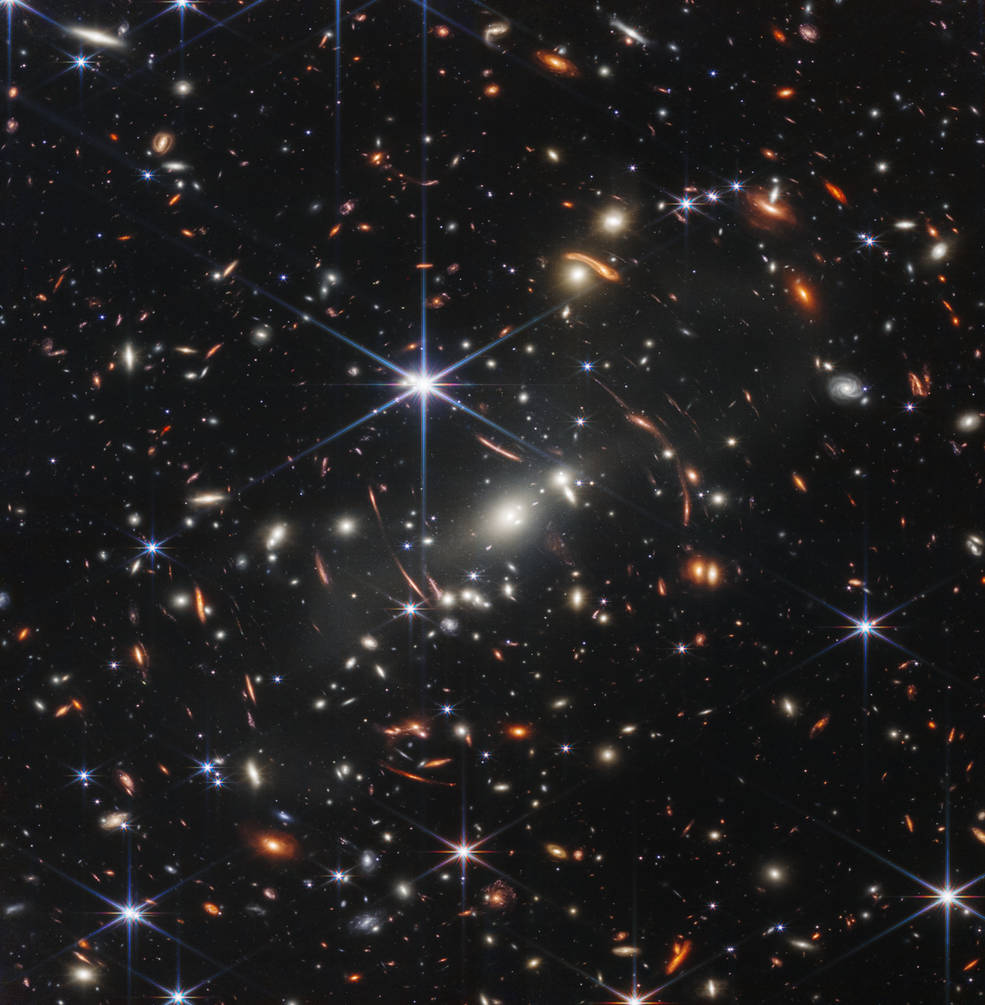
Another piece of extraordinary technology has made it into the main news stream: Like the Hubble Telescope before, the James Webb Space Telescope JWST is making the headlines. On the eve of the first public release of JWST’s first images, U.S. President Joe Biden was presented with one of them:

If you take a grain of rice and hold it up between two fingers, extending your arm towards the sky, the area which will be covered by this little grain of rice contains all the information similar to the picture above. Meaning, if you cover your entire perspective of the sky with such grains of rice at arms length, and you would be able to look through the Earth and do the same for the entire three-dimensional sphere that is the sky, the number of pictures like this one would equal the number of rice corns you have to use for this exercise. And with the exception of a few foreground stars, what you see in pictures like these are galaxies. Each of them containing billions of stars. According to our now ever firmer knowledge about the prevalence of planet forming around suns, there will be more planets circling around suns than there are suns in galaxies. And we talk about hundreds of billions of galaxies in the observable universe, at least.

I grew up with the hubris thinking that we may be alone in the universe. I can’t even emphasize how ridiculous such a thought is, in my view. But the period during which our observable universe has presented conditions which allow life to form as we know it, this may be the case since a few billion years. On a scale of the universe, civilisations like ours are a speck of dust, and I believe there are many of them.

If we blow ours up, oh well, will the universe notice?

Well, I am leaving the field of science here, and I will say the universe will cry because of our failure to do what we are supposed to do. Contributing to the beauty of this universe, rather than to our own selfishness.

Blip.


Uvalde – A Practical Proposal: Stop the monetization of social media channels glorifying Small Arms and Light Weapons

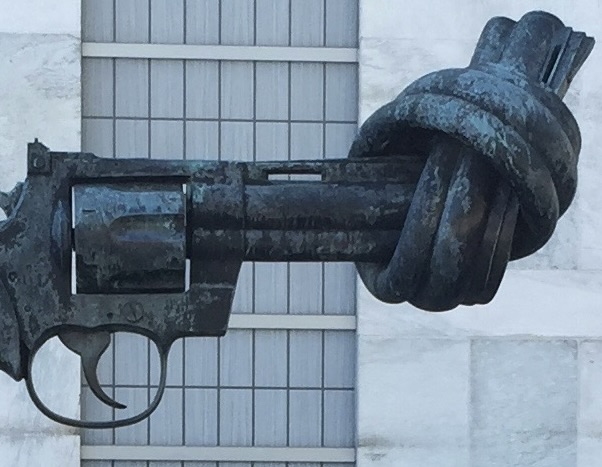
Picture taken by the author, 2016

Living in the United States between 2013 and 2018, I have had an inside view into the discussion that never seems to get anywhere: How to end the unending series of mass shootings which especially haunt this country. Like so many others, I am sick and tired. I am mad with the arms lobby, I do not understand how any politician arguing the rights of the Second Amendment being more important than any meaningful gun control law in light of the suffering of relatives, especially parents and caregivers, can even sleep, knowing that their sick and crazy protection of the gun lobby is making them morally complicit, as the next mass shooting will not occur in a decade, or next year, but within weeks.

At the time of this writing, parents, caregivers, husbands, wives, relatives, friends in Uvalde, Texas join a group of uncounted individuals who do not get relief from unspeakable pain, suffering losses that no parent and loved one should ever have to live with. Being a parent myself, my heart is broken and my thoughts are reaching out to those who feel utterly destroyed, hopeless, powerless, left with no meaning in their life any more.

Please watch this BBC video.

Gun violence in the United States takes more victims than traffic does. With brutal ignorance, the argument is repeated, over and over again, by these enablers of the NRA, that gun control does not curb this violence, that only armed security at schools does. There is no grain of evidence for such outrageous claims, against all comparative scientific evaluation of the effect of gun control legislation in jurisdictions all over the world. I am not even bothering with referencing such results here, they are ubiquitous for everyone who is really interested in getting the picture.

I invite you, for example, to watch the statement of Jimmy Kimmel, on occasion of the Uvalde school mass killing. I don’t have to add anything.

Meanwhile, German news report about contacts which the perpetrator had, in the weeks running up to the crime, with a fifteen year old girl in Germany. Including that the perpetrator clearly announced his intentions, and not only over the last minutes, but long before.

Which brought me to the role of Social Media, again. And here is a practical suggestion:

Demonetize any social media channel glorifying Small Arms and Light Weapons.


Since 2019, my work is connected to the efforts of the German Federal Foreign Office to support activities of States and international organizations to set up strategic, long-term, and meaningful gun control. We support this in six jurisdictions in the Western Balkans, we support it in the Carribean, we support it in West Africa, we look for ways how to engage in East Europe, and in Central Asia. The center of gravity of my work revolves around supporting the six jurisdictions of the Western Balkans in their effort to implement a regional strategic roadmap addressing all aspects of gun and ammunition control in a holistic way. Please, if you’re interested, read about the Western Balkans SALW Control Roadmap here. I am connected to similar activities in other regions of the world.

So I believe I know what I am talking about.


Advising on all technical, strategic, and often political aspects of this support work, I need to stay informed about latest developments, types of weapons and ammunition, converted weapons, 3D-printed weapons, and so much more.

That’s how Youtube began to invade my watchlist with weapons channels of the craziest forms.

I won’t even promote them here by mentioning names. They are pervasive, ubiquitous, the makers of these channels live and hail from the United States, Germany, Austria, just to name but a few.

Privately I am watching other things. I am subscribing to a few channels of vanlifers, who struggle to keep up a watching community of a few thousand, sometimes more. But none of them reaches the hundreds of thousands or millions of subscribers and views which weapons’ channels easily get. And I do know, from extensive watching, how absolutely centered these channels are around monetization, how makers tip-toe around some rules which would lead to a de-monetization of a vlog entry.

Here are two suggestions:

  1. Those of us who watch these channels: Unsubscribe, and make yourself heard about the reasons why you are doing this, in the comments’ sections. Subscribing to these channels is allowing the makers of these channels to generate a part of their revenue. Stop watching this stuff.
  2. To social media: It is time to take sides, and not to wait for a sickening and tiring new round of discussions on regulating the Internet. You don’t have to take the channels offline. Just demonetize any channel which can not clearly live up to justified reasons, such as scientific, policy, news&reporting, or else. Don’t hide behind the argument that the line is difficult to draw. The number of channels with people firing weapons under the craziest of all circumstances just for the purpose of glorifying weapons, and attract people watching it, it is outrageous. Take a stand. Don’t put your business model front and center. Act with compassion and support those who are eaten alive by grief, for the rest of their lives.