Does Compassion Know Boundaries?

On the featured picture: Art by Eva-Maria Horstick, arteve.de. Part of a series created by using AI-tools. Eva was in the final preparations for an exposition in Israel when the Hamas attack October 07 created mass casualties, suffering, despair, trauma, and the grounds for even more suffering. Her project in Israel is on hold with no certainty whether it has a future, or not.


I am fascinated by the train of thought stemming from the recent reaction to the blog post “The Attack on Humanity by Terrorism: Blinding and manipulating through inciting hatred and fear on an unimaginable scale – The monster hides in plain sight” from my nephew Nils: “Never again” must signify “never again for anyone, regardless of your ethnicity, religion or constructed social identities – A letter from my nephew“. It also makes sense to read the blog entry which is, so to speak, sitting between these two posts: “Bits and Pieces – November Thoughts – Some Book and Video Recommendations“.

Why is that?


If one reads these posts in a sequential manner, the complexity of the topics at hand becomes apparent. May be even overwhelming. Sometimes I feel they can become confusing. After all, we all try to make sense of our environment.

Making sense of information is what brains do for a living. Here is a book recommendation: “Livewired: The Inside Story of the Ever-Changing Brain” by David Eagleman (Canongate Books; Main edition – 1 July 2021). It is fascinating. I may have my own difficulties to accept the comparison of animal brains (including our own) with all-purpose-computing devices, but on a neurophysiological level it is correct for sensory and at least some higher cognitive functions. Whether this includes what we name “awareness” is subject to research, but we don’t know this yet. Which could make me getting lost in talking about Artificial Intelligence, but I won’t, except for using a blog picture which has been created using AI-Tools. Look at more of it here: arteve.de. Sometimes I think awareness is holding a key stitching so many confusing topics together.

Brains do constantly work on making sense of any sensory input, and I think the same is true for any sort of cognitive input by means of abstract forms of information, beyond what we process through our five senses. To operate in this world requires an ability to conclude on what is happening “around us”. Like we make sense of optical input through our eyes, we are also wired to interpret the information which is reaching us through communication, through news, chatter, gossip.

Meaning: We construct a representation of the world around us. If you read David Eagleman”s newest book, or the one I have been referring to in other blog entries, “The Brain”, you will appreciate that what we perceive as “the outer world” in reality is a construct inside our brain. Using this comparison, it is easy to accept that, for example, our visual representation of the world around us is limited to that part of the electromagnetic spectrum which we call “visible light” (telling, that name, isn’t it?). Same with acoustic input: We don’t hear what bats hear, or cats, or dogs, (ultra high frequencies) or elephants (ultra low frequencies). We construct our inner representation of what we call the “outer world” through the possibilities and limitations of our sensory input. The brain is agnostic where this input comes from. Throw input data on a brain, it will automatically work on making sense of it. Eagleman’s book offers fascinating insight into how this can lead to replacement or even enhancement of capabilities to create an inner world which we mistakenly equal with the outer world.

The same is true for processing information about the world as we have created it with our constructs which hold larger groups or societies together. We try to make sense of all sorts of data, and information. With that, we establish something which we then may call “truth”. Which is a treacherous word. In the realm of the fabrics for societal cohesion there is no space for “objective truth”. Rather it is about concepts which compete with each other. Terms used in social media such as “influencer” and “follower” are bluntly revealing this. Donald Trump’s choice of “Truth Social” as a brand name for his own bullhorn social media platform is telling: It’s about my truth, not your truth. Which renders any coherent use of the term “truth” very fragile, at least.

The interpretation of, say, visual information on physical objects in our environment is relatively stable: As long as the light gets reflected from an apple, even different lighting conditions will usually make me “see” an apple. Not a peach, not a shoe, not a snake, but an apple. Information encoded in light reflected from physical objects is less prone to manipulation, though it is possible. By contrast, the interpretation of data about our highly complex individual, social and political relationships, the interpretation of concepts which have no physical representation in the world (for example law, human rights, cultural norms, spiritual or religious or secular beliefs) is highly dependent on a great number of factors manipulating the result about what we believe to understand. There seems not to be one reality which could be universally accepted by all. There seem to be many competing “realities”. For one, thirty years ago I decided to prefer Apple computers and to ridicule Windows computers. It sticks, until today. Once you’re locked into one explanation of reality, it is very hard to stay open-minded enough to look at information which appears to go against the foundations of what you have decided to “follow”. Which is where “influencing” comes in: It is meant to get you into this select perception, and preferably to keep you there.

What do people make with this fact? How do I live with the recognition that my interpretation of my environment is fundamentally different from anybody else’s interpretation, but that none is holding a universal truth?

The brain is a highly social organ: It can not survive without other brains. It needs connections, it needs proximity to and synchronicity with other brains, it constantly does one thing: Establishing a framework of reference which does make sense within a shared reality with others. The hermit in a mountain cave who lives a solitary life and is able to come to autonomous attitudes and conclusions through “deep thinking” is a highly idealised concept, appealing only to very rare individuals. And even a hermit had to grow up in a social context before deciding to choose solitary self-confinement. The reality is: We depend on belonging to groups, for the sanity of our own mind depends on it. We can’t do without “influencing“ and “following”, all of us. That is also why I believe the pandemic created a global mental depression through massive deprivation of brains from what they need, and why I put the pandemic into the row of destabilising developments of the current world order: The effects contribute to our global development until today.

And again, why am I asking this question against the context I started with above?

It has to do with what is stressing our societal cohesion, in many different societies: Can I empathise with suffering of people without having to be on “one side, or the other side”? Can I acknowledge, as my nephew and I suggest from different vantage points, that we acknowledge suffering equally, and not limited to the fate of one group? Look at hashtags on Tic Toc: #istandwithisrael, and #istandwithpalestine appear to be mutually exclusive. Just one example for an attitude leading to “If you’re not with me, you’re against me.” Why do people follow such a foolish logic?

How do I make sense of data, information, conclusions, interpretations, efforts to manipulate, by reducing complexity and establishing an explanatory pattern? Are there any principles which can help guiding me on a higher plane of consciousness?

In attempting to avoid a futile and not-so-competent academic discourse, I am sure, however, that one crucial factor in how we interpret the world around us is what I would call “simplification”, or “categorization”, or “reduction”. Brains are highly specialised in identifiying patterns in incoming data or information, and that has been useful since the emergence of the pre-frontal cortex many millennia ago. What is setting Homo Sapiens apart from our ancestors may also be what is haunting us most: Any categorization reduces complexity, but also limits our appreciation about what happens. Whilst we have achieved an outstanding and evolutionary unique ability creating mental concepts which allow for cohesion of larger groups and societies, we still use the same hardware (our brains) for reducing complexity, and establishing peer connections with others. From there, competition arises, which is a good concept. But also intolerance arises. And conflict. And yes, we have developed fancy tools far more powerful than sticks and stones for successfully killing other fellow human beings. Have we missed out on developing commensurate tools allowing for empathy and compassion beyond the peer groups we have been born into, drawn into, chosen to belong to?

I don’t think so. Wisdom traditions hold these values since thousands of years. Which, against the evolutionary context of our brain development, still is a drop in the bucket. Meaning: The development and cultivation of compassion and empathy in a contemporary context is subject to evolution, too.

We have to work on this. Hard. Otherwise we will be history ourselves.

“Never again” must signify “never again for anyone”, regardless of your ethnicity, religion or constructed social identities – A letter from my nephew

On the picture: Concentration Camp Memorial Site Dachau – Picture taken by the author


Nils is my nephew. Between him and me there are, give or take, three decades in age. Ever since I can remember we are very close. Souls don’t know age difference.

He is living in Neukölln, a district of Berlin known for its energy from its multi-cultural scene, or should I say “scenes”, because like neighboring Kreuzberg, it’s diversity is hard to describe, but wonderful to experience: Spend a spring or summer evening there in street cafes, with a view overlooking waterways and cobblestone scenery, vibrant international people gathering, discussing, having fun, it’s quite magic.

Mariam from Egypt and Nils from Germany are married. Last time I visited, I lost myself in their hospitality, our discussions, lovely Arab food and I had to rush back to my campsite in the “deep southeast” of Berlin (former East-Berlin) before the gates were closing.

When I published my post “The Attack on Humanity by Terrorism: Blinding and manipulating through inciting hatred and fear on an unimaginable scale – The monster hides in plain sight, Nils wrote me an email, offering his perspective. In subsequent family discussions I sensed how much the public discussion of Israel and Palestine had touched very raw nerves of people in their everyday lives. So I invited him to share his comments on my blog. He translated his text into English, and here it is.

I find it gripping. Nils has put his finger on a very uncomfortable truth here. So, read it. Observe your emotions when you read it. It’s important to do that. I will follow on in another blog entry.


Dear Uncle,

I appreciate your post and share your perspective on the horrific loss of life at the hands of Hamas. October 7 is still in our memories and as time progresses I would like to add two perspectives: on Germany and its domestic discourse, and on the conflict itself.

In the weeks after Hamas’ horrific attack on innocent civilians and the ensuing violence in Palestine, I have come to doubt whether we, as Germans, have fully grasped the lessons of our own history. Germany’s historic guilt for the Shoah and WWII enshrined the principle ‘never again’ in our cultural identity. Never again must Jewish life be endangered by violence, in Germany and elsewhere in the world. I appreciate this lesson and its importance becomes ever more urgent as we witness a surge of anti-Semitic violence. It is deplorable and, primarily, a problem of our own making that Jewish life in Germany is threatened by hate crimes. After all, the Federal Criminal Police Office reports that 85% of anti-Semitic hate crimes are committed by native Germans.

Looking at the German public discourse I am very much worried that we reduce the painful lesson of our history selectively. “Never again” must signify “never again for anyone”, regardless of your ethnicity, religion or constructed social identities. Yet we are witnessing a massive shift in political discourse as migrant life is increasingly criminalized by means of legislation and law enforcement, whether in schools, workplaces, or on the streets. We focus heavily on language [is Hamas a terror organisation or a government, is a protest chant insinuating other meaning, is it fair to classify Israeli policies as Apartheid] that we fail to have a genuine discussion about the events on the ground. Jewish and Palestinian voices are loud and clear on these issues, we have so far failed to listen.

In Berlin, Israelis and Palestinians, Jews and Muslims call for a ceasefire and a two-state solution, side by side. In this sense your dream is a reality today. However, your dream takes a bizarre if not sinister turn looking at the arrests by German police of Jewish individuals with anti- or left-Zionist beliefs for sedition as they speak out against the violence in Gaza. Yes, German police arrests Jewish life for using the right to freedom of expression on German soil. Civil society organisations such as Oyoun that created cross-cultural spaces for difficult conversations between Arabs and Jews have had funding and therefore their life lines removed.  Artists and cultural workers from the Global South that create truly special alliances with Arabs and Jews and imagine shared futures are being cancelled, forced to resign, or refuse to appear in public from fear of reprisals or being slandered by the German press. Empathy flourishes at the heart of civil society, yet politicians and decision-makers from right and traditionally left-of-centre parties defame and dismantle these non-German perspectives.

Instead, we have a narrative that ignores all of these voices and portrays the two sides as irreconcilable. It seems too uncomfortable for the German public to be called upon by Jewish and Arab groups demanding equal rights for Israelis and Palestinians. It seems so uncomfortable that opinions that challenge this status quo are silenced for sedition or other charges. Meanwhile German mainstream public and private media does their part in communicating only a very narrow perspective on the conflict. Hateful celebrations of a small number of people in the aftermath of the Hamas’ attacks were amplified. Cross-cultural protests, the attitude of protesters and their slogans are misrepresented and racial prejudices are spread. At the same time, media reports about Arabs and Jews in Germany and abroad as a homogenous mass and juxtaposes their interests and needs. This enables alt-right discourses and strengthens their political parties, such as the AfD.

What does that mean for the health of our own democracy and values of Enlightenment?

Palestinian and Arab life in Germany was removed of their right to freedom of expression in the first weeks of October. Children are prohibited from wearing the Kufija or show a Palestinian flag in school, criminalising their identity instead of engaging them on important discussions. Longstanding slogans of civil rights movements are being taken out of context and criminalized, in public spaces and in protests. German muslims and migrants are expected to verbally distance themselves from Hamas in every public and private conversation, fostering that people with a specific background need to prove themselves or cannot be trusted. Do I need to justify myself in every conversation that I am in fact not a Nazi, despite my identity?

The result is a slow erosion of political cultural and rights in Germany today. And reality is unfortunately as harsh as it sounds: non-European migrant and German communities, whether from the Middle East or elsewhere, feel unsafe as their social and political realities are marginalized, criminalized, and their fundamental freedoms restricted.

Stefan, the lessons of “never again” stipulate that the dignity and integrity of ALL life should guide our actions. We must call out injustice wherever it occurs. Israel’s defense against Hamas’ attacks is a logical response to a vile assault on our shared humanity. Let us remind ourselves that Palestinians themselves do not favour Hamas, with only 27% of Gaza’s residents supporting Hamas before October 7. This figure is comparable to German’s support for the right-wing and anti-constitutional party AfD in Germany.

The massive loss of Palestinian life is a direct result from the horrific assaults of Hamas in Israel’s soil. Yet as we look at Gaza and the West Bank today, we cannot overlook and excuse the Israeli government’s collective punishment of Palestinian life at the hand of a government that rejects a two-state solution, builds settlements at an alarming rate and openly endorses apartheid policies. The dehumanizing rhetoric adopted by Israeli officials pave the way for mass atrocities. We witness this today as we observe an unprecedented destruction of civilian infrastructure and loss of life in Gaza. In the West Bank, settler violence flourishes under the protection of the Israeli Defence Force. Back home, in safety and privilege, we label any criticism of Israel as anti-Semitic, no matter if such criticism is vocalized by human rights organizations, governments, the UN or even Jewish-Israeli opposition to the Netanjahu government.

Why can’t we condemn the injustices in the West Bank, the collective punishment in Gaza, and Hamas’s heinous attacks with equal vigor? To what extend are we enabling an apartheid regime that solidifies its control under the guise of war? Why are Palestinians and Arabs not allowed to mourn their dead and voice their outrage with the collective punishment of Palestinian life? Why are we, as Germans with a Nazi history, so focused on Palestinians denouncing Hamas and anti-Semitism while arresting Jewish individuals demanding equality and safety for everyone? As a nation with a complex history, why can’t we engage the multifaceted reality of the Israel-Palestine conflict with empathy and dialogue for both sides? Why can’t we understand that Palestinians cannot pay for our own atrocities?

As per international law, neutral bystanders of crimes against humanity and severe human rights violations bear responsibility. Germany is politically not neutral in this conflict and its military exports to Israel are up nearly 10-fold. We stigmatize Jewish and migrant lives due to our inability to critically engage with our past and our allies. It is uncomfortable to us Germans with Nazi history to look in the mirror and critically reflect for fear of standing on the wrong side of history. Our solidarity with and historic responsibility for Jewish life must not lead us down a path of supporting violence and denying another people’s right to self-determination. We risk betraying our fundamental principles of human dignity and democratic freedoms in reaction to our historical traumas. We alienate and disrespect Jewish perspectives, German and non-German people of color and, in the process, thereof, risk losing our own humanity.

Uncle, I appreciate the conversation that you have started. We are the generations that follow the Shoah and the atrocities of World War II. It is our historic responsibility to uphold and apply its lessons to all life, to uphold their dignity and integrity in Germany and abroad.”


Note as of 25 November: Very small editorial corrections on request from Nils for clarity. Since the blog post has been up since one day and has been read, and since these are not grammar corrections, here the corrections for transparency:

a) German muslims and migrants are expected to verbally distance themselves from Hamas

b) Do I need to justify myself abroad (remove word)

c) non-European migrant and German communities

d) We alienate and disrespect diverse Jewish perspectives, German and non-German people of color and

Bits and Pieces – November Thoughts – Some Book and Video Recommendations

Featured picture: Mushrooms in autumn, Berlin, taken by the author, 2023

I spent almost two weeks in Berlin. The golden autumn colours of early November have been replaced by the grey/brown colors of a few remaining leaves which will soon be gone as well, leaving the remaining green only for the the firs, and a few bushes. The dark winter time has arrived, rain is dripping off the trees, the pedestrian’s walkways are covered with layers of sticky leaves, less and less fresh mushrooms pop up in the woods, walking in the forest needs to be done early afternoon, otherwise I would need a torch. I am starting this blog entry shortly before 4 pm, and daylight is fading. Since this night the raindrops hammered away on the roof of my caravan, the heating system humming along, coffee will soon be replaced by herbal tea for the cozy evening. My cat friend just enjoying the time he is spending with me, or checking the rainy neighborhood, then coming back for yet another snooze. This winter I am, at least for the moment, doing better with the depression attacks which always come with the darker season. In my conversations with other people in my life I frequently hear about depressive mood swings. The reasons not only being related to the darker afternoons and long nights: Frequently I will listen to the despair and feeling of utter hopelessness which seems to come with the never-ending stream of troublesome and often horrific news about human suffering. I do also suspect that long-term impact from the Covid-19-pandemic plays an important part in all that. As far as I know, our scientific understanding of it has grown significantly.


Yet, I am doing mostly okay, and I am preparing for my two-days-travel back to Belgrade. Almost done with my house-cleaning and preparation of my campervan, I am now sitting here processing some pieces for writing. Each of them not seeming to warrant an entire article. But all of them somewhat relevant. So I try to establish a conduit of sorts which I want to put on the blog before moving towards the next installment in the series of “essays on policing“.


On De-humanization, and on Getting The Ducks Into One Line

I said that I am doing relatively okay, despite the following quotations:

  1. “We pledge to you that we will root out the communists, Marxists, fascists and the radical left thugs that live like vermin within the confines of our country…
  2. “The threat from outside forces is far less sinister, dangerous and grave than the threat from within. Our threat is from within. Because if you have a capable, competent, smart, tough leader, Russia, China, North Korea, they’re not going to want to play with us.”
  3. “those who try to make that ridiculous assertion are clearly snowflakes grasping for anything because they are suffering from … and their entire existence will be crushed when … returns to …”
  4. “…undocumented immigrants are “poisoning the blood of our country.”

Who said that?

Number 1, 2, and 4 are quotations from the former President of the United States, Donald Trump, including on occasion of a Veteran’s Day Speech he gave November 10, 2023. The Washington Post reported under the headline “Trump calls political enemies ‘vermin,’ echoing dictators Hitler, Mussolini“.
Number 3 is attributed to Steven Cheung, a Trump campaign spokesman, after media was following up on the comments above.

Other articles, such as in the New York Times, make reference to openly discussed plans to creating giant camps, “a vastly expanded network that would facilitate the deportation of millions of undocumented immigrants, including longtime residents with deep ties to communities”.

Nr 45, in unison with his minions, is extremely articulate about using every power available to crush enemies, their wifes, and their families. Reports are out that right-wing organisations such as the Heritage Foundation are in possession of vetting lists with tens of thousands of names of individuals considered to be loyal to Trump, with the aim to install them in every corner of Federal administrative agencies, the Department of Justice, the Department of State, and the Department of Defense.

People appear to get either excited about this, or tired. CNN’s Jack Tapper was very clear in one comment where he said that this is the open attack to get the Republican Party in line. Because: Who is crying foul related to such comments, aggression, retribution, and vengeance? Not many. In a recent article I wrote about this. The obvious next and strategic blow is aiming at getting the Republican ducks into a line. Dissent will not be tolerated once Nr 45 is the official party candidate for the job as Nr 47. Tapper literally likened the Grand Old Party to the only institution which can stop the demolition of democratic values as it is unleashed by an upcoming autocratic leader. Of course, there still will be an election, and we may be lucky to get away without the ultimate consequences. But, do we know that? And does it justify complacency, or denial? Certainly not.


The use of terms like “vermin” then leads to the historic responsibility which Germany bears for the consequences of Nazi-Germany’s crimes against humanity. The Holocaust has put Germany into a role where, what we call “Staatsraeson”, leads to a strong supporting role to Israel which Germany has taken after the Hamas Terror Attacks of October 07, 2023. Chancellor Scholz stated “The security of Israel is German Staatsraeson”. Meaning that Germany recognizes Israels’ right to self-defense, and the following actions in the Gaza-strip.

Which, in my experience, is a conflict and war with a potential of antagonisation ripping through the German and other societies like none I have witnessed in a long time.

When I look at the human suffering of civilians in Israel, and in Palestine, and in conflicts and civil wars in the Ukraine, so many places in Africa, and so much more, at one point I raised the question: “How open do I have to keep the path to my soul in order to stay compassionate and loving for all those who are victims of brutal violence, conflict, oppression, and war?” I genuinely feel like this, in order to stay out of crippling inertia and depression. But one answer which I got was “I can’t keep my soul open much longer, I can not bear this.” So, is this a reflex of emotional and spiritual survival? Will such a reflex lead to shutting down our mercy and compassion, and lead to a simplified world where we will be selective in our compassion, selective in our support to universal values?

I came across a Youtube video produced through an interview with Yuval Noah Harari, one of my favorite authors, a historian and professor in the Department of History at the Hebrew University of Jerusalem. This is an amazing piece of media work, and it describes in a very intense way why we moved from a relatively peaceful period into a current period of conflict and war. Harari and the authors explain in vivid presentations why the demise of a current world order (arguing a monopolar world order before this time of conflict) is leading into chaos, and dissolution of international instruments of stability and order. I strongly recommend watching it, it is a nine-minute piece and Harari is very clear about the imminent threat to humanity as a whole if we don’t find a way out, and back to common values.

And, on a more personal note, a continuation of my article on “The Attack on Humanity by Terrorism: Blinding and manipulating through inciting hatred and fear on a unimaginable scale – The monster hides in plain sight” might come up, perhaps in a form of a discourse, attempting to bridge the divide. Because standing in against terror, standing in for human rights, it does not mean to be on either one or the other side, which is the devious result from Hamas’ mastermind plan. By the way, in my previous blog article I mentioned that Hamas’ aim will be to make the attack on Israeli citizens forgotten. Here a link to a Hamas political leader denying that Hamas attacked innocent Israeli citizens, but only conscripts, despite the overwhelming footage which included old people, women, children.


Somewhat related to the above, and somewhat a comment for a new paragraph is the following, and I quote from a BBC article:

“Then in 2006, Hamas kidnapped a soldier, 19-year-old Gilad Shalit, in a cross-border raid. His father, Noam, led a painful five-year campaign to bring him home, stressing the “unwritten contract” between the state and its conscripts.

Benjamin Netanyahu, the prime minister – then as now – signed off on the biggest ever prisoner exchange for a single soldier. More than a thousand inmates were released including Yahya Sinwar, who went on to lead Hamas in Gaza, and apparently masterminded the 7 October attacks.

Emphasis by italic and bold letters are all mine.

The very same way, but may be a thousand times more grave, we may see future terror leaders coming from what is happening right now. Some may say: “See, this is why the response to this attack is wrong.” I do say: This is part of the devilish logic which has been masterminded by Hamas, because it is not leaving Israel with any alternative to responding with military means. As I said, this does not give Israel a free reign unshackled from restraints by international law. It simply means that whatever Israel does, Hamas’ logic aims at disruption of communication and future violence. Another question which I have heard from a friend: When the Ukraine was attacked, all of us welcomed Ukrainian refugees. Where is the response of the Arab world, taking in people from Gaza? That includes the painful question why the Rafah border crossing is kept close by Egypt. I am not an expert, nor my friend is. But the question is valid. And unnerving.


Yet, how can I fare relatively well despite such news?

Here is a book recommendation: “In Love With The World – A Monk’s Journey Through the Bardos of Living and Dying” by Helen Tworkov and Yongey Mingyur Rinpoche. Here is a link to Amazon, but you can buy it everywhere. I enjoyed it thoroughly on my Kindle, though.

I don’t know how you will feel when reading this book. I can imagine that you might retract, because it is about Life and Death, Living and Dying, Dying and Living. I have no writing skills to even summarize it. To me, it is mindblowing, and gripping. It is about Mingyur’s begin of a four-year wandering-retreat which he went on in 2015, in his Tibetan Buddhist monastic tradition. It is a wonderful story filled with details about his experiences after leaving a protected monastry environment, exposing himself to the loud, noisy, dirty and poor street life of India. I wonder how he could remember all these details which make up a story creating most colorful images in my phantasy. It is a book with a unique approach to mix daily experience with Buddhist thinking and tradition. It is a book in which he gets poisoned by rotten food and almost dies. Most of all, it is a book describing his experiences during this process of a near-death-experience.

For Tibetan Buddhism life and death are an endless series of “Bardos”, or transitions. Trillions of beginnings and endings in daily life, bigger ones through changes throughout one’s life, and the great Bardo of coming into this life as well as leaving this life. Which is, in Buddhism, something I can not appropriately describe. Some would name it birth-death-rebirth, except if you leave this cycle of constant involuntary rebirth by awakening. Of course, this is a profoundly spiritual belief without any ability to prove it by means of science. Of course, it is one of many ways how to make sense, except you are utterly atheist. But like Pema Choedron’s book “How We Live Is How We Die”, Mingyur Rinpoche’s book is filled with practical wisdom of how to apply the profoundly human principles of compassion and love, which, in my view, sit at the spiritual root of what we have labeled Human Rights. This book helps in accepting there is literally no permanence at all in life.

The book is one of the reasons for why I am doing relatively well.


Alright. Now my head is free for the finishing touches on the next “essay on policing”, which will focus on some very personal experiences which I made on my path towards integrity.

Stay tuned.

The Attack on Humanity by Terrorism: Blinding and manipulating through inciting hatred and fear on an unimaginable scale – The monster hides in plain sight

The featured picture: Memorial Site Concentration Camp Dachau – Germany. Picture taken by the author on occasion of visiting the site May 2019, with two dearest American friends.


Every parent has seen this: A child in devious mood, quickly checking that it is not being watched, then hitting his or her sibling. The sibling being attacked yells for Mom or Dad. The parent rushing in, trying to find out what happened, and the attacker claiming “Mom, she started it, not me!” Bullies on schoolyards do the same: They immediately accuse the victim of having started the fight when caught.

As parents, we would join in the common experience that this is a typical phase within childhood development. If we are wise, we would undertake all efforts not to be manipulated into taking one child’s side. If we are able to clearly identify what happened, and who started it, we would work towards an understanding that action has consequences, that own behavior leads to accountabilty. We love them both. We would work hard helping our children to gain values of coexistence, rather than domination. We would learn how to explain the need for compromise, and that any compromise includes giving something away in order to share getting something. Myself being a parent, I remember this vividly. It can be absolutely unnerving being confronted with two children who are locked into a fight, not capable to give up, and becoming furious that Mom or Dad does not take their side. It takes a lot of patience and diplomatic skills to navigate through these situations until both children are ready for a compromise. In more than one case, I messed it up. The consequence was turmoil, protracted fights, and pain on all sides. But if successful, peace is reestablished quickly. And at some point during their development coming out of age, former children will look back at their fighting memories with smiles and jokes.


Childish behavior? What does it have to do with the title of this blog entry?

Let me try to paint a larger picture before locking in on what, in another context, representatives of the United Nations have named actions “verging on pure evil“. With this wording AFP is quoting UN officials talking about the unimaginable suffering of Darfuri people again, twenty years after a genocide. They are at the brink of another one. I have written about it, here. Most of us don’t even see these news. We are transfixed by what is happening in Israel and the Palestine Territories. I want to write about action which has crossed the border into the realm of pure evil: The Hamas terror attack against Israel and Israeli civilians, October 07, 2023.

In order to create the link from childish “tit for tat” and “he started it, not me” kindergarden behavior to what appears to have exploded into fiery emotional antagonization making it difficult offering an argument calling for reason, I want to recall how used we have become to the application of this utterly childish behavior as a most devious tool of manipulation by adults, namely by adults who hold or held highest office, and how a cohort of followers is using this method for manipulating and controlling massive portions of entire societies. The trick is: Blame the other side, trick them into anger and hatred, and capitalize on it. After pointing this out, I will take it to its most recent extreme application: This time in the corner of terrorism. Because we are running the risk of being successfully blindfolded by the mastery of a plan coming straight from hell, emerging through the underground tunnels in Gaza.


The 45th President of the United States brought this childish logic of always blaming others to perfection in each and every argument. When accused of bullying behavior, he would point to others having started it. When held accountable for own actions, he would point to others, faking stories, hammering out endless lies about these peoples’ own alleged evil. We have been through endless years where this person simply followed one rule: Escalation. On uncounted occasions we found and find ourselves in a reality where every day reveals another outrageous attack which was previously considered to be unthinkable. He is not alone in that, and I am not even talking about his followers, I am talking about other Heads of State, Presidents, Dictators, Autocrats. My argument is that this form of behavior has become mainstream, on a global level. Ruling people, manipulating people, controlling people, by inciting hate, anxiety, anger, and locking them into a fake narrative through lies which stop any bipartisan communication cold in its tracks. Once I am not willing to listen to people with other views, because I am told they are the enemies, I have successfully been locked into a world being solely controlled by these pied pipers.

However, like in the case of Nr 45 and others, we still underestimate them. We try to find reasons, we may ridicule, laugh, minimise, deny. I take a different approach: I assume that people like Nr 45 or others are not just deranged, or are stuck in childish behavior, or may suffer from mental conditions including narcissism and psychopathy making them incapable to act differently. They may be all that, but I do believe they act in cold blood. I believe that Nr 45 knows exactly what he is doing. Currently he is playing the story of facing prison “for the American people” to absolute perfection. It doesn’t matter that every Democrat is laughing at that silly argument. It does matter that this story locks up millions of other people in a scenario justifying to demolish democracy, and being intolerant to anyone different from their fascist, xenophobic and misogynistic thinking. I believe there is a good chance he may succeed again, and this is openly discussed in mainstream media. Which will open the doors of hell. Again. Never before in my view it has been more important to remember lessons of history. We are about to make horrible mistakes, once more.


This modus operandi is not new, at all. Sect leaders do it. Dogmatic ideology and ultra-orthodox religion does it, within any faith I know. Hostage takers do it. Hitler did it. Children in insane family situations face the same, as victims. Rocker gangs, street gangs, mafia-type organisations, they all deploy these principles, partly or in full. And these are just a few examples, small and large. At the core, it is about mercilessly controlling others for the own benefit.

Terrorism and violent extremism is using the same approach. The list of contemporary examples is long and would stretch from Afghanistan to the Middle East, from East Africa to West Africa, I could name examples in the Carribean, in Middle, Central, and South America, in Europe, just from the list of country situations I have a personal experience with. Of course it would include Afghanistan, the Ukraine, and the history or even small contemporary pockets in the Balkans. Again, just examples. Do we pay attention to Africa?

But nothing leaves me more scared than what is happening since October 07, 2023, the day of a most horrific attack by Hamas against Israel and the Israeli people.


Why is that?

It was Hamas who launched a terror attack from hell. It were Hamas terrorists who equipped themselves with GoPro cameras, livestreaming their hunt for Israelis hiding in horror. Lifestreaming how they maimed and raped and killed them. Amplifying the lifestreaming done by ISIS a thousand times larger. It were Hamas terrorists who deliberately bragged and documented their murderous attack on innocent Israeli citizens, claiming unspeakable atrocities in messages sent back to their families on social media channels.

For me, one question sits front and center: Why have they done that? And my answer is: In order to maximise blind emotions by Israeli citizens, in order instill hatred in the Jewish community all over the world, in order to derange a beginning hopeful dialogue between Israel and Arabic States, and in order to outrage international friends and supporters of the Jewish community. Reminded of 9/11, I am. At the same time, Hamas did this in order to be seen in the world of their sympathisers and supporters, to instill raw emotions of lust for more cruelties. They simply calculated that, within weeks, nobody would remember these pictures, because the world would be flooded by picures of dead Palestinian children.

Why?

There is only one answer possible: The sheer size of this attack, it’s careful long-term planning in utmost secrecy, and its military-style execution serves one brutally calculated purpose: To incite blind fury in the Israeli society. Hamas has done this for no other purpose than to provoke the most massive attack against Palestinians in the Gaza strip possible. Hamas’ calculus includes not only hundreds of Israeli hostages. It includes 2 million hostages in the form of Palestinian citizens who have no chance other than to live with probably the most sophisticated network of tunnels that the world has ever seen. Those tunnels do not serve as protection for the Palestinian people. They don’t serve as food storage for the population, or as shelters for them. These tunnels serve the purpose of a terror organisation, allowing fighters to move in security, rest between combat, storing huge amounts of weapons and military equipment (and food for the fighters), and deliberately placing the entrances of these tunnels into buildings used by civilians.

Hamas wants the Israeli military to overreact. Hamas wants to see as many Palestinian civilians being killed as possible. Israel, struggling with the pain of a terror attack and death tolls paling much since the Holocaust, now struggles with how to exercise the right of self-defense and taking at the same time all reasonable precaution to avoid civilian casualties in a situation where the other party to this war is using an entire population not as a shield, but as victims in a strategy aiming to blame Israel for violations of international law on armed conflict. Hamas, not Israel, is fundamentally violating the responsibility of any government to protect their own citizens. Hamas is leaving Palestinian citizens no choice but to be in the cross-hairs of IDF military action. The newsrooms are filled with stories of Israeli intelligence operatives calling Palestinian people hours before a planned strike, guiding them by telling which buildings have to be evacuated, and how much time is left. The newsrooms are not filled with stories how Hamas fighters lay down their weapons during any temporary silence of the guns, helping their population to get out of the combat zone. They simply don’t do that, because they need, and want, the pictures of Palestinian dead people, the pictures of overcrowded hospitals. They don’t want to show the entrances into the tunnel network under those hospitals.

This does not mean that Israel somehow can gain a moral benefit. It does not take Israels’ responsibilities away at all, as many in highest functions and being friends of Israel have stated, including highest officials in my own government, with mindblowing clarity and standing at Israel’s side. Germany has a historic responsibility, until today.

But it does mean that under no circumstances Hamas shall be allowed to successfully victimise itself, executing a long-term strategy exactly aiming at that. In this, there is the connection to the childish bully, and autocrats and would-be autocrats.

It does mean that there is a direct consequence of Hamas’s strategic and operational decisions for those Palestinanian casualties, in addition to the havoc they caused on the side of Israeli citizens. Every Palestinian citizen killed is being killed because of deliberate and calculated decisions from Hamas political and military commanders who want to see exactly this happening, rather than taking precautionary measures in order to adhere with their own obligation to protect the citizens of Gaza.

Hamas and their supporters will do everything to keep this fact in hiding, though in plain sight. Whether Israel exercises caution during a strike and casualties have been unavoidable and in compliance with international law, or whether there will be operations gone out of control, in each and every case Hamas will use these pictures for deflecting from its own accountability, and outmaneuvering Israel, finding herself in the most awful “Catch 22” situation imaginable. Each action is aiming at raising fury of Israelis, and every ultra-orthodox jew taking the law into his or her own hands will be used to contribute to the narrative that the evil is Israel.

That is the evil. And it started with this devilish plan executed by Hamas. For that, Hames needs to be held accountable. Like everyone else who violates international law, including the law of armed conflict. There is no other way. But this was carefully planned and executed by Hamas, including killing their own population through this calculus.


Why am I so passionate about this?

In recent weeks I am confronted with a flood of passionate reactions. Many of which are entirely polarised. The list of reports of people demonstrating for the one cause or the other with peaceful means is endless, and global. The list of incidents of anti-semitic violence is horribly long in many countries. Anti-semitic sentiments are exploding. The list of demonstrations and actions in support of the Palestianian cause is including unacceptable violence, in places where this stokes yet another round of xenophobic reactions. Many countries experience this.

At the same time, I am witnessing an emotional energy in this affecting the day-to-day discussions of “ordinary” people exceeding by far anything I have witnessed in previous developments, like when the war in the Ukraine broke out. Most recently, it affected my own family. It feels like if one supports the Israeli case, only subdued mentioning of the suffering of innocent civilians on the Palestinian side minimises the risk of being suspected of supporting “their” cause. The same the other way round: Reminding of the fate of the Palestinian people seems not to be very compatible with, at the same time, expressing equal sympathies for Israeli victims.

Been there on so many other occasions of conflict. But this time it feels very explosive including in societies far away.

Sympathy and compassion for the suffering of innocent people is running the risk of becoming monopolised: Either one is on the Israeli side, or the Palestinian side. Very much the same way, demonstrations appear to focus on the one or the other narrative, or may be it’s the way how media is reporting about them. And the mantra of “Who started it?”, “Who is responsible for it?”, it often leads to fingerpointing towards the other side. A collective view appears to be difficult to argue.

I would dream of demonstrations in which Israeli and Palestianian victims, mourning their loved ones, stand in for the protection of their human rights together. And where Hamas is isolated. Punched out. By both sides. Accused of the sheer monstrosity of their decision how to set the world on fire. And where more than it already is happening, Israeli voices can be heard how they desperately try to exercise caution. And other voices making it clear that there is no space for human rights violations.

And above all, that there is no space for collective responsibility of both peoples for actions of individuals, or in the case of the Palestinian people, a terror organisation. That both people have a right and will to co-exist.

It was this discussion that Hamas wants to eradicate. Because Hamas wants to eradicate the State of Israel. To achieve this, they are ready to kill their own children.

I mourn every innocent victim of this endless cycle of putting the blame on others, including through a recent terror attack from hell’s underbelly. I wish we retain an ability to listen to each other, and to cultivate an attitude where I first and foremost look at my own accountability, before talking about the accountability of others.

That’s my yardstick.

essays on policing – Integrity – Why do I use this term?


Integrity

the quality of being honest and having strong moral principles that you refuse to change

(Cambridge Dictionary)


“: firm adherence to a code of especially moral or artistic values : INCORRUPTIBILITY

: an unimpaired condition : SOUNDNESS: the quality or state of being complete or undivided : COMPLETENESS

(Merriam Webster)

A close friend responded to my recent blog entry on integrity: “I love word etymology – think about this – integrity … integrated … mid 17th century: from Latin integrat- “made whole” :)”


On the featured picture: June 30, 2005, I visited a refugee camp with thousands of internally displaced persons (we call them IdP) close to Al Fashir, the regional capital of Darfur, in Sudan. I took many pictures, this one displays a young girl sheltering a baby in her arms. My visit was part of a European Union Factfinding Mission. We tried to find out how we could assist the African Union Mission AMIS in their gargantuan task of providing security to people in Darfur. Tormented by a civil war, Darfuri people fled a situation in which they found themselves attacked by militias burning their villages, killing and maiming villagers, trapping women who went to fetch water at local waterholes, subjecting them to most cruel violence, raping and killing them. The fate of children was equally horrible. Refugees had come to these camps where they hoped for protection. Places like these were abuzz with the presence of peacekeepers and non governmental organizations providing most basic humanitarian assistance. The Internet was chock-full with shocking stories and with outrage, the pictures of suffering went around the world. What would follow were many years of peacekeeping, first by the African Union, then by the hybrid Mission UNAMID, jointly conducted by United Nations and African Union. For many years, UNAMID included the largest uniformed policing component of any peacekeeping operation, by far exceeding the 4700 police officers from up to 54 nations which were deployed to Kosovo, under UNMIK. UNAMID police and military components focused heavily on protecting civilians. By comparison, capacity-building of Sudanese policing was very limited, which sets this Mission apart from, for example, how UNMIK operated a large capacity-building component. There are many reasons for this due to the nature of this very specific environment. However, this difference is noteworthy.

UNAMID completed it’s mandate December 31, 2020. April 2023, severe clashes began between Sudanese government military forces and forces under the RSF. Conflict and it’s horrible consequences quickly reached Darfur again. Twenty years after the beginning of an international effort to protect civilians in Darfur, Darfuri people find themselves in the same horrible situation of being attacked by militias, their villages ransacked and burned, the population facing the very same threats which they suffered from two decades earlier.


Four days after I published the first “essay on policing”, a friend called me. She came from lunch with another friend of ours. Both are Romanian police officers. Both served in UNMIK in Kosovo at the same time when I was there. Both had, and have, distinguished careers with intense ties to policing in international peace operations. “He is writing his memoirs!“, the other friend exclaimed to my friend. Yes, to some extent there are elements of a memoir in this series of essays on policing. But not because I want to put my story out there on the Internet the same way like vloggers put their lifes on Youtube. I feel like it would be boring if I would take an impersonal academic view on the topic of policing. Textbooks on policing may be found in libraries of police academies. You can go there on your own. You also will find many publications on international aspects of policing. To some I have contributed. My objective here is a little different: I would like to draw your interest on some aspects of policing which I find deeply relevant in a contemporary discussion of a fragmented, increasingly violent world. And I believe I can do that best if I make it interesting by establishing a personal context. That then, somehow, is also like writing a memoir. I was in my street cafe this morning and had a conversation with the waiter, who speaks five different languages. We spoke about how people can easily misunderstand others if they just believe they are talking about the same issue. Everyone has a personal story, a personal and cultural, and a language context. In order to find commonalities, one has to tell one’s own story, and to listen to the story of others.

As I mentioned in the introductory essay, my time in Kosovo exposed me to the question “What have police officers from 54 different nations in common?“. And secondly, to the equally important question “Which are the principles and values which we want to promote for an entirely new Kosovo Police?“. It was the starting point for all work reflected within these “essays on policing”.

What you see above is an early attempt to structure my thoughts on policing using a mindmap. Behind some of these branches there are deeper levels which I have hidden here. By no means this early mindmap is complete, I am using it here as a conduit for a conclusion which came up when I attempted to cluster topical areas which could possibly be of relevance for these essays. At the end of this thought process I was left with one organising principle around which I could arrange a number of aspects showing up in this mindmap: What is integrity?

I started from there and thus the next few chapters reflect on “integrity“. In order to not make this a highly abstract tractise, I will look at it from the vantage point of my own experiences. They can not be generalised, but they may be an incentive for thinking. They somewhat focus on what I call “my policing DNA”.


Throughout those two decades of my own involvement in any international operation including larger uniformed police components I have seen two interdependent objectives. Of course, these two objectives do not stand in isolation from other objectives of such missions. But they can be identified in efforts under the umbrella of the United Nations, the European Union, the African Union, and others. These functions can be seen in mandates for peacekeeping, they are reflected in some civilian crisis management operations’ mandates, as well as in some United Nations’ Special Political Missions. They can be found in peace support operations of the African Union or missions of sub-regional organisations in Africa. Whichever language is being used in the respective mandates, they relate to

  1. To protect civilians
  2. To build national capacity in the field of security and the rule of law.

Of course, peace operations have several other core functions, and also some specific mandates which are unique to a single mission. However, in those international operations with larger uniformed police components these two core objectives can be found.

In addition, there are missions and operations within the framework of international organisations and also multi-lateral and bilateral efforts which involve policing expertise only in the field of capacity building for institutions in the field of security and the rule of law.

These capacity building efforts can continue over long periods of time and are, so to speak, handed over from one international activity to the next, on the long-winded road from conflict engagement towards peacekeeping, then peacebuilding, ultimately hopefully leading to lasting peace. In specific geographic contexts, such as for example the Western Balkans, these capacity building activities continue long after and have become an increasing part of integration efforts into the European Union. This also will hold true for other parts of South-Eastern Europe, such as for example Moldova and the Ukraine.

For each and every of these different categories of international activities we have witnessed what happens when support activities within both objectives, or one of them, were terminated too early, not implemented under the right assumptions and circumstances, or under political constraints and pressure, or when the overarching framework of international ambitions, the necessary political unity of key actors, unrealistic mission mandates, understaffing with expertise and numbers, or fragmentation of international activities, led to the break-down of complex and costly activities. I spare a list of relevant examples, because, that list would be shamefully long. No type of international assistance would get away without having a share in this sad compilation.

But what I would like to stress: There would be an equally long list of examples of successful missions, both related to the interim task of protecting civilians, and the task of supporting an acceptable and capable array of institutions in the field of policing and the rule of law. Also here, these success stories do not single out one or another form of international mission setup being more capable than other forms. I leave the question “Why is this so?” to academic research. On many occasions I have been subjected to interviews by researchers. So I do know that this work is out there.

I use the following arguments for the interrelation between the Protection of Civilians and Capacity Building:

a) The protection of civilians is a core responsibility of the State.

b) Protection of civilians under the mandate of international organisations or coalitions of the willing is a temporary substitution of this function of the State. Reasons can sit with that a State (1) should not, (2) does not want to, or (3) can not sufficiently exercise this protection, or any combination of these three factors. For clarity: There are predominantly military engagements “out there”, often of bilateral nature, which brand themselves “peacekeeping” and which, at least, do not fall under the scope of what I write about here. Personally, I refuse to name, for example, military detachments of the Russian Federation in some States in South East Europe, “peacekeeping”. They are instruments of political and military control, such as in Moldova, or elsewere.

c) Any efforts of international protection of civilians must be accompanied by support of capacity building in the field of security and justice, as otherwise there is no exit strategy for this temporary substitution.

That is why capacity-building sits at the core of any successful international assistance in situations of conflict, war, and post-conflict support. It must be done right, otherwise the mission runs into critical failure.

It is from there that I witnessed so many mandates, reports, inquiries, or statements carrying buzzwords such as “sustainable“, “local ownership“, “lasting impact“, and so many more.

In all those scenarios in which I would be asked whether we were successful in assisting in setting up credible institutions in the field of security and the rule of law, I would examine to which extent it was possible to nurture “integrity” within the work of individuals, groups, organisations, legal frameworks, leadership, management, and corporate identities. Personally, I would believe that this is the case for example in the Western Balkans.

There is a final reason for why I am attempting to look at international policing within peace operations, and policing at large, through the lens of attributes such as “integrity”: Catch-phrases like “sustainable establishment” and so many else include a time-dimension. Here, any assessment can become tricky. If one focuses on short time-spans, an assessment on “sustainability” does not make sense. If one looks at time-spans which are stretching over decades, “sustainability” can lead to depressing assessments if, and once, new conflict is emerging. Twenty years ago we started to put immense efforts into protecting civilians in Darfur. Fifteen years ago we began to assess, on request of key U.N. Member States, whether we had succeeded and could disengage. Since recently, we find the situation of Darfuri people where it was twenty years ago. You can say the same for Haiti, for example. We currently witness so many situations beyond the ability of peace operations to influence them leading to constant repetitions of cycles of violence with immense civilian suffering. West Africa, Central Africa, East Africa, you name it. Including the Middle East. I was in Rafah on occasion of the opening of the border crossing in November 2005 under the auspices of a EU monitoring mission, dubbed EUBAM Rafah. After the terror organisation Hamas took over the Gaza strip, our efforts stalled. Around the same time, I was in the West Bank, in a line of support of capacity building for the Palestinan Police through an EU civilian crisis management mission dubbed EUPOL COPPS. If one widens the aperture of the time lens too wide, sustainability answers can become very blurry.

Any assessment of why this is so would be drowning this writing. In taking a view using a lense named “integrity” I hope to inject a different, perhaps fresh, perspective. It will also allow me to make some comments, in later essays, on why short-term goals in capacity building do NOT work. As my friend and predecessor as U.N. Police Adviser Mark Kroeker used to say: “You can’t stand up a police organisation”. Like I, he also avoided to speak of “Police Forces”.

“Integrity” relates to values. Values give meaning, purpose, and support long-term development. Wherever we assist in capacity-building, our success depends on how we can support the establishment of a “DNA” which allows the implementation of policing according to some universally accepted values. Whilst this is true from an agnostic perspective for any set of values, here comes the first hard choice: Which values do we want to put front and center? Of course, being a peacekeeper, my own response comes without a split-second of thinking: The values of the Universal Declaration of Human Rights, and everything which followed throughout decades of development of a universal framework of the United Nations.

Next, I will try to examine this from a personal vantage point, my own socialisation into a German police organisation.

So, how did I find my own way into the police, and policing?


Stay tuned.

essays on policing – Bloss keine Spuren hinterlassen – setting the context


… for words can be communicative only between those who share similar experiences…

Alan Watts

essay

an analytic, interpretative, or critical literary composition usually much shorter and less systematic and formal than a dissertation or thesis and usually dealing with its subject from a limited and often personal point of view

“Bloss keine Spuren hinterlassen – Don’t leave traces behind”

A sub-title with a smile. A rhetorical device, a pun (humorous use of words with multiple meanings or words to create wordplay), both referring to what criminals would try in order to evade being caught, but also an attitude moving through the world without leaving an impact, or sometimes used ironically for police officers not doing the work they are expected to do. Not applicable to those officers who violate rules of engagement. These guys are astonishingly open, even in the age of body cameras adding to the ubiquitous street cams. An absolutely appalling example out of many can be found here. I’ll never stop being ashamed of these, and I met quite a few of them.


This collection of essays represents a part of a larger writing effort which has been ongoing for more than ten years now. To write these essays was only possible after I came to a certain point within my work on a project carrying the working title “After The Storm – Who Am I?”.

After The Storm – Who Am I?” is an unpublished memoir. The first third in it is about how I grew up, from the very first moments I can remember, until I left my family home, at the age of eighteen years. “essays on policing” pick up at the very moment when I left my parental home and became a police officer. 

From a methodological viewpoint, “essays on policing” are different from “After The Storm”. These essays deal with fundamental aspects of policing, how I was facing them early on, which lessons I took, and how this pervaded into my international work on policing. They try to capture statements which I have found relevant for what I would name “ethical policing”. “essays on policing” have values written all over them. Values relating to human and citizen rights, values related to democracy, values related to the essential role of a rule of law within an understanding which I will attempt to capture, and which is based on a definition of the rule of law developed by the United Nations. “essays on policing” reflect also on the work of some passionate individuals extending the work reflected within a universal notion of a rule of law, by attempting to come up with a universal notion of policing, an essence which would be acceptable for every Member State of the United Nations. It led to the Strategic Guidance Framework of the United Nations for international policing in peace operations. 

In that way, there is something like a twin-track approach in my larger work which becomes visible here. Whilst “essays on policing” is based on the successful professional path which I took after leaving my parental home, in “After The Storm – Who Am I?” the second out of three parts is dealing with my experiences in my personal life. I am locked in a never-ending debate with myself whether this should be published, or remain a personal notebook.

Ultimately, there may be another set of essays, if I manage to stick to my large plan: “essays on trauma and reconciliation” would attempt to capture both my private and my professional experiences with the impact of, and the lifelong consequences of, trauma. If I would manage, then those parts of the entire narrative would be out there which might contribute to storytelling on what my friends and I call “experience, strength, and hope”. I hope you, the reader, will find some things useful. Take it, and leave the rest.

Whether “After The Storm – Who Am I” remains unpublished, or not, my own work in this mothership project then would see its finishing line by describing how I entered into that phase of my life in which I am now. I changed the course ten years ago (at the time of this writing in October 2023), my awakening began there, and my writing began. The third part would deal with how I woke up and what happened on that bumpy road. How I realized what was wrong, from the outset on, and what impact the beginning, those early years I am writing about in the other project had on my survival strategies. I name them survival strategies, since I only thought they were life strategies, and I would not know how limited these strategies were.

In my professional life however, everything I learned in my early years was allowing me to become an ethical and successful police officer. But my path since ten years has made me more humble in why I do, professionally, what I do. The compassion and humility has increased, the attempt to be recognized for contributing  something important has gone down at the same time. I wish I can say, one day, that I got that entirely out of my system. It is one of the reasons why I ultimately decided against publishing a book. I have no interest in monetising this endeavor.

During these ten years I started to write this blog (https://durabile.me) on all things I feel strong about in the fields of peace&security, and trauma&reconciliation. Policing related topics were always a core part of this blog. And once I knew, in this long process of scattered writing on book projects, mixed with writing up memories in order to understand myself better, and to heal, and mixed up with writing stuff on my blog, I now reached the point where the first element can become publicly visible: To write about my experiences with policing, in the national and international work that I am doing since four and a half decades.

This is the framework in which my writing makes sense. Like it is helpful to know where the artist was when she painted a picture, in order to interpret the picture, it is useful to know that these essays are the first to be published. They are not the first I have been working on, though. The other work continues. One day at a time.

The developments in our contemporary global world of peace & security, and war & conflict, these developments make me feel it is perhaps useful to start with putting these “essays on policing” out. My policing views are global, as is my related experience. Perhaps my thoughts help in shaping your thinking, and also your contribution to forming the world we all would like to see, to preserve, and to be guardians of, for the sake of our children, and life iself.


In memory of Sven

December 06, 2000, a large number of people gathered on the stairs of the Pristina sports stadium in Kosovo. All those different uniforms on the picture were police uniforms. At least one representative from each Nation contributing police officers to the United Nations Interim Mission in Kosovo, also known as UNMIK, made it into this picture. Meaning that 53 different national police uniforms are on display here.

We did this in honor of the outgoing Police Commissioner, late Sven Frederiksen of Denmark. He was moved to tears. He also was deeply exhausted, had no energy left. A few of us brought him to the airport and I won’t forget his happy smile, knowing this time would be the final departure after a grueling tour of duty between 1999 and 2000.

In fall 2001 I visited Sven and his wife Annie in their summer house in Denmark. I was so glad to see him, he had lost some weight, had gained some energy, and Annie was visibly happy.

In Kosovo I had been Sven’s Deputy Police Commissioner for Operations, and I had left UNMIK five months after Sven left the Mission. I knew I wanted to go back, and so would I. A few months after I visited Sven I became Police Commissioner of the UNMIK Police.

Sven, on the other hand, had set his mind on the upcoming transition from the United Nations International Police Task Force IPTF in Bosnia & Hercegovina to a follow-on mission, the European Union Police Mission in Bosnia & Hercegovina, known as EUPM. Sven became the last Commissioner of the IPTF and first Head of Mission of the EUPM.

Also on the picture: Michael Jorsback of Sweden, UNMIK’s Deputy Police Commissioner for Administration. He left UNMIK in January 2001 to become the second person establishing the Office of the Police Adviser to the Secretary General of the United Nations in New York, after Halvor Hartz of Norway.

So, I arrived back in Pristina for the United Nations, Sven was in Sarajevo for the European Union, Michael was in New York for the U.N.

Late in January 2004 I was in Berlin, briefing a parliamentary committee on the work of the United Nations Police in Kosovo. It was during that time that I received news about Sven’s untimely death. He died in Sarajevo, at the age of 56 years.

 Sven was my first international boss, and had become a close friend. I followed him in his footsteps twice, in Kosovo, where I took the helm of UNMIK Police between 2002 and 2004, and in Bosnia&Hercegovina, where I continued with the work of Sven and two of his successors, between 2008 and 2012.

 I would follow Michael’s footsteps too. 2013 I was appointed as the United Nations Secretary General’s Police Adviser and I held that function until November 2017.

For Sven, on behalf of uncounted others from all over the World. Police, soldiers, civilians, those who need help, and those who assist them


Why these essays?

Since four and a half decades I am concerned with policing. Half of the time in a national police career, rising through the ranks and performing many different specific functions related to policing. 

Half of the time I have been doing something different. I have brought my policing expertise into international policy implemented by the United Nations or the European Union, or directly into German foreign policy. Efforts to contribute to help others. That’s the most simple way how I could describe it. Whether it was peacekeeping or peace building as understood by the United Nations, or civilian crisis management, a tool of the European Union’s Common Foreign and Security Policy, or in direct support of the German Federal Foreign Office, it always was, at it’s core, about helping others.

I use this simplification because the tools in the “international toolbox” of what we also name the Peace&Security Architecture, those tools change. Some have a long history with phases running through decades, such as U.N. Peacekeeping. NATO knows Peace Support Operations. Other regional organisations, such as the Organization for Security and Cooperation in Europe, or the African Union, have adopted their own terminology for operations of their own, often under a U.N. Security Council Mandate, or on direct invitation by a State requesting help. The European Union has civilian and military crisis management as a tool at their hands, either on invitation by States involved, or upon authorization by the U.N. Security Council.

In all these operations, policing plays a role, sometimes small, sometimes it was a very large role. Now times are fundamentally changing, and that feels pretty scary. I don’t know whether, in addition to adding to a public record, these experiences with peacekeeping throughout many decades make sense when, at the same time, elements of the international peace&security architecture are under severe threat to fall apart, to be ripped into pieces by individuals, networks, States, who do not adhere any longer to the underlying contract. The Charta of the United Nations itself has been challenged, recently. A member of the Permanent Five in the United Nations Security Council violated it through a War of Aggression against the Ukraine.

There also is conflict intervention, or what could be named peace enforcement. These operations exist as well in the post-World War II – architecture. These operations are meant to run under authorizations which ultimately refer to the Security Council of the United Nations. In certain cases, this legal cover of the United Nations’ highest body in the field of international peace and security was not there, because it was impossible to get it. Remember, the five permanent members of the U.N. Security Council can, and do, exercise vetos. Selfish reasons have become the predominant factor for these vetos. They nibble, bite, and rip at the DNA of the function of the U.N. Security Council, to safeguard international peace and order.

Whilst some peacekeeping operations with an executive mandate were, in my view, successful, they were sometimes preceeded by some form of international armed coercion during a conflict. As the Security Council was not able to authorize those, this haunts the discussion about the legitimacy of armed coercion of warring parties into peace, until today. By extension, the notion of “robust peacekeeping” later added. The international community comprised of diplomats and legal scholars worked on reconciling lessons learned from some efforts by creating a “Responsibility to Protect” (R2P) as a new international legal principle. At the same time, the capacity of the Security Council to work as expected in the United Nations’ Charta deteriorated. The principle of R2P exists since 2005 through the commitment of United Nations Member States. However, its practical application suffers heavily from the growing inability of the Security Council of the U.N. to resolve conflicts. The use of their veto rights by some of the Security Council Members increased over time in situations when the application of R2P would have been practically against the fundamental opposition of some of the permanent members of the Security Council with great power to allow national sovereignty issues being affected by this new principle. These Member Sates acted in national selfishness by blocking efforts to intervene in conflicts where we feared the possibility of genocide. Thus, currently R2P has had its heydays of discussion a long time ago. A very similar development happened around the establishment of the International Criminal Court ICC.

Back to peacekeeping, and compared with it, some more regional conceptual frameworks have a shorter history, and are also somewhat more vulnerable to change on shorter timelines, such as E.U. crisis management. There was a high level of ambition at the beginning, it has seen its share of many transformations, it struggled with criticism of having become less meaningful, and may be some new hopes for reviving its strength are more than dreams, but that will depend on credibility of implementation during very unstable times. Policing was strong in the E.U. field at the beginning, got less visible through integrated mission concepts over time, but its expertise is still alive. 

Then, sometimes when tools such as peacekeeping or other forms don’t work, there are coalition efforts. My work and travel related to Iraq and Afghanistan dealt with situations when military campaigns in both countries required more than military engagement. Inside these military coalitions there was a requirement for civilian capacity building almost immediately after the heavy military operations succeeded with some form of victory. At the same time international efforts within coalitions of willing States attempted to build up civilian capacity related to the aftermath of conflict and war in parallel to growing efforts of civilian capacity building inside military missions. Afghanistan is a prime example for such developments. Both in Iraq and Afghanistan there was heavy engagement on the policing side by many actors. It was very difficult, very challenging, and success was rare, and in my view, often unsustainable. Depending on the viewpoint, others may differ on this assessment.

I left international peacekeeping in November 2017 at the end of my tenure as United Nations Police Adviser. I continued with my contributing to German efforts to sustain an international order of peace and security with an assignment inside the German Federal Foreign Office. After my retirement as a police officer in January 2020, I continue to contribute my expertise into the work of the German Federal Foreign Office. Currently through a long-term project in the Western Balkans. To some extent, this project sits between the end of Peacebuilding and increasing European integration.

Over those past years after I left New York, I witnessed the development within the international framework of peace&security somewhat from an outsider perspective, meaning that I have to be careful with assessing current states of play. But I feel it is correct to say that I belong to those who deplore deeply an erosion of the capacity of the International Community to do things together. The less the unity of the International Community exists, the more likely nationalism and also conflict and war occur. We can see this, right now. And it makes also sense by turning the argument around: The more nationalism, the more disruption of international peace and security. At some point, the disruptive and devastating effects become self-fulfilling prophecies within a downward spiral. At the time of beginning to write these lines, I was even not sure about where the World stands when taking a larger view onto the war of aggression of the Russian Federation against the Ukraine. I was writing this introductory essay in February 2023. One year earlier this war in the Ukraine started. One morning I read Thomas L. Friedman’s OpEd in the New York Times titled “Year Two of the Ukraine War is Going to Get Scary”. At that time I wrote that I am sure I will need a few more months before even a first draft of my essays will be ready, and that, therefore, I will have an opportunity to do a reality check in hindsight, whether Thomas L. Friedman is right with assuming that a war between Great Powers is what may be looming, if we don’t find a way out. I agree with Friedman. We are either so close to an abyss, or we are already in free fall. I hope not, but I don’t now.

I am finishing writing these lines and publishing this essay by October 25, 2023. October 07, Hamas and other terrorist organizations unleashed a horrific terror attack with unspeakable atrocities against Israel, and Israeli people. The world is changing again. We try to stem ourselves against a tide of terror, violence, and war. Not even mentioning the erosion of democracy, terror, and civilian suffering in, for example, an increasing number of African States. In some of them I was twenty years ago. Like in Darfur, where people suffer again, as if these 20 years in between would never have happened.

In today’s visible and public discussions, international policing within peace operations therefore has a very small role to play, compared to twenty, or ten years ago. There is no discussion about it within war contexts, like in the Ukraine. There was little recognition about all policing efforts which we undertook in Afghanistan when things imploded there 2021. It was mostly a military view how we looked at the aftermath, and what went wrong. And where international policing still plays an important role, meaning in United Nations peace operations in Africa, the interest we collectively take in those struggling operations within the West has significantly decreased. Wagner mercenaries now roam freely in the international supermarkets in Bangui, Central African Republic, pushing shopping carts and lining up at the cashier together with international peacekeepers. Could a picture be more sad? I am so sorry for my many African friends. And MINUSMA in Mali is in the final stages of being thrown out of Mali by the military nomenclature cooperating with Wagner. What next?

So, is this a discussion about demise?

I don’t think this way. In my heart of hearts I am inspired by Buddhism. There, the Buddha says “All composite things are impermanent”. By that very logic, peacekeeping had its heydays, and currently it has not. International policing faces the same. But in Buddhism, especially in Tibetan forms of it, there is great emphasis on the transitional nature of everything. Things just simply change. The perception of a beginning or an end is, from that viewpoint, an illusion. I believe this is what we see today. Things we took for granted, they simply change. 

And it is up to us to be part of this process. Thus, my reflections on policing, and international policing, they are meant to be a tiny contribution to describing how it worked, and where it did not work, and may be why, so that there is a chance that we can preserve the great value that policing, done right, has in societies, in democracies, and in international support of peace & security, once we find a joint way ahead again.
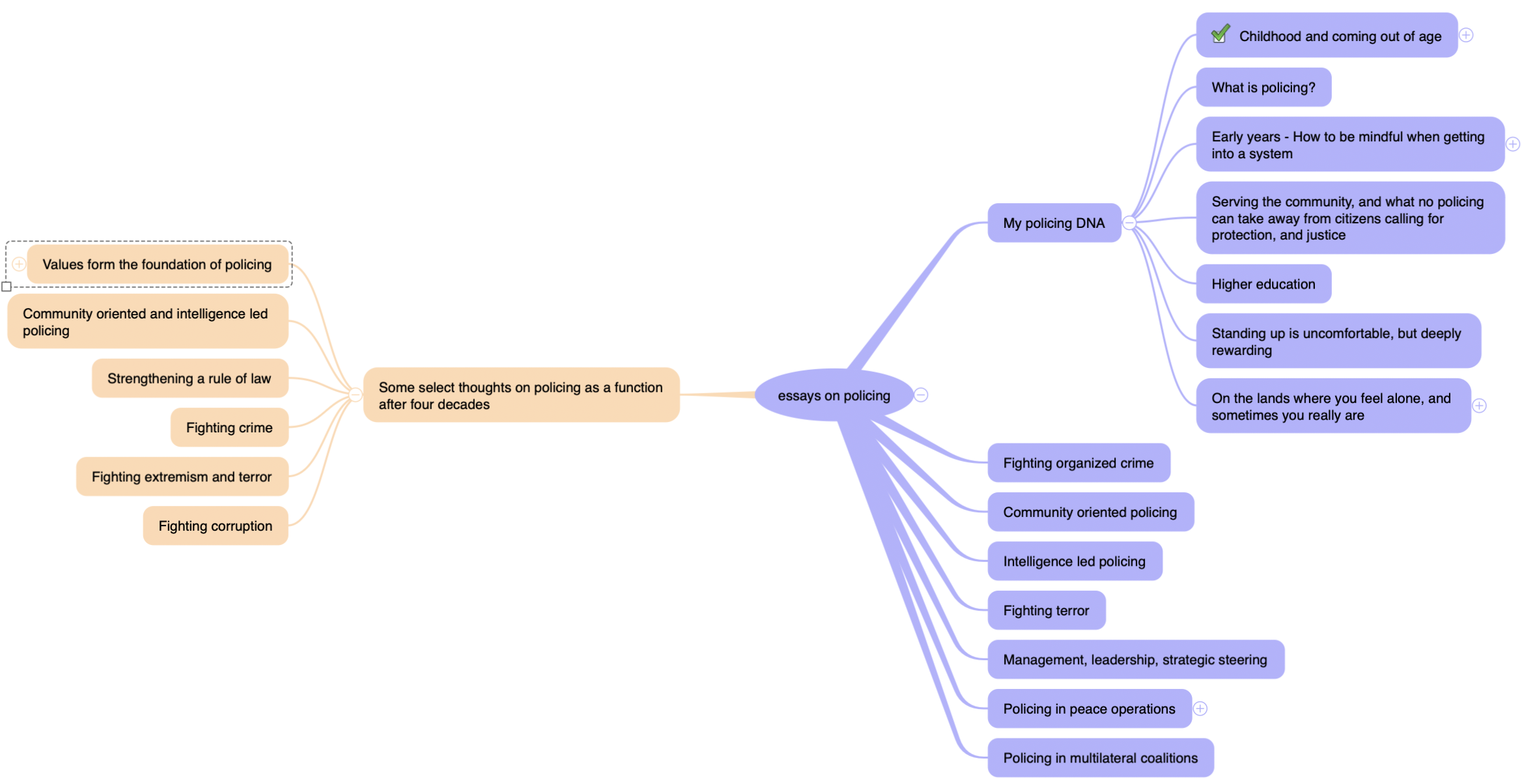
On Integrity – When Things Fall Apart – Setting Up Firewalls Against Corruption

Are you Mingyur Rinpoche?

My father asked me this question soon after I began studying with him, when I was around nine years old. It was so gratifying to know the correct answer that I proudly declared, Yes I am.

Then he asked, Can you show me the one thing in particular that makes you Mingyur Rinpoche?

Yongey Mingyur Rinpoche with Helen Tworkov – In Love With The World – New York – Spiegel & Grau – 2019


Do you know this feeling when you attempt to describe something, and the subject of your attention is evading your focus like a moving target? Or at other times, it all feels like a cloudy foggy thing which you can not grab? Like, to the extent that you begin to doubt your own capacity to use elaborate, meaningful words? Ultimately doubting you have anything relevant to say at all?

Every now and then this feeling gets me when I attempt to muster fresh energy for my book projects. Since months I am working on finishing writing about the term “integrity“. There are several chapters on integrity within my draft book project on policing. I try to use examples from my own professional socialisation, reflecting on what guided me in adhering to principles such as “integrity”. In doing that I got caught up in memories about situations when my integrity was challenged, situations in which I may just have been lucky enough to escape a nearby-by catastrophe, allowing me to learn, after wiping off the cold sweat of anxiety and fear. Learning almost never happens through absorption of theoretical knowledge alone. It is always based on experiences, including mistakes. Especially making mistakes. Consider this an essential and it will soften your reflex to quickly judge people who made a mistake. As long as this leads to learning. How often got I lucky when riding my motorbike, escaping from a crash just because something like fate, or pure luck, protected me? How lucky was I when I fell from a tree two years ago, finding myself on the ground with a broken vertebrae, but no lasting damage? “What if things would have gone a little bit more sideways?” This question has been so pervasive in my life. And sideways many things in my life went, of course. I don’t know of any human being gaining experience without things going sideways.

So, if I just managed to act with uncorrupted integrity in my line of professional work, but at the same can not claim that this is true for every other aspect of my life, where does that leave me? Well, I can say that I know what I am talking about, both related to areas where I maintained integrity, and related to areas which required some thorough amendments, ultimately. It doesn’t make my statements less true, or weakens them. He or She who sees the splinter in the eye of others but not the big chunk of wood sticking out of the own eye (does this German idiomatic make sense in an English article?), is hypocritical: “It would never happen to me” is a statement which, at minimum, is foolish. Or may be that person has little imaginative capacity how fast things can go sideways. All too often, those who state things like these, they hide their own skeletons in the basement of their houses. I have witnessed moral sermons from people who got caught with their own dirty secrets later on. We live in times where it has become possible to act without any integrity at all, and to recklessly pursue egoistic agendas based on never ending streams of lies, and bullying behaviour. Tearing down the foundations of anything which is standing in the way. By the way: Huge kudos to the U.S. judiciary these days.

So, what is integrity?

And, speaking of my doubts: I am attempting to write my books since ten years. Nothing has seen the light of the day. But this blog has, since now almost ten years, captured a stream of consciousness which I initially had planned of being captured in books. May be I am not meant to write a book. May be I am meant to write here.

Integrity is one of those terms which can be subjected to a definition. Any definition I found or came up with myself is grounded within a context. Like “structural integrity” as an engineering term. Like “organizational integrity”, within a business corporation, or within a government administration. “Personal integrity” as well can relate to so many different situations. Integrity as a police officer, integrity as a partner in a relationship, integrity in adhering to principles, or, in a very specific context, integrity as a preventative firewall against relapse, into self-harming behavior, or substance abuse. In these, and so many more situations we use this term “integrity”.

Things that appear simple if we don’t think about them, or take them for granted, they get very complicated and hard to describe when you take a closer look. “Integrity” is one of these concepts that fall into this category. In a more recent private conversation I was presented with a sentence from Brené Brown: “Integrity – Choosing courage over comfort, choosing what is right over what is fun, fast, or easy; and choosing to practice our values rather than simply professing them.” Less a definition, more a pointer related to ethical behavior which, if applied, constitutes integrity as a character trait.

Leaving you here for the day. I’ll start to define integrity in my next blog entry.

Have you heard the news today?

I went to my neighborhood cafeteria for breakfast this morning. Part of my routine when I am in Belgrade. Enjoying a croissant, a coffee. Chatting away with people I have come to know here. Sometimes I take my laptop with me, sometimes my Kindle for reading in a book. Today, I only had my phone on me and jotted down the following conversation:

Have you heard the news about what is happening in Israel?

Me: “Yes, I have, it is so awful what is happening!”

“I don’t understand why people can’t just talk to each other. Everywhere there is violence! People are being killed in Ukraine. Now people are being killed in Israel. And at so many other places! And it can happen here, too.”

Me: “It can happen anywhere and we all must prevent it, whereever we are. The world has become such a fragile place. There is so much violence and war, and it seems not to be ending.”

It is so sad to see when people can not live in peace. So sad to see people suffering and hating each other.”

Me: “Yes, and it makes one feeling so helpless. Because it feels like we can do so little about it. We read these stories, we are upset, we wonder what we can do. Sometimes we get tired and don’t want to listen to these news any more.”

“Yes.”

Me: “The only thing I know to do is to listen and to understand my neighbors and to live peacefully and to help. It feels like so little, so small, but it is the only thing I feel that is possible. It is so important not to look away.”

“Dobro. You want your double espresso with warm milk?”

Me: “Hvala!”

My conversation with a waiter in my street cafe in Belgrade this morning. He is a young Russian. Compassionate. Humble. Always laughing. Working in Serbia. Worried about Ukrainians. Israelis. Palestinians. No dogma or pre-occupation, no hate. Living a simple life here. Respected by customers and friendly neighbors. Been listened to by a foreigner from Germany. Both guests here.

A Long Summer – Creativity Refill

I took a long break from writing. I don’t write when I have doubts whether I have someting meaningful to say. So I spent a summer with introspection. Just sitting with my unease. Yesterday I felt the creative energy coming back for the first time. At the end of two weeks with my children here in Toronto I enjoy a second cup of coffee, the house still silent, this part of the World experiencing the beginning of a Saturday morning, my friends in Europe already moving into the afternoon, and I am opening the WordPress editor for the first time since months.

What happened leading to the end of my incommunicado? At the surface of it, it were two articles I read.


One relates to August 19, 2003, when the United Nations office in Baghdad was targeted in a suicide attack. Today, August 19, 2023, marks this day for the twentieth time. Sergio Viera de Mello, the Special Representative of the United Nations’ Secretary General, and 21 other people died in that attack. I belong to those who can’t forget this day, like many dear friends, in the United Nations, and beyond. I won’t forget Luis da Costa, personally. Many of my colleagues who serve or served in th UN have somebody dear to them whom they lost that day. The BBC article “How a suicide bomb attack changed the lives of UN aid workers” by Imogen Foulkes memorizes this horrible attack and reflects on how the attack changed the way the United Nations system is working, until today.

At the time of the attack I was working for the United Nations in my office in Pristina, Kosovo. I was the Police Commissioner of the United Nations Interim Mission in Kosovo by then. When this mission, dubbed UNMIK, was established in 1999, Kosovo was a place of severe post-war violence for several years to come. Like thousands of other UN staffers, we police officers would rent apartments for living amongst the population, and going to work using soft-skin vehicles and working from regular offices. May be fenced, may be some very normal security around, but we would literally live and work within the population, for the population. We would take risks of being attacked, I still have many pictures in my archive. But countries like mine, Germany, would be willing to send their police officers into an environment where we could find ourselves waking up to the aftermath of a bomb explosion nearby. In one of those many cases, a German police officer literally woke up one morning to discover two new holes in his living room: A rocket propelled grenade had punched an entry hole and an exit hole into his rental apartment. At no point I heard any serious request from Police Contributing Countries to withdraw police officers from the deployment into this mission. We stayed, like we did the same in previous missions, in Bosnia & Hercegovina, or elsewhere.

Later, in my time with Headquarters of the European Union or the United Nations, I would travel to Iraq, to Afghanistan, to Sudan/Darfur, to South Sudan, to Mali, the Central African Republic, to Somalia. In those places, I would meet police officers in so-called “Super Camps” or other protected compounds. I would move around with them in armored vehicles. My memories of travels outside of Baghdad’s Green Zone or outside the protected areas of Kabul include heaviest military protection. Yes, there still were the established Missions in which UN staff would live under more normal circumstances, such as in the Democratic Republic of Congo, or in Haiti, or Timor Leste, or Liberia, or Ivory Coast. But the world of the United Nations changed way more than only in relation to security. The BBC article says “In 2022 there were 235 attacks on aid workers, according to the Aid Worker Security Database, and 116 were killed.” Add the casualties amongst United Nations peacekeepers, I believe they are not even accounted for in this. Places like Mali and others have caused a human toll on United Nations staff that would have been unimaginable twenty years ago.

Like community policing, peacekeeping of the United Nations is about communication. It is about being temporarily rooted in a host population, in order to promote peace, to contribute to peace, and to develop the means of a host State in order to guarantee peace and security again. How do you do that through the thick protective glass shields of a heavy armored vehicle? I saw a convoy of armed UN vehicles moving slowly through a refugee camp in Darfur, stopping at the center, UN police officers getting out, protected by other officers with guns, sitting down with camp elders, then moving back into that convoy of armored turtles. Every day, once or twice. Walk in the shoes of those elders, think about how they may feel.

And like in the microcosm of daily operations, the inability to communicate achieving joint goals is also reflected within the United Nations Security Council. The erosion of jointness, whatever there was before, on the side of the five permament members of the Security Council has reached unprecedented levels. Those inside the system saw this storm coming for many years, if not decades. A toothless political instrument designed to be ultimatly the arbiter of peace and security on a global level is the product of countless defeats within that round chamber to achieve common positions which meaningfully legitimate the field work of the UN. As a consequence, not only behemoths like the UN Mission in the Democratic Republic of Congo suffer. Recently, the drawdown of one of the biggest UN Missions, in Mali, has begun. It just is the most recent case in a long line of withdrawals, some successful, some not. The most recent developments in Sudan’s Darfur area remind me of exactly what happened twenty years ago and led to the establishment of the African Union’s AMIS, and then UNAMID as it’s UN-successor. History moving in cycles? No progress, because a temporary halt of violence and decay is not exactly what we would name “sustainable” peace? One of the reasons why I fell silent, for some months. Watching the ever growing influence and presence of Wagner mercenaries, left and right of UN peacekeeping in the Sahel, and filling the void even more after Russian propaganda has successfully contributed to hollowing out democracies in Africa, to the advantage of autocratic leaders, power-hungry Generals and corrupt local elites. As a side-note, I see the defensive posture taken by Baltic States bordering Belarus, since parts of Wagner were stationed there in the aftermath of this most notable One-Day-Putsch attempt of Yevgeny Prigozhin.

Like terrorism aims at disrupting communication and sowing fear, establishing own versons of a so-called “truth”, the same is true for political processes of antagonisation, being the product of nationalism, being the product of reckless selfishness playing with the natural fear of human beings, establishing falsehoods, repeating lies as long as necessary so to become the “truth” for many. All of the above falls in line with a longer and larger development leading us to where we are, today. How do I explain this to my youngest children? By not stopping to tell stories, in order to establish memory, and context. It is not about attempting to revive the past, but to have meaningful informed context for how to operate in the Here and Now. I did this over the past two weeks here in Canada with my kids. Obviously, it gives me the energy for telling stories in my blog, again. It is not about getting my memories “out there”, again and again. It is about contributing to establishing context for those who will be at the helm of decision making nowadays, or soon. People like my children. Every parent shares that responsibility.

Not having contextual knowledge is one thing. Denial is the other. Which brings me to the other article, the second one.


How European Officials View a Possible Second Trump Term” is the second article. I read it in the New York Times this morning, August 19.

When I arrived in Toronto two weeks ago, catching up with my ex-wife casually, I was about to ask her how Canadians are looking at the series of ever expanding criminal indictments of Nr 45. I was stopped with a smile, but cold in my tracks: “If it is about Trump, I don’t want to hear it.”

When I travel in Europe, whether in South-East Europe, or in my country, Germany, discussions of the current state of affairs in the United States appear to be very detached from what I can see when focusing on U.S. domestic press and media. Sometimes it feels like the 45th U.S. Presidency has become an afterthought in Europe. Media reporting in European outlets which I follow are way different to the hype on CNN, MSNBC, and other media. Yes, I read liberal news, more or less sympathetic to the Democrat’s cause. I don’t make myself suffering from watching Fox News, or hate-mongering media outlets. My daily list of suggested videos on Youtube is reflecting that preference, too. I don’t want to have my list of suggestions become convoluted with hate, fear, anger, and lies.

Yes, there is a point in not to over indulge. Much of the American hype also leads to stoking emotions which keep me coming back to yet another piece of sensational news. But this is only one part of the story. The other part is, that as a concerned person informing myself through reading more of this stuff than, say, the average person, I get genuinely scared.

The NYT article talks about the subdued expression of grave concern amongst politicians and policymakers in Europe. Grave concern about the real possibility of a second term of office for Donald Trump. What it would mean, for the U.S., Europe, the support for the Ukraine in their fighting a war against a Russian aggressor, for relations between Super Powers including China and (still?) the U.S., for the European Union, other regional organisations such as the African Union, for the United Nations, and for principles based on the Charta of the United Nations, including the Rule of Law, first and foremost.

The article reports about an understandably subdued expression of fear by European leaders and diplomats. In politics, facing reality means being careful about closing doors, in the interest of the own constituency. It also means not to contribute to creating self-fulfilling prophecies. Lastly, it means not to play into the hands of adversaries by giving them the platform of antagonisation and hate which is their only objective.

Yet, there always is a cost attached to everything. The necessity to remain cautious and mindful, it also plays into the overwhelming wish of human psychology to deny reality. In European discussions with everyday people, there are those who do not know about the sheer monstrosity of hate and the open announcement of retribution and retaliation which comes from every sentence uttered by Nr. 45. And of course, I prefer to listen to people who are not right-wing extremists. It would take me a lot of energy to talk to somebody who openly supports the German right-wing extremists within the political party called “AfD”. Whilst I do not listen to those, I am under no illusion that their hate-mongering thinking and sometimes covert, sometimes more and more open action will literally explode in a scenario where Nr 45 would become Nr 47. Our challenge is to find ways of naming the reality as it is without invoking the same which sits at the heart of those extremist’s agenda: Ruling by fear, overruling the rule of law, establishing regime change, overcoming a system from within. Once more, I recall Germany’s history of how the Weimar Republic was defeated from within. By the way, it included the victimisation of own punishment and incarceration, after the so-called “Beer Hall Putsch“.

I am quoting Wikipedia here for ease of reference, though a bit longish: “The Beer Hall Putsch, also known as the Munich Putsch,[1][note 1] was a failed coup d’état by Nazi Party(Nationalsozialistische Deutsche Arbeiterpartei or NSDAP) leader Adolf HitlerGeneralquartiermeister Erich Ludendorffand other Kampfbund leaders in MunichBavaria, on 8–9 November 1923, during the Weimar Republic. Approximately two thousand Nazis marched on the Feldherrnhalle, in the city centre, but were confronted by a police cordon, which resulted in the deaths of 16 Nazi Party members and four police officers.[2]

Hitler escaped immediate arrest and was spirited off to safety in the countryside. After two days, he was arrested and charged with treason.[3]

The putsch brought Hitler to the attention of the German nation for the first time and generated front-page headlines in newspapers around the world. His arrest was followed by a 24-day trial, which was widely publicised and gave him a platform to express his nationalist sentiments to the nation. Hitler was found guilty of treason and sentenced to five years in Landsberg Prison,[note 2] where he dictated Mein Kampf to fellow prisoners Emil Maurice and Rudolf Hess.

Of course, I would NEVER EVER compare Nr. 45 with Adolf Hitler. NEVER EVER. But it is also fair to link you up with one for many references which may make you think yourself: “Donald Trump’s ex-wife once said Trump kept a book of Hitler’s speeches by his bed” is a reference to an article in “Business Insider” of September 1, 2015. It is just one of many results of a simple Google search, and references can be found in many reputable news outlets. What I do seriously believe is that Trump is actively using the indictments for his narrative, rather than trying to avoid them.

But back to denial: It is a common experience in which I have an in-depth personal share from many operational situations throughout my time with the United Nations and the European Union: Aside of those who are careful with their words so not to add to fear-mongering, there are those who elegantly snuff at worst-case scenarios, giving an impression as if they would have serious insider-knowledge, assuring you that your worst-case scenarios are but a paranoid dream not based on what they pretend to know. I witnessed too many situations where we woke up to a different reality. After that, those smart people quickly switch sides, pretend grave concern, joining those who say, exhaling moral authority: “How could that happen?”

I don’t say we will wake up in a different world next year. But I will say that chances are close to 50:50. If one only follows American polls, the sheer amount of those who simply stick to Nr 45 is overwhelming. The timidity of all Republican potential contenders of Trump for the Republican choice as Presidential candidate is deafening. The polled support of U.S. citizens supporting violent regime change counts a bit less than 20 Million. The shattered few remains of a healthy Republican core DNA will diminish with an almost unhearable “poof” once Nr 45 would win the race for the Republican candidacy. Retribution and cleansing the G.O.P. will follow as a first step. This scenario is already very much an emerging serious threat. From there, an election campaign would leave the great American people ever more divided and prepared for extremist action. Finally, just in case Nr 45 would become Nr 47, the immediate agenda would be nothing else than cleansing the Administration, everything would be about retribution, retaliation, and riddling the system with spineless brainless hateful self-serving cronies.

The Rule of Law would cease to exist, because I simply can not see the depth of resilience much longer which has brought amazing, brave, and highly skilled representatives of the justice system to where the U.S. is today. Just think about it: Donald J. Trump is defendant in four criminal cases with 91 charges (of which 44 are federal, 47 are state charges), alongside a huge number of co-conspirators. The four cases include the Jan. 6 election case, the classified documents case, the N.Y falsifying business records case, and the Georgia 2020 election case. In the Georgia case, Nr 45 and 18 others stand accused of violations of a powerful anti-racketeering law (RICO), which was solely created for enabling justice to arrest powerful Mafiosi. One of those who prided themselves for using the RICO provisions against the Mafia is now defendant under the same provisions: Rudy Giuliani.

I don’t think it is an over-statement to qualify the threat as being existential for the Rule of Law. The evidence fills whole Internet archives, and is now pouring into the courtrooms, through brave prosecutors, and brave judges. Unsurprisingly, the media is also abuzz with the judgement by doomsayers who assess the risk of indicting a former President as a threat to politics, and democratic governance. I disagree. This can not be tampered down by attempting to subdue the course of justice. Chances are that this would not change the battle for democracy at minimum, it may well be that it would be a serious blow in itself. There is no grey zone in here. It is about black and white, truth must stand up against lies, and the only chief principle is that we shall not fall into resentment, anger, and fear. Because this is what the other side wants.


Can I somewhat end my blog revival entry on a happy note, in case you’re still reading this?

Here is my current list of books I am reading. I bought myself a Kindle Scribe, and it has entirely changed the way I am reading. No books in my travel luggage. An amazing book-size screen. A battery-life for many weeks without even needing a charge.

I read “On The Origin Of Time” from Thomas Hertog. An amazing and equally mind-boggling book about Stephen Hawking’s final theory.

I read Zoe Kors’ “Radical Intimacy”, which is a great read within both the extended and the more narrow meaning of the word “intimacy”.

I read the classic text “The Prophet” by Khalil Gibran, (available in The Guttenberg Project open library).

In parallel I re-read “Psychoanalysis and Zen Buddhism” by Erich Fromm.

I am reading Pema Choedron’s amazing book “How We Live Is How We Die” for the fourth time.

I am reading “Polishing the Mirror” by Ram Dass, and I will continue with Daisetz Deitaro Suzukis’ book “Mysticism – Christian and Buddhist”.

Finally, and with great pleasure, I am re-reading a book which I read last time probably four decades ago: Frank Herbert’s “Dune”.

All of those justify an own decription of my impressions. May be I’ll do some, at a later stage. Not here. But reading healthy wholesome literature covering a spiritual connection with the World, from various angles of mystical tradition, and combining that with a well-written book like “On The Origin Of Time”, which ends with surprising statements about what we can not know by means of science, it is one of those things over the summer which allowed me to re-position myself, to re-center myself, and to find new creative energy here, again.


Finally, since I started with a 20-year memory, I am ending with another one, a personal anniversary: Tomorrow it will be the tenth time I am honouring a decision I took August 20, 2013. It marked the beginning of a path which ultimately allowed me to reconcile with my own complex PTSD. It allows me to explain personal experiences and context to my now teenager-children, without being overwhelmed by own emotions. Not that you got an impression that my writing got less intense, if you read the above. Yet, there is a difference between passion and strong emotions.

Grateful that I can detach better. Like taking several months of break from writing here, or on my book projects. Now, back to work. Like, in my job, finding convincing arguments why reducing the threat from small arms and light weapons is important, even when we face the opposite discussion in light of a war in Europe.

There always is a time post-conflict. Better prepare for it now.

Addendum on Cyber Warfare

Yesterday I published a piece on the need to better comprehend, and possibly to regulate, the implications which come from the use of new and highly sophisticated systems in the field of Artificial Intelligence (A.I.). New applications with abilities to understand, and to respond, in natural language, or in the form of complex visual compositions are crossing a boundary line where it becomes very difficult for an unknowing observer to identify that the communication partner is an A.I. system. Their capabilities are scarily powerful, ranging from natural conversations through writing poems, articles or other complex pieces of writing, or even computer code, just based on natural language input.

I mentioned the possibility for such systems to be abused in malicious contexts. Like any modern piece of software, their inner workings are almost impossible to understand for people who do not take their time for an in-depth learning curve. At the same time, their capacities are fascinating. Meaning that they and their results are looking so good, and the dangers coming from their unregulated use appear so abstract, that they permeate into the real word with a speed which makes curbing unwanted effects a gigantic mission (almost) impossible.

Now, on the general dangers from this cyberworld, here a very comprehensive and meticulous documentation which the English version of the German news magazine DER SPIEGEL put online yesterday: “The “Vulkan Files”: A Look Inside Putin’s Secret Plans for Cyber-Warfare. I just want to recommend reading it. The full scale of Russia’s integral user of cyber weapons into regular warfare and State sponsored terrorism becomes very obvious. The report is based on comprehensive research including insider information which DER SPIEGEL conducted together with investigative partner organisations.

Looking at it, the strategic range of hostile activities, in and way beyond the current war of aggression raging against the Ukraine, becomes clear. Those hostile cyber activities are an integral part in larger operations, and they target the West, as well as any people posing a threat to Putin’s control regime. Which does not come at a surprise. Recent public discussions have made it very difficult to qualify what we collectiviely are finding ourselves in. People with authorized public voices have to tread their words very carefully, simply because any language of war can escalate a situation which is meant to be escalated by those in Russia who wage a war against the Ukraine, and who, that would be safe to say, are extremely hostile against the West, and do not hesitate to lure the West into a larger scale conflict of some kind. Oh, no, wrong: We are already in a larger scale conflict, and we try to defend ourselves, and to de-escalate that situation back into the realm of international diplomacy.

Subject to attacks in the cyber-realm are any people, organisations, or infrastructure deemed worthy to be attacked in gaining influence, information, control, manipulate through desinformation, influence public opinion, or just to exercise visible destructive power. It does not matter whether it is you, a civilian or a military or a political target, or an industrial or government target. Depending on the malicious intent, literally everyone is subject to these attacks, like, influencing your opinion and framework of perception of Russia’s war activities, and Putin and his collaborators committing crimes against humanity, and war crimes.

DER SPIEGEL is able to exhibit the contours of the full scale of it, and only by one of those actors who try to use this cyber-power. A lot has been written about others, such as in Iran, in North Korea, or in China. But the Russian side of things becomes more and more obvious, partly because, as DER SPIEGEL states, these activities are not even meant to be covert to a full extent any more. But make no mistake, the cutting edge use of state of the art tools will always be kept in the dark.

Stating what we all should know. But in this context, new A.I. tools such as language based models, are already being used, and are increasingly being used. They may become the new “power tool”.

Few things are more important than systematic cyber security strategies, including police and military defense and deterrence. In countries of the European Union, in countries aspiring to join the E.U., and generally within countries who contribute the upholding of principles including Human Rights, a rule of law, and democracy as a means of basing the power on the will expressed by the people, not by dictators, oligarchs, autocrats, or, I may add, any people who put their own power beyond the limits of a rule of law. Those inlude Organized Crime.

In some countries I work in, these vulnerabilties take the form of wide open barn doors. There is a need to collectively close these doors. Yes, the Internet is about freedom of communication and information exchange, for the prosper of All. But exactly this is under attack. Often invisible. Until massive cyber attacks bring governance to a screeching halt. Which is what we have witnessed in some countries not mentioned in DER SPIEGEL, between 2019 and 2022.