How to navigate within these essays: Initially these essays were meant to form a book. I have decided to publish them, step by step, on this blog. By nature of blogging, the most recent article appears on top of all other articles, whether they are part of this anthology, or they address other issues. If you want to read these essays like a book, HEAD OVER HERE and navigate through the content of the entire set of essays on policing.
Integrity
“the quality of being honest and having strong moral principles that you refuse to change”
“: firm adherence to a code of especially moral or artistic values : INCORRUPTIBILITY
: an unimpaired condition : SOUNDNESS: the quality or state of being complete or undivided : COMPLETENESS”
A close friend responded to my recent blog entry on integrity: “I love word etymology – think about this – integrity … integrated … mid 17th century: from Latin integrat- “made whole” :)”
On the featured picture: June 30, 2005, I visited a refugee camp with thousands of internally displaced persons (we call them IdP) close to Al Fashir, the regional capital of Darfur, in Sudan. I took many pictures, this one displays a young girl sheltering a baby in her arms. My visit was part of a European Union Factfinding Mission. We tried to find out how we could assist the African Union Mission AMIS in their gargantuan task of providing security to people in Darfur. Tormented by a civil war, Darfuri people fled a situation in which they found themselves attacked by militias burning their villages, killing and maiming villagers, trapping women who went to fetch water at local waterholes, subjecting them to most cruel violence, raping and killing them. The fate of children was equally horrible. Refugees had come to these camps where they hoped for protection. Places like these were abuzz with the presence of peacekeepers and non governmental organizations providing most basic humanitarian assistance. The Internet was chock-full with shocking stories and with outrage, the pictures of suffering went around the world. What would follow were many years of peacekeeping, first by the African Union, then by the hybrid Mission UNAMID, jointly conducted by United Nations and African Union. For many years, UNAMID included the largest uniformed policing component of any peacekeeping operation, by far exceeding the 4700 police officers from up to 54 nations which were deployed to Kosovo, under UNMIK. UNAMID police and military components focused heavily on protecting civilians. By comparison, capacity-building of Sudanese policing was very limited, which sets this Mission apart from, for example, how UNMIK operated a large capacity-building component. There are many reasons for this due to the nature of this very specific environment. However, this difference is noteworthy.
UNAMID completed it’s mandate December 31, 2020. April 2023, severe clashes began between Sudanese government military forces and forces under the RSF. Conflict and it’s horrible consequences quickly reached Darfur again. Twenty years after the beginning of an international effort to protect civilians in Darfur, Darfuri people find themselves in the same horrible situation of being attacked by militias, their villages ransacked and burned, the population facing the very same threats which they suffered from two decades earlier.
Four days after I published the first “essay on policing”, a friend called me. She came from lunch with another friend of ours. Both are Romanian police officers. Both served in UNMIK in Kosovo at the same time when I was there. Both had, and have, distinguished careers with intense ties to policing in international peace operations. “He is writing his memoirs!“, the other friend exclaimed to my friend. Yes, to some extent there are elements of a memoir in this series of essays on policing. But not because I want to put my story out there on the Internet the same way like vloggers put their lifes on Youtube. I feel like it would be boring if I would take an impersonal academic view on the topic of policing. Textbooks on policing may be found in libraries of police academies. You can go there on your own. You also will find many publications on international aspects of policing. To some I have contributed. My objective here is a little different: I would like to draw your interest on some aspects of policing which I find deeply relevant in a contemporary discussion of a fragmented, increasingly violent world. And I believe I can do that best if I make it interesting by establishing a personal context. That then, somehow, is also like writing a memoir. I was in my street cafe this morning and had a conversation with the waiter, who speaks five different languages. We spoke about how people can easily misunderstand others if they just believe they are talking about the same issue. Everyone has a personal story, a personal and cultural, and a language context. In order to find commonalities, one has to tell one’s own story, and to listen to the story of others.
As I mentioned in the introductory essay, my time in Kosovo exposed me to the question “What have police officers from 54 different nations in common?“. And secondly, to the equally important question “Which are the principles and values which we want to promote for an entirely new Kosovo Police?“. It was the starting point for all work reflected within these “essays on policing”.
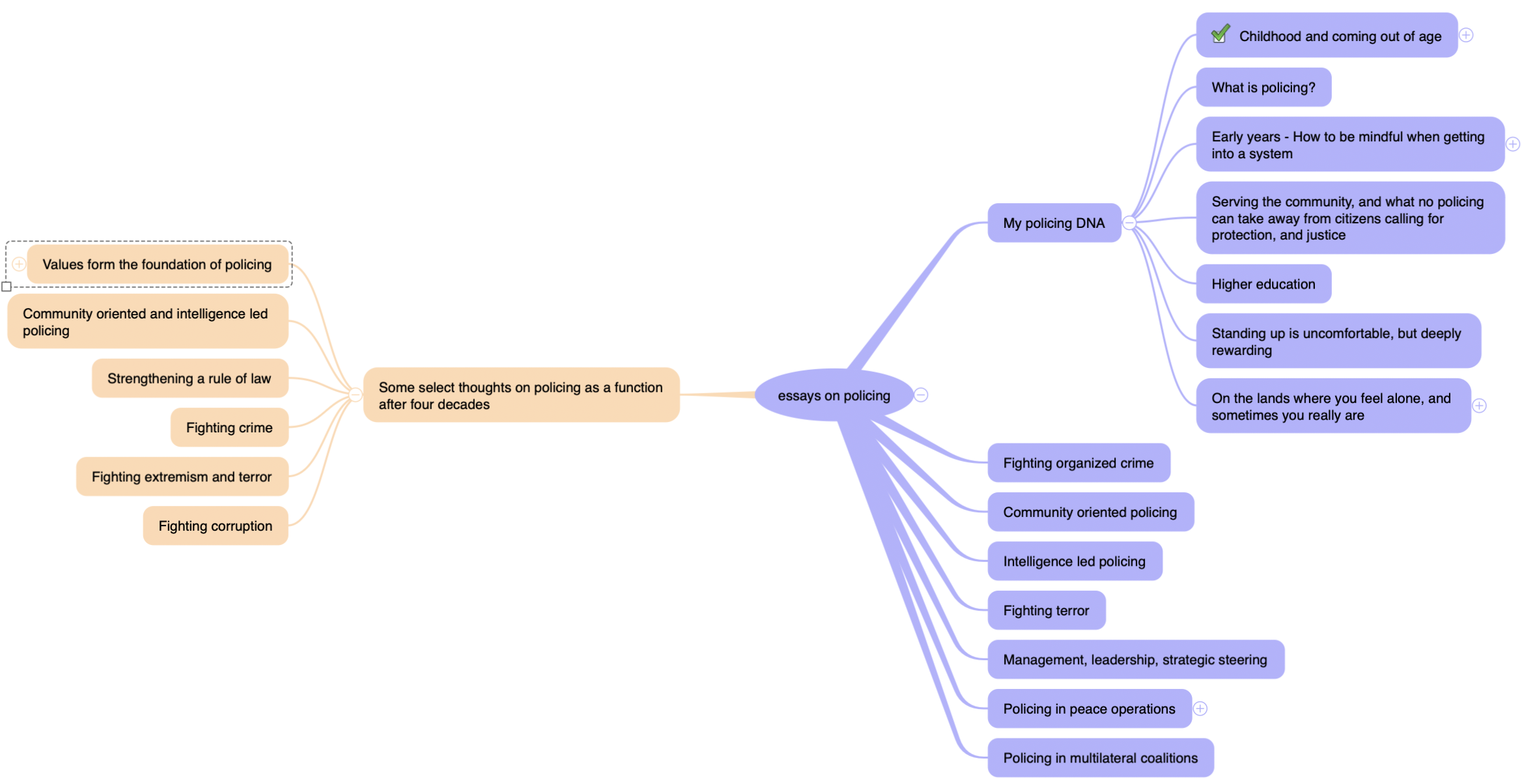
What you see above is an early attempt to structure my thoughts on policing using a mindmap. Behind some of these branches there are deeper levels which I have hidden here. By no means this early mindmap is complete, I am using it here as a conduit for a conclusion which came up when I attempted to cluster topical areas which could possibly be of relevance for these essays. At the end of this thought process I was left with one organising principle around which I could arrange a number of aspects showing up in this mindmap: What is integrity?
I started from there and thus the next few chapters reflect on “integrity“. In order to not make this a highly abstract tractise, I will look at it from the vantage point of my own experiences. They can not be generalised, but they may be an incentive for thinking. They somewhat focus on what I call “my policing DNA”.
Throughout those two decades of my own involvement in any international operation including larger uniformed police components I have seen two interdependent objectives. Of course, these two objectives do not stand in isolation from other objectives of such missions. But they can be identified in efforts under the umbrella of the United Nations, the European Union, the African Union, and others. These functions can be seen in mandates for peacekeeping, they are reflected in some civilian crisis management operations’ mandates, as well as in some United Nations’ Special Political Missions. They can be found in peace support operations of the African Union or missions of sub-regional organisations in Africa. Whichever language is being used in the respective mandates, they relate to
- To protect civilians
- To build national capacity in the field of security and the rule of law.
Of course, peace operations have several other core functions, and also some specific mandates which are unique to a single mission. However, in those international operations with larger uniformed police components these two core objectives can be found.
In addition, there are missions and operations within the framework of international organisations and also multi-lateral and bilateral efforts which involve policing expertise only in the field of capacity building for institutions in the field of security and the rule of law.
These capacity building efforts can continue over long periods of time and are, so to speak, handed over from one international activity to the next, on the long-winded road from conflict engagement towards peacekeeping, then peacebuilding, ultimately hopefully leading to lasting peace. In specific geographic contexts, such as for example the Western Balkans, these capacity building activities continue long after and have become an increasing part of integration efforts into the European Union. This also will hold true for other parts of South-Eastern Europe, such as for example Moldova and the Ukraine.
For each and every of these different categories of international activities we have witnessed what happens when support activities within both objectives, or one of them, were terminated too early, not implemented under the right assumptions and circumstances, or under political constraints and pressure, or when the overarching framework of international ambitions, the necessary political unity of key actors, unrealistic mission mandates, understaffing with expertise and numbers, or fragmentation of international activities, led to the break-down of complex and costly activities. I spare a list of relevant examples, because, that list would be shamefully long. No type of international assistance would get away without having a share in this sad compilation.
But what I would like to stress: There would be an equally long list of examples of successful missions, both related to the interim task of protecting civilians, and the task of supporting an acceptable and capable array of institutions in the field of policing and the rule of law. Also here, these success stories do not single out one or another form of international mission setup being more capable than other forms. I leave the question “Why is this so?” to academic research. On many occasions I have been subjected to interviews by researchers. So I do know that this work is out there.
I use the following arguments for the interrelation between the Protection of Civilians and Capacity Building:
a) The protection of civilians is a core responsibility of the State.
b) Protection of civilians under the mandate of international organisations or coalitions of the willing is a temporary substitution of this function of the State. Reasons can sit with that a State (1) should not, (2) does not want to, or (3) can not sufficiently exercise this protection, or any combination of these three factors. For clarity: There are predominantly military engagements “out there”, often of bilateral nature, which brand themselves “peacekeeping” and which, at least, do not fall under the scope of what I write about here. Personally, I refuse to name, for example, military detachments of the Russian Federation in some States in South East Europe, “peacekeeping”. They are instruments of political and military control, such as in Moldova, or elsewere.
c) Any efforts of international protection of civilians must be accompanied by support of capacity building in the field of security and justice, as otherwise there is no exit strategy for this temporary substitution.
That is why capacity-building sits at the core of any successful international assistance in situations of conflict, war, and post-conflict support. It must be done right, otherwise the mission runs into critical failure.
It is from there that I witnessed so many mandates, reports, inquiries, or statements carrying buzzwords such as “sustainable“, “local ownership“, “lasting impact“, and so many more.
In all those scenarios in which I would be asked whether we were successful in assisting in setting up credible institutions in the field of security and the rule of law, I would examine to which extent it was possible to nurture “integrity” within the work of individuals, groups, organisations, legal frameworks, leadership, management, and corporate identities. Personally, I would believe that this is the case for example in the Western Balkans.
There is a final reason for why I am attempting to look at international policing within peace operations, and policing at large, through the lens of attributes such as “integrity”: Catch-phrases like “sustainable establishment” and so many else include a time-dimension. Here, any assessment can become tricky. If one focuses on short time-spans, an assessment on “sustainability” does not make sense. If one looks at time-spans which are stretching over decades, “sustainability” can lead to depressing assessments if, and once, new conflict is emerging. Twenty years ago we started to put immense efforts into protecting civilians in Darfur. Fifteen years ago we began to assess, on request of key U.N. Member States, whether we had succeeded and could disengage. Since recently, we find the situation of Darfuri people where it was twenty years ago. You can say the same for Haiti, for example. We currently witness so many situations beyond the ability of peace operations to influence them leading to constant repetitions of cycles of violence with immense civilian suffering. West Africa, Central Africa, East Africa, you name it. Including the Middle East. I was in Rafah on occasion of the opening of the border crossing in November 2005 under the auspices of a EU monitoring mission, dubbed EUBAM Rafah. After the terror organisation Hamas took over the Gaza strip, our efforts stalled. Around the same time, I was in the West Bank, in a line of support of capacity building for the Palestinan Police through an EU civilian crisis management mission dubbed EUPOL COPPS. If one widens the aperture of the time lens too wide, sustainability answers can become very blurry.
Any assessment of why this is so would be drowning this writing. In taking a view using a lense named “integrity” I hope to inject a different, perhaps fresh, perspective. It will also allow me to make some comments, in later essays, on why short-term goals in capacity building do NOT work. As my friend and predecessor as U.N. Police Adviser Mark Kroeker used to say: “You can’t stand up a police organisation”. Like I, he also avoided to speak of “Police Forces”.
“Integrity” relates to values. Values give meaning, purpose, and support long-term development. Wherever we assist in capacity-building, our success depends on how we can support the establishment of a “DNA” which allows the implementation of policing according to some universally accepted values. Whilst this is true from an agnostic perspective for any set of values, here comes the first hard choice: Which values do we want to put front and center? Of course, being a peacekeeper, my own response comes without a split-second of thinking: The values of the Universal Declaration of Human Rights, and everything which followed throughout decades of development of a universal framework of the United Nations.
Next, I will try to examine this from a personal vantage point, my own socialisation into a German police organisation.
So, how did I find my own way into the police, and policing?
Stay tuned.
 Stefan Feller
Pingback: The Attack on Humanity by Terrorism: Blinding and manipulating through inciting hatred and fear on a unimaginable scale – The monster hides in plain sight | Stefan Feller